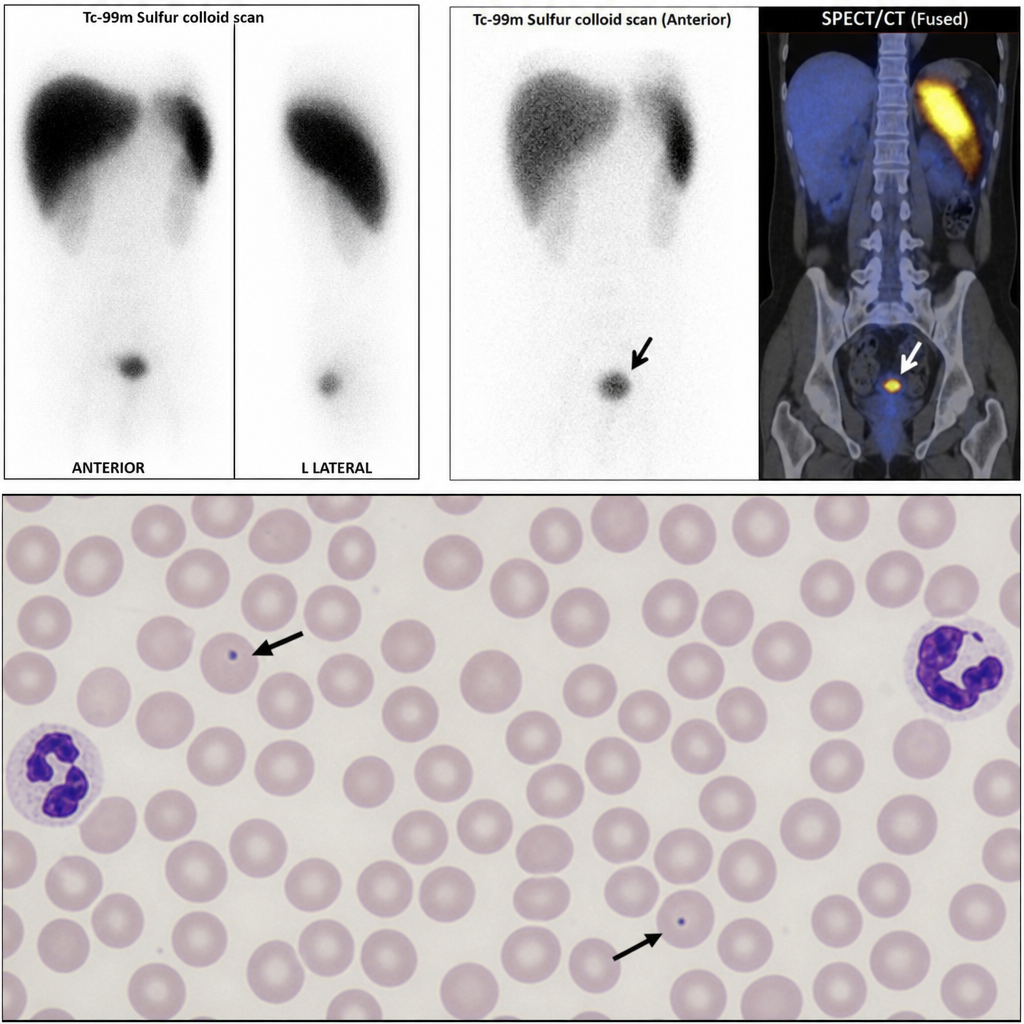
In the evaluation of a suspected hepatic hemangioma, what is the expected behavior of Tc-99m labeled RBCs during scintigraphy?
A lady presented with a 4 cm tumor in the left parietal lobe for which she underwent surgery and radiotherapy. After 3 months she presented with headache and vomiting. Which of the following would characterize the lesion in the patient?
Tc-labeled RBCs are used for all except:
In a patient presenting with jaundice, the HIDA scan would be most useful for which of the following:
All the following radioisotopes are used in painful body metastasis except
Radio-isotope of iodine used for thyroid tissue destruction:
Gamma camera in Nuclear Medicine is used for –
MUGA scan is not useful in:
Radioactive isotope of which of the following is used in bone scans?
Which of the following is not an artificial radio isotope element?
Explanation: ***Increased uptake on delayed images*** - Hepatic hemangiomas are vascular malformations with **slow blood flow** within their extensive sinusoidal spaces. - This slow flow causes the **Tc-99m labeled RBCs** to accumulate gradually and remain trapped within the lesion, leading to characteristic increased uptake on delayed images (typically 1-2 hours after injection). *Decreased uptake on delayed images* - This pattern would suggest **washout** of the tracer, which is not characteristic of hemangiomas where the tracer is retained due to sluggish flow. - It could be seen in highly vascular but non-hemangioma lesions where tracer clearance is rapid. *No uptake* - Lack of uptake would indicate a **non-vascular lesion** or a lesion with very poor perfusion, which is not consistent with a hemangioma's highly vascular nature. - While initial images might show less uptake than surrounding liver due to slow flow, delayed images will show accumulation. *Diffuse uptake* - **Diffuse uptake** throughout the liver would indicate normal liver parenchyma or a condition affecting the entire organ, not a localized benign tumor like a hemangioma. - Hemangiomas are typically discrete lesions that show focal uptake.
Explanation: ***18FDG PET Scan*** - This patient, presenting with new neurological symptoms after **surgery and radiotherapy** for a cerebral tumor, faces a diagnostic dilemma: differentiating between **tumor recurrence** and **radiation necrosis**. - **18FDG PET scans** effectively distinguish between these two conditions because viable tumor cells exhibit high metabolic activity and thus actively take up **fluorodeoxyglucose (FDG)**, while radiation necrosis is metabolically inactive and shows little to no FDG uptake. *Digital subtraction angiography with dual source CT scan* - **Digital subtraction angiography (DSA)** is primarily used to visualize **vascular structures** and is not the modality of choice for differentiating tumor recurrence from radiation necrosis. - A **dual-source CT scan** is useful for rapid imaging and dynamic studies but lacks the metabolic information needed for this specific differentiation. *Gd-enhanced MRI* - While **Gd-enhanced MRI** is excellent for detecting **structural changes** and **blood-brain barrier disruption**, it often cannot definitively differentiate between **tumor recurrence** and **radiation necrosis**. - Both conditions can present with similar **enhancement patterns** on MRI, making differentiation challenging without additional metabolic information. *99Tc-HMPAO SPECT brain* - **99mTc-HMPAO SPECT** measures **regional cerebral blood flow (rCBF)**, which can be altered in both tumors and areas of radiation injury. - However, it does not provide the specific metabolic information (glucose metabolism) needed to reliably distinguish between **viable tumor cells** and **radiation necrosis** as effectively as FDG PET.
Explanation: ***Liver adenoma*** - Tc-labeled RBCs are primarily used to highlight a specific type of tissue or process. **Liver adenomas** do not typically show an affinity for **Tc-labeled RBCs**, as they are benign epithelial tumors with a different vascular composition. - While adenomas can be vascular, they do not inherently contain the **vascular pooling** or blood volume characteristics that would be specifically targeted by **Tc-labeled RBCs** for diagnostic imaging. *LV function* - **Tc-labeled RBCs** (or Tc-99m-pertechnetate) are commonly used in **gated blood pool imaging** (MUGA scan) to assess **left ventricular (LV) function**, including **ejection fraction** and wall motion abnormalities. - This technique directly visualizes the blood pool within the cardiac chambers, making it suitable for assessing functional parameters of the heart. *GI bleeding* - **Tc-labeled RBCs** are a standard imaging agent for detecting and localizing **active gastrointestinal (GI) bleeding**, especially when the bleeding rate is intermittent or slow. - The labeled RBCs extravasate at the site of hemorrhage, creating a 'hot spot' that can be identified over time. *Liver hemangioma* - **Tc-labeled RBCs** are highly effective in diagnosing **liver hemangiomas**, which are benign vascular tumors composed of large, dilated blood vessels. - These lesions show characteristic uptake and retention of **labeled RBCs** due to their slow blood flow and large intravascular space, appearing as early peripheral enhancement with subsequent centripetal filling.
Explanation: ***Biliary atresia*** - A **HIDA scan** (hepatobiliary iminodiacetic acid scan) is instrumental in diagnosing biliary atresia by demonstrating the **absence of bile flow** into the duodenum. - In infants with persistent jaundice, the failure of the tracer to appear in the small bowel after a prolonged period strongly suggests this condition, indicating **obstructed or absent bile ducts**. *Cholelithiasis* - While HIDA scans can detect **cystic duct obstruction** in acute cholecystitis, they are less definitive for uncomplicated cholelithiasis (gallstones without acute inflammation). - **Ultrasound** is typically the primary imaging modality for diagnosing gallstones due to its non-invasiveness and ability to visualize stones directly. *Benign biliary disease* - This is a broad category, and while a HIDA scan can assess bile flow, it's not the **primary diagnostic tool** for all benign biliary conditions. - For most benign biliary diseases (e.g., choledocholithiasis without acute cholecystitis), **ultrasound, ERCP, or MRCP** often provide more detailed anatomical information. *Bile duct carcinoma* - A HIDA scan might show **obstructed bile flow** in bile duct carcinoma (cholangiocarcinoma), but it does not provide the detailed anatomical information or staging necessary for diagnosis and treatment planning. - **CT, MRI, MRCP, or ERCP** with biopsy are far more effective for identifying, characterizing, and staging bile duct malignancies.
Explanation: ***Yttrium*** - **Yttrium-90 (⁹⁰Y)** is a pure **beta-emitter** primarily used for **radioembolization of liver tumors** (selective internal radiation therapy) and **radiosynovectomy** for joint inflammation. - It is **NOT a standard radioisotope for treating painful bone metastases**, unlike the other options listed. - Its high-energy beta particles and specific applications make it unsuitable for the palliative treatment of bone pain from metastases. *Tin-117* - **Tin-117m (¹¹⁷ᵐSn-DTPA)** is a **conversion electron emitter** that has been studied and used for palliation of painful bone metastases. - It localizes to areas of increased osteoblastic activity and provides localized radiation therapy. - Though less commonly used than Samarium-153 or Strontium-89, it is still a therapeutic option for bone pain. *Samarium-153* - **Samarium-153 (¹⁵³Sm-EDTMP)** is a commonly used **beta-emitting radioisotope** for the treatment of painful bone metastases. - It selectively binds to areas of increased bone turnover, such as metastases, and its beta emissions provide **localized pain relief**. - FDA-approved and widely used for bone pain palliation. *Strontium-89* - **Strontium-89 (⁸⁹Sr)** is another highly effective **beta-emitting radioisotope** used for palliation of painful bone metastases. - It is a **calcium analog** and is preferentially incorporated into bone mineral at sites of increased osteoblastic activity. - FDA-approved and considered a gold standard for bone pain treatment.
Explanation: ***I-131*** - **Iodine-131** is widely used in nuclear medicine for the **destruction of thyroid tissue** in conditions like hyperthyroidism (Graves' disease) and differentiated thyroid cancer due to its emission of both beta and gamma radiation. - The **beta particles** emitted by I-131 have a short tissue penetration range, allowing for localized destruction of thyroid cells while minimizing damage to surrounding tissues. *I-132* - **Iodine-132** has a very short half-life (2.3 hours) and a lower energy beta emission compared to I-131, making it less suitable for sustained tissue destruction. - It is not commonly used for thyroid ablation due to its **less favorable decay characteristics** for therapeutic applications. *I-123* - **Iodine-123** is primarily a **gamma emitter** with a half-life of 13.2 hours, making it ideal for diagnostic imaging of the thyroid (e.g., thyroid scans). - It delivers a low radiation dose and is not used for tissue destruction because it lacks the **destructive beta particle emission** required for therapeutic effects. *I-125* - **Iodine-125** is a gamma emitter with a longer half-life (59.4 days) and is predominantly used in brachytherapy for some cancers and occasionally for **diagnostic imaging and research**. - While it has limited therapeutic uses, its primary application is not for widespread thyroid tissue ablation due to its **different decay mode** compared to I-131.
Explanation: ***Organ imaging*** - A **gamma camera** is primarily used to detect gamma rays emitted from **radiopharmaceuticals** introduced into the body. - This detection allows for the creation of 2D images or 3D tomographic images (SPECT) of organ function and structure. *Measuring the radioactivity* - While radioactivity is measured by the gamma camera, its primary purpose is not just to quantify dps/Bq, but to create a **spatial distribution** of this radioactivity. - Dedicated **dosimeters** or **activity meters** are used for precise measurement of radioactivity. *RIA* - **Radioimmunoassay (RIA)** is a laboratory technique used to measure the concentration of substances (e.g., hormones, drugs) in a sample, not a function of the gamma camera. - RIA utilizes **radioactively labeled antibodies** and antigens but does not involve imaging the body. *Monitoring the surface contamination* - **Geiger counters** or specific contamination meters are used for monitoring surface contamination. - A gamma camera is designed for internal imaging and is not practical or optimized for detecting external surface contamination.
Explanation: ***Regional wall perfusion*** - A MUGA scan assesses **ventricular function** through blood pool imaging, evaluating wall motion and ejection fraction. - It does not directly visualize or quantify myocardial perfusion, which is the flow of blood through the coronary arteries to the heart muscle. *Stroke volume* - A MUGA scan accurately measures **end-diastolic volume** and **end-systolic volume**, from which stroke volume (EDV – ESV) can be calculated. - This parameter directly reflects the amount of blood pumped out by the ventricle with each beat. *Left ventricular ejection fraction* - The MUGA scan is considered a gold standard for calculating **left ventricular ejection fraction** (LVEF), a key indicator of cardiac pump function. - It uses a count-based method from gated blood pool images to determine the percentage of blood ejected from the left ventricle. *Regional wall motion* - MUGA scans are highly effective in assessing **regional wall motion abnormalities**, identifying areas of **hypokinesis**, **akinesis**, or **dyskinesis**. - This is crucial for diagnosing and monitoring conditions like myocardial ischemia or infarction, and is a primary utility of the scan.
Explanation: ***Technetium*** - **Technetium-99m** (**Tc-99m**) is the most commonly used radioisotope for **bone scans** due to its favorable decay characteristics and ability to be chelated with phosphates. - When injected, **Tc-99m**-labeled phosphates are incorporated into areas of **increased osteoblastic activity**, highlighting regions of bone remodeling, trauma, infection, or malignancy. *Iodine* - **Iodine radioisotopes** (e.g., **Iodine-123**, **Iodine-131**) are primarily used for imaging and treating **thyroid conditions** because the thyroid gland actively absorbs iodine. - They are not used in bone scans as iodine does not accumulate significantly in bone tissue. *Gallium* - **Gallium-67** (**Ga-67**) is used in scans for detecting **inflammation**, **infection**, and some **tumors**, particularly lymphomas. - While it can sometimes enhance in areas of bone infection, it is not the primary or preferred agent for general **bone scintigraphy**. *Phosphorus* - While **phosphate compounds** are used as carriers for the radioactive isotope in bone scans, elemental **phosphorus** itself is not used as a radioactive isotope for imaging. - The **phosphate** ligands are labeled with **Technetium-99m** to create the radiopharmaceutical.
Explanation: ***Ra-226*** * **Radium-226** (Ra-226) is a **naturally occurring radioactive isotope** of radium, found in the uranium decay chain. * It is not artificially produced but rather exists in nature as a product of the **radioactive decay of uranium-238**. *Co-60* * **Cobalt-60** is a **synthetic radioactive isotope** produced by neutron activation of cobalt-59. * It is widely used in **radiation therapy** and industrial applications, making it an artificial radioisotope. *I-125* * **Iodine-125** is an **artificially produced radioisotope** commonly used in brachytherapy and diagnostic imaging. * It is created in a nuclear reactor by bombarding tellurium-124 with neutrons, making it not naturally occurring. *Tc-99m* * **Technetium-99m** is the most widely used **artificial radioisotope** in nuclear medicine for diagnostic imaging. * It is produced artificially from molybdenum-99 generators and does not occur naturally, making it an ideal choice for medical imaging due to its short half-life and gamma emission.
Physics of Nuclear Medicine
Practice Questions
Radiopharmaceuticals
Practice Questions
Radiation Detection in Nuclear Medicine
Practice Questions
Thyroid Scintigraphy
Practice Questions
Bone Scintigraphy
Practice Questions
Renal Nuclear Medicine
Practice Questions
Cardiac Nuclear Medicine
Practice Questions
Pulmonary Nuclear Medicine
Practice Questions
Neurological Nuclear Medicine
Practice Questions
PET/CT Principles and Applications
Practice Questions
Radionuclide Therapy
Practice Questions
Radiation Safety in Nuclear Medicine
Practice Questions
Get full access to all questions, explanations, and performance tracking.
Start For Free