Radioactive phosphorus is used in the treatment of which condition?
Which radionucleide is the choice for the assessment of renal function?
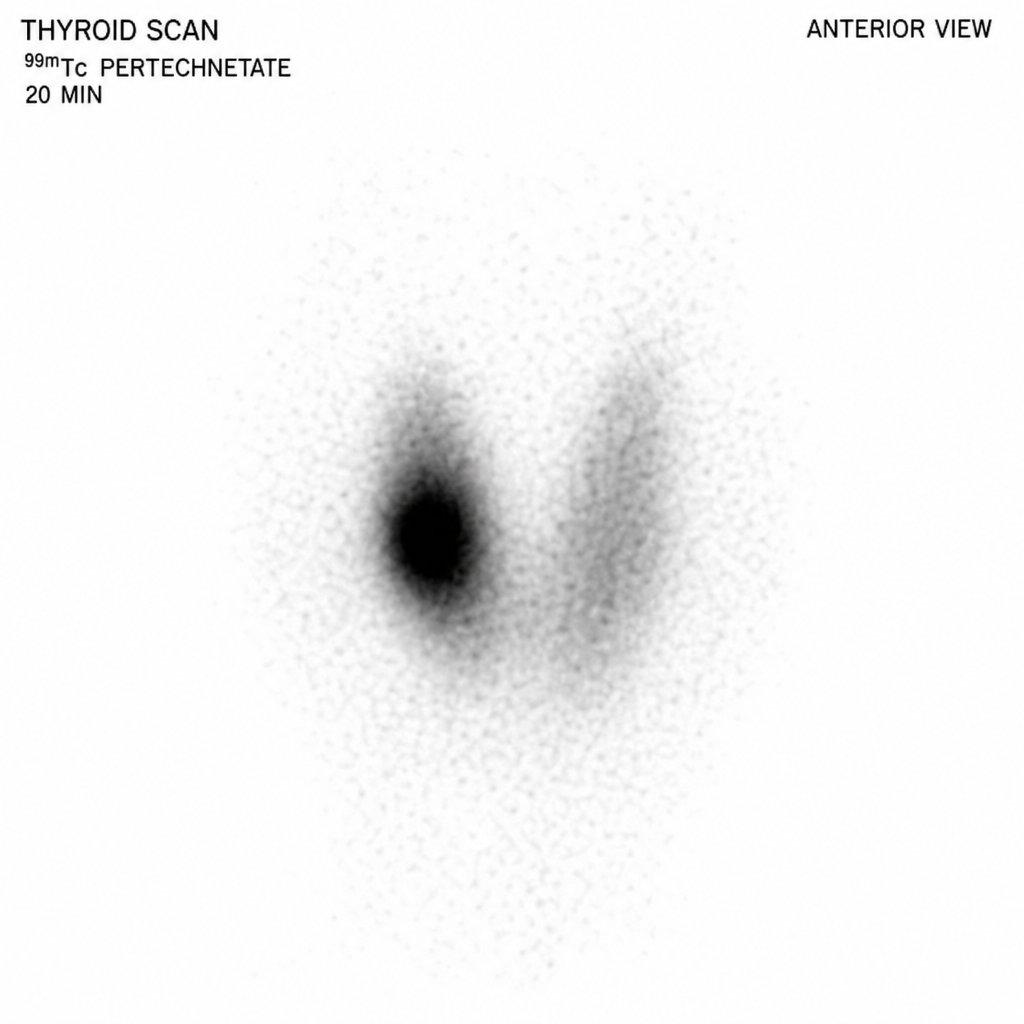
What does a "cold nodule" represent on a thyroid scintiscan?
Which of the following conditions is NOT evaluated using 99mTc-DMSA scintigraphy?
Which of the following is the most specific and sensitive screening test in a case of renovascular hypertension?
Which of the following isotopes of Iodine is used for thyroid scan?
Which of the following investigations is best for evaluating renal function failure?
Vesicoureteric reflux is demonstrated by using which imaging modality?
Which radioisotope is used systemically in Polycythemia rubra vera?
Which radio-isotope is used in pancreatic scanning?
Explanation: **Explanation:** **Radioactive Phosphorus-32 (P-32)** is a pure beta-emitter with a physical half-life of 14.3 days. It is used in the treatment of **Polycythemia Vera (PV)** because phosphorus is a key component of nucleic acids. Since hematopoietic cells in the bone marrow have a high turnover rate and rapid DNA synthesis, they preferentially concentrate P-32. The emitted beta particles cause local ionization, leading to the suppression of hyperactive bone marrow and a reduction in red blood cell production. **Analysis of Options:** * **A. Polycythemia (Correct):** P-32 was historically the treatment of choice for PV. While hydroxyurea and phlebotomy are now preferred due to the long-term risk of leukemic transformation associated with radiation, P-32 remains an option for elderly patients or those refractory to other therapies. * **B. Thyroid metastasis:** These are treated with **Radioactive Iodine-131 (I-131)**, which is sequestered by thyroid tissue via the sodium-iodide symporter. * **C. Multiple myeloma:** Treatment typically involves chemotherapy, proteasome inhibitors, and autologous stem cell transplant. While P-32 was once explored for bone pain, it is not a standard treatment. * **D. Embryonal cell carcinoma:** This is a germ cell tumor treated primarily with surgical resection and platinum-based chemotherapy (BEP regimen). **High-Yield Clinical Pearls for NEET-PG:** * **P-32 Properties:** Pure beta emitter; maximum tissue penetration is approximately 8 mm. * **Other uses of P-32:** It is also used for the **palliative treatment of painful bone metastases** (though Strontium-89 and Samarium-153 are more common) and via intra-articular injection for **radiosynovectomy** in chronic synovitis. * **Diagnostic use:** The "P-32 uptake test" was formerly used to differentiate benign from malignant intraocular melanomas.
Explanation: **Explanation:** The correct answer is **DTPA (Diethylenetriaminepentaacetic acid)**. In nuclear medicine, renal function is assessed using radiopharmaceuticals that are handled by the kidneys through specific physiological processes. **Why DTPA is correct:** Technetium-99m (Tc-99m) labeled **DTPA** is the gold standard for measuring the **Glomerular Filtration Rate (GFR)**. It is filtered solely by the glomerulus and is neither secreted nor reabsorbed by the renal tubules. This makes it the choice for evaluating renal perfusion and function, especially in obstructive uropathy (Diuretic Renography) and renovascular hypertension. **Why the other options are incorrect:** * **MIBG (Metaiodobenzylguanidine):** An analog of norepinephrine used primarily for imaging neuroendocrine tumors, such as **Pheochromocytoma** and Neuroblastoma. * **Thallium (Tl-201):** A potassium analog used historically for **myocardial perfusion imaging** and differentiating tumor recurrence from radiation necrosis in the brain. * **Sulphur (Tc-99m Sulphur Colloid):** Used for **Liver-Spleen imaging** (reticuloendothelial system) and evaluating gastrointestinal bleeds or gastric emptying. **High-Yield Clinical Pearls for NEET-PG:** * **Tc-99m MAG3:** The agent of choice for renal imaging in patients with **renal failure** (it is secreted by tubules, providing better images at low GFR). * **Tc-99m DMSA:** The agent of choice for **renal cortical imaging** (detecting scars/pyelonephritis) as it binds to the proximal convoluted tubules. * **Captopril Renography:** Used to diagnose Renal Artery Stenosis; a positive scan shows a significant drop in GFR in the affected kidney after Captopril administration.
Explanation: ### Explanation **Underlying Medical Concept** Thyroid scintigraphy (using **Technetium-99m pertechnetate** or **Iodine-123**) assesses the functional activity of thyroid tissue based on its ability to trap and organify radionuclides. A **"cold nodule"** is a region of the thyroid gland that fails to take up the radioactive tracer. This lack of uptake indicates that the tissue is **non-functioning** (hypofunctional). While most cold nodules are benign (e.g., cysts, adenomas, or focal thyroiditis), they are clinically significant because approximately **10–15%** of them represent thyroid malignancy. In contrast, "hot" (hyperfunctioning) nodules are almost never malignant. **Analysis of Options** * **Option A (Incorrect):** "Cold" refers to the lack of tracer uptake on the scan image, not the physical temperature of the nodule upon palpation. * **Option B (Incorrect):** A hyperactive nodule is termed a **"hot nodule."** These appear darker/more intense than the surrounding thyroid tissue and typically suppress the rest of the gland. * **Option D (Incorrect):** While inflammation can affect tracer uptake, the term "cold" specifically describes the functional imaging appearance, not the presence or absence of clinical inflammatory signs like rubor or calor. **High-Yield Clinical Pearls for NEET-PG** * **Incidence:** Cold nodules are the most common finding on thyroid scans (approx. 80-85% of nodules). * **Next Step in Management:** If a cold nodule is identified, the gold standard for definitive diagnosis is **Fine Needle Aspiration Cytology (FNAC)**. * **Warm Nodule:** Has uptake similar to normal thyroid tissue; the risk of malignancy is low (approx. 5%). * **Tracer of Choice:** Tc-99m is preferred for routine scans due to its short half-life (6 hours) and lower radiation dose compared to Iodine-131.
Explanation: **Explanation:** **99mTc-DMSA (Dimercaptosuccinic Acid)** is a **static renal imaging agent** that binds to the proximal convoluted tubules in the renal cortex. Because it remains fixed in the cortex for a prolonged period, it is the gold standard for visualizing **functional renal anatomy** rather than physiological drainage. 1. **Why Renal Artery Stenosis (RAS) is the correct answer:** RAS is a vascular and functional perfusion abnormality. It is evaluated using **99mTc-MAG3 or 99mTc-DTPA** (dynamic renography), often combined with an **ACE inhibitor (Captopril) challenge**. DMSA is a static cortical agent and cannot assess real-time blood flow or glomerular filtration changes required to diagnose RAS. 2. **Analysis of Incorrect Options:** * **Renal Scarring:** DMSA is the **investigation of choice** for detecting cortical scarring (e.g., from chronic pyelonephritis) as scars appear as "cold" defects (areas of photopenia). * **Renal Pseudomass:** It helps differentiate a true tumor from a "pseudotumor" (like a prominent Column of Bertin). A pseudomass will show normal DMSA uptake (functioning tissue), whereas a malignant tumor will appear as a void. * **Renal Anomalies:** It is excellent for identifying ectopic kidneys, horseshoe kidneys, or assessing the functional contribution of a multicystic dysplastic kidney. **High-Yield Clinical Pearls for NEET-PG:** * **Static Agents:** 99mTc-DMSA (Cortex imaging), 99mTc-Glucoheptonate (Both cortex and excretion). * **Dynamic Agents:** 99mTc-DTPA (GFR measurement), 99mTc-MAG3 (ERPF; best for neonates/renal failure). * **Acute Pyelonephritis:** DMSA is the most sensitive test to detect early cortical inflammation. * **Wait Time:** Imaging is typically performed **2–4 hours** after injection to allow for optimal cortical fixation.
Explanation: **Explanation:** **Renovascular Hypertension (RVH)** is most commonly caused by Renal Artery Stenosis (RAS). The goal of screening is to identify hemodynamically significant stenosis that leads to hypertension. **Why MRI (MRA) is the correct answer:** Magnetic Resonance Angiography (MRA) is currently considered the most sensitive and specific non-invasive screening tool for RVH. It provides excellent anatomical detail of the renal arteries without the need for iodinated contrast or ionizing radiation. Gadolinium-enhanced MRA has a sensitivity and specificity often exceeding 90-95%, making it superior for visualizing the main renal arteries, especially in patients where CT contrast is contraindicated. **Analysis of Incorrect Options:** * **A. HRCT:** High-Resolution CT is primarily used for evaluating interstitial lung diseases; it has no role in vascular imaging of the kidneys. * **B. CT Guided Angiography (CTA):** While CTA is highly accurate, it requires a high volume of iodinated contrast (nephrotoxic risk) and ionizing radiation. In many modern guidelines, MRA is preferred as a screening tool due to its safety profile, though CTA remains a close alternative. * **C. Captopril Radionuclide Scan:** Formerly a popular screening test, its sensitivity is significantly lower in patients with bilateral disease or impaired renal function. It is a functional test rather than an anatomical one and has largely been superseded by MRA/CTA. **Clinical Pearls for NEET-PG:** * **Gold Standard:** Digital Subtraction Angiography (DSA) remains the "Gold Standard" for diagnosis but is invasive. * **First-line Screening (Cost-effective):** Duplex Doppler Ultrasound is often the initial screening test in clinical practice, though it is operator-dependent. * **Etiology:** Atherosclerosis (most common overall) and Fibromuscular Dysplasia (most common in young females; "string of beads" appearance). * **Caution:** Avoid MRA with Gadolinium in patients with GFR <30 mL/min due to the risk of Nephrogenic Systemic Fibrosis (NSF).
Explanation: ### Explanation **1. Why I-123 is the Correct Answer:** Iodine-123 (I-123) is the isotope of choice for **diagnostic thyroid scanning** because it emits pure **gamma radiation (159 keV)**, which is ideal for detection by a gamma camera. It has a short half-life of approximately **13.2 hours**, resulting in a significantly lower radiation dose to the patient compared to I-131. It provides superior image quality for assessing thyroid morphology and function. **2. Analysis of Incorrect Options:** * **I-125:** This isotope has a long half-life (60 days) and emits low-energy photons. It is primarily used in **radioimmunoassays (RIA)** and **brachytherapy** (e.g., prostate cancer seeds), but not for routine thyroid imaging. * **I-127:** This is the only **stable, non-radioactive** isotope of iodine. It is the form found in iodized salt and does not emit radiation, making it useless for imaging. * **I-131:** While used for thyroid uptake studies, its primary role is **therapeutic** (treatment of Graves' disease or thyroid cancer). It emits **beta particles**, which cause tissue destruction, and has a long half-life (8 days), leading to high radiation exposure. It is generally avoided for routine diagnostic scans unless looking for metastatic thyroid cancer. **3. NEET-PG High-Yield Pearls:** * **Technetium-99m pertechnetate (Tc-99m):** Often used as an alternative for thyroid scans because it is cheaper and more readily available than I-123. However, it is only "trapped" by the thyroid and not "organified." * **Cold Nodule:** A region of decreased uptake on a scan; carries a ~15-20% risk of malignancy. * **Hot Nodule:** Increased uptake; usually benign (e.g., Toxic Adenoma). * **Stun Phenomenon:** Large diagnostic doses of I-131 can "stun" thyroid tissue, reducing the effectiveness of subsequent therapeutic doses; this is why I-123 is preferred for pre-treatment scanning.
Explanation: **Explanation:** Evaluating renal function in the context of failure requires assessing different physiological parameters, including Glomerular Filtration Rate (GFR), tubular secretion, and functional cortical mass. Since "renal function" is a broad term, multiple nuclear scans are utilized depending on the specific clinical requirement. 1. **DTPA (Diethylenetriaminepentaacetic acid) Scan:** This is the gold standard for measuring **GFR**. It is filtered solely by the glomerulus and is not reabsorbed or secreted. It is the investigation of choice for dynamic renography to assess perfusion and excretion (obstructive uropathy). 2. **DMSA (Dimercaptosuccinic acid) Scan:** This is a **static renal scan** that binds to the proximal convoluted tubules. It is the best investigation for evaluating **functional renal parenchyma**, detecting cortical scarring (e.g., in chronic pyelonephritis), and calculating differential renal function. 3. **Iodohippurate (OIH) Renography:** Historically used to measure **Effective Renal Plasma Flow (ERPF)**. While largely replaced by MAG3 (Mercaptoacetyltriglycine) in modern practice, it remains a classic method for evaluating tubular secretion, which is often preserved longer than GFR in certain types of renal failure. Since all three modalities evaluate different facets of renal performance (filtration, cortical mass, and secretion), they are all valid investigations for evaluating renal function failure. **High-Yield Clinical Pearls for NEET-PG:** * **Best for GFR:** DTPA. * **Best for Cortical Scarring/Ectopic Kidney:** DMSA. * **Best for Renal Function in Neonates/Renal Failure:** MAG3 (preferred over DTPA due to higher extraction fraction). * **Captopril Renography:** Used for diagnosing Renovascular Hypertension (Renal Artery Stenosis).
Explanation: **Explanation:** The correct answer is **MAG3 - Tc 99 (Mercaptoacetyltriglycine scan)**. Vesicoureteric reflux (VUR) is typically evaluated using a **Radionuclide Cystogram (RNC)**. In this procedure, the radiopharmaceutical (most commonly **Tc-99m MAG3** or Tc-99m Sulfur Colloid) is introduced into the bladder to detect the retrograde flow of urine into the ureters or kidneys. MAG3 is preferred for indirect cystography because it is cleared rapidly by the kidneys via tubular secretion, providing high-contrast images of the urinary tract. **Analysis of Options:** * **A. DMSA Scan:** This is a "static" renal scan. DMSA binds to the proximal convoluted tubules. It is the gold standard for detecting **renal cortical scarring** (often a consequence of VUR) and acute pyelonephritis, but it cannot demonstrate active reflux. * **B. DTPA Scan:** This is a "dynamic" scan used primarily to estimate the **Glomerular Filtration Rate (GFR)** and evaluate obstructive uropathy. While it can be used for indirect cystography, MAG3 is superior due to better target-to-background ratios. * **D. I123 Iodocholesterol Scan:** This is used for **adrenal cortical imaging** (e.g., diagnosing Cushing’s syndrome or Conn’s syndrome), not the urinary tract. **High-Yield Clinical Pearls for NEET-PG:** * **Direct Radionuclide Cystography (DRC):** More sensitive than MCU (Micturating Cystourethrogram) for detecting VUR and involves lower radiation. However, it provides poor anatomical detail compared to MCU. * **DMSA = "D" for Detail/Damage:** Used for cortical scars. * **DTPA = "G" for GFR:** Filtered by the glomerulus. * **MAG3 = "T" for Tubular secretion:** Best for neonates and patients with impaired renal function.
Explanation: **Explanation:** **Phosphorus-32 ($^{32}$P)** is the correct answer because it is a pure **beta-emitter** that mimics stable phosphorus in the body. In Polycythemia Rubra Vera (PRV), $^{32}$P is incorporated into the hydroxyapatite crystal of the bone matrix and rapidly dividing cells. Since the bone marrow is hyperactive in PRV, it takes up the isotope preferentially. The emitted beta particles cause local ionization, leading to the suppression of erythropoiesis and a reduction in red cell mass. While largely replaced by Phlebotomy and Hydroxyurea due to the long-term risk of leukemic transformation, it remains a classic systemic radiotherapy option for PRV. **Analysis of Incorrect Options:** * **$^{131}$I (Iodine-131):** Used primarily for the diagnosis and treatment of thyroid disorders (Hyperthyroidism and Thyroid Carcinoma) due to its selective uptake by follicular cells. * **Strontium-89 ($^{89}$Sr):** A calcium analog used for the **palliative treatment of painful bone metastases** (e.g., from prostate or breast cancer). It targets osteoblastic lesions rather than the marrow cells themselves. * **Rhenium-186:** Another radiopharmaceutical used for the palliation of metastatic bone pain, similar to Strontium-89 and Samarium-153. **High-Yield Clinical Pearls for NEET-PG:** * **$^{32}$P Properties:** Pure beta emitter, physical half-life of **14.3 days**. * **Route:** Administered intravenously as sodium phosphate. * **Other uses of $^{32}$P:** Historically used for malignant pleural/peritoneal effusions and topically for superficial skin tumors. * **Major Side Effect:** Increased risk of transformation into **Acute Myeloid Leukemia (AML)** or Myelofibrosis (usually after 10+ years).
Explanation: **Explanation:** The correct answer is **Se75 (Selenomethionine-75)**. **Why Se75 is the correct answer:** Pancreatic scanning relies on the organ's high demand for amino acids to synthesize digestive enzymes. **Selenomethionine-75** is a radiopharmaceutical where the sulfur atom in the essential amino acid methionine is replaced by radioactive Selenium-75. Because the pancreas cannot distinguish between methionine and selenomethionine, it rapidly takes up the isotope. This allows for scintigraphic imaging of the pancreas to detect tumors or chronic pancreatitis. However, this technique has largely been replaced by modern CT, MRI, and EUS. **Analysis of Incorrect Options:** * **Cr51 (Chromium-51):** Primarily used for labeling Red Blood Cells (RBCs) to measure red cell volume, survival time, and to detect gastrointestinal blood loss. * **I131 (Iodine-131):** Used predominantly for thyroid imaging, treatment of hyperthyroidism, and thyroid carcinoma. * **Tc99m (Technetium-99m):** The most common medical isotope used for various scans (bone, thyroid, Meckel’s, etc.) due to its ideal half-life and energy, but it is not the specific agent for traditional pancreatic amino acid uptake studies. **High-Yield Clinical Pearls for NEET-PG:** * **Se75-Selenomethionine** is the classic isotope for the pancreas, but it is also used for **parathyroid imaging** (though Sestamibi is now preferred). * **Half-life of Se75:** Approximately 120 days. * **Modern Pancreatic Imaging:** For functional neuroendocrine tumors (like Insulinomas or Gastrinomas), **Ga-68 DOTATATE PET/CT** is now the gold standard. * **Exocrine function test:** The "Secretin-Pancreozymin test" is the gold standard for exocrine assessment, not nuclear imaging.
Physics of Nuclear Medicine
Practice Questions
Radiopharmaceuticals
Practice Questions
Radiation Detection in Nuclear Medicine
Practice Questions
Thyroid Scintigraphy
Practice Questions
Bone Scintigraphy
Practice Questions
Renal Nuclear Medicine
Practice Questions
Cardiac Nuclear Medicine
Practice Questions
Pulmonary Nuclear Medicine
Practice Questions
Neurological Nuclear Medicine
Practice Questions
PET/CT Principles and Applications
Practice Questions
Radionuclide Therapy
Practice Questions
Radiation Safety in Nuclear Medicine
Practice Questions
Get full access to all questions, explanations, and performance tracking.
Start For Free