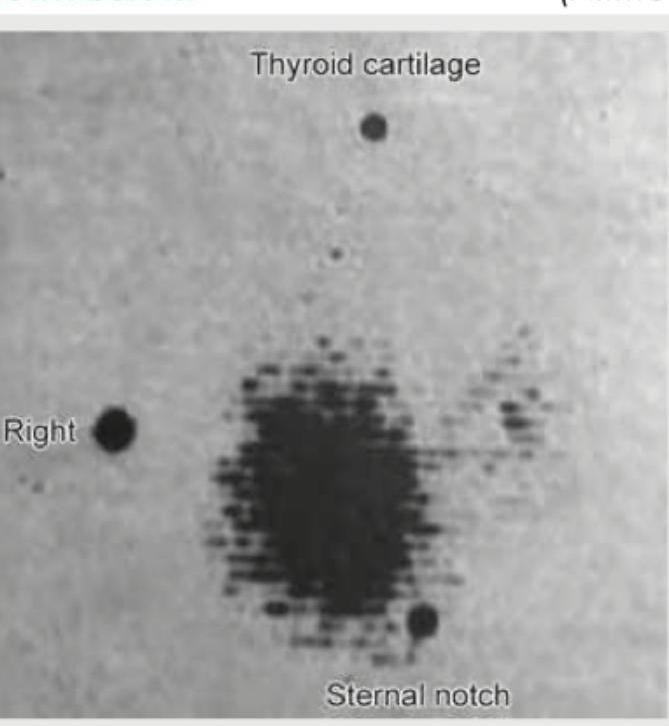
Which one of the following conditions is diagnosed by Tc-99m Pertechnetate Scintigraphy?
Which of the following tissues is most sensitive to radiation?
What is the modality of choice for screening of bony metastases?
What is the half-life of F-18?
What is the gold standard method for detecting renal scarring in a patient with recurrent urinary tract infection?
Phosphorus-32 emits:
Radioactive iodine for thyroid carcinoma is given by which route?
Whole-body iodine scan after total thyroidectomy is not recommended for which type of thyroid cancer?
What is true about PET scan?
Which radiotracer is used for acute myocardial infarct scintigraphy?
Explanation: **Explanation:** **Meckel’s diverticulum** is the correct answer because it frequently contains **ectopic gastric mucosa** (present in approximately 50% of symptomatic cases). The radiopharmaceutical **Technetium-99m (Tc-99m) Pertechnetate** has a natural affinity for the mucoid cells of the gastric mucosa. When injected intravenously, it is taken up and secreted by these cells, allowing for the visualization of the diverticulum as a "hot spot" (area of increased tracer uptake) usually located in the right lower quadrant. This procedure is clinically known as a **Meckel’s Scan**. **Why other options are incorrect:** * **Pharyngeal (Zenker’s), Duodenal, and Colonic diverticula** do not typically contain ectopic gastric mucosa. Therefore, they do not concentrate Tc-99m Pertechnetate. These conditions are better diagnosed using anatomical imaging like Barium studies or CT scans. **High-Yield Clinical Pearls for NEET-PG:** * **Rule of 2s:** Meckel’s diverticulum occurs in 2% of the population, is 2 inches long, located 2 feet from the ileocecal valve, and often presents by age 2. * **Pharmacological Augmentation:** To increase the sensitivity of the scan, the following may be used: * **Pentagastrin:** Stimulates uptake by gastric mucosa. * **H2 Blockers (e.g., Cimetidine):** Inhibits the release of the pertechnetate from the mucosal cells into the lumen. * **Glucagon:** Decreases peristalsis, preventing the "washout" of the tracer. * **False Negatives:** Can occur if there is no ectopic gastric mucosa or if there is brisk bleeding washing away the tracer.
Explanation: The sensitivity of tissues to ionizing radiation is governed by the **Law of Bergonie and Tribondeau**, which states that radiosensitivity is directly proportional to the rate of cell proliferation and inversely proportional to the degree of cell differentiation. ### Why Bone Marrow is the Correct Answer **Bone marrow (specifically hematopoietic stem cells)** is the most radiosensitive tissue in the body. These cells are undifferentiated, rapidly dividing, and have a high metabolic rate. Even low doses of radiation can lead to significant depletion of the precursor pool, resulting in pancytopenia. ### Analysis of Incorrect Options * **Germinal cells (Ovary/Testis):** While highly sensitive (second only to bone marrow/lymphoid tissue), they are slightly less sensitive than the hematopoietic system in terms of immediate cell death and systemic impact. * **Gut epithelium:** The lining of the gastrointestinal tract consists of rapidly dividing cells (crypt cells), making it highly sensitive. However, it ranks below the bone marrow and gonads on the sensitivity scale. * **Skin:** Skin consists of moderately sensitive cells. While radiation dermatitis is common, the basal layer of the epidermis is less sensitive than the stem cells of the bone marrow. ### High-Yield Clinical Pearls for NEET-PG * **Most Radiosensitive Cell:** Lymphocyte (Exception to the law: it is a non-dividing cell but highly sensitive). * **Most Radioresistant Cell:** Nerve cell (highly differentiated, non-dividing). * **Order of Sensitivity (High to Low):** Bone Marrow > Gonads > GI Epithelium > Skin > Connective Tissue > Bone > Nerve. * **Most sensitive phase of the cell cycle:** M phase (Mitosis), followed by G2. * **Most resistant phase:** Late S phase.
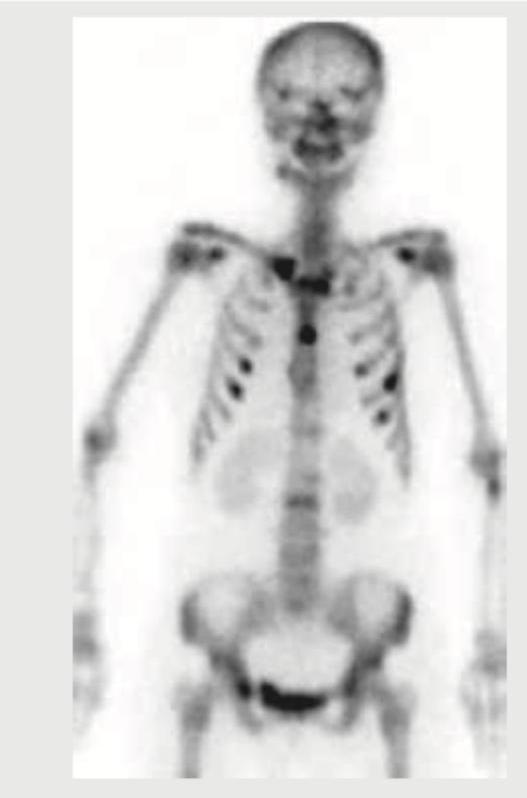
Explanation: **Explanation:** The modality of choice for **screening** bony metastases is a **Bone Scan (Technetium-99m MDP scintigraphy)**. This is due to its high sensitivity and ability to perform a whole-body survey in a single session. **Why Bone Scan is correct:** Bone scans detect **osteoblastic activity** (bone remodeling). Metastatic cells disrupt normal bone metabolism, leading to increased uptake of the radiopharmaceutical ("hot spots"). Its primary advantage is that it can detect functional changes **weeks to months before** structural changes become visible on conventional imaging. **Why other options are incorrect:** * **Plain Radiograph:** It has very low sensitivity. A bone lesion only becomes visible on an X-ray after **30-50% of bone mineral density** is lost. It is used for confirming a site at risk of pathological fracture, not for screening. * **CT Scan:** While excellent for evaluating cortical bone and detailed anatomy, it is not used for screening because it is difficult to scan the entire skeleton at once and involves high radiation doses. * **MRI:** This is the **most sensitive** modality for detecting early marrow involvement (even before a bone scan). However, it is not the "screening modality of choice" due to high costs, long scan times, and limited availability for whole-body imaging. **High-Yield Clinical Pearls for NEET-PG:** 1. **"Cold" Lesions:** Highly aggressive tumors (e.g., Multiple Myeloma, Renal Cell Carcinoma) may show no uptake on a bone scan because they are purely osteolytic and do not trigger a bone-forming response. 2. **Flare Phenomenon:** An apparent increase in uptake/number of lesions on a bone scan shortly after starting chemotherapy, which actually represents healing, not progression. 3. **Superscan:** A bone scan showing intense, symmetrical skeletal uptake with **absent renal activity**, typically seen in widespread metastases (Prostate CA) or metabolic bone disease.
Explanation: **Explanation:** **Fluorine-18 (F-18)** is the most commonly used radioisotope in **Positron Emission Tomography (PET)** imaging. The correct half-life of F-18 is **110 minutes** (approximately 1.8 hours). This duration is clinically ideal: it is long enough to allow for the synthesis of radiopharmaceuticals (like FDG), transport to imaging centers, and uptake by tissues, yet short enough to minimize the radiation dose to the patient. **Analysis of Incorrect Options:** * **B. 90 minutes:** This is a common distractor; while close, the precise physical half-life is 109.7 minutes. * **C. 6 hours:** This is the half-life of **Technetium-99m (Tc-99m)**, the most widely used isotope in conventional nuclear medicine (SPECT). * **D. 13 days:** This is the half-life of **Iodine-123 (I-123)**, used for thyroid imaging and uptake studies. **High-Yield Clinical Pearls for NEET-PG:** * **Production:** F-18 is produced in a **cyclotron** by proton bombardment of Oxygen-18. * **Decay Mode:** It decays by **Positron ($\beta^+$) emission**. The emitted positron annihilates with an electron, producing two 511 keV photons emitted 180° apart. * **Common Tracer:** **18F-FDG** (Fluorodeoxyglucose) is a glucose analog used to image metabolic activity. It is "trapped" in cells via phosphorylation by hexokinase (metabolic trapping). * **Critical Organ:** The critical organ (highest radiation dose) for 18F-FDG is the **Urinary Bladder wall**, as the tracer is excreted renally. Patients are encouraged to hydrate and void frequently after the scan.
Explanation: **Explanation:** **99mTc-DMSA (Dimercaptosuccinic Acid)** is the gold standard for detecting renal cortical scarring and assessing differential renal function. DMSA is a **static renal imaging agent** that binds to the sulfhydryl groups in the proximal convoluted tubules of the renal cortex. Because it remains fixed in the cortex for a prolonged period, it provides high-resolution images of the renal parenchyma. Areas of scarring appear as "cold spots" (photopenic areas) or wedge-shaped defects with associated volume loss. **Analysis of Incorrect Options:** * **99mTc-DTPA (Diethylene Triamine Pentaacetic Acid):** This is a **dynamic renal imaging agent** primarily filtered by the glomerulus. It is the investigation of choice for measuring the Glomerular Filtration Rate (GFR) and evaluating obstructive uropathy, but it lacks the cortical resolution required to detect scars. * **99mTc-MIBG Scan:** Used primarily for imaging neuroendocrine tumors, such as pheochromocytoma and neuroblastoma. It is an analog of norepinephrine and has no role in renal cortical imaging. * **99mTc-MDP (Methylene Diphosphonate):** This is the standard agent for **skeletal scintigraphy (bone scan)**. While it is excreted by the kidneys, it is used to detect osteoblastic activity, not renal pathology. **High-Yield Clinical Pearls for NEET-PG:** * **DMSA Scan Timing:** In acute pyelonephritis, a DMSA scan can show temporary defects. To confirm permanent **scarring**, the scan should be performed at least 4–6 months after the acute infection. * **VUR Link:** Recurrent UTIs and Vesicoureteral Reflux (VUR) are the most common causes of DMSA-detected scars (Reflux Nephropathy). * **MAG3 (Mercaptoacetyltriglycine):** Another dynamic agent (secreted by tubules) used for renal scans, especially in patients with impaired renal function, but DMSA remains superior for cortical morphology.
Explanation: **Explanation:** **Phosphorus-32 ($^{32}P$)** is a radioactive isotope of phosphorus that decays into stable Sulfur-32 via **Beta ($\beta^-$) decay**. During this process, a neutron in the nucleus is converted into a proton, releasing a high-energy electron (beta particle) and an antineutrino. **Why Beta particles are correct:** $^{32}P$ is a pure beta emitter with a physical half-life of **14.3 days**. It emits particles with a maximum energy of 1.71 MeV, which have a mean tissue penetration of approximately 3 mm (maximum 8 mm). This makes it ideal for targeted radiotherapy, as the energy is deposited locally within the tissue where the isotope is concentrated. **Why other options are incorrect:** * **Alpha particles:** These are heavy, positively charged particles (Helium nuclei). While highly ionizing, $^{32}P$ does not undergo alpha decay. Alpha emitters (like Radium-223) are used for different therapeutic purposes. * **Neutrons:** Neutron emission is generally associated with nuclear fission or specific laboratory sources (like Californium-252), not standard therapeutic radiopharmaceuticals like $^{32}P$. * **X-rays:** X-rays originate from electron shell transitions, whereas $^{32}P$ decay is a nuclear process. While some isotopes emit Gamma rays (photons) during decay, $^{32}P$ is a "pure" emitter, meaning it lacks significant gamma or X-ray emission. **High-Yield Clinical Pearls for NEET-PG:** 1. **Clinical Uses:** Historically used for **Polycythemia Vera** (to suppress bone marrow) and **Essential Thrombocythemia**. It is also used for the palliative treatment of **metastatic bone pain** and in **intracavitary therapy** (e.g., malignant pleural effusions). 2. **Route:** Usually administered intravenously (as sodium phosphate). 3. **Mechanism:** It mimics naturally occurring phosphorus and is incorporated into the hydroxyapatite matrix of the bone and the nucleic acids of rapidly dividing cells. 4. **Half-life:** Remember the value **14.3 days**; it is a frequent numerical question in radiology exams.
Explanation: **Explanation:** The correct answer is **A. Oral route**. Radioactive Iodine (I-131) is the mainstay for the treatment of differentiated thyroid carcinomas (papillary and follicular) following a total thyroidectomy. The physiological basis for this treatment is the **sodium-iodide symporter (NIS)**, which allows thyroid cells to actively trap iodine. 1. **Why Oral?** I-131 is highly water-soluble and is rapidly and almost completely absorbed from the gastrointestinal tract into the bloodstream. It is typically administered as a **capsule** or a **tasteless liquid solution**. This route is non-invasive, cost-effective, and achieves excellent bioavailability, making systemic administration via other routes unnecessary. 2. **Why other options are incorrect:** * **Intravenous:** While technically possible, it is unnecessary due to the high GI absorption rate and carries a higher risk of radioactive contamination/spill during administration. * **Topical:** Iodine cannot be absorbed through the skin in therapeutic concentrations required to treat malignancy. * **Intra-arterial:** This is an invasive procedure used for localized chemoembolization (e.g., in liver cancer) but is not indicated for thyroid tissue, which is best targeted systemically via the bloodstream. **High-Yield Clinical Pearls for NEET-PG:** * **Isotope used:** **I-131** is used for therapy (emits **Beta particles** for tissue destruction and **Gamma rays** for imaging). **I-123** is preferred for pure diagnostic scanning due to lower radiation dose. * **Preparation:** Patients must have high TSH levels (>30 mIU/L) to stimulate iodine uptake, achieved either by thyroid hormone withdrawal or recombinant human TSH (rhTSH). * **Contraindication:** Radioactive iodine is strictly **contraindicated in pregnancy** (crosses the placenta and destroys the fetal thyroid). * **Side Effects:** Sialadenitis (inflammation of salivary glands) is a common early complication; patients are advised to use sialogogues (like lemon drops) to minimize damage.
Explanation: **Explanation:** The fundamental concept behind iodine scanning is the ability of thyroid follicular cells to concentrate iodine via the **Sodium-Iodide Symporter (NIS)**. **Why Medullary Thyroid Cancer (MTC) is the correct answer:** MTC originates from the **Parafollicular C-cells** (neuroendocrine cells), which produce calcitonin. Unlike follicular cells, C-cells do not express the NIS and do not have the physiological machinery to trap or organify iodine. Therefore, MTC is **non-iodine avid**. A whole-body iodine scan (WBS) would be negative even in the presence of metastatic disease, making it clinically useless for this subtype. **Why the other options are incorrect:** * **Papillary (PTC) and Follicular (FTC) Thyroid Cancer:** These are "Differentiated Thyroid Cancers" (DTC) arising from follicular epithelium. They retain the expression of the NIS (though often at lower levels than normal tissue). Post-thyroidectomy WBS is a standard procedure in these cases to detect residual thyroid tissue or distant metastases (e.g., lungs, bone). * **Anaplastic Thyroid Cancer:** While anaplastic cancer is also non-iodine avid, it is typically excluded from this specific question's logic because it is undifferentiated. However, in the context of standard management protocols, MTC is the classic "high-yield" answer because it arises from a completely different cell lineage (C-cells). **NEET-PG High-Yield Pearls:** * **Tumor Marker for MTC:** Calcitonin and CEA (used for follow-up instead of Thyroglobulin). * **Imaging for MTC:** Since iodine scans don't work, **Ga-68 DOTATATE PET/CT** or FDG-PET/CT are preferred for localization. * **Genetics:** MTC is associated with **RET proto-oncogene** mutations (MEN 2A and 2B). * **Stunning Effect:** Diagnostic doses of I-131 can "stun" cells, reducing the efficacy of subsequent therapeutic doses; hence, I-123 is often preferred for diagnostic WBS.
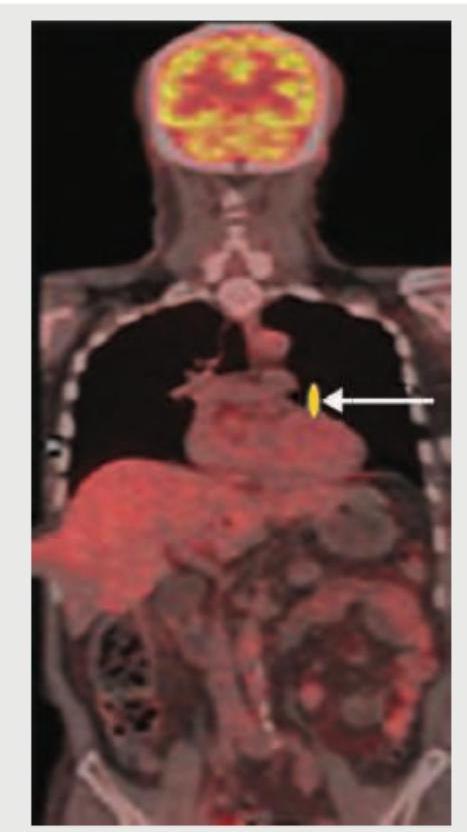
Explanation: ### Explanation **Correct Answer: B. Coincident photons detected at 511 keV** **Underlying Concept:** Positron Emission Tomography (PET) relies on the physics of **positron decay**. When a positron-emitting radiopharmaceutical (like 18F-FDG) is injected, the emitted positron travels a short distance and encounters an electron. This encounter results in an **annihilation event**, where their combined mass is converted into energy. This energy is released as **two 511 keV photons** traveling in exactly opposite directions (180 degrees apart). The PET scanner uses "coincidence detection" circuitry to record an event only when two photons strike opposing detectors simultaneously. **Analysis of Incorrect Options:** * **A. Single photon detected at 511 keV:** This describes SPECT (Single Photon Emission Computed Tomography), which uses isotopes like Technetium-99m that emit single gamma rays. PET requires the simultaneous detection of a pair of photons. * **C. X-rays are used:** PET is a functional imaging modality using gamma rays emitted from within the body. While PET is often combined with CT (PET-CT), the PET component itself does not use X-rays. * **D. Lead collimators are used:** Conventional Gamma cameras (SPECT) use heavy lead collimators to filter out scattered rays. PET uses **"electronic collimation"** based on the coincidence timing of the two photons, making physical lead collimators unnecessary and allowing for much higher sensitivity. **High-Yield Clinical Pearls for NEET-PG:** * **Most common tracer:** 18F-Fluorodeoxyglucose (FDG), a glucose analog. * **Mechanism of FDG:** It is phosphorylated by hexokinase into FDG-6-phosphate and becomes **trapped** in cells (metabolic trapping). * **Physiological uptake:** Normal high uptake is seen in the **brain** (uses glucose), **heart**, and **urinary tract** (excretion). * **Preparation:** Patients must fast for 4–6 hours; blood glucose should ideally be <150–200 mg/dL to avoid competition for cell receptors.
Explanation: **Explanation** **Tc99m stannous pyrophosphate (PYP)** is the correct answer because it is a "hot spot" imaging agent used for detecting acute myocardial infarction (MI). The underlying mechanism involves the deposition of calcium in the mitochondria of irreversibly damaged myocardial cells. Tc99m-PYP binds to these **calcium phosphate deposits** within the infarcted tissue. It is most sensitive between **24 to 72 hours** after the onset of symptoms and typically becomes negative after 7 to 14 days. **Analysis of Incorrect Options:** * **Thallium-201:** This is a potassium analogue used for **"cold spot"** imaging. It is taken up by viable, perfused myocardium. In an acute MI, Thallium would show a defect (area of no uptake), making it useful for viability and stress studies, but not specific for acute infarct labeling. * **Gallium-67:** This tracer is primarily used for imaging **inflammation, infection, and certain tumors** (like lymphoma). It is not used for myocardial infarct imaging. * **Neodymium:** This is a rare-earth element with no standard role as a radiotracer in clinical nuclear medicine scintigraphy. **High-Yield Clinical Pearls for NEET-PG:** * **Hot Spot vs. Cold Spot:** Tc99m-PYP is a "Hot Spot" agent (infarct glows), while Thallium-201 and Tc99m-Sestamibi are "Cold Spot" agents (infarct appears as a hole). * **The "Doughnut Sign":** In a large transmural MI, Tc99m-PYP may show uptake only at the periphery of the infarct (where some blood flow remains), creating a "doughnut" appearance. * **Modern Utility:** While largely replaced by Cardiac MRI and Troponin assays for acute MI, Tc99m-PYP is now the gold standard for diagnosing **Transthyretin Cardiac Amyloidosis (ATTR)**.
Physics of Nuclear Medicine
Practice Questions
Radiopharmaceuticals
Practice Questions
Radiation Detection in Nuclear Medicine
Practice Questions
Thyroid Scintigraphy
Practice Questions
Bone Scintigraphy
Practice Questions
Renal Nuclear Medicine
Practice Questions
Cardiac Nuclear Medicine
Practice Questions
Pulmonary Nuclear Medicine
Practice Questions
Neurological Nuclear Medicine
Practice Questions
PET/CT Principles and Applications
Practice Questions
Radionuclide Therapy
Practice Questions
Radiation Safety in Nuclear Medicine
Practice Questions
Get full access to all questions, explanations, and performance tracking.
Start For Free