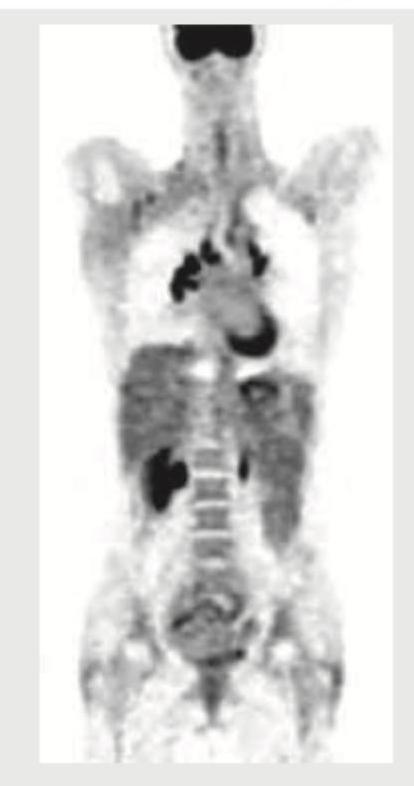
Which of the following statements are true about the Metaiodobenzylguanidine (MIBG) scan?
Which of the following is NOT a pure beta emitter?
Technetium-labeled RBCs are used for the diagnosis of which condition?
What is the radiopharmaceutical used to detect hotspots in myocardial infarction (MI)?
Which of the following statements regarding radioisotopes used in nuclear medicine is true?
What diagnosis is implied by the results of this gallium scan?

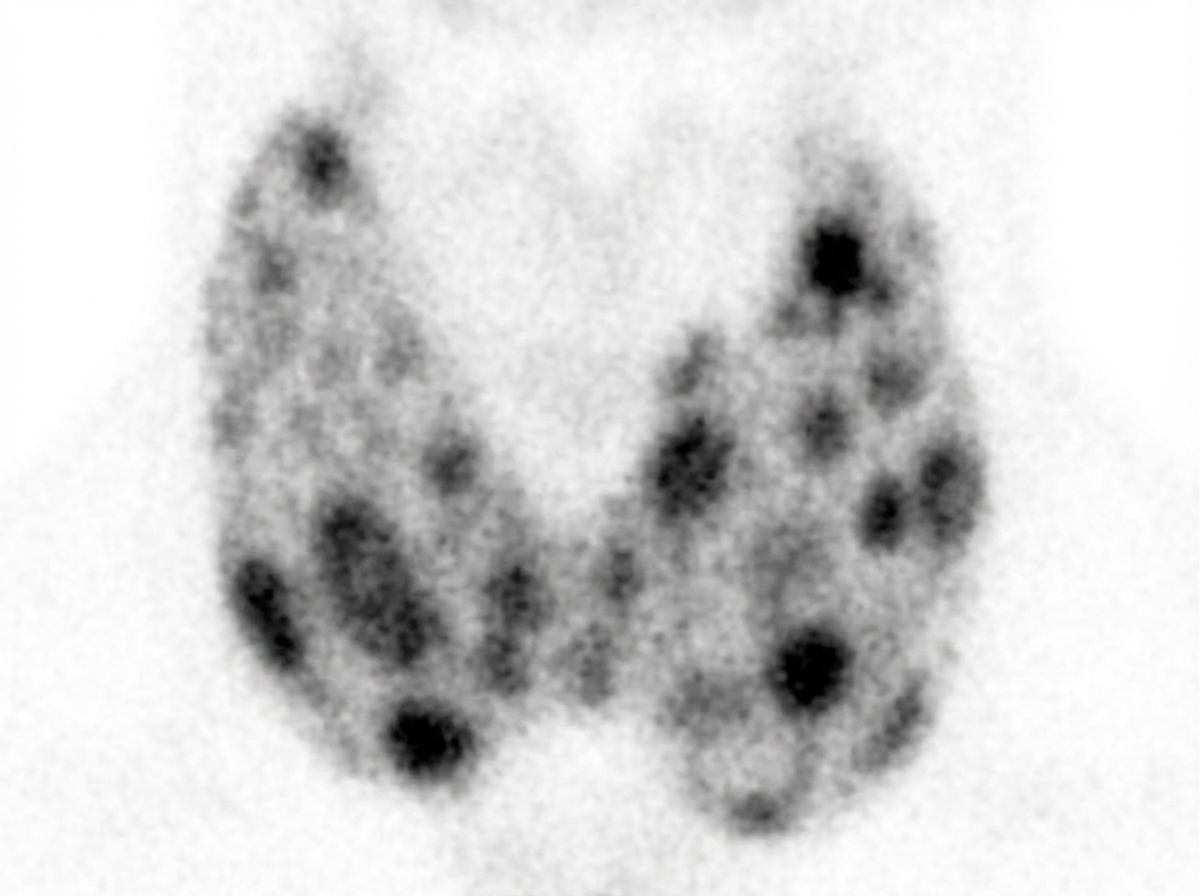
Which of the following statements about isotope scanning of the thyroid is FALSE?
What radiopharmaceutical is used for a liver scan?
What is the investigation of choice for extra-adrenal pheochromocytoma?
A Sestamibi scan is used to evaluate which of the following conditions?
Explanation: **Explanation:** **Metaiodobenzylguanidine (MIBG)** is a structural analog of norepinephrine (guanethidine derivative). It is taken up by the **Type-1 energy-dependent amine uptake mechanism** into the presynaptic storage vesicles of cells derived from the neural crest. 1. **Why Neuroblastoma is the focus:** While MIBG is used for several neuroendocrine tumors, it is the **gold standard** functional imaging modality for **Neuroblastoma** (Option C). It is used for initial staging, assessing response to therapy, and detecting recurrence. In pediatric oncology, MIBG is highly specific for neuroblastoma, often showing bone marrow involvement even when conventional imaging is negative. 2. **Analysis of other options:** * **Options A, B, and D:** Technically, MIBG *does* concentrate in catecholamine-producing cells and is used for Pheochromocytoma and Paraganglioma. However, in the context of NEET-PG "single best answer" questions, **Neuroblastoma** is the most frequent and classic association tested for MIBG. If this were a "Multiple Select" question, all would be correct; as a single choice, Neuroblastoma is the primary clinical application emphasized in standard radiology textbooks (like Grainger & Allison). **High-Yield Clinical Pearls for NEET-PG:** * **Isotopes used:** **I-123 MIBG** is preferred over I-131 because it has a shorter half-life, lower radiation dose, and provides superior image quality (SPECT). * **Thyroid Blockade:** It is mandatory to administer **Lugol’s iodine** or Potassium Iodide before the scan to prevent the uptake of free radioactive iodine by the thyroid gland. * **Drug Interference:** Drugs like Tricyclic Antidepressants (TCAs), Labetalol, and Reserpine must be stopped as they interfere with MIBG uptake. * **Therapeutic Use:** I-131 MIBG can be used for targeted radiotherapy in advanced or refractory neuroblastoma.
Explanation: **Explanation:** In nuclear medicine, radionuclides are classified based on the type of radiation they emit. **Pure beta emitters** are ideal for targeted therapy because they emit electrons that travel short distances, destroying local tissue without significant systemic radiation exposure. However, they are difficult to image because they lack gamma emissions. **Why Samarium-153 is the correct answer:** **Samarium-153 ($^{153}$Sm)** is a **mixed emitter**. It emits both beta particles (for therapy) and **gamma rays** (103 keV). The presence of gamma radiation allows for scintigraphic imaging (dosimetry and localization) while the beta particles treat the pathology. It is commonly used for the palliation of painful bone metastases (e.g., in prostate or breast cancer). **Analysis of Incorrect Options:** * **Yttrium-90 ($^{90}$Y):** A pure beta emitter. It is widely used in **Selective Internal Radiation Therapy (SIRT)** for liver tumors and in radiosynovectomy. * **Strontium-89/90 ($^{89/90}$Sr):** These are pure beta emitters. Strontium-89 is used for bone pain palliation, while Strontium-90 is often used in ophthalmic applicators for pterygium. * **Phosphorus-32 ($^{32}$P):** (Often grouped with these) is also a pure beta emitter used historically for Polycythemia Vera. **High-Yield Clinical Pearls for NEET-PG:** * **Pure Beta Emitters:** Yttrium-90, Phosphorus-32, Strontium-90. (Mnemonic: **Y**oung **P**eople **S**tudy). * **Mixed Emitters (Beta + Gamma):** Iodine-131, Samarium-153, Lutetium-177. These are "theranostic" because they can treat and be imaged simultaneously. * **Alpha Emitter:** Radium-223 (used for bone metastases; improves survival in CRPC). * **Half-life of $^{153}$Sm:** Approximately 46 hours.
Explanation: **Explanation:** The correct answer is **Splenic disease**. Technetium-99m labeled Red Blood Cells (RBCs) are a versatile tool in nuclear medicine, but their application depends on how the RBCs are treated before injection. **Why Splenic disease is correct:** To image the spleen specifically, the patient’s RBCs are labeled with **Tc-99m** and then **heat-denatured** (damaged) by heating them to exactly 49.5°C for 15 minutes. The body recognizes these as "damaged" cells, and the spleen—acting as the body's primary filter—sequesters them. This is the gold standard for identifying **ectopic splenic tissue (splenosis)** or a **supplementary spleen** (accessory spleen) when anatomical imaging is inconclusive. **Why other options are incorrect:** * **Biliary tree abnormalities:** These are evaluated using **Tc-99m HIDA** (Hepatobiliary Iminodiacetic Acid) scans, which track bile flow. * **Renal disease:** Renal imaging uses agents like **Tc-99m DTPA** (for GFR), **MAG3** (for tubular secretion), or **DMSA** (for cortical scarring). * **Pulmonary embolism:** This is diagnosed using a **V/Q scan**. The perfusion part uses **Tc-99m MAA** (Macroaggregated Albumin), not RBCs. **High-Yield Clinical Pearls for NEET-PG:** 1. **Tc-99m Labeled RBCs (Non-denatured):** Used for detecting **Gastrointestinal (GI) bleed** (highly sensitive for slow bleeds) and diagnosing **Hepatic Hemangiomas** (showing "delayed filling"). 2. **MUGA Scan:** Uses Tc-99m labeled RBCs to accurately calculate the Left Ventricular Ejection Fraction (LVEF). 3. **Heat-denatured RBCs:** Specifically used for **Spleen Scintigraphy**. If the question mentions "damaged RBCs," always think of the spleen.
Explanation: ### Explanation **Correct Answer: C. Pyrophosphate Tc 99m** **Mechanism of Action:** Technetium-99m stannous pyrophosphate (99mTc-PYP) is used for **"Hot Spot" imaging** in acute myocardial infarction. When myocardial cells are irreversibly damaged (infarcted), there is an influx of calcium into the mitochondria. The pyrophosphate binds to these **calcium hydroxyapatite crystals** within the necrotic tissue. This creates a "hot spot" (area of increased uptake) on the scan, allowing for the direct visualization of the infarcted zone. This scan is most sensitive between **24 to 72 hours** after the onset of symptoms. **Analysis of Incorrect Options:** * **A. Thallium-201 (Tl-201):** This is a potassium analog used for **"Cold Spot" imaging**. It is taken up by viable, perfused myocardium. In an MI, the dead tissue appears as a "cold spot" (defect) because it cannot take up the tracer. * **B. Gallium (Ga-67):** This is primarily used for detecting **inflammation, infections, or certain tumors** (like lymphoma). While it can show uptake in inflammatory myocarditis, it is not the standard for MI detection. * **C. Albumin (99mTc-HSA):** This is a blood pool agent used primarily for **MUGA scans** to evaluate ventricular ejection fraction and wall motion, not for identifying necrotic tissue. **High-Yield Clinical Pearls for NEET-PG:** * **Hot Spot Imaging:** 99mTc-Pyrophosphate (detects necrotic tissue). * **Cold Spot Imaging:** Thallium-201 or 99mTc-Sestamibi (detects viable tissue). * **PET Scan (Gold Standard for Viability):** F-18 Fluorodeoxyglucose (FDG) is used to differentiate "hibernating myocardium" from permanent scars. * **Rule of Thumb:** If the question asks for "Hot Spot" in MI, always look for Pyrophosphate.
Explanation: ### Explanation **1. Why Option A is Correct:** Iodine-125 (I-125) has a physical half-life of **59.4 days** (approximately 60 days). It decays via electron capture and emits low-energy gamma rays (35 keV). Due to its long half-life and specific emission profile, it is primarily used in **Radioimmunoassay (RIA)**, laboratory research, and permanent interstitial **brachytherapy** (e.g., for prostate cancer). **2. Why the Other Options are Incorrect:** * **Option B:** The half-life of **Iodine-131 (I-131)** is **8.02 days**, not 12 days. It is a beta and gamma emitter used for both imaging and therapy (ablation of thyroid tissue). * **Option C:** **Iodine-125** is the isotope typically used in RIA because its long half-life provides a better shelf-life for diagnostic kits. I-131 is rarely used for RIA due to its shorter half-life and higher radiation dose. * **Option D:** **Iodine-123 (I-123)** is preferred over I-125 for thyroid scans. I-123 has an ideal energy (159 keV) for gamma cameras and a short half-life (13.2 hours), resulting in a lower radiation dose to the patient. I-125 is not used for routine thyroid imaging. **High-Yield Clinical Pearls for NEET-PG:** * **Technetium-99m (Tc-99m):** The "workhorse" of nuclear medicine; half-life is **6 hours**; energy is **140 keV**. * **I-131:** Used for treating Graves' disease and Thyroid Cancer (Beta emitter). * **I-123:** Best iodine isotope for diagnostic thyroid uptake and imaging. * **Half-life Rule of Thumb:** * I-123: ~13 hours * I-131: ~8 days * I-125: ~60 days
Explanation: ***Sarcoidosis*** - **Gallium-67 scan** shows characteristic **panda sign** (parotid and lacrimal gland uptake) and **lambda sign** (bilateral hilar and right paratracheal lymph node uptake), which are pathognomonic for sarcoidosis. - These specific uptake patterns on gallium scan are highly diagnostic and distinguish sarcoidosis from other inflammatory conditions. *Mumps* - Involves **parotid gland swelling** but lacks the characteristic **bilateral hilar lymphadenopathy** seen on gallium scan. - **Viral parotitis** would not show the **lambda sign** or **systemic inflammatory uptake** pattern typical of sarcoidosis. *Paget's disease* - Primarily affects **bone metabolism** and would show increased uptake in **affected bones** rather than parotid glands or hilar lymph nodes. - **Gallium scan** is not typically used for Paget's disease diagnosis; **bone scan** with technetium-99m is preferred. *Septic emboli* - Would show **multiple scattered hot spots** in lungs corresponding to **infected embolic foci**, not the organized bilateral hilar pattern. - Lacks the characteristic **panda sign** and **lambda sign** that are specific for sarcoidosis on gallium imaging.
Explanation: **Explanation** The primary objective of thyroid isotope scanning is to assess the **functional status** of a thyroid nodule (categorizing it as hot, warm, or cold). **1. Why Option D is the Correct (False) Statement:** Isotope scanning relies on the thyroid gland's ability to trap and organify iodine under the influence of **TSH**. In hypothyroid patients, the gland is underactive or destroyed, and the scan typically shows poor or absent uptake, providing no diagnostic utility. The first-line investigation for hypothyroidism is a biochemical profile (TSH, Free T4), while the first-line investigation for a thyroid nodule is **USG-guided FNAC**, not a scan. **2. Analysis of Other Options:** * **Option A:** **I-123** is the isotope of choice for thyroid imaging because it has a short half-life (13 hours) and emits pure gamma radiation, resulting in a lower radiation dose than I-131. * **Option B:** While "cold" nodules (non-functioning) have a higher risk of malignancy than "hot" nodules, the vast majority (**~80-85%**) are still **benign** (e.g., cysts, adenomas, or thyroiditis). * **Option C:** "Warm" or "Hot" nodules (functioning) are rarely malignant, but the risk is not zero; approximately **5%** or less may harbor malignancy. **Clinical Pearls for NEET-PG:** * **Cold Nodule:** High risk of malignancy (~15-20%). * **Hot Nodule:** Low risk of malignancy (<1-5%); usually represents a toxic adenoma. * **Technetium-99m pertechnetate:** Often used in clinical practice due to low cost and ready availability, though it is only trapped and not organified. * **I-131:** Primarily used for **therapeutic** purposes (ablation) rather than routine imaging due to high-energy beta emission.
Explanation: **Explanation:** The correct answer is **Technetium 99m (Tc-99m) sulphur colloid**. **1. Why Tc-99m Sulphur Colloid is correct:** This radiopharmaceutical is used for **liver-spleen imaging** based on the principle of **phagocytosis**. Once injected intravenously, the particles (size 0.1–1.0 μm) are cleared from the blood by the **Reticuloendothelial System (RES)**. Specifically, about 80–90% of the dose is taken up by the **Kupffer cells** in the liver, while the remainder is taken up by the spleen and bone marrow. It is primarily used to detect functional liver tissue, focal nodular hyperplasia (FNH), or "cold spots" representing tumors, abscesses, or cysts. **2. Analysis of Incorrect Options:** * **B. Tc-99m Mebrofenin:** This is an iminodiacetic acid (IDA) derivative used for **Hepatobiliary (HIDA) scans**. It evaluates hepatocyte function and the biliary excretion system (e.g., diagnosing acute cholecystitis), rather than the RES/liver parenchyma. * **C. Tc-99m MIBI:** Primarily used for **Myocardial Perfusion Imaging** (Sestamibi scan) and parathyroid imaging. * **D. Tc-99m DTPA:** A chelating agent cleared by glomerular filtration, used for **Renal Dynamic Imaging** to assess the Glomerular Filtration Rate (GFR). **3. High-Yield Clinical Pearls for NEET-PG:** * **Colloid Shift:** In cases of portal hypertension or cirrhosis, there is decreased liver uptake and increased uptake in the **spleen and bone marrow**. * **Focal Nodular Hyperplasia (FNH):** This is the only liver tumor that typically appears "hot" or "isointense" on a sulphur colloid scan because it contains Kupffer cells. * **Particle Size:** If particles are too small, they go to the bone marrow; if too large, they get trapped in the lungs.
Explanation: **Explanation:** The investigation of choice for localizing an extra-adrenal pheochromocytoma (also known as a paraganglioma) is **Contrast-Enhanced Computed Tomography (CECT)**. 1. **Why CT is the Correct Answer:** CT is the initial imaging modality of choice due to its high spatial resolution and excellent sensitivity (90–100%) for detecting tumors in the abdomen and pelvis. In the context of extra-adrenal pheochromocytomas—which most commonly occur at the **Organ of Zuckerkandl** (near the aortic bifurcation)—CT provides precise anatomical localization and assessment of the relationship with adjacent vascular structures, which is critical for surgical planning. 2. **Why Other Options are Incorrect:** * **MRI:** While MRI is superior for detecting tumors in specific locations (e.g., intracardiac, juxtavascular) or in patients where radiation/contrast is contraindicated (pregnant women/children), it is generally considered a second-line anatomical imaging tool after CT. * **X-ray:** This lacks the soft-tissue resolution required to identify small retroperitoneal or pelvic masses. * **MIBG Scan ($^{123}$I-MIBG):** This is a **functional** imaging study. While highly specific, it is not the "investigation of choice" for initial localization. It is reserved for cases where the primary tumor is not found on CT/MRI, to screen for metastatic disease, or to confirm that a mass seen on CT is indeed a pheochromocytoma. **Clinical Pearls for NEET-PG:** * **Rule of 10s:** 10% are extra-adrenal, 10% are bilateral, 10% are malignant, and 10% occur in children. * **Biochemical Screening:** Always perform biochemical tests (plasma or 24-hour urinary metanephrines) **before** imaging to confirm the diagnosis. * **Scintigraphy:** If MIBG is negative but suspicion is high, **$^{68}$Ga-DOTATATE PET/CT** is now considered the most sensitive functional imaging for paragangliomas (especially those associated with SDHB mutations).
Explanation: **Explanation:** **Technetium-99m Sestamibi (MIBI)** is a lipophilic cationic compound that is taken up by cells with high mitochondrial activity. In the context of hyperparathyroidism, it is the gold standard imaging modality for localizing a **Parathyroid Adenoma** (Option C). The physiological basis of the scan relies on **differential washout**. Both the thyroid gland and the hyperfunctioning parathyroid tissue take up Sestamibi initially. However, the tracer washes out rapidly from normal thyroid tissue but is retained much longer within the oxyphil cells (which are mitochondria-rich) of a parathyroid adenoma. Delayed imaging (usually at 2 hours) typically shows persistent focal uptake in the adenoma. **Analysis of Incorrect Options:** * **A & B (Ectopic Tissues):** While Sestamibi can identify ectopic parathyroid tissue (e.g., in the mediastinum), the primary and most common clinical indication is the localization of a parathyroid adenoma. For ectopic thyroid tissue, **Pertechnetate (Tc-99m)** or **I-131/I-123** scans are preferred due to the specific iodine-trapping mechanism of thyroid follicular cells. * **D (Extra-adrenal Pheochromocytoma):** These are best evaluated using **MIBG (Metaiodobenzylguanidine)** scans or **PET-CT (Gallium-68 DOTATATE)**, which target catecholamine transporters or somatostatin receptors, respectively. **High-Yield Clinical Pearls for NEET-PG:** * **Dual-phase technique:** Sestamibi imaging involves an early phase (10–15 mins) and a delayed phase (1.5–3 hours). * **Sestamibi in Oncology:** It is also used in myocardial perfusion imaging (MPI) and for evaluating breast lesions (Sestimibi Mammography/MBI). * **SPECT/CT:** Combining Sestamibi with CT significantly improves the anatomical localization of adenomas, especially in re-operative cases.
Physics of Nuclear Medicine
Practice Questions
Radiopharmaceuticals
Practice Questions
Radiation Detection in Nuclear Medicine
Practice Questions
Thyroid Scintigraphy
Practice Questions
Bone Scintigraphy
Practice Questions
Renal Nuclear Medicine
Practice Questions
Cardiac Nuclear Medicine
Practice Questions
Pulmonary Nuclear Medicine
Practice Questions
Neurological Nuclear Medicine
Practice Questions
PET/CT Principles and Applications
Practice Questions
Radionuclide Therapy
Practice Questions
Radiation Safety in Nuclear Medicine
Practice Questions
Get full access to all questions, explanations, and performance tracking.
Start For Free