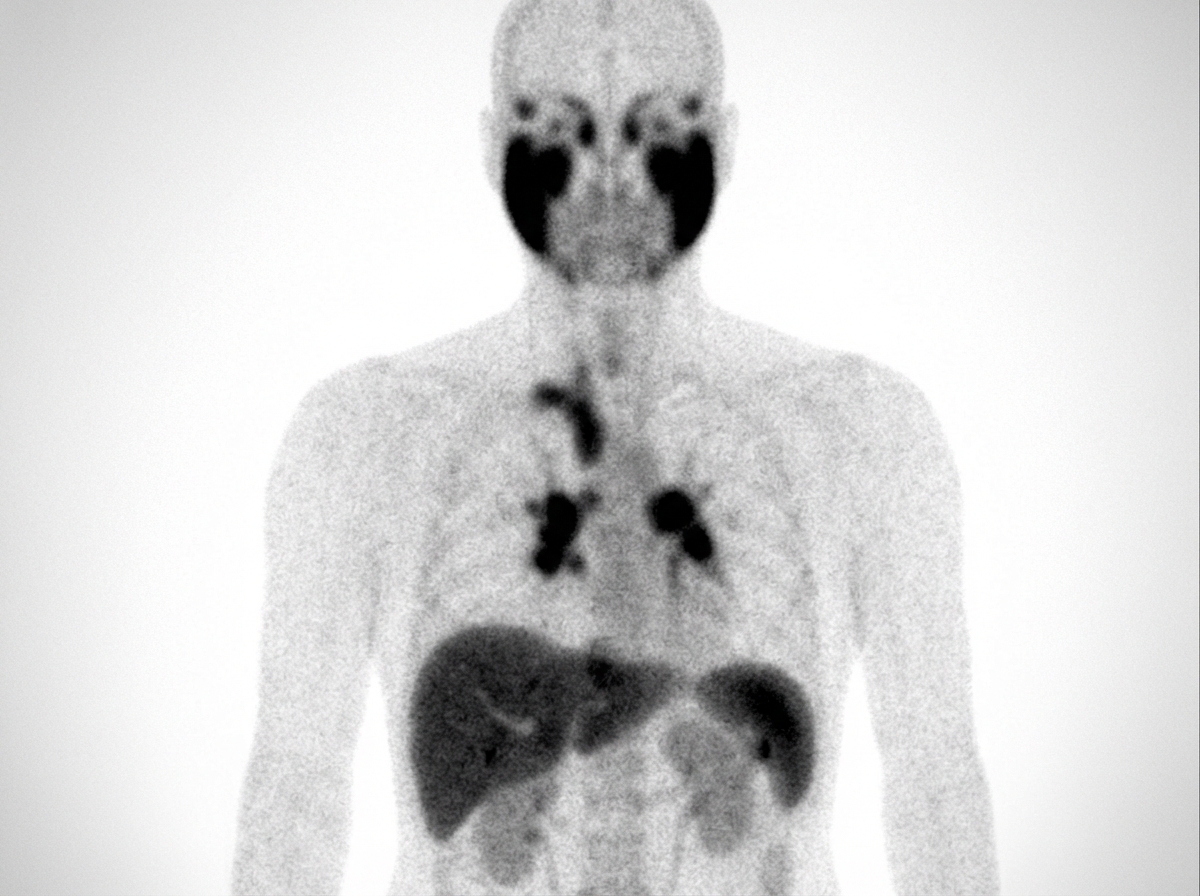
What is the best imaging modality for the localization of parathyroid glands in hyperparathyroidism?
MIBG (metaiodobenzylguanidine) is an analogue to which of the following neurotransmitters?
The "R"s of radiobiology include the following except:
Which of the following radiotracers is commonly used in PET scans?
What is meant by PET scan?
What is the most suitable radioisotope of iodine for treating hyperthyroidism?
The Bragg peak effect is most noticeable in which type of radiation?
Which imaging modality utilizes gamma rays?
Which isotope is used for Radioactive Iodine Uptake (RAIU) test?
Radioiodine ablation is preferred in which of the following conditions?
Explanation: **Explanation:** The **Technetium-99m (Tc-99m) Sestamibi scan** is the gold standard for the preoperative localization of parathyroid adenomas in patients with hyperparathyroidism. **Why it is the correct answer:** The mechanism relies on **differential washout**. Tc-99m Sestamibi is taken up by both the thyroid and the parathyroid glands (due to high mitochondrial content). However, the tracer washes out rapidly from normal thyroid tissue but is **retained much longer** in hyperfunctioning parathyroid tissue (adenomas or hyperplasia). Delayed imaging (at 2–3 hours) typically reveals a persistent "hot spot" representing the parathyroid pathology. When combined with SPECT/CT, it provides excellent anatomical and functional localization, even for ectopic glands (e.g., in the mediastinum). **Why the other options are incorrect:** * **A. X-ray of the neck:** X-rays only show bony structures or soft tissue masses and cannot differentiate parathyroid tissue from surrounding structures. * **B. Ultrasound (USG) of the neck:** While often the first-line investigation due to its low cost and lack of radiation, it is operator-dependent and cannot detect **ectopic** parathyroid glands located behind the trachea or in the chest. * **C. I-131 scan:** This is used for imaging thyroid tissue (specifically for thyroid cancer or hyperthyroidism) and is not taken up by parathyroid glands. **Clinical Pearls for NEET-PG:** * **Dual-Phase Technique:** This refers to the early and delayed imaging used in Sestamibi scans. * **Ectopic Glands:** The most common site for an ectopic parathyroid gland is the **thymus (anterior mediastinum)**. * **Hungry Bone Syndrome:** A high-yield post-operative complication of parathyroidectomy characterized by profound hypocalcemia. * **First-line vs. Best:** While USG is often the initial test, **Tc-99m Sestamibi** is the "best" and most sensitive modality for localization.
Explanation: **Explanation:** **1. Why Norepinephrine is Correct:** MIBG (Metaiodobenzylguanidine) is a structural analogue of **Norepinephrine** (noradrenaline). It enters neuroendocrine cells via the **Type-1 energy-dependent sodium pump (Uptake-1 mechanism)**, the same transporter used by norepinephrine. Once inside the cell, it is stored in presynaptic storage vesicles. Because it mimics the distribution of sympathetic innervation, it is used to image tumors derived from the neural crest. **2. Analysis of Incorrect Options:** * **Epinephrine:** While chemically related to norepinephrine, MIBG specifically mimics the uptake and storage kinetics of norepinephrine at the sympathetic nerve endings. * **Adenine & Guanine:** These are purine nitrogenous bases involved in the structure of DNA and RNA. They have no structural or functional relationship with the catecholamine pathway or MIBG. **3. Clinical Pearls & High-Yield Facts for NEET-PG:** * **Isotopes Used:** * **I-123 MIBG:** Preferred for diagnostic imaging (better image quality, lower radiation dose). * **I-131 MIBG:** Used for both imaging and high-dose **targeted radiotherapy** (e.g., in malignant pheochromocytoma). * **Clinical Indications:** It is the gold standard for localizing **Pheochromocytoma**, **Neuroblastoma** (staging and response), and Paragangliomas. * **Patient Preparation:** It is crucial to **block the thyroid gland** with Lugol’s iodine or Potassium Iodide before the scan to prevent the uptake of free radioactive iodine. * **Drug Interactions:** Drugs like Tricyclic Antidepressants (TCAs) and Reserpine must be stopped as they interfere with the Uptake-1 mechanism, leading to false-negative results.
Explanation: The concept of the **"Rs of Radiobiology"** describes the biological factors that influence how tissues and tumors respond to ionizing radiation, particularly during fractionated radiotherapy. ### **Explanation of the Correct Answer** **D. Reexcitation** is the correct answer because it is **not** one of the recognized Rs of radiobiology. In physics, excitation refers to an electron moving to a higher energy state, but it is not a biological mechanism that determines tissue recovery or tumor response in clinical radiotherapy. ### **Explanation of the Incorrect Options** The classical **4 Rs** (proposed by Withers) are: 1. **Repair (A):** Refers to the ability of cells to repair sublethal radiation damage. Normal tissues generally have a better repair capacity than tumor cells, which is the basis for fractionation. 2. **Reoxygenation (B):** Hypoxic tumor cells are resistant to radiation. Between fractions, as outer tumor cells die, previously hypoxic inner cells get better access to oxygen, making them more sensitive to the next dose. 3. **Repopulation (C):** Surviving cells (both normal and malignant) divide and multiply between fractions. This is why treatment should not be unnecessarily prolonged. 4. **Redistribution (Assortment):** Cells are most sensitive in the **M and G2 phases** of the cell cycle. Fractionation allows surviving cells to move into these sensitive phases. *Note: A 5th R, **Radiosensitivity**, is often added to account for the intrinsic sensitivity of different cell types.* ### **NEET-PG High-Yield Pearls** * **Most sensitive phase of cell cycle:** M phase (followed by G2). * **Most resistant phase of cell cycle:** Late S phase. * **Oxygen Enhancement Ratio (OER):** Radiation is 2–3 times more effective in the presence of oxygen (relevant to Reoxygenation). * **Fractionation:** Exploits the difference in **Repair** capacity between normal and cancer cells to minimize side effects.
Explanation: **Explanation:** **1. Correct Answer: A. FDG (Fluorodeoxyglucose)** Positron Emission Tomography (PET) scans rely on radiopharmaceuticals that emit positrons. **18F-FDG** is the most widely used PET tracer. It is a glucose analog that is taken up by cells via GLUT transporters. Once inside the cell, it is phosphorylated by hexokinase into FDG-6-phosphate; however, unlike normal glucose, it cannot undergo further glycolysis and becomes "trapped" inside the cell. This makes it an excellent marker for tissues with high metabolic activity, such as malignant tumors, brain tissue, and sites of inflammation. **2. Analysis of Incorrect Options:** * **B. DTPA (Diethylenetriaminepentaacetic acid):** Labeled with Technetium-99m (99mTc), this is a **Gamma camera** tracer used primarily for renal dynamic imaging (to measure GFR) and aerosol lung ventilation scans. * **C. MAG-3 (Mercaptoacetyltriglycine):** Also labeled with 99mTc, this is the agent of choice for renal scans in patients with suspected renal artery stenosis or renal failure, as it is primarily secreted by the renal tubules. * **D. I-131 (Radioactive Iodine):** This is a beta and gamma emitter used in conventional scintigraphy and radionuclide therapy for thyroid carcinoma and hyperthyroidism. It is not a positron emitter used in standard PET. **3. High-Yield Clinical Pearls for NEET-PG:** * **Half-life of 18F:** Approximately **110 minutes**, allowing for transport from cyclotrons to hospitals. * **Patient Preparation:** Patients must fast for 4–6 hours to keep insulin levels low, as insulin shifts FDG into muscles rather than tumors. * **Brown Fat:** Can cause "false positives" on PET; beta-blockers or keeping the patient warm can minimize this. * **Other PET Tracers:** 11C-Choline (Prostate CA), 13N-Ammonia (Myocardial perfusion), and 68Ga-DOTATATE (Neuroendocrine tumors).
Explanation: **Explanation:** **Positron Emission Tomography (PET)** is a functional nuclear medicine imaging technique. The correct answer is **Option B** because the process relies on the emission of **positrons** (anti-electrons) from a radiopharmaceutical injected into the patient. **Underlying Medical Concept:** The most common tracer used is **18F-FDG (Fluorodeoxyglucose)**. Once injected, the radioisotope undergoes beta-plus decay, emitting a positron. This positron travels a short distance before colliding with an electron in the tissue, causing an **annihilation event**. This event produces two 511 keV photons (gamma rays) traveling in exactly opposite directions (180°), which are detected by the PET scanner to create a 3D image of metabolic activity. **Analysis of Incorrect Options:** * **Option A & D (Positive):** While positrons have a positive charge, the "P" specifically stands for the particle itself (Positron), not the charge. * **Option C & D (Energy):** The "E" stands for **Emission**, referring to the discharge of particles from the nucleus. While energy is released, it is not the nomenclature used for the modality. **High-Yield Clinical Pearls for NEET-PG:** * **Mechanism:** PET measures **metabolic activity** (glucose uptake), whereas CT/MRI measure anatomy. * **Standard Tracer:** 18F-FDG is a glucose analog; high uptake is seen in brain, heart, and most malignancies (due to the Warburg effect). * **Key Contraindication:** Uncontrolled hyperglycemia (blood glucose >200 mg/dL) as it competes with the tracer. * **Clinical Use:** Staging, restaging, and monitoring response to chemotherapy in oncology. * **Cyclotron:** The machine required to produce the short-lived positron-emitting isotopes used in PET.
Explanation: **Explanation:** The correct answer is **I-131**. The primary goal in treating hyperthyroidism (such as Graves' disease or toxic multinodular goiter) is the destruction of overactive thyroid tissue. **Why I-131 is the drug of choice:** I-131 is unique because it undergoes **beta-minus ($\beta^-$) decay**. While it emits both gamma rays and beta particles, the **beta particles** are responsible for the therapeutic effect. These particles have a short path length (approx. 1–2 mm), allowing for localized destruction of thyroid follicular cells without damaging adjacent structures like the parathyroid glands or recurrent laryngeal nerve. It has a physical half-life of **8.02 days**, providing a sustained therapeutic dose. **Analysis of Incorrect Options:** * **I-123:** This isotope emits only gamma radiation and has a short half-life (13 hours). It is excellent for **diagnostic imaging** (thyroid scans) and uptake studies because it provides clear images with low radiation exposure, but it lacks the beta emission required for therapy. * **I-125:** This isotope has a long half-life (60 days) and emits low-energy photons. It is primarily used in **radioimmunoassays (RIA)** and prostate brachytherapy seeds, but it is not effective for treating hyperthyroidism. * **I-132:** This is a very short-lived isotope (half-life of 2.3 hours) occasionally used in research or pediatric diagnostic studies to minimize radiation dose, but it is unsuitable for ablation. **Clinical Pearls for NEET-PG:** * **Mechanism of Action:** I-131 causes pyknosis and necrosis of follicular cells followed by fibrosis. * **Contraindications:** Pregnancy (absolute) and breastfeeding. Pregnancy must be ruled out with a $\beta$-hCG test before administration. * **Side Effect:** The most common long-term complication of I-131 therapy is **hypothyroidism**, requiring lifelong levothyroxine. * **Diagnostic vs. Therapeutic:** Remember: **I-123 is for "Seeing" (Diagnosis), I-131 is for "Killing" (Therapy).**
Explanation: ### Explanation **Correct Option: B. Proton** The **Bragg Peak** is a physical phenomenon characterized by a distinct peak in the energy loss of ionizing radiation as it travels through matter. For heavy charged particles like **protons** and alpha particles, the rate of ionization (and thus dose deposition) is relatively low and constant as they enter the body. However, as the particle slows down, its interaction with atoms increases, leading to a sharp, localized spike in energy deposition (the Bragg Peak) just before the particle comes to a complete stop. This allows clinicians to target deep-seated tumors with high precision while sparing surrounding healthy tissue. **Incorrect Options:** * **A. X-rays:** These are photons (electromagnetic radiation) that lack mass and charge. They follow an exponential attenuation pattern, depositing their maximum dose near the surface and gradually decreasing as they penetrate deeper. They do not exhibit a Bragg peak. * **C. Neutrons:** These are uncharged particles. While they have mass, they interact primarily through nuclear collisions rather than continuous ionization, resulting in a dose distribution more similar to photons than protons. * **D. Electrons:** Being very light charged particles, they undergo significant scattering and "straggling." This causes their energy deposition to be spread out rather than concentrated at a specific depth, preventing a sharp Bragg peak. **High-Yield Clinical Pearls for NEET-PG:** * **Proton Beam Therapy (PBT):** The primary clinical application of the Bragg peak. It is the treatment of choice for tumors near critical structures (e.g., **chordomas of the skull base, uveal melanoma, and pediatric malignancies**) to minimize long-term side effects. * **Spread-Out Bragg Peak (SOBP):** In clinical practice, proton beams of varying energies are superimposed to create a wider "plateau" of dose deposition to cover the entire volume of a tumor. * **LET (Linear Energy Transfer):** Protons have a higher LET at the Bragg peak compared to the entry path, increasing their relative biological effectiveness (RBE) at the target site.
Explanation: **Explanation:** The correct answer is **PET Scan (Positron Emission Tomography)**. **Why PET Scan is correct:** PET imaging is a functional nuclear medicine modality. It involves the administration of a positron-emitting radiopharmaceutical (most commonly **18F-FDG**). When a positron is emitted, it travels a short distance and encounters an electron, resulting in an **annihilation reaction**. This reaction produces two **511 keV gamma-ray photons** that travel in opposite directions (180 degrees apart). These gamma rays are then detected by the PET scanner to create an image. **Why the other options are incorrect:** * **CT Scan (Computed Tomography):** Utilizes **X-rays** produced by an X-ray tube to create cross-sectional images of the body. * **DEXA Scan (Dual-Energy X-ray Absorptiometry):** Uses two different low-dose **X-ray** beams to measure bone mineral density. * **Fluoroscopy:** A technique that uses continuous **X-ray** beams to obtain real-time moving images of internal structures. **High-Yield Clinical Pearls for NEET-PG:** * **Gamma Camera/SPECT:** Also utilizes gamma rays, but these are emitted directly from a radioisotope (e.g., **Technetium-99m**) rather than through positron annihilation. * **Energy Level:** Remember the specific energy of PET photons is always **511 keV**. * **Cyclotron:** Positron emitters used in PET scans are typically produced in a cyclotron. * **MRI & Ultrasound:** These are non-ionizing modalities; MRI uses radiofrequency waves in a magnetic field, while Ultrasound uses high-frequency sound waves.
Explanation: The **Radioactive Iodine Uptake (RAIU)** test is a functional study used to measure the metabolic activity of the thyroid gland. It is primarily used to differentiate causes of hyperthyroidism (e.g., Graves' disease vs. Thyroiditis). ### **Explanation of Options** * **A. I-123 (Correct):** I-123 is the isotope of choice for RAIU and thyroid imaging. It is a **pure gamma emitter** with a photon energy of **159 keV**, which is ideal for detection by gamma cameras. Crucially, it has a short half-life of **13.2 hours**, resulting in a significantly lower radiation dose to the patient compared to other isotopes. * **B. I-137 (Incorrect):** This is not a standard isotope used in clinical medicine. It is a fission product with no role in thyroid diagnostics. * **C. I-125 (Incorrect):** While used in laboratory assays (like RIA) and prostate brachytherapy, it is not used for RAIU due to its long half-life (60 days) and low-energy emissions which are difficult to image. ### **Clinical Pearls for NEET-PG** * **I-131 vs. I-123:** While I-123 is preferred for **imaging/uptake** (diagnostic), **I-131** is primarily used for **therapy** (ablation of thyroid cancer or Graves') because it emits **Beta particles**, which cause local tissue destruction. I-131 has a longer half-life of **8 days**. * **Technetium-99m pertechnetate:** Can also be used for thyroid imaging (trapped but not organified), but it is not used for formal "uptake" percentage calculations. * **Contraindication:** Radioactive iodine studies are strictly contraindicated in **pregnancy** and breastfeeding. * **High Uptake:** Seen in Graves' disease and Toxic Multinodular Goiter. * **Low Uptake:** Seen in Subacute Thyroiditis, Factitious Thyrotoxicosis, and Iodine overload (Jod-Basedow effect).
Explanation: **Explanation:** The correct answer is **D. Post-surgery papillary carcinoma.** Radioiodine (I-131) ablation is a standard adjuvant therapy following total thyroidectomy in patients with differentiated thyroid cancers (DTC), such as Papillary and Follicular carcinoma. The primary goal is to destroy any residual microscopic thyroid tissue or occult metastatic foci. This procedure facilitates the use of Serum Thyroglobulin as a highly sensitive tumor marker for follow-up and improves the sensitivity of future diagnostic whole-body iodine scans. **Why other options are incorrect:** * **A. Pregnancy:** This is an **absolute contraindication**. I-131 crosses the placenta and can destroy the fetal thyroid gland, leading to irreversible cretinism and potential teratogenicity. * **B. Graves’ Disease:** While I-131 is a treatment modality for Graves’, it is generally reserved for adults who fail medical therapy (Antithyroid drugs). It is not the "preferred" first-line treatment in all demographics, especially when compared to the definitive role it plays in post-surgical cancer management. * **C. Young Patients:** In children and adolescents, physicians generally prefer medical management or surgery over radioiodine due to the theoretical long-term risk of secondary malignancies and the potential impact on gonadal function. **High-Yield Clinical Pearls for NEET-PG:** * **Isotope of Choice:** I-131 is used for therapy (Beta emitter), while I-123 or I-131 (in lower doses) is used for imaging. * **Preparation:** Patients must have high TSH levels (>30 mIU/L) to ensure maximum uptake, achieved either by thyroid hormone withdrawal or recombinant human TSH (rhTSH). * **Safety:** Patients must avoid pregnancy for at least 6–12 months following I-131 therapy. * **Contraindications:** Pregnancy, breastfeeding, and severe uncontrolled thyrotoxicosis.
Physics of Nuclear Medicine
Practice Questions
Radiopharmaceuticals
Practice Questions
Radiation Detection in Nuclear Medicine
Practice Questions
Thyroid Scintigraphy
Practice Questions
Bone Scintigraphy
Practice Questions
Renal Nuclear Medicine
Practice Questions
Cardiac Nuclear Medicine
Practice Questions
Pulmonary Nuclear Medicine
Practice Questions
Neurological Nuclear Medicine
Practice Questions
PET/CT Principles and Applications
Practice Questions
Radionuclide Therapy
Practice Questions
Radiation Safety in Nuclear Medicine
Practice Questions
Get full access to all questions, explanations, and performance tracking.
Start For Free