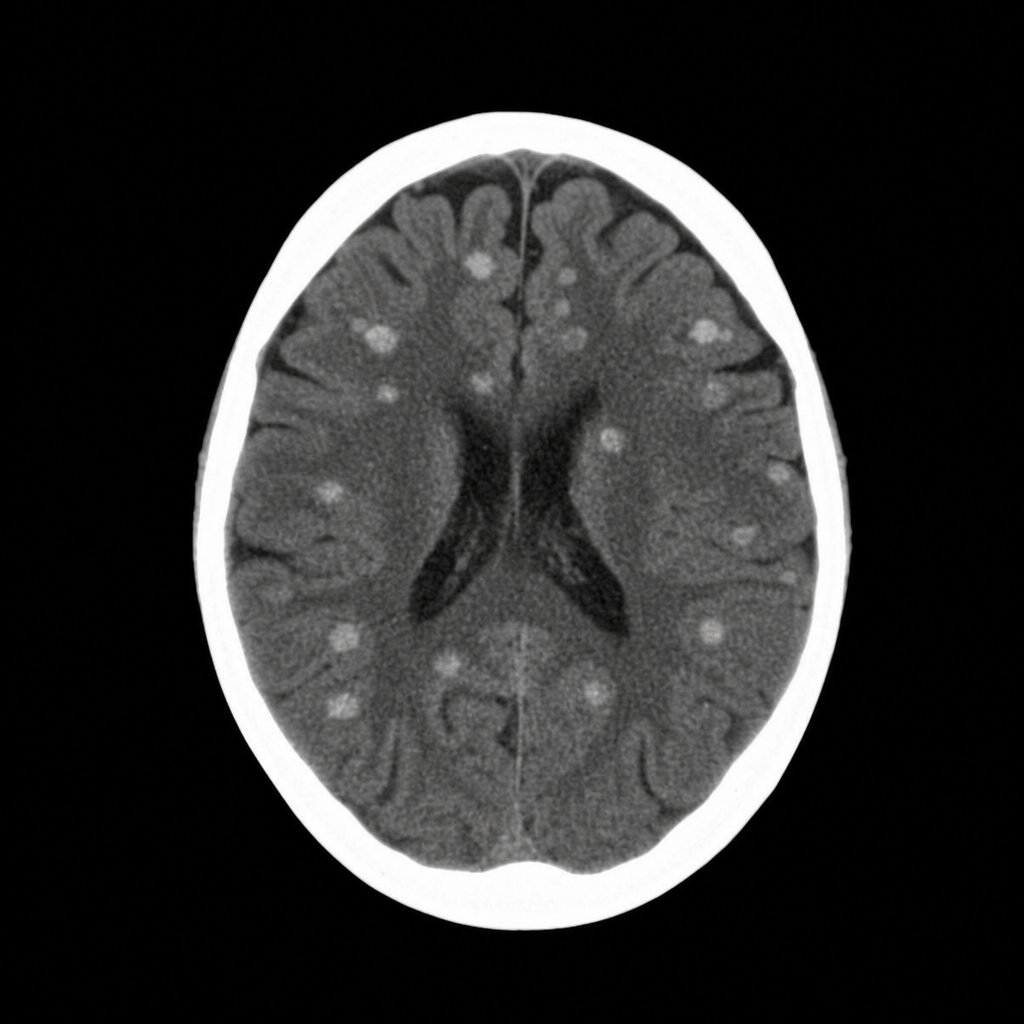
What is the best imaging modality for the diagnosis of tubercular meningitis?
Which is the most common intraparenchymal brain tumor to show calcification?
What is the most common extra-axial intracranial tumor?
A local cerebral lesion with ring enhancement on CT scan is typically caused by which of the following?
What is the diagnostic test of choice for cerebral cysticercosis?
What is the most common intracranial tumour?
What is the gold standard investigation for cerebral arteriovenous malformation?
Which of the following statements regarding cerebral microbleeds (CMBs) is FALSE?
Tram-line calcification on skull X-ray is characteristically seen in which of the following conditions?
The "bare orbit" sign is characteristic of which of the following conditions?
Explanation: **Explanation:** **1. Why Contrast-enhanced MRI (CE-MRI) is the Correct Answer:** MRI is the gold standard for neuroimaging in Tubercular Meningitis (TBM) due to its superior soft-tissue contrast and multiplanar imaging capabilities. The hallmark of TBM is **thick, gelatinous basal exudates**. CE-MRI is highly sensitive in detecting **intense leptomeningeal enhancement**, especially within the basal cisterns (Sylvian fissures, perimesencephalic, and suprasellar cisterns). Furthermore, MRI is far superior to CT in identifying early complications such as small infarcts (due to vasculitis), cranial nerve involvement, and early-stage tuberculomas. **2. Why the Incorrect Options are Wrong:** * **Contrast-enhanced CT (CE-CT):** While often the first investigation performed in emergency settings to rule out hydrocephalus, CT has lower sensitivity for detecting subtle meningeal enhancement and posterior fossa pathology compared to MRI. * **PET and SPECT:** These are functional imaging modalities. While PET may be used to identify extracranial systemic tuberculosis or differentiate a tuberculoma from a malignancy in ambiguous cases, they play no role in the primary diagnosis of meningitis. **3. NEET-PG High-Yield Clinical Pearls:** * **Classic Triad on Imaging:** 1. Basal meningeal enhancement, 2. Hydrocephalus (usually communicating), and 3. Infarcts (most common in the "Medial Striate" and "Thalamoperforating" arteries, leading to basal ganglia infarcts). * **Tuberculoma Appearance:** On MRI, a "mature" tuberculoma often shows a **"Target Sign"** (central calcification or necrosis with peripheral enhancement). * **Most Common Complication:** Hydrocephalus is the most frequent complication of TBM in children. * **Gold Standard for Diagnosis:** While MRI is the best *imaging* modality, the definitive gold standard remains CSF analysis (demonstrating AFB on smear/culture or positive GeneXpert).
Explanation: **Explanation:** **Oligodendroglioma** is the correct answer because it is the most common **intraparenchymal** (within the brain tissue) tumor to exhibit calcification. Radiologically, calcification is seen in approximately **70–90%** of these cases. These tumors typically present as cortical or subcortical masses, most frequently in the **frontal lobe**, and often cause seizures. On CT scans, the calcifications are often described as "clumped" or "ribbon-like." **Analysis of Incorrect Options:** * **Meningioma (Option A):** While meningiomas very frequently show calcification (psammoma bodies), they are **extraparenchymal** (arising from the meninges) rather than intraparenchymal. * **Astrocytoma (Option C):** Low-grade astrocytomas can calcify, but the frequency is much lower (approx. 15–20%) compared to oligodendrogliomas. Glioblastoma Multiforme (GBM) rarely shows calcification unless there is a prior lower-grade lesion. * **Ependymoma (Option D):** These frequently calcify (about 50% of cases), but they are typically **intraventricular** or periventricular in location rather than purely intraparenchymal. **High-Yield NEET-PG Pearls:** * **Genetic Marker:** Oligodendrogliomas are strongly associated with the **1p/19q co-deletion**, which predicts a better response to chemotherapy. * **Imaging Sign:** On MRI, they often show a "cortical expansion" look. * **Most common calcified tumor in children:** Craniopharyngioma (suprasellar location). * **Most common posterior fossa tumor to calcify:** Ependymoma. * **Rule of Thumb:** If a question asks for the most common *intraparenchymal* calcified tumor in an adult, always think **Oligodendroglioma**.
Explanation: **Explanation:** **Meningioma** is the correct answer as it is the most common primary intracranial tumor overall and the most frequent **extra-axial** tumor, accounting for approximately 35–40% of all adult brain tumors. These tumors arise from the arachnoid cap cells of the arachnoid villi. On imaging, they typically present as well-circumscribed, dural-based masses that show intense, homogenous enhancement and often exhibit the "dural tail sign." **Analysis of Incorrect Options:** * **Schwannoma:** While these are common extra-axial tumors (especially Vestibular Schwannomas at the cerebellopontine angle), they are significantly less frequent than meningiomas. * **Lipoma:** These are rare, congenital malformations (not true neoplasms) often found near the midline, such as the corpus callosum. * **Arachnoid Cyst:** These are benign, CSF-filled sacs. While they are common extra-axial "lesions," they are developmental cysts rather than tumors. **High-Yield Clinical Pearls for NEET-PG:** * **Demographics:** More common in females (2:1 ratio) due to progesterone receptors on the tumor cells. * **Imaging Hallmarks:** Look for the **"Dural Tail Sign"** (thickening of adjacent dura) and **"CSF Cleft Sign"** (displaced CSF/vessels between the tumor and brain parenchyma, confirming its extra-axial location). * **Histology:** The classic finding is **Psammoma bodies** (laminated calcifications) and whorled patterns of cells. * **Associations:** Multiple meningiomas are strongly associated with **Neurofibromatosis Type 2 (NF2)**. * **Hyperostosis:** Meningiomas often cause reactive thickening of the overlying bone, a key diagnostic feature on CT.
Explanation: **Explanation:** **Ring-enhancing lesions (RELs)** are a classic radiological finding where a lesion shows a peripheral rim of contrast enhancement surrounding a central non-enhancing area (usually necrosis, pus, or cystic fluid). **1. Why Toxoplasmosis is correct:** *Toxoplasma gondii* is the most common cause of cerebral abscesses in immunocompromised patients (especially those with HIV/AIDS). On a CT scan, it typically presents as multiple, small, ring-enhancing lesions located in the **basal ganglia** and corticomedullary junction. The enhancement represents a breakdown of the blood-brain barrier and inflammatory granulation tissue surrounding the necrotic core. **2. Why the other options are incorrect:** * **Intracranial Hemorrhage & Hematoma:** Acute blood appears **hyperdense (bright white)** on a non-contrast CT. It does not typically show ring enhancement in the acute phase. While a resolving hematoma can occasionally show rim enhancement due to vascularized granulation tissue, it is not a "typical" presentation compared to infectious or neoplastic causes. * **Cysts:** Simple cysts (like arachnoid cysts) are fluid-filled sacs with very thin walls that do not enhance with contrast. They appear hypodense (dark) and follow CSF density. **3. NEET-PG High-Yield Pearls:** To remember the differential diagnosis for ring-enhancing lesions, use the mnemonic **"MAGIC DR"**: * **M**etastasis (most common overall) * **A**bscess (Pyogenic, Fungal, or Toxoplasmosis) * **G**lioblastoma Multiforme (GBM) * **I**nfarct (subacute phase) * **C**ontusion * **D**emyelinating disease (e.g., Tumefactive MS - often "open-ring" enhancement) * **R**adiation necrosis **Clinical Tip:** In HIV patients, the main differential for a ring-enhancing lesion is **Toxoplasmosis vs. Primary CNS Lymphoma**. Toxoplasmosis is usually multiple and involves the basal ganglia, while Lymphoma is often solitary and may show subependymal spread.
Explanation: **Explanation:** Neurocysticercosis (NCC) is the most common parasitic infection of the human central nervous system. The choice of imaging depends on the stage of the parasite and the clinical objective. **Why Non-contrast CT (NCCT) is the Correct Answer:** For the **initial diagnosis** and screening of cerebral cysticercosis, **NCCT scan** is considered the investigation of choice. This is because the most common presentation in clinical practice is the **calcified stage** (nodular calcified stage), and CT has superior sensitivity for detecting small parenchymal calcifications compared to MRI. In an emergency setting (e.g., a patient presenting with a first-ever seizure), NCCT is the rapid, standard-of-care tool to identify these pathognomonic "starry sky" calcifications. **Analysis of Incorrect Options:** * **MRI:** While MRI is the **most sensitive** modality for identifying the scolex (hole-with-dot appearance), evaluating the vesicular stage, and detecting intraventricular or cisternal involvement, it often misses small calcifications. It is the "gold standard" for characterization but not the primary diagnostic screening tool for calcified lesions. * **Contrast CT:** While it can show ring enhancement in the colloidal vesicular stage, it is not superior to NCCT for identifying the hallmark calcifications and adds unnecessary radiation/cost for initial screening. * **Plain X-ray:** This may show "cigar-shaped" calcifications in the soft tissues (muscles), but it has no role in diagnosing cerebral involvement. **High-Yield Clinical Pearls for NEET-PG:** * **Pathognomonic finding:** A cystic lesion with an eccentric hyperdense/hyperintense nodule representing the **scolex**. * **Most common site:** Gray-white matter junction. * **Drug of choice:** Albendazole (Praziquantel is an alternative). Steroids must be started *before* antiparasitic drugs to prevent inflammatory edema. * **Staging:** Vesicular (viable) → Colloidal vesicular (dying, ring-enhancing) → Granular nodular → Nodular calcified (healed).
Explanation: ### Explanation **Correct Answer: D. Metastatic tumours** **Why it is correct:** In the general population, **metastatic tumors** are the most common intracranial neoplasms, outnumbering primary brain tumors by a ratio of approximately 10:1. They typically reach the brain via hematogenous spread and are most frequently found at the **gray-white matter junction** due to the narrowing of blood vessels in this region. The most common primary sources are the lung (most common overall), breast, melanoma, renal cell carcinoma, and colon. **Why the other options are incorrect:** * **A. Astrocytoma:** While Glioblastoma (a Grade IV Astrocytoma) is the most common *primary malignant* brain tumor in adults, it is still less frequent than secondary metastases. * **B. Medulloblastoma:** This is the most common *primary malignant* brain tumor in **children**, typically arising in the cerebellum (posterior fossa). * **C. Meningioma:** This is the most common *primary benign* intracranial tumor. While highly prevalent, the incidence of metastatic disease remains higher in clinical practice. **High-Yield Clinical Pearls for NEET-PG:** * **Most common primary source of brain metastasis:** Lung cancer (Small cell > Non-small cell). * **Most common source of hemorrhagic metastasis:** Melanoma, Choriocarcinoma, Renal Cell Carcinoma, and Thyroid cancer (Mnemonic: **MCRT**). * **Imaging Hallmark:** Metastases often present as multiple, well-circumscribed lesions with significant **perilesional vasogenic edema** out of proportion to the size of the lesion. * **Single vs. Multiple:** While metastases are usually multiple, Bronchogenic carcinoma and RCC are known to frequently present as solitary brain metastases.
Explanation: **Explanation:** **Cerebral Angiography (Digital Subtraction Angiography - DSA)** is the gold standard for diagnosing and evaluating cerebral arteriovenous malformations (AVMs). The underlying medical concept relies on its superior **temporal and spatial resolution**. AVMs are high-flow vascular shunts; DSA allows for real-time visualization of the "nidus," identification of specific arterial feeders, and detection of early venous drainage. It is essential for treatment planning (surgery, embolization, or radiosurgery) as it can identify high-risk features like intranidal aneurysms. **Why other options are incorrect:** * **DWI MRI scan:** Diffusion-Weighted Imaging is the gold standard for detecting **acute ischemic stroke** (cytotoxic edema), not vascular malformations. * **CT scan:** While a Non-Contrast CT (NCCT) is the initial investigation of choice to rule out **acute intracranial hemorrhage** (a common complication of AVMs), it cannot delineate the vascular architecture of the malformation itself. * **MRI scan:** MRI (specifically T2/FLAIR sequences) is excellent for showing the "honeycomb" appearance or "bag of black worms" (flow voids), but it lacks the hemodynamic detail provided by DSA. **High-Yield Clinical Pearls for NEET-PG:** * **Classic Sign:** On MRI, AVMs typically show **"Flow Voids"** due to rapidly moving blood. * **Spetzler-Martin Grading:** Used to estimate surgical risk based on size, eloquence of adjacent brain tissue, and venous drainage pattern. * **Most common presentation:** Intracranial hemorrhage (30-50%) followed by seizures. * **Gold Standard for Aneurysm/AVM:** Always Digital Subtraction Angiography (DSA).
Explanation: **Explanation:** **1. Why Option A is the Correct (False) Statement:** Cerebral microbleeds (CMBs) are typically **not visible on standard T2-weighted spin-echo sequences.** They are best detected using **T2* Gradient Recalled Echo (GRE)** or **Susceptibility-Weighted Imaging (SWI)**. This is due to the "blooming effect" caused by paramagnetic hemosiderin deposits (breakdown products of hemoglobin), which create local magnetic field inhomogeneities. On GRE/SWI, they appear as small, well-defined, rounded areas of signal void (hypointensity). **2. Analysis of Other Options:** * **Option B (Lobar CMBs):** This is a true statement. The distribution of CMBs is a key diagnostic clue. **Lobar microbleeds** (cortical-subcortical) are highly suggestive of **Cerebral Amyloid Angiopathy (CAA)**, especially in elderly patients. * **Option C (Hypertension):** This is a true statement. **Hypertensive vasculopathy** typically causes microbleeds in deep brain structures, such as the basal ganglia, thalamus, pons, and cerebellum. * **Option D (Cognitive Decline):** This is a true statement. A high burden of CMBs is a marker of small vessel disease and is independently associated with an increased risk of cognitive impairment and dementia. **High-Yield NEET-PG Pearls:** * **Imaging Gold Standard:** SWI is more sensitive than GRE for detecting CMBs. * **Boston Criteria:** Used for the diagnosis of Cerebral Amyloid Angiopathy (CAA), where lobar microbleeds are a primary feature. * **Differential Diagnosis:** Must be distinguished from "mimics" like calcifications, diffuse axonal injury (DAI), and small cavernomas. * **Clinical Significance:** CMBs are a strong predictor of future intracerebral hemorrhage (ICH), especially in patients on anticoagulants.
Explanation: **Explanation:** **Sturge-Weber Syndrome (SWS)**, also known as encephalotrigeminal angiomatosis, is the correct answer. The characteristic **"tram-line" (or railroad track) calcifications** seen on a skull X-ray or CT scan represent cortical and subcortical calcifications. These occur due to chronic ischemia caused by the underlying leptomeningeal angioma (vascular malformation), leading to cortical atrophy and dystrophic calcification in the second and third layers of the cerebral cortex. **Analysis of Incorrect Options:** * **Ependymoma:** While these tumors often show calcification (especially in the fourth ventricle), it is typically punctate or chunky, not linear or "tram-line." * **Thrombosed cerebral vein:** On a CT scan, a thrombosed dural sinus may show the "Empty Delta Sign" (with contrast) or a "Cord Sign" (hyperdensity on non-contrast CT), but it does not cause tram-line calcifications. * **Meningioma:** These often show psammomatous calcifications, which appear as diffuse, grainy, or "sunburst" patterns, rather than following the gyral contours of the brain. **High-Yield Clinical Pearls for NEET-PG:** * **Classic Triad of SWS:** Facial port-wine stain (Nevus Flammeus in the $V_1/V_2$ distribution), leptomeningeal angioma, and glaucoma. * **Imaging Gold Standard:** **Contrast-enhanced MRI** is the most sensitive modality to detect leptomeningeal enhancement. * **Calcification Pattern:** The calcifications are actually in the **brain parenchyma (cortex)**, not the vessels themselves, though they follow the gyral pattern. * **Associated Feature:** "Dyke-Davidoff-Mason syndrome" features can be seen, including compensatory skull thickening and enlargement of paranasal sinuses due to cerebral hemiatrophy.
Explanation: The **"Bare Orbit" sign** is a classic radiological hallmark of **Neurofibromatosis type 1 (NF-1)**. ### **1. Why NF-1 is Correct** The sign is caused by **sphenoid wing dysplasia** (specifically the absence or hypoplasia of the greater wing of the sphenoid). On a frontal skull radiograph or CT, the absence of the sphenoid wing removes the normal bony boundary between the middle cranial fossa and the orbit. This results in an empty-appearing orbit (the "bare orbit") and leads to **pulsatile exophthalmos**, as the pulsations of the cerebrospinal fluid (CSF) are transmitted directly to the orbital contents. ### **2. Why Other Options are Incorrect** * **Neurofibromatosis type 2 (NF-2):** Characterized by "MISME" (Multiple Inherited Schwannomas, Meningiomas, and Ependymomas), most notably bilateral vestibular schwannomas. It does not typically involve sphenoid wing dysplasia. * **Schwannoma:** While NF-1 is associated with neurofibromas, isolated schwannomas do not cause the structural bony defects required to produce the bare orbit sign. * **Ependymoma:** These are glial tumors (commonly found in the fourth ventricle or spinal cord in NF-2) and have no association with orbital bony dysplasia. ### **3. High-Yield Clinical Pearls for NEET-PG** * **Lisch Nodules:** Iris hamartomas (most common ocular finding in NF-1). * **Optic Nerve Glioma:** The most common visceral tumor in NF-1. * **Buphthalmos:** Congenital glaucoma (enlarged eye) often seen in NF-1. * **Radiology Tip:** If you see a "bare orbit" on a CT scan, also look for a **plexiform neurofibroma** (described as a "bag of worms" appearance) in the adjacent soft tissues.
Neuroanatomy for Radiologists
Practice Questions
Cerebrovascular Diseases
Practice Questions
Intracranial Tumors
Practice Questions
CNS Infections
Practice Questions
Demyelinating and Degenerative Diseases
Practice Questions
Head Trauma Imaging
Practice Questions
Spine Imaging: Trauma and Degenerative Disease
Practice Questions
Spine Tumors and Infections
Practice Questions
Pediatric Neuroradiology
Practice Questions
Congenital CNS Anomalies
Practice Questions
Functional Neuroimaging
Practice Questions
Neurointerventional Procedures
Practice Questions
Get full access to all questions, explanations, and performance tracking.
Start For Free