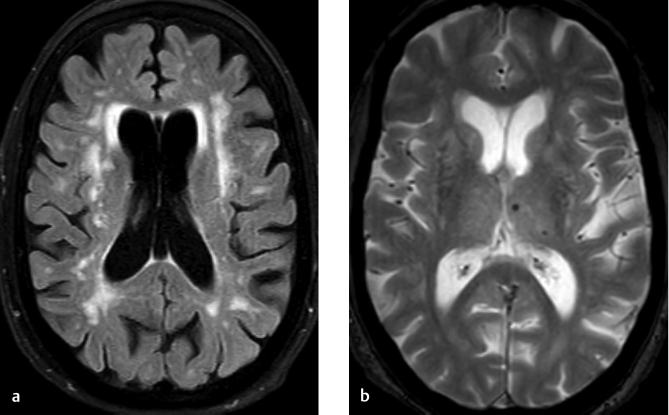
What condition is shown in the MR angiogram of the skull?

What is the most sensitive investigation for diffuse axonal injury?
In which condition is the 'Eye of the Tiger' appearance typically observed?
Hummingbird sign in brain MRI is seen in ?
Who is credited with the development of cerebral angiography?
Presence of delta sign on contrast enhanced CT scan suggests presence of?
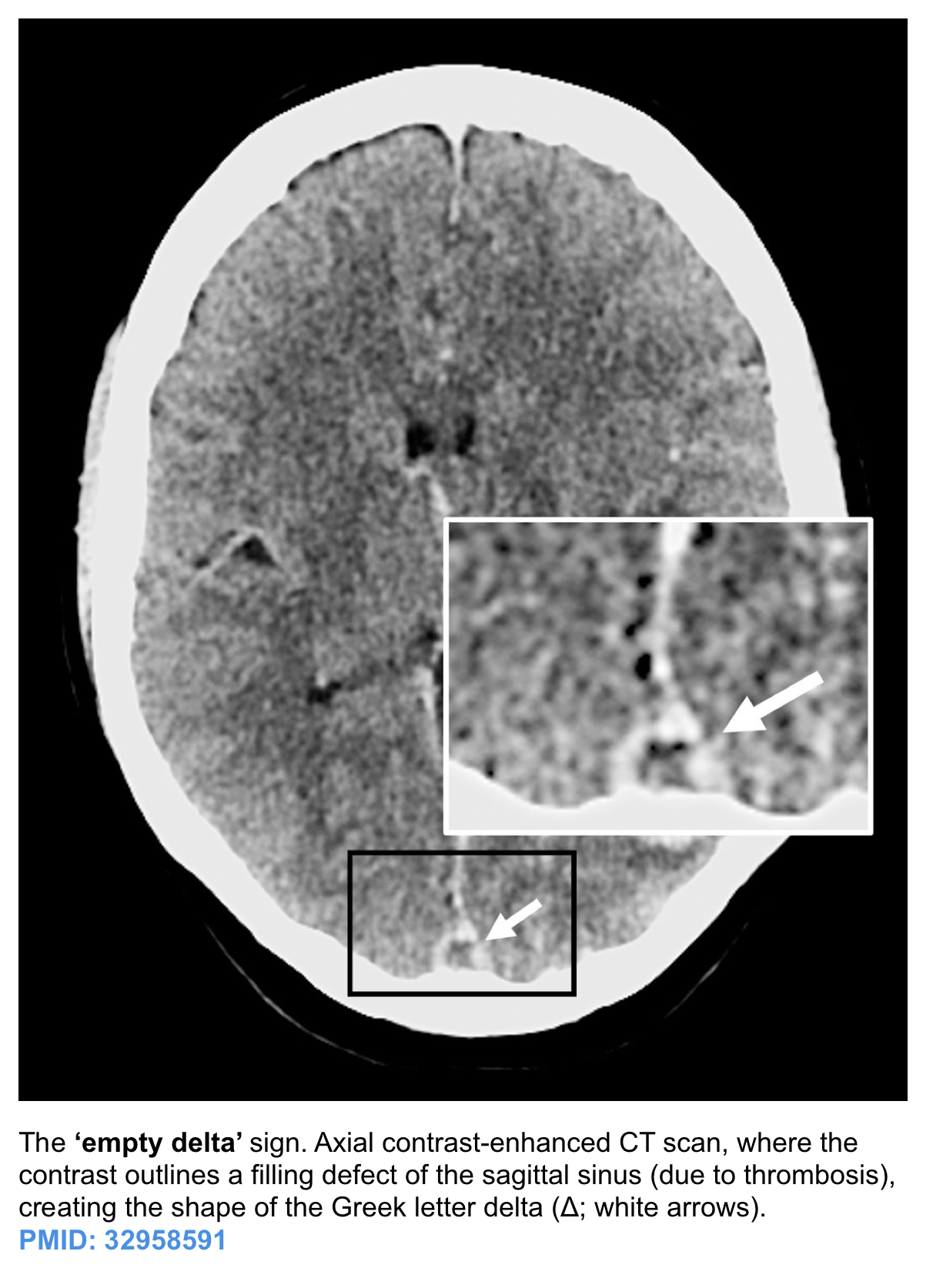
Identify the condition in the image below?

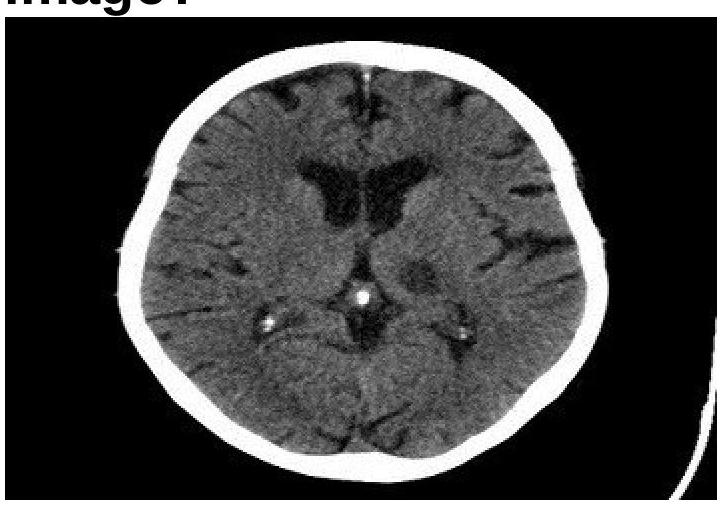
Identify the condition based on the provided image.
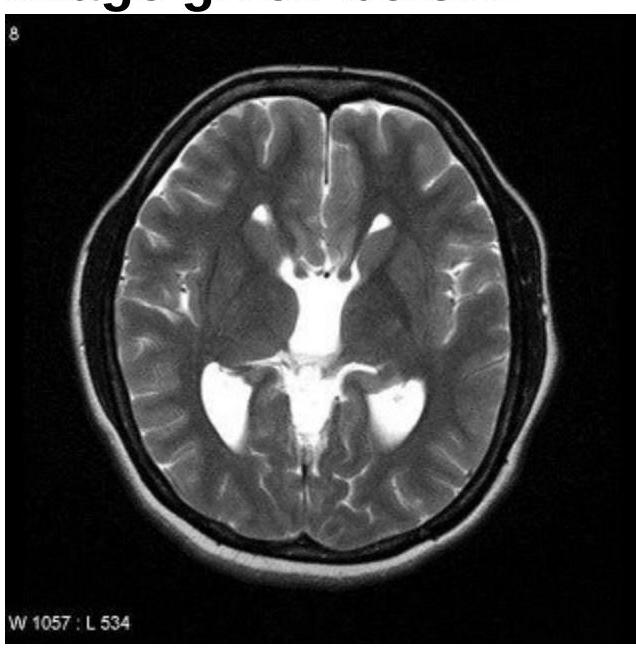
Identify the condition shown in the CT scan image.

Epidural hematoma on CT scan shows which of the following?
Explanation: ***Vein of Galen malformation*** - The image provided is an **MR angiogram (MRA)**, which clearly shows a **large, dilated vein of Galen**. This is the characteristic appearance of a Vein of Galen malformation. - This congenital vascular malformation involves a direct artery-to-vein shunt, leading to the characteristic aneurysmal dilatation of the vein. *Dandy-Walker malformation* - This is a congenital brain malformation characterized by **agenesis or hypoplasia of the cerebellar vermis** and cystic dilation of the fourth ventricle. - While it affects brain structures, it does not involve the type of vascular abnormality seen in the image. *Pneumocephalus* - **Pneumocephalus** refers to the presence of **air within the intracranial cavity**, often due to trauma or surgery. - It would appear as dark areas on imaging, representing air, not the bright, dilated vascular structures seen here. *Crouzon syndrome* - **Crouzon syndrome** is a genetic disorder characterized by **craniosynostosis**, which is the premature fusion of skull sutures. - This condition primarily affects bone growth and skull shape, with no direct involvement of the cerebral vasculature as depicted in the MRA.
Explanation: ***MRI*** - **Magnetic Resonance Imaging (MRI)** is the most sensitive imaging modality for detecting **diffuse axonal injury (DAI)** due to its ability to visualize microscopic changes in white matter integrity. - **Susceptibility Weighted Imaging (SWI)** is particularly sensitive for detecting **microhemorrhages** (petechial hemorrhages) at gray-white matter junctions, corpus callosum, and brainstem—characteristic locations for DAI. - **Diffusion Weighted Imaging (DWI)** and **Diffusion Tensor Imaging (DTI)** can demonstrate disruption of axonal tracts by showing restricted diffusion and measuring changes in fractional anisotropy. - Conventional sequences like **T2*-weighted gradient-recalled echo (GRE)** and **FLAIR** also help detect edema and blood products associated with DAI. *CT* - **Computed Tomography (CT) scans** are often the initial imaging modality in acute head injury due to their speed and ability to detect gross abnormalities like **hemorrhages** or **fractures**. - However, CT is **insensitive** to the microscopic axonal shearing and tears characteristic of DAI, typically appearing normal even in severe cases. *X ray* - **X-rays** are primarily used to evaluate **bone structures** and detect **skull fractures**. - They provide no information about soft tissue injury to the brain parenchyma, making them completely insensitive for detecting DAI. *PET scan* - A **Positron Emission Tomography (PET) scan** measures metabolic activity in the brain and can show changes in glucose metabolism or neurotransmitter function. - While PET may reveal **functional deficits** or **metabolic abnormalities** in chronic stages of brain injury, it is not used in the acute setting to diagnose DAI and does not directly visualize axonal damage.
Explanation: ***Hallervorden-Spatz syndrome*** - The "Eye of the Tiger" sign is characteristic of **pantothenate kinase-associated neurodegeneration (PKAN)**, formerly known as Hallervorden-Spatz syndrome. - This imaging finding refers to a central region of **pallidal hyperintensity** surrounded by a rim of hypointensity on T2-weighted MRI scans due to **iron accumulation**. *Progressive supranuclear palsy* - This condition is characterized by midbrain atrophy, often described as the "**hummingbird sign**" or "**penguin silhouette sign**" on imaging. - It primarily affects eye movements, balance, and gait, but does not typically present with the "Eye of the Tiger" pattern. *Levodopa-responsive dystonia* - This is a rare genetic disorder, often due to mutations in the **GCH1 gene**, affecting dopamine synthesis. - Imaging findings are typically **normal**, and it is not associated with the "Eye of the Tiger" sign. *All of the options* - Since the "Eye of the Tiger" sign is pathognomonic for **Hallervorden-Spatz syndrome (PKAN)**, it is not observed in the other listed conditions. - Therefore, choosing "all of the options" would be incorrect.
Explanation: ***Progressive supranuclear palsy*** - The **hummingbird sign** is characteristic of progressive supranuclear palsy, seen as a specific pattern on MRI where the midbrain has atrophy, giving a "hummingbird" appearance. - It correlates with symptoms such as **gait instability**, **ocular dysfunction**, and **progressive neurological decline** typical of this condition. *Multiple sclerosis* - Often presents with **plaques** or **lesions in white matter** on MRI rather than a hummingbird sign. - Symptoms typically include **episodic neurological deficits** and may involve sensory, motor, or visual pathways. *Parkinson's disease* - Primarily features **substantia nigra degeneration**, which does not present a hummingbird sign on imaging. - Symptoms include **resting tremors**, and **bradykinesia**, without the distinct midbrain morphological change associated with progressive supranuclear palsy. *Alzheimer disease* - Characterized by **cortical atrophy** and does not show the hummingbird sign; instead, it features changes more related to **memory loss** and **cognitive decline**. - MRI findings may show **ventricular enlargement** and hippocampal atrophy rather than midbrain changes.
Explanation: ***Egas Moniz*** - **António Egas Moniz** (1874-1955) was a Portuguese neurologist who introduced the technique of **cerebral angiography** in 1927. - He used a **contrast medium** (initially sodium iodide, later thorium dioxide) to visualize the cerebral blood vessels, significantly advancing the diagnosis of brain tumors and other cerebrovascular diseases. - He was awarded the **Nobel Prize in Physiology or Medicine** in 1949 for his work on prefrontal leucotomy. *Sir Walter Dandy* - **Walter Dandy** (1886-1946) was an American neurosurgeon known for his pioneering work in **ventriculography** and **pneumoencephalography**, techniques used to visualize the brain's ventricular system. - While he made significant contributions to neuroimaging, he is not credited with the development of cerebral angiography. *Godfrey Hounsfield* - **Sir Godfrey Hounsfield** (1919-2004) was a British electrical engineer who developed the first **computed tomography (CT)** scanner in 1972. - He shared the **Nobel Prize in Physiology or Medicine** in 1979 with Allan Cormack for this revolutionary contribution to diagnostic imaging. - His work transformed medical imaging, but cerebral angiography predates CT by several decades. *Seldinger* - **Sven-Ivar Seldinger** (1921-1998) was a Swedish radiologist who developed the **Seldinger technique** in 1953. - This technique is a common method for safely obtaining percutaneous access to blood vessels and other hollow organs, widely used in various interventional procedures, including modern angiography. - While his technique revolutionized how angiography is performed, he did not invent cerebral angiography itself.
Explanation: ***Lateral sinus thrombophlebitis*** - The **delta sign** (also known as the "empty delta sign") on a contrast-enhanced CT scan is a classic radiological finding for **venous sinus thrombosis**. This sign is due to the thrombus filling the sinus, surrounded by contrast-enhanced dura. - While the image specifically mentions the sagittal sinus, the principle of a filling defect in a venous sinus due to thrombosis and the resulting "delta sign" applies to other dural venous thromboses, including **lateral sinus thrombophlebitis**. *Cholesteatoma* - A cholesteatoma is an **epidermal cyst** located in the middle ear or mastoid, visualized on CT as a **soft tissue mass**. - Its presence is typically indicated by **bone erosion** of the ossicles or mastoid, not a delta sign in the venous sinuses. *Cerebellar abscess* - A cerebellar abscess is a **collection of pus** within the cerebellar tissue, usually appearing as a **ring-enhancing lesion** on contrast CT. - It does not present with a delta sign, which is specific to venous sinus thrombosis. *Mastoiditis* - Mastoiditis is an **inflammation** or **infection of the mastoid air cells**, often appearing as **opacification of the mastoid air cells**, bone destruction, or periosteal elevation on CT. - While mastoiditis can sometimes lead to lateral sinus thrombosis, the delta sign itself is direct evidence of the **thrombosis**, not the mastoid inflammation.
Explanation: ***Lacunar infarct*** - The image displays a small, well-demarcated **hypodensity** (darker area) in the basal ganglia region, characteristic of a lacunar infarct. - Lacunar infarcts are typically caused by **occlusion of small perforating arteries** and result in small, deep infarcts, often appearing as precise, round or ovoid lesions on CT. *Embolic infarct* - Embolic infarcts tend to be **larger**, wedge-shaped, and often extend to the cortical surface, unlike the deep, small lesion seen. - They are commonly associated with a **cardiac source** or large artery atherosclerosis leading to distal embolization. *Thrombotic infarct* - Thrombotic infarcts are usually **larger** areas of infarction due to occlusion of a major artery, often preceded by symptoms like TIAs. - While they also appear hypodense, they are typically **more extensive** and less precisely defined than a lacunar infarct in the early stages. *Intracerebral hemorrhage* - Intracerebral hemorrhage would appear as a **hyperdense** (bright white) area on a non-contrast CT scan due to the presence of acute blood. - The image clearly shows a **hypodense lesion**, ruling out acute hemorrhage.
Explanation: ***Callosal dysgenesis*** - The image shows **colpocephaly**, characterized by **dilatation of the posterior horns** of the lateral ventricles and narrowing of the anterior horns. This is a classic MRI finding in callosal dysgenesis. - The absence or partial formation of the **corpus callosum** leads to a high-riding third ventricle and parallel lateral ventricles, which are often visualized alongside colpocephaly. *Dandy-Walker syndrome* - Characterized by a **cystic dilatation of the fourth ventricle** that fills the posterior fossa, leading to an upward displacement of the tentorium. - This condition involves agenesis or hypoplasia of the **cerebellar vermis**, which is not depicted in this image. *Aicardi syndrome* - Aicardi syndrome is characterized by the triad of **agenesis of the corpus callosum**, **chorioretinal lacunae**, and **infantile spasms**. - While it includes agenesis of the corpus callosum, the image alone does not provide evidence of the ocular or seizure components of Aicardi syndrome. *Septo-optic dysplasia* - This condition is defined by the **triad of optic nerve hypoplasia**, **pituitary hormone abnormalities**, and **midline brain defects**, specifically hypoplasia or absence of the septum pellucidum. - The image does not show features specific to optic nerve hypoplasia or the typical midline cysts or absent septum pellucidum characteristic of septo-optic dysplasia.
Explanation: ***Dandy-Walker malformation*** - The image shows an enlarged posterior fossa with **cystic dilation of the fourth ventricle** and **absence/hypoplasia of the cerebellar vermis**, which are classic features of Dandy-Walker malformation. - The elevated tentorium and upward displacement of the transverse sinuses are also characteristic, contributing to the distinct appearance. *Cerebellar vermis hypoplasia* - While cerebellar vermis hypoplasia is a component of Dandy-Walker malformation, it is not the sole, defining feature. - Dandy-Walker also includes cystic dilation of the fourth ventricle and an enlarged posterior fossa, which are evident in the image and go beyond isolated vermis hypoplasia. *Mega cisterna magna* - A **mega cisterna magna** is a benign enlargement of the cisterna magna, which is the space between the cerebellum and the medulla oblongata. - Unlike in Dandy-Walker malformation, a mega cisterna magna usually does not involve displacement of the tentorium or hypoplasia of the cerebellar vermis, and the fourth ventricle is typically normal in shape and size. *None of the options* - The image clearly displays the diagnostic hallmarks of Dandy-Walker malformation, making this option incorrect.
Explanation: ***Biconvex hyperdense lesion*** - An epidural hematoma is characterized by a **biconvex** (lens-shaped) collection of blood between the dura mater and the skull. - Since it is an acute hemorrhage, the blood appears **hyperdense** (bright white) on a CT scan. *Crescent-shaped hyperdense lesion* - A **crescent shape** is characteristic of an **acute subdural hematoma**, not an epidural hematoma. - While acute subdural hematomas are also hyperdense, their crescent shape (following the contour of the brain) distinguishes them from the biconvex epidural hematomas. - Epidural hematomas are limited by suture lines and appear lens-shaped, while subdural hematomas can cross suture lines. *Biconcave hypodense lesion* - A **biconcave** shape is not a standard description in neuroradiology and does not represent epidural hematoma. - **Hypodense** would indicate an older lesion or other pathology, not acute hemorrhage. *Ring-enhancing hypodense lesion* - **Ring-enhancing lesions** are typically associated with abscesses, glioblastoma, or metastatic tumors, not an acute hematoma. - A **hypodense** (darker) center with enhancement would indicate an abscess or necrotic tumor, not a fresh extravasation of blood.
Neuroanatomy for Radiologists
Practice Questions
Cerebrovascular Diseases
Practice Questions
Intracranial Tumors
Practice Questions
CNS Infections
Practice Questions
Demyelinating and Degenerative Diseases
Practice Questions
Head Trauma Imaging
Practice Questions
Spine Imaging: Trauma and Degenerative Disease
Practice Questions
Spine Tumors and Infections
Practice Questions
Pediatric Neuroradiology
Practice Questions
Congenital CNS Anomalies
Practice Questions
Functional Neuroimaging
Practice Questions
Neurointerventional Procedures
Practice Questions
Get full access to all questions, explanations, and performance tracking.
Start For Free