Investigation of choice for leptomeningeal carcinomatosis:
Time of Flight technique is employed in —
Which of the following is the most common cause of a mixed cystic and solid suprasellar mass seen on cranial MR scan of a 10-year-old child:
Wrapping up of the cerebellum around the brain stem in Chiari Malformation is called
Which sequence best shows white matter demyelination?
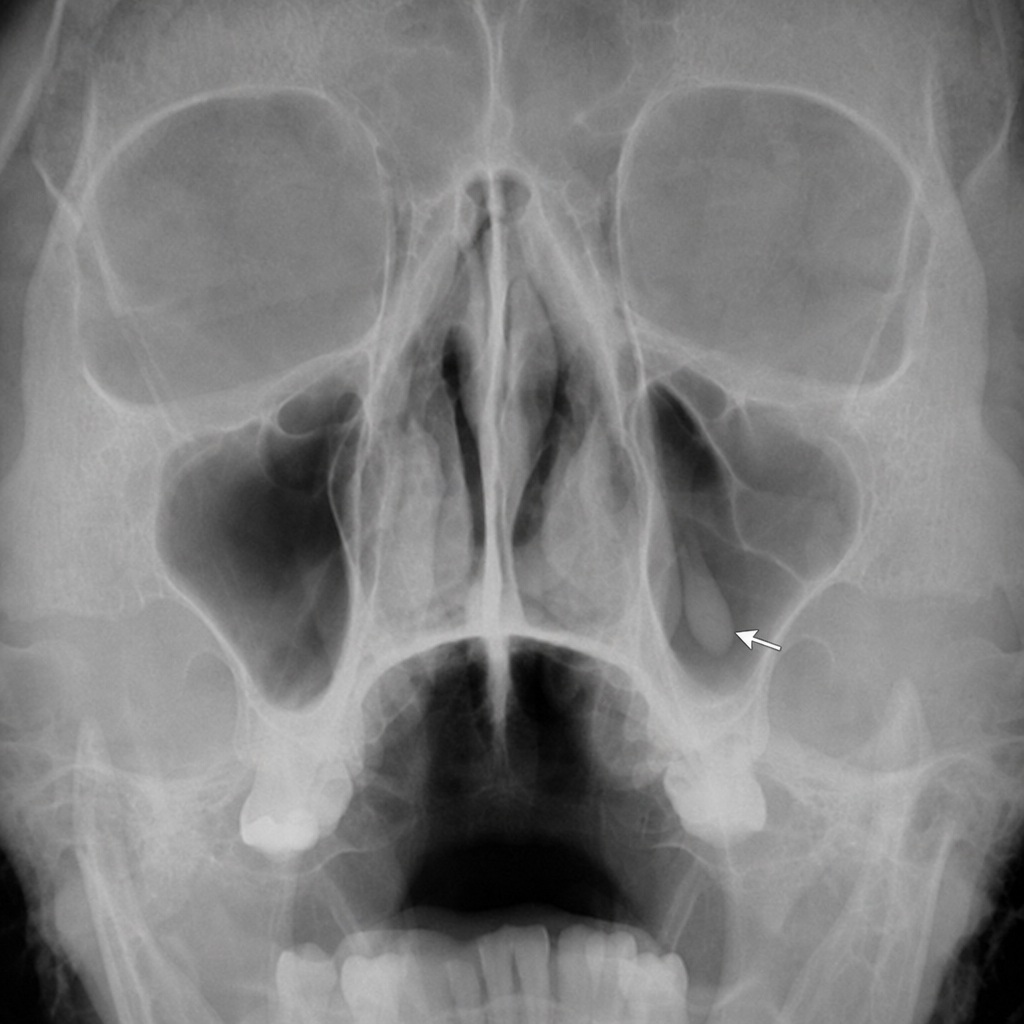
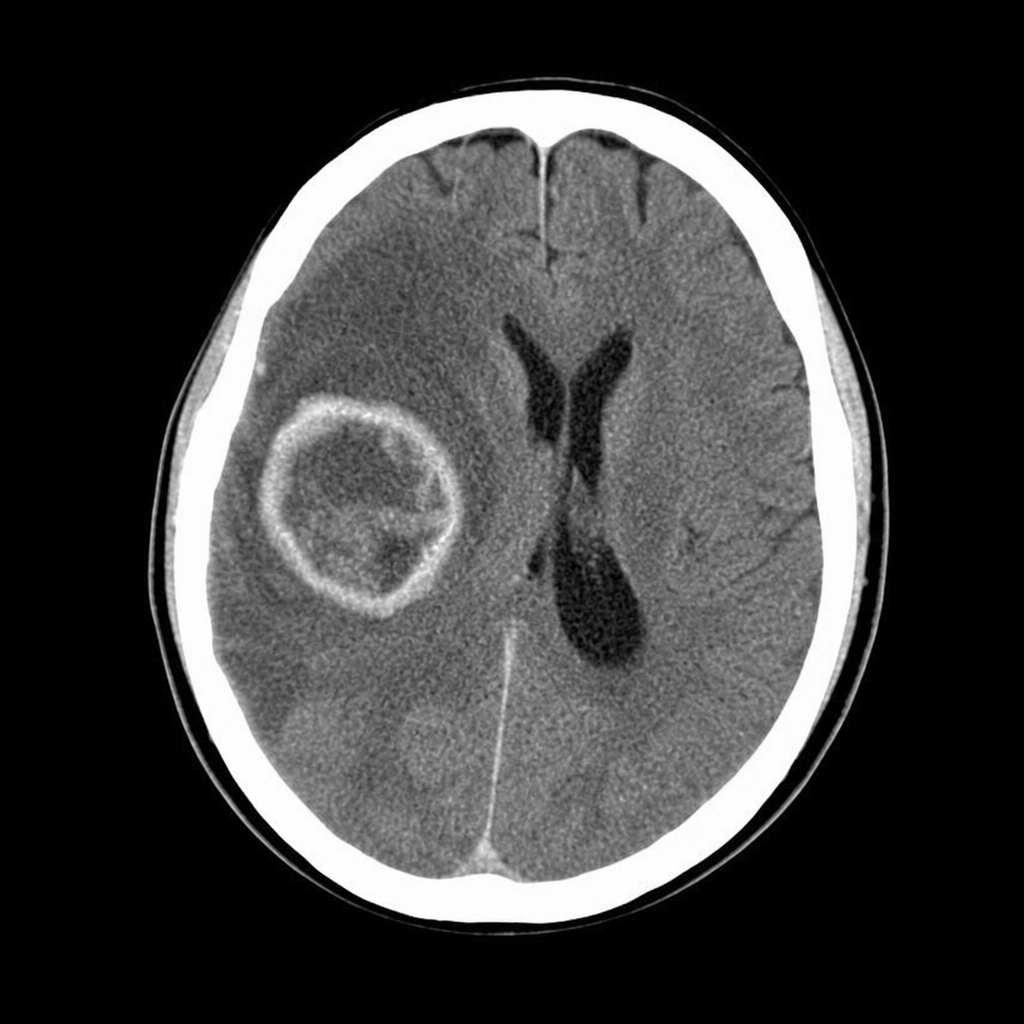
A patient presents with fever and a rim-enhancing lesion with an air-fluid level on brain CT. What is the most likely diagnosis?
Not a feature of berry aneurysm on CT angiogram
Most specific finding of acute stroke on CT
Best imaging modality for acoustic neuroma screening
What is the typical MRI finding in multiple sclerosis (MS)?
Explanation: ***Gd enhanced MRI*** - **Gadolinium-enhanced MRI** is the investigation of choice for **leptomeningeal carcinomatosis** as it can visualize the subtle nodular or linear enhancement along the leptomeninges, indicating tumor dissemination. - It offers superior **soft tissue contrast** and spatial resolution compared to CT, enabling detection of small lesions and accurate mapping of disease extent. *CT scan* - A **CT scan** has limited sensitivity for detecting leptomeningeal involvement due to poor contrast resolution of soft tissues and the dura/arachnoid spaces. - It might show hydrocephalus or large tumor deposits, but subtle leptomeningeal enhancement is often missed. *SPECT* - **Single photon emission computed tomography (SPECT)** is primarily used for functional imaging and is not the investigation of choice for anatomical visualization of leptomeningeal carcinomatosis. - Its resolution is too low to detect the fine structural changes associated with leptomeningeal spread. *PET* - **Positron emission tomography (PET)**, often combined with CT, identifies metabolically active tumor cells and can detect diffuse metastatic disease. - While useful for overall cancer staging and identifying primary lesions, it is less effective than gadolinium-enhanced MRI for directly visualizing the morphology and enhancement patterns of leptomeningeal carcinomatosis due to limited spatial resolution in the CSF spaces.
Explanation: ***MR imaging*** - The **Time of Flight (TOF)** technique is a type of **magnetic resonance angiography (MRA)** that exploits the phenomenon of **flow-related enhancement** of fresh, unsaturated blood entering an imaging slice. - It is used to visualize blood flow without the need for an external contrast agent, making it particularly useful for assessing vessels in the brain and neck. *Spiral CT* - **Spiral CT** (helical CT) involves continuous data acquisition as the patient moves through the gantry, creating a spiral path of X-ray projection data. - While it has revolutionised CT angiography, it does not employ the Time of Flight principle, which is specific to MR imaging. *Digital radiography* - **Digital radiography** uses X-rays to create images, which are captured by digital sensors rather than photographic film. - This technique primarily focuses on structural imaging and does not involve the physical principles (like spin physics of protons in a magnetic field) necessary for Time of Flight applications. *CT angiography* - **CT angiography** uses **iodinated contrast material** injected intravenously to visualize blood vessels with high resolution using X-rays. - Unlike Time of Flight MRA, it relies on the contrast enhancement of flowing blood with an exogenous agent, not on the intrinsic properties of blood flow within a magnetic field.
Explanation: ***Craniopharyngioma*** * **Craniopharyngiomas** are the most common cause of a mixed cystic and solid suprasellar mass in children, often presenting with calcifications. * These tumors typically arise from Rathke's pouch remnants and can cause symptoms related to **pituitary dysfunction** and **visual field defects**. *Optic chiasma glioma* * **Optic chiasma gliomas** usually present as solid masses, although they can sometimes have cystic components. * They are more commonly associated with **Neurofibromatosis type 1** and primarily cause visual symptoms. *Pituitary Adenoma* * **Pituitary adenomas** are rare in children and typically present as purely solid masses, although cystic degeneration can occur. * They are more common in adults and often cause symptoms of **hormonal overproduction** or hypopituitarism. *Germinoma* * **Germinomas** are usually solid and homogenously enhancing tumors, sometimes with small cystic areas. * They are frequently located in the **pineal region** or suprasellar region and can cause hydrocephalus or endocrine dysfunction.
Explanation: ***Banana sign*** - The **banana sign** describes the characteristic **flattening and anterior curvature** of the cerebellum, wrapping around the brainstem, which is seen in conjunction with **Chiari Malformation type II**. - This appearance is due to the **inferior displacement** of the cerebellum into the foramen magnum. *Lemon sign* - The **lemon sign** refers to the **bilateral indentation** of the frontal bones, making the fetal head appear lemon-shaped on ultrasound. - While also associated with **Chiari Malformation type II**, it describes the cranial vault shape, not the cerebellar configuration. *Tectal Beak* - The **Tectal Beak** describes a posterior displacement and pointed configuration of the **tectum** (quadrigeminal plate) due to CSF flow disruption. - This is often seen in **Chiari Malformation type II** but refers to the midbrain structure, not the cerebellum wrapping around the brainstem. *Lambda sign* - The **Lambda sign** (or twin-peak sign) is an ultrasound finding used to differentiate **dichorionic-diamniotic** twin pregnancies from monochorionic pregnancies. - It indicates the presence of a **chorionic membrane** with a triangular projection between the twins and is unrelated to Chiari malformation.
Explanation: ***FLAIR*** - **FLAIR (Fluid-Attenuated Inversion Recovery)** imaging is highly sensitive for detecting white matter lesions, especially those located juxtacortically and periventricularly, which are characteristic of demyelination. - It suppresses the signal from cerebrospinal fluid (CSF), making lesions adjacent to the ventricles or in the subarachnoid space more conspicuous by appearing hyperintense against the dark CSF. *DWI* - **DWI (Diffusion-Weighted Imaging)** is primarily used to detect acute ischemic stroke by showing restricted diffusion, which is not the primary feature of demyelination. - While some white matter lesions may show subtle DWI changes, it is not the best sequence for initial detection or characterization of demyelinating plaques. *T1W* - **T1-weighted (T1W)** images are excellent for anatomical detail and can show atrophy or "black holes" (areas of permanent axonal loss) in chronic demyelination, but they are less sensitive for primary lesion detection than FLAIR. - Acute demyelinating lesions are often isointense or mildly hypointense on T1W, making them difficult to distinguish without contrast enhancement. *GRE* - **GRE (Gradient Echo)** sequences are very sensitive to blood products (e.g., hemorrhage) and iron deposition, often used for microbleeds and certain types of vascular malformations. - It has limited utility in directly visualizing or characterizing white matter demyelination, which typically does not involve significant blood products or iron in its acute phase.
Explanation: ***Brain abscess*** - The presence of **fever** points towards an infectious etiology, and a **rim-enhancing lesion with an air-fluid level** on CT is highly characteristic of a brain abscess. The air-fluid level suggests gas-forming organisms or communication with an air-containing structure like a paranasal sinus. - An abscess is a collection of pus, and the "rim-enhancement" indicates the inflammatory capsule surrounding the infection, while the **air-fluid level** is virtually pathognomonic for an abscess containing gas. *Glioblastoma* - While glioblastoma can be a **rim-enhancing lesion**, it is a primary brain tumor and typically does not present with **fever** or an **air-fluid level**. - It often shows **irregular, thick enhancement** and typically causes significant surrounding edema, but the key differentiating factors here are the fever and air-fluid level. *Metastasis* - Brain metastases often present as **multiple, rim-enhancing lesions**, but they are tumors and do not typically cause **fever** (unless very large with extensive necrosis) or exhibit **air-fluid levels**. - The clinical context (e.g., history of cancer) would be important for metastasis, but the **air-fluid level** strongly differentiates this case. *Tuberculoma* - A tuberculoma is a **granulomatous lesion** that can also show **rim enhancement**, especially with central caseous necrosis. However, it typically does not present with an **air-fluid level**. - While fever can be present in tuberculosis, the **air-fluid level** is the most discriminating feature pointing away from tuberculoma and towards an abscess.
Explanation: ***Peripheral location*** - **Berry aneurysms** are typically located at arterial bifurcations, often in the **Circle of Willis**, making them central rather than peripheral. - Their rupture leads to **subarachnoid hemorrhage**, which usually originates from these central locations. *Saccular shape* - The term "berry aneurysm" itself refers to their characteristic **saccular, sac-like shape**, distinguishing them from fusiform aneurysms. - This morphology is a key diagnostic feature seen on **CT angiography**. *Enhancement* - During **CT angiography**, the contrast material within the aneurysm lumen will enhance, clearly delineating its borders and size. - This enhancement is crucial for visualizing the aneurysm and identifying potential rupture. *Calcification* - While less common than in other types of aneurysms, **calcification of the aneurysm wall** can occur, particularly in older, unruptured aneurysms. - This calcification can be seen on non-contrast CT scans and sometimes implies chronicity.
Explanation: ***Hyperdense MCA sign*** - The **hyperdense middle cerebral artery (MCA) sign** is a direct visualization of a **thrombus** within the MCA, making it highly specific for an acute ischemic stroke caused by large vessel occlusion. - This sign indicates an acute arterial occlusion, which is key to early diagnosis and determining eligibility for **thrombolytic therapy**. *Sulcal effacement* - **Sulcal effacement** (loss of the normal grooves in the brain surface) may be an early sign of **brain edema** secondary to ischemia. - However, it is a non-specific finding and can be seen in other conditions causing brain swelling, such as trauma or infection. *Mass effect* - **Mass effect**, such as midline shift or effacement of ventricles, typically occurs later in the course of a large ischemic stroke due to significant edema. - In the acute phase, especially within the first few hours, mass effect is usually not evident, and its presence might suggest a different pathology or a more advanced stroke. *Loss of gray-white differentiation* - **Loss of gray-white differentiation** is an indirect sign of early cerebral ischemia, reflecting developing cytotoxic edema in the affected brain tissue. - While an important early indicator, it is less specific than the hyperdense MCA sign, as various acute brain injuries can cause similar changes.
Explanation: ***MRI with gadolinium*** - **Magnetic Resonance Imaging (MRI) with gadolinium contrast** is the gold standard for acoustic neuroma (vestibular schwannoma) detection due to its superior soft tissue resolution. - It effectively visualizes **small tumors** arising from the vestibular nerve within the internal auditory canal and cerebellopontine angle. *Nuclear scan* - **Nuclear scans** are generally used for assessing metabolic activity or specific tissue uptake, such as in oncology for metastasis detection or thyroid conditions. - They lack the **anatomical detail and resolution** needed to visualize small intracranial tumors like acoustic neuromas. *CT temporal bone* - **CT scans of the temporal bone** are excellent for evaluating bony structures, such as fractures or erosion of the internal auditory canal. - However, they have **limited sensitivity for soft tissue masses** and can miss small acoustic neuromas. *Plain skull X-ray* - **Plain skull X-rays** provide very limited information about soft tissues and are not useful for screening or diagnosing acoustic neuromas. - They mainly visualize **gross bony abnormalities** and cannot detect subtle pathologies within the internal auditory canal or cerebellopontine angle.
Explanation: ***Periventricular lesions*** - **Demyelinating plaques** in a periventricular distribution are a hallmark MRI finding in **multiple sclerosis**, often appearing as **Dawson's fingers**. - These lesions reflect areas of **demyelination** and inflammation characteristic of the disease. *Basal ganglia calcification* - This finding is more commonly associated with conditions like **Fahr's disease**, **hypoparathyroidism**, or certain infections, not primary to MS. - While calcifications can occur in rare cases of MS, they are not a typical or diagnostic feature. *Diffuse cortical atrophy* - **Cortical atrophy** can be present in later stages of MS, but it is a **non-specific** finding not unique to MS and not a primary diagnostic marker. - It is more commonly seen in neurodegenerative diseases like **Alzheimer's disease** or in the elderly, and less characteristic of early MS. *Subdural hematoma* - A **subdural hematoma** is a collection of blood between the dura mater and arachnoid mater, usually due to trauma. - This is an **acute neurological emergency** and entirely unrelated to the pathology and typical MRI features of multiple sclerosis.
Neuroanatomy for Radiologists
Practice Questions
Cerebrovascular Diseases
Practice Questions
Intracranial Tumors
Practice Questions
CNS Infections
Practice Questions
Demyelinating and Degenerative Diseases
Practice Questions
Head Trauma Imaging
Practice Questions
Spine Imaging: Trauma and Degenerative Disease
Practice Questions
Spine Tumors and Infections
Practice Questions
Pediatric Neuroradiology
Practice Questions
Congenital CNS Anomalies
Practice Questions
Functional Neuroimaging
Practice Questions
Neurointerventional Procedures
Practice Questions
Get full access to all questions, explanations, and performance tracking.
Start For Free