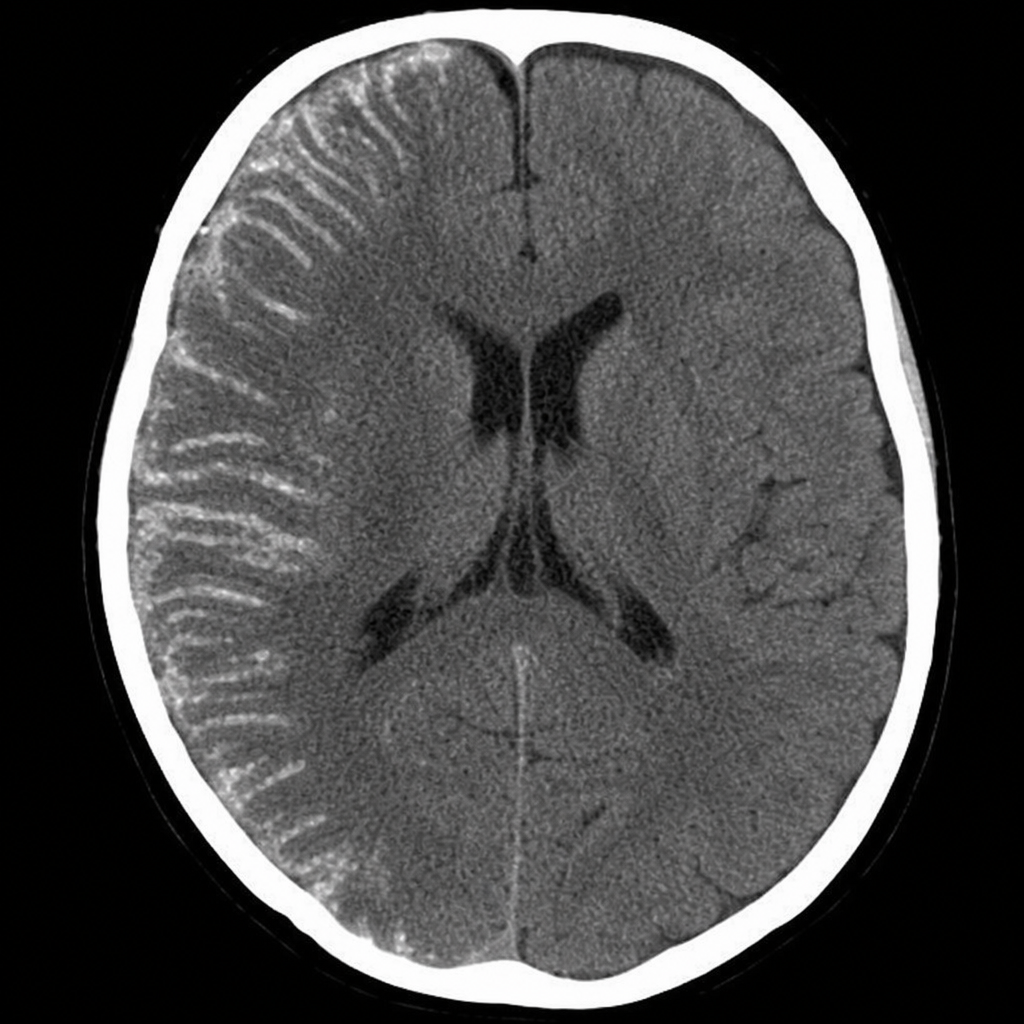
Which of the following is not true about non-contrast CT scan in head injury?
Shape of extradural hematoma on NCCT is?
A 32-year-old woman is evaluated in the clinic for symptoms of polyuria and polydipsia. She has no significant past medical history and her only medication is the oral contraceptive pill. Her physical examination is entirely normal. Urine and serum biochemistry investigations are suggestive of central diabetes insipidus (DI). Which of the following is the most likely finding on magnetic resonance imaging (MRI) of the brain?
A middle aged female presents with prolonged history of back pain followed by slowly progressive weakness of both lower limbs, spasticity and recent onset difficulty in micturation. On neurological examination there is evidence of dorsal myelopathy. MRI scan of spine shows a well-defined mid-dorsal intradural homogenous contrast enhancing mass lesion. The likely diagnosis is:
Which one of the following is the most preferred route to perform cerebral angiography?
The characteristic feature of Lhermitte-Duclos disease is:
The investigation of choice for vestibular schwannoma is
Dawson's fingers are seen in -
A 45-year-old female complains of progressive lower limb weakness, spasticity, and urinary hesitancy. MRI shows an intradural enhancing mass lesion in the spinal cord. MOST likely diagnosis is:
Corpus callosum involvement on MRI is usually seen in which of the following conditions?
Explanation: ***Subdural hematoma increases in density on serial CT scans over weeks*** - A **subdural hematoma (SDH)** typically **decreases in density** over weeks due to clot lysis and absorption of its proteinaceous components, transitioning from hyperdense (acute) to isodense (subacute) and then hypodense (chronic). - An increase in density on serial CT scans would imply continued bleeding or re-hemorrhage, which is not the typical natural progression of an acute SDH. *Extradural hematomas are usually lens-shaped* - **Extradural hematomas (EDH)** are typically **biconvex** or **lens-shaped** because they accumulate in the epidural space and are limited by cranial sutures where the dura is tightly adhered to the skull. - This characteristic shape helps distinguish them from subdural hematomas. *Acute subdural hematoma appears as crescent shadow of increased density* - An **acute subdural hematoma (SDH)** appears as a **crescent or crescent-shaped shadow** of increased density (hyperdense) on a non-contrast CT scan because it spreads along the inner surface of the dura, conforming to the brain's convexity. - This indicates active bleeding that is relatively fresh, usually within the first 3-7 days. *Subarachnoid hemorrhage appears as areas of increased density in basilar cisterns* - **Subarachnoid hemorrhage (SAH)** manifests as areas of **increased density (hyperdensity)** within the **basilar cisterns**, Sylvian fissures, or sulci, due to blood filling these cerebrospinal fluid (CSF)-containing spaces. - This finding is a key indicator of SAH on non-contrast CT.
Explanation: ***Lens shaped*** - An **extradural hematoma** (EDH) appears **biconvex** or **lens-shaped** because it is limited by the cranial sutures, where the dura mater is tightly attached to the inner table of the skull. - This characteristic shape helps differentiate it from other intracranial hemorrhages on **non-contrast CT (NCCT)** scans. *Bean shaped* - While descriptive, "bean-shaped" is not the standard or most accurate descriptor for an EDH, which is typically more organized and sharply delineated due to its confinement. - This term might be loosely applied to other lesions but lacks the precision needed for a confident diagnosis of EDH. *Crescent shaped* - A **crescent shape** is characteristic of a **subdural hematoma (SDH)**, which spreads more freely over the brain surface as it is located between the dura and arachnoid mater, not limited by sutures. - This shape indicates bleeding across suture lines, a key differentiator from EDH. *Medially concave* - This describes the typical appearance of a **subdural hematoma** (SDH), where the collection of blood conforms to the curvature of the brain surface and can extend across suture lines. - An EDH is typically **convex** towards the brain parenchyma because of the dura's adherence to the skull at the sutures.
Explanation: ***lack of hyperintense signals from the posterior pituitary*** - In **central diabetes insipidus**, there is a deficiency in **vasopressin (ADH)** production or release from the posterior pituitary. - The normal **hyperintense signal** from the posterior pituitary on T1-weighted MRI is due to stored ADH-neurophysin granules; its absence suggests depleted ADH stores, consistent with central DI. *agenesis of the corpus callosum* - **Agenesis of the corpus callosum** is a congenital malformation characterized by the partial or complete absence of the corpus callosum, the main commissural pathway connecting the cerebral hemispheres. - This condition is typically associated with neurological symptoms such as seizures or developmental delays, and is **not directly linked** to the pathophysiology of diabetes insipidus. *hyperintense signals in the cerebral cortex* - **Hyperintense signals in the cerebral cortex** on MRI can indicate various pathologies like inflammation, ischemia, or demyelination. - These findings are **non-specific** and would typically point towards neurological conditions affecting brain tissue, not specifically the endocrine dysfunction seen in central DI. *hypothalamic tumor* - A **hypothalamic tumor** could indeed cause central DI by damaging the cells responsible for ADH production or the supraopticohypophysial tract. - However, the question asks for the **most likely finding** specifically related to the posterior pituitary's appearance in central DI, which is the absence of its normal hyperintensity due to ADH depletion. While a tumor is a cause, the direct consequence visible on MRI due to ADH deficiency is the lack of posterior pituitary bright spot.
Explanation: ***Spinal meningioma*** - This diagnosis fits the profile of a **middle-aged female** with a **slowly progressive dorsal myelopathy**, including **spasticity** and **urinary dysfunction**, as meningiomas are common in this demographic. - The MRI finding of a **well-defined, mid-dorsal, intradural, homogenous, contrast-enhancing mass** is highly characteristic of a spinal meningioma. *Dermoid cyst* - Dermoid cysts are typically **congenital lesions** and often present earlier in life with symptoms like **tethered cord syndrome** or related cutaneous stigmata. - While intradural, they usually present as **non-enhancing lesions** on MRI, unless there's an associated rupture or inflammatory reaction. *Epidermoid cyst* - Epidermoid cysts are also usually **congenital** and less common in the dorsal spine as primary lesions; their progression is often more indolent with less overt myelopathic signs early on. - On MRI, epidermoid cysts appear as **non-enhancing lesions** with signal characteristics similar to cerebrospinal fluid (CSF), distinguishing them from enhancing masses. *Intradural Lipoma* - Intradural lipomas are typically **congenital spinal lesions** often associated with **dysraphic states** and usually diagnosed in childhood. - They appear as **fat-containing lesions** on MRI, showing characteristic high signal intensity on T1-weighted images and signal suppression on fat-saturated sequences, and generally **do not show significant contrast enhancement**.
Explanation: **Transfemoral route (Correct Answer)** - The **transfemoral** route is the **most preferred** and widely used method for cerebral angiography due to its **safety**, ease of access, and lower complication rates. - It allows for the safe cannulation of **cerebral vessels** using a catheter inserted into the **femoral artery** and advanced up to the aortic arch. - This is the **gold standard approach** (Seldinger technique) for diagnostic and interventional cerebral angiography. *Direct carotid puncture (Incorrect)* - This method is more invasive and carries a higher risk of complications, such as **hematoma**, **stroke**, or **carotid artery dissection**. - It is typically reserved for cases where other routes are inaccessible or when very specific and localized imaging is required. - Largely of **historical significance** now that safer endovascular techniques are available. *Transaxillary route (Incorrect)* - The **transaxillary** route is an alternative but carries a higher risk of complications like **brachial plexus injury** and **bleeding** compared to the transfemoral approach. - It may be considered when the femoral access is not feasible, for example, in patients with severe peripheral vascular disease affecting the femoral arteries. *Transbrachial route (Incorrect)* - The **transbrachial** (or **transradial**) route is also an alternative but is generally less preferred due to the risk of **radial or brachial artery spasm** or damage, and it can be technically more challenging. - This route is typically avoided if possible, especially when the transfemoral route is readily available and safe. - May be considered in patients with severe aortoiliac disease or morbid obesity.
Explanation: ***Thickened cerebellar folia*** - **Lhermitte-Duclos disease**, also known as **dysplastic gangliocytoma of the cerebellum**, is characterized by a **hamartomatous overgrowth** of the granular layer of the cerebellum. - This overgrowth leads to **thickened, abnormal cerebellar folia** that can exert mass effect on surrounding structures. *Atrophic cerebellar folia* - **Cerebellar atrophy** involves the loss of cerebellar tissue, resulting in **thinned or shrunken folia**, which is the opposite of Lhermitte-Duclos disease. - Atrophy is typically seen in neurodegenerative conditions, chronic alcohol abuse, or certain genetic disorders. *Septum pellucidum agenesis* - **Septum pellucidum agenesis** is the absence of the septum pellucidum, a thin membrane separating the lateral ventricles, and is associated with conditions like **septo-optic dysplasia** or certain chromosome abnormalities. - This is a structural anomaly of the forebrain, **unrelated to cerebellar pathology** like Lhermitte-Duclos disease. *Vermian hypoplasia* - **Vermian hypoplasia** refers to the **underdevelopment of the cerebellar vermis**, a central part of the cerebellum, often seen in conditions like **Dandy-Walker malformation** or Joubert syndrome. - While it affects cerebellar development, it is primarily a **volume reduction** rather than a specific dysplastic overgrowth of the folia.
Explanation: ***Gadolinium enhanced MRI*** - **Gadolinium-enhanced MRI** is the gold standard due to its superior spatial resolution for soft tissues, allowing for clear visualization of the tumor within the **internal auditory canal** and **cerebellopontine angle**. - It effectively detects even small **vestibular schwannomas**, which are typically missed by other imaging modalities. *PET scan* - **PET scans** are primarily used for assessing metabolic activity in tumors and are more relevant for distinguishing between benign and malignant lesions, or for staging cancer, rather than purely anatomical localization of a **vestibular schwannoma**. - Its resolution is often insufficient to precisely delineate small lesions in the **internal auditory canal**. *SPECT* - **SPECT** uses gamma-ray emitting radiotracers and is more commonly employed in nuclear medicine for functional imaging of organs or to assess blood flow, particularly in cardiac or neurological conditions like epilepsy, rather than for detailed anatomical imaging of tumors such as **vestibular schwannomas**. - Its spatial resolution is generally lower than MRI, making it less suitable for detecting small lesions in complex anatomical regions. *Contrast enhanced CT scan* - While a **contrast-enhanced CT scan** can show larger tumors and bony erosion, its soft tissue contrast is inferior to MRI, which means it may miss smaller **vestibular schwannomas**. - It also exposes the patient to **ionizing radiation**, and its primary role in vestibular schwannoma detection is often limited to cases where MRI is contraindicated.
Explanation: ***Multiple sclerosis*** - **Dawson's fingers** are a characteristic imaging finding in **multiple sclerosis (MS)**, seen as finger-like demyelinating lesions radiating perpendicularly from the corpus callosum on MRI. - These lesions represent perivenular inflammation and demyelination, a hallmark of **MS pathology**. *Multiple myeloma* - This is a **hematological malignancy** characterized by the proliferation of plasma cells in the bone marrow, leading to bone lesions, renal failure, and hypercalcemia. - It does not involve demyelinating lesions in the brain and therefore would not show Dawson's fingers on imaging. *SACD* - **Subacute combined degeneration (SACD)** is primarily caused by **vitamin B12 deficiency**, affecting the posterior and lateral columns of the spinal cord and peripheral nerves. - While it causes neurological symptoms, it does not involve brain demyelination in the pattern of Dawson's fingers. *Friedreich's ataxia* - This is a **hereditary neurodegenerative disorder** primarily affecting the spinal cord, cerebellum, and peripheral nerves, leading to ataxia, dysarthria, and scoliosis. - It is not characterized by demyelinating brain lesions and therefore would not present with Dawson's fingers.
Explanation: ***Meningioma*** - Intradural enhancing mass lesion in the **spinal cord** with progressive neurological symptoms like **lower limb weakness**, **spasticity**, and **urinary hesitancy** are highly suggestive of a **spinal meningioma**, which is the most common intradural extramedullary tumor in middle-aged females. - Meningiomas are typically **dural-based tumors** that enhance homogeneously with contrast on MRI and cause spinal cord compression. *Intradural lipoma* - Intradural lipomas are typically **non-enhancing** lesions on MRI, composed of fat with high T1 signal intensity. - They are often congenital and may not present with such acute, progressive neurological deficits. - They do not show contrast enhancement. *Neuroepithelial cyst* - Neuroepithelial cysts, such as **arachnoid cysts**, are typically **non-enhancing** and follow cerebrospinal fluid (CSF) signal intensity on MRI. - They rarely present as an enhancing mass and are more likely to be asymptomatic or cause symptoms due to mass effect without enhancement. *Dermoid cyst* - Dermoid cysts are typically **non-enhancing** lesions that contain **fatty components** and other ectodermal derivatives. - While they can cause neurological symptoms due to mass effect, they do not present as an enhancing lesion on MRI. - They show restricted diffusion and may have a chemical meningitis if ruptured.
Explanation: ***Butterfly glioblastoma*** - This is a highly malignant brain tumor (WHO Grade IV) that characteristically **crosses the corpus callosum**, allowing it to spread across both cerebral hemispheres, creating a **butterfly-like appearance** on MRI. - The corpus callosum acts as a pathway for tumor spread, leading to bilateral neurological deficits. - This is the **classic and most characteristic** imaging finding associated with corpus callosum involvement. *SSPE (Subacute Sclerosing Panencephalitis)* - SSPE is a rare, progressive brain disorder caused by persistent measles virus infection. - While advanced stages may show periventricular and corpus callosum lesions, the **more characteristic findings** are diffuse white matter T2/FLAIR hyperintensities in the parietotemporal and occipital regions. - Corpus callosum involvement is not the primary or most specific feature. *Phytanic acid deficiency (Refsum disease)* - This is a rare peroxisomal disorder characterized by accumulation of phytanic acid. - MRI typically shows **cerebellar atrophy** and nonspecific white matter changes. - **Corpus callosum is typically spared** in Refsum disease. *Krabbe's disease* - This is a galactocerebrosidase deficiency causing leukodystrophy. - While Krabbe's disease can involve the corpus callosum (particularly the splenium), the **more characteristic and earlier findings** involve the **cerebellar white matter, corona radiata, thalami, and pyramidal tracts**. - Butterfly glioblastoma remains the **most specific** and **most classic** condition associated with corpus callosum involvement on MRI.
Neuroanatomy for Radiologists
Practice Questions
Cerebrovascular Diseases
Practice Questions
Intracranial Tumors
Practice Questions
CNS Infections
Practice Questions
Demyelinating and Degenerative Diseases
Practice Questions
Head Trauma Imaging
Practice Questions
Spine Imaging: Trauma and Degenerative Disease
Practice Questions
Spine Tumors and Infections
Practice Questions
Pediatric Neuroradiology
Practice Questions
Congenital CNS Anomalies
Practice Questions
Functional Neuroimaging
Practice Questions
Neurointerventional Procedures
Practice Questions
Get full access to all questions, explanations, and performance tracking.
Start For Free