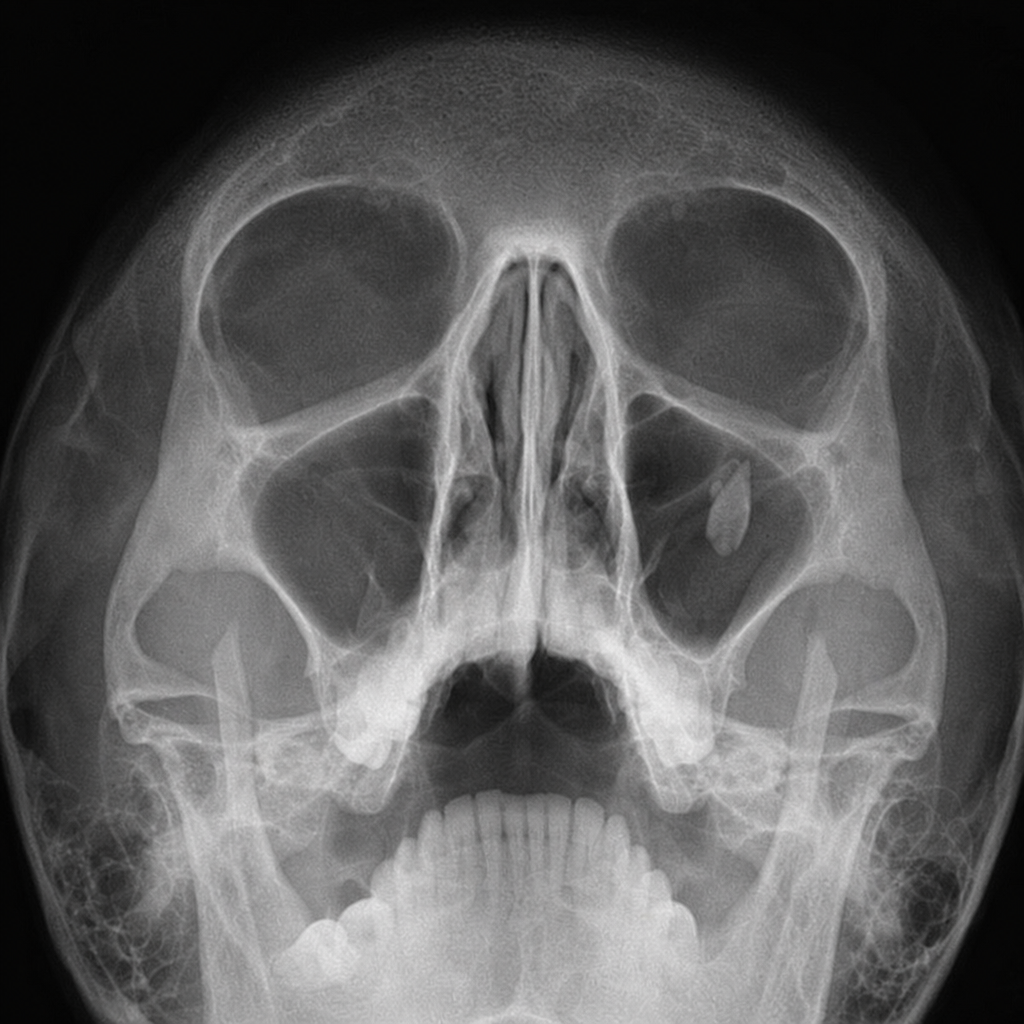
An MRI brain shows 'molar tooth sign' in the posterior fossa. This radiological finding is pathognomonic for which condition?
An MRI shows 'eye of the tiger' sign in basal ganglia. Which pathological finding would confirm pantothenate kinase-associated neurodegeneration?
A brain MRI shows 'hot cross bun' sign in pons. Which additional finding would best support the diagnosis of multiple system atrophy?
An MRI brain shows 'pencil shavings' appearance in the corpus callosum. Which additional finding would best support the diagnosis of multiple sclerosis?
What is the investigation of choice for diagnosing subarachnoid hemorrhage (SAH)?
Investigation of choice in cerebral abscess is -
Shape of post traumatic Epidural hematoma is
First sign of hydrocephalus in children is:
Which of the following investigations is contraindicated in patients with metallic foreign body?
A leukemia patient who has undergone multiple courses of chemotherapy develops herpes simplex encephalitis. Which of the following would you expect a CT scan of the patient's brain to show?
Explanation: ***Molar tooth sign - Joubert syndrome*** - The **molar tooth sign** on MRI, characterized by elongated superior cerebellar peduncles and an abnormally deep interpeduncular fossa, is the **pathognomonic diagnostic feature** for **Joubert syndrome**. - It signifies cerebellar vermis hypoplasia/aplasia and abnormal brainstem configuration, leading to the clinical manifestations of **ataxia**, **oculomotor apraxia**, **hyperpnea/apnea episodes**, and **developmental delay** seen in Joubert syndrome. - Additional MRI features include **bat wing configuration of the 4th ventricle** and **thick, horizontal superior cerebellar peduncles**. *Lemon sign - Chiari II malformation* - The **lemon sign** refers to the bitemporal indentation of the fetal skull on ultrasound, often associated with **spina bifida** and **Chiari II malformation**. - It indicates cranial deformity due to reduced intracranial pressure from open neural tube defects, not related to Joubert syndrome. *Banana sign - Chiari II malformation* - The **banana sign** describes the characteristic curved shape of the cerebellum on fetal ultrasound when the posterior fossa is effaced due to **Chiari II malformation**. - This flattening and anterior displacement of the cerebellum is associated particularly with **myelomeningocele**, and is not a feature of Joubert syndrome. *Baseball cap sign - Holoprosencephaly* - The **baseball cap sign** is a neuroimaging finding seen in **holoprosencephaly**, particularly the semi-lobar or lobar forms, where the **frontal horns of the lateral ventricles appear fused or closely apposed**. - This finding indicates severe forebrain malformation and midline fusion defects, not characteristic of Joubert syndrome.
Explanation: ***Iron deposits*** - **Pantothenate kinase-associated neurodegeneration (PKAN)** is characterized by abnormal **iron accumulation** in the basal ganglia, particularly the globus pallidus. - The "eye of the tiger" sign on MRI is a classic radiologic feature of PKAN, reflecting specific patterns of iron deposition in the **globus pallidus**. *Neurofibrillary tangles* - **Neurofibrillary tangles** are a hallmark pathological feature of **Alzheimer's disease** and other tauopathies, not PKAN. - They consist of hyperphosphorylated **tau protein** and are found intracellularly within neurons. *Lewy bodies* - **Lewy bodies** are abnormal aggregates of protein, primarily **alpha-synuclein**, found in the brains of individuals with **Parkinson's disease** and **Lewy body dementia**. - They are distinct from the iron accumulation seen in PKAN. *Calcium deposits* - While **calcium deposits** can occur in the brain in various conditions (e.g., Fahr's disease), they are not the primary or defining pathological finding in **PKAN**. - PKAN is specifically linked to dysfunctional **pantothenate kinase** leading to iron accumulation.
Explanation: ***Putaminal rim sign*** - The **putaminal rim sign** (T2 hypointensity along the lateral margin of the putamen with hyperintense signal within the putamen) is a characteristic and relatively specific finding for **multiple system atrophy (MSA)** on MRI. - Combined with the **'hot cross bun' sign** (pontine atrophy and cruciform high signal intensity on T2-weighted images), these findings are highly suggestive of MSA, reflecting the degeneration of pontocerebellar fibers and substantia nigra-striatal pathways. *Midbrain 'hummingbird' sign* - The **midbrain 'hummingbird' sign** (atrophy of the midbrain tegmentum with relative preservation of the pons) is a classic imaging feature of **progressive supranuclear palsy (PSP)**, not MSA. - This sign indicates selective atrophy in PSP affecting the midbrain, leading to a characteristic appearance on sagittal MRI. *Morning glory sign* - The **morning glory sign** refers to a congenital anomaly of the optic disc, where the optic nerve head is enlarged, excavated, and surrounded by a peripapillary glial ring. - This finding is a developmental ocular defect and is not associated with neurodegenerative conditions like multiple system atrophy. *Empty delta sign* - The **empty delta sign** is an imaging finding seen on contrast-enhanced CT or MRI of the brain, indicative of **cerebral venous sinus thrombosis**, specifically in the superior sagittal sinus. - It represents the lack of contrast within the thrombosed sinus, surrounded by enhancing dura, and is unrelated to MSA.
Explanation: ***Dawson's fingers*** - **Dawson's fingers** are ovoid lesions oriented perpendicular to the callososeptal interface, commonly visualized on MRI, and are highly characteristic of multiple sclerosis. - The "pencil shavings" appearance in the corpus callosum refers to specific lesions that, combined with Dawson's fingers, strongly indicate **demyelination** consistent with MS. *Empty delta sign* - The **empty delta sign** is a neuroimaging finding associated with **venous sinus thrombosis**, particularly in the superior sagittal sinus. - This sign indicates a thrombus filling the sinus, which is distinct from the demyelinating lesions seen in multiple sclerosis. *Hot cross bun sign* - The **hot cross bun sign** is typically observed in **multisystem atrophy (MSA)**, specifically the cerebellar type (MSA-C), on MRI. - It reflects degeneration of the pontine and cerebellar tracts, and is not a feature of multiple sclerosis. *Morning glory sign* - The **morning glory sign** is a congenital anomaly of the optic disc, characterized by an enlarged, funnel-shaped disc with a central glial tuft. - This is a developmental malformation and has no association with multiple sclerosis or its acquired demyelinating lesions.
Explanation: ***CT scan*** - A **non-contrast CT scan of the head** is the immediate investigation of choice for diagnosing SAH due to its high sensitivity for detecting fresh blood. - It can quickly identify the presence of **blood in the subarachnoid space**, especially within the first 6-12 hours after symptom onset. *Radionuclide scan* - This imaging technique uses **radioactive tracers** to evaluate organ function or blood flow. - It is **not used for acute diagnosis** of SAH, as it does not directly visualize blood in the CNS. *X-ray skull* - An **X-ray of the skull** primarily visualizes bone structures and can detect fractures or other bony abnormalities. - It is **ineffective at detecting blood** in the subarachnoid space and is not used for SAH diagnosis. *MRI* - While MRI can detect SAH, especially in subacute or chronic phases, it is **less sensitive than CT for acute SAH** due to longer acquisition times and motion artifacts. - It is often considered if CT is negative and clinical suspicion remains high, but **not as the initial investigation of choice** in an acute setting.
Explanation: ***MRI*** - **MRI with DWI (Diffusion-Weighted Imaging) and contrast** is the **investigation of choice** for cerebral abscess due to its superior sensitivity and specificity. - It can detect **early cerebritis stage** before frank abscess formation, which CT may miss. - MRI provides excellent **characterization of the abscess capsule**, showing smooth, thin, hyperintense rim on T1-weighted images with contrast. - **DWI sequences** show restricted diffusion in the pus-filled cavity (bright on DWI, dark on ADC), which helps differentiate abscess from other ring-enhancing lesions like tumors or cysts. - Superior for detecting **small or multiple abscesses**, posterior fossa lesions, and brainstem involvement. *CT Scan* - **CT with contrast** is widely used as the **initial investigation** in emergency settings due to rapid availability and ability to quickly identify ring-enhancing lesions. - It effectively shows location, size, edema, and mass effect, and is useful for surgical planning. - However, it is **less sensitive than MRI** for early-stage abscesses, small lesions, and differentiating abscess from other pathologies. *Plain X-ray* - **Plain skull X-ray** has no role in diagnosing cerebral abscesses as it cannot visualize brain parenchyma or intracranial fluid collections. - It only shows bone abnormalities or calcifications, which are not diagnostic of acute abscess. *Ultrasound* - **Transcranial ultrasound** has very limited utility in adults due to the skull barrier; it may be used in neonates through the fontanelle or for intraoperative guidance. - Cannot provide the detailed anatomical and pathological information required for diagnosis of cerebral abscess in typical clinical practice.
Explanation: ***Biconvex hyperdense*** - An **epidural hematoma** is typically shaped like a **biconvex** (lens-shaped) lesion because the blood collects between the skull and the dura mater, which is tightly adherent to the cranial sutures. - The fresh blood is **hyperdense** (bright white) on a CT scan due to its high protein content. *Biconcave hyperdense* - **Biconcave** hematomas are characteristic of **subdural hematomas**, which spread diffusely over the brain surface within the subdural space. - While acute subdural hematomas are also **hyperdense**, their shape is distinctly different from epidural hematomas. *Biconvex hypodense* - A **biconvex shape** is consistent with an epidural hematoma, but **hypodense** (darker) would suggest an older, chronic hematoma where blood products have degraded. - Acute epidural hematomas are always **hyperdense** due to fresh blood. *Biconcave hypodense* - This description aligns with a **chronic subdural hematoma**, which is typically **biconcave** (crescent-shaped) and **hypodense** due to the breakdown of blood products over time. - It does not describe an acute post-traumatic epidural hematoma.
Explanation: ***Sutural diastasis*** - In children, especially infants, the **sutures** between skull bones are not yet fused, allowing for expansion of the skull. - As intraventricular pressure increases in hydrocephalus, the **CSF** pushes outwards, causing the sutures to widen or separate, which is known as **sutural diastasis**, an early and key radiographic sign. *Thinned out vault* - This is a **later finding** in chronic hydrocephalus, occurring as sustained increased intracranial pressure remodels and thins the skull bones. - It is not the initial sign because the skull's primary response to acute pressure is to expand at the sutures. *Post clinoid erosion* - **Erosion of the posterior clinoid processes** is a sign of long-standing, increased intracranial pressure affecting the sella turcica. - This occurs **after** the initial compensatory mechanisms like sutural widening have been exhausted or are insufficient. *Large head* - While a **large head (macrocephaly)** is a prominent clinical sign of hydrocephalus in children, particularly infants, it is the **result of sutural diastasis and skull expansion**. - The radiological finding of **sutural diastasis** precedes the clinically observable significant increase in head circumference.
Explanation: ***MRI*** - Magnetic resonance imaging (MRI) uses a powerful **magnetic field** and radio waves to create detailed images of organs and tissues. - The strong magnetic field can cause **ferromagnetic metallic objects** to move, heat up, or malfunction, posing a significant safety risk. *CT Scan* - A CT scan uses **X-rays** to produce cross-sectional images of the body and is generally safe in the presence of metallic foreign bodies. - While metallic objects can cause **artifacts** (streaks or distortions) in CT images, this does not pose a direct safety risk to the patient. *VER* - **Visual Evoked Response (VER)**, also known as VEP (Visual Evoked Potential), is an electrophysiological test that measures the electrical activity of the brain in response to visual stimuli. - It does not involve strong magnetic fields or radiation and is therefore **safe** for patients with metallic foreign bodies. *ERG* - An **Electroretinogram (ERG)** measures the electrical responses of the retina to light stimulation, assessing retinal function. - It is a non-invasive test that does not use magnetic fields or X-rays and is **not contraindicated** in the presence of metallic foreign bodies.
Explanation: ***Focal edema and hemorrhagic changes selectively in the temporal and frontal lobes*** - **Herpes simplex encephalitis (HSE)** characteristically causes inflammation and damage in the **temporal and frontal lobes** due to the virus's preferential tropism for these regions. - CT scans in HSE often reveal signs of **edema**, **hemorrhage**, and sometimes **mass effect**, particularly in these specific areas. *Generalized edema and hemorrhagic changes* - While encephalitis can cause edema, **generalized edema** and widespread hemorrhagic changes are less typical for HSE, which tends to have a more **localized** presentation. - This pattern might be seen in other severe forms of encephalitis or diffuse brain injury, but it's not the hallmark of **HSE**. *Focal edema and hemorrhagic changes selectively in the brainstem* - Involvement of the **brainstem** is uncommon in typical HSE; instead, the temporal and frontal lobes are the primary targets for viral replication and inflammatory response. - Brainstem encephalitis can occur with other pathogens or autoimmune conditions, but it's not the characteristic presentation of **herpes simplex encephalitis**. *Focal edema and hemorrhagic changes selectively in the basal ganglia* - Lesions predominantly in the **basal ganglia** are not characteristic of HSE, which typically spares these deep brain structures. - Basal ganglia involvement can be seen in conditions like carbon monoxide poisoning, metabolic encephalopathies, or certain deep-seated infections, but not typically in **HSE**.
Neuroanatomy for Radiologists
Practice Questions
Cerebrovascular Diseases
Practice Questions
Intracranial Tumors
Practice Questions
CNS Infections
Practice Questions
Demyelinating and Degenerative Diseases
Practice Questions
Head Trauma Imaging
Practice Questions
Spine Imaging: Trauma and Degenerative Disease
Practice Questions
Spine Tumors and Infections
Practice Questions
Pediatric Neuroradiology
Practice Questions
Congenital CNS Anomalies
Practice Questions
Functional Neuroimaging
Practice Questions
Neurointerventional Procedures
Practice Questions
Get full access to all questions, explanations, and performance tracking.
Start For Free