A 55 year old male came with history of hoarseness of voice for which direct laryngoscopy was done and the lesion was biopsied to detect squamous cell carcinoma. He now requires investigation to detect extent of cartilage involvement, imaging of pre and paraglottic spaces and any extension to deep neck structures. Most appropriate investigation of choice will be:
Indications of computed tomography after head injury include all EXCEPT:
The term mid-line shift is associated with:
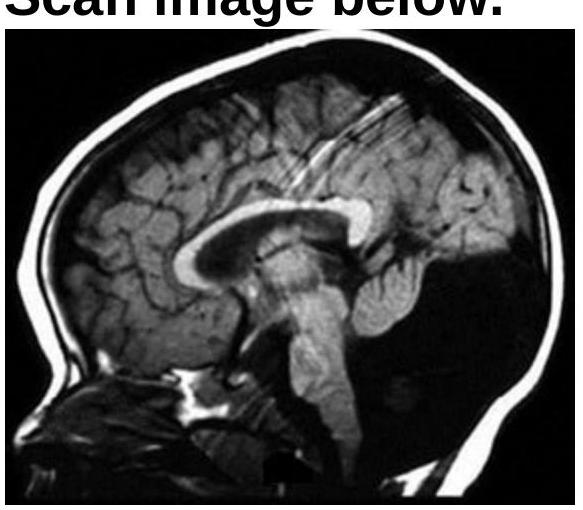
Identify the diagnosis using the MRI provided.

A 40-year-old male presents with a history of headaches, fever, and new-onset seizures. An MRI of the brain is performed, revealing a ring-enhancing lesion with central restricted diffusion on diffusion-weighted imaging (DWI). What is the most likely diagnosis?
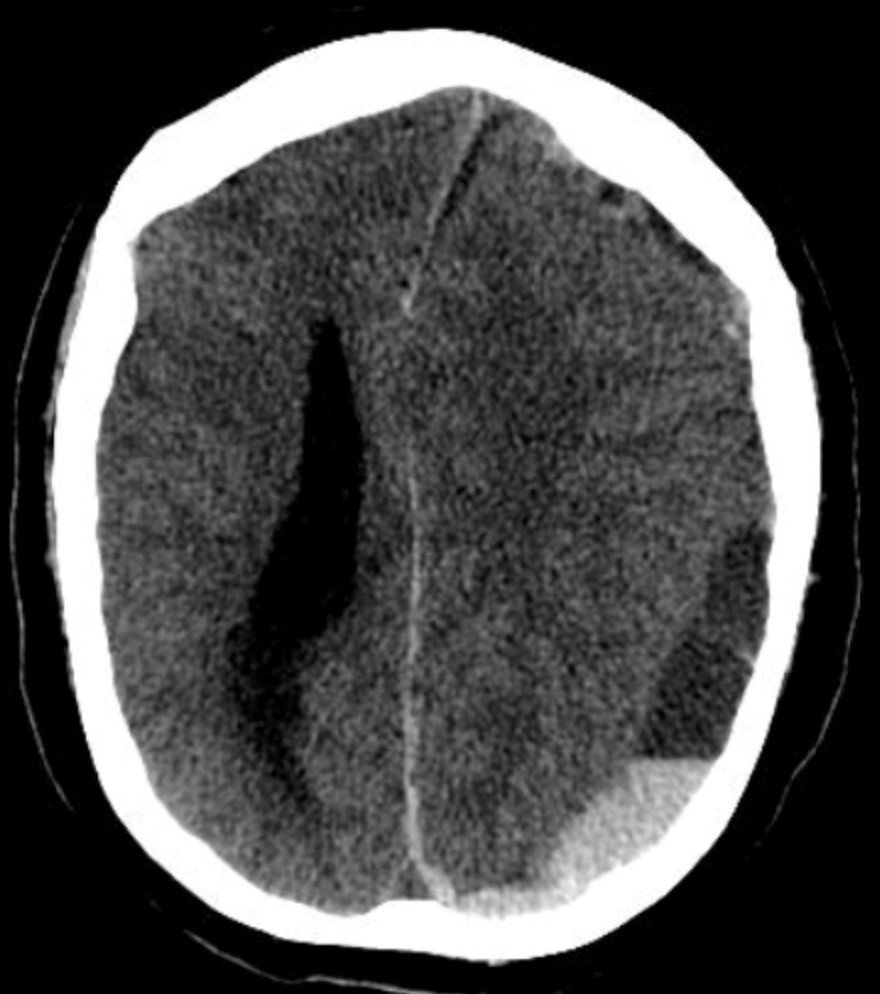
An 80-year-old male with a history of frequent falls presents with progressive headache, confusion, and mild hemiparesis over the past few weeks. A CT scan of the head is performed, and the image provided shows a crescent-shaped, hypodense collection over the left cerebral hemisphere with a slight midline shift. What is the most likely diagnosis?

A patient presents with ear discharge. The CT image is shown below. Based on the clinical presentation and imaging, what is the most likely diagnosis?

A patient with a history of chronic ear infection now presents with manifestations, including headache and vomiting. A CT brain image is shown. What is the most probable diagnosis?

Bleeding as shown in the image is due to which of the following vessels?

A cerebral angiogram shows stenosis of the terminal internal carotid arteries with an abnormal network of collateral vessels. Which finding is most characteristic of moyamoya syndrome?
Explanation: ***MRI*** - **MRI** is superior for evaluating **cartilage involvement** (especially thyroid cartilage), pre-epiglottic, and paraglottic space invasion due to its excellent **soft tissue contrast**. - It also helps in assessing **deep neck invasion**, perineural spread, and for identifying disease recurrence after radiation therapy. *CT Scan* - While CT can show bone and cartilage calcification, its ability to differentiate subtle **cartilage invasion** and **soft tissue involvement** in the pre-epiglottic and paraglottic spaces is inferior to MRI. - It involves **ionizing radiation** and may not provide as detailed information regarding the extent of soft tissue and marrow invasion. *Repeat direct laryngoscopy under general anaesthesia* - This is an **invasive procedure** primarily used for direct visualization, biopsy, and staging of superficial lesions or for therapeutic interventions. - It is not effective for evaluating the **depth of invasion** or spread to **deep neck structures**. *Endo Ultrasound* - **Endoscopic ultrasound (EUS)** is primarily used for evaluating gastrointestinal and sometimes tracheobronchial lesions for depth of invasion and nodal staging. - It is **not the primary imaging modality** for assessing the extent of laryngeal squamous cell carcinoma, especially for cartilage invasion or deep neck structures.
Explanation: ***Mild head injury in a 50-year-old man*** - This is not an absolute indication for CT scanning after head injury, especially if the patient is **neurologically intact** (GCS 15) and has no other high-risk features. - While age **> 65 years** is considered a risk factor in some guidelines (Canadian CT Head Rule), age 50 alone does not warrant CT in mild head injury (GCS 13-15) without additional warning signs. - CT would be indicated if this patient had **other risk factors** such as loss of consciousness, amnesia, vomiting, anticoagulation use, or dangerous mechanism of injury. *Open depressed fracture* - This is a **high-risk feature** indicating a severe head injury and potential for **intracranial injury** or infection, requiring immediate imaging. - CT is essential to assess the extent of **bone depression**, foreign bodies, and associated brain injury. *Glasgow Coma Scale < 13 at any point* - A GCS score below 13 signifies a **moderate to severe head injury** and is a critical indication for immediate CT to evaluate for significant intracranial pathology. - This level of altered consciousness suggests a **potential for life-threatening brain injury** that must be rapidly identified. *Amnesia > 30 minutes* - **Post-traumatic amnesia (PTA)** lasting longer than 30 minutes is a recognized risk factor for **intracranial injury**, even in patients with otherwise normal GCS scores. - It indicates a more significant impact on brain function and warrants a CT scan to rule out **structural lesions** per NICE and Canadian CT Head Rules.
Explanation: **Head injury** - **Mid-line shift** refers to the displacement of the brain's central structures, such as the septum pellucidum or pineal gland, from their normal position due to a **mass effect** from a lesion like a hematoma or edema following a head injury. - This displacement is a critical sign of increased **intracranial pressure** and can lead to herniation syndromes, indicating a severe and life-threatening condition. *Chest injury* - Chest injuries typically involve structures within the thorax, such as the lungs, heart, or rib cage. - While a tension pneumothorax can cause a **mediastinal shift** (displacement of the trachea and heart), this is distinct from a "mid-line shift" which specifically describes brain structures. *Abdominal injury* - Abdominal injuries usually affect organs like the liver, spleen, or intestines. - These injuries can cause significant internal bleeding or organ damage but do not directly lead to a "mid-line shift" of brain structures. *Limb injury* - Limb injuries involve damage to bones, muscles, ligaments, or blood vessels in the extremities. - These injuries are localized to the limbs and are not associated with any form of intracranial shift or increased intracranial pressure.
Explanation: ***Chiari type 1 malformation*** - The sagittal MRI image clearly shows the **cerebellar tonsils prolapsing below the foramen magnum** into the cervical spinal canal, which is the hallmark of a Chiari type 1 malformation. - This condition can lead to symptoms like headaches, neck pain, and neurological deficits due to compression of the brainstem and spinal cord. *Dandy-Walker malformation* - This malformation involves the **agenesis or hypoplasia of the cerebellar vermis** and persistent cystic dilation of the fourth ventricle, creating a large posterior fossa cyst. - The image does not show an enlarged posterior fossa with a cystic fourth ventricle or a severely hypoplastic vermis. *Vein of Galen malformation* - This is a **rare congenital vascular malformation** involving a direct arteriovenous shunt without an intervening capillary bed, typically presenting as an enlarged vein of Galen. - The provided image is a sagittal view demonstrating cerebellar tonsillar herniation, not a prominent or malformed vein of Galen. *Agenesis of the corpus callosum* - This condition is characterized by the **partial or complete absence of the corpus callosum**, the band of white matter connecting the two cerebral hemispheres. - On sagittal MRI, this would show absence of the corpus callosum and typically radial gyral patterns, which are not seen in this image.
Explanation: ***Brain abscess*** - A **ring-enhancing lesion** with **central restricted diffusion** on DWI is highly characteristic of a brain abscess, due to the presence of pus containing densely packed inflammatory cells and bacteria with high viscosity. - The clinical presentation of **headaches, fever**, and **new-onset seizures** is consistent with an infectious process and increased intracranial pressure. - This combination of imaging and clinical features is pathognomonic for pyogenic brain abscess. *Glioblastoma multiforme* - While GBM can present with **ring-enhancing lesions** and seizures, it typically exhibits **facilitated diffusion** (high ADC values) on DWI due to necrotic tumor core, not restricted diffusion. - GBM is a highly infiltrative tumor with extensive **vasogenic edema**. - Fever is uncommon in GBM unless there is secondary infection. *Metastatic brain tumor* - Metastatic lesions can be **ring-enhancing** and cause seizures, but **restricted diffusion** is not typical unless there is acute hemorrhage or superimposed infection. - The presence of **fever** points away from uncomplicated metastasis. - Multiple lesions at the gray-white matter junction are more typical of metastases. *Toxoplasmosis* - Toxoplasmosis in **immunocompromised individuals** (HIV/AIDS with CD4 <100) causes **multiple ring-enhancing lesions** with predilection for basal ganglia. - Restricted diffusion is **not consistently seen** with toxoplasmosis, unlike pyogenic abscesses. - The specific DWI finding of central restricted diffusion makes brain abscess the most definitive diagnosis.
Explanation: ***Chronic subdural hematoma*** - The presented CT scan shows a **crescent-shaped, hypodense collection** over the left cerebral hemisphere, which is characteristic of a chronic subdural hematoma. **Hypodensity** indicates older, liquefied blood. - The patient's age (**80-year-old** with **frequent falls**), and the **progressive symptoms** (headache, confusion, mild hemiparesis over weeks) are highly consistent with a chronic rather than acute presentation. *Acute subdural hematoma* - An acute subdural hematoma would typically present as a **hyperdense** (bright) crescent-shaped collection on CT due to fresh blood. - Symptoms would usually be more acute and severe, developing over hours to days, which does not match the "past few weeks" progression. *Epidural hematoma* - An epidural hematoma is typically **lens-shaped (biconvex)**, not crescent-shaped, and usually results from a traumatic arterial bleed. - While it can cause midline shift, its characteristic shape and often acute presentation (often with a lucid interval) differentiate it from the described scenario. *Intracerebral hemorrhage* - An intracerebral hemorrhage occurs within the brain parenchyma, appearing as a **hyperdense mass within the brain tissue** on CT, not as a collection over the cerebral hemisphere. - The symptoms would depend on the location but would not typically involve a crescent-shaped collection outside the brain parenchyma.
Explanation: ***Temporal lobe abscess*** - The CT scan shows a **ring-enhancing lesion** in the **temporal lobe**, which is characteristic of a brain abscess. - **Ear discharge** (otorrhea), particularly from otitis media, is a common predisposing factor for temporal lobe abscesses due to the proximity of the middle ear and mastoid to the temporal lobe. - Otogenic brain abscesses account for a significant proportion of intracranial complications from ear infections, with the temporal lobe being the most common location. *Extradural abscess* - An **extradural abscess** would typically be located between the dura mater and the skull, often presenting as a **lenticular or biconvex collection** displacing the dura and brain, not within the brain parenchyma as seen here. - While ear infections can lead to extradural abscesses, the imaging clearly shows an intraparenchymal lesion. *Cerebellar abscess* - A **cerebellar abscess** would be located in the cerebellum (posterior fossa), which is a different anatomical location from the lesion seen in the image (which is in the supratentorial compartment, consistent with the temporal lobe). - Although ear infections can also lead to cerebellar abscesses, the lesion's position on the CT scan does not correspond to the cerebellum. *Meningitis* - **Meningitis** is an inflammation of the meninges and typically manifests on CT as **leptomeningeal enhancement**, particularly in the sulci and basal cisterns, rather than a discrete, encapsulated mass lesion like an abscess. - While ear discharge can be associated with meningitis, the imaging findings strongly point to an abscess, not diffuse meningeal inflammation.
Explanation: ***Temporal lobe Abscess*** - The CT scan shows a **ring-enhancing lesion** with significant surrounding edema, which is characteristic of a **brain abscess**. - Given the history of a **chronic ear infection**, the temporal lobe is a common site for bacterial spread from the mastoid air cells or middle ear. *Meningitis* - Meningitis involves inflammation of the **meninges** and typically presents with diffuse changes on imaging, such as sulcal effacement or leptomeningeal enhancement, rather than a focal, encapsulated lesion. - While it can cause headache and vomiting, the CT image does not show findings typical of meningitis. *Extradural Abscess* - An extradural (or epidural) abscess is located **between the dura mater and the skull bone**. - It would typically appear as a collection outside the brain parenchyma, potentially causing mass effect but distinct from an intraparenchymal lesion seen in the image. *Cerebral Abscess* - The image does show a **cerebral abscess**, but this option is less specific than "Temporal lobe abscess." - The question asks for the **most probable diagnosis**, and combining the imaging findings with the patient's history of ear infection points to a specific location within the cerebrum.
Explanation: ***Bridging veins*** - The image depicts a **subdural hemorrhage (subdural hematoma)**, a collection of blood between the dura mater and the arachnoid mater, typically appearing as a **crescent-shaped** hyperdensity that conforms to the brain surface. - This type of hemorrhage is caused by the tearing of **bridging veins** that traverse the subdural space, connecting the cerebral cortex to the dural venous sinuses. - Tearing of these veins occurs due to rapid acceleration-deceleration forces causing the brain to move relative to the dura, stretching and rupturing the veins. This is common in **head trauma**, especially in the elderly (due to brain atrophy increasing vein vulnerability) or infants. *Lenticulostriate artery* - Rupture of the lenticulostriate arteries (perforating branches of the middle cerebral artery) typically leads to **intraparenchymal hemorrhage**, specifically in the basal ganglia or internal capsule. - This type of bleeding is confined within the brain parenchyma, rather than collecting in the subdural space as seen in the image. - Associated with hypertensive hemorrhage. *Vertebral artery* - The vertebral arteries supply the posterior circulation of the brain, and their rupture can lead to **subarachnoid hemorrhage** (if a posterior circulation aneurysm ruptures) or **intraparenchymal bleeding** in the brainstem or cerebellum. - Bleeding from the vertebral artery is not associated with the subdural collection pattern shown in the image. *Middle meningeal artery* - The middle meningeal artery runs in the epidural space, and its rupture (often due to temporal bone fracture) causes an **epidural hematoma**. - An epidural hematoma is characterized by a **biconvex (lentiform) shape** on imaging and is situated between the dura mater and the skull, which is distinct from the **crescent-shaped** subdural collection shown. - Does not cross suture lines, unlike subdural hematomas which can extend over multiple lobes.
Explanation: ***Lenticulostriate collaterals*** - Moyamoya syndrome is characterized by **stenosis or occlusion of the supraclinoid internal carotid arteries** and the development of an abnormal network of collateral vessels, particularly the **lenticulostriate arteries**, to compensate for decreased blood flow. - These collaterals appear as a "puff of smoke" or **"moyamoya" vessels** on angiography, which are distinct from the "string of beads" typically seen in fibromuscular dysplasia. *Corkscrew vessels* - **Corkscrew vessels** are not typically associated with Moyamoya syndrome but are more characteristic of other conditions like **vasculitis** or **atherosclerosis** in some contexts. - This term usually describes tortuous and dilated vessels, which differ from the specific collateral development in Moyamoya. *Serpentine collaterals* - While Moyamoya involves collateral formation, the term **"serpentine collaterals"** is a general description for tortuous vessels and not specific to the unique pathology or anatomical location of collaterals in Moyamoya. - The distinctive feature of Moyamoya is the involvement and hypertrophy of small, deep collaterals such as the lenticulostriate arteries. *Spider vessels* - **Spider vessels** (telangiectasias or spider angiomas) are cutaneous findings associated with conditions like **hepatic cirrhosis** or hereditary hemorrhagic telangiectasia, not a cerebral angiographic sign of Moyamoya syndrome. - This term refers to superficial vascular lesions composed of a central arteriole surrounded by radiating capillaries.
Neuroanatomy for Radiologists
Practice Questions
Cerebrovascular Diseases
Practice Questions
Intracranial Tumors
Practice Questions
CNS Infections
Practice Questions
Demyelinating and Degenerative Diseases
Practice Questions
Head Trauma Imaging
Practice Questions
Spine Imaging: Trauma and Degenerative Disease
Practice Questions
Spine Tumors and Infections
Practice Questions
Pediatric Neuroradiology
Practice Questions
Congenital CNS Anomalies
Practice Questions
Functional Neuroimaging
Practice Questions
Neurointerventional Procedures
Practice Questions
Get full access to all questions, explanations, and performance tracking.
Start For Free