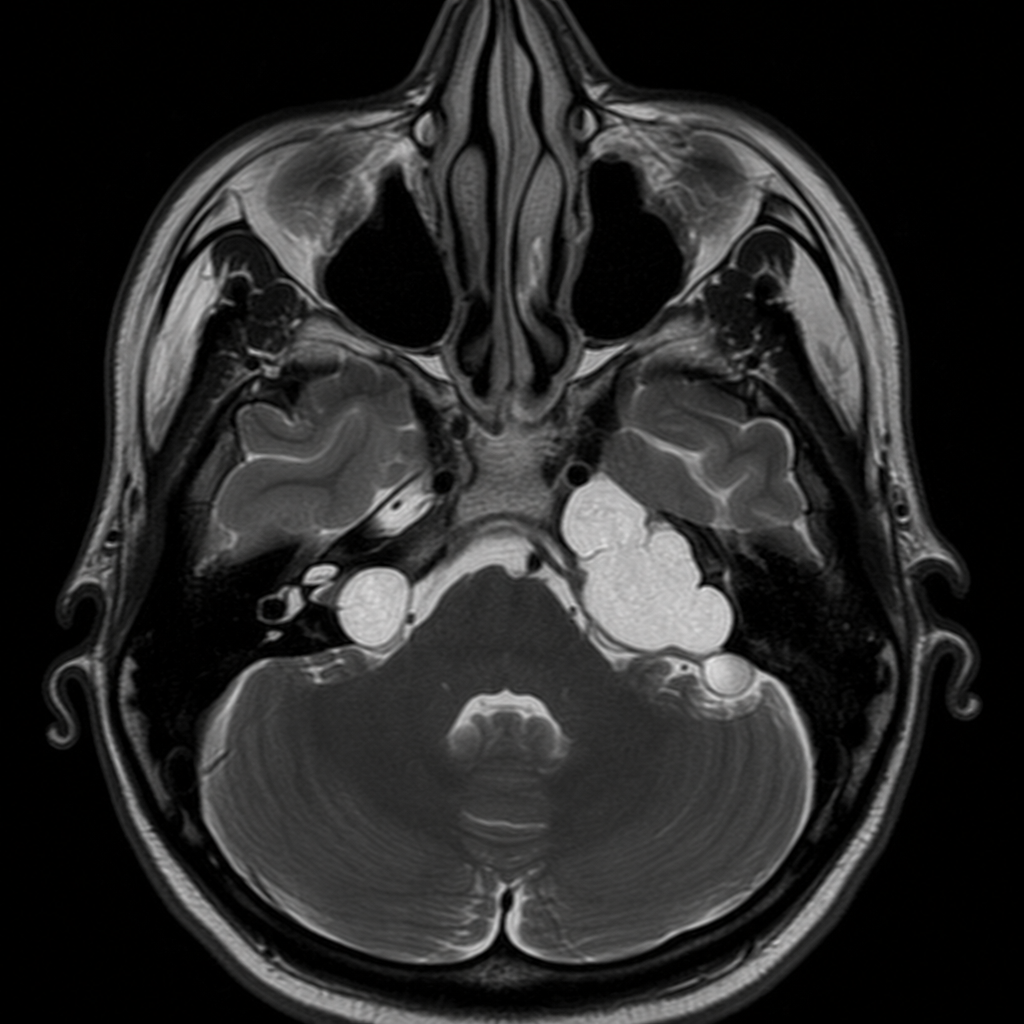
Which of the following is true about giant aneurysms?
In cerebral angiography, through which artery is the dye typically injected?
Which of the following statements about CT scan is FALSE?
Cerebral angiography was performed by whom?
Which condition is characterized by the Lyre sign?
"Lyre sign" is a feature of:
The "face of the giant panda" sign on MRI brain is characteristic of which condition?
A 39-year-old man presents to his physician with the complaint of loss of peripheral vision. The subsequent magnetic resonance imaging (MRI) scan demonstrates what abnormality?

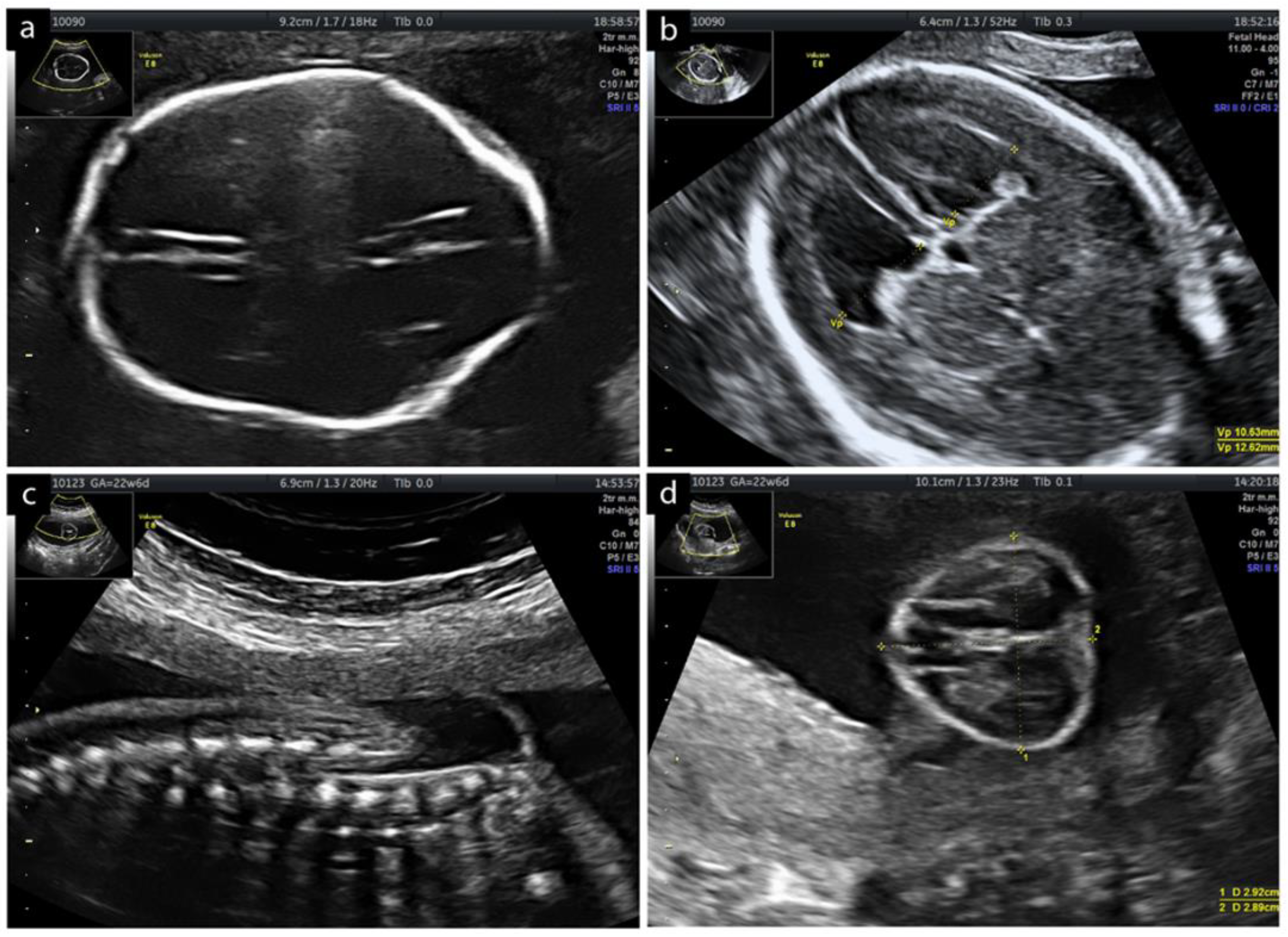
What is your diagnosis?

The "Tiger eye sign" on MRI is characteristic of which of the following conditions?
Explanation: **Explanation:** **Giant Intracranial Aneurysms** are defined as aneurysms with a diameter **>25 mm**. Their clinical behavior differs significantly from smaller berry aneurysms. 1. **Why Option C is Correct:** Due to their massive size, giant aneurysms act as **space-occupying lesions**. They exert a significant **mass effect** on adjacent neural structures (cranial nerves or brainstem). For example, a giant aneurysm in the posterior communicating artery often presents with a 3rd nerve palsy. While they can rupture, the "pressure effect" is a hallmark clinical presentation. 2. **Why Options A, B, and D are Incorrect:** * **Option A:** Giant aneurysms have a **high risk of rupture** (estimated at ~6% per year) due to high wall tension (Law of Laplace). They do not "rarely" rupture. * **Option B:** The most common site for giant aneurysms is the **Internal Carotid Artery (ICA)**, particularly the cavernous and ophthalmic segments, followed by the middle cerebral artery (MCA) and the basilar terminus. * **Option D:** While intra-aneurysmal thrombus is common due to turbulent flow, "thromboembolic phenomena" (distal strokes) are less common presenting features compared to the direct mass effect. **High-Yield Clinical Pearls for NEET-PG:** * **Imaging Gold Standard:** Digital Subtraction Angiography (DSA). * **MRI Appearance:** Often shows a "flow void" if patent, or a "popcorn" appearance/laminated layers if partially thrombosed. * **Law of Laplace:** Wall tension = (Pressure × Radius) / Wall thickness. This explains why larger aneurysms are more prone to rupture. * **Common Presentation:** Cranial nerve palsies (especially III, IV, and VI) and visual field defects.
Explanation: **Explanation:** In modern interventional radiology, the **Femoral artery** (specifically the Common Femoral Artery) is the gold-standard access point for cerebral angiography via the **Seldinger technique**. This is because the femoral artery is a large-caliber, superficial vessel that is easily compressible against the femoral head for hemostasis. It provides a relatively straight and wide anatomical pathway through the aorta to the carotid and vertebral arteries, allowing for the easy manipulation of large catheters and neuro-interventional devices. **Analysis of Incorrect Options:** * **Brachial and Axillary Arteries:** These were used historically but are now largely avoided due to a higher risk of complications, including hematomas that can cause permanent nerve damage (brachial plexus injury) and a higher incidence of vasospasm. * **Radial Artery:** While the "Transradial Approach" (TRA) is rapidly gaining popularity for both cardiac and cerebral angiograms due to lower bleeding risks and earlier patient mobilization, the **Femoral artery** remains the "typical" or conventional answer for examinations unless "radial" is specified as the preferred modern alternative. **High-Yield Clinical Pearls for NEET-PG:** * **The Seldinger Technique:** The universal method for vascular access (Needle → Guide wire → Dilator/Sheath → Catheter). * **Puncture Site:** The femoral artery should be punctured below the inguinal ligament to prevent **retroperitoneal hemorrhage**, a life-threatening complication where bleeding occurs into the pelvic cavity. * **Gold Standard:** Digital Subtraction Angiography (DSA) via femoral access remains the gold standard for diagnosing intracranial aneurysms and Arteriovenous Malformations (AVMs).
Explanation: **Explanation:** The correct answer is **B**, as CT is **not** the best imaging modality for soft tissue pathology; **MRI (Magnetic Resonance Imaging)** is the gold standard for this purpose due to its superior contrast resolution and ability to differentiate between various soft tissue structures (e.g., ligaments, tendons, muscles, and nerves). **Analysis of Options:** * **Option A (Acute SAH):** Non-contrast CT (NCCT) is the investigation of choice for acute subarachnoid hemorrhage. It is highly sensitive (nearly 95-98% in the first 24 hours) for detecting hyperdense fresh blood in the basal cisterns and sulci. * **Option C (Skull Trauma):** CT is the gold standard for acute head trauma. It excels at identifying cortical bone fractures, acute intracranial hemorrhages (EDH, SDH), and mass effect/herniation. * **Option D (Calcification):** CT is significantly more sensitive than MRI for detecting calcification. On CT, calcium appears bright white (high attenuation), whereas on MRI, it can have variable signals and is often difficult to distinguish from other low-signal structures like flowing blood or air. **High-Yield Clinical Pearls for NEET-PG:** * **Hounsfield Units (HU):** Remember the density values: Bone (+1000), Acute Blood (+60 to +80), Water (0), Fat (-50 to -100), and Air (-1000). * **Hyperacute Stroke:** NCCT is done first to **rule out hemorrhage** before starting thrombolysis, though MRI (DWI sequence) is the most sensitive for early ischemia. * **Contrast:** Iodinated contrast is used in CT (risk of CIN), while Gadolinium is used in MRI (risk of NSF).
Explanation: **Explanation:** **Correct Answer: D. Egas Moniz** Cerebral angiography was first performed in **1927** by the Portuguese neurologist **António Egas Moniz**. He successfully visualized the intracranial blood vessels by injecting a radiopaque contrast medium (initially thorium dioxide and later sodium iodide) into the carotid artery. For his pioneering work in both angiography and leucotomy, he was awarded the Nobel Prize in Physiology or Medicine in 1949. **Analysis of Incorrect Options:** * **A. Sir Walter Dandy:** A legendary neurosurgeon known for inventing **Pneumoencephalography** (1918) and Ventriculography. He was also the first to clip an intracranial aneurysm. * **B. George Moore:** He is credited with the early use of fluorescein dyes to localize brain tumors during surgery, but not for the invention of angiography. * **C. Seldinger (Sven-Ivar Seldinger):** He revolutionized the field of interventional radiology in 1953 by introducing the **Seldinger Technique**. This is the standard method for percutaneous vascular access using a needle, guidewire, and catheter, but it was developed decades after the first cerebral angiogram. **High-Yield Clinical Pearls for NEET-PG:** * **Gold Standard:** Digital Subtraction Angiography (DSA) remains the "gold standard" for diagnosing vascular pathologies like aneurysms and Arteriovenous Malformations (AVMs). * **Contrast Media:** Modern angiography uses non-ionic, low-osmolar iodinated contrast to minimize neurotoxicity. * **Historical Milestone:** Moniz’s work bridged the gap between clinical neurology and neurosurgery by allowing the visualization of tumors based on the displacement of blood vessels.
Explanation: **Explanation:** The **Lyre sign** is a classic radiological finding associated with a **Carotid Body Tumour (CBT)**, also known as a chemodectoma or carotid body paraganglioma. **Why it occurs:** The carotid body is located at the bifurcation of the Common Carotid Artery (CCA). As the tumour grows within this bifurcation, it causes a characteristic **widening or splaying of the interval between the Internal Carotid Artery (ICA) and the External Carotid Artery (ECA)**. On angiography or contrast-enhanced CT/MRI, this displacement resembles the strings of a lyre (a U-shaped string instrument). **Analysis of Incorrect Options:** * **Grave’s disease:** Characterized by "Thyroid acropachy" or "Exophthalmos." On imaging, it shows enlargement of extraocular muscles (sparing the tendons), often remembered by the mnemonic **IMSLO** (Inferior > Medial > Superior > Lateral > Oblique). * **Meniere’s disease:** A clinical diagnosis of the inner ear; imaging is typically used to rule out other pathologies like vestibular schwannoma. It does not involve the carotid bifurcation. * **Lateral sinus thrombosis:** Associated with the **"Empty Delta Sign"** on contrast-enhanced CT (though more common in superior sagittal sinus thrombosis) and the **"Cord sign"** on non-contrast CT. **High-Yield Clinical Pearls for NEET-PG:** * **Fontaine’s Sign:** Carotid body tumours are clinically mobile horizontally but fixed vertically (due to their attachment to the carotid bifurcation). * **Salt-and-Pepper Appearance:** On MRI (T2/T1+C), CBTs show high vascularity (flow voids = salt) and areas of hemorrhage/slow flow (pepper). * **Shamblin Classification:** Used to grade CBTs based on their surgical resectability and involvement of the carotid vessels.
Explanation: ### Explanation **Correct Answer: D. Carotid body tumor** The **Lyre sign** is a classic radiological hallmark of a **Carotid Body Tumor (Paraganglioma)**. This sign is observed on conventional angiography or CT/MR angiography. It refers to the characteristic **splaying (widening) of the carotid bifurcation** caused by a highly vascular mass located within the carotid notch. The mass pushes the Internal Carotid Artery (ICA) posterolaterally and the External Carotid Artery (ECA) anteromedially, mimicking the shape of a "lyre" (a U-shaped string instrument). #### Why the other options are incorrect: * **Cystic hygroma:** This is a congenital lymphatic malformation typically found in the posterior triangle of the neck in infants. On imaging, it appears as a multilocular cystic mass that infiltrates tissue planes rather than splaying the carotids. * **Branchial fistula:** Usually arises from the second branchial arch, with an external opening along the lower third of the sternocleidomastoid muscle. It does not present as a vascular mass at the carotid bifurcation. * **Bezold’s abscess:** This is a complication of mastoiditis where pus tracks into the sheath of the sternocleidomastoid muscle. It presents as an inflammatory collection in the neck, not a solid tumor splaying the arteries. #### High-Yield Clinical Pearls for NEET-PG: * **Fontaine’s Sign:** Carotid body tumors are mobile horizontally but fixed vertically (due to their attachment to the carotid bifurcation). * **Salt-and-Pepper Appearance:** On MRI (T2/T1+C), these tumors show a "salt-and-pepper" pattern; "pepper" represents flow voids of high-velocity vessels, and "salt" represents foci of hemorrhage or slow flow. * **Shamblin Classification:** Used to grade these tumors based on their involvement/encasement of the carotid vessels. * **Origin:** They arise from the **chemoreceptor cells** of the carotid body (neural crest origin).
Explanation: ### Explanation **Correct Option: A. Wilson's Disease** The **"Face of the Giant Panda"** sign is a classic radiological hallmark of Wilson’s disease (hepatolenticular degeneration), an autosomal recessive disorder of copper metabolism. On **T2-weighted MRI** at the level of the **midbrain**, this sign is formed by: * **High signal intensity (hyperintensity):** In the tegmentum. * **Preserved normal signal (relative hypointensity):** In the Red Nuclei (forming the "eyes") and the Pars Reticulata of the Substantia Nigra (forming the "ears"). * **Hypointensity:** In the Superior Colliculi (forming the "chin"). This pattern results from the selective deposition of copper and subsequent gliosis/edema in the midbrain. **Analysis of Incorrect Options:** * **B. Japanese Encephalitis:** Characteristically shows bilateral **thalamic involvement** (hemorrhagic or non-hemorrhagic) on MRI. While it can affect the midbrain, it does not produce the specific "Panda" configuration. * **C. Rasmussen's Encephalitis:** A chronic inflammatory disease presenting with intractable seizures and progressive **unilateral cerebral atrophy**. * **D. Wernicke's Encephalopathy:** Typically shows T2/FLAIR hyperintensities in the **mammillary bodies**, periaqueductal gray matter, and dorsomedial thalami due to Thiamine (B1) deficiency. **High-Yield Clinical Pearls for NEET-PG:** * **Double Panda Sign:** Seen when the "Face of the Giant Panda" (midbrain) is present along with the **"Panda Cub" sign** in the pons (caused by sparing of the central tegmental tracts and corticospinal tracts). * **Basal Ganglia:** Wilson's disease most commonly affects the **Putamen** (bilateral T2 hyperintensity). * **Diagnosis:** Low serum ceruloplasmin, high 24-hour urinary copper, and **Kayser-Fleischer (KF) rings** on slit-lamp exam.
Explanation: ***Pituitary adenoma*** - Loss of **peripheral vision** (bitemporal hemianopia) is the classic presentation of **pituitary adenoma** compressing the **optic chiasm**. - MRI typically shows a **sellar/suprasellar mass** with **signal heterogeneity** and possible **suprasellar extension** in macroadenomas. *Cerebral atrophy* - Presents with **generalized brain volume loss** and **ventricular enlargement**, not focal visual field defects. - Associated with **dementia** and **cognitive decline**, not isolated peripheral vision loss. *Optic glioma* - Causes **monocular visual loss** or **central scotomas**, not bilateral peripheral vision loss. - MRI shows **fusiform enlargement** of the **optic nerve** with **T2 hyperintensity**, not sellar masses. *Pontine hemorrhage* - Results in **quadriplegia**, **coma**, and **pinpoint pupils** due to brainstem involvement. - MRI demonstrates **hyperacute hemorrhage** in the **pons** with surrounding **edema**, not visual field defects.
Explanation: ***Craniorachischisis*** - A severe **neural tube defect** combining both **anencephaly** (absence of brain and skull vault) and complete **rachischisis** (open spinal canal along entire length). - Represents the most extensive form of neural tube defect with **complete failure of neural tube closure** affecting both cranial and spinal regions. *Anencephaly* - Involves only the **cranial region** with absence of brain and skull vault, but the **spinal cord remains intact**. - Does not include the complete **spinal rachischisis** component seen in this severe condition. *Iniencephaly* - Characterized by severe **cervical retroflexion** with the head bent backward and an **occipital bone defect**. - Presents as a **localized malformation** rather than the extensive cranial and complete spinal involvement. *Myelomeningocele* - A **localized spinal defect** where neural tissue and meninges protrude through a **vertebral defect** forming a sac. - Limited to a **specific spinal segment** and does not involve cranial abnormalities or complete spinal opening.
Explanation: **Explanation:** The **"Eye of the Tiger" sign** is a classic radiological hallmark seen on **T2-weighted MRI** of the brain. It is pathognomonic for **Hallervorden-Spatz disease**, now more commonly known as **Pantothenate Kinase-Associated Neurodegeneration (PKAN)**, a subtype of Neurodegeneration with Brain Iron Accumulation (NBIA). **1. Why Option A is correct:** The sign consists of a central area of **hyperintensity** (high signal) surrounded by a rim of **hypointensity** (low signal) in the **Globus Pallidus**. * The **hypointensity** is due to excessive iron deposition (paramagnetic effect). * The central **hyperintensity** represents gliosis, vacuolization, and edema. Together, these create the appearance of a tiger’s eye. **2. Why other options are incorrect:** * **Option B (CHHS):** This is a hematological condition. While chronic hemolysis can lead to systemic iron overload (hemosiderosis), it does not typically present with this specific localized pattern in the basal ganglia. * **Option C (Achalasia Cardia):** This is a motility disorder of the esophagus. The characteristic radiological sign for Achalasia is the **"Bird’s beak" appearance** on a Barium swallow, not a neuroimaging sign. **3. High-Yield Clinical Pearls for NEET-PG:** * **Gene Mutation:** PKAN is caused by a mutation in the **PANK2 gene** (Autosomal Recessive). * **Clinical Presentation:** Patients typically present with extrapyramidal symptoms like **dystonia**, parkinsonism, and choreoathetosis. * **Differential Diagnosis:** Other causes of basal ganglia mineralization (like Fahr’s disease) show hyperdensity on CT, but the specific "Eye of the Tiger" configuration is unique to PKAN.
Neuroanatomy for Radiologists
Practice Questions
Cerebrovascular Diseases
Practice Questions
Intracranial Tumors
Practice Questions
CNS Infections
Practice Questions
Demyelinating and Degenerative Diseases
Practice Questions
Head Trauma Imaging
Practice Questions
Spine Imaging: Trauma and Degenerative Disease
Practice Questions
Spine Tumors and Infections
Practice Questions
Pediatric Neuroradiology
Practice Questions
Congenital CNS Anomalies
Practice Questions
Functional Neuroimaging
Practice Questions
Neurointerventional Procedures
Practice Questions
Get full access to all questions, explanations, and performance tracking.
Start For Free