The dense middle cerebral artery (MCA) sign is seen in which of the following conditions?
Widened Bat wing sylvian fissures are associated with which of the following conditions?
A child presents with raised ICT; on CT scan, a lesion is seen around the foramen of Monro and multiple periventricular calcific foci are noted. What is the most probable diagnosis?
What is the investigation of choice for the diagnosis of a posterior fossa tumor?
Subependymal Giant Cell Astrocytoma is commonly associated with which of the following conditions?
Which of the following conditions is most commonly associated with calcification of the basal ganglia?
What is the most common primary brain tumor in adults?
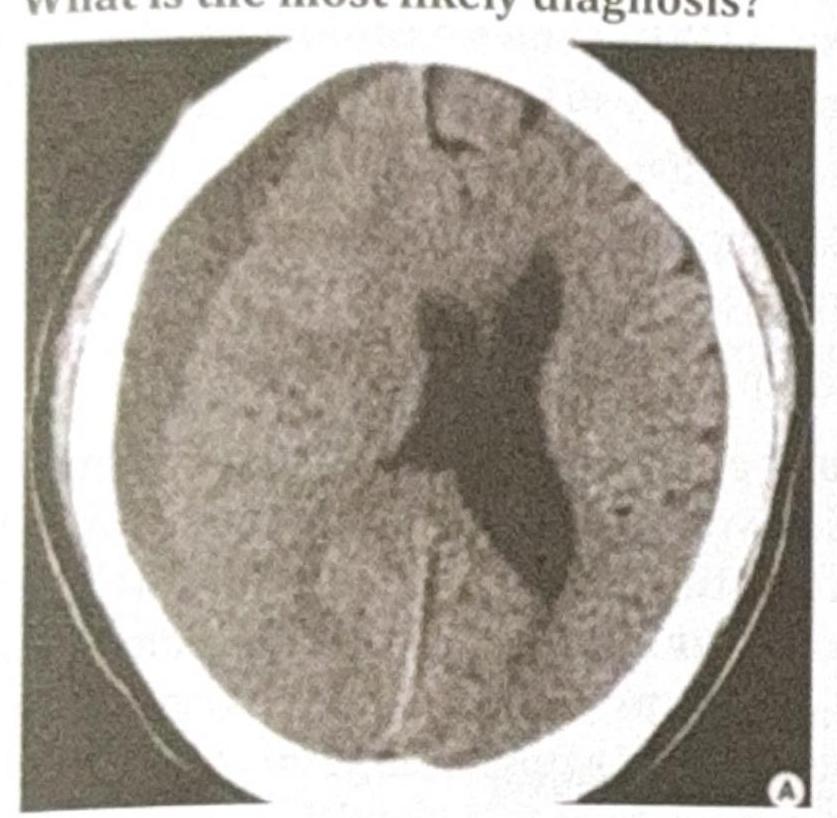
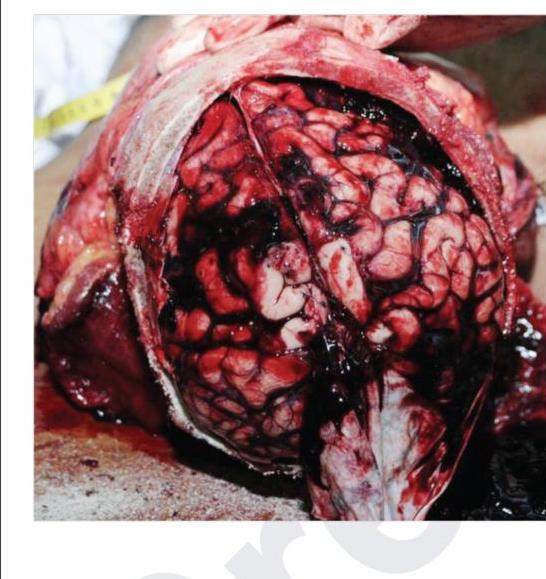
Punch drunk syndrome is associated with which of the following conditions?
Which of the following is NOT a characteristic feature of meningioma?
What is the most common posterior fossa brain tumor in children?
Explanation: **Explanation:** The **Hyperdense MCA sign** is one of the earliest radiological markers of an **acute ischemic stroke** on a non-contrast CT (NCCT) scan. **1. Why Acute Infarct is correct:** The sign represents a **thrombus or embolus** lodged within the first segment (M1) of the Middle Cerebral Artery. Because a fresh blood clot has a higher protein concentration and lower water content than flowing blood, it appears hyperattenuating (whiter) compared to the surrounding brain tissue and the contralateral vessel. It is typically seen within the first **0–6 hours** of symptom onset, often before parenchymal changes like "loss of insular ribbon" or "sulcal effacement" become visible. **2. Why other options are incorrect:** * **Subacute Infarct:** By this stage (24 hours to 2 weeks), the clot has usually started to lyse or organize, and the primary CT findings are vasogenic edema and mass effect (hypodensity), not vascular hyperdensity. * **Subacute Hemorrhage:** While blood is dense, a subacute hemorrhage refers to intraparenchymal or extra-axial collections. The "Dense MCA sign" specifically refers to an intravascular phenomenon. * **Chronic Infarct:** Chronic strokes are characterized by encephalomalacia and gliosis, appearing as CSF-filled cystic spaces (hypodense/black) with associated ventricular dilatation (ex-vacuo). **Clinical Pearls for NEET-PG:** * **High Specificity:** The sign is 90–100% specific for MCA occlusion but has low sensitivity (approx. 30%). * **Dot Sign:** A variation seen when the clot is in the M2 or M3 branches within the sylvian fissure, appearing as a high-density "dot." * **False Positives:** High hematocrit (polycythemia) or calcification of the arterial wall (atherosclerosis) can mimic this sign. Always compare with the opposite side. * **Prognostic Value:** Its presence often indicates a large territory infarct and a poorer functional prognosis.
Explanation: **Explanation:** **Glutaric Aciduria Type 1 (GA-1)** is an autosomal recessive metabolic disorder caused by a deficiency of glutaryl-CoA dehydrogenase. The hallmark neuroimaging finding is the **"Bat-wing appearance"** of the Sylvian fissures. This occurs due to significant frontotemporal atrophy and hypoplasia, leading to failure of opercularization (the brain tissue fails to cover the Insula). This creates wide, open CSF spaces in the temporal regions, resembling the wings of a bat. Additionally, these patients often show signal abnormalities in the basal ganglia (especially the putamen) and are prone to subdural hematomas. **Analysis of Incorrect Options:** * **Maple Syrup Urine Disease (MSUD):** Characterized by "MSUD edema," which involves intramyelinic cytotoxic edema. On MRI, this presents as restricted diffusion in the myelinated tracts (brainstem, cerebellar peduncles, and internal capsule). * **Galactosemia:** Typically presents with non-specific white matter changes, cerebral atrophy, and sometimes neonatal brain edema, but does not feature the characteristic bat-wing fissures. * **Canavan Disease:** A leukodystrophy characterized by diffuse, symmetric white matter involvement (including subcortical U-fibers) and **macrocephaly**. The classic finding is an elevated **NAA peak** on MR Spectroscopy. **Clinical Pearls for NEET-PG:** * **Bat-wing appearance:** Pathognomonic for Glutaric Aciduria Type 1. * **Macrocephaly + High NAA:** Canavan Disease. * **Macrocephaly + Rosenthal Fibers:** Alexander Disease. * **Tiger-eye appearance:** Pantothenate Kinase-Associated Neurodegeneration (PKAN). * **Molar Tooth Sign:** Joubert Syndrome.
Explanation: ### Explanation The clinical presentation and imaging findings are classic for **Subependymal Giant Cell Astrocytoma (SEGA)**, a benign (WHO Grade 1) tumor strongly associated with **Tuberous Sclerosis Complex (TSC)**. **Why SEGA is the correct answer:** 1. **Location:** SEGAs characteristically arise near the **foramen of Monro**. As they grow, they frequently cause obstructive hydrocephalus, leading to symptoms of raised intracranial pressure (ICT). 2. **Associated Findings:** The "multiple periventricular calcific foci" described are **subependymal nodules (SENs)**. These are hamartomatous lesions that often calcify and are a hallmark of Tuberous Sclerosis. A SEN that grows (>1 cm) or shows progressive enhancement near the foramen of Monro is diagnostic of SEGA. **Analysis of Incorrect Options:** * **Central Neurocytoma:** While also located near the foramen of Monro/septum pellucidum, it typically presents in young adults (20–40 years), not children, and is not associated with periventricular calcific nodules. It often has a "Swiss-cheese" appearance due to cystic spaces. * **Ependymoma:** Most commonly occurs in the fourth ventricle in children. While it can calcify, it does not typically present with the specific pattern of periventricular nodules seen in TSC. * **Ganglioglioma:** These are typically peripheral, cortically-based tumors (most common in the temporal lobe) that present with chronic epilepsy rather than midline obstructive hydrocephalus. **High-Yield Clinical Pearls for NEET-PG:** * **TSC Diagnostic Triad (Vogt’s Triad):** Adenoma sebaceum (facial angiofibromas), mental retardation, and epilepsy. * **Imaging Hallmark:** "Candle guttering" appearance on the ventricular walls due to multiple subependymal nodules. * **Management:** mTOR inhibitors (e.g., **Everolimus**) are now often used to reduce the size of SEGA in TSC patients. * **Other TSC associations:** Ash-leaf spots, Shagreen patches, Cardiac rhabdomyoma, and Renal Angiomyolipoma (AML).
Explanation: **Explanation:** **MRI (Magnetic Resonance Imaging)** is the investigation of choice for posterior fossa tumors due to its superior soft-tissue contrast and multiplanar imaging capabilities. The posterior fossa is a small, bony compartment containing the brainstem and cerebellum. MRI allows for precise localization, assessment of brainstem invasion, and detection of associated complications like hydrocephalus or tonsillar herniation. **Why MRI is superior:** * **No Bone Artifact:** Unlike CT, MRI does not suffer from "beam-hardening artifacts" caused by the dense petrous temporal bone and occipital bone, which often obscure details in the posterior fossa. * **Multiplanar Imaging:** Sagittal and coronal views are essential to visualize the relationship of the tumor to the foramen magnum and tentorium cerebelli. * **Contrast Enhancement:** Gadolinium-enhanced MRI helps differentiate between various tumor types (e.g., Medulloblastoma vs. Ependymoma). **Why other options are incorrect:** * **CT Scan:** While useful in emergencies to detect acute hydrocephalus or calcification, it provides poor visualization of the posterior fossa due to significant bony artifacts. * **Angiography:** Primarily used to assess vascularity or for preoperative embolization (e.g., in Hemangioblastoma), but not for primary diagnosis. * **Myelography:** Used for spinal canal pathology; it has no role in diagnosing intracranial posterior fossa masses. **High-Yield Clinical Pearls for NEET-PG:** * **Most common posterior fossa tumor in children:** Cerebellar Astrocytoma (overall), but Medulloblastoma is the most common *malignant* one. * **"Step-off" sign on MRI:** Characteristic of Ependymomas as they tend to squeeze through the foramina of Luschka and Magendie. * **Investigation of choice for most CNS pathologies:** MRI (except for acute intracranial hemorrhage, where NCCT is preferred).
Explanation: **Explanation:** **Subependymal Giant Cell Astrocytoma (SEGA)** is a benign (WHO Grade 1), slow-growing tumor typically located near the Foramen of Monro. It is the most common CNS neoplasm associated with **Tuberous Sclerosis Complex (TSC)**, occurring in approximately 5–15% of patients. 1. **Why Tuberous Sclerosis is Correct:** SEGA is considered a major diagnostic criterion for TSC. It typically arises from the transformation of subependymal nodules (SENs). On imaging, SEGAs appear as well-circumscribed, enhancing masses near the Foramen of Monro, often causing obstructive hydrocephalus. The underlying pathophysiology involves mutations in the *TSC1* (hamartin) or *TSC2* (tuberin) genes, leading to overactivation of the mTOR pathway. 2. **Why Other Options are Incorrect:** * **Neurofibroma:** Associated with Neurofibromatosis Type 1 (NF1). While NF1 involves CNS tumors (like Optic Nerve Gliomas), SEGA is not a feature. * **Schwannoma:** Classically associated with Neurofibromatosis Type 2 (NF2), particularly bilateral vestibular schwannomas. * **Ependymoma:** These are distinct glial tumors arising from the ependymal lining of ventricles or the central canal of the spinal cord; they are not syndromically linked to TSC. **High-Yield Clinical Pearls for NEET-PG:** * **Imaging Hallmark:** A calcified or enhancing mass >1 cm at the Foramen of Monro in a pediatric patient is highly suggestive of SEGA. * **Vogt’s Triad (TSC):** Adenoma sebaceum (facial angiofibromas), seizures, and mental retardation. * **Other TSC CNS findings:** Cortical tubers (hamartomas) and Subependymal Nodules (SENs). * **Treatment:** Surgical resection or **Everolimus** (an mTOR inhibitor), which is specifically used to shrink SEGAs in TSC patients.
Explanation: **Explanation:** **Basal Ganglia Calcification (BGC)** is a significant radiological finding in neuroradiology. While the question identifies **Wilson’s Disease** as the correct association, it is important to note that while Wilson's typically presents with copper deposition and T2-hyperintensities (the "Face of the Giant Panda" sign), chronic mineral deposition can lead to calcification in the basal ganglia. **Why the options are correct/incorrect:** * **Wilson’s Disease (Correct):** It is a disorder of copper metabolism. While gliosis and edema are more common, dystrophic calcification occurs in the lentiform nuclei (putamen and globus pallidus) due to chronic metabolic insult. * **Berry’s Aneurysm:** These are saccular aneurysms typically located at the Circle of Willis. They present with Subarachnoid Hemorrhage (SAH) rather than parenchymal basal ganglia calcification. * **Cysticercosis:** Neurocysticercosis (NCC) typically presents with "starry sky" appearances of multiple small, punctate calcifications scattered throughout the parenchyma (at the grey-white junction), not localized specifically to the basal ganglia. * **Idiopathic Hyperparathyroidism:** While endocrine disorders (Hypoparathyroidism and Pseudohypoparathyroidism) are the **most common** pathological causes of BGC, "Idiopathic Hyperparathyroidism" is a less common clinical entity compared to the metabolic changes seen in Wilson's or Hypoparathyroidism in an exam context. **NEET-PG High-Yield Pearls:** 1. **Fahr’s Syndrome:** Idiopathic, familial bilateral vascular calcification of the basal ganglia. 2. **Most Common Cause:** Physiological (age-related) calcification, usually seen in the globus pallidus of patients >40 years. 3. **Endocrine Link:** Hypoparathyroidism is the most frequent pathological cause of bilateral BGC. 4. **Imaging:** CT is the gold standard for detecting calcification (appears hyperdense/white). On MRI, calcification is usually T1/T2 hypointense but can vary.
Explanation: **Explanation:** The correct answer is **Metastases**. In the context of all brain tumors in adults, **metastatic lesions** are the most common, occurring more frequently than all primary brain tumors combined. They typically originate from the lung (most common), breast, kidney, or melanoma and often present as multiple, well-circumscribed lesions at the grey-white matter junction with significant perilesional edema. **Analysis of Options:** * **A. Glioma:** This is a broad category of tumors arising from glial cells. While common, they are less frequent than metastases. * **C. Meningioma:** This is the most common **extra-axial** and most common **benign** primary brain tumor in adults. * **D. Astrocytoma:** This is a subtype of glioma. Specifically, Glioblastoma Multiforme (GBM/Grade IV Astrocytoma) is the most common **malignant primary** brain tumor in adults, but it is still less common than metastatic disease. **High-Yield Clinical Pearls for NEET-PG:** * **Most common brain tumor overall:** Metastases. * **Most common primary brain tumor:** Meningioma (if benign is included) or Glioblastoma (if focusing on malignancy). * **Most common source of brain mets:** Lung cancer (specifically Small Cell and Adenocarcinoma). * **Imaging Hallmark:** Metastases often show "ring enhancement" on contrast-enhanced MRI. * **Rule of Thumb:** If a question asks for the most common tumor without specifying "primary," the answer is always Metastases. If it specifies "primary," the answer is Meningioma.
Explanation: **Explanation:** **Punch Drunk Syndrome**, also known as **Dementia Pugilistica** or Chronic Traumatic Encephalopathy (CTE), is a neurodegenerative condition caused by repeated concussive or sub-concussive blows to the head, classically seen in boxers. **Why Subdural Hematoma (SDH) is the correct answer:** The repetitive acceleration-deceleration injuries in boxing lead to the stretching and tearing of the **bridging cortical veins** as they cross the subdural space to drain into the dural sinuses. This mechanism frequently results in **Chronic Subdural Hematomas**. Over time, the cumulative effect of these vascular injuries, combined with progressive cortical atrophy and tau protein deposition, leads to the clinical triad of cognitive decline, parkinsonism, and behavioral changes characteristic of the syndrome. **Analysis of Incorrect Options:** * **Extradural Hematoma (EDH):** Usually results from acute arterial trauma (e.g., middle meningeal artery) following a skull fracture. It is an acute, life-threatening event rather than a chronic sequela of repetitive minor trauma. * **Subarachnoid Hemorrhage (SAH):** Most commonly caused by ruptured aneurysms or acute high-impact trauma. While it can occur in boxing, it is not the hallmark pathological association of Punch Drunk Syndrome. * **Intraventricular Bleed:** Typically associated with severe traumatic brain injury (TBI), hypertension, or prematurity, rather than the chronic, repetitive low-velocity impacts of pugilism. **High-Yield Clinical Pearls for NEET-PG:** * **Radiology of SDH:** Appears as a **crescent-shaped (concavo-convex)** collection that can cross suture lines but not dural attachments. * **Imaging of choice:** Non-contrast CT (NCCT) head. Chronic SDH appears **hypodense** (dark), while acute SDH is **hyperdense** (bright). * **Pathology of CTE:** Characterized by the accumulation of **phosphorylated tau protein** in a pattern distinct from Alzheimer’s disease. * **Cavum Septum Pellucidum:** Often found to be fenestrated or enlarged in patients with Dementia Pugilistica.
Explanation: ### Explanation **Meningiomas** are the most common primary intracranial tumors. The core concept to understand here is their anatomical origin: they arise from **arachnoid cap cells** of the leptomeninges, making them **extra-axial** tumors (located outside the brain parenchyma). **Why Option D is the Correct Answer:** Meningiomas are classic examples of **extra-axial** tumors. They compress the brain from the outside rather than infiltrating it from within. Characteristics of extra-axial lesions include the displacement of gray matter, widening of the subarachnoid space (CSF cleft sign), and a broad-based attachment to the dura. Therefore, labeling it an "intra-axial tumor" is factually incorrect. **Analysis of Incorrect Options:** * **A. Calcification:** This is a very common feature, seen in approximately 20–25% of cases. On histopathology, these often appear as **Psammoma bodies**. * **B. Dural tail sign:** This represents thickening and enhancement of the dura mater adjacent to the tumor. While not pathognomonic, it is highly suggestive of meningioma. * **C. Mother-in-law sign:** This is a classic radiological "nickname" referring to the tumor's vascularity on angiography. The tumor "comes early and stays late"—meaning the contrast blush appears early in the arterial phase and persists long into the venous phase. **High-Yield Clinical Pearls for NEET-PG:** * **Most common location:** Parasagittal/Convexity. * **Gender Predilection:** More common in females (due to progesterone receptors). * **Association:** Strongly associated with **Neurofibromatosis Type 2 (NF2)**, especially when multiple. * **MRI Appearance:** Usually isointense to gray matter on T1 and T2; shows **intense, homogenous enhancement** post-gadolinium. * **Bone changes:** Often causes **hyperostosis** (thickening) of the overlying bone.
Explanation: **Explanation:** The correct answer is **Pilocytic Astrocytoma**. While many older textbooks previously cited medulloblastoma as the most common, current epidemiological data and recent editions of standard radiology and neurosurgery texts (like Bailey's and Nelson's) confirm that **Juvenile Pilocytic Astrocytoma (JPA)** is the most common pediatric posterior fossa tumor and the most common primary pediatric brain tumor overall. **Why Pilocytic Astrocytoma is correct:** It is a WHO Grade I tumor, typically arising in the cerebellum. On imaging, it classically presents as a **large cystic lesion with a brightly enhancing mural nodule**. It has a relatively benign course and a favorable prognosis compared to other brain tumors. **Analysis of Incorrect Options:** * **Medulloblastoma:** This is the most common **malignant** (WHO Grade IV) brain tumor in children. It typically arises from the roof of the 4th ventricle (vermis) and shows a "drop metastasis" pattern via CSF. * **Hemangioblastoma:** While this is a common primary intra-axial tumor of the posterior fossa in **adults**, it is rare in children unless associated with Von Hippel-Lindau (VHL) syndrome. * **Occipital fossa tumor:** This is a general anatomical description rather than a specific pathological diagnosis. **High-Yield Clinical Pearls for NEET-PG:** * **Most common posterior fossa tumor:** Pilocytic Astrocytoma. * **Most common malignant CNS tumor in children:** Medulloblastoma. * **Most common supratentorial tumor in children:** Craniopharyngioma. * **Imaging Hallmark (JPA):** Cyst with an enhancing mural nodule. * **Imaging Hallmark (Medulloblastoma):** Hyperdense mass on CT (due to high cellularity) filling the 4th ventricle.
Neuroanatomy for Radiologists
Practice Questions
Cerebrovascular Diseases
Practice Questions
Intracranial Tumors
Practice Questions
CNS Infections
Practice Questions
Demyelinating and Degenerative Diseases
Practice Questions
Head Trauma Imaging
Practice Questions
Spine Imaging: Trauma and Degenerative Disease
Practice Questions
Spine Tumors and Infections
Practice Questions
Pediatric Neuroradiology
Practice Questions
Congenital CNS Anomalies
Practice Questions
Functional Neuroimaging
Practice Questions
Neurointerventional Procedures
Practice Questions
Get full access to all questions, explanations, and performance tracking.
Start For Free