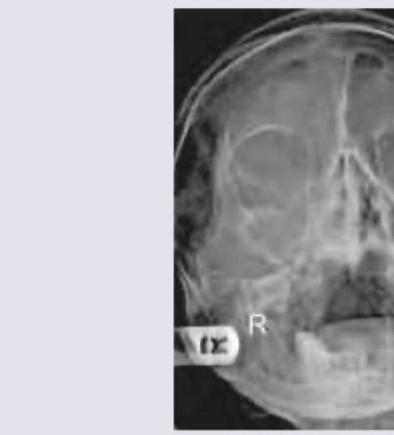
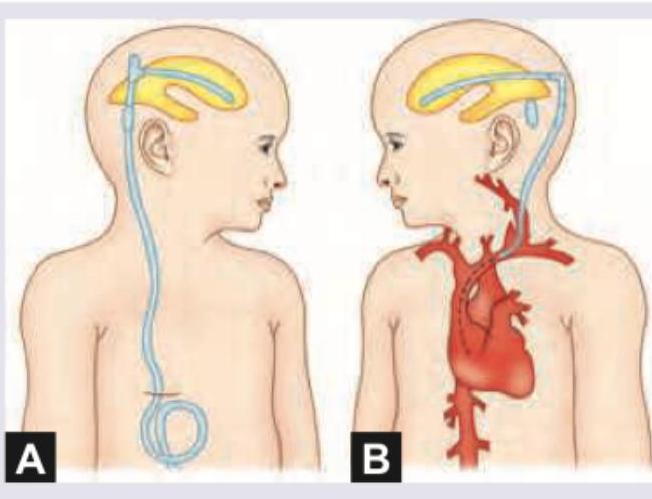
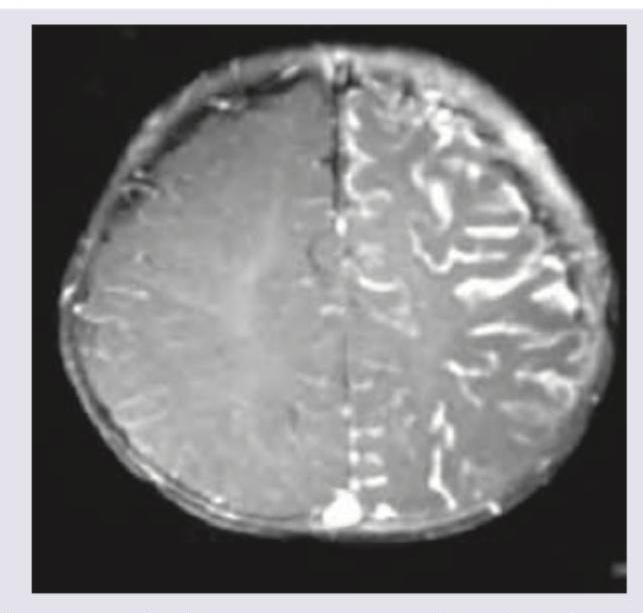
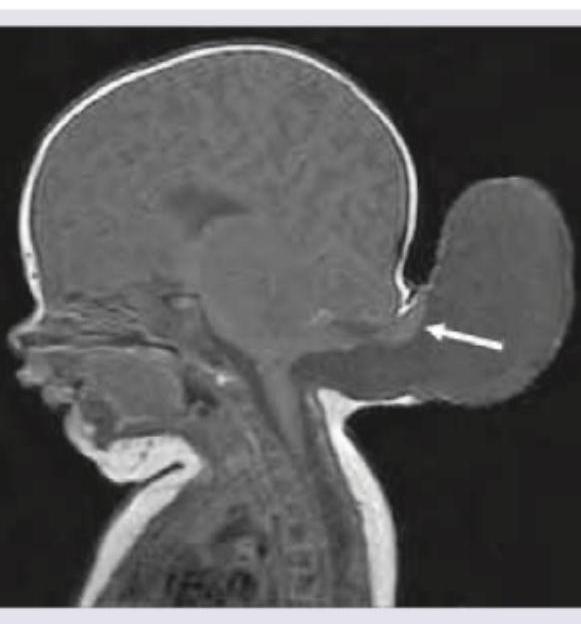
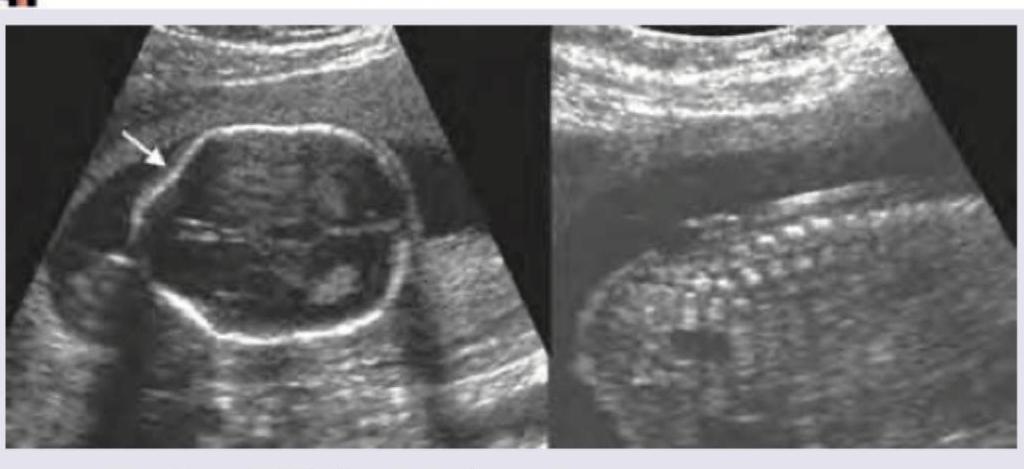
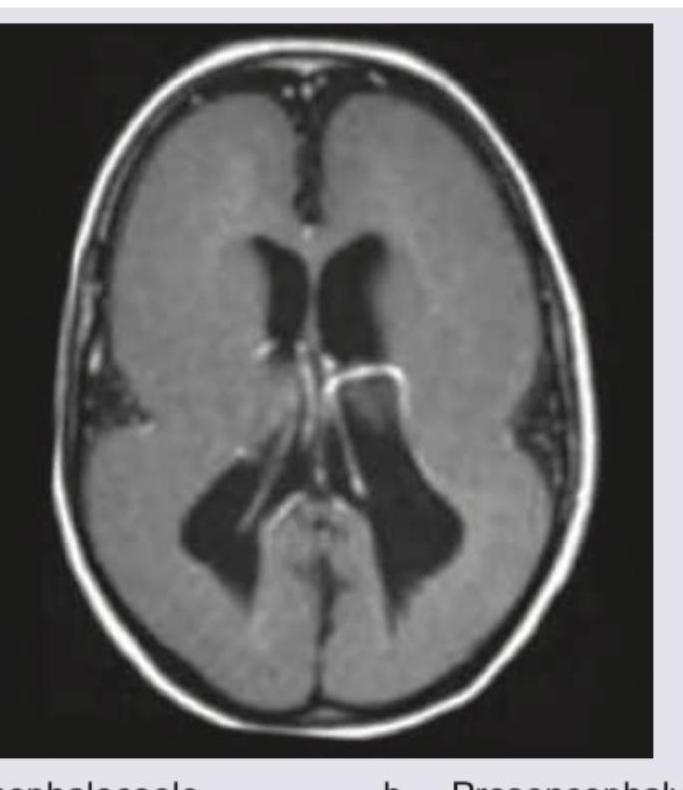
A patient with Miller Dieker syndrome on neuroimaging showed a smooth cortex with no convolutions. What is this condition of the brain where the convolutions are absent called?
Which MRI sequence is used to detect brain edema?
Which radiological sign is characteristic of meningioma?
A 10-year-old child presents with new onset of visual field abnormalities and diabetes insipidus. A head CT reveals a 3 cm mass lesion with focal calcification superior to the sella turcica. Needle biopsy of this mass shows tumor tissue resembling tooth enamel. What is the most likely diagnosis?
Which imaging modality is least useful in a case of CNS neoplasm?
What is the characteristic 'soap bubble' appearance seen in meningoencephalitis?
All of the following cause basal ganglia calcification except?
A round hyperdense lesion on NC-CT located in the 3rd ventricle is most likely to be which of the following?
What is the investigation of choice for suspected neuroangiofibroma?
What is the most common CNS tumor that shows calcification?
Explanation: **Explanation:** The correct answer is **Lissencephaly** (Option B). **1. Understanding the Correct Answer:** Lissencephaly, derived from the Greek words *lissos* (smooth) and *enkephalos* (brain), is a rare gene-linked brain malformation. It is characterized by the **absence of normal convolutions (gyri and sulci)** in the cerebral cortex, resulting in a "smooth brain" appearance. This condition occurs due to **defective neuronal migration** during the 12th to 24th weeks of gestation. * **Miller-Dieker Syndrome** is a classic association, caused by a microdeletion on chromosome 17p13.3 (LIS1 gene). Radiologically, it presents with a "Figure-of-8" appearance on axial sections due to a wide Sylvian fissure and a thickened cortex (pachygyria). **2. Why Other Options are Incorrect:** * **Holoprosencephaly:** A failure of the forebrain (prosencephalon) to divide into two cerebral hemispheres. It is characterized by a single midline ventricle and facial midline defects (e.g., cyclopia). * **Rachischisis:** A severe form of neural tube defect where the spinal column remains open, often associated with an exposed spinal cord (myeloschisis). * **Arhinencephaly:** The congenital absence of the olfactory bulbs and tracts. It is frequently seen as a component of holoprosencephaly. **3. High-Yield Clinical Pearls for NEET-PG:** * **Agyria:** Complete absence of gyri (smooth brain). * **Pachygyria:** Broad, thick, and few gyri. * **Imaging Sign:** The **"Figure-of-8" appearance** or "Hourglass" appearance on MRI/CT is pathognomonic for classic lissencephaly. * **Clinical Triad:** Severe developmental delay, intractable epilepsy (infantile spasms), and microcephaly.
Explanation: **Explanation:** **FLAIR (Fluid Attenuated Inversion Recovery)** is the sequence of choice for detecting brain edema and most parenchymal pathologies. In standard T2-weighted images, both edema and normal Cerebrospinal Fluid (CSF) appear bright (hyperintense), making it difficult to distinguish lesions near the ventricles or sulci. FLAIR "nulls" or suppresses the signal from free-flowing water (CSF), making it appear dark, while pathological edema remains bright. This high contrast makes FLAIR the most sensitive sequence for identifying periventricular plaques (Multiple Sclerosis), cortical contusions, and subarachnoid hemorrhage. **Analysis of Incorrect Options:** * **T1WI (T1 Weighted Imaging):** Primarily used for anatomical detail. Edema appears dark (hypointense) on T1, providing poor sensitivity for detecting fluid-related pathology. * **SWI (Susceptibility Weighted Imaging):** Highly sensitive to "blooming" artifacts. It is the gold standard for detecting **microhemorrhages**, calcification, and venous blood (deoxyhemoglobin). * **DWI (Diffusion Weighted Imaging):** Specifically detects restricted diffusion of water molecules. It is the gold standard for **hyperacute ischemic stroke** (cytotoxic edema), but not for general vasogenic edema. **High-Yield Clinical Pearls for NEET-PG:** * **Vasogenic Edema:** Seen in tumors/abscesses; involves white matter; bright on FLAIR. * **Cytotoxic Edema:** Seen in early stroke; involves both gray and white matter; bright on **DWI**. * **STIR (Short Tau Inversion Recovery):** Similar to FLAIR but suppresses **fat** signal; used for orbital and spinal imaging. * **Bright on T1:** Fat, melanin, proteinaceous fluid, and methemoglobin (subacute blood).
Explanation: **Explanation:** **1. Why "Mother-in-law" sign is correct:** The **"Mother-in-law" sign** is a classic angiographic description of a meningioma. It refers to the phenomenon where the tumor blush appears early in the arterial phase and **stays late** into the venous phase (much like a mother-in-law who "comes early and stays late"). This occurs because meningiomas are highly vascular tumors, typically supplied by the external carotid artery (e.g., middle meningeal artery), characterized by slow-clearing interstitial contrast. **2. Analysis of Incorrect Options:** * **B. Owl eye sign:** Seen in **CMV encephalitis** (intranuclear inclusions) or on MRI in the spinal cord during **Anterior Spinal Artery Syndrome**. It is also a classic histopathological feature of Reed-Sternberg cells in Hodgkin Lymphoma. * **C. Tiger eye sign:** A characteristic MRI finding (T2-weighted images) in **Pantothenate Kinase-Associated Neurodegeneration (PKAN)**, showing low signal intensity in the globus pallidus with a central high signal. * **D. Inverted Napoleon hat sign:** A radiologic sign seen on frontal lumbar X-rays in cases of severe **Spondylolisthesis** (Grade III or IV), where the L5 vertebra slips forward over the sacrum. **3. Clinical Pearls for NEET-PG:** * **Dural Tail Sign:** The most common MRI finding for meningioma (though not pathognomonic). * **Psammoma Bodies:** Histological hallmark (dystrophic calcification). * **Sunburst/Spoke-wheel appearance:** Pattern of vascular supply on angiography. * **Hyperostosis:** Meningiomas often cause thickening of the overlying bone, unlike most other brain tumors which cause bone erosion.
Explanation: **Explanation:** The clinical presentation and imaging findings are classic for a **Craniopharyngioma**, specifically the **Adamantinomatous type**, which is the most common subtype in children. **1. Why Craniopharyngioma is correct:** * **Origin:** These tumors arise from remnants of **Rathke’s pouch**. * **Location:** They are typically **suprasellar**, explaining the compression of the optic chiasm (visual field defects) and the pituitary stalk/hypothalamus (diabetes insipidus). * **Imaging:** The "Rule of 90%" applies to pediatric craniopharyngiomas: 90% are cystic, 90% show **calcification** (as seen on this CT), and 90% enhance. * **Histology:** The description "resembling tooth enamel" refers to the **Adamantinomatous** pattern, characterized by palisading epithelium and "wet keratin." **2. Why the other options are incorrect:** * **Glioblastoma Multiforme:** Typically occurs in older adults and is an intra-axial hemispheric tumor, not a calcified suprasellar mass in a child. * **Large Pituitary Adenoma:** Rare in children. While they cause visual defects, they are usually solid, arise *within* the sella (expanding it), and rarely show the heavy calcification seen here. * **Medulloblastoma:** This is a posterior fossa tumor arising from the cerebellum. It presents with ataxia and obstructive hydrocephalus, not suprasellar symptoms. **High-Yield Pearls for NEET-PG:** * **Bimodal Age Distribution:** Peaks at 5–14 years and 50–75 years. * **Machinery Oil Fluid:** On aspiration, the cysts contain dark, cholesterol-rich fluid. * **Papillary Type:** More common in adults; usually solid, lacks calcification, and lacks the "tooth enamel" histology. * **Imaging Hallmark:** CT is superior for detecting the characteristic calcification.
Explanation: **Explanation:** The primary challenge in imaging the adult Central Nervous System (CNS) is the **intact calvarium (skull)**, which acts as a physical barrier to sound waves. **Why Ultrasound is the Correct Answer:** Ultrasound relies on the transmission of high-frequency sound waves. In adults, the thick, mineralized bone of the skull reflects almost all ultrasound waves, preventing visualization of the underlying brain parenchyma. While ultrasound is useful in neonates (via the open anterior fontanelle) or intraoperatively (once a bone flap is removed), it is the **least useful** modality for the initial diagnosis or screening of a CNS neoplasm in a standard clinical setting. **Analysis of Other Options:** * **MRI (Gold Standard):** This is the investigation of choice for CNS neoplasms due to its superior soft-tissue contrast, multiplanar imaging capabilities, and ability to visualize the posterior fossa without bony artifacts. * **CT Scan:** Often the first-line investigation in emergency settings. It is highly sensitive for detecting calcification (e.g., in oligodendrogliomas), acute hemorrhage, and gross mass effect or midline shift. * **Radiograph (X-ray):** While largely replaced by CT/MRI, radiographs can still show indirect signs of chronicity, such as "copper beaten skull" (increased intracranial pressure), pineal gland displacement, or erosion of the sella turcica. Thus, it remains more informative than a non-penetrative ultrasound. **NEET-PG High-Yield Pearls:** * **IOC for most CNS tumors:** MRI with Gadolinium contrast. * **Best for Calcification:** CT scan (e.g., Craniopharyngioma, Oligodendroglioma). * **Intraoperative Ultrasound:** Used by neurosurgeons to locate subcortical tumors in real-time after craniotomy. * **Neurosonogram:** Only useful in infants until the **anterior fontanelle** closes (usually by 12–18 months).
Explanation: **Explanation:** **Cryptococcus neoformans** is the most common fungal infection of the CNS, typically seen in immunocompromised patients (e.g., HIV/AIDS). The characteristic **'soap bubble' appearance** on MRI (T2-weighted images) occurs due to the spread of the fungus from the subarachnoid space into the **Virchow-Robin (perivascular) spaces**. As the organisms multiply, they secrete a gelatinous polysaccharide capsule, causing these spaces to dilate and form small, non-enhancing cystic clusters in the basal ganglia and thalamus. **Analysis of Incorrect Options:** * **Mucormycosis:** Typically presents as an aggressive, angioinvasive infection originating in the sinuses. It often shows bone destruction and cerebral infarction/hemorrhage rather than cystic clusters. * **Tubercular Meningitis:** Characterized by thick, **basal exudates** and intense meningeal enhancement. It commonly leads to hydrocephalus and infarcts (due to vasculitis) or "tuberculomas" (ring-enhancing lesions). * **HSV Encephalitis:** Classically involves the **temporal lobes** and limbic system. On MRI, it shows T2/FLAIR hyperintensity and edema in these regions, often with hemorrhagic transformation, but not a 'soap bubble' pattern. **High-Yield NEET-PG Pearls:** * **Diagnosis:** India Ink preparation of CSF shows a "halo" (capsule); Latex Agglutination test for cryptococcal antigen is highly specific. * **Imaging:** Look for "Gelatinous pseudocysts" in the basal ganglia. * **Treatment:** Induction with Amphotericin B + Flucytosine, followed by Fluconazole. * **Key Sign:** Unlike most infections, Cryptococcal pseudocysts typically show **minimal or no peripheral enhancement** because of the lack of an inflammatory response in immunocompromised hosts.
Explanation: **Explanation:** Basal ganglia calcification (BGC) is a common radiological finding that can be physiological (age-related) or pathological. **Why Wilson’s Disease is the Correct Answer:** Wilson’s disease is characterized by the toxic accumulation of **copper** in the liver and brain (specifically the lentiform nucleus). On MRI, it typically presents with **T2-hyperintensity** (gliosis and edema) and the classic "Face of the Giant Panda" sign in the midbrain. It does **not** typically cause calcification; rather, it causes tissue necrosis and cystic changes. **Analysis of Other Options:** * **Hyperparathyroidism:** Both hyper- and hypoparathyroidism (and pseudohypoparathyroidism) are classic endocrine causes of BGC due to abnormalities in calcium-phosphate metabolism. * **Leigh’s Disease (Subacute Necrotizing Encephalomyelopathy):** While primarily known for symmetric T2-hyperintensities in the basal ganglia, chronic stages of mitochondrial disorders like Leigh’s disease or MELAS can occasionally manifest with dystrophic calcification. * **Cysticercosis:** While Neurocysticercosis (NCC) most commonly presents as parenchymal cysts or "starry sky" calcifications in the cortex, it can involve the basal ganglia, leading to focal calcified granulomas. **High-Yield Clinical Pearls for NEET-PG:** * **Fahr’s Syndrome:** An idiopathic, familial condition presenting with massive, symmetric basal ganglia calcification. * **Most Common Cause:** Physiological calcification (usually in the globus pallidus) is the most common cause in patients >40 years. * **Infections:** The "TORCH" group (especially CMV and Toxoplasmosis) are major causes of intracranial calcification in neonates. * **Wilson’s Disease MRI:** Look for the "Double Panda Sign" (Giant Panda in midbrain + Miniature Panda in pons).
Explanation: **Explanation:** The correct answer is **Colloid cyst**. This is a classic "spotter" in neuroradiology based on its characteristic location and density. **1. Why Colloid Cyst is Correct:** A colloid cyst is a benign, mucin-containing lesion typically located at the **Foramen of Monro** in the anterior-superior aspect of the **3rd ventricle**. On a Non-Contrast CT (NC-CT), it classically appears as a **well-circumscribed, hyperdense (bright) round lesion**. The hyperdensity is due to the high protein content or inspissated (thickened) gelatinous material within the cyst. Its strategic location can cause sudden obstructive hydrocephalus by blocking the flow of CSF. **2. Why the Other Options are Incorrect:** * **Arachnoid Cyst:** These are CSF-filled sacs. On CT, they are **hypodense** (isodense to CSF) and do not show hyperdensity. * **Epidermoid Cyst:** These typically occur in the cerebellopontine angle. On CT, they are **hypodense** and have a "cauliflower-like" appearance that fills cisterns rather than appearing as a smooth round 3rd-ventricle mass. * **Subependymal Giant Cell Astrocytoma (SEGA):** While located near the Foramen of Monro, SEGA is a solid tumor associated with **Tuberous Sclerosis**. It is usually iso-to-hypodense on NC-CT and shows **strong contrast enhancement**, unlike the simple hyperdensity of a colloid cyst. **High-Yield Clinical Pearls for NEET-PG:** * **Classic Symptom:** "Drop attacks" or positional headaches (relieved by lying down) due to intermittent CSF obstruction. * **MRI Appearance:** Variable signal on T1/T2 depending on protein concentration, but most commonly hyperintense on T1. * **Treatment:** Surgical excision or endoscopic drainage to prevent sudden death from acute hydrocephalus.
Explanation: **Explanation:** **Juvenile Nasopharyngeal Angiofibroma (JNA)**, often referred to in clinical contexts as neuroangiofibroma when it involves the skull base, is a benign but locally aggressive, highly vascular tumor typically seen in adolescent males. **Why Contrast-enhanced CT (CECT) is the Investigation of Choice:** CECT is considered the initial investigation of choice because it provides superior bone detail and demonstrates the characteristic vascular nature of the tumor. The hallmark of JNA on CECT is **intense, homogenous enhancement** following contrast administration. Furthermore, CT is essential for identifying the pathognomonic **Holman-Miller sign** (anterior bowing of the posterior wall of the maxillary sinus), which indicates the tumor's origin in the sphenopalatine foramen. **Analysis of Incorrect Options:** * **Ultrasound (USG):** USG has no role in evaluating deep-seated skull base or nasopharyngeal lesions due to bone interference. * **Plain CT Scan:** While it can show bone remodeling and the Holman-Miller sign, it cannot demonstrate the tumor's characteristic hypervascularity, making it insufficient for a definitive diagnosis. * **MRI:** While MRI is superior for evaluating intracranial extension and soft tissue planes, CECT remains the primary diagnostic tool for initial assessment and bone destruction patterns. **High-Yield Clinical Pearls for NEET-PG:** * **Classic Triad:** Adolescent male + Recurrent epistaxis + Nasal obstruction. * **Origin:** Sphenopalatine foramen. * **Gold Standard for Vascular Mapping:** Digital Subtraction Angiography (DSA). It is performed prior to surgery for **pre-operative embolization** to reduce blood loss. * **Holman-Miller Sign (Antral Sign):** Anterior bowing of the posterior maxillary wall (High-yield finding).
Explanation: **Explanation:** The correct answer is **Craniopharyngioma**. In the context of CNS tumors, the distinction between "most common to calcify" and "highest percentage of calcification" is a frequent source of confusion in NEET-PG. **1. Why Craniopharyngioma is correct:** Craniopharyngioma is a benign, Grade I tumor arising from Rathke’s pouch. It is the most common CNS tumor to show calcification overall, particularly in the pediatric population. Approximately **90% of pediatric craniopharyngiomas** (Adamantinomatous type) show calcification on CT scans. While the adult (Papillary) type calcifies less frequently, the sheer frequency and density of calcification in the pediatric subgroup make it the top answer for this general question. **2. Why other options are incorrect:** * **Oligodendroglioma:** This tumor has the **highest percentage** of calcification among primary intra-axial tumors (70–90%). However, because it is much rarer than craniopharyngiomas or meningiomas, it is not the "most common" tumor encountered with calcification. * **Meningioma:** These frequently show psammomatous calcification (20–25%), but the incidence is significantly lower than in craniopharyngiomas. * **Pilocytic Astrocytoma:** While it can show calcification (approx. 10–20%), it is not a hallmark feature compared to the others. **High-Yield Clinical Pearls for NEET-PG:** * **Mnemonic for Calcified Brain Tumors:** "Old Men Are Pushing Crates" (**O**ligodendroglioma, **M**eningioma, **A**strocytoma, **P**ineal tumors, **C**raniopharyngioma). * **CT vs. MRI:** CT is the gold standard for detecting tumor calcification. * **Craniopharyngioma Triad:** Visual field defects (bitemporal hemianopia), endocrine dysfunction (growth retardation/DI), and calcified suprasellar mass. * **Adamantinomatous type:** Shows "machinery oil" fluid within cysts and "wet keratin" on histology.
Neuroanatomy for Radiologists
Practice Questions
Cerebrovascular Diseases
Practice Questions
Intracranial Tumors
Practice Questions
CNS Infections
Practice Questions
Demyelinating and Degenerative Diseases
Practice Questions
Head Trauma Imaging
Practice Questions
Spine Imaging: Trauma and Degenerative Disease
Practice Questions
Spine Tumors and Infections
Practice Questions
Pediatric Neuroradiology
Practice Questions
Congenital CNS Anomalies
Practice Questions
Functional Neuroimaging
Practice Questions
Neurointerventional Procedures
Practice Questions
Get full access to all questions, explanations, and performance tracking.
Start For Free