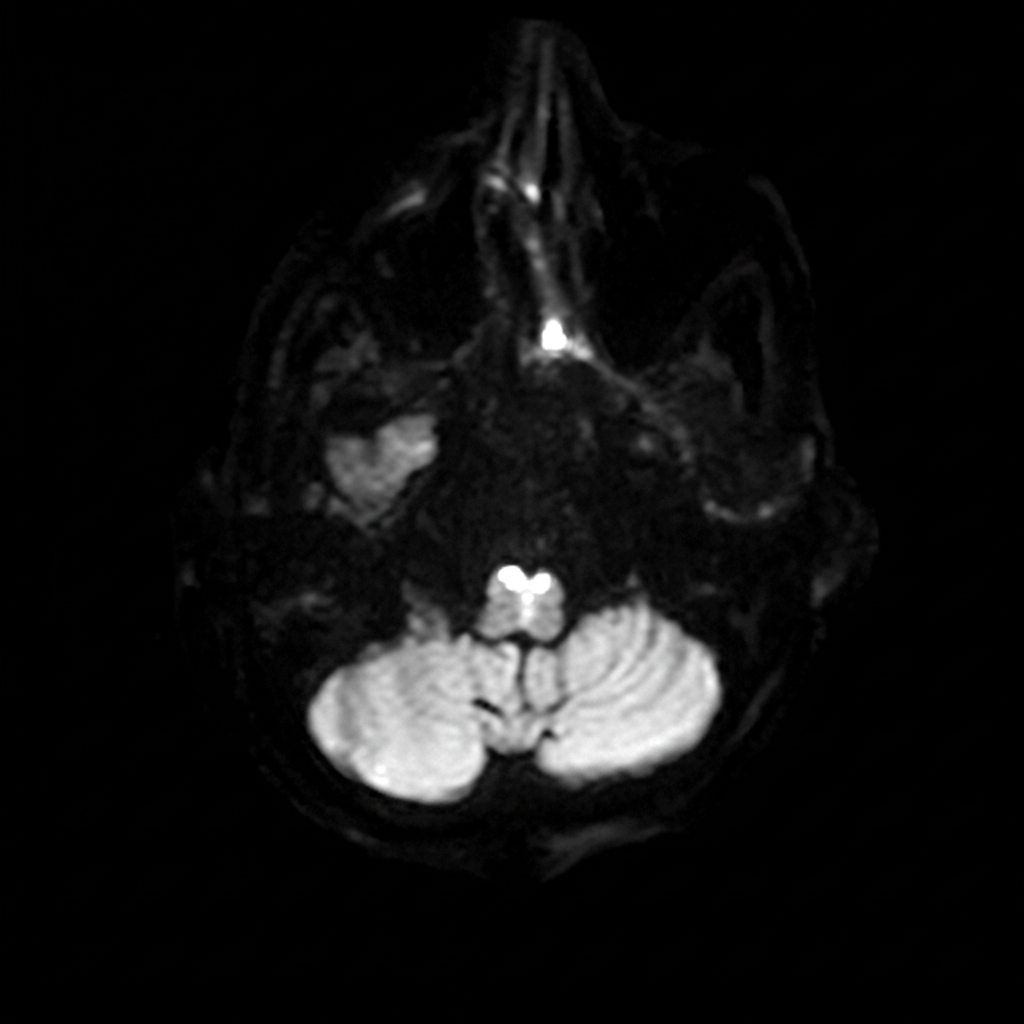
A 45-year-old man with AIDS presents with misperceptions, tiredness, and memory loss. Which imaging feature favors a diagnosis of progressive multifocal leukoencephalopathy over HIV encephalopathy?
What condition is associated with the "Radial Band" sign on MRI Brain?
What is the commonest location for Craniopharyngioma?
Tigroid pattern on MRI is associated with which of the following diseases?
The gyromagnetic property of the Hydrogen nucleus is utilized in which imaging modality?
Diffusion-weighted imaging typically shows bright signal suggestive of diffusion restriction in all of the following except?
Which of the following statements about Craniopharyngioma is FALSE?
Intracranial calcification with cystic lesion in plain X-ray skull is seen in?
Which of the following statements is FALSE regarding Multiple Sclerosis (MS)?
Which of the following intracranial materials appears most dense on computed tomography of the head?
Explanation: ### Explanation The clinical presentation of cognitive decline in an AIDS patient necessitates a distinction between **Progressive Multifocal Leukoencephalopathy (PML)** and **HIV Encephalopathy (HIVE)**. **Why Option D is Correct:** PML is caused by the reactivation of the **JC virus**, which infects oligodendrocytes. On MRI, it typically presents as **bilateral, asymmetrical** white matter hyperintensities on T2/FLAIR. A hallmark feature of PML is its predilection for the **peripheral subcortical white matter**, specifically involving the **subcortical U-fibers**, giving the lesions a "scalloped" appearance at the gray-white matter junction. **Why Other Options are Incorrect:** * **A & B (Mass effect and Contrast enhancement):** Both PML and HIVE are typically **non-enhancing** and do **not** exhibit mass effect. The presence of enhancement or mass effect should prompt consideration of CNS Lymphoma or Toxoplasmosis. * **C (Bilateral symmetrical periventricular lesions):** This is the classic description of **HIV Encephalopathy**. HIVE tends to be diffuse, symmetric, and characteristically **spares the subcortical U-fibers**, localized instead in the deep periventricular white matter. **NEET-PG High-Yield Pearls:** 1. **PML:** Asymmetric + Peripheral (U-fibers involved) + Scalloped borders. 2. **HIVE:** Symmetric + Central/Periventricular (U-fibers spared) + Associated with diffuse cerebral atrophy. 3. **Imaging Modality of Choice:** MRI is far more sensitive than CT for both conditions. 4. **CD4 Count:** PML usually occurs when CD4 < 100 cells/µL, whereas HIVE can occur at slightly higher levels but is most severe in advanced AIDS.
Explanation: ### Explanation **Correct Answer: B. Tuberous Sclerosis** The **"Radial Band" sign** is a highly specific neuroimaging feature of **Tuberous Sclerosis Complex (TSC)**. These bands represent linear or curvilinear areas of abnormal signal intensity extending from the periventricular white matter to the subcortical region (cortex). * **Pathophysiology:** They correspond to **migratory tracks** of dysplastic glial cells and neurons that failed to reach the cortical surface during embryogenesis. * **MRI Appearance:** They are best visualized on **FLAIR** or **T2-weighted** sequences as hyperintense lines following the path of the radial glial fibers. --- ### Why the other options are incorrect: * **A. Multiple Sclerosis:** Characterized by **Dawson’s Fingers**, which are ovoid demyelinating plaques oriented perpendicular to the lateral ventricles, representing perivenular inflammation. * **C. Multisystem Atrophy type C (MSA-C):** Classically associated with the **"Hot Cross Bun" sign**, representing degeneration of the pontine fibers and raphe nuclei. * **D. Progressive Supranuclear Palsy (PSP):** Associated with the **"Hummingbird" sign** or **"Mickey Mouse" sign** due to midbrain atrophy with preservation of the pons. --- ### High-Yield Clinical Pearls for NEET-PG: 1. **Vogt’s Triad (TSC):** Adenoma sebaceum (facial angiofibromas), Mental retardation, and Seizures (only seen in ~30% of patients). 2. **Other CNS findings in TSC:** * **Cortical Tubers:** Hamartomatous lesions (90% of cases). * **Subependymal Nodules (SEN):** Located along the walls of lateral ventricles; often calcified ("Candle guttering"). * **SEGA (Subependymal Giant Cell Astrocytoma):** A benign tumor typically located near the Foramen of Monro, which can cause obstructive hydrocephalus. 3. **Ash-leaf spots:** Often the earliest clinical sign of TSC, visible under Wood’s lamp.
Explanation: **Explanation:** Craniopharyngiomas are benign but locally aggressive tumors (WHO Grade 1) derived from the remnants of **Rathke’s pouch**. Understanding their embryological origin is key to identifying their location. **1. Why Suprasellar is correct:** The most common location for Craniopharyngioma is the **suprasellar region (approx. 75-90%)**. While they can involve both the sella and the suprasellar space, a purely intrasellar location is rare. They typically arise from the pituitary stalk (infundibulum) and expand upwards into the suprasellar cistern, often compressing the optic chiasm. **2. Analysis of Incorrect Options:** * **Intrasellar:** While Craniopharyngiomas can have an intrasellar component, a purely intrasellar location is seen in only about 5-10% of cases. Pituitary adenomas are the most common purely intrasellar tumors. * **Intraventricular:** Though large tumors can bulge into the floor of the third ventricle, they do not primarily originate there. * **Intracerebral:** These tumors are extra-axial (outside the brain parenchyma). **3. NEET-PG High-Yield Pearls:** * **Bimodal Age Distribution:** Peaks at 5–14 years and 50–75 years. * **Adamantinomatous Type:** Common in children; characterized by "machine oil" fluid, calcification (90%), and a cystic appearance. * **Papillary Type:** Common in adults; usually solid, lacks calcification. * **Imaging Hallmark:** The "Rule of 90s" for pediatric cases—90% are cystic, 90% show enhancement, and 90% show calcification (best seen on CT). * **Clinical Triad:** Visual field defects (Bitemporal hemianopia), endocrine dysfunction (GH deficiency/Diabetes Insipidus), and increased intracranial pressure.
Explanation: **Explanation:** The **Tigroid pattern** (also known as the leopard skin pattern) is a classic radiological sign seen in **Metachromatic Leukodystrophy (MLD)**. **1. Why Metachromatic Leukodystrophy is correct:** MLD is an autosomal recessive lysosomal storage disorder caused by a deficiency of the enzyme **Arylsulfatase A**, leading to the accumulation of sulfatides. On T2-weighted MRI, there is confluent symmetrical periventricular white matter hyperintensity. The "Tigroid" appearance occurs because of the **sparing of the perivascular myelin bundles** within the areas of demyelination. These spared dark spots/stripes against a bright background of demyelinated white matter resemble the skin of a tiger or leopard. **2. Why other options are incorrect:** * **Krabbe disease:** Characterized by "thalami hyperdensity" on CT and involvement of the posterior limb of the internal capsule and optic radiations. It does not show the tigroid pattern. * **Niemann-Pick disease:** Primarily a lipid storage disorder affecting the viscera (hepatosplenomegaly) and brain (atrophy), but it is not typically associated with specific leukodystrophy patterns like the tigroid sign. * **Alexander disease:** Characterized by a **frontal lobe predominance** of white matter changes and the presence of Rosenthal fibers on pathology. **3. High-Yield Clinical Pearls for NEET-PG:** * **MLD:** Most common hereditary leukodystrophy; look for "Tigroid pattern" and "Gallbladder wall thickening." * **Adrenoleukodystrophy:** X-linked; involves **posterior** white matter (occipito-parietal) and shows peripheral enhancement. * **Canavan Disease:** Characterized by **elevated N-acetylaspartate (NAA)** on MR spectroscopy and involvement of subcortical U-fibers (macrocephaly). * **Pelizaeus-Merzbacher Disease:** Also shows a tigroid pattern, but MLD is the more common association tested.
Explanation: ### Explanation **Correct Answer: D. Magnetic Resonance Imaging (MRI)** The fundamental principle of MRI is based on the **gyromagnetic properties** of atomic nuclei that possess an odd number of protons or neutrons. The **Hydrogen nucleus ($^1H$)**, consisting of a single proton, is the most commonly used element in clinical MRI because of its abundance in the human body (water and fat) and its high **gyromagnetic ratio**. When placed in a strong external magnetic field ($B_0$), these hydrogen protons align themselves and undergo **precession** (a spinning motion). The frequency of this precession is determined by the **Larmor Equation**: $\omega = \gamma B_0$ (where $\gamma$ is the gyromagnetic ratio). By applying a Radiofrequency (RF) pulse at this specific frequency, the nuclei absorb energy (resonance), which is later emitted as a signal to create the image. **Why other options are incorrect:** * **Ultrasonography (USG):** Utilizes high-frequency **sound waves** and the principle of acoustic impedance/piezoelectric effect, not magnetism. * **Positron Emission Tomography (PET):** A functional imaging modality that detects pairs of **gamma rays** emitted indirectly by a positron-emitting radionuclide (tracer). * **Computed Tomography (CT):** Uses **X-rays** (ionizing radiation) to measure the attenuation of tissues based on their electron density. **High-Yield Clinical Pearls for NEET-PG:** * **Gyromagnetic ratio ($\gamma$) of Hydrogen:** Approximately **42.58 MHz/Tesla**. * **Tesla (T):** The unit of magnetic field strength. 1 Tesla = 10,000 Gauss. * **Quenching:** The rapid loss of superconductivity in MRI magnets, leading to the release of liquid helium (cryogen). * **Contraindications:** MRI is contraindicated in patients with non-compatible cardiac pacemakers, metallic intraocular foreign bodies, or cochlear implants.
Explanation: **Explanation:** Diffusion-Weighted Imaging (DWI) measures the random Brownian motion of water molecules. **Diffusion restriction** (appearing bright/hyperintense on DWI and dark on ADC maps) occurs when this movement is limited by cellular swelling, high cellularity, or viscous material. **Why Alzheimer’s Disease is the correct answer:** Alzheimer’s is a **neurodegenerative disorder** characterized by neuronal loss and brain atrophy. Instead of restriction, there is often an *increase* in the extracellular space due to cell death, leading to **increased diffusion** (facilitated diffusion). Therefore, it does not show the bright signal characteristic of restriction. **Analysis of Incorrect Options:** * **MCA Territory Infarct:** In acute ischemic stroke, the failure of Na+/K+ ATPase pumps leads to **cytotoxic edema**. Water shifts into cells, causing them to swell and narrowing the extracellular space, which severely restricts diffusion. This is the most common clinical use of DWI. * **Brain Abscess:** The central cavity of a pyogenic abscess contains thick, **viscous pus** (inflammatory cells, bacteria, and debris), which significantly restricts the movement of water molecules. * **CNS Lymphoma:** This is a highly **hypercellular tumor** with a high nuclear-to-cytoplasmic ratio. The dense packing of cells leaves little room for water to move, resulting in diffusion restriction. **Clinical Pearls for NEET-PG:** * **DWI "Bright" Mnemonic (ABCD):** **A**bscess, **B**lood (Acute clot), **C**ytotoxic edema (Infarct), **D**ense tumors (Lymphoma, Medulloblastoma). * **ADC Map:** Always correlate DWI with the Apparent Diffusion Coefficient (ADC) map to rule out "T2 shine-through." True restriction must be **Bright on DWI and Dark on ADC.** * **Epidermoid Cyst:** A classic differential for a "bright" DWI signal in the CP angle, distinguishing it from an arachnoid cyst (which follows CSF signal).
Explanation: **Explanation:** Craniopharyngiomas are benign, slow-growing tumors arising from the remnants of **Rathke’s pouch**. Understanding the distinction between its two histological subtypes is crucial for NEET-PG. **Why Option B is the Correct (False) Statement:** Calcification is a hallmark of Craniopharyngioma, but its frequency varies significantly with age. It is seen in over **90% of pediatric cases** (Adamantinomatous type) but is relatively **uncommon in adults** (Papillary type), occurring in only about 40-50% of cases. Therefore, stating it "commonly calcifies in adults" is inaccurate compared to the pediatric population. **Analysis of Other Options:** * **Option A (Solid-cystic lesion):** This is a classic imaging finding. On MRI/CT, these tumors typically present as complex masses with both solid components and large cystic areas. * **Option C (Adamantinomatous type):** This subtype follows a bimodal distribution but is predominantly seen in **children**. It is characterized by the "wet keratin" and the "90% rule" (90% cystic, 90% calcified). * **Option D (Machine oil content):** The cysts in the adamantinomatous type contain a thick, brownish-yellow fluid rich in cholesterol crystals, often described as **"motor oil" or "machine oil"** appearance. **High-Yield Clinical Pearls for NEET-PG:** * **Location:** Most common suprasellar tumor in children. * **Visual Deficit:** Bitemporal hemianopia (due to compression of the optic chiasm). * **Endocrine Issues:** Growth retardation and Diabetes Insipidus are common presentations. * **Imaging Sign:** "Eggshell calcification" on CT. * **Papillary Type:** Seen almost exclusively in adults; usually solid, lacks calcification, and lacks the "machine oil" fluid.
Explanation: **Explanation:** **Craniopharyngioma** is the most common suprasellar tumor in children and is characterized by a classic triad of **Cysts, Calcification, and Solid components**. On a plain X-ray skull, the presence of suprasellar calcification associated with a cystic lesion is highly suggestive of this diagnosis. Calcification is seen in approximately **90% of pediatric cases** and about 50% of adult cases. These tumors arise from the remnants of **Rathke’s pouch** and often present with visual field defects (bitemporal hemianopia) and endocrine dysfunction. **Why other options are incorrect:** * **Meningioma:** While these are frequently calcified (psammomatous calcification), they are typically **solid, hyperdense** extra-axial tumors. They rarely present as cystic lesions on plain X-rays. * **Glioma:** Low-grade gliomas may show calcification (especially Oligodendrogliomas), but they are primarily parenchymal tumors and do not typically present with the classic "cystic-calcified" appearance in the suprasellar region on a plain radiograph. * **Medulloblastoma:** This is a posterior fossa tumor (involving the cerebellum/fourth ventricle). While it may show faint calcification in 10-20% of cases, it is not a cystic lesion and is not located in the regions typically assessed for calcification on a standard lateral skull X-ray. **High-Yield Clinical Pearls for NEET-PG:** * **Adamantinomatous type:** Common in children; shows "machine oil" fluid within cysts and heavy calcification. * **Papillary type:** Common in adults; usually solid and rarely calcified. * **Imaging Gold Standard:** MRI is preferred to see the "machinery oil" appearance (high T1 signal), but **CT is the most sensitive** for detecting the characteristic calcification.
Explanation: ### Explanation **1. Why Option C is the Correct (False) Statement:** In Multiple Sclerosis (MS), **T2-weighted (T2W) and FLAIR (Fluid-Attenuated Inversion Recovery)** sequences are the most sensitive for detecting plaques. On T1-weighted images, acute plaques are usually isointense or hypointense and are not diagnostic on their own. However, **Gadolinium-enhanced T1 images** are the gold standard for identifying *active* (acute) inflammation, as they show breakdown of the blood-brain barrier. Chronic, irreversible axonal damage appears as "black holes" (hypointensities) on T1. **2. Analysis of Other Options:** * **Option A (True):** Involvement of the **corpus callosum** (specifically the callososeptal interface) is highly characteristic of MS. These are often seen as "Dawson’s Fingers"—ovoid lesions oriented perpendicular to the lateral ventricles. * **Option B (True):** MS plaques typically occur in the **periventricular white matter**. On CT, these appear as areas of **decreased attenuation** (hypodense), though CT is significantly less sensitive than MRI. * **Option D (True):** MS plaques are characterized by edema and demyelination, which increases water content. Therefore, they appear **hyperintense (bright)** on T2-weighted and FLAIR sequences. **3. High-Yield Clinical Pearls for NEET-PG:** * **McDonald Criteria:** The current diagnostic standard focusing on dissemination in space (DIS) and time (DIT). * **Imaging Gold Standard:** MRI is the investigation of choice. * **Dawson’s Fingers:** Pathognomonic T2/FLAIR hyperintensities perpendicular to the ventricles representing perivenular demyelination. * **CSF Findings:** Presence of **Oligoclonal bands** (IgG) not present in the serum. * **Uhtoff’s Phenomenon:** Worsening of neurological symptoms with increased body temperature.
Explanation: **Explanation:** The density of structures on a Computed Tomography (CT) scan is measured in **Hounsfield Units (HU)**, which represents the degree of X-ray attenuation. The higher the HU value, the denser (whiter/more hyperdense) the material appears. 1. **Acute Hematoma (Correct):** Fresh blood is hyperdense on CT, typically ranging from **+60 to +80 HU**. This high density is primarily due to the high concentration of **hemoglobin** and the formation of a fibrin clot, which increases protein density relative to water. As a hematoma ages (chronic stage), it becomes isodense and eventually hypodense as hemoglobin breaks down. 2. **Gray Matter:** Appears slightly denser than white matter due to higher water content and lower lipid content, with values around **+35 to +45 HU**. 3. **White Matter:** Contains high amounts of myelin (fat), which is less dense than cellular gray matter. It typically measures **+20 to +30 HU**. 4. **CSF (Cerebrospinal Fluid):** Being primarily water-based, it has a low density of **0 to +10 HU**, appearing dark (hypodense) on CT. **High-Yield Clinical Pearls for NEET-PG:** * **Density Hierarchy:** Bone (+1000 HU) > Acute Blood (+60 to +80) > Gray Matter (+40) > White Matter (+30) > Water/CSF (0) > Fat (-50 to -100) > Air (-1000). * **The "Lemon" vs. "Banana":** Epidural hematomas (EDH) are biconvex/lentiform, while Subdural hematomas (SDH) are crescent-shaped. * **Hyperdense MCA Sign:** An early sign of ischemic stroke representing an acute thrombus in the Middle Cerebral Artery.
Neuroanatomy for Radiologists
Practice Questions
Cerebrovascular Diseases
Practice Questions
Intracranial Tumors
Practice Questions
CNS Infections
Practice Questions
Demyelinating and Degenerative Diseases
Practice Questions
Head Trauma Imaging
Practice Questions
Spine Imaging: Trauma and Degenerative Disease
Practice Questions
Spine Tumors and Infections
Practice Questions
Pediatric Neuroradiology
Practice Questions
Congenital CNS Anomalies
Practice Questions
Functional Neuroimaging
Practice Questions
Neurointerventional Procedures
Practice Questions
Get full access to all questions, explanations, and performance tracking.
Start For Free