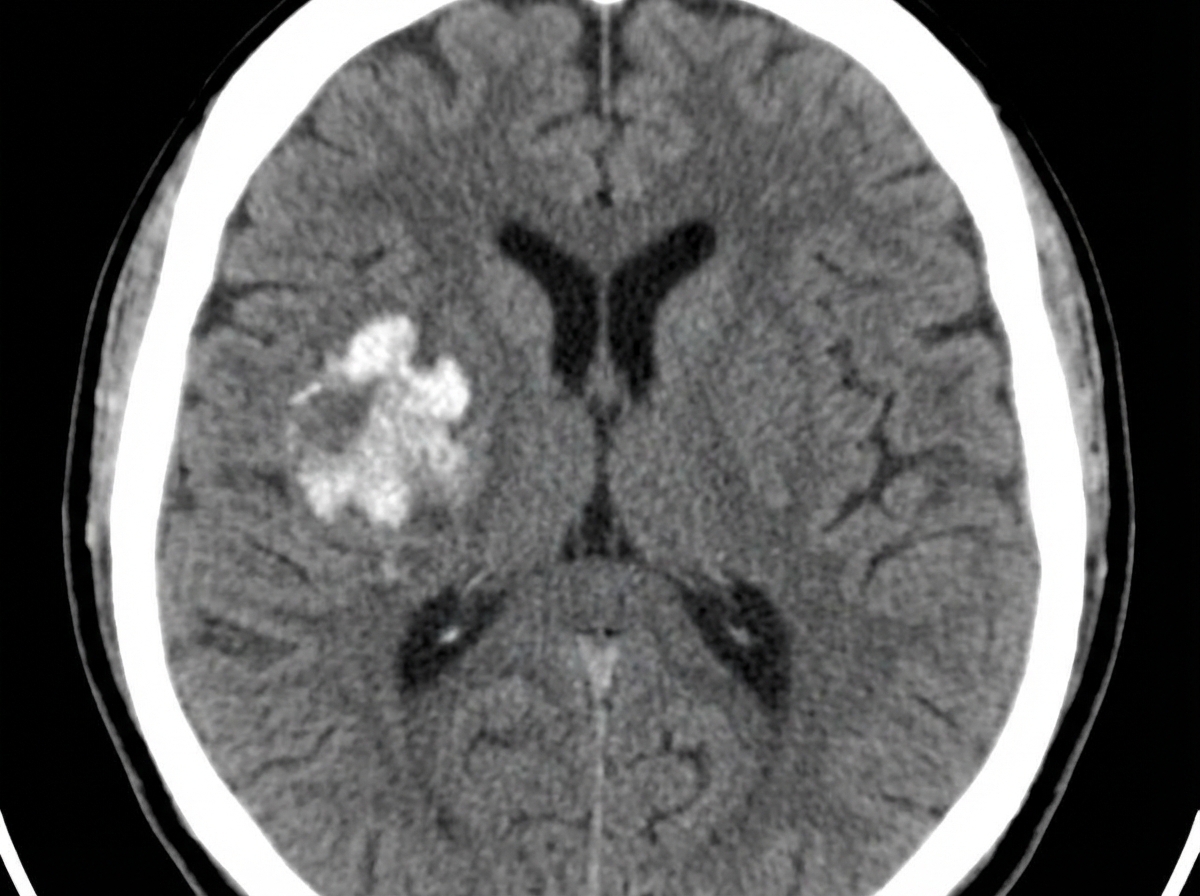
Which of the following is not a MRI feature of Mesial temporal sclerosis?
Which imaging modality detects a brain infarct at the earliest?
Which of the following is NOT a normal variant of intracranial venous drainage?
Medusa head appearance on MRI is seen in which of the following?
Humming bird sign on MRI is seen in which of the following conditions?
Which condition is characterized by 'eggshell' calcification in the skull X-ray?
A 9-year-old child presents with scoliosis, a hairy tuft in the skin of the back, and neurological deficit. Plain X-rays reveal multiple vertebral anomalies and a vertical bony spur overlying the lumbar spine on AP view. What is the most probable diagnosis?
Aneurysm of which artery causes a perichiasmal lesion that may cause nasal hemianopia?
Tram line calcification seen in skull X-ray are characteristic of:
A 52-year-old female complains of sudden visual abnormalities. Her history reveals a 30 pack-year history of smoking, hypertension, and hypercholesterolemia. A head CT shows a lesion in the right occipital lobe, and an angiogram reveals an embolic stroke of the right posterior cerebral artery. What type of visual deficit is she most likely experiencing?
Explanation: **Explanation:** Mesial Temporal Sclerosis (MTS) is the most common cause of drug-resistant focal epilepsy. It is characterized by neuronal loss and gliosis within the hippocampus and associated structures of the limbic system. **Why Option C is the correct answer:** Blurring of the grey-white matter junction is a classic imaging hallmark of **Focal Cortical Dysplasia (FCD)**, not MTS. While MTS involves atrophy and signal changes, the distinct demarcation between grey and white matter in the temporal lobe is generally preserved. If blurring is present, it suggests a different underlying pathology or a dual pathology (MTS + FCD). **Analysis of Incorrect Options (Features of MTS):** * **D. Atrophy of hippocampus:** This is the most sensitive and specific sign. On MRI, it presents as a loss of volume and increased T2/FLAIR signal intensity (gliosis). * **A & B. Atrophy of Mammillary Body and Fornix:** The hippocampus is part of the Circuit of Papez. Chronic hippocampal neuronal loss leads to **transneuronal degeneration** of its efferent pathways. Since the fornix is the primary outflow tract and the mammillary bodies are the major targets, both undergo secondary atrophy in chronic MTS. **NEET-PG High-Yield Pearls:** * **Best MRI Sequence:** Coronal T2-weighted or FLAIR images perpendicular to the long axis of the hippocampus. * **Classic Triad:** Hippocampal atrophy, increased T2 signal, and loss of internal architecture (digitations). * **Associated Findings:** Dilatation of the temporal horn of the lateral ventricle (ex-vacuo) and atrophy of the collateral white matter (the "temporal pole" signal change). * **Clinical Correlation:** Often associated with a history of prolonged febrile seizures in early childhood.
Explanation: **Explanation:** **Diffusion-Weighted Imaging (DWI)** is the most sensitive imaging modality for detecting an acute ischemic stroke. It can identify an infarct within **3–30 minutes** of onset. The underlying mechanism is **Cytotoxic Edema**. When blood flow is compromised, the failure of the ATP-dependent Na+/K+ pump causes sodium and water to shift into the intracellular space. This restricts the Brownian motion (random movement) of water molecules. DWI sequences are highly sensitive to this restriction, appearing as a **hyperintensity (bright signal)** on the scan. **Why other options are incorrect:** * **NCCT (Non-contrast CT):** While it is the initial investigation of choice to **rule out hemorrhage**, it is insensitive to early ischemic changes. Signs like the "Hyperdense MCA sign" or "Insular ribbon sign" usually take 6–12 hours to appear. * **CECT:** Contrast is generally avoided in acute stroke protocols as it can mask an underlying hemorrhage and does not improve the detection of early ischemia compared to NCCT. * **X-ray:** This modality has no role in the diagnosis of intracranial soft tissue pathologies like infarcts. **High-Yield Clinical Pearls for NEET-PG:** * **Gold Standard for Stroke:** MRI with DWI is the gold standard for early diagnosis. * **DWI vs. ADC:** To confirm a true infarct and rule out "T2 shine-through," the hyperintensity on DWI must correspond to a **hypointensity (dark signal) on the ADC (Apparent Diffusion Coefficient) map.** * **Earliest CT sign:** Hyperdense MCA sign (represents a thrombus). * **Window Period:** For thrombolysis (IV Alteplase), the window is 4.5 hours; for mechanical thrombectomy, it can extend up to 24 hours based on perfusion imaging.
Explanation: **Explanation:** The **Median Prosencephalic Vein (MPV)** is not a normal variant; it is a **pathological embryonic precursor**. In normal development, the MPV regresses as the internal cerebral veins and the Great Vein of Galen form. If the MPV persists, it leads to a **Vein of Galen Malformation (VOGM)**—a high-flow arteriovenous shunt typically diagnosed in neonates presenting with high-output heart failure or macrocephaly. **Analysis of Incorrect Options:** * **Inferior Sagittal Sinus:** A normal anatomical structure located in the free lower margin of the falx cerebri. It drains into the Straight Sinus. * **Occipital Sinus:** A normal variant and the smallest of the dural venous sinuses. It resides in the attached margin of the falx cerebelli and drains into the confluence of sinuses (torcular herophili). * **Marginal Sinus:** A normal venous channel that surrounds the foramen magnum. It communicates with the occipital sinus and the internal vertebral venous plexus. **High-Yield Clinical Pearls for NEET-PG:** * **Vein of Galen Malformation:** The most common "aneurysm" in the neonatal brain is actually a persistent Median Prosencephalic Vein. * **Persistent Falcine Sinus:** Often associated with the absence or hypoplasia of the Straight Sinus; it is a common finding in VOGM. * **Empty Delta Sign:** Seen on contrast CT/MRI in **Dural Venous Sinus Thrombosis (DVST)**, most commonly involving the Superior Sagittal Sinus. * **Torcular Herophili:** The confluence where the Superior Sagittal, Straight, and Occipital sinuses meet.
Explanation: **Explanation:** **Venous Angioma**, also known as **Developmental Venous Anomaly (DVA)**, is the most common intracranial vascular malformation. It consists of a cluster of small, radially arranged medullary veins that drain into a single, large collector vein. On MRI (especially post-gadolinium T1 or susceptibility-weighted imaging), this radial pattern resembles the snakes on the head of the mythical figure Medusa, hence the classic **"Caput Medusae"** or **"Medusa head"** appearance. **Analysis of Incorrect Options:** * **Arteriovenous Malformation (AVM):** Characterized by a "bag of worms" appearance due to a nidus of tangled vessels with high-flow shunting. It does not show the organized radial drainage pattern of a DVA. * **Cavernous Hemangioma (Cavernoma):** Classically described as having a **"Popcorn"** or "Mulberry" appearance on MRI, often with a peripheral rim of hemosiderin (hypointense on T2/GRE). * **Vein of Galen Malformation:** An arteriovenous fistula resulting in massive dilatation of the prosencephalic vein of Markowski. It typically presents in neonates with high-output heart failure. **High-Yield Clinical Pearls for NEET-PG:** * **Management:** DVAs are usually asymptomatic "incidentalomas" and represent a variation of normal venous drainage. They should **not** be surgically removed, as doing so can lead to venous infarction of the brain territory they drain. * **Associations:** DVAs are frequently associated with **Cavernous Malformations** (up to 30% of cases). * **Imaging Gold Standard:** While MRI is excellent, Digital Subtraction Angiography (DSA) shows the "Medusa head" specifically during the **venous phase**.
Explanation: The **Hummingbird sign** (also known as the **Penguin sign**) is a classic radiologic hallmark of **Progressive Supranuclear Palsy (PSP)**, a Parkinson-plus syndrome. ### 1. Why Progressive Supranuclear Palsy is Correct The sign is seen on **midsagittal T1-weighted MRI** images. It occurs due to profound **atrophy of the midbrain tegmentum** while the pons remains relatively preserved in size. This creates a silhouette resembling a hummingbird, where the thinned midbrain represents the bird's head/beak and the bulky pons represents the body. Another related finding is the **Mickey Mouse sign**, seen on axial sections due to the thinning of the midbrain peduncles. ### 2. Why Other Options are Incorrect * **Multiple Sclerosis:** Characterized by "Dawson’s Fingers" (periventricular demyelinating plaques perpendicular to the lateral ventricles) and the "Open Ring sign." * **Developmental Venous Anomaly (DVA):** A benign vascular variant characterized by the **"Caput Medusae" sign** (multiple small medullary veins draining into a single large collector vein). ### 3. High-Yield Clinical Pearls for NEET-PG * **Clinical Triad of PSP:** Supranuclear ophthalmoplegia (vertical gaze palsy), pseudobulbar palsy, and axial rigidity with frequent early falls. * **Mickey Mouse Sign:** Axial MRI showing midbrain atrophy in PSP. * **Hot Cross Bun Sign:** Seen in **MSA-C** (Multiple System Atrophy, Cerebellar type) due to degeneration of pontocerebellar fibers. * **Eye-of-the-Tiger Sign:** Seen in **NBIA** (Pantothenate Kinase-Associated Neurodegeneration) involving the globus pallidus.
Explanation: **Explanation:** The correct answer is **Lipoma of Corpus Callosum**. This is a rare congenital lesion (a hamartoma) often associated with dysgenesis of the corpus callosum. On a lateral skull X-ray, it presents with a pathognomonic **"Eggshell" or "Bracket-shaped" calcification**. This occurs because the lipoma undergoes peripheral curvilinear calcification at its margins. On CT, it is easily identified by its characteristic fat density (negative Hounsfield units). **Analysis of Incorrect Options:** * **Meningioma:** Typically shows **"Psammomatous" calcification** (punctate/granular). On X-ray, it may also show hyperostosis of the overlying bone or increased vascular markings (sunburst appearance). * **Tuberous Sclerosis:** Characterized by **"Candle guttering"** appearance due to subependymal nodules. Calcifications are usually multiple, nodular, and located in the periventricular regions (subependymal hamartomas). * **Sturge-Weber Syndrome:** Classically presents with **"Tram-track" or "Railroad track" calcifications**. These are cortical/subcortical curvilinear calcifications that follow the gyri and sulci of the brain, usually in the occipital or parietal lobes. **High-Yield Clinical Pearls for NEET-PG:** * **Lipoma of Corpus Callosum:** Most common location for intracranial lipomas; frequently associated with **agenesis of the corpus callosum**. * **Other "Eggshell" Calcifications:** In systemic radiology, this term also refers to hilar lymph nodes in **Silicosis** and the wall of a **Hydatid cyst**. * **Fat on MRI:** Lipomas appear hyperintense on T1-weighted images and drop in signal on fat-suppression sequences.
Explanation: ### Explanation The clinical presentation of a **hairy tuft (hypertrichosis)**, scoliosis, and neurological deficits in a child is classic for **Spinal Dysraphism**. The pathognomonic finding here is the **vertical bony spur** seen on the AP X-ray, which confirms the diagnosis of **Diastomatomyelia**. #### 1. Why Diastomatomyelia is Correct Diastomatomyelia is a type of occult spinal dysraphism characterized by a **longitudinal splitting of the spinal cord** into two hemicords. * **The Spur:** In Type I diastomatomyelia, the hemicords are separated by a rigid **osseous (bony) or fibrocartilaginous septum** (the "spur"). This spur is visible on plain X-rays and CT scans. * **Cutaneous Markers:** Overlying skin changes like a tuft of hair, hemangioma, or dimples are present in over 50% of cases. * **Tethered Cord:** The septum often "tethers" the cord, leading to progressive neurological deficits and scoliosis as the child grows. #### 2. Why Other Options are Incorrect * **Dorsal Dermal Sinus:** This is an epithelium-lined tract extending from the skin to the deep tissues/spine. While it presents with a skin dimple, it does not feature a bony spur on X-ray. * **Tight Filum Terminale:** This involves a thickened filum (>2mm) causing a low-lying conus medullaris. It presents with "Tethered Cord Syndrome" but lacks the sagittal splitting of the cord or a bony septum. * **Caudal Regression Syndrome:** This involves partial or complete agenesis of the distal spine (sacrum/lumbar vertebrae). It is strongly associated with maternal diabetes, not a midline bony spur. #### 3. NEET-PG High-Yield Pearls * **Imaging Gold Standard:** **MRI** is the investigation of choice to visualize the hemicords and the contents of the thecal sac. * **Location:** Most commonly occurs between **L1 and L3** levels. * **Associated Anomalies:** Frequently associated with **syringomyelia** and **vertebral anomalies** (hemivertebrae, butterfly vertebrae, or intersegmental fusion). * **Pang’s Classification:** Type I (two dural sacs with a bony spur) vs. Type II (single dural sac with a fibrous septum).
Explanation: ### Explanation The visual pathway is highly sensitive to vascular compression. To understand this question, one must correlate the anatomical location of the artery with the specific fibers of the optic chiasm it compresses. **1. Why Ophthalmic Artery is correct:** The **ophthalmic artery** arises from the internal carotid artery (ICA) just as it emerges from the cavernous sinus, medial to the anterior clinoid process. An aneurysm at this origin (specifically the **Ophthalmic segment of the ICA**) projects superiorly and medially. This puts direct pressure on the **lateral (uncrossed) fibers** of the optic chiasm. Since the lateral fibers carry information from the **nasal retina** (which views the temporal field), unilateral compression causes a nasal field defect in the ipsilateral eye. If the compression is bilateral (rare), it results in **binasal hemianopia**. **2. Why other options are incorrect:** * **Anterior Communicating Artery (A-com):** Aneurysms here typically compress the **central/anterior** aspect of the chiasm, affecting decussating nasal fibers, leading to **bitemporal hemianopia**. * **Middle Cerebral Artery (MCA):** The MCA is located laterally in the Sylvian fissure, far from the optic chiasm. MCA strokes or aneurysms typically affect the optic radiations, causing **homonymous hemianopia**. * **Posterior Communicating Artery (P-com):** P-com aneurysms are classic for causing **3rd Nerve Palsy** (mydriasis and ptosis) due to their proximity to the oculomotor nerve, rather than chiasmal field defects. **3. NEET-PG High-Yield Pearls:** * **Bitemporal Hemianopia:** Most common chiasmal defect; caused by Pituitary Adenoma (from below), Craniopharyngioma (from above), or A-com aneurysms. * **Binasal Hemianopia:** Extremely rare; associated with bilateral ICA atherosclerosis or ophthalmic artery aneurysms. * **Rule of Thumb:** Lateral compression = Nasal defect; Central compression = Temporal defect.
Explanation: **Explanation:** **Sturge-Weber Syndrome (SWS)**, also known as encephalotrigeminal angiomatosis, is the correct answer. The characteristic "tram-line" or "railroad track" calcifications seen on a skull X-ray (and more clearly on CT) represent **gyriform cortical calcifications**. These occur due to chronic ischemia and venous stasis caused by the underlying leptomeningeal angioma, leading to calcium deposition in the second and third layers of the cerebral cortex. These calcifications typically follow the convolutions of the brain, creating the parallel-line appearance. **Analysis of Incorrect Options:** * **Congenital CMV:** Characterized by **periventricular calcifications** (around the ventricles). * **Congenital Toxoplasmosis:** Characterized by **diffuse, scattered intracranial calcifications** throughout the brain parenchyma. * **Craniopharyngioma:** Shows **suprasellar calcifications** (curvilinear or nodular), most commonly seen in the adamantinomatous subtype in children. **High-Yield Clinical Pearls for NEET-PG:** * **SWS Triad:** 1. Port-wine stain (Nevus flammeus) in the V1/V2 distribution of the trigeminal nerve; 2. Leptomeningeal angioma (ipsilateral to the skin lesion); 3. Glaucoma. * **Imaging Gold Standard:** Contrast-enhanced **MRI** is the most sensitive investigation to detect leptomeningeal enhancement ("pial angiomatosis"). * **Skull X-ray finding:** Calcifications are usually not visible until after 2 years of age. * **Genetics:** Associated with a somatic mutation in the **GNAQ gene**.
Explanation: ### Explanation **1. Why the Correct Answer is Right:** The patient has suffered an embolic stroke of the **right Posterior Cerebral Artery (PCA)**, leading to an infarct in the **right occipital lobe** (primary visual cortex). * **Neuroanatomy:** The visual pathway posterior to the optic chiasm (optic tract, lateral geniculate nucleus, optic radiations, and visual cortex) carries fibers from the **contralateral** visual field. * A lesion in the right occipital lobe results in a loss of vision in the left half of the visual field in both eyes, a condition known as **Left Homonymous Hemianopia**. * *Note:* While PCA strokes often present with "macular sparing" due to collateral supply from the Middle Cerebral Artery (MCA) to the occipital pole, the primary deficit remains a homonymous hemianopia. **2. Why the Incorrect Options are Wrong:** * **A. Bitemporal hemianopia:** This occurs due to a lesion at the **optic chiasm** (e.g., pituitary adenoma), affecting the decussating nasal retinal fibers. * **B. Central scotoma:** This is typically seen in **macular degeneration** or **optic neuritis** (lesion of the macula or optic nerve). * **D. Left superior quadrantanopia:** Also known as "pie in the sky," this results from a lesion in the **Right Meyer’s Loop** (temporal lobe), not the entire occipital cortex. **3. Clinical Pearls for NEET-PG:** * **PCA Stroke Triad:** Homonymous hemianopia (with macular sparing), hemisensory loss (thalamic involvement), and alexia without agraphia (if the dominant hemisphere/splenium is involved). * **Macular Sparing:** Occurs because the occipital pole (representing the macula) has a **dual blood supply** from both the PCA and MCA. * **Rule of Thumb:** Any lesion **behind the chiasm** produces a contralateral homonymous deficit.
Neuroanatomy for Radiologists
Practice Questions
Cerebrovascular Diseases
Practice Questions
Intracranial Tumors
Practice Questions
CNS Infections
Practice Questions
Demyelinating and Degenerative Diseases
Practice Questions
Head Trauma Imaging
Practice Questions
Spine Imaging: Trauma and Degenerative Disease
Practice Questions
Spine Tumors and Infections
Practice Questions
Pediatric Neuroradiology
Practice Questions
Congenital CNS Anomalies
Practice Questions
Functional Neuroimaging
Practice Questions
Neurointerventional Procedures
Practice Questions
Get full access to all questions, explanations, and performance tracking.
Start For Free