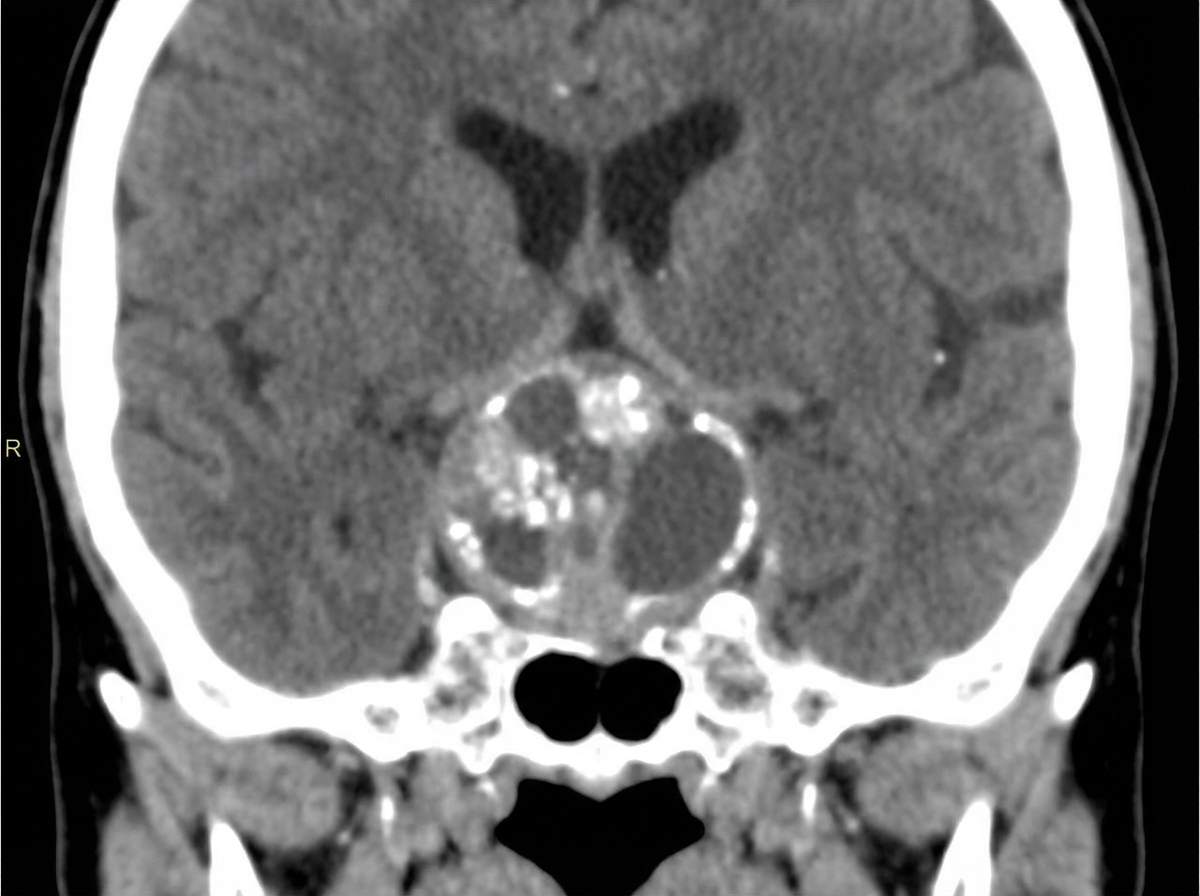
Which of the following findings would distinguish hydrocephalus due to aqueductal stenosis from hydrocephalus due to Dandy-Walker malformation?
The "Eye of the Tiger" sign on neuroimaging is classically associated with which of the following conditions?
Meningioma on plain radiography reveals which of the following findings?
Which is the least common site for the occurrence of a berry aneurysm?
Tram track calcification is a feature of which of the following conditions?
Pseudarthrosis of the tibia is seen associated with which of the following conditions?
A neurosurgeon evaluated a child presenting with precocious puberty and uncontrollable laughter. What is the likely diagnosis the neurosurgeon suspected, prompting an MRI?
The 'Hot Cross Bun' sign on MRI is characteristically seen in which of the following conditions?
A 37-year-old man with AIDS presents with confusion, lethargy, and memory loss. CT of the brain demonstrates multiple supratentorial enhancing masses. Which imaging feature favors a diagnosis of toxoplasmosis rather than primary CNS lymphoma?
What condition is characterized by a "puff of smoke" appearance on contrast CT angiography?
Explanation: The key to distinguishing various types of hydrocephalus on imaging lies in identifying the **level of obstruction** and the resulting **morphological changes** in the skull. ### **Why Posterior Fossa Volume is the Correct Answer** The fundamental difference between these two conditions is the anatomical site of the pathology: 1. **Dandy-Walker Malformation (DWM):** This is characterized by the triad of cystic dilatation of the fourth ventricle, cerebellar vermis agenesis/hypoplasia, and an **enlarged posterior fossa**. The high position of the tentorium and torcula (torcular-lambdoid inversion) leads to a pathognomonically large posterior fossa. 2. **Aqueductal Stenosis:** This involves an obstruction at the Aqueduct of Sylvius (connecting the 3rd and 4th ventricles). While it causes massive supratentorial dilatation, the **posterior fossa remains normal or even small** in size because the 4th ventricle is not involved and is often compressed. ### **Analysis of Incorrect Options** * **A & C (Third and Lateral Ventricles):** Both conditions result in "obstructive" hydrocephalus that causes significant dilatation of the lateral and third ventricles. Therefore, these cannot be used to differentiate the two. * **D (Head Circumference):** Both conditions can lead to macrocephaly (increased head circumference) due to increased intracranial pressure and ventricular expansion in an infant with open sutures. ### **High-Yield Clinical Pearls for NEET-PG** * **Dandy-Walker Triad:** 1. Cystic expansion of the 4th ventricle; 2. Vermian hypoplasia; 3. Enlarged posterior fossa. * **Aqueductal Stenosis:** Most common cause of congenital hydrocephalus. On MRI, look for "funneling" of the proximal aqueduct. * **Key Imaging Sign:** In DWM, the **Torcula** (confluence of sinuses) is pushed **above** the level of the lambdoid suture (Torcular-lambdoid inversion). * **Differential:** In **Mega Cisterna Magna**, the posterior fossa is large, but the cerebellar vermis and 4th ventricle are normal.
Explanation: ### Explanation **Correct Option: A. Pantothenate kinase-associated neurodegeneration (PKAN)** The "Eye of the Tiger" sign is a pathognomonic MRI finding seen on **T2-weighted imaging** of the brain. It is characterized by a central area of hyperintensity (representing gliosis and vacuolization) surrounded by a rim of marked hypointensity (representing iron deposition) in the **globus pallidus**. This condition, formerly known as Hallervorden-Spatz syndrome, is an autosomal recessive disorder caused by a mutation in the *PANK2* gene, leading to abnormal iron accumulation in the basal ganglia. **Incorrect Options:** * **B. Neurofibromatosis type 1:** Classically associated with **FASI** (Focal Abnormal Signal Intensities) or "UBOs" (Unidentified Bright Objects) on T2 MRI, typically found in the basal ganglia, cerebellum, and brainstem. * **C. Glomus tumor:** In the head and neck (e.g., Glomus jugulare), these tumors show a characteristic **"Salt and Pepper" appearance** on MRI due to high-flow vascular voids (pepper) and focal hemorrhage (salt). * **D. Alobar holoprosencephaly:** Characterized by the **"Pancake," "Cup," or "Bowl"** appearance of the cerebrum, a monoventricle, and fused thalami. **High-Yield Clinical Pearls for NEET-PG:** * **Imaging Modality:** The Eye of the Tiger sign is best visualized on **T2-weighted** or **T2* (Gradient Echo)** sequences due to their sensitivity to paramagnetic iron. * **Clinical Presentation:** Patients typically present with progressive extrapyramidal symptoms, including dystonia, parkinsonism, and spasticity. * **Differential for Basal Ganglia Iron:** While other NBIA (Neurodegeneration with Brain Iron Accumulation) disorders show iron deposition, the specific "Eye of the Tiger" pattern is highly specific for **PANK2 mutations**.
Explanation: **Explanation:** **Meningiomas** are the most common primary intracranial tumors. On plain radiography (Skull X-ray), the most characteristic and frequent finding is **calcification**, which occurs in approximately 10–15% of cases. This calcification is often psammomatous (sand-like) and can appear as a faint, punctate, or dense amorphous mass. **Why the other options are incorrect:** * **Erosion:** While large meningiomas can cause pressure atrophy of the inner table, it is less characteristic than calcification or hyperostosis. * **Sutural diastasis:** This is a sign of generalized increased intracranial pressure (ICP) in children whose sutures have not yet fused. It is not a specific feature of meningioma itself. * **Osteosclerosis:** While meningiomas often cause **Hyperostosis** (thickening of the overlying bone due to tumor invasion or vascularity), "osteosclerosis" is a more general term for increased bone density and is not the preferred radiological descriptor for the reactive bone changes seen in meningiomas. **High-Yield Clinical Pearls for NEET-PG:** * **Hyperostosis frontalis interna:** A common mimic on X-ray, but usually bilateral and spares the midline. * **Sunburst appearance:** Meningiomas can show a "sunburst" or "radial" pattern of spicules due to periosteal reaction. * **Gold Standard:** Contrast-enhanced MRI is the investigation of choice, showing the classic **"Dural Tail Sign."** * **Histology:** Look for **Psammoma bodies** (laminated calcifications) and whorled patterns of cells. * **Vascularity:** On angiography, they show a characteristic **"Mother-in-law sign"** (comes early, stays late).
Explanation: **Explanation:** Berry (saccular) aneurysms are the most common cause of non-traumatic subarachnoid hemorrhage (SAH). They typically occur at the bifurcations of the arteries within the **Circle of Willis**. **1. Why Vertebral Artery is the correct answer:** Approximately **85-95%** of berry aneurysms occur in the **Anterior Circulation**. The remaining **5-15%** occur in the **Posterior Circulation**. Within the posterior circulation, the Basilar artery (specifically the basilar tip) is the most common site. The **Vertebral artery** is statistically the least common site among the options provided, representing a very small fraction of posterior circulation aneurysms. **2. Analysis of Incorrect Options:** * **Anterior Communicating Artery (A-com):** This is the **most common** overall site (approx. 30-35%) for berry aneurysms. * **Middle Cerebral Artery (MCA):** This is the second most common site (approx. 20-25%), typically occurring at the MCA bifurcation in the Sylvian fissure. * **Basilar Artery:** While less common than anterior circulation sites, it is the most frequent site for aneurysms in the posterior circulation (approx. 10%). **Clinical Pearls for NEET-PG:** * **Most common site overall:** Anterior Communicating Artery. * **Most common site for Giant Aneurysms (>25mm):** Internal Carotid Artery (ICA). * **Risk Factors:** Hypertension, Smoking, Polycystic Kidney Disease (ADPKD), and Ehlers-Danlos syndrome. * **Gold Standard Investigation:** Digital Subtraction Angiography (DSA). * **Initial Investigation of choice for SAH:** Non-contrast CT (NCCT) Head (shows "star-shaped" hyperdensity in basal cisterns).
Explanation: **Explanation:** **Sturge-Weber Syndrome (SWS)**, also known as encephalotrigeminal angiomatosis, is the correct answer. The "tram-track" appearance refers to **gyriform cortical calcifications** that typically occur in the parietal and occipital lobes. These calcifications are not within the blood vessels themselves but in the underlying cerebral cortex, caused by chronic ischemia and venous stasis resulting from the overlying leptomeningeal angioma. On a CT scan or skull X-ray, these appear as parallel curvilinear opaque lines following the contours of the cerebral gyri. **Analysis of Incorrect Options:** * **Cytomegalovirus (CMV):** Characteristically presents with **periventricular calcifications**. In contrast, Toxoplasmosis typically presents with scattered, diffuse intracranial calcifications. * **Paragonimiasis:** While it can cause CNS lesions, it is classically associated with **"soap-bubble" calcifications** in the brain, not tram-track patterns. * **Corpus Callosal Lipoma:** This is associated with **"bracket-shaped" calcifications** (peripheral curvilinear calcification) and a midline fat-density mass on CT. **High-Yield Pearls for NEET-PG:** * **SWS Triad:** Port-wine stain (Nevus flammeus in V1/V2 distribution), Leptomeningeal angioma, and Glaucoma. * **Imaging Gold Standard:** Contrast-enhanced MRI is the most sensitive modality to detect leptomeningeal enhancement (pial angiomatosis). * **Tram-track sign in other systems:** Do not confuse this with the "tram-track" sign in **Membranoproliferative Glomerulonephritis (MPGN)** (basement membrane splitting) or **Optic Nerve Sheath Meningioma**.
Explanation: **Explanation:** **Neurofibromatosis type 1 (NF-1)**, also known as von Recklinghausen disease, is a multisystem neurocutaneous disorder caused by a mutation in the *NF1* gene on chromosome 17. While primarily known for cutaneous and neurological manifestations, it has significant skeletal associations. **Congenital pseudarthrosis of the tibia (CPT)** is a classic orthopedic manifestation of NF-1, occurring in approximately 5% of patients. It typically presents as anterolateral bowing of the tibia, leading to a "false joint" (pseudarthrosis) due to poor bone healing and pathological fractures. **Analysis of Incorrect Options:** * **Neurofibromatosis type 2 (NF-2):** Located on chromosome 22, this is characterized by bilateral vestibular schwannomas and meningiomas. It lacks the characteristic skeletal dysplasias (like tibial bowing or sphenoid wing dysplasia) seen in NF-1. * **Von Hippel-Lindau (VHL):** An autosomal dominant condition (chromosome 3) characterized by hemangioblastomas of the CNS/retina, renal cell carcinoma, and pheochromocytoma. It does not involve long bone pseudarthrosis. * **Sturge-Weber Syndrome:** A phakomatosis characterized by a facial port-wine stain (nevus flammeus) and leptomeningeal angiomas. Skeletal involvement is not a feature of this syndrome. **High-Yield Clinical Pearls for NEET-PG:** * **NF-1 Skeletal Triad:** Sphenoid wing dysplasia, thinning of long bone cortex (with or without pseudarthrosis), and scoliosis (often dystrophic). * **Mnemonic for NF-1:** "CAFE SPOT" (Café-au-lait spots, Axillary freckling, Fibromas, Eye Lisch nodules, Skeletal bowing, Positive family history, Tumors like Optic gliomas). * **Radiological Sign:** The "Pencilling" of the tibia or fibula is often seen prior to the development of a full pseudarthrosis.
Explanation: ### Explanation **Correct Answer: B. Hypothalamic hamartoma** The clinical dyad of **precocious puberty** and **uncontrollable laughter (gelastic seizures)** is pathognomonic for a **Hypothalamic Hamartoma (HH)**. * **Mechanism:** HH is a non-neoplastic congenital malformation consisting of ectopic neuronal and glial tissue. It typically arises from the **tuber cinereum** or mammillary bodies. * **Gelastic Seizures:** These are characterized by sudden, stereotyped outbursts of laughing or smirking without an underlying emotional cause. The hamartoma acts as an intrinsic epileptogenic focus. * **Precocious Puberty:** The lesion often contains GnRH-secreting neurons, which prematurely activate the pituitary-gonadal axis. **Why the other options are incorrect:** * **A. Craniopharyngioma:** While these occur in the suprasellar region and cause visual field defects or endocrine deficiencies (e.g., growth failure, diabetes insipidus), they are not associated with gelastic seizures. * **C. Pheochromocytoma:** This is a catecholamine-secreting tumor of the adrenal medulla causing hypertension, palpitations, and diaphoresis; it has no primary neurological or precocious puberty presentation. * **D. Pituitary adenoma:** These are rare in children. While they can cause hormonal imbalances (e.g., prolactinoma or Cushing’s), they do not present with the specific seizure semiology of gelastic laughter. **High-Yield Clinical Pearls for NEET-PG:** * **MRI Appearance:** HH appears as a well-defined, non-enhancing mass in the region of the tuber cinereum that is **isointense to gray matter** on T1 and T2 weighted images. * **Classic Triad:** Gelastic seizures, precocious puberty, and developmental delay/behavioral issues. * **Treatment:** Medical management for seizures is often refractory; surgical options include thermocoagulation or gamma knife radiosurgery.
Explanation: ### Explanation The **'Hot Cross Bun' sign** is a classic neuroimaging finding characterized by a cruciform (cross-shaped) hyperintensity in the **pons** on T2-weighted MRI sequences. #### 1. Why Multisystem Atrophy (MSA) is Correct The sign is highly specific for **Multisystem Atrophy - Cerebellar type (MSA-C)**, formerly known as Olivopontocerebellar atrophy. * **Pathophysiology:** It results from the selective degeneration of the **pontine transverse fibers** and the **median raphe**, while the longitudinal corticospinal tracts are relatively preserved. * **Imaging:** The loss of these fibers leads to gliosis and increased water content, which appears as a bright "cross" against the darker background of the pons on T2 MRI, resembling the traditional spiced bun. #### 2. Analysis of Incorrect Options * **B. Lewy Body Dementia:** Characterized clinically by visual hallucinations and Parkinsonism. Imaging typically shows generalized cortical atrophy but lacks specific brainstem signs like the hot cross bun. * **C. Progressive Supranuclear Palsy (PSP):** Associated with the **'Hummingbird' sign** or **'King Penguin' sign** due to midbrain atrophy with a preserved pons. * **D. Alzheimer's Disease:** Characterized by disproportionate **hippocampal atrophy** (measured by the MTA score) and parietal lobe atrophy. #### 3. NEET-PG High-Yield Pearls * **MSA-P (Parkinsonian type):** Look for the **'Putaminal Slit' sign** (hyperintense rim at the lateral edge of the putamen). * **MSA-C (Cerebellar type):** Look for the **'Hot Cross Bun' sign** and olivopontocerebellar atrophy. * **Differential:** While classic for MSA, the hot cross bun sign can rarely be seen in other conditions like spinocerebellar ataxia (SCA) or secondary to vasculitis, but for exam purposes, **MSA-C** is the primary association.
Explanation: In the context of HIV/AIDS, differentiating between **Toxoplasmosis** (the most common opportunistic infection) and **Primary CNS Lymphoma (PCNSL)** is a classic diagnostic challenge. ### **Explanation of the Correct Answer** **Option D** is correct because **FDG-PET imaging** measures metabolic activity. * **PCNSL** is a high-grade malignancy with high glucose metabolism, showing **increased tracer uptake (hot lesions)**. * **Toxoplasmosis** is an inflammatory/infectious process and typically shows **decreased or absent tracer uptake (cold lesions)**. Similarly, on Thallium-201 SPECT, PCNSL is Thallium-positive, while Toxoplasmosis is Thallium-negative. ### **Analysis of Incorrect Options** * **A. Subependymal distribution:** This is a hallmark of **PCNSL**. Toxoplasmosis typically involves the basal ganglia and corticomedullary junction. * **B. Lesions hyperdense on unenhanced CT:** PCNSL is a highly cellular tumor, making it characteristically **hyperdense** on non-contrast CT. Toxoplasmosis lesions are usually hypo- or isodense. * **C. Lesion size >3 cm:** PCNSL tends to present as **large, solitary lesions** (>3 cm). Toxoplasmosis usually presents as **multiple, smaller lesions** (<2 cm). ### **High-Yield Clinical Pearls for NEET-PG** * **The "Eccentric Target Sign":** Highly specific for Toxoplasmosis on MRI (a small eccentric nodule along the wall of the enhancing ring). * **Trial of Therapy:** If the diagnosis is uncertain, patients are often started on anti-toxoplasmosis treatment (Pyrimethamine + Sulfadiazine). Lack of clinical/radiological improvement after 1–2 weeks strongly suggests PCNSL. * **CD4 Count:** Both occur in advanced immunosuppression, but PCNSL is typically seen at lower CD4 counts (<50 cells/µL) compared to Toxoplasmosis (<100 cells/µL).
Explanation: **Explanation:** **Moya Moya Disease (Option A)** is a chronic, progressive cerebrovascular disorder characterized by the bilateral stenosis or occlusion of the terminal portion of the internal carotid arteries (ICA) and their proximal branches. To compensate for this ischemia, a network of fragile, dilated collateral vessels develops at the base of the brain (lenticulostriate and thalamostriate arteries). On angiography, these fine collaterals create a hazy, smoky appearance, which Japanese radiologists termed "Moya Moya" (meaning **"puff of smoke"**). **Analysis of Incorrect Options:** * **Acrodermatitis Enterohepatica (Option B):** A genetic disorder of zinc absorption characterized by periorificial dermatitis, alopecia, and diarrhea. It has no primary radiological vascular findings. * **Neuromyelitis Optica (Option C):** Also known as Devic’s disease, this is an inflammatory demyelinating condition affecting the optic nerves and spinal cord. MRI typically shows Longitudinally Extensive Transverse Myelitis (LETM). * **Kasabach-Merritt Syndrome (Option D):** A life-threatening condition where a vascular tumor (usually a tufted angioma or kaposiform hemangioendothelioma) leads to consumptive coagulopathy and thrombocytopenia. **High-Yield Clinical Pearls for NEET-PG:** * **Bimodal Age Distribution:** Typically affects children (presenting with TIA/Stroke) and adults in their 30s-40s (presenting with Hemorrhage). * **Imaging Gold Standard:** Digital Subtraction Angiography (DSA) is the gold standard for diagnosis and staging (Suzuki Staging). * **Ivy Sign:** On FLAIR MRI, slow-moving leptomeningeal collateral flow appears as linear hyperintensities in the sulci. * **Treatment:** Surgical revascularization (e.g., EDAS or STA-MCA bypass) is the definitive management.
Neuroanatomy for Radiologists
Practice Questions
Cerebrovascular Diseases
Practice Questions
Intracranial Tumors
Practice Questions
CNS Infections
Practice Questions
Demyelinating and Degenerative Diseases
Practice Questions
Head Trauma Imaging
Practice Questions
Spine Imaging: Trauma and Degenerative Disease
Practice Questions
Spine Tumors and Infections
Practice Questions
Pediatric Neuroradiology
Practice Questions
Congenital CNS Anomalies
Practice Questions
Functional Neuroimaging
Practice Questions
Neurointerventional Procedures
Practice Questions
Get full access to all questions, explanations, and performance tracking.
Start For Free