What is the stage of neurocysticercosis characterized by a visible cyst with a scolex and minimal edema?
A 40-year-old female patient presented with recurrent headaches. MRI showed an extra-axial, dural-based, and enhancing lesion. What is the most likely diagnosis?
Which of the following lesions characteristically shows a biconvex shape on CT scan?
Bilateral symmetrical basal ganglia calcification is seen with which condition?
What is the investigation of choice (IOC) for mesial temporal sclerosis?
On MR-spectroscopy, what peak is typically seen at 3.2 ppm?
A 10-year-old boy presents with gelastic seizures and precocious puberty. Examination reveals no focal neurological deficits. NCCT shows a soft tissue density nodule in the hypothalamic region. CEMRI is performed to characterize the lesion. What is the most probable diagnosis?
A 12-year-old boy is rushed to the emergency room in a coma after falling from an upper story window of his home. MRI shows a subdural hematoma over the left hemisphere. What is the most likely source of intracranial bleeding in this patient?
Which of the following cranial nerves can be visualized on a plain CT scan?
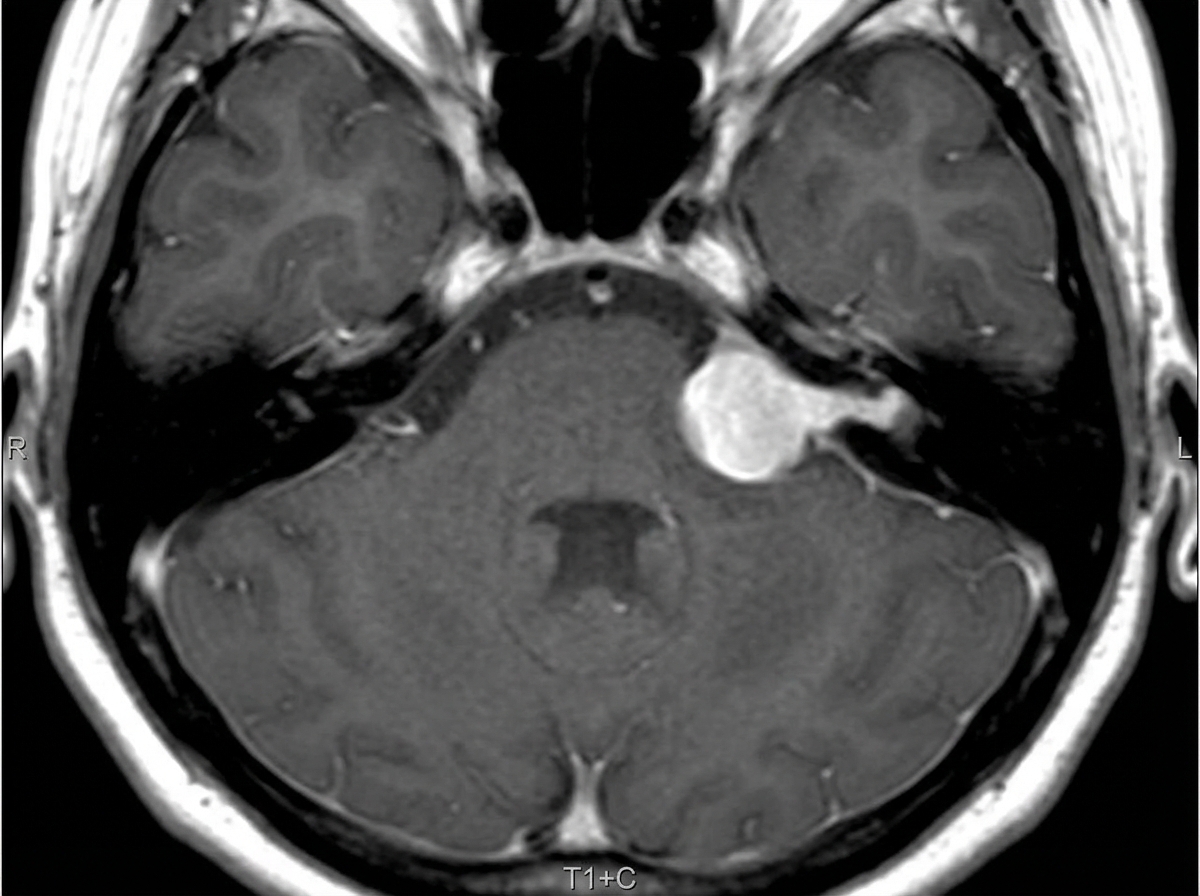
What is the investigation of choice for acoustic neuroma?
Explanation: Neurocysticercosis (NCC), caused by the larvae of *Taenia solium*, progresses through four distinct radiologic stages. Understanding these is high-yield for NEET-PG. **Correct Answer: A. Vesicular Stage** In the **Vesicular stage**, the parasite is alive and viable. The host’s immune system has not yet recognized the larva, resulting in **minimal to no surrounding edema** or inflammation. Radiologically, it appears as a well-defined CSF-density cyst. The pathognomonic feature is the **"hole-with-a-dot" appearance**, where the "dot" represents the eccentric, opaque **scolex** (the head of the tapeworm). **Why the other options are incorrect:** * **B. Colloidal Vesicular:** The larva begins to die, and the cyst fluid becomes turbid. This triggers a robust immune response, leading to significant **perilesional edema** and intense **ring enhancement** on MRI/CT. * **C. Granular Nodular:** The cyst retracts and thickens. Edema decreases as the lesion transforms into an enhancing nodule. * **D. Calcific Nodular:** The final "healed" stage. The lesion becomes a small, shrunken, hyperdense **calcified speck** (best seen on CT). There is no edema and the scolex is no longer distinguishable. **High-Yield Clinical Pearls for NEET-PG:** * **Most common presentation:** New-onset seizures in an adult (in endemic areas). * **Imaging of Choice:** **MRI** is superior for identifying the scolex and staging; **CT** is superior for the calcific stage. * **Treatment Paradox:** Initiating cysticidal drugs (Albendazole/Praziquantel) during the vesicular or colloidal stage can worsen edema due to parasite death; hence, **corticosteroids** are often co-administered.
Explanation: ### Explanation **Correct Answer: A. Meningioma** **Why it is correct:** The description provided—**extra-axial, dural-based, and enhancing**—is the classic radiologic triad for a **Meningioma**. * **Extra-axial:** This means the lesion arises outside the brain parenchyma. Key signs include the displacement of gray matter and the presence of a "CSF cleft" between the mass and the brain. * **Dural-based:** Meningiomas arise from arachnoid cap cells. On MRI, they typically show a **"Dural Tail Sign"** (thickening and enhancement of the adjacent dura mater). * **Enhancing:** They are highly vascular and show intense, homogenous contrast enhancement. They are more common in females (middle-aged) due to progesterone receptors. **Why the other options are incorrect:** * **B. Glioma:** These are **intra-axial** tumors (arising from within the brain tissue). They typically lack a dural attachment and often show irregular enhancement or necrosis (especially Glioblastoma). * **C. Schwannoma:** While extra-axial, these typically arise from cranial nerves (most commonly CN VIII in the cerebellopontine angle). They do not usually present as broad-based dural lesions across the vault. * **D. Pituitary Adenoma:** These are specific to the **sella turcica**. While they are extra-axial and enhance, the location is restricted to the sellar/suprasellar region, not general dural surfaces. **High-Yield Clinical Pearls for NEET-PG:** * **Most common** primary intracranial tumor in adults. * **MRI Hallmark:** "Dural Tail Sign" and "CSF Cleft Sign." * **Histology:** Look for **Psammoma bodies** (concentric calcifications) and whorled patterns. * **Association:** Multiple meningiomas are strongly associated with **Neurofibromatosis Type 2 (NF2)**. * **Hyperostosis:** They often cause thickening of the overlying bone, which can be seen on CT.
Explanation: ### Explanation **1. Why Epidural Hematoma (EDH) is the Correct Answer:** An **Epidural Hematoma** occurs due to bleeding into the potential space between the skull and the dura mater, most commonly following a rupture of the **middle meningeal artery** (associated with temporal bone fractures). The characteristic **biconvex (lentiform or lemon-shaped)** appearance on a CT scan occurs because the dura mater is firmly attached to the skull at the **cranial sutures**. As the arterial blood collects, it exerts high pressure, stripping the dura away from the bone but remaining confined by these sutural attachments. This forces the hematoma to expand inward toward the brain, creating the classic convex shape. **2. Why Other Options are Incorrect:** * **Subdural Hematoma (SDH):** These occur due to the tearing of **bridging veins** between the dura and the arachnoid mater. Since this space is not limited by sutures, the blood spreads thinly and widely along the brain's surface, resulting in a **crescent-shaped (concave)** appearance. Unlike EDH, SDH can cross suture lines but is limited by dural reflections like the falx cerebri. **3. Clinical Pearls for NEET-PG:** * **Lucid Interval:** Classically associated with EDH (the patient regains consciousness briefly before deteriorating). * **Suture Lines:** EDH **does not** cross suture lines (limited by dural attachments), whereas SDH **does** cross suture lines. * **Source of Bleed:** EDH is usually **arterial** (Middle Meningeal Artery); SDH is usually **venous** (Bridging Veins). * **Hyperdensity:** On NCCT, acute blood appears hyperdense (bright white). As it ages (chronic SDH), it becomes isodense or hypodense.
Explanation: **Explanation:** **Fahr’s Disease (Idiopathic Basal Ganglia Calcification)** is the correct answer. It is a rare genetic neurological disorder characterized by abnormal, **bilateral, and symmetrical calcium deposits** in the basal ganglia, thalamus, and cerebral cortex. While secondary causes of such calcification include metabolic disorders (most commonly **hypoparathyroidism**), Fahr’s disease refers to the primary, idiopathic, or familial form. On CT, these appear as hyperdense areas typically involving the globus pallidus, putamen, and caudate nuclei. **Analysis of Incorrect Options:** * **Wilson’s Disease:** Characterized by copper deposition rather than calcium. On MRI, it typically shows the **"Face of the Giant Panda"** sign (hyperintensity in the tegmentum with preserved red nuclei) and T2 hyperintensities in the basal ganglia, not symmetrical calcification. * **Cytomegalovirus (CMV):** A common cause of congenital infection. It typically presents with **periventricular calcifications** and microcephaly, rather than isolated basal ganglia involvement. * **Toxoplasmosis:** Congenital toxoplasmosis presents with **diffuse, scattered parenchymal calcifications** and obstructive hydrocephalus. In HIV patients, it presents as ring-enhancing lesions. **NEET-PG High-Yield Pearls:** * **CT is the gold standard** for detecting intracranial calcification (appears hyperdense/white). * The most common cause of pathological basal ganglia calcification is **Hypoparathyroidism** (always check serum calcium/PTH). * **"Face of the Miniature Panda"** sign is seen in the midbrain tegmentum in Wilson’s Disease. * **Differential for Basal Ganglia lesions:** Carbon monoxide poisoning (necrosis), Wilson's (copper), and Fahr's (calcium).
Explanation: **Explanation:** **Mesial Temporal Sclerosis (MTS)** is the most common cause of drug-resistant structural epilepsy. The diagnosis relies on identifying hippocampal atrophy and gliosis. **Why PET-CT is the Correct Answer (in the context of functional localization):** While MRI is the gold standard for **anatomical** imaging, **Interictal FDG-PET** is considered the investigation of choice for the **functional localization** of the epileptogenic focus. In MTS, PET-CT typically demonstrates **hypometabolism** in the affected temporal lobe. In many clinical scenarios and competitive exams, when the question asks for the most sensitive functional study to confirm the metabolic deficit associated with the seizure focus, PET-CT is the preferred answer. **Analysis of Incorrect Options:** * **A. CECT:** Computed Tomography has poor soft-tissue resolution for the posterior fossa and temporal lobes. It is generally insensitive to the subtle volume losses and signal changes characteristic of MTS. * **B. MRI:** This is the best **initial** and **anatomical** investigation. A dedicated "Epilepsy Protocol" MRI shows hippocampal atrophy and increased T2/FLAIR signal. However, if PET-CT is provided as an option, it specifically highlights the metabolic dysfunction that defines the clinical disease. * **D. USG:** Ultrasound has no role in adult neuroimaging for epilepsy as the skull prevents visualization of parenchymal structures. **High-Yield Clinical Pearls for NEET-PG:** * **MRI Findings in MTS:** Hippocampal atrophy, loss of internal digitations, and **increased T2/FLAIR signal** (gliosis). * **Gold Standard for Anatomy:** MRI (specifically Coronal FLAIR sequences). * **Functional IOC:** PET-CT (shows interictal hypometabolism). * **EEG:** Often shows anterior temporal spikes, but is a physiological, not radiological, investigation.
Explanation: **Explanation:** Magnetic Resonance Spectroscopy (MRS) is a non-invasive imaging technique used to measure the concentration of specific metabolites in the brain. The position of these metabolites on the frequency axis is measured in **parts per million (ppm)**. **1. Why Choline is correct:** **Choline (Cho)** resonates at **3.2 ppm**. It is a marker of cell membrane turnover (synthesis and degradation). In clinical practice, an elevated Choline peak is a hallmark of increased cellular proliferation, making it a sensitive indicator for **malignant tumors** (e.g., high-grade gliomas) and inflammatory processes. **2. Analysis of Incorrect Options:** * **Lipid and Lactate (0.9–1.3 ppm):** These peaks are found at the far right of the spectrum. Lactate (1.3 ppm) indicates anaerobic glycolysis and is seen in necrotic tumors or cerebral ischemia. * **N-acetyl aspartate (NAA) (2.0 ppm):** NAA is a marker of neuronal integrity. A decrease in NAA signifies neuronal loss or damage, commonly seen in tumors, infarcts, or neurodegenerative diseases. * **Creatine (Cr) (3.0 ppm):** Creatine represents energy metabolism. It is the most stable peak and is often used as a reference point to calculate metabolite ratios (e.g., Cho/Cr ratio). **High-Yield Clinical Pearls for NEET-PG:** * **Hunter’s Angle:** On a normal MRS, the peaks of NAA, Cr, and Cho form an ascending line (45-degree angle). In brain tumors, this angle is reversed (Cho rises, NAA falls), known as the **"Steal Phenomenon"** or "Inverted Hunter's Angle." * **Alanine (1.48 ppm):** A characteristic peak for **Meningiomas**. * **Myo-inositol (3.5 ppm):** A marker for astrocytes; elevated in **Alzheimer’s disease** and low-grade gliomas.
Explanation: ### Explanation **Correct Answer: B. Hypothalamic hamartoma** The clinical triad of **gelastic seizures** (characteristic "laughing" spells), **precocious puberty**, and a non-enhancing mass in the hypothalamic region is pathognomonic for a **Hypothalamic Hamartoma (HH)**. * **Pathophysiology:** HH is a non-neoplastic congenital malformation consisting of ectopic neuronal and glial tissue. It is located at the tuber cinereum or mamillary bodies. * **Imaging Features:** On MRI, it appears as a well-circumscribed mass that is **isointense to gray matter** on T1WI and iso- to hyperintense on T2WI. Crucially, it shows **no contrast enhancement** (unlike most tumors) because it lacks a disrupted blood-brain barrier. * **Clinical Correlation:** Gelastic seizures arise from the intrinsic epileptogenicity of the hamartoma, while precocious puberty occurs due to the ectopic secretion of Gonadotropin-Releasing Hormone (GnRH). **Why Incorrect Options are Wrong:** * **A. Hypothalamic Astrocytoma:** These are usually low-grade (pilocytic) gliomas. They typically show significant contrast enhancement and often present with visual field defects rather than gelastic seizures. * **C. Craniopharyngioma:** These are typically suprasellar, showing a "mixed" appearance (cystic components, solid parts, and **calcifications**). They usually present with growth retardation and bitemporal hemianopia. * **D. Germinoma:** These are highly malignant tumors found in the midline (pineal or suprasellar region). They show **intense, uniform contrast enhancement** and are associated with diabetes insipidus. **High-Yield Clinical Pearls for NEET-PG:** * **Classic Triad:** Gelastic seizures + Precocious puberty + Hypothalamic mass. * **MRI Hallmark:** A sessile or pedunculated mass that is **isointense to gray matter** and shows **no enhancement**. * **Treatment:** Medical management for seizures; surgery or Gamma Knife radiosurgery for refractory cases. GnRH analogues are used for precocious puberty.
Explanation: ### Explanation **Correct Answer: A. Bridging veins** **Concept:** A **Subdural Hematoma (SDH)** occurs due to the rupture of the **bridging veins** as they traverse the subdural space to drain into the dural venous sinuses (most commonly the Superior Sagittal Sinus). These veins are susceptible to shearing forces during head trauma, especially in deceleration injuries like a fall. On imaging, SDH typically appears as a **crescent-shaped (concave)** collection that can cross suture lines but is limited by dural reflections (like the falx cerebri). **Analysis of Incorrect Options:** * **B. Charcot-Bouchard aneurysm:** These are microaneurysms of the small perforating arteries (e.g., lenticulostriate arteries) caused by chronic hypertension. Their rupture leads to **intraparenchymal hemorrhage**, typically in the basal ganglia, not a subdural hematoma. * **C. Internal carotid artery:** Rupture of the ICA or its branches (like the ACOM or PCOM) due to a berry aneurysm typically results in a **Subarachnoid Hemorrhage (SAH)**, characterized by blood in the cisterns and sulci ("star-shaped" appearance on CT). * **D. Middle meningeal artery:** This is the classic source of an **Epidural Hematoma (EDH)**. It is usually associated with a temporal bone fracture. On imaging, EDH appears **biconvex (lentiform)** and does not cross suture lines. **NEET-PG High-Yield Pearls:** * **Shape:** SDH = Crescentic/Concave; EDH = Biconvex/Lentiform. * **Sutures:** SDH **crosses** sutures; EDH **does not** cross sutures. * **Demographics:** While common in trauma, chronic SDH is frequently seen in elderly patients and alcoholics due to brain atrophy, which increases the tension on bridging veins. * **Imaging Choice:** Non-contrast CT (NCCT) Head is the initial investigation of choice in acute trauma, though MRI is more sensitive for small collections.
Explanation: **Explanation:** **1. Why the Optic Nerve is Correct:** The **Optic Nerve (CN II)** is the only cranial nerve consistently visible on a non-contrast plain CT scan of the orbit. This is due to the principle of **natural contrast**. The optic nerve is surrounded by **retrobulbar fat**, which has low attenuation (appears black) on CT. The density of the nerve itself stands out against this fatty background. Additionally, the optic nerve is relatively thick and encased in a dural sheath containing CSF, further enhancing its visibility. **2. Why the Other Options are Incorrect:** * **Trigeminal (CN V), Facial (CN VII), and Hypoglossal (CN XII):** These nerves are much smaller in caliber and travel through the cisterns of the posterior fossa or complex bony canals. On a plain CT, the surrounding CSF and dense petrous bone create significant "beam hardening" artifacts and lack the inherent tissue contrast (like fat) required to distinguish these fine neural structures. To visualize these nerves, **MRI (especially 3D-CISS or FIESTA sequences)** is the gold standard. **3. High-Yield Clinical Pearls for NEET-PG:** * **MRI vs. CT:** While CT is excellent for bony anatomy (e.g., internal auditory canal), MRI is the modality of choice for visualizing all cranial nerves. * **Optic Nerve Thickening:** On CT, a "tram-track" appearance of the optic nerve (calcification/enhancement of the sheath) is characteristic of **Optic Nerve Sheath Meningioma**. * **Enlargement:** Diffuse enlargement of the optic nerve on CT/MRI in a child is highly suggestive of **Optic Nerve Glioma** (associated with Neurofibromatosis Type 1). * **Cisternal Segments:** For nerves in the CP angle (CN VII, VIII), MRI is mandatory as CT cannot resolve these structures.
Explanation: **Explanation:** **Acoustic Neuroma (Vestibular Schwannoma)** is a benign tumor arising from the Schwann cells of the vestibular nerve (CN VIII). The investigation of choice is **Gadolinium-enhanced MRI (MRI with contrast)**. **Why MRI with contrast is the correct answer:** MRI offers superior soft-tissue resolution of the posterior fossa compared to CT. Gadolinium contrast is essential because it allows for the detection of even tiny, **intracanalicular tumors** (those confined within the internal auditory canal) that might be missed on non-contrast sequences. Acoustic neuromas characteristically show **intense, uniform enhancement** on T1-weighted contrast-enhanced images. **Why other options are incorrect:** * **CT (with or without contrast):** CT is poor at visualizing the posterior fossa due to "bone-hardening artifacts" from the surrounding petrous bone. While it may show secondary signs like widening of the internal auditory canal in large tumors, it frequently misses small lesions. * **MRI without contrast:** While large tumors may be visible on T2-weighted sequences (especially CISS or FIESTA sequences), non-contrast MRI can miss small tumors that are isointense to surrounding structures. **High-Yield Clinical Pearls for NEET-PG:** * **Gold Standard:** Gadolinium-enhanced MRI. * **Classic Sign:** "Ice-cream cone" appearance (the intracanalicular component is the cone, and the cisternal component is the ice cream). * **Bilateral Acoustic Neuromas:** Pathognomonic for **Neurofibromatosis Type 2 (NF2)**. * **Clinical Presentation:** Progressive sensorineural hearing loss (SNHL), tinnitus, and equilibrium imbalance. * **Angle:** It is the most common tumor of the **Cerebellopontine (CP) angle**.
Neuroanatomy for Radiologists
Practice Questions
Cerebrovascular Diseases
Practice Questions
Intracranial Tumors
Practice Questions
CNS Infections
Practice Questions
Demyelinating and Degenerative Diseases
Practice Questions
Head Trauma Imaging
Practice Questions
Spine Imaging: Trauma and Degenerative Disease
Practice Questions
Spine Tumors and Infections
Practice Questions
Pediatric Neuroradiology
Practice Questions
Congenital CNS Anomalies
Practice Questions
Functional Neuroimaging
Practice Questions
Neurointerventional Procedures
Practice Questions
Get full access to all questions, explanations, and performance tracking.
Start For Free