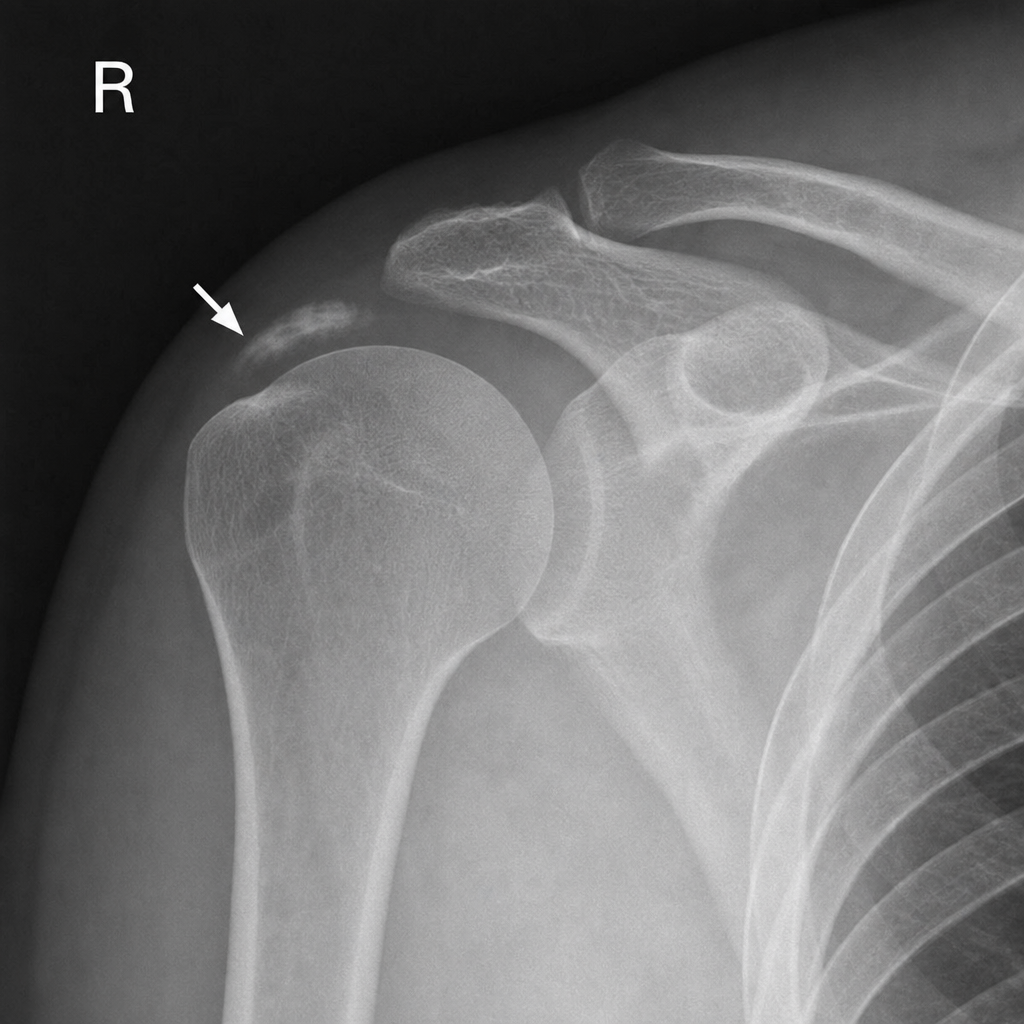
Sacrotuberous ligament calcification is a characteristic feature of?
By examining the provided X-ray of a wrist, determine the age of the patient.

A 70-year-old male presents with signs of obstructive uropathy and severe, continuous pain in the back region. The provided X-ray of the patient's lumbar spine shows pathology. What is the most likely condition the patient is suffering from?

An X-ray shows reduction of the intervertebral disc space and a fusiform shadow along the vertebra. What is the most likely diagnosis?
What causes the sunray appearance in osteosarcoma?
Looser's zones are seen in which condition?
Geographic lytic lesions in the vault of the skull with bevelled edges are typically seen with which of the following conditions?
What is the best imaging modality for Pelizaeus-Merzbacher disease?
The "light-bulb sign" on an X-ray of the shoulder is indicative of which condition?
The 'winking owl' sign is characteristic of which of the following conditions?
Explanation: **Explanation:** **Fluorosis** is a chronic metabolic bone disease caused by the ingestion of excessive fluoride, typically through contaminated groundwater. The hallmark of skeletal fluorosis is **osteosclerosis** (increased bone density) and **extensive ligamentous calcification**. The **sacrotuberous ligament** is one of the most characteristic sites for this ectopic calcification, often appearing as a dense, ossified band on a pelvic X-ray. Other commonly affected ligaments include the sacrospinous, iliolumbar, and the posterior longitudinal ligament (leading to spinal stenosis). **Why other options are incorrect:** * **Alkaptonuria (Ochronosis):** Characterized by multi-level **intervertebral disc calcification** and narrowing, often described as "vacuum phenomena" or "wafer-like" calcification. It does not typically target the sacrotuberous ligament. * **Osteopetrosis:** A genetic disorder of defective osteoclast function leading to "marble bone disease." While it causes diffuse sclerosis and a "bone-within-bone" appearance, it does not typically cause ligamentous calcification. * **Pseudogout (CPPD):** Characterized by **chondrocalcinosis** (calcification of hyaline and fibrocartilage), most commonly in the knees (menisci), wrists (TFCC), and symphysis pubis, rather than pelvic ligaments. **High-Yield Clinical Pearls for NEET-PG:** * **Radiological Triad of Fluorosis:** Osteosclerosis (spine/pelvis), Osteophytosis, and Ligamentous/Tendon calcification. * **Early Sign:** Roughening and blurring of the trabecular pattern in the pelvis and lumbar spine. * **D/D for Diffuse Osteosclerosis:** Fluorosis, Osteopetrosis, Myelofibrosis, and Sclerotic bone metastases (e.g., Prostate CA). * **Key differentiator:** Fluorosis is the most likely diagnosis when diffuse sclerosis is accompanied by exuberant ligamentous ossification.
Explanation: ***7 years*** - At 7 years, the **capitate**, **hamate**, **triquetral**, and **lunate** ossification centers are typically visible on wrist X-ray according to the **Greulich and Pyle atlas**. - The **radial epiphysis** appears around this age, and **growth plates** remain wide open, consistent with normal 7-year developmental patterns. *6 years* - At 6 years, only the **capitate** and **hamate** are consistently ossified, with **triquetral** ossification just beginning or absent. - The **radial epiphysis** has not yet appeared, and fewer **carpal ossification centers** would be visible compared to the presented X-ray. *8 years* - At 8 years, additional ossification centers like the **scaphoid** and **trapezium** would typically be visible on X-ray. - The **ulnar epiphysis** begins to appear around this age, which would not match the developmental stage shown in this X-ray. *9 years* - At 9 years, most **carpal bones** including **scaphoid**, **trapezium**, and **trapezoid** would be clearly ossified and visible. - The **pisiform** ossification center may begin to appear, representing more advanced skeletal maturation than demonstrated in this X-ray.
Explanation: ***Prostate carcinoma*** - **Osteoblastic (sclerotic) metastases** on lumbar spine X-ray combined with obstructive uropathy in a 70-year-old male is pathognomonic for **prostate adenocarcinoma**. - Prostate cancer characteristically spreads to the **axial skeleton** (spine, pelvis, ribs) via **Batson's venous plexus**, causing **bone pain** and **sclerotic lesions**. *Benign prostatic hyperplasia* - Can cause **obstructive uropathy** but does **not metastasize** or produce bone lesions on X-ray. - Typically presents with **lower urinary tract symptoms** (hesitancy, weak stream, nocturia) without severe back pain or spinal pathology. *Prostatitis* - An **infectious/inflammatory condition** that does not cause **metastatic bone lesions** or obstructive uropathy. - Usually presents with **acute onset** of **dysuria**, **fever**, and **pelvic pain**, not chronic back pain with spinal pathology. *Hydronephrosis* - This is a **consequence** of urinary obstruction, not a primary diagnosis explaining the **lumbar spine pathology**. - Represents **kidney dilatation** due to urine backflow and would not account for the **osteoblastic lesions** seen on spinal X-ray.
Explanation: **Explanation:** The clinical presentation described—**reduction of intervertebral disc space** combined with a **fusiform shadow**—is a classic radiological hallmark of **Tuberculosis of the spine (Pott’s disease)**. 1. **Why it is correct:** In spinal TB, the infection typically begins in the paradiscal area. Proteolytic enzymes are absent in TB (unlike pyogenic infections), but the destruction of the subchondral bone leads to the collapse of the disc into the vertebral bodies, causing **disc space narrowing**. The "fusiform shadow" represents a **paravertebral abscess** (cold abscess) formed by the collection of pus, debris, and caseous material under the anterior longitudinal ligament. 2. **Why other options are incorrect:** * **Psoas abscess:** While often caused by spinal TB, a psoas abscess typically presents as a teardrop-shaped shadow tracking along the psoas muscle margin toward the groin, rather than a localized fusiform shadow along the thoracic/lumbar vertebrae. * **Hemorrhage in posterior mediastinum:** This would present as a widened mediastinum on X-ray, usually following trauma or aortic pathology, and would not cause destruction of the intervertebral disc space. * **Osteoporosis:** This leads to increased radiolucency, "codfish vertebrae" (biconcave), or wedge fractures, but the **intervertebral disc space is characteristically preserved** or even appears widened. **High-Yield Clinical Pearls for NEET-PG:** * **Earliest sign of Spinal TB on X-ray:** Reduction/narrowing of the intervertebral disc space. * **Most common site:** Lower thoracic and upper lumbar vertebrae. * **Gibbus Deformity:** A sharp angular kyphosis resulting from the collapse of anterior vertebral bodies. * **Paradiscal type:** The most common pattern of involvement in adults. * **Imaging of choice:** MRI is the most sensitive modality to detect early marrow edema and soft tissue extensions.
Explanation: ### Explanation **1. Why Periosteal Reaction is Correct:** The "sunray" or "sunburst" appearance is a classic **aggressive periosteal reaction**. In osteosarcoma, the tumor grows so rapidly that it lifts the periosteum away from the bone cortex. As the tumor expands, it stretches the Sharpey’s fibers (which anchor the periosteum to the bone). Osteoblasts then deposit new bone along these stretched fibers, perpendicular to the bone surface. On a radiograph, these thin, radiating spicules of bone resemble the rays of a sun. **2. Analysis of Incorrect Options:** * **A. Bone destruction:** While osteosarcoma causes significant cortical destruction (often seen as a "moth-eaten" pattern), destruction itself does not create the radiating spicules; it is the reactive bone formation that does. * **C. Vascular calcification:** Though tumors are highly vascular, the sunray pattern is composed of osteoid/bone matrix, not calcified blood vessels. * **D. Bone hypertrophy:** Hypertrophy refers to an increase in the size of existing bone tissue (often seen in stress responses). The sunray appearance represents *new* reactive bone formation, not the enlargement of existing structures. **3. NEET-PG High-Yield Pearls:** * **Codman’s Triangle:** Another hallmark of osteosarcoma; it occurs when the periosteum is lifted at the edge of the tumor, forming a triangular elevation. * **Location:** Most commonly occurs in the **metaphysis** of long bones (Distal femur > Proximal tibia). * **Age Group:** Bimodal distribution, primarily affecting adolescents (10–20 years). * **Other Patterns:** Do not confuse "Sunray" (Osteosarcoma) with "Onion-skin" (Ewing’s Sarcoma) or "Soap-bubble" (Giant Cell Tumor).
Explanation: **Explanation:** **Looser’s zones** (also known as pseudofractures, Milkman lines, or cortical infractions) are the pathognomonic radiographic hallmark of **Osteomalacia** in adults (and Rickets in children). **Why Osteomalacia is correct:** Osteomalacia is characterized by defective mineralization of the osteoid matrix, often due to Vitamin D deficiency. Looser’s zones represent stress fractures where the body attempts to repair the bone with unmineralized osteoid rather than calcified bone. On X-ray, these appear as thin, transverse radiolucent bands perpendicular to the cortex, often occurring symmetrically. Common sites include the axillary margin of the scapula, neck of the femur, pubic rami, and ribs. **Why other options are incorrect:** * **Osteoporosis:** This involves a decrease in total bone mass (both matrix and mineral are lost), leading to fragility fractures (e.g., vertebral compression), but not Looser’s zones. * **Osteosarcoma:** A primary malignant bone tumor characterized by aggressive bone destruction, a "sunburst" periosteal reaction, and Codman’s triangle. * **TB Spine (Pott’s Disease):** Characterized by paradiscal destruction, reduced disc space, and cold abscess formation, typically involving the anterior vertebral bodies. **NEET-PG High-Yield Pearls:** * **Radiological Triad of Osteomalacia:** Generalized rarefaction (decreased bone density), coarsened trabeculae, and Looser’s zones. * **Rugger Jersey Spine:** Seen in Renal Osteodystrophy (secondary hyperparathyroidism), not simple osteomalacia. * **Looser’s zones vs. Stress Fractures:** Unlike true fractures, Looser’s zones are often bilateral, symmetrical, and show no significant callus formation.
Explanation: ### Explanation **Correct Answer: B. Eosinophilic granuloma** **Why it is correct:** Eosinophilic granuloma (EG) is the most common and localized form of **Langerhans Cell Histiocytosis (LCH)**. In the skull, it typically presents as a well-defined, "punched-out" lytic lesion. The hallmark radiological feature is the **"bevelled edge"** appearance. This occurs because the destruction of the inner table of the skull is more extensive than the outer table (or vice versa), creating a slanted or "hole-within-a-hole" appearance on a radiograph. When multiple such geographic lesions coalesce, it is referred to as a **"Map-like" or "Geographic skull."** **Why the other options are incorrect:** * **A. Multiple Myeloma:** Characteristically shows multiple, small, uniform, "punched-out" lytic lesions. Unlike EG, these lesions lack sclerotic margins and do not typically show bevelled edges. * **C. Hyperparathyroidism:** Classically associated with a **"Salt and pepper" skull** (mottled appearance due to multiple tiny lucencies) and resorption of the lamina dura. * **D. Reticular cell carcinoma:** This is an older term for primary lymphoma of the bone. It usually presents with a "moth-eaten" or permeative pattern of bone destruction rather than well-circumscribed geographic lesions with bevelled edges. **High-Yield Clinical Pearls for NEET-PG:** * **LCH Triad (Hand-Schüller-Christian disease):** Exophthalmos, Diabetes Insipidus, and Bone lesions. * **Button Sequestrum:** A piece of devitalized bone (sequestrum) seen within a lytic lesion; highly suggestive of EG or Osteomyelitis. * **Vertebra Plana:** Complete collapse of a vertebral body (pancake vertebra) is a classic presentation of LCH in the spine. * **Age Group:** EG is most commonly seen in children and young adults (5–15 years).
Explanation: **Explanation:** **Pelizaeus-Merzbacher Disease (PMD)** is a rare X-linked recessive leukodystrophy characterized by a defect in myelin formation (hypomyelination) due to mutations in the **PLP1 gene**. **Why MRI is the Correct Answer:** MRI is the gold standard and the most sensitive modality for diagnosing PMD. Because the primary pathology is a failure of normal myelination, MRI can visualize the lack of white matter maturation. The characteristic finding is a **"tigroid" pattern** or diffuse, symmetrical T2 hyperintensity throughout the white matter, representing a permanent state of neonatal-like hypomyelination. MRI is superior because it provides high soft-tissue contrast necessary to distinguish between gray and white matter development. **Why Other Options are Incorrect:** * **X-ray:** Primarily visualizes bone; it cannot evaluate white matter or brain parenchyma. * **Ultrasound (USG):** While useful in neonates through the open fontanelle, it lacks the resolution to detect specific white matter signal changes required for a leukodystrophy diagnosis. * **CT Scan:** CT is poor at evaluating white matter maturation. While it may show non-specific atrophy in late stages, it cannot detect the subtle hypomyelination patterns seen on MRI. **High-Yield Clinical Pearls for NEET-PG:** * **Pathognomonic MRI Sign:** Diffuse T2 hyperintensity (hypomyelination) with a "tigroid" appearance (sparing of perivascular myelin islands). * **Clinical Triad:** Nystagmus (often rotary), developmental delay, and progressive spasticity. * **Biochemical Defect:** Mutation in the Proteolipid Protein 1 (PLP1) gene. * **MRS Finding:** Usually shows relatively preserved N-acetylaspartate (NAA) levels compared to other demyelinating diseases.
Explanation: ### Explanation **Correct Answer: C. Posterior dislocation of the shoulder** The **"Light-bulb sign"** is a classic radiographic feature of a **posterior shoulder dislocation**. In a normal shoulder, the proximal humerus has a distinct anatomical shape with the greater tuberosity visible laterally. However, when the shoulder dislocates posteriorly, the humeral head is forced into **fixed internal rotation**. In this position, the greater tuberosity rotates anteriorly, and the humeral head appears symmetrical and rounded, resembling a light bulb or a pear when viewed on a standard Anteroposterior (AP) X-ray. **Analysis of Incorrect Options:** * **A & D (Fractures):** While fractures can accompany dislocations (like a Hill-Sachs or Bankart lesion), the "light-bulb" appearance specifically refers to the rotational profile of the humerus, not the cortical break of the scapula or humeral neck. * **B (Anterior Dislocation):** This is the most common type of shoulder dislocation. It typically presents with the humeral head displaced inferiorly and medially to the glenoid, often associated with a "Hill-Sachs lesion" (compression fracture of the posterosuperolateral humeral head). It does not produce the symmetrical light-bulb shape. **High-Yield Clinical Pearls for NEET-PG:** * **Mechanism:** Posterior dislocations are rare (2-5%) and typically occur due to **seizures, electric shocks**, or high-energy trauma (forced adduction and internal rotation). * **Associated Signs:** Look for the **"Rim sign"** (widening of the glenohumeral joint space >6mm) and the **"Trough line sign"** (a vertical line representing a compression fracture of the anterior humeral head). * **Best View:** An **Axillary or Scapular Y-view** is the gold standard to confirm the diagnosis when AP films are ambiguous.
Explanation: **Explanation:** The **'Winking Owl' sign** is a classic radiological finding seen on an anteroposterior (AP) view of the spine. It occurs due to the **destruction of a vertebral pedicle**. On a normal AP radiograph, the two pedicles appear as "eyes" on either side of the vertebral body (the "face"). When one pedicle is destroyed, it disappears, making the vertebra look like an owl with one eye closed or "winking." **1. Why Vertebral Metastasis is Correct:** Osteolytic metastases (most commonly from lung, breast, or kidney cancers) have a predilection for the pedicles because they are highly vascular. The destruction of the pedicle cortical bone leads to its disappearance on X-ray, creating the winking owl appearance. **2. Analysis of Incorrect Options:** * **Vertebral Tuberculosis (Pott’s Spine):** Typically involves the **intervertebral disc space** and adjacent vertebral bodies. It usually spares the posterior elements (like pedicles) until late stages. * **Vertebral Fracture:** While a fracture can involve the pedicle, it usually presents as a lucent line or displacement rather than the complete osteolytic disappearance characteristic of the "wink." * **Vertebral Mass:** While a primary bone tumor (like Osteoblastoma) could involve the pedicle, the term "winking owl" is classically and most frequently associated with metastatic disease in exam contexts. **High-Yield Clinical Pearls for NEET-PG:** * **Blind Spot:** The winking owl sign is a late finding; approximately 30-50% of bone mineral must be lost before it is visible on a plain X-ray. * **Absent Pedicle Sign:** If both pedicles are destroyed, it is referred to as the **"Blind Owl" sign**. * **Pedicle Sparing:** If you see vertebral body collapse but the **disc space is preserved**, think **Metastasis**. If the **disc space is destroyed**, think **Infection/TB**.
Radiographic Anatomy of Bones and Joints
Practice Questions
Imaging of Fractures and Dislocations
Practice Questions
Arthritides: Inflammatory and Degenerative
Practice Questions
Metabolic Bone Diseases
Practice Questions
Bone and Soft Tissue Tumors
Practice Questions
Congenital Skeletal Anomalies
Practice Questions
Spine Imaging
Practice Questions
Skeletal Infections
Practice Questions
Sports Medicine Imaging
Practice Questions
Imaging of Prostheses and Implants
Practice Questions
Musculoskeletal Ultrasound
Practice Questions
MSK Interventional Procedures
Practice Questions
Get full access to all questions, explanations, and performance tracking.
Start For Free