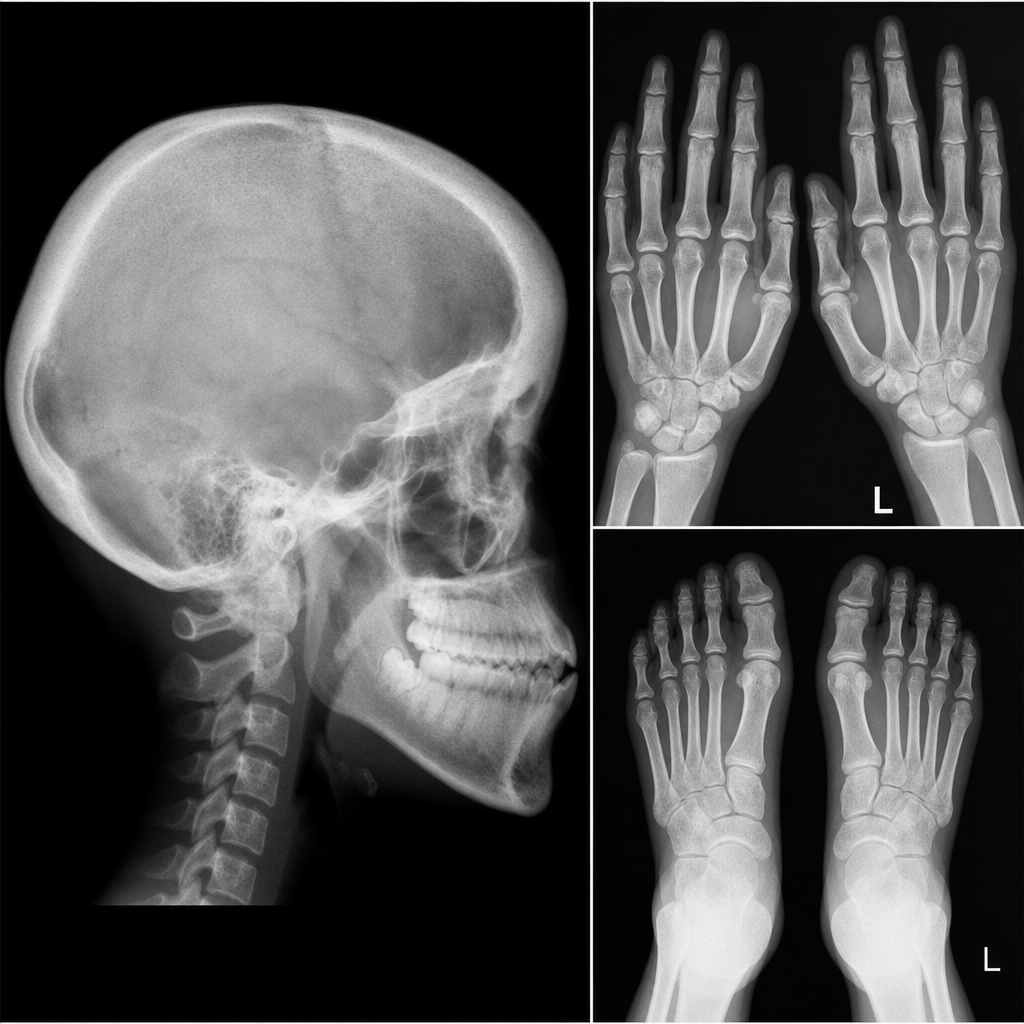
An expansile lytic lesion of the sacrum with specks of calcification is suggestive of which of the following?
Fluid levels are seen in which of the following conditions?
What condition is characterized by this type of lesion?

Multiple raindrop osteolytic lesions are seen in which of the following conditions?
Which of the following is NOT a radiological feature of scurvy?
Which of the following is not a radiological feature of rickets?
The "tongue-in-groove" or "tottering fence post" appearance of the femur is seen in which of the following conditions?
A short-statured patient presents with an X-ray showing vertebral flattening and beaking. What is the likely diagnosis?
In lead poisoning, where is lead deposition typically seen on a radiograph?
Looser's zone occurs in which of the following anatomical locations?
Explanation: **Explanation:** **Chordoma** is a rare, slow-growing malignant tumor arising from the remnants of the **notochord**. It has a predilection for the ends of the spinal column, with the **sacrococcygeal region** being the most common site (50%), followed by the spheno-occipital (clivus) region (35%). Radiologically, it presents as a midline, **expansile lytic lesion** causing bone destruction. A key diagnostic feature is the presence of **internal calcifications** (seen in ~50-90% of cases), which represent residual bone fragments or intratumoral sequestration rather than true matrix mineralization. **Why other options are incorrect:** * **Osteosarcoma:** Typically occurs in the metaphysis of long bones (e.g., distal femur). While it shows bone destruction, it is characterized by "osteoid formation" (dense sclerosis) and aggressive periosteal reactions (Codman’s triangle), which are absent here. * **Secondaries (Metastases):** While common in the sacrum, they are usually multiple and rarely present as a solitary, midline expansile mass with specific calcification patterns unless from a primary like mucinous adenocarcinoma. * **Fibrous Histiocytoma:** This is a rare bone tumor that typically affects the ends of long bones. It presents as a lytic lesion but lacks the characteristic midline sacral location and calcification pattern of a chordoma. **High-Yield Pearls for NEET-PG:** * **Most common site:** Sacrococcygeal region. * **Histology:** Characterized by **Physaliphorous cells** (large cells with vacuolated, bubbly cytoplasm). * **Immunohistochemistry (IHC):** Positive for **Brachyury** (highly specific), S100, and Cytokeratin. * **Age group:** Typically occurs in the 5th to 6th decades of life.
Explanation: **Explanation:** The presence of **fluid-fluid levels** on MRI or CT is a classic radiological sign caused by the settling of blood products of different densities (sedimentation) within cystic spaces. This occurs when there is intralesional hemorrhage and the patient remains immobile for a period before imaging. * **A. Aneurysmal Bone Cyst (ABC):** This is the most common condition associated with fluid-fluid levels. ABCs are benign, reactive bone lesions characterized by blood-filled, cavernous spaces. * **B. Telangiectatic Osteosarcoma:** This is a high-grade malignant mimic of ABC. It contains large cystic cavities filled with blood and necrotic debris, frequently demonstrating fluid-fluid levels. It is distinguished from ABC by the presence of solid, enhancing nodular components and aggressive bone destruction. * **C. Malignant Fibrous Histiocytoma (MFH) / Pleomorphic Sarcoma:** While less common than in ABC or Telangiectatic Osteosarcoma, fluid levels can be seen in any bone tumor that undergoes extensive internal hemorrhage or cystic degeneration, including MFH and Giant Cell Tumors (GCT). **Clinical Pearls for NEET-PG:** 1. **Fluid-fluid levels are NOT pathognomonic** for any single lesion; they simply indicate internal hemorrhage. 2. **Differential Diagnosis (Mnemonic: "A-G-T"):** **A**BC, **G**iant Cell Tumor, and **T**elangiectatic Osteosarcoma are the top three differentials. 3. **Key Distinguisher:** If fluid levels are seen in a lesion with **thick, nodular, enhancing septa** or a solid soft tissue component, suspect **Telangiectatic Osteosarcoma** over a benign ABC. 4. **Imaging Modality of Choice:** **MRI** is the most sensitive modality to demonstrate these levels due to its superior soft-tissue contrast.
Explanation: ***Pseudohypoparathyroidism*** - Characterized by **heterotopic calcifications** and **soft tissue calcifications** visible on imaging, particularly in subcutaneous tissues and basal ganglia. - Associated with **Albright's hereditary osteodystrophy** features including short stature, brachydactyly, and intellectual disability. *Rheumatoid arthritis* - Shows **joint space narrowing**, **periarticular osteopenia**, and **marginal erosions** on imaging, not soft tissue calcifications. - Typically affects **small joints** symmetrically with **synovial thickening** and effusions. *Osteoarthrosis* - Demonstrates **joint space narrowing**, **osteophyte formation**, and **subchondral sclerosis** on radiographs. - Does not typically present with **soft tissue calcifications** or heterotopic ossification patterns. *Psoriasis* - Radiological findings include **asymmetric joint involvement**, **pencil-in-cup deformity**, and **enthesitis**. - May show **dactylitis** and **sacroiliitis** but lacks the characteristic **soft tissue calcifications** seen in pseudohypoparathyroidism.
Explanation: **Explanation:** The term **"Raindrop skull"** or **"Raindrop osteolytic lesions"** classically refers to multiple, well-defined, "punched-out" radiolucent lesions of varying sizes scattered throughout the calvarium. These represent areas of bone destruction. **Why the correct answer is right:** In the context of this specific question, **Lattice-like sclerosis** (often associated with the radiographic appearance of **Multiple Myeloma**) is the correct choice. Multiple Myeloma is the most common primary bone malignancy in adults and is characterized by plasma cell proliferation. These cells secrete osteoclast-activating factors, leading to the classic "punched-out" or "raindrop" appearance on a skeletal survey. **Analysis of Incorrect Options:** * **Lead poisoning:** Characterized by **"Lead lines"** (dense metaphyseal bands), not lytic lesions. * **Intracranial lesion:** While some lesions (like eosinophilic granuloma) can cause skull defects, they typically present as solitary "beveled-edge" lesions rather than a generalized "raindrop" pattern. * **Multiple fractures:** These present as linear lucencies or cortical disruptions, usually following trauma, and do not mimic the circular, disseminated lytic pattern of myeloma. **NEET-PG High-Yield Pearls:** * **Raindrop Skull:** Pathognomonic for **Multiple Myeloma**. * **Salt and Pepper Skull:** Seen in **Hyperparathyroidism** (granular decalcification). * **Cotton Wool Skull:** Seen in the sclerotic phase of **Paget’s Disease**. * **Hair-on-end Appearance:** Seen in **Thalassemia** and Sickle Cell Anemia (due to extramedullary hematopoiesis). * **Skeletal Survey:** The investigation of choice for Multiple Myeloma (MRI is more sensitive for early marrow involvement, but X-ray identifies the "raindrop" lesions).
Explanation: **Explanation:** The correct answer is **D. Cupping of bone ends**. This is because cupping, fraying, and splaying of the metaphysis are hallmark radiological features of **Rickets**, not Scurvy. In Rickets, the failure of osteoid mineralization leads to a "cup-shaped" deformity due to the pressure of the adjacent epiphysis on the softened metaphysis. **Analysis of Scurvy (Vitamin C Deficiency) Features:** Scurvy is characterized by a defect in collagen synthesis, leading to capillary fragility and impaired osteoid formation, while calcification of cartilage remains intact. * **White line of Fraenkel (Option B):** This represents a dense, radiopaque line at the metaphysis due to an accumulation of calcified cartilage matrix (as it cannot be converted to bone). * **Zone of Rarefaction (Option C):** Also known as the **Trümmerfeld zone**, this is a lucent band located just proximal to the White line of Fraenkel, representing a site of weakened, fractured trabeculae. * **Pencil line changes (Option A):** This refers to the thinning of the cortex, making the bone appear transparent with a sharp, thin peripheral outline like a pencil sketch. **High-Yield Clinical Pearls for NEET-PG:** * **Wimberger’s Sign:** A dense radiopaque halo surrounding a lucent center in the epiphysis. * **Pelkan Spur:** Lateral bony outgrowths at the metaphysis due to healing of subperiosteal hemorrhages. * **Subperiosteal Hemorrhage:** The most specific clinical sign, though not visible on X-ray until healing begins (elevation of periosteum). * **Key Differentiator:** Scurvy presents with **increased density** (White line), whereas Rickets presents with **decreased density** (Fraying/Cupping).
Explanation: **Explanation:** The correct answer is **Frenkel’s line**, which is a radiological hallmark of **Scurvy (Vitamin C deficiency)**, not Rickets. Frenkel’s line (also known as the "white line of Frankel") represents a dense, irregular zone of provisional calcification at the metaphysis due to the failure of osteoid formation despite continued calcification. **Analysis of Options:** * **Metaphyseal Cupping (Option A):** In Rickets, the lack of mineralization leads to the softening of the metaphysis. Under the pressure of the adjacent epiphysis and weight-bearing, the metaphysis becomes concave or "cup-shaped." * **Physeal Widening (Option B):** This is the earliest radiological sign of Rickets. It occurs due to the failure of mineralization of the zone of provisional calcification, leading to an accumulation of hypertrophic chondrocytes and an increased thickness of the growth plate (physis). * **Triradiate Pelvis (Option D):** This is a late feature of Rickets/Osteomalacia. Softening of the pelvic bones leads to inward protrusion of the acetabulum due to the pressure of the femoral heads, resulting in a characteristic "heart-shaped" or triradiate pelvic outlet. **NEET-PG High-Yield Pearls:** * **Rickets Triad:** Cupping, Splaying, and Fraying of the metaphysis (best seen at the distal radius/ulna). * **Harrison’s Sulcus:** A horizontal groove along the lower border of the thorax corresponding to the insertion of the diaphragm. * **Rachitic Rosary:** Palpable/visible enlargement of the costochondral junctions. * **Scurvy vs. Rickets:** While Rickets features a "frayed" metaphysis, Scurvy features a "dense" metaphysis (Frankel's line), Wimberger’s ring (dense epiphysis), and Pelkan spurs.
Explanation: ### Explanation The "tongue-in-groove" or "tottering fence post" appearance is a classic radiological sign of **Hyperparathyroidism (HPT)**, specifically seen in the femur. **1. Why Hyperparathyroidism is correct:** In hyperparathyroidism, excess Parathyroid Hormone (PTH) stimulates osteoclastic activity, leading to significant bone resorption. In the femur, this manifests as **subperiosteal and endosteal resorption**. The longitudinal streaks of lucency (resorption) alternating with remaining bone create a pattern resembling a "tongue-in-groove" or a "tottering fence post." This is part of the spectrum of *Osteitis Fibrosa Cystica*. **2. Why other options are incorrect:** * **Fibrous Dysplasia:** Characterized by a **"Ground-glass" matrix** and expansion of bone. It may cause a "Shepherd’s crook" deformity of the femur, but not the fence post appearance. * **Paget’s Disease:** Features include cortical thickening, coarsening of trabeculae, and bone enlargement. Classic signs include the **"Blade of grass"** or "Flame sign" (in long bones) and "Cotton wool" spots (in the skull). * **Fracture neck of femur:** This is a traumatic or pathological break. While HPT can lead to pathological fractures, the specific "tongue-in-groove" description refers to the metabolic resorption pattern, not the fracture itself. **3. High-Yield Clinical Pearls for NEET-PG:** * **Pathognomonic sign of HPT:** Subperiosteal bone resorption, most commonly seen on the **radial aspect of the middle phalanges** of the 2nd and 3rd fingers. * **Skull:** "Salt and pepper" appearance (granular decalcification). * **Spine:** "Rugger-jersey spine" (sclerosis of vertebral endplates). * **Brown Tumors:** Also known as osteoclastomas; these are non-neoplastic lytic lesions filled with fibrous tissue and blood (hemosiderin).
Explanation: ### Explanation **Correct Option: A. Achondroplasia** Achondroplasia is the most common cause of disproportionate short-limb dwarfism. It is an autosomal dominant condition caused by a mutation in the **FGFR3 gene**. The characteristic spinal finding in achondroplasia is **vertebral flattening (platyspondyly)** and **anterior beaking** (specifically at the L1-L2 level). This occurs due to defective endochondral ossification. Other classic radiological features include: * **Spine:** Progressive narrowing of the interpedicular distance (caudally), posterior scalloping of vertebrae, and "bullet-shaped" vertebrae. * **Pelvis:** "Champagne glass" pelvis (short, broad iliac bones) and "square" iliac wings. * **Hands:** "Trident hand" (increased space between the 3rd and 4th digits). **Why other options are incorrect:** * **B. Protein Energy Malnutrition:** Primarily affects soft tissues and growth plates (growth arrest lines), but does not cause specific vertebral beaking or flattening. * **C. Rickets:** Characterized by **cupping, fraying, and splaying** of the metaphyses and widening of the growth plate. While it can cause "rachitic rosary" and bowing of legs, it does not present with the specific vertebral morphology of achondroplasia. * **D. Down’s Syndrome:** Associated with skeletal findings like **atlanto-axial instability** and "hyper-extensible" joints, but the classic spinal feature is increased height of the lumbar vertebrae (tall vertebrae), not flattening. **NEET-PG High-Yield Pearls:** * **Anterior Beaking:** If central, think **Morquio Syndrome** (Mucopolysaccharidosis IV); if inferior/anteroinferior, think **Hurler Syndrome**. * **Interpedicular Distance:** In a normal spine, this distance *increases* downwards; in Achondroplasia, it *decreases* (pathognomonic). * **Rhizomelic shortening:** Shortening of the proximal segments (humerus/femur), typical of Achondroplasia.
Explanation: **Explanation:** In pediatric lead poisoning (plumbism), the characteristic radiographic finding is the presence of **"Lead Lines."** These are dense, transverse radiopaque bands located specifically at the **metaphyseal regions** of growing long bones. **Why the Metaphysis?** The metaphysis is the site of most active endochondral ossification. Lead is a divalent cation that mimics calcium; it is absorbed by osteoclasts and deposited in the zone of provisional calcification. Lead inhibits the normal resorption of calcified cartilage, leading to an increased density of the primary spongiosa. It is important to note that the "lead line" is not actually a layer of lead, but rather an area of **increased bone density** resulting from lead-induced metabolic interference. These lines are most prominent in areas of rapid growth, such as the knees (distal femur, proximal tibia) and wrists. **Analysis of Incorrect Options:** * **A. Epiphyseal region:** The epiphysis contains the secondary ossification centers. While lead can affect growth, it does not typically deposit in a linear radiopaque fashion here. * **C. Diaphyseal region:** The diaphysis (shaft) consists of mature cortical bone. Lead lines are a phenomenon of the growth plate transition zone, which the diaphysis lacks. * **D. Any of the above:** Lead deposition is highly site-specific to the metaphysis in growing children. **High-Yield Clinical Pearls for NEET-PG:** * **Lead Lines:** Usually appear when blood lead levels exceed **70–80 μg/dL**. * **Differential Diagnosis:** Similar metaphyseal bands can be seen in healing rickets, phosphorus poisoning, bismuth ingestion, or treated leukemia. * **Other Radiographic Signs:** In chronic ingestion, look for **radiopaque flecks** in the GI tract (pica). * **Clinical Triad:** Encephalopathy, abdominal colic, and microcytic hypochromic anemia with **basophilic stippling**.
Explanation: **Explanation:** **Looser’s zones** (also known as pseudofractures, Milkman’s fractures, or cortical infractions) are the pathognomonic radiological hallmark of **Osteomalacia** in adults and **Rickets** in children. 1. **Underlying Concept:** These are not true fractures but represent stress fractures where the damaged bone is replaced by **unmineralized osteoid** (soft, poorly calcified bone matrix) rather than mature bone. On an X-ray, they appear as thin, transverse radiolucent lines perpendicular to the cortex, often with sclerotic margins. 2. **Anatomical Locations:** They typically occur at sites of mechanical stress or where major arteries cross the bone. Common locations include: * **Pubic rami** (most common site). * **Femoral neck** and medial aspect of the proximal femur. * **Ribs** and the axillary margin of the **scapula**. * Other sites include the ulna, radius, and fibula. * Since all options (A, B, and C) are classic sites for these lesions, **Option D (All the above)** is correct. **High-Yield Clinical Pearls for NEET-PG:** * **Pathognomonic for:** Osteomalacia (Adults). * **Radiological appearance:** Transverse lucent bands, often bilateral and symmetrical. * **Biochemical findings in Osteomalacia:** Low/Normal Serum Calcium, Low Serum Phosphate, and **Elevated Alkaline Phosphatase (ALP)**. * **Differential Diagnosis:** Do not confuse Looser's zones with *March fractures* (true stress fractures in normal bone) or *Milkman syndrome* (a specific clinical presentation of osteomalacia).
Radiographic Anatomy of Bones and Joints
Practice Questions
Imaging of Fractures and Dislocations
Practice Questions
Arthritides: Inflammatory and Degenerative
Practice Questions
Metabolic Bone Diseases
Practice Questions
Bone and Soft Tissue Tumors
Practice Questions
Congenital Skeletal Anomalies
Practice Questions
Spine Imaging
Practice Questions
Skeletal Infections
Practice Questions
Sports Medicine Imaging
Practice Questions
Imaging of Prostheses and Implants
Practice Questions
Musculoskeletal Ultrasound
Practice Questions
MSK Interventional Procedures
Practice Questions
Get full access to all questions, explanations, and performance tracking.
Start For Free