The earliest radiological change to appear in a case of acute osteomyelitis is:
In which of the following conditions are polyostotic lesions not seen?
In scurvy, all of the following radiological signs are seen except:
Which of the following is least useful for diagnosing spondylolisthesis?
What is the radiological feature characteristic of osteosarcoma?
Fallen fragment sign is a feature of what?
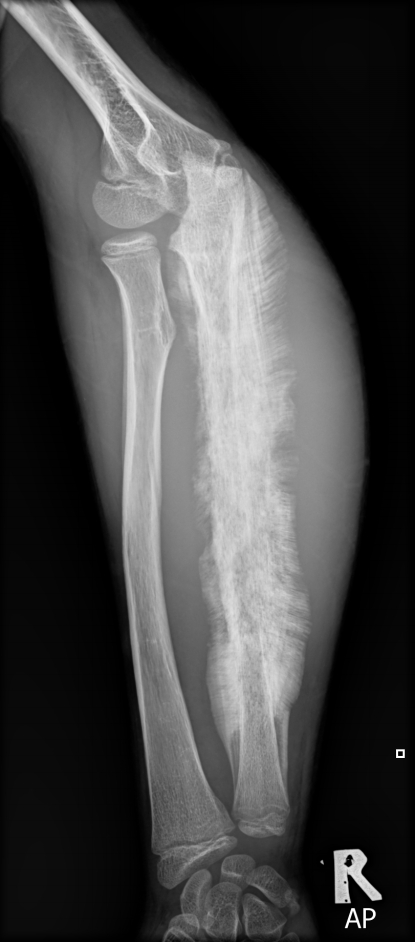
Aggressive bone production with a characteristic "sunray" appearance on x-ray is diagnostic of osteosarcoma in this child because of:
A 10-year-old obese boy was referred to the emergency department with a history of hip pain. He was observed to be limping and complained of severe pain. Which of the following investigations is least appropriate for this condition?
Which of the following conditions is least likely to present as an eccentric osteolytic lesion?
In which condition are Looser's zones typically observed?

Explanation: ***Loss of plane between soft tissue and muscle*** - This finding, often seen as **soft tissue swelling** and effacement of fat planes on radiographs, is the **earliest detectable radiographic sign** in acute osteomyelitis, typically appearing within 24-48 hours. - It reflects the initial inflammatory changes and **edema** in the soft tissues surrounding the infected bone. *Periosteal reaction* - This occurs later than soft tissue changes, usually appearing after **7-10 days** of infection, as the periosteum is lifted and new bone formation begins. - It is a sign of bone irritation and can be seen as linear or lamellated **new bone growth** parallel to the cortex. *Sequestrum formation* - A sequestrum is a piece of **devitalized (necrotic) bone** that separates from the healthy bone, a much later complication of osteomyelitis. - It typically appears several weeks into the disease course, indicating established bone necrosis and usually requiring surgical intervention. *Bony sclerosis* - **Bony sclerosis**, or increased bone density, is a sign of chronic inflammation and new bone formation in response to persistent infection. - This change is usually observed in the **later stages of osteomyelitis** or in chronic forms, not in the acute phase.
Explanation: ***Osteoid osteoma*** - An **osteoid osteoma** is typically a **solitary bone lesion**, meaning it rarely presents as polyostotic lesions. - It characteristically presents with **nocturnal pain relieved by NSAIDs**. *Hemangioma* - While often solitary, **hemangiomas** can occasionally be **multiple or polyostotic**, especially in syndromes like **Klippel-Trenaunay syndrome**. - These are benign **vascular tumors** that can occur in bone. *Fibrous dysplasia* - **Fibrous dysplasia** can be **monostotic** (single lesion) or **polyostotic** (multiple lesions), with the polyostotic form often part of **McCune-Albright syndrome**. - It involves the replacement of normal bone with **fibrous tissue**. *Multiple myeloma* - **Multiple myeloma** is a **hematologic malignancy** characterized by the proliferation of plasma cells in the bone marrow, leading to **multiple lytic bone lesions** (polyostotic). - These lesions often manifest as **pain**, **pathological fractures**, and **hypercalcemia**.
Explanation: ***Soap bubble appearance*** - This radiological sign is typically associated with **fibrous dysplasia** or certain types of **bone tumors**, such as **aneurysmal bone cysts** or **giant cell tumors**, indicating a lytic lesion with trabeculae. - It does not characterize the bone changes seen in **scurvy**, which primarily involves impaired collagen synthesis leading to weakened bone structure. *Pelken spur* - This refers to a **lateral metaphyseal spur** or projection, which is a classic radiographic finding in **scurvy**. - It results from the **subperiosteal hemorrhage** and subsequent callus formation, alongside weakening of the cortex at the metaphysis. *Zone of demarcation near epiphysis* - This describes the **Trümmerfeld zone**, a rarefaction (lucent line) in the metaphysis, immediately adjacent to the epiphysis. - It signifies the impaired osteoid formation and **demineralization** of the provisional calcification zone due to vitamin C deficiency. *Frenkel's line* - Also known as the **white line of Frenkel**, this is a dense, sclerotic line at the metaphysis adjacent to the epiphyseal plate. - It represents the dense, calcified but un-osteoidized cartilage that forms due to normal calcification of cartilage but **defective osteoblastic activity** in scurvy.
Explanation: ***X-ray spine AP view*** - An **AP (Anterior-Posterior) view** of the spine is least useful for diagnosing spondylolisthesis because it does not adequately demonstrate the **forward slippage** of one vertebra over another. - This view primarily visualizes the spine in the **coronal plane**, making it difficult to assess the **sagittal displacement** characteristic of spondylolisthesis. *X-ray spine lateral view* - A **lateral view** of the spine is highly useful as it directly shows the **sagittal alignment** and can clearly demonstrate the **anterior displacement** of a vertebral body. - It is often the **initial imaging modality** for suspecting and classifying spondylolisthesis severity. *MRI* - **MRI** is excellent for evaluating **soft tissue structures**, such as the spinal cord, nerve roots, and intervertebral discs, which can be compressed or damaged by spondylolisthesis. - While it can visualize the slippage, it is usually reserved for assessing **neurological compromise** or if surgical planning requires detailed soft tissue information. *CT scan* - **CT scans** provide detailed **bony anatomy** and are highly effective in visualizing the pars interarticularis defects (spondylolysis) often associated with spondylolisthesis. - It offers superior detail compared to plain X-rays for assessing the **extent of bone displacement** and associated degenerative changes.
Explanation: ***Sunray appearance*** - The **sunburst** or **sunray appearance** is a characteristic radiological feature of osteosarcoma, representing rapidly growing tumor spicules extending perpendicularly from the bone cortex. - This pattern is formed by **calcified tumor osteoid** radiating from the periosteum. *Periosteal new bone formation* - While osteosarcoma does involve periosteal new bone formation, this term is **too general** and can describe various bone conditions and tumors. - The specific pattern of new bone formation in osteosarcoma is better described by terms like "sunray" or "Codman's triangle", which are more diagnostic. *Cotton wool spots* - **Cotton wool spots** are seen in **Paget's disease of bone**, representing areas of sclerotic bone. - This appearance is not characteristic of osteosarcoma, which typically presents with destructive and proliferative bone changes. *Osteoid formation* - **Osteoid formation** is a histological hallmark of osteosarcoma, as it is a bone-forming tumor. - However, on radiology, the presence alone of osteoid is not a specific diagnostic feature; rather, it's the **pattern of osteoid mineralization** that defines the radiological appearance.
Explanation: ***Simple bone cyst*** - The **fallen fragment sign** is pathognomonic for a **simple bone cyst (SBC)**, occurring when a fragment of cortical bone breaks off and falls to the dependent portion of the cyst cavity. - This sign is visible on **radiographs** and indicates a **fluid-filled cavity**, as bone fragments would not fall in a solid tumor. *Aneurysmal bone cyst* - While also a **benign osteolytic lesion**, an aneurysmal bone cyst (ABC) is characterized by **blood-filled spaces** and does not typically exhibit the fallen fragment sign. - ABCs are often **expansile** and may show **fluid-fluid levels** on MRI, but not free-floating bone fragments. *Giant cell tumor* - This is an **aggressive, often benign** bone tumor characterized by **multinucleated giant cells** and typically affects the **epiphysis** of long bones in young adults. - Giant cell tumors are **solid lesions** and do not contain fluid-filled cavities where bone fragments could fall. *Fibrous dysplasia* - Fibrous dysplasia is a **developmental anomaly** where normal bone is replaced by **fibrous tissue and immature bone**. - Radiographically, it often presents with a **"ground-glass" appearance** and cortical thinning, but it is a solid lesion and does not feature the fallen fragment sign.
Explanation: ***Periosteal reaction*** - The characteristic "sunray" or "sunburst" appearance in osteosarcoma is a type of **aggressive periosteal reaction**, where tumor spicules grow perpendicular to the bone surface lifting the periosteum. - This pattern is highly suggestive of a rapidly growing malignant bone tumor like **osteosarcoma**, especially in a child. *Calcification along the periosteum* - While there is calcification associated with the periosteum, simply calcification along the periosteum is a **general term** and does not specifically describe the pattern seen in a "sunray" appearance. - Many conditions can cause periosteal calcification, and it does not always indicate the **aggressive, spiculated growth** characteristic of osteosarcoma. *Calcification along the blood vessels* - **Vascular calcification** refers to calcification within blood vessel walls, which is a separate pathological process. - This is not directly related to the **bone tumor's growth pattern** or the "sunray" appearance on an X-ray. *Soft tissue invasion* - While osteosarcoma often **invades surrounding soft tissues**, this invasion itself doesn't directly cause the "sunray" appearance. - The "sunray" pattern specifically refers to the **periosteal new bone formation** and not the mere presence of tumor cells in soft tissue.
Explanation: ***USG of hip*** - An **ultrasound (USG)** of the hip is generally not the primary imaging modality for diagnosing conditions like **slipped capital femoral epiphysis (SCFE)**, which is suggested by the patient's presentation. - While USG can detect effusions or synovitis, it provides poor visualization of bony structures and the physeal plate, which are crucial for diagnosing SCFE. *X-ray of the hip* - **X-rays** (AP and frog-leg lateral views) are the **initial and most important imaging study** for diagnosing SCFE. - They effectively visualize the **epiphyseal displacement** relative to the metaphysis and are sufficient for diagnosis in most cases. *MRI of the hip* - **MRI** is highly sensitive for detecting early or subtle SCFE, especially when X-rays are inconclusive. - It can evaluate the **physeal edema**, chondral changes, and avascular necrosis, providing more detailed information than X-rays. *CT scan of hip* - A **CT scan** provides excellent bony detail and can precisely assess the **degree of physeal slip** and femoral head deformity. - It may be used for surgical planning, especially in complex cases or when the slip is difficult to assess with X-rays.
Explanation: ***Simple bone cyst*** - Typically appears as a **central lytic lesion** rather than eccentric, most commonly located in the **proximal humerus** or femur. - It is often asymptomatic and discovered incidentally, which is different from other options that are more active lesions. *Aneurysmal bone cyst* - Presents as an **eccentric**, lytic lesion that is often **expansile**, causing cortical thinning or deformation [1]. - Commonly occurs in adolescents, associated with pain and swelling in the affected area. *Giant cell tumour* - Characterized by a **eccentric osteolytic lesion**, usually located around the **knee joint** (distal femur or proximal tibia) [2,3]. - Although it can be locally aggressive, it often presents with **pain and swelling** [2]. *Fibrous cortical defect* - Usually presents as an **eccentric, well-defined** cortical lesion in children and is considered a benign developmental anomaly [1]. - Commonly found on the **metaphysis** of long bones, often self-resolving without interventions [1]. **References:** [1] Kumar V, Abbas AK, et al.. Robbins and Cotran Pathologic Basis of Disease. 9th ed. Bones, Joints, and Soft Tissue Tumors, pp. 1206-1208. [2] Kumar V, Abbas AK, et al.. Robbins and Cotran Pathologic Basis of Disease. 9th ed. Bones, Joints, and Soft Tissue Tumors, pp. 1205-1206. [3] Kumar V, Abbas AK, et al.. Robbins and Cotran Pathologic Basis of Disease. 9th ed. Bones, Joints, and Soft Tissue Tumors, p. 1206.
Explanation: ***Osteomalacia (soft bones)*** - **Looser's zones**, also known as **pseudofractures** or **Milkman's lines**, are a classic radiological sign of osteomalacia. - They represent areas of unmineralized osteoid, which are typically symmetrical, perpendicular to the bone cortex, and penetrate part of the bone. *Osteogenesis imperfecta (brittle bone disease)* - This is a genetic disorder characterized by **fragile bones** due to a defect in **collagen production**. - While patients have frequent fractures, the hallmark radiological findings are not Looser's zones but rather generalized **osteopenia** and **multiple fractures** at various stages of healing. *Osteopetrosis (marble bone disease)* - Osteopetrosis is characterized by **abnormally dense bones** due to defective osteoclast function, leading to a failure of bone resorption. - This condition results in bones that are thick and brittle, often with a **"bone-within-a-bone" appearance** or **Erlenmeyer flask deformities**, not Looser's zones. *Hypoparathyroidism (low parathyroid hormone levels)* - This condition is characterized by **low blood calcium levels** and **high blood phosphate levels** due to insufficient parathyroid hormone. - While it affects bone metabolism, it does not typically manifest with Looser's zones; instead, findings may include **increased bone density** in some cases or normal bone density, along with features related to hypocalcemia such as **basal ganglia calcifications**.
Radiographic Anatomy of Bones and Joints
Practice Questions
Imaging of Fractures and Dislocations
Practice Questions
Arthritides: Inflammatory and Degenerative
Practice Questions
Metabolic Bone Diseases
Practice Questions
Bone and Soft Tissue Tumors
Practice Questions
Congenital Skeletal Anomalies
Practice Questions
Spine Imaging
Practice Questions
Skeletal Infections
Practice Questions
Sports Medicine Imaging
Practice Questions
Imaging of Prostheses and Implants
Practice Questions
Musculoskeletal Ultrasound
Practice Questions
MSK Interventional Procedures
Practice Questions
Get full access to all questions, explanations, and performance tracking.
Start For Free