Investigation of choice for soft tissue sarcoma is -
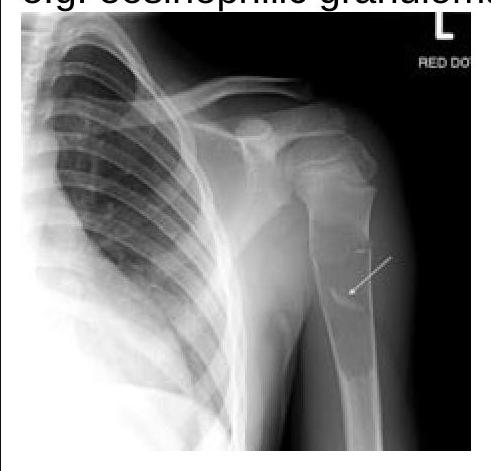
What does the fallen fragment sign indicate in radiology?
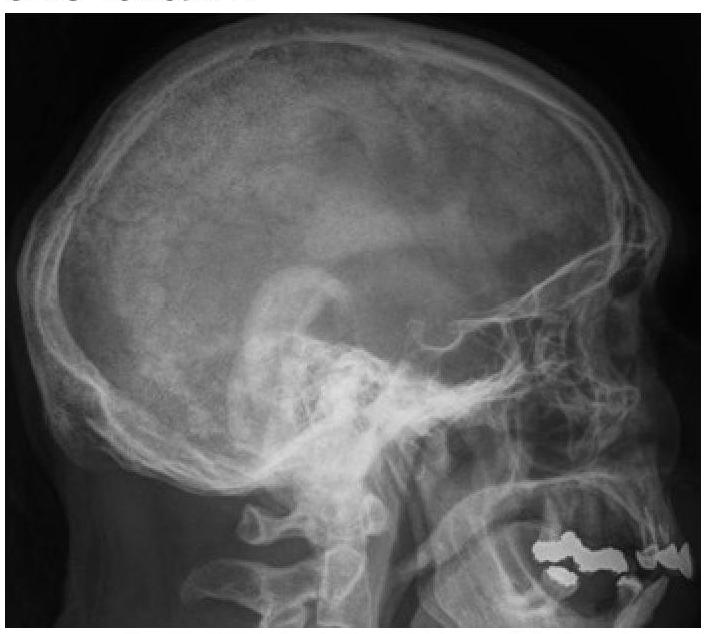
What type of lesions in the skull bones can be identified on this X-ray?
Radiological sign in case of Perthes disease?
Which condition is characterized by a 'moth-eaten' appearance of the bones?
In which condition is the 'Picture frame vertebra' seen?
Which condition is associated with the pencil in cup deformity?
What is the condition characterized by a 'dripping candle wax' appearance on the spine?
Which of the following conditions can cause periosteal reactions?
What is seen on x-ray with posterior elbow dislocation
Explanation: ***MRI*** - **Magnetic Resonance Imaging (MRI)** is the investigation of choice for soft tissue sarcomas due to its superior **soft tissue contrast resolution**, allowing for detailed assessment of tumor size, location, and extent within muscle, fat, and neurovascular structures. - MRI is crucial for **surgical planning**, helping to define tumor margins and evaluate involvement of adjacent critical structures. *CT* - While CT scans can identify masses, they have **limited soft tissue contrast resolution** compared to MRI, making it less effective for precise delineation of soft tissue sarcomas. - CT is often used for **staging to detect metastatic disease**, particularly in the lungs, rather than for primary tumor characterization. *Ultrasound* - **Ultrasound** is a good initial screening tool for soft tissue masses due to its accessibility and lack of radiation, but it is **operator-dependent** and has limitations in assessing deep or large lesions. - It can help differentiate cystic from solid lesions and guide biopsies but **lacks the comprehensive detail** of MRI for definitive diagnosis and staging. *X-ray* - **X-rays** are primarily used to visualize **bone abnormalities** and are generally not effective for evaluating soft tissue masses unless there is associated calcification or bone erosion. - They provide **minimal information** regarding the internal structure or extent of a soft tissue sarcoma.
Explanation: ***Indicates a simple bone cyst*** - The **fallen fragment sign** is a classic radiographic finding seen in **simple bone cysts** (unicameral bone cysts), particularly after a pathological fracture. - It occurs when a **fractured piece of bone** falls through the fluid-filled cyst cavity due to gravity, creating a characteristic appearance that indicates a benign, fluid-filled lesion. - This sign is considered **pathognomonic** for simple bone cysts. *Indicates osteosarcoma* - Osteosarcoma is a **malignant bone tumor** characterized by aggressive bone destruction and **osteoid formation**. - It typically does not demonstrate a fallen fragment sign; instead, it often shows a **Codman triangle** or **sunburst periosteal reaction**. - The aggressive nature and solid tumor composition make this sign incompatible with osteosarcoma. *Indicates an aneurysmal bone cyst* - An aneurysmal bone cyst (ABC) is a **benign, vascular bone lesion** that is usually multiloculated and blood-filled. - While it can cause bone expansion and pathological fractures, the fallen fragment sign is **not characteristic** of ABCs, which are typically hemorrhagic and contain blood-filled septa rather than clear fluid. - ABCs show a characteristic **fluid-fluid level** on imaging, not a fallen fragment. *Indicates adamantinoma* - Adamantinoma is a **rare, low-grade malignant bone tumor** most commonly found in the tibia. - This tumor does not exhibit a fallen fragment sign; its radiographic features often include **lobulated osteolytic lesions** with a sclerotic rim. - It is a solid tumor without the fluid-filled cavity necessary for this sign.
Explanation: ***Paget's disease*** - An X-ray of the skull in Paget's disease typically shows **thickening of the skull vault** and areas of both **osteolysis** and **osteosclerosis**, leading to a characteristic "cotton wool" appearance. - The disease involves abnormal bone remodeling, leading to enlarged and weakened bones susceptible to deformity and fracture. *Multiple myeloma* - On a skull X-ray, multiple myeloma usually presents as multiple, sharply-defined, **"punched-out" lytic lesions** without a sclerotic border. - These lesions reflect areas where malignant plasma cells have destroyed bone, which is distinct from the mixed lytic and sclerotic changes of Paget's disease. *Osteosarcoma* - Osteosarcoma is a **primary bone malignancy** that typically presents as a solitary lesion with a mixture of lytic and sclerotic areas, often with a **sunburst or Codman's triangle** periosteal reaction. - It most commonly affects long bones in younger individuals and is a much less common presentation in the skull compared to other bone conditions. *Osteomyelitis* - Osteomyelitis is an **infection of the bone** that would appear on an X-ray as areas of bone destruction (lysis) and new bone formation (sclerosis), often with **sequestrum** (dead bone) and **involucrum** (new bone formation around the infection). - While it can affect the skull, its imaging features would typically be localized signs of infection rather than the widespread, generalized changes seen in Paget's disease.
Explanation: ***Flattening of femoral head*** - **Flattening** and **fragmentation** of the femoral head are characteristic radiological findings in **early-stage** Perthes disease. - This flattening is a direct consequence of the **avascular necrosis** and subsequent **remodeling** of the femoral epiphysis. *Fragmentation of femoral head epiphysis* - While **fragmentation** is a key feature of Perthes disease, it's typically observed **after** the initial flattening and sclerosis in the avascular stage. - It represents the process of **resorption** and **revascularization** as the bone attempts to heal. *Lateral femoral head displacement* - **Lateral displacement** of the femoral head is a more common finding in conditions like **slipped capital femoral epiphysis (SCFE)**, where the epiphysis slips from the metaphysis. - In Perthes disease, the primary issue is the **necrosis and collapse** of the femoral head itself, rather than displacement from the neck. *Limited hip abduction* - **Limited hip abduction** is a clinical sign, not a radiological sign, and it is a common symptom in Perthes disease due to pain, inflammation, and deformity of the femoral head. - Radiological signs are visual abnormalities observed on imaging studies like X-rays.
Explanation: ***Multiple myeloma*** [1][2] - Characterized by **punched-out lytic lesions** in bones, often described as **moth-eaten** appearance on imaging [1]. - Associated with **elevated serum proteins** and **Bence Jones proteins** in urine, confirming the diagnosis [2]. *Eosinophilic granuloma* - Usually presents with **solitary bone lesions** and is linked to **Langerhans cell histiocytosis** rather than the moth-eaten pattern. - Does not typically cause generalized **lytic bone lesions** seen in cases of multiple myeloma. *Chondromyxoid fibroma* - Generally appears as a **well-defined cortical lesion** and is not associated with a moth-eaten appearance. - It predominantly affects the **metaphysis** of long bones and shows a characteristic **cartilaginous matrix**. *Osteoid osteoma* - Presents with a **nidus** of osteoid formation, leading to localized bone pain, and does not exhibit a moth-eaten consistency. - Tends to cause **cortical bone thickening** rather than the diffuse lytic lesions associated with multiple myeloma. **References:** [1] Kumar V, Abbas AK, et al.. Robbins and Cotran Pathologic Basis of Disease. 9th ed. Diseases of White Blood Cells, Lymph Nodes, Spleen, and Thymus, p. 608. [2] Cross SS. Underwood's Pathology: A Clinical Approach. 6th ed. Common Clinical Problems From Blood And Bone Marrow Disease, pp. 616-617.
Explanation: ***Paget disease*** - The "picture frame vertebra" sign is a classic radiographic finding in **Paget disease**, characterized by **cortical thickening** and sclerosis around the vertebral body circumference, resembling a picture frame. - This appearance is due to the disordered bone remodeling processes (increased osteoclastic bone resorption followed by disorganized osteoblastic new bone formation) characteristic of Paget disease. *Osteopetrosis (marble bone disease)* - Osteopetrosis is characterized by **increased bone density** due to defective osteoclast function, leading to bones that are dense but brittle. - It does not typically present with the specific "picture frame" appearance of individual vertebrae, but rather with diffuse sclerosis of bones. *Ankylosing spondylitis (AS)* - Ankylosing spondylitis primarily affects the **axial skeleton**, causing inflammation and eventual fusion of the vertebrae (leading to a "bamboo spine" appearance). - While it involves the spine, it does not produce the "picture frame" vertebral sign seen in Paget disease. *Osteoporosis* - Osteoporosis is characterized by **reduced bone mass** and microstructural deterioration of bone tissue, leading to increased bone fragility and fracture risk. - Radiographically, it shows **decreased bone density** and possible vertebral compression fractures, which is the opposite of the increased bone density and cortical thickening seen in the "picture frame" sign.
Explanation: ***Psoriatic arthritis*** - The **pencil-in-cup deformity** is a classic radiographic finding in advanced psoriatic arthritis, occurring due to **periarticular bone erosion** and phalangeal telescoping. - This specific deformity is characterized by the proximal phalanx eroding and fitting into the expanded distal phalanx, resembling a "pencil in a cup." *Rheumatoid arthritis* - While rheumatoid arthritis causes significant joint destruction, it typically presents with **periarticular erosions** and **joint space narrowing**, but not the characteristic pencil-in-cup morphology. - Common deformities include **swan-neck** and **boutonnière** deformities, and ulnar deviation. *Ankylosing spondylitis* - This condition primarily affects the **axial skeleton**, leading to spinal fusion and **sacroiliitis**. - Peripheral joint involvement is less common and typically does not result in the pencil-in-cup deformity; instead, it can cause **syndesmophytes**. *Avascular necrosis* - **Avascular necrosis** (AVN) involves the death of bone tissue due to lack of blood supply, primarily affecting the femoral head or other major joints. - Radiographic findings include **subchondral collapse**, crescent sign, and eventual joint destruction, but not the specific deformities seen in inflammatory arthritis like pencil-in-cup.
Explanation: ***Melorheostosis*** - This rare sclerosing bone dysplasia is characterized by **unilateral, linear periosteal bone thickening** that gives the appearance of **"dripping candle wax"** on imaging studies. - The distinctive radiographic finding is due to an overgrowth of cortical bone, often affecting a single limb. *Metastasis* - **Bone metastases** typically present as multifocal lytic or blastic lesions, depending on the primary tumor, rather than a linear, thick "dripping candle wax" pattern. - While they can involve the spine, the radiographic morphology is distinct from the **cortical thickening** seen in melorheostosis. *TB spine* - Tuberculosis of the spine, or **Pott's disease**, primarily causes **vertebral body destruction**, kyphosis, and *paravertebral abscess formation*. - It does not produce the characteristic **"dripping candle wax" appearance** of cortical hyperostosis. *Osteopetrosis* - **Osteopetrosis** (marble bone disease) is characterized by a generalized increase in **bone density** due to defective osteoclast function. - This condition results in uniformly dense and thickened bones, often referred to as **"bone within a bone"** or a **"sandwich vertebrae"** appearance, which differs from the localized, flowing hyperostosis of melorheostosis.
Explanation: ***All of the options*** - **Periosteal reactions** are non-specific findings that indicate periosteal irritation or inflammation, which can be caused by a wide range of pathologies including infection, neoplasia, and trauma. - This option correctly encompasses the various causes listed in the other choices, making it the most accurate answer. *Osteomyelitis* - **Osteomyelitis**, an infection of the bone, can cause inflammation of the surrounding periosteum, leading to periosteal new bone formation. - The type of periosteal reaction can vary, from **lamellated** to **solid**, depending on the chronicity and aggressiveness of the infection. *Syphilis* - **Congenital syphilis** and tertiary acquired syphilis can lead to significant bone involvement, including **periostitis**, which manifests as periosteal reactions. - The classic appearance in children with congenital syphilis is a **wavy** or **irregular cortical thickening** due to widespread periostitis. *Tumor* - Both **primary bone tumors** (e.g., osteosarcoma, Ewing's sarcoma) and **metastatic lesions** can elicit a periosteal response as they invade or irritate the periosteum. - The periosteal reaction in tumors can present as aggressive patterns like a **sunburst** or **Codman's triangle**, indicating rapid bone destruction and new bone formation.
Explanation: ***Coronoid process appears posterior to humerus*** - In a **posterior elbow dislocation**, the ulna and radius (including the coronoid process) are displaced **posteriorly** relative to the distal humerus. - This posterior displacement means the coronoid process, which normally articulates with the trochlea of the humerus, will be located behind the humerus on a lateral X-ray view. *Coronoid process appears anterior to humerus* - This position would typically be seen in an **anterior elbow dislocation**, which is rare. - In a normal elbow, the coronoid process is anterior to the elbow joint's axis but maintains articulation with the trochlea. *Coronoid process appears below humerus* - The term "below" is imprecise in this context and does not accurately describe the characteristic displacement in a posterior dislocation. - Displacement in dislocations is typically described in relation to the main bone involved (humerus) in an anterior-posterior or medial-lateral plane. *No visible coronoid process* - The coronoid process is an integral part of the ulna and is almost always visible on plain X-rays, even in dislocations. - Its presence is key to identifying the ulna's position relative to the humerus.
Radiographic Anatomy of Bones and Joints
Practice Questions
Imaging of Fractures and Dislocations
Practice Questions
Arthritides: Inflammatory and Degenerative
Practice Questions
Metabolic Bone Diseases
Practice Questions
Bone and Soft Tissue Tumors
Practice Questions
Congenital Skeletal Anomalies
Practice Questions
Spine Imaging
Practice Questions
Skeletal Infections
Practice Questions
Sports Medicine Imaging
Practice Questions
Imaging of Prostheses and Implants
Practice Questions
Musculoskeletal Ultrasound
Practice Questions
MSK Interventional Procedures
Practice Questions
Get full access to all questions, explanations, and performance tracking.
Start For Free