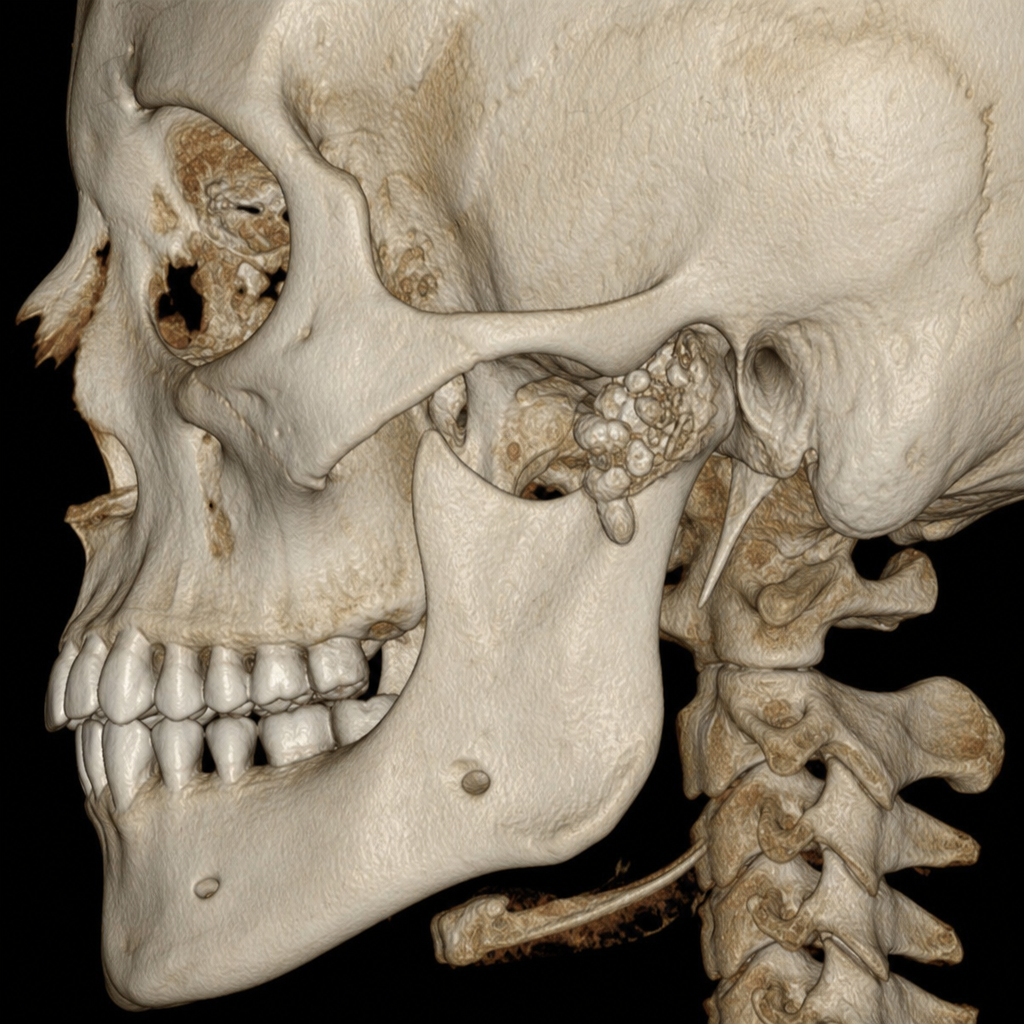
What is the main diagnostic feature of osteoarthritis on X-ray imaging?
Which investigation is least effective in diagnosing acute osteomyelitis?
Shenton's line is seen in X-ray of -
X-ray appearance of sequestrum?
First radiological sign for active tubercular arthritis is?
Which of the following is not a typical radiological finding in rheumatoid arthritis?
Cotton wool skull is a radiological feature of which condition?
Based on the X-ray image, which condition is indicated by a sunray appearance?

The given image is an x-ray of a 22-year-old female. What is the probable diagnosis based on the x-ray?

What is the angle shown in the image known as?

Explanation: ***Joint space narrowing*** - This is the **primary and most consistent radiographic feature** of **osteoarthritis (OA)**, reflecting progressive **cartilage loss** over time. - It is the earliest radiographic change and forms the basis of radiological grading systems for OA severity. - Joint space narrowing is caused by **articular cartilage degradation**, allowing the bone ends to move closer together. - Along with **osteophytes**, it constitutes the cardinal radiographic sign of OA. *Subchondral sclerosis* - While a characteristic feature of OA, **subchondral sclerosis** represents a secondary change occurring as bone remodeling in response to cartilage loss. - It reflects hardening and thickening of bone beneath the articular surface but typically appears later in disease progression. - It is a hallmark feature but not the primary diagnostic criterion. *Periarticular osteopenia* - This refers to decreased bone density around the joint and is characteristic of **inflammatory arthropathies** like **rheumatoid arthritis**, not osteoarthritis. - OA typically shows **increased bone density** (sclerosis) rather than osteopenia. - It suggests active inflammation and bone resorption, which is distinct from the degenerative changes in OA. *Joint ankylosis* - **Joint ankylosis** is complete bony fusion of a joint, seen in severe inflammatory conditions like **ankylosing spondylitis** or advanced rheumatoid arthritis. - It is not a feature of osteoarthritis, which maintains joint mobility despite cartilage loss and remodeling. - OA is characterized by **degeneration**, not fusion.
Explanation: ***X-ray*** - **Plain radiographs** are often normal in the early stages of acute osteomyelitis, as bony changes take time to develop. - Changes like **periosteal elevation** or **bony destruction** typically become visible only after 10-14 days following infection onset. *Bone scan* - A **three-phase bone scan** (technetium-99m) is highly sensitive for detecting early osteomyelitis by showing increased blood flow and uptake in the affected area. - It can detect changes within 24-48 hours of infection, making it useful when plain radiographs are normal. *MRI* - **Magnetic Resonance Imaging (MRI)** is considered the most sensitive and specific imaging modality for diagnosing acute osteomyelitis. - It provides excellent soft tissue contrast, allowing early detection of **marrow edema**, **abscess formation**, and **cortical disruption**. *CT scan* - **Computed Tomography (CT) scans** are useful for visualizing cortical bone changes, **sequestra**, and defining the extent of bone involvement, especially helpful for surgical planning. - While more sensitive than X-rays, it is typically less sensitive than MRI in detecting early marrow changes in acute osteomyelitis.
Explanation: ***Antero-posterior pelvis with both hips*** - Shenton's line is a curved line that can be drawn along the inferior border of the **femoral neck** and continuous with the inferior border of the **superior pubic ramus** (obturator foramen). - It is best visualized on an **antero-posterior X-ray of the pelvis** including both hips and is commonly assessed for hip dislocations or fractures. *Antero-posterior shoulder* - This view is primarily used to assess the **glenohumeral joint**, clavicle, and scapula. - Shenton's line specifically relates to the hip joint anatomy and is not relevant to the shoulder. *Lateral cervical spine* - A lateral cervical spine view focuses on the alignment of the **vertebral bodies**, intervertebral discs, and neural foramina in the neck. - It is used for assessing conditions like cervical fractures, dislocations, or degenerative changes, not hip pathology. *Lateral lumbosacral spine* - This view is used to evaluate the **lumbar vertebrae** and sacrum, looking for disc herniations, spondylolisthesis, or spinal alignment issues. - Shenton's line is not a landmark assessed on a lateral lumbosacral spine X-ray.
Explanation: ***Radiodense bone fragments*** - A **sequestrum** refers to a piece of dead bone that has become detached from the surrounding healthy bone, typically due to **osteomyelitis**. - On X-ray, this necrotic bone often appears **denser** (radiodense) than the surrounding viable bone because it has lost its blood supply and can undergo sclerosis, or it simply stands out within the less dense inflammatory exudate. *Osteopenic fragment* - An **osteopenic fragment** would indicate a piece of bone with reduced density, often associated with bone loss or demineralization, which is not characteristic of a sequestrum. - While surrounding bone might appear osteopenic due to infection, the sequestrum itself is typically **denser**. *Fragment with honeycomb loculated appearance* - A **honeycomb or loculated appearance** is typically associated with conditions like fibrous dysplasia, aneurysmal bone cysts, or certain tumors, which involve bone remodeling or cystic changes, not necrotic bone. - This appearance suggests architectural changes within the bone rather than a detached piece of dead bone. *Radiolucent area with speckled calcification* - A **radiolucent area** implies an area of decreased bone density, and when combined with speckled calcifications, it might suggest entities like cartilage tumors (e.g., enchondroma) or certain types of malignant bone tumors. - This description does not fit the characteristic appearance of a **sequestrum**, which is a **dense** bone fragment within a radiolucent area of pus and granulation tissue.
Explanation: ***Localized osteoporosis*** - **Localized osteoporosis** in the juxta-articular region is often the earliest detectable radiological sign in active tubercular arthritis due to **inflammation-induced bone resorption**. - This finding reflects the initial bone changes in response to the **Mycobacterium tuberculosis** infection. *Sclerosis* - **Sclerosis** (increased bone density) in the subchondral bone is typically a feature of chronic or healing arthritis, indicating bone repair and remodeling, which occurs much later than initial inflammation. - It is not an early sign of active disease but rather a response to long-standing stress or infection. *Joint space reduction* - **Joint space reduction** occurs as cartilage is destroyed, which is a relatively later stage in tubercular arthritis, as initial inflammation primarily affects the synovium and juxta-articular bone. - While it is a common radiological finding in many forms of arthritis, it usually follows significant cartilage degradation, thus not being the first sign. *Osteophytes* - **Osteophytes** (bone spurs) are characteristic of degenerative joint disease (osteoarthritis) and represent the body's attempt to stabilize the joint in response to chronic wear and tear or instability. - They are not typically associated with the acute inflammatory process of active tubercular arthritis.
Explanation: ***Subchondral sclerosis*** - **Subchondral sclerosis** is a hallmark of **osteoarthritis**, representing bone hardening beneath damaged cartilage, which is not characteristic of rheumatoid arthritis. - In rheumatoid arthritis, the primary pathology involves **synovial inflammation** leading to bone erosion rather than bone thickening. *Symmetrical involvement* - **Symmetrical polyarthritis** is a defining feature of rheumatoid arthritis, often affecting the same joints on both sides of the body. - This pattern helps differentiate it from other inflammatory arthropathies that might exhibit asymmetrical joint involvement. *Marginal erosion* - **Marginal erosions** are a classic early radiological sign of rheumatoid arthritis, caused by the inflammatory pannus invading the bare areas of bone. - These erosions typically appear at the edges of the joint, where the synovial membrane attaches. *Juxta-articular osteopenia* - **Juxta-articular osteopenia** (localized bone thinning near the joint) is an early and common radiological finding in rheumatoid arthritis. - It results from local inflammatory mediators and disuse around the affected joints.
Explanation: ***Paget's disease*** - The "cotton wool skull" appearance is a **classic radiological finding** in **Paget's disease of bone**, particularly in the **sclerotic phase** - This appearance results from patchy areas of **osteosclerosis** (increased bone density) interspersed with areas of **osteolysis** (bone destruction) - The mixed lytic-sclerotic pattern creates the characteristic fluffy, cotton wool-like appearance on skull radiographs *Eosinophilic granuloma* - Presents as **well-demarcated lytic (punched-out) lesions** in the skull - Does not cause the mixed osteolytic and osteosclerotic changes characteristic of cotton wool appearance - Typically affects children and young adults *Fibrous dysplasia* - Appears as **ground-glass opacity** or lytic lesion with sclerotic rim on radiographs - Shows homogeneous expansion of bone rather than patchy changes - Does not produce the cotton wool pattern seen in Paget's disease *Osteopetrosis* - Characterized by abnormally **dense, uniformly sclerotic bones** throughout the skeleton - Results from defective osteoclast function (Albers-Schönberg disease) - Presents with diffuse increased density rather than the patchy cotton wool pattern
Explanation: ***Osteosarcoma*** - A **sunray or sunburst appearance** on X-ray is a classic radiologic sign of osteosarcoma, representing new bone formation perpendicular to the bone cortex. - This aggressive primary bone tumor often presents with a combination of **osteoblastic (bone-forming)** and osteolytic (bone-destroying) features. *Osteochondroma* - Osteochondromas appear as **bony outgrowths** from the surface of bones, covered by a cartilage cap. - They are typically benign and do not exhibit the aggressive periosteal reaction seen in a sunray appearance. *Osteoclastoma* - Also known as a **giant cell tumor of bone**, osteoclastomas are typically **lytic lesions** that cause bone destruction. - They do not form new bone in a sunray pattern. *Chondroblastoma* - Chondroblastomas are rare, benign cartilaginous tumors usually found in the **epiphysis** of long bones. - They are typically **well-circumscribed lytic lesions** with fine, punctate calcifications, not a sunray pattern.
Explanation: ***Giant cell tumor*** - The X-ray shows a **lytic lesion** in the **distal humeral metaphysis extending into the epiphysis**, which is characteristic of a giant cell tumor. - Giant cell tumors typically occur in **young adults (20-40 years old)**, are often **eccentric with no sclerotic rim**, and can be aggressive, resembling the presented image in a 22-year-old female. *Chondroblastoma* - This typically presents as an **epiphyseal lesion** with a sclerotic rim in patients with **open physes**, usually younger than 20 years. - The lesion in the image appears to extend beyond the epiphysis, and the patient's age (22) makes chondroblastoma less likely as the physes are generally closed. *Osteochondroma* - This is an **exophytic lesion** typically growing away from the joint, characterized by a cartilage cap and continuity of the cortex and medullary cavity with the parent bone. - The image shows an **intraosseous lytic lesion**, not an exophytic bony projection. *Aneurysmal bone cyst* - This lesion often presents as an **expansile, lytic lesion** with internal septations and fluid-fluid levels, more common in the **metaphysis of long bones** in individuals younger than 20. - While aneurysmal bone cysts can be expansile, they typically show a "soap bubble" appearance with prominent internal septations, unlike the more solid-appearing lesion characteristic of giant cell tumor in this patient.
Explanation: ***Correct Option: Cobb angle*** - The image displays a method for measuring the angle of a spinal curvature, which is known as the **Cobb angle** - This measurement is routinely used to assess the severity of **scoliosis** by drawing lines parallel to the vertebral endplates at the extreme ends of the curve and then determining the angle between these lines - The Cobb angle is the **gold standard** for quantifying scoliosis and monitoring curve progression *Incorrect Option: Bohler angle* - The **Bohler angle** is a measurement used in the assessment of **calcaneal fractures** - It is formed by two lines drawn on a lateral foot X-ray and is not relevant to spinal deformities *Incorrect Option: Ferguson angle* - The **Ferguson angle**, also known as the lumbosacral angle, measures the angle of the sacral base relative to the horizontal - It describes the degree of **lordosis** and is not used to quantify scoliosis as depicted in the image *Incorrect Option: Baumann angle* - The **Baumann angle** is an important measurement used in pediatric orthopedics to assess the alignment of the **distal humerus** after a supracondylar fracture - It is irrelevant to spinal imaging and curvature assessment
Radiographic Anatomy of Bones and Joints
Practice Questions
Imaging of Fractures and Dislocations
Practice Questions
Arthritides: Inflammatory and Degenerative
Practice Questions
Metabolic Bone Diseases
Practice Questions
Bone and Soft Tissue Tumors
Practice Questions
Congenital Skeletal Anomalies
Practice Questions
Spine Imaging
Practice Questions
Skeletal Infections
Practice Questions
Sports Medicine Imaging
Practice Questions
Imaging of Prostheses and Implants
Practice Questions
Musculoskeletal Ultrasound
Practice Questions
MSK Interventional Procedures
Practice Questions
Get full access to all questions, explanations, and performance tracking.
Start For Free