In an elderly patient with sudden onset of severe lower back pain without trauma, which imaging study is most appropriate to diagnose a suspected vertebral compression fracture?
What is the most effective method for diagnosing a suspected stress fracture in an athlete with normal initial X-rays?
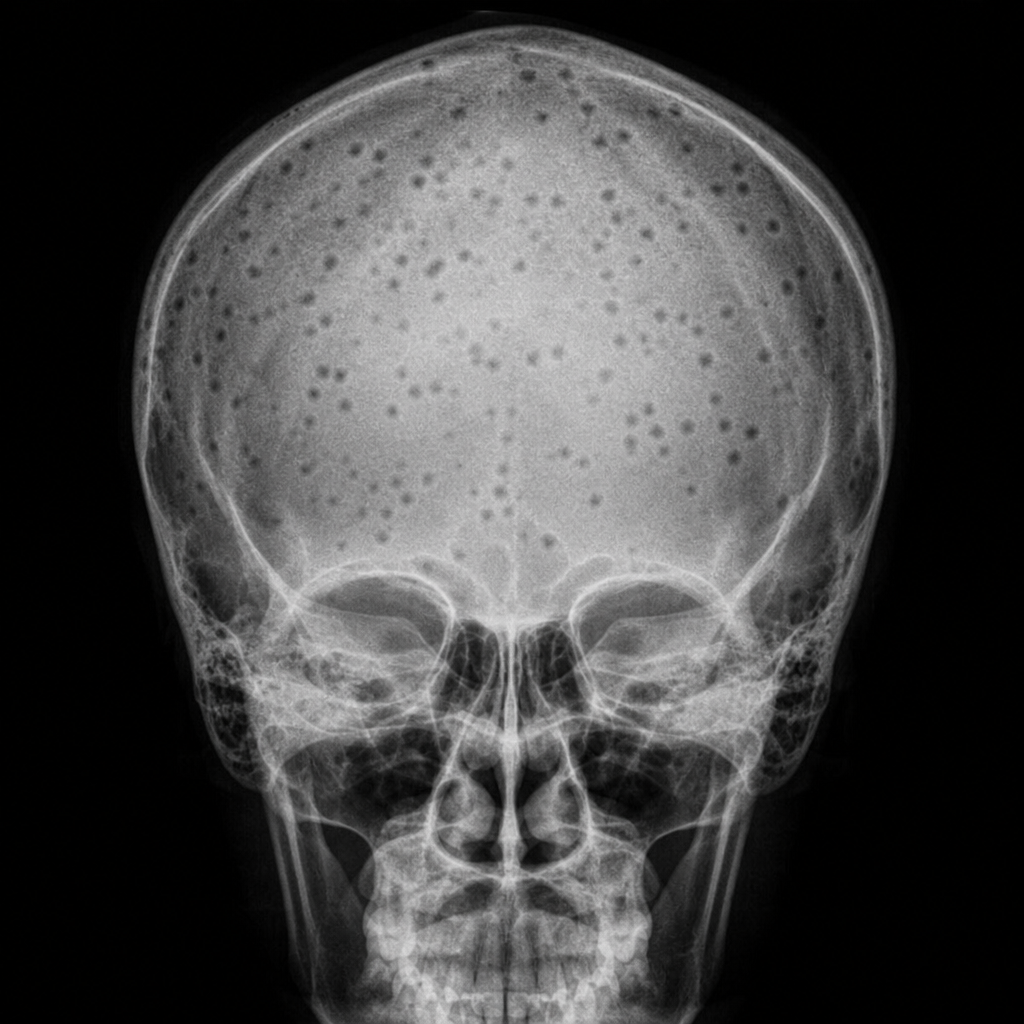
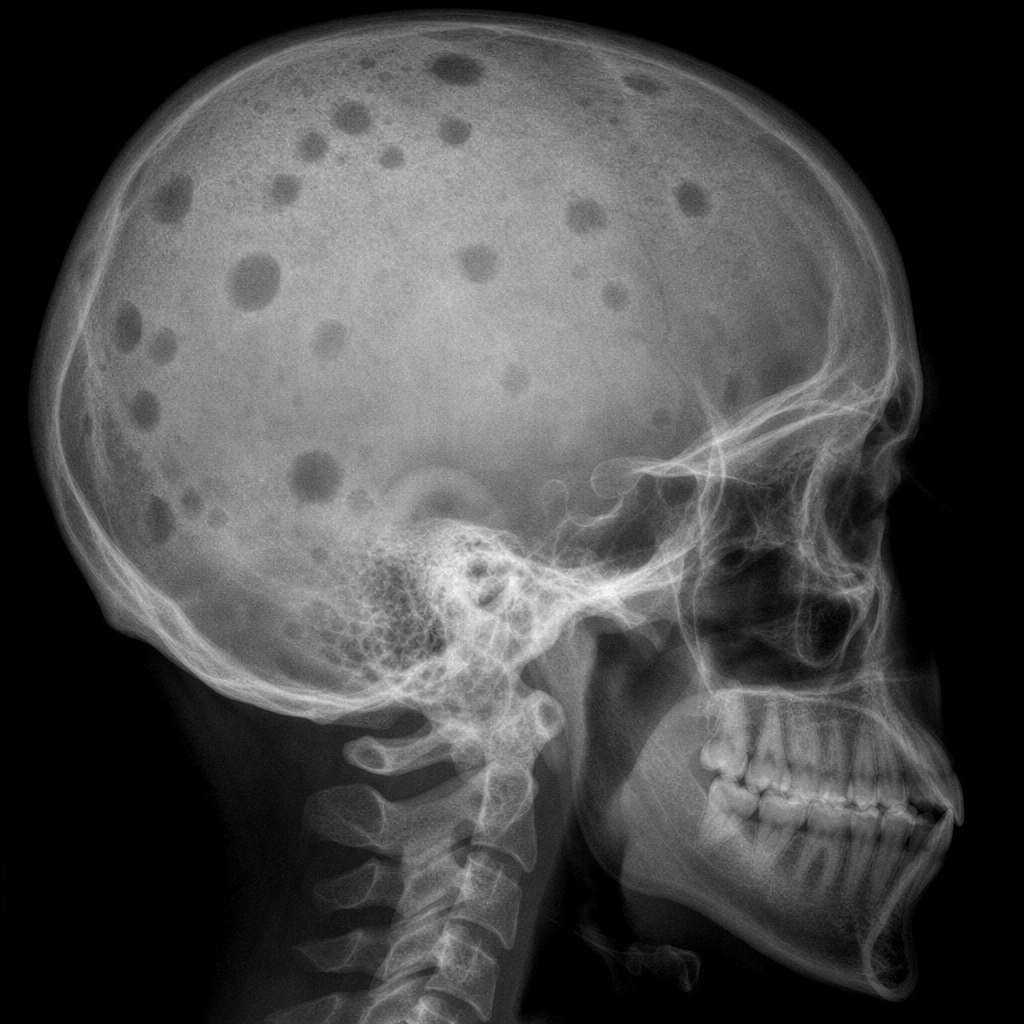
What is the characteristic appearance of multiple myeloma on a skeletal survey?
Which imaging feature helps to differentiate an enchondroma from a chondrosarcoma on radiographs?
An MRI of the spine shows vertebral body collapse. Which imaging feature would most strongly suggest a diagnosis of malignancy?
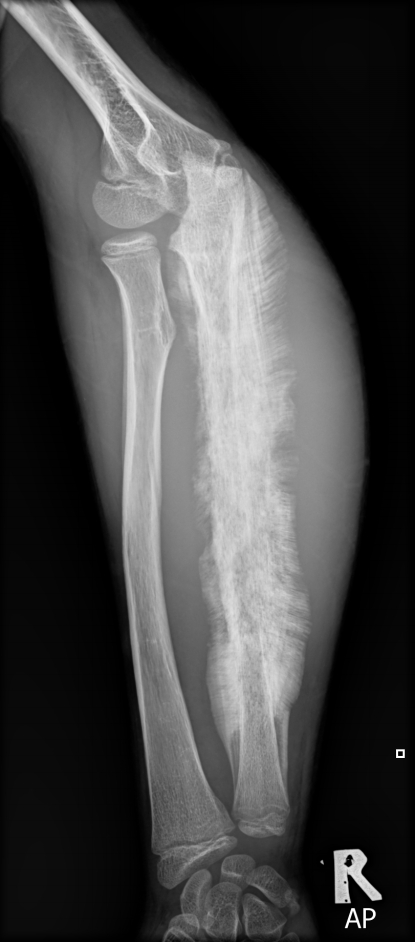
What type of periosteal reaction is considered non-aggressive?
Which imaging modality is best suited for identifying soft tissue damage and marrow involvement in bone tumors?
Which radiographic sign is characteristic of scoliosis?
Which feature on imaging indicates subacute osteomyelitis (Brodie's abscess)?
A 55-year-old female with a history of osteoarthritis presents with worsening pain in the hips and knees. What specific imaging findings on X-ray would confirm osteoarthritis as opposed to other forms of arthritis?
Explanation: ***X-ray of the lumbar spine*** - **Plain radiography** is the **first-line imaging modality** for suspected vertebral compression fractures in clinical practice. - It can effectively demonstrate **loss of vertebral height**, cortical disruption, and characteristic wedge deformity. - **Cost-effective**, widely available, and provides adequate diagnostic information in most cases of uncomplicated compression fractures. - If X-ray is inconclusive or if there are red flags (neurological deficits, suspected malignancy), further imaging with MRI may be indicated. *MRI of the lumbar spine* - While **MRI** is the most sensitive modality for detecting **acute fractures** and distinguishing them from chronic ones, it is **not the first-line investigation**. - MRI is reserved for cases with **neurological compromise**, when X-ray is **negative or inconclusive**, or when there is suspicion of **underlying malignancy or infection**. - In an uncomplicated suspected compression fracture without red flags, starting with MRI is not the most appropriate or cost-effective approach. *CT scan of the lumbar spine* - **CT** provides excellent bony detail and can confirm fractures when X-ray findings are equivocal. - However, it is not routinely used as the **initial investigation** due to higher radiation exposure compared to plain radiography. - CT is useful for **pre-operative planning** or assessing complex fracture patterns. *Bone scan* - A **bone scan** has low specificity and poor anatomical detail. - It cannot differentiate compression fractures from other causes of increased bone turnover and is rarely used for this indication in current practice.
Explanation: ***MRI*** - **Magnetic Resonance Imaging (MRI)** is highly sensitive for detecting **bone marrow edema** and subtle cortical changes characteristic of early stress fractures, even when X-rays are normal. - It provides excellent soft tissue and bone detail, helping to differentiate stress fractures from other causes of pain like **tendinopathy** or **periostitis**. *Repeat X-ray in two weeks* - While a **repeat X-ray** may show evidence of healing or periosteal reaction after two weeks, it is less sensitive for early diagnosis and delays definitive management. - Initial X-rays are often normal in early stress fractures because bone changes may not be sufficient for radiographic detection. *CT scan* - A **CT scan** provides excellent bony detail and can detect subtle fractures, but it exposes the patient to **ionizing radiation**. - It is generally less sensitive than MRI for detecting early stress fractures, which often involve bone edema before a clear fracture line is visible. *Bone scan* - A **bone scan** (scintigraphy) is highly sensitive for detecting increased bone turnover, which occurs with stress fractures. - However, it has **poor specificity**, as other conditions such as infection, tumor, or degenerative changes can also cause increased uptake, often requiring further imaging for confirmation.
Explanation: ***Punched-out lytic lesions*** - Multiple myeloma is characterized by the proliferation of **plasma cells** in the bone marrow, which produce factors that activate osteoclasts and inhibit osteoblasts. - This imbalance leads to localized bone destruction, appearing as sharply demarcated, **radioluscent (lytic) lesions** without a sclerotic rim on X-ray. *Osteoblastic lesions* - **Osteoblastic (sclerotic) lesions** are typically associated with conditions that stimulate bone formation, such as metastatic prostate cancer. - Multiple myeloma rarely presents with osteoblastic activity; its hallmark is bone destruction. *Mixed lytic and sclerotic lesions* - **Mixed lesions** can be seen in various metastatic cancers (e.g., breast cancer, lymphoma), reflecting a balance of both bone destruction and new bone formation. - This appearance is not typical for multiple myeloma, which predominantly presents with osteolysis. *Diffuse osteopenia* - While multiple myeloma can cause generalized **osteopenia** due to widespread bone destruction, it is not the *most characteristic* or specific finding on a skeletal survey. - **Punched-out lytic lesions** are more distinctive and diagnostic for multiple myeloma compared to diffuse bone thinning, which can be seen in many other conditions (e.g., osteoporosis).
Explanation: ***Periosteal reaction*** - The presence of a **periosteal reaction** (especially an aggressive or interrupted pattern) is a key radiographic indicator that suggests a **chondrosarcoma** rather than an enchondroma, as enchondromas are benign and typically do not elicit periosteal bone response unless complicated by pathologic fracture. - However, it's important to note that **low-grade (grade 1) chondrosarcomas** may **not show periosteal reaction**, making this feature most useful when present but not reliable when absent. - Among the given radiographic features, periosteal reaction is the most specific indicator of malignant transformation. *Soft tissue mass* - A **soft tissue mass** extending beyond the bone cortex is highly characteristic of **chondrosarcoma**, particularly higher-grade tumors, and is an important differentiating feature. - However, **early or low-grade chondrosarcomas** may not demonstrate a clear soft tissue component on plain radiographs, limiting its sensitivity for detecting all malignant cases. - When present, it's a strong indicator of malignancy, but its **absence does not exclude chondrosarcoma**. *Bone expansion* - Both enchondromas and chondrosarcomas can cause **bone expansion**, particularly in the small bones of the hands and feet for enchondromas, or with larger tumor burden for chondrosarcomas. - Therefore, **bone expansion alone** is **not a reliable differentiating feature** between these two entities. *Calcification pattern* - Both enchondromas and chondrosarcomas typically exhibit **chondroid calcifications**, described as **"rings and arcs"** or **"stippled/punctate"** patterns. - While more irregular, permeative, or absent mineralization might suggest higher-grade malignancy, the **pattern of calcification** on plain radiographs is **not definitively discriminatory** for differentiation between enchondroma and chondrosarcoma.
Explanation: ***Presence of a soft tissue mass*** - A **paravertebral or epidural soft tissue mass** in combination with vertebral body collapse is highly suggestive of a malignant etiology, such as metastatic tumor or primary spinal tumor. - Malignant processes often destroy cortical bone and extend into surrounding soft tissues, forming an **extradural mass**. - This is one of the most specific features distinguishing malignant from benign (osteoporotic) vertebral collapse. *High signal on T1-weighted images* - High signal on T1-weighted images typically indicates **fat**, **subacute hemorrhage**, or a lesion with high protein content, which is non-specific for malignancy. - While some tumors can hemorrhage, T1 hyperintensity alone is not a strong indicator of malignancy in vertebral collapse. *High signal on T2-weighted images* - High signal on T2-weighted images usually indicates **edema**, **inflammation**, or **increased fluid content**, which can be seen in both benign conditions (e.g., acute osteoporotic fracture, osteomyelitis) and malignant processes. - This finding is too non-specific to strongly differentiate malignancy from other causes of vertebral collapse. *Low signal on both T1 and T2 images* - Low signal on both T1 and T2 images can indicate **sclerosis**, **fibrosis**, or **calcification**, which are more commonly associated with chronic benign conditions or healed fractures. - This pattern is generally less indicative of an active, aggressive malignant process causing acute vertebral collapse.
Explanation: ***Lamellated*** - A **lamellated** or "onion skin" periosteal reaction indicates that the periosteum has laid down **multiple layers** of new bone. - This pattern suggests a **slower, intermittent growth** process, allowing the body time to form distinct layers, often seen in less aggressive conditions or conditions with periods of remission. *Spiculated* - **Spiculated** or "sunburst" periosteal reaction involves fine, linear bone spicules growing perpendicular to the cortex. - This is a hallmark of **aggressive bone destruction**, often seen in highly malignant tumors such as osteosarcoma, representing rapid bone formation by the tumor. *Interrupted* - An **interrupted** periosteal reaction, such as a **Codman’s triangle**, indicates that the periosteum attempted to lay down new bone but was continuously lifted by a rapidly expanding lesion. - This pattern is a strong indicator of an **aggressive process**, typically rapid tumor growth, which does not allow for full bone mineralization. *Thick and irregular* - A **thick and irregular** periosteal reaction, particularly when haphazardly formed, suggests an ongoing aggressive process that causes rapid and disorganized bone new formation. - This morphology is often associated with **malignant bone tumors** or aggressive infections, where normal bone modeling is disrupted.
Explanation: ***MRI*** - **Magnetic Resonance Imaging** is superior for visualizing **soft tissue structures**, including muscles, tendons, ligaments, and marrow. - It excels in detecting **bone marrow edema**, tumor invasion into soft tissues, and early signs of **osteonecrosis**. *CT scan* - CT scans are excellent for evaluating **bone cortex** and identifying **calcifications** or **ossifications** within soft tissue masses. - While it can depict bone destruction, its ability to differentiate soft tissue components and detect marrow infiltration is inferior to MRI. *X-ray* - X-rays are the initial imaging modality for suspected bone tumors, primarily showing **gross bone abnormalities** like osteolytic or osteoblastic lesions. - They have limited utility for visualizing soft tissue involvement or detailed marrow changes. *Bone scan* - A bone scan, or **scintigraphy**, identifies areas of increased **metabolic activity** in bone, which can indicate tumor presence, infection, or trauma. - It is highly sensitive for detecting bone lesions but is not specific for tumor type and does not provide detailed anatomical information about soft tissue or marrow.
Explanation: ***Cobb angle*** - The **Cobb angle** is the primary method used to quantify the magnitude of **spinal curvature** in scoliosis. - It is measured on **anterior-posterior radiographs** by drawing lines along the superior endplate of the uppermost vertebra and the inferior endplate of the lowermost vertebra involved in the curve, and then measuring the angle formed by their perpendiculars. *Jones angle* - The **Jones angle** is not a standard radiographic measure used in the diagnosis or classification of **scoliosis**. - This term is not typically used in musculoskeletal radiology for spinal deformities. *Tilleaux sign* - The **Tillaux fracture** (or **Tillaux-Chaput fracture**) is a **Salter-Harris type III fracture** of the **anterolateral distal tibial epiphysis** in adolescents. - It involves the anterolateral portion of the distal tibial physis and occurs due to asymmetric physeal closure. - It is not related to the assessment or measurement of **spinal curvature** in scoliosis. *Garden classification* - The **Garden classification** is used to categorize **femoral neck fractures** based on the displacement of the fracture fragments. - It is not relevant to the assessment or measurement of **spinal deformities** like scoliosis.
Explanation: ***Central lucency surrounded by sclerosis*** - A **Brodie's abscess** is a subacute form of osteomyelitis characterized by a **central lucency** (representing pus/granulation tissue) surrounded by a thick rim of **sclerotic bone** on imaging. - This classic appearance reflects the body's attempt to wall off and contain the infection, leading to chronic inflammation and bone remodeling. *Periosteal reaction* - While **periosteal reaction** can be seen in acute osteomyelitis or other bone pathologies, it is a non-specific finding and not the hallmark of a Brodie's abscess. - In subacute or chronic osteomyelitis, the periosteum can be thickened but the defining feature is the central lesion with sclerosis. *Erosion of the joint surface* - **Joint surface erosion** is typical of septic arthritis or inflammatory arthropathies, indicating infection or inflammation directly affecting the joint space. - Brodie's abscess is usually found in the metaphysis or epiphysis of long bones, often *away* from the joint surface. *Diffuse osteopenia* - **Diffuse osteopenia** is a systemic reduction in bone density, often seen in conditions like osteoporosis or disuse atrophy. - It is not a characteristic imaging feature of a localized bone infection like a Brodie's abscess, which typically presents with focal bone changes.
Explanation: ***Joint space narrowing and subchondral sclerosis*** - **Joint space narrowing** on X-ray is a hallmark of osteoarthritis, reflecting the loss of articular cartilage in affected joints - **Subchondral sclerosis**, an increase in bone density beneath the cartilage, is another characteristic X-ray finding in osteoarthritis, indicating a response to increased mechanical stress - Together with **osteophytes** (which may also be present), these findings form the classic radiographic triad of osteoarthritis - This combination specifically differentiates OA from inflammatory arthritides *Periosteal elevation and joint effusion* - **Periosteal elevation** is typically associated with conditions like osteomyelitis, tumors, or aggressive bone lesions, not primary osteoarthritis - **Joint effusion** can be present in various arthritides but is not specific to osteoarthritis and does not confirm the diagnosis on X-ray *Soft tissue swelling and marginal erosions* - **Soft tissue swelling** is a non-specific finding common to many inflammatory and non-inflammatory joint conditions - **Marginal erosions** are characteristic of inflammatory arthritides, particularly **rheumatoid arthritis**, and are NOT seen in osteoarthritis - The presence of erosions would argue against OA as the primary diagnosis *Uniform joint space loss and periarticular osteopenia* - **Uniform (concentric) joint space loss** is more typical of inflammatory arthritis, whereas OA shows **asymmetric** joint space narrowing - **Periarticular osteopenia** (bone loss around joints) is a feature of inflammatory arthritis, particularly rheumatoid arthritis, not osteoarthritis - In OA, you see increased bone density (sclerosis), not decreased density (osteopenia)
Radiographic Anatomy of Bones and Joints
Practice Questions
Imaging of Fractures and Dislocations
Practice Questions
Arthritides: Inflammatory and Degenerative
Practice Questions
Metabolic Bone Diseases
Practice Questions
Bone and Soft Tissue Tumors
Practice Questions
Congenital Skeletal Anomalies
Practice Questions
Spine Imaging
Practice Questions
Skeletal Infections
Practice Questions
Sports Medicine Imaging
Practice Questions
Imaging of Prostheses and Implants
Practice Questions
Musculoskeletal Ultrasound
Practice Questions
MSK Interventional Procedures
Practice Questions
Get full access to all questions, explanations, and performance tracking.
Start For Free