Radiological sign of spondylolysis is
X-ray spine of a child is shown. What is the probable diagnosis?

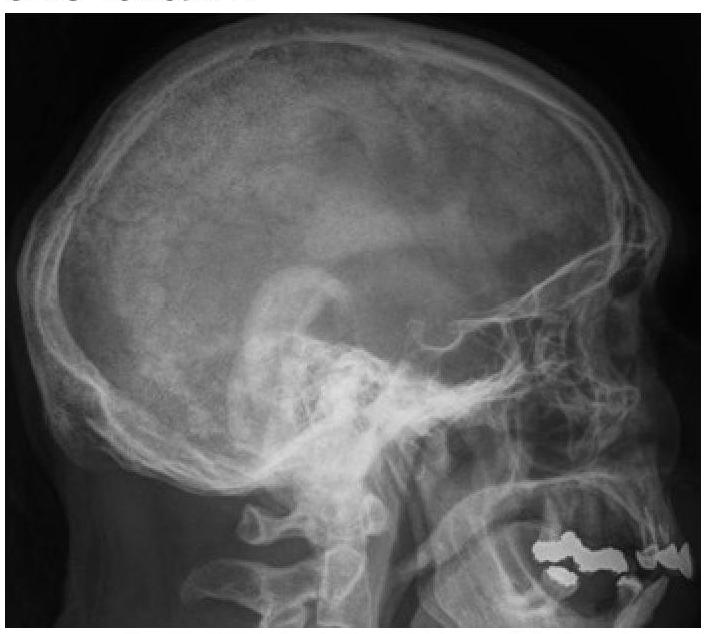
The PRIMARY mechanisms that cause increased bone density (sclerosis) on X-ray include: a) Increased thickening of trabeculae b) Fracture & Collapse of cancellous bone c) Defective mineralization d) Myositis ossificans
Earliest investigation for diagnosis of Ankylosing spondylitis:
"Hour-glass" shape of the chest and "tri-radiate pelvis" are seen radiologically in -
Which imaging modality is LEAST useful in the initial diagnosis of stress fractures?
Codman triangle is seen in
In an adult patient, interpret the finding of a vertebral body that has lost almost its entire height anteriorly and posteriorly (pancake vertebra). Which of the following conditions is most likely associated with this finding?
A radiograph is obtained from a child with scoliosis. What is the name of the angle used to measure spinal curvature?
A 75-year-old female has chronic backache. X-ray of the spine is shown. What is the most likely diagnosis?

Explanation: **'Scottish dog with collar' sign** - The **'Scottish dog with collar' sign** on oblique radiographs of the lumbar spine is characteristic of **spondylolysis**. - It represents a fracture in the **pars interarticularis**, which appears as a collar around the neck of the "dog". *'Cap' sign* - The **'Cap' sign** is sometimes referred to in the context of **osteochondroma**, not spondylolysis. - It describes the cartilaginous cap covering an osteochondroma. *Napoleon's hat sign* - The **Napoleon's hat sign** is seen on an anteroposterior radiograph of the lumbar spine in cases of **spondylolisthesis**. - It indicates severe **anterior displacement** of the L5 vertebra over the sacrum, causing the L5 body and transverse processes to resemble a cocked hat. *Winking owl sign* - The **Winking owl sign** is associated with a **pedicle agenesis** or destruction, often due to a metastatic lesion. - It refers to the absence of a pedicle on an anterior-posterior radiograph, with the remaining pedicle and spinous process forming the "owl's eye" and "nose."
Explanation: ***Rugger Jersey spine*** - This X-ray image shows alternating bands of **increased density (sclerosis) at the superior and inferior endplates** with **central lucency** in the vertebral bodies, creating the characteristic "Rugger Jersey spine" appearance. - This pattern is commonly associated with **secondary hyperparathyroidism**, most often seen in patients with **chronic renal failure**. - The alternating bands resemble the horizontal stripes on a rugby jersey, hence the name. *Bamboo spine* - **Bamboo spine** is a characteristic finding in advanced **ankylosing spondylitis**, where ossification of the annulus fibrosus and anterior longitudinal ligament leads to **syndesmophytes** bridging adjacent vertebral bodies. - This creates a smooth, continuous appearance resembling bamboo, which is not the pattern seen in this image. *Normal spine* - A **normal spine** would show **uniform bone density** throughout the vertebral bodies without the alternating lucent and sclerotic bands seen in this image. - Normal vertebral bodies have homogeneous trabecular bone density without endplate sclerosis. *Ivory spine* - An **ivory vertebra** refers to a **homogeneously dense and enlarged** vertebral body, typically observed in conditions like **metastatic prostate cancer** (blastic metastases), **Paget's disease**, or **lymphoma**. - This is typically a **localized finding** in a single or few vertebrae, distinct from the **generalized alternating band pattern** seen in Rugger Jersey spine.
Explanation: ***ab*** - Increased **thickening of trabeculae** directly leads to more bone substance per unit volume, which appears as increased density or sclerosis on X-rays due to greater attenuation of radiation. - **Fracture and collapse of cancellous bone** results in impaction and compaction of bone tissue, increasing its density and thus appearing sclerotic on imaging. *ac* - While **increased thickening of trabeculae** contributes to sclerosis, **defective mineralization** (option c) actually leads to **osteomalacia** or **rickets**, characterized by **decreased bone density**, not increased density. *ad* - **Increased thickening of trabeculae** causes sclerosis. However, **myositis ossificans** (option d) involves the formation of ectopic bone within muscle tissue—a specific condition causing localized calcification/ossification outside the normal bone structure, not a primary mechanism for generalized bone density increase or sclerosis of existing bone. *bc* - **Fracture and collapse of cancellous bone** can contribute to sclerosis. However, **defective mineralization** (option c) would lead to **reduced bone density**, making this combination incorrect for explaining increased bone density.
Explanation: ***MRI STIR sequence*** - An **MRI STIR (Short Tau Inversion Recovery) sequence** is highly sensitive for detecting early inflammatory changes in the **sacroiliac joints** and spine, such as **bone marrow edema**, which is a hallmark of early ankylosing spondylitis. - It can identify disease activity and structural changes *before* they are visible on conventional X-rays, making it the earliest diagnostic tool. *CT scan* - While a **CT scan** provides excellent detailed images of bone, it is not as sensitive as MRI for detecting early inflammatory changes like **bone marrow edema** in the sacroiliac joints. - It involves significant **radiation exposure** and is typically used for more advanced structural assessment rather than early diagnosis. *Bone scan* - A **bone scan** (scintigraphy) shows areas of increased bone turnover but is **not specific** for ankylosing spondylitis and has lower spatial resolution compared to MRI. - It can indicate inflammation or increased metabolic activity but cannot differentiate specific causes or provide detailed anatomical information as effectively as MRI. *X-ray* - **X-rays** are often the initial imaging modality due to their accessibility, but they only show **structural changes** (like erosions, sclerosis, or fusion) in the sacroiliac joints and spine at a later stage of the disease. - Early inflammatory changes, such as **bone marrow edema**, are typically not visible on plain radiographs, leading to a delay in diagnosis compared to MRI.
Explanation: ***Osteomalacia*** - The "hour-glass" shape of the chest is caused by **ricketic rosary** and flaring of the lower ribs, while the "tri-radiate pelvis" is due to inward bending of the acetabula and outward bending of the iliac bones. - These radiological findings are characteristic of **bone demineralization** and softening seen in osteomalacia, which result from impaired bone mineralization due to **vitamin D deficiency** *Myxedema* - Myxedema is severe **hypothyroidism** characterized by skin and subcutaneous tissue swelling, not by specific skeletal deformities like those described. - While it can affect bone metabolism, it does not typically lead to the distinct "hour-glass chest" or "tri-radiate pelvis." *Hyperthyroidism* - **Hyperthyroidism** causes an **increased bone turnover** and can lead to **osteoporosis** over time, increasing fracture risk. - However, it does not manifest with the specific characteristic radiological deformities of the chest and pelvis associated with osteomalacia. *Hyperparathyroidism* - **Hyperparathyroidism** causes **increased bone resorption** leading to subperiosteal bone resorption, "salt and pepper skull," and brown tumors. - While it affects bone structure, it does not produce the specific "hour-glass chest" or "tri-radiate pelvis" deformities characteristic of osteomalacia.
Explanation: ***Correct: CT*** - While **CT** can show bony details, it is **less sensitive** than MRI or bone scan for early stress fractures, which often involve subtle marrow edema or periosteal reaction - Its primary role is usually in defining **fracture geometry** or evaluating **fracture healing**, not initial detection - **CT is rarely used as a first-line imaging modality** for suspected stress fractures *Incorrect: MRI* - **MRI** is highly sensitive for **stress fractures**, detecting early changes such as **marrow edema** and **periosteal reaction** before they are visible on X-ray - It is considered the **gold standard** for confirming a stress fracture when initial X-rays are negative - This is one of the MOST useful modalities, not the least *Incorrect: Bone scan* - **Bone scintigraphy** (bone scan) is very sensitive for **stress fractures**, as it detects increased **osteoblastic activity** at the site of injury - It can identify stress fractures long before they are visible on plain radiographs, showing a focal area of increased radiotracer uptake - This is highly useful for initial diagnosis, not the least useful *Incorrect: X-ray* - **Plain radiographs (X-rays)** are often the **initial imaging modality** for suspected stress fractures due to availability and cost - However, they have **low sensitivity in the early stages** - early stress fractures may appear normal on X-ray - Visible signs such as **sclerosis, periosteal reaction**, or a **fracture line** only develop several weeks after symptom onset - Despite low sensitivity, X-ray is still more commonly used for initial evaluation than CT
Explanation: ***Osteosarcoma*** - A **Codman triangle** is a **periosteal reaction** seen on X-rays, characterized by a triangular elevation of the **periosteum** away from the bone cortex due to rapid growth of a tumor. - **Osteosarcoma** is the **most classic** association with Codman triangle among aggressive bone tumors. - This is the **most common primary malignant bone tumor** and typically occurs in the metaphysis of long bones (around the knee). *Madura foot* - This is a chronic granulomatous infection of the foot (mycetoma), typically characterized by **multiple draining sinuses** and **granuloma formation**, not periosteal elevation. - Radiographically, it shows **soft tissue swelling**, **bone destruction**, and **osteomyelitis**, but not a Codman triangle. *Ewing's sarcoma* - This aggressive tumor **can also show Codman triangle** as it grows rapidly and elevates the periosteum. - However, it is **more characteristically** associated with an **"onion peel" periosteal reaction** (concentric layers of new bone formation). - While both tumors can show Codman triangle, **osteosarcoma remains the most classic association** in medical literature and exam questions. *Giant cell tumor* - This is a benign but locally aggressive tumor typically found in the **epiphysis** of long bones (after physeal closure). - Radiographically, it appears as an **eccentric, expansile, "soap bubble" lytic lesion** without a prominent periosteal reaction like a Codman triangle. - The tumor is **subarticular** and **non-sclerotic**, extending to the articular surface.
Explanation: ***Multiple myeloma*** - **Multiple myeloma** causes diffuse **osteolytic lesions** throughout the vertebral body due to plasma cell infiltration, leading to uniform collapse and the characteristic **pancake vertebra** appearance. - In **adult patients**, multiple myeloma is the most common cause of **vertebra plana**, as the diffuse marrow replacement weakens the entire vertebral structure symmetrically. *Tuberculosis (Pott's disease)* - **Pott's disease** typically causes **anterior wedge collapse** with preservation of the posterior vertebral body, creating **kyphotic deformity** rather than complete flattening. - It commonly involves **disc space destruction** and **paraspinal abscess formation**, not the uniform pancake-like collapse seen in multiple myeloma. *Osteogenesis imperfecta* - This **genetic collagen disorder** causes **brittle bones** with frequent fractures, but vertebral involvement typically shows **anterior compression** with preserved posterior height. - The **wedge-shaped deformities** in osteogenesis imperfecta differ from the complete, uniform height loss characteristic of pancake vertebra. *Eosinophilic granuloma* - **Eosinophilic granuloma** can cause **vertebra plana** in **pediatric patients** as the most common cause, but it's less frequent in adults compared to multiple myeloma. - While it can produce complete vertebral collapse, it typically presents as a **solitary lesion** rather than the diffuse skeletal involvement seen in multiple myeloma.
Explanation: **Cobb's Angle** - **Cobb's angle** is the primary method for measuring the severity of **scoliosis** on radiographs. - It is measured by drawing lines parallel to the superior endplate of the most tilted superior vertebra and the inferior endplate of the most tilted inferior vertebra of the curve; the angle between these two lines (or their perpendiculars) is the Cobb angle. *Bohler's Angle* - **Bohler's angle** is used in the assessment of **calcaneus fractures** and is measured on a lateral foot radiograph. - A decrease in this angle is indicative of a calcaneal fracture. *Ferguson's Angle* - **Ferguson's angle**, also known as the lumbosacral angle, measures the inclination of the sacrum relative to the horizontal in the standing position. - It is primarily used in the assessment of **spondylolisthesis** and other lumbosacral conditions. *Pauwels' Angle* - **Pauwels' angle** is used to classify **femoral neck fractures** based on the angle of the fracture line relative to the horizontal. - It helps determine the severity and stability of femoral neck fractures, guiding treatment decisions.
Explanation: ***Osteoporosis*** - The X-ray shows diffuse **osteopenia** (reduced bone density) and **vertebral compression fractures**, particularly visible in the lateral view, which are characteristic findings in elderly patients with osteoporosis and chronic backache. - The vertebral bodies appear **demineralized** and some exhibit a loss of height, suggesting collapse due to weakened bone structure. *Spondylodiscitis* - This condition involves **inflammation of the vertebral body and adjacent intervertebral disc**, typically showing **erosions** of the vertebral endplates and **narrowing of the disc space** on X-ray, which are not clearly evident here as the primary issue. - While it can cause back pain, the dominant finding on this X-ray is widespread bone density loss and fractures, rather than localized infection-related changes. *Pott's spine* - Pott's spine (**tuberculous spondylitis**) is a form of osteomyelitis that causes **destruction of vertebral bodies** and adjacent discs, often leading to a **gibbus deformity** (sharp posterior angulation of the spine). - The X-ray does not show extensive vertebral destruction, paraspinal abscess formation, or typical kyphotic deformity associated with Pott's spine. *Spondylolisthesis* - Spondylolisthesis is characterized by the **forward slippage of one vertebral body over another**, often due to a defect in the pars interarticularis. - While there may be some degenerative changes, there is no clear evidence of significant anterior translation of a vertebral body on the lateral X-ray that would indicate spondylolisthesis.
Radiographic Anatomy of Bones and Joints
Practice Questions
Imaging of Fractures and Dislocations
Practice Questions
Arthritides: Inflammatory and Degenerative
Practice Questions
Metabolic Bone Diseases
Practice Questions
Bone and Soft Tissue Tumors
Practice Questions
Congenital Skeletal Anomalies
Practice Questions
Spine Imaging
Practice Questions
Skeletal Infections
Practice Questions
Sports Medicine Imaging
Practice Questions
Imaging of Prostheses and Implants
Practice Questions
Musculoskeletal Ultrasound
Practice Questions
MSK Interventional Procedures
Practice Questions
Get full access to all questions, explanations, and performance tracking.
Start For Free