A 2-year-old boy suffering from leukemia. Which of the following is the most characteristic X-ray finding?
Earliest and characteristic radiological finding of leukemia in children
A 35-year-old lady with chronic backache. On X-ray she had a D12 collapse. But intervertebral disk space is maintained. All are possible except:
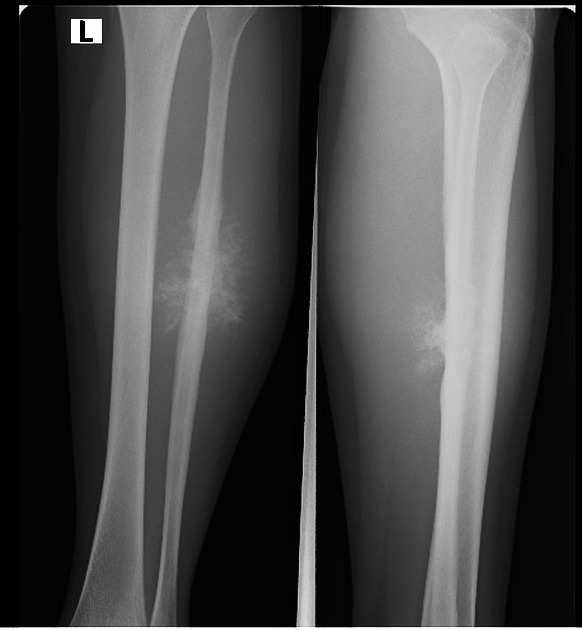
A 7-year-old child presents with a lesion in upper tibia. X-ray shows radiolucent area with Codman's triangle and sunray appearance. Diagnosis is

Radiological features in rickets?
X-ray views of fracture of nasal bone include all except:
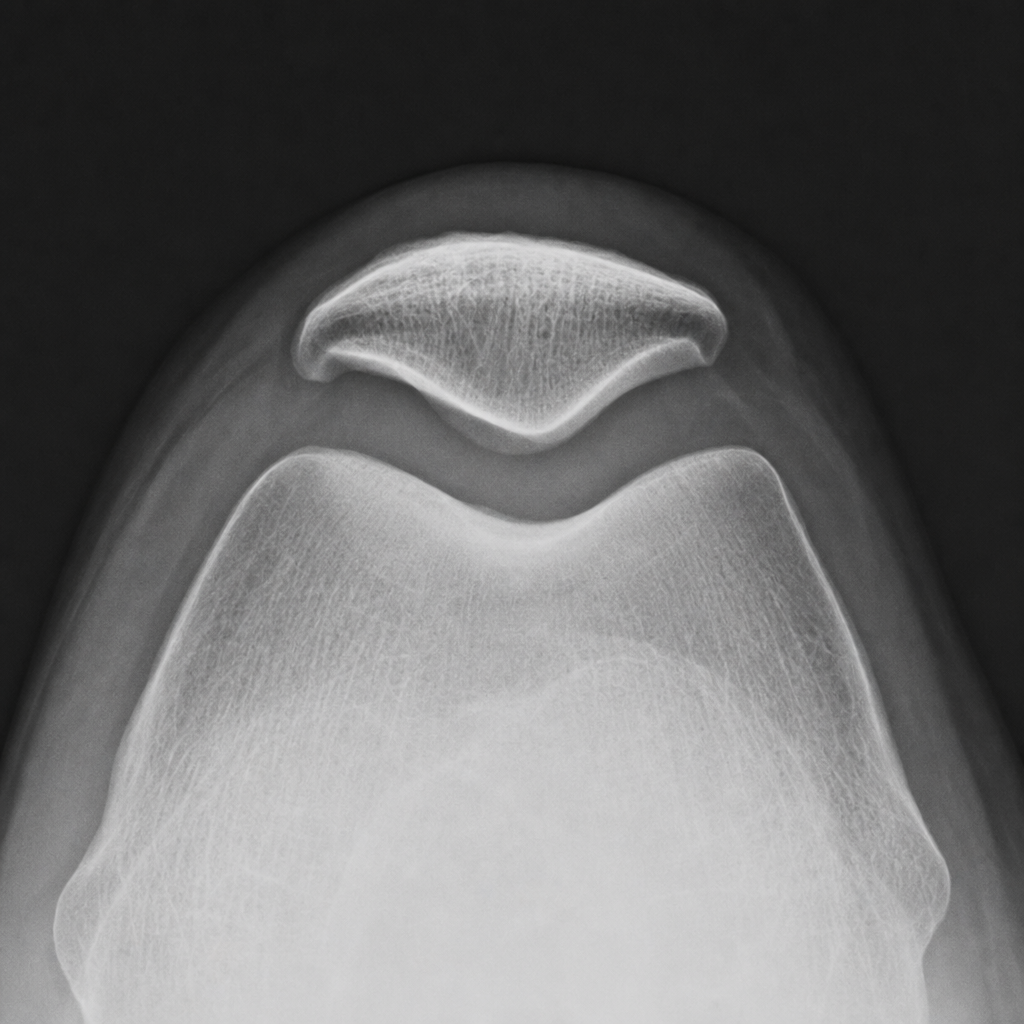
Blumensaat line is used to radiologically diagnose an anatomical condition called patella alta. It is
Punched out lesion in the skull is indicative of:
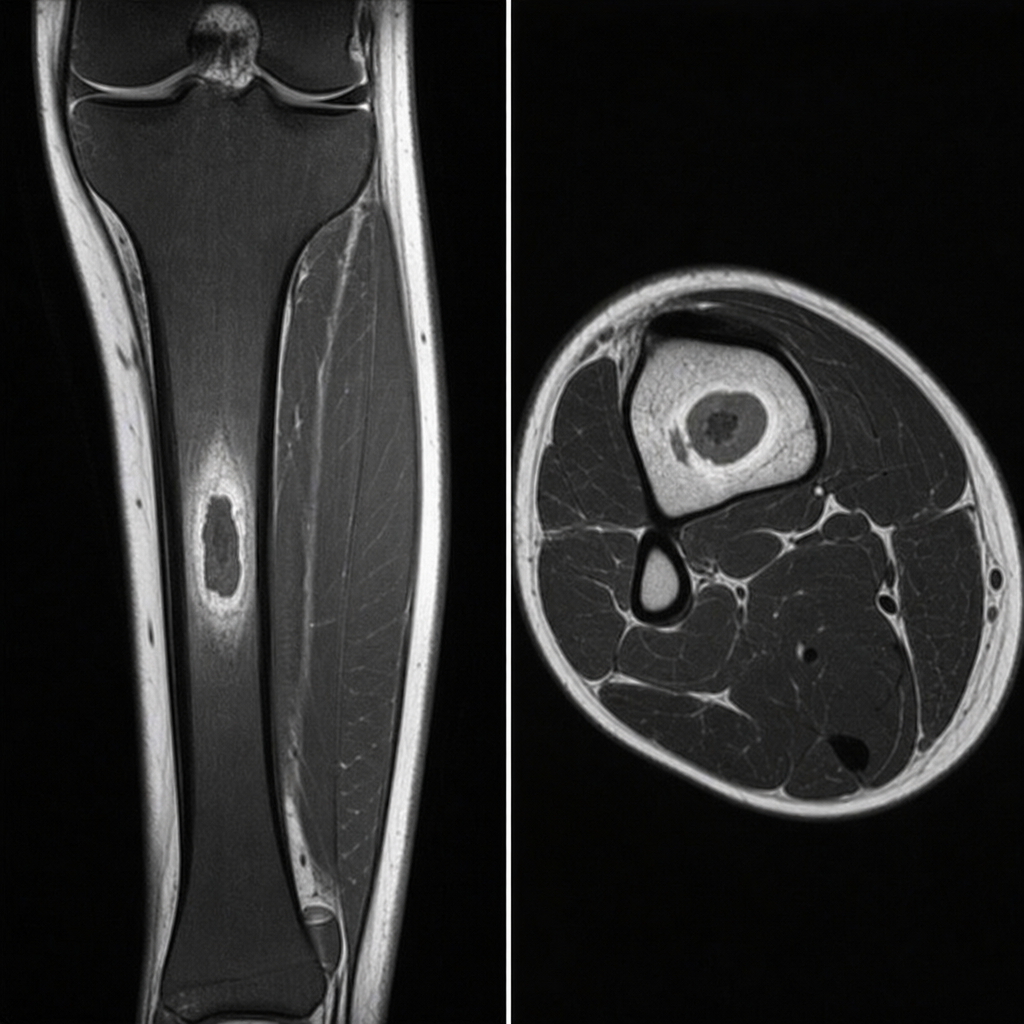
True about osteoid osteoma is
Which of the following is NOT a radiological finding of scurvy?
Explanation: ***Transverse line of dark band below the growth plate*** - This finding, often called a **leukemic line** or **lucent metaphyseal band**, is highly characteristic of childhood leukemia. - It represents accumulation of **leukemic cells** in the metaphysis, causing osteopenia and a lucent band. *Osteolytic lesion in flat bones* - While **osteolytic lesions** can occur in leukemia, they are more commonly seen in advanced stages or with specific subtypes. - They are not as characteristic or early a finding as metaphyseal lucencies in childhood leukemia. *Osteosclerosis of long bones* - **Osteosclerosis** (increased bone density) is generally not a feature of leukemia; rather, bone marrow infiltration typically leads to osteopenia. - This finding is more associated with conditions like myelofibrosis or certain metastatic cancers. *Periosteal new bone formation* - **Periosteal new bone formation** can be seen in leukemia due to direct periosteal infiltration or hemorrhage, but it is less specific. - It is also a feature of osteomyelitis, trauma, or other bone tumors, making it less characteristic compared to metaphyseal lines.
Explanation: ***Translucent transverse metaphyseal bands*** - These **translucent transverse metaphyseal bands**, also known as **leukemic lines**, represent areas of **decreased bone density** due to **leukemic infiltration** and impaired osteogenesis. - They are the **earliest and most characteristic radiological finding** in children with acute leukemia, particularly **acute lymphoblastic leukemia (ALL)**. *Metaphyseal Osteosclerosis* - This refers to increased bone density in the metaphysis, which is generally not an early or characteristic finding of leukemia. - While osteosclerosis can occur in some hematologic conditions, it is not primary to the initial presentation of leukemia. *Metaphyseal cortical erosions* - **Cortical erosions** indicate bone destruction but are typically seen in more advanced stages or in aggressive forms of leukemia, not as the earliest characteristic sign. - They are often associated with larger masses of leukemic cells eroding the bone cortex. *Periosteal reaction* - **Periosteal reaction** (new bone formation on the surface of the bone) can occur in leukemia due to **periosteal irritation** from expanding leukemic infiltrates. - However, it is a **less specific finding** and usually appears later than metaphyseal bands, or in response to gross bone involvement.
Explanation: ***Tuberculosis*** - **Tuberculosis of the spine (Pott's disease)** characteristically causes destruction of the **intervertebral disc space** in addition to vertebral body collapse. - The disease often begins in the vertebral body and spreads to the adjacent disc and vertebrae, leading to a **gibbus deformity** and eventual fusion. *Multiple myeloma* - This condition is a **plasma cell malignancy** that frequently causes **osteolytic lesions** and vertebral collapse without typically affecting the intervertebral disc spaces primarily. - Myeloma cells infiltrate the bone marrow, leading to osteoclast activation and bone destruction. *Metastasis* - **Metastatic disease** to the spine commonly causes **vertebral body collapse** while **preserving the intervertebral disc space** because malignancies typically spread through the blood to the bone rather than directly invading the cartilaginous disc. - Common primary sites for spinal metastases include breast, lung, prostate, kidney, and thyroid. *Osteoporosis* - Severe **osteoporosis** can lead to **vertebral compression fractures (collapse)**, especially in the thoracic and lumbar spine, but usually **spares the intervertebral disc space**. - The bone loss weakens the vertebral body, making it susceptible to collapse with minimal trauma or even spontaneously.
Explanation: ***Osteosarcoma*** - The classic radiographic features of **Codman's triangle** (periosteal elevation) and **sunray appearance** (spiculated periosteal reaction) are highly characteristic of osteosarcoma. - This tumor commonly affects the **metaphysis of long bones** in children and young adults, with the distal femur and proximal tibia being frequent sites. *Osteoid Osteoma* - This is a **benign bone tumor** characterized radiographically by a small radiolucent **nidus** surrounded by a rim of dense sclerosis. - It does not present with Codman's triangle or sunray appearance and typically causes **nocturnal pain relieved by NSAIDs**. *Ewing sarcoma* - Ewing sarcoma often presents with an **"onion skin" periosteal reaction** (layers of new bone formation) due to its aggressive nature. - While it can be destructive and radiolucent, it typically does not classically exhibit the sunray appearance or a distinct Codman's triangle as prominently as osteosarcoma. *Chondrosarcoma* - Chondrosarcoma is a **malignant cartilaginous tumor** that usually affects older adults more commonly than children. - Radiographically, it often shows a **lobulated appearance** with **punctate or ring-and-arc calcifications** within the lesion, not the sunray or Codman's triangle findings.
Explanation: ***All of the options*** - **All three findings are classic radiological features of rickets**, reflecting defective mineralization and abnormal bone growth at the growth plates. **Widening of distal end of metaphysis** - This is a **hallmark sign** of rickets, best seen at the wrist (distal radius and ulna) - Results from accumulation of **unmineralized osteoid** and cartilage at the growth plate - The growth plate appears widened, irregular, and has increased distance between epiphysis and metaphysis **Cupping of distal end of radius** - **Cupping and fraying** of the metaphysis are characteristic findings - The metaphyseal margin becomes **concave** (cup-shaped) instead of straight - Associated with irregular, frayed appearance due to defective mineralization - Most prominent at sites of rapid growth (wrist, knee) **Delayed ossification of epiphyses** - Epiphyseal ossification centers appear **later than normal** or are poorly mineralized - Results in **decreased bone density** and delayed skeletal maturation - Part of the generalized growth disturbance in rickets **Other radiological features** of rickets include: loss of sharp zone of provisional calcification, osteopenia, bowing deformities, pathological fractures (Looser zones), and rachitic rosary.
Explanation: ***Submental view*** - The **submental view** (or basal view) is primarily used to visualize the **zygomatic arches** and the base of the skull, not the nasal bones. - This projection involves aiming the X-ray beam from beneath the chin, making it unsuitable for detailed assessment of nasal bone fractures. *Waters view* - The **Waters view** (occipitomental view) is commonly used to assess the **maxillary sinuses**, orbits, and zygomatic bones, which can provide some indirect information about nasal structures. - While not a primary view for nasal bones, it can show displacement of parts of the nasal skeleton if the fracture extends to adjacent structures. *Lateral view* - The **lateral view** of the nasal bones is considered the **gold standard** for detecting nasal bone fractures. - It clearly shows the **contour and integrity of the nasal bones**, helping to identify fracture lines and displacement. *Occlusal view* - The **occlusal view** is primarily used for visualizing the **hard palate**, floor of the mouth, or anterior portions of the maxilla and mandible. - While it's not a standard view for nasal bone fractures, it may be used in specific cases to assess involvement of the palatal or alveolar processes if the fracture extends inferiorly.
Explanation: ***Drawn through the roof of the intercondylar notch of femur*** - The **Blumensaat line** is a radiologic landmark defined by the **roof of the intercondylar notch** of the femur on a lateral knee X-ray. - It is used in the diagnosis of **patella alta** or **patella baja** by assessing the position of the patella relative to this line; the inferior pole of the patella should ideally be at or slightly below the Blumensaat line in a flexed knee. *The line joining the greater trochanter and the centre of the patella* - This description does not correspond to the **Blumensaat line** or any standard anatomical measurement for patellar position. - The greater trochanter is part of the proximal femur, far removed from the knee joint for this specific radiological evaluation. *Drawn through the superior pole of patella.* - While lines can be drawn in relation to the patella, the **Blumensaat line** is specifically defined by the **femoral intercondylar notch**, not the superior pole of the patella. - Other indices like the **Insall-Salvati ratio** use the patellar pole, but in relation to the patellar tendon length, not as the Blumensaat line itself. *The line joining the ASIS with the centre of patella* - This line is not the **Blumensaat line** and does not have a standard application in diagnosing **patella alta** or baja. - The **anterior superior iliac spine (ASIS)** is part of the pelvis and would not be used in a direct measurement of patellar height on a knee X-ray.
Explanation: **Multiple myeloma** - **Punched-out lesions** on skull X-rays are a **classic radiographic finding** in multiple myeloma, resulting from uncontrolled proliferation of **plasma cells** in the bone marrow and subsequent osteolytic activity. - The lesions are typically **lytic**, sharply demarcated, and lack a sclerotic rim, reflecting focal bone destruction without significant bone formation. *Metastasis* - While bone metastases can cause **lytic lesions** in the skull, they are often less uniformly "punched out" and can present with mixed lytic and blastic features. - Metastatic lesions are usually multifocal but may not have the characteristic sharp, non-sclerotic border seen in myeloma. *Osteosarcoma* - **Osteosarcoma** is a primary malignant bone tumor characterized by the production of **osteoid** or immature bone by malignant cells. - It typically presents as a **sclerotic** or mixed lytic/sclerotic lesion with ill-defined margins and often a soft tissue mass, rather than discrete punched-out lesions. *Ewing's sarcoma* - **Ewing's sarcoma** is a highly malignant primary bone tumor commonly affecting long bones and the pelvis. - Radiographically, it often presents with an **"onion-skin" periosteal reaction** or a permeative lytic lesion, which is distinct from the sharply defined punched-out lesions of multiple myeloma.
Explanation: ***Radiolucent zone surrounded by sclerosis*** - A characteristic radiological feature of **osteoid osteoma** is a small, central **radiolucent nidus** (the tumor itself) surrounded by a dense area of reactive **sclerosis**. - This **sclerosis** is the body's response to the tumor, attempting to wall it off. *Onset before the age of 10 years* - **Osteoid osteoma** typically presents in individuals between **10 and 20 years of age**, with a peak incidence in the second decade of life. - While it can occur at any age, presentation before age 10 is less common. *Night pain not relieved by salicylates* - The classic pain associated with **osteoid osteoma** is **worse at night** and (importantly) **dramatically relieved by NSAIDs**, particularly salicylates such as aspirin. - Pain *not* relieved by salicylates would argue against this diagnosis. *Bone scan shows decreased uptake* - A **bone scan** would typically show **increased uptake** in the area of an **osteoid osteoma** due to the intense osteoblastic activity and increased blood flow within the lesion. - Decreased uptake would be highly unusual and suggest other pathologies.
Explanation: ***Fraying of metaphysis*** - This finding is more characteristic of **rickets**, a vitamin D deficiency, where there is disordered growth plate mineralization. - In scurvy, bone growth continues but with a **defective matrix**, making the metaphyseal area more prone to fracture and weakening rather than fraying. *Pencil-thin cortex* - This describes extreme **cortical thinning** due to impaired osteoid formation in scurvy, making bones fragile. - It arises from the failure of **osteoblasts** to lay down adequate bone matrix, leading to reduced bone density. *Wimberger sign* - Refers to a **sclerotic ring** or zone of increased density at the periphery of the epiphysis, representing a zone of provisional calcification. - This is a classic, though not pathognomonic, sign of **scurvy** in children, indicating abnormal bone formation at the epiphyseal margins. *Pelkan spur* - Also known as the **corner sign**, this indicates an **outward spurring** or beak-like projection at the metaphysis. - It results from the **collapse of the weakened metaphyseal bone** and subsequent displacement or compression, which is a characteristic feature of scurvy.
Radiographic Anatomy of Bones and Joints
Practice Questions
Imaging of Fractures and Dislocations
Practice Questions
Arthritides: Inflammatory and Degenerative
Practice Questions
Metabolic Bone Diseases
Practice Questions
Bone and Soft Tissue Tumors
Practice Questions
Congenital Skeletal Anomalies
Practice Questions
Spine Imaging
Practice Questions
Skeletal Infections
Practice Questions
Sports Medicine Imaging
Practice Questions
Imaging of Prostheses and Implants
Practice Questions
Musculoskeletal Ultrasound
Practice Questions
MSK Interventional Procedures
Practice Questions
Get full access to all questions, explanations, and performance tracking.
Start For Free