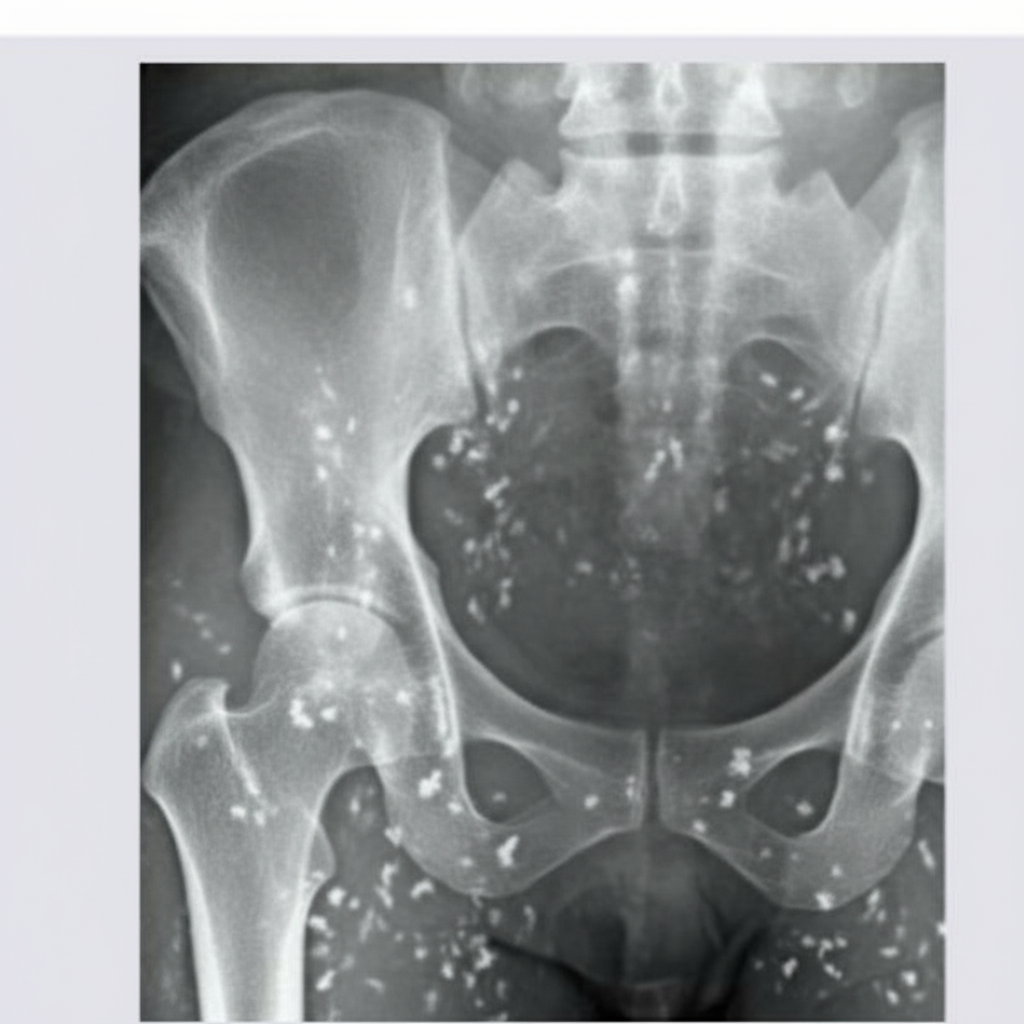
Characteristic subperiosteal bone resorption in Hyperparathyroidism is best seen at which location?
Which of the following radiographic features is NOT seen in hyperparathyroidism?
Which of the following is NOT a feature of Achondroplasia?
Sunray appearance and Codman's triangle are radiological features of which of the following tumors?
X-ray changes in acromegaly include all of the following except:
A 67-year-old woman develops symptoms of cough and sputum production after an upper respiratory tract infection. A CXR does not show any signs of pneumonia but the report mentions a "pseudo fracture" sign (Looser zones) seen in the left scapula compatible with osteomalacia. She has no pain in the scapula. Which of the following best differentiates rickets and osteomalacia?
Rugger jersey spine is seen in which of the following conditions?
The "Shiny Corner Sign" is typically seen in which of the following conditions?
The corduroy sign refers to which of the following findings?
Posterior scalloping of vertebrae is seen in all of the following conditions except?
Explanation: **Explanation:** **Hyperparathyroidism (HPT)** leads to increased osteoclastic activity due to excess Parathyroid Hormone (PTH). This manifests radiologically as bone resorption, which can occur in subperiosteal, subchondral, subligamentous, or intracortical locations. **Why Option C is Correct:** **Subperiosteal bone resorption** is the most specific radiographic sign of hyperparathyroidism. It occurs earliest and is most characteristically seen along the **radial aspect of the middle phalanges** of the 2nd and 3rd fingers. The cortical margin appears "lace-like" or frayed rather than a sharp white line. **Analysis of Incorrect Options:** * **A. Rib margins:** While subperiosteal resorption can occur at the upper margins of ribs, it is less common and less specific than phalangeal involvement. * **B. Medial margin of proximal humerus:** This is a common site for subperiosteal resorption (along with the medial tibia and femoral neck), but it is not the "classic" or most sensitive diagnostic site compared to the hands. * **D. Lamina dura:** Resorption of the lamina dura (the bone surrounding tooth sockets) is a well-known feature of HPT, but it is **less specific** as it can also be seen in Paget’s disease and osteomalacia. **High-Yield Clinical Pearls for NEET-PG:** * **Rugger-Jersey Spine:** Band-like osteosclerosis at the vertebral endplates (classic in secondary HPT/Renal Osteodystrophy). * **Salt and Pepper Skull:** Multiple tiny lucencies in the calvarium (granular decalcification). * **Brown Tumors (Osteoclastomas):** Well-defined lytic lesions (not true neoplasms) caused by rapid bone turnover. * **Order of Resorption:** Subperiosteal (most specific) > Subchondral (distal clavicles/SI joints) > Subligamentous (trochanters).
Explanation: In **Hyperparathyroidism (HPT)**, excessive secretion of Parathyroid Hormone (PTH) leads to increased osteoclastic activity, resulting in systemic bone resorption. **Explanation of the Correct Option:** * **Option C (Small radiopacities around the teeth):** This is the correct answer because it is **not** a feature of HPT. In HPT, the hallmark is bone **resorption** (radiolucency), not bone formation (radiopacity). Small radiopacities around the teeth (specifically at the root apices) are characteristic of **periapical cemental dysplasia** or **condensing osteitis**, not metabolic bone disease. **Explanation of Incorrect Options:** * **Option A (Absence of lamina dura):** This is a classic early radiographic sign of HPT. The lamina dura is the cortical bone lining the tooth socket. Increased PTH causes subperiosteal resorption of this bone, leading to its disappearance. * **Option B (Ground glass appearance):** While more commonly associated with Fibrous Dysplasia, a "ground glass" or "salt and pepper" appearance of the skull and jaw occurs in HPT due to the loss of normal trabecular patterns and replacement by fine, granular demineralized bone. **High-Yield Clinical Pearls for NEET-PG:** * **Subperiosteal bone resorption** is the most pathognomonic sign of HPT, most commonly seen on the **radial aspect of the middle phalanges** of the 2nd and 3rd fingers. * **Brown Tumors:** These are well-defined lytic lesions (osteoclastomas) that occur in advanced HPT. * **Rugger-Jersey Spine:** Characterized by bands of increased bone density at the superior and inferior endplates of vertebrae, typically seen in **Secondary HPT** (Renal Osteodystrophy). * **Salt and Pepper Skull:** Multiple tiny lucencies in the calvarium.
Explanation: **Explanation:** Achondroplasia is the most common cause of disproportionate short-limb dwarfism. It is an autosomal dominant condition caused by a mutation in the **FGFR3 gene**, which leads to abnormal endochondral ossification. **1. Why "Acromelic dwarfism" is the correct answer:** Achondroplasia is characterized by **Rhizomelic shortening**, meaning the proximal segments of the limbs (humerus and femur) are most severely affected. In contrast, **Acromelic** refers to the shortening of distal segments (hands and feet), which is not a feature of Achondroplasia. **2. Analysis of Incorrect Options (Features of Achondroplasia):** * **Champagne glass pelvis:** Due to the shortening of the iliac bones and a decrease in the vertical height of the pelvis, the pelvic inlet becomes broad and shallow, resembling a champagne glass. * **Tombstone iliac bone:** The iliac wings appear squared and flat, often described as "tombstone-shaped." * **Bullet-shaped vertebra:** In the lumbar spine, the vertebral bodies show anterior wedging or "beaking," giving them a bullet-shaped appearance. This is often associated with a decrease in interpedicular distance (caudal narrowing). **High-Yield Clinical Pearls for NEET-PG:** * **Trident Hand:** A characteristic gap between the 3rd and 4th digits. * **Skull:** Frontal bossing with midface hypoplasia and a depressed nasal bridge. * **Spine:** Narrowing of the interpedicular distance from L1 to L5 (the opposite of normal anatomy). * **Genetics:** 80% of cases are due to *de novo* mutations associated with advanced paternal age.
Explanation: **Explanation:** The correct answer is **Osteosarcoma**. This is a high-grade malignant bone-forming tumor characterized by the production of osteoid. The radiological features mentioned—**Sunray (Sunburst) appearance** and **Codman’s triangle**—are classic signs of an aggressive periosteal reaction. 1. **Sunray Appearance:** This occurs when the tumor grows so rapidly that it stretches the periosteal Sharpey’s fibers perpendicular to the bone. As these fibers ossify, they create a radiating, spiculated pattern. 2. **Codman’s Triangle:** This is formed when the advancing tumor lifts the periosteum away from the bone cortex. The triangular area of new bone formation at the margin where the periosteum is being elevated is known as Codman’s triangle. While not pathognomonic, it signifies a highly aggressive process. **Analysis of Incorrect Options:** * **Ewing’s Sarcoma:** Characteristically shows an **"Onion-skin" appearance** (lamellated periosteal reaction) due to successive layers of new bone formation. * **Chondrosarcoma:** Typically presents with **"Popcorn calcification"** (stippled or flocculent) within a cartilaginous matrix. * **Multiple Myeloma:** Classically presents with multiple, well-defined **"Punched-out" lytic lesions**, particularly in the skull, with an absence of reactive new bone formation. **High-Yield Clinical Pearls for NEET-PG:** * **Age Group:** Osteosarcoma typically affects the 10–20 year age group (bimodal distribution, second peak >60 years). * **Location:** Most common site is the **metaphysis** of long bones, especially around the knee ("Away from the elbow, towards the knee"). * **Serum Marker:** Elevated **Alkaline Phosphatase (ALP)** is a significant prognostic marker. * **Most common site of metastasis:** Lungs (presents as "cannonball" secondaries).
Explanation: In **Acromegaly**, excessive growth hormone (GH) and IGF-1 after epiphyseal closure lead to the overgrowth of bone and soft tissues. **Explanation of the Correct Answer:** * **Option A (Lengthened terminal phalanx):** This is the **incorrect** statement. In acromegaly, the terminal phalanges do not lengthen; instead, they undergo **tufting** (widening of the distal tips), giving them a "spade-like" appearance. This is a classic radiological sign known as **Spade Phalanx**. **Explanation of Incorrect Options:** * **Option B (Widened joint spaces):** GH stimulates the proliferation of articular cartilage. This leads to an initial widening of joint spaces, particularly in the hands and hips, which is a unique feature compared to most other arthropathies. * **Option C (Mandibular changes):** GH causes appositional bone growth. This results in **prognathism** (protrusion of the lower jaw), lengthening of the mandible, and an increase in the mandibular angle (becoming more **obtuse**). * **Option D (Premature osteoarthritis):** While joint spaces initially widen, the hypertrophied cartilage is structurally weak. This leads to early degeneration, resulting in secondary osteoarthritis characterized by large osteophytes and subchondral cysts. **High-Yield NEET-PG Pearls for Acromegaly:** 1. **Skull:** Enlargement of the Sella Turcica (due to pituitary adenoma) and frontal bossing with prominent supraorbital ridges. 2. **Sinuses:** Marked hyperpneumatization of paranasal sinuses (especially frontal). 3. **Heel Pad Thickness:** A diagnostic measurement; >21–25 mm is highly suggestive of acromegaly. 4. **Vertebrae:** Posterior scalloping of vertebral bodies and increased anteroposterior diameter.
Explanation: ### Explanation The fundamental difference between **Rickets** and **Osteomalacia** lies in the **skeletal maturity** of the patient at the time of the metabolic insult. Both conditions involve a defect in the mineralization of the osteoid matrix, usually due to Vitamin D deficiency or phosphate depletion. * **Rickets:** Occurs in the **growing skeleton** (children) before the epiphyseal plates have closed. It primarily affects the **growth plate (physis)** and the zone of provisional calcification, leading to characteristic signs like cupping, splaying, and fraying of metaphyses. * **Osteomalacia:** Occurs in the **mature skeleton** (adults) after the epiphyseal plates have closed. Since there is no active growth plate, the defect is limited to the remodeling of the bone cortex and trabeculae. #### Analysis of Options: * **Option A:** The severity of the mineralization defect depends on the degree of Vitamin D/Phosphate deficiency, not the age of the patient. * **Option B:** Both conditions can be caused by various factors, including Vitamin D deficiency, renal tubular acidosis, malabsorption, or hypophosphatemia. * **Option D:** Secondary hyperparathyroidism is a common physiological response to low calcium in **both** Rickets and Osteomalacia. #### High-Yield Clinical Pearls for NEET-PG: 1. **Looser Zones (Pseudo-fractures/Milkman’s fractures):** These are pathognomonic for Osteomalacia. They are narrow radiolucent lines oriented perpendicular to the cortex, representing unmineralized osteoid at sites of stress/nutrient arteries. 2. **Common Sites for Looser Zones:** Axillary margin of the scapula (as seen in this case), femoral neck, pubic rami, and ribs. 3. **Radiological Hallmark of Rickets:** Widening of the growth plate and "Cupping and Splaying" of the metaphysis (best seen at the wrist/knee). 4. **Rugger-Jersey Spine:** Seen in renal osteodystrophy (a combination of osteomalacia and secondary hyperparathyroidism).
Explanation: **Explanation:** **Rugger Jersey Spine** is a classic radiological sign characterized by prominent horizontal bands of increased bone density (sclerosis) at the superior and inferior endplates of the vertebral bodies, with a relatively radiolucent center. This creates a striped appearance resembling the horizontal stripes on a British rugby jersey. **Why CRF is the correct answer:** In **Chronic Renal Failure (CRF)**, secondary hyperparathyroidism develops. This leads to **Renal Osteodystrophy**, where there is a paradoxical combination of bone resorption and osteosclerosis. The increased parathyroid hormone (PTH) stimulates osteoblastic activity, leading to the deposition of excess osteoid tissue specifically at the vertebral endplates, resulting in the characteristic "Rugger Jersey" appearance. **Analysis of Incorrect Options:** * **A. Myeloma:** Typically presents with "punched-out" lytic lesions or generalized osteopenia. Sclerosis is rare unless there is a healing fracture or the rare POEMS syndrome. * **B. TB Spine (Pott’s Disease):** Characterized by paradiscal destruction, loss of disc space height, and pre/paravertebral "cold" abscesses. It does not produce a striped sclerotic pattern. * **D. Ankylosing Spondylitis:** Features include "Bamboo spine" (due to syndesmophytes), squaring of vertebrae, and sacroiliitis, rather than endplate sclerosis. **NEET-PG High-Yield Pearls:** * **Rugger Jersey Spine:** Pathognomonic for **Secondary Hyperparathyroidism** (CRF). * **Sandwich Vertebra:** Seen in **Osteopetrosis** (denser, more sharply defined bands than Rugger Jersey). * **Picture Frame Vertebra:** Seen in **Paget’s Disease** (peripheral sclerosis with central lucency). * **H-shaped Vertebra (Lincoln Log):** Seen in **Sickle Cell Anemia** (due to endplate infarction).
Explanation: **Explanation:** The **Shiny Corner Sign** (also known as the Romanus lesion) is a classic early radiographic finding in **Ankylosing Spondylitis (AS)**. It represents reactive sclerosis at the corners of the vertebral bodies. **Why Ankylosing Spondylitis is correct:** The pathophysiology begins with **enthesitis** (inflammation at the site where ligaments/tendons attach to bone) at the insertion of the annulus fibrosus into the vertebral corners. This leads to small erosions (**Romanus lesions**). As these erosions heal, the body responds with reactive osteosclerosis, which appears as increased radiodensity or "whiteness" at the corners of the vertebrae on a lateral X-ray, termed the "Shiny Corner Sign." This eventually progresses to squaring of the vertebrae and the formation of syndesmophytes (Bamboo spine). **Why other options are incorrect:** * **Psoriatic Arthritis:** While it is a seronegative spondyloarthropathy, it typically presents with asymmetric, bulky, non-marginal syndesmophytes rather than the symmetric, marginal sclerosis seen in AS. * **Rheumatoid Arthritis:** Primarily affects synovial joints (MCP, PIP) and the cervical spine (atlantoaxial subluxation). It does not cause enthesitis-related vertebral corner sclerosis. * **Gouty Arthritis:** Characterized by "punched-out" erosions with overhanging edges (Martel’s sign) in peripheral joints, not spinal enthesitis. **High-Yield Clinical Pearls for NEET-PG:** * **Earliest X-ray change in AS:** Sacroiliitis (usually bilateral and symmetric). * **Bamboo Spine:** Formed by marginal syndesmophytes (ossification of the outer fibers of the annulus fibrosus). * **Dagger Sign:** A single radiodense line on frontal X-ray due to ossification of the supraspinous and interspinous ligaments. * **Anderson Lesion:** Non-infectious spondylodiscitis seen in AS. * **HLA-B27:** Strongly associated with AS (>90% of cases).
Explanation: **Explanation:** The **Corduroy Sign** (also known as the "striated" or "salt and pepper" appearance) is the classic radiological hallmark of a **Vertebral Hemangioma**. **1. Why Option A is Correct:** Vertebral hemangiomas are benign, slow-growing vascular tumors. As the vascular spaces replace the normal bone marrow, there is a compensatory thickening of the remaining **longitudinal (vertical) trabeculae** to maintain the structural integrity of the vertebral body. On a lateral X-ray or CT scan, these thickened vertical trabeculae appear as parallel linear opacities, resembling the texture of corduroy fabric. **2. Why the Other Options are Incorrect:** * **Options B & D:** The horizontal trabeculae are typically resorbed first in hemangiomas, leaving only the vertical ones to bear the weight. Horizontal thickening is not a characteristic feature of this pathology. * **Options C & D:** **Chordomas** are malignant tumors arising from the remnants of the primitive notochord. They typically present as destructive, osteolytic lesions with a large soft-tissue component and irregular calcification (especially in the sacrococcygeal region), rather than organized trabecular thickening. **3. High-Yield Clinical Pearls for NEET-PG:** * **CT Appearance:** On axial CT, the thickened vertical trabeculae seen in cross-section create a **"Polka-dot sign."** * **MRI Appearance:** Hemangiomas typically show **high signal intensity on both T1 and T2** weighted images due to the presence of intralesional fat and vessels. * **Most Common Site:** The thoracic and lumbar spine are the most frequently involved regions. * **Management:** Most are asymptomatic and discovered incidentally; however, "aggressive hemangiomas" can cause cord compression.
Explanation: **Explanation:** **Posterior scalloping** refers to an exaggerated concavity of the posterior surface of the vertebral body. It is typically caused by increased intraspinal pressure or dural ectasia (widening of the dural sac). **Why Homocystinuria is the correct answer:** Homocystinuria is characterized by **osteoporosis** and a tendency for biconcave vertebrae ("codfish vertebrae") due to bone softening, but it is **not** associated with dural ectasia or posterior scalloping. This distinguishes it clinically and radiologically from Marfan syndrome, despite other skeletal similarities. **Analysis of incorrect options:** * **Neurofibromatosis (Type 1):** This is the most common cause of posterior scalloping. It occurs due to dural ectasia, presence of lateral meningocele, or adjacent neurofibromas eroding the bone. * **Marfan Syndrome:** A classic cause of posterior scalloping due to **dural ectasia**, which is a major criteria in the Ghent nosology for diagnosis. * **Achondroplasia:** Scalloping occurs here due to a congenitally narrow spinal canal and shortened pedicles, which leads to relatively increased pressure on the posterior vertebral bodies. **NEET-PG High-Yield Pearls:** * **Mnemonic for Posterior Scalloping (M-A-N-E-S):** **M**arfan syndrome, **A**chondroplasia, **N**eurofibromatosis, **E**pendymoma (or other intraspinal tumors), **S**yringomyelia. * **Anterior Scalloping:** Classically seen in **tuberculous spondylitis** (Pott’s spine) due to subligamentous spread of abscess, and in **lymphoma** (due to pressure from enlarged para-aortic lymph nodes). * **Dural Ectasia:** If you see this term in a clinical vignette involving a tall patient with lens subluxation, think Marfan syndrome. If skin spots (Lisch nodules/Café-au-lait) are mentioned, think NF-1.
Radiographic Anatomy of Bones and Joints
Practice Questions
Imaging of Fractures and Dislocations
Practice Questions
Arthritides: Inflammatory and Degenerative
Practice Questions
Metabolic Bone Diseases
Practice Questions
Bone and Soft Tissue Tumors
Practice Questions
Congenital Skeletal Anomalies
Practice Questions
Spine Imaging
Practice Questions
Skeletal Infections
Practice Questions
Sports Medicine Imaging
Practice Questions
Imaging of Prostheses and Implants
Practice Questions
Musculoskeletal Ultrasound
Practice Questions
MSK Interventional Procedures
Practice Questions
Get full access to all questions, explanations, and performance tracking.
Start For Free