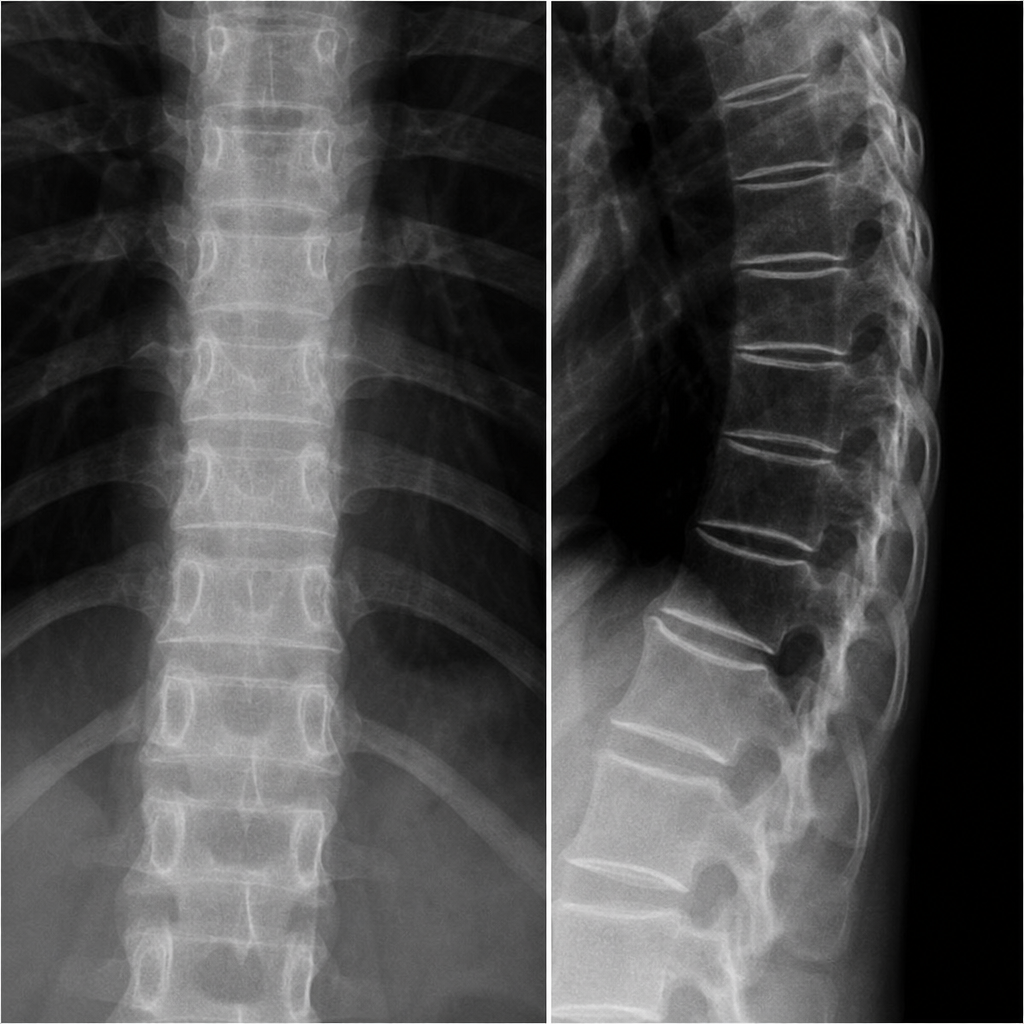
Identify the condition shown in the given X-ray:

A man presents with back pain following a road traffic accident (RTA). There is no history of neurological deficit. An X-ray of the spine is done. What is the diagnosis based on the image?

A patient with systemic mastocytosis undergoes skeletal survey. Which radiological finding is most characteristic of skeletal involvement?
An MRI pelvis shows 'bow tie' sign in the sacrum. Which additional finding would best support sacral insufficiency fracture?
An MRI spine shows 'pancake vertebra' appearance. Which additional finding would best support osteoporotic compression fracture?
An abdominal CT shows 'champagne glass' appearance of pelvic bones. Which additional finding would best support Paget's disease?
An MRI shows 'salt and pepper' appearance of skull. Which bone scan finding would best support Paget's disease?
An MRI shows 'pencil-in-cup' deformity of interphalangeal joints. Which radiological finding would best support psoriatic arthritis?
Initial radiological finding seen in knee TB
Soap bubble appearance on X-ray is seen in which bone tumor?
Explanation: ***Correct Answer: Osgood-Schlatter disease*** - The X-ray shows characteristic **fragmentation** and **irregularity** of the **tibial tuberosity**, which is pathognomonic for Osgood-Schlatter disease. - This condition commonly affects **adolescents** during periods of rapid growth, causing **anterior knee pain** that worsens with activity. - The radiographic findings demonstrate chronic **traction apophysitis** at the insertion of the **patellar tendon**. *Incorrect: Tibial tuberosity fracture* - An acute tibial tuberosity fracture would show a **distinct fracture line** with possible displacement, rather than the chronic fragmentation pattern seen here. - This type of fracture typically results from **sudden forceful quadriceps contraction** and presents with acute onset of severe pain. *Incorrect: Gerdy's tubercle fracture* - Gerdy's tubercle is located on the **lateral aspect of the proximal tibia**, serving as the insertion point for the **iliotibial band**. - A fracture at this location would not explain the **anterior tibial tuberosity changes** visible in this X-ray image. *Incorrect: Lateral epicondyle of femur* - The lateral epicondyle of the femur is located at the **distal end of the femur**, not at the tibial tuberosity where the radiographic changes are visible. - Pathology at the lateral epicondyle would not cause the **tibial tuberosity fragmentation** seen in this X-ray.
Explanation: ***Spinous process fracture*** - The X-ray image reveals a **fracture of the spinous process** of one of the cervical vertebrae, characterized by a visible discontinuity or separation of this posterior bony projection. - This type of fracture, often caused by direct trauma or forceful hyperextension/hyperflexion, typically presents with localized back pain but often **without neurological deficit** as the spinal canal generally remains intact. *Chance fracture* - A **Chance fracture** (or seatbelt fracture) is a horizontal fracture of a vertebral body, usually in the thoracolumbar region, often caused by distractional forces (e.g., flexion over a seatbelt). - It involves all three columns of the spine (anterior, middle, and posterior) and is not seen in the cervical spine X-ray provided. *Compression fracture* - A **compression fracture** is characterized by the collapse of the vertebral body, often resulting in a wedge shape. - This typically appears as reduced height of the anterior vertebral body on an X-ray, which is not the primary finding in the image. *Fracture of base of vertebrae* - A **fracture at the base of the vertebrae** is a non-specific term; specific vertebral fractures are categorized based on the part of the vertebra affected (e.g., vertebral body, pedicle, lamina, spinous process). - The image distinctly shows a fracture in the **spinous process**, not the main body or base of the vertebra.
Explanation: ***Sclerotic bone lesions*** - **Sclerotic bone lesions** are the most characteristic radiological finding in systemic mastocytosis with skeletal involvement, appearing as numerous small, dense foci creating a classic **"polka dot pattern"** on skeletal survey. - This pattern results from **mast cell infiltration** with subsequent **osteoblast stimulation**, leading to increased bone density. - The sclerotic pattern is seen in approximately **70% of patients** with skeletal mastocytosis and is highly suggestive of the diagnosis. *Lytic bone lesions* - While mastocytosis can occasionally present with lytic lesions, they are **much less common** than sclerotic changes. - Pure lytic lesions are more characteristic of **multiple myeloma**, **metastatic disease**, or **Langerhans cell histiocytosis**. *Mixed lytic-sclerotic lesions* - **Mixed patterns** can occur in mastocytosis but represent a less common presentation compared to predominantly sclerotic lesions. - When mixed lesions are present, they typically show **more sclerotic than lytic** components. *Periosteal reaction* - **Periosteal reaction** indicates periosteal irritation and is typically seen in **osteomyelitis**, **trauma**, **aggressive tumors**, or **hypertrophic osteoarthropathy**. - This is **not a characteristic feature** of systemic mastocytosis and would suggest an alternative diagnosis or complication.
Explanation: ***H-pattern on bone scan*** - The "bow tie" sign on MRI, indicating **sacral insufficiency fracture**, is often accompanied by an **H-pattern** (or Honda sign) on a **technetium-99m bone scan**. - This characteristic H-pattern reflects increased radionuclide uptake in the **sacral ala** and across the **sacral body**, following the fracture lines. *Cortical destruction* - **Cortical destruction** is typically associated with **malignant processes** or severe infections, which are not characteristic of insufficiency fractures. - While fractures can disrupt bone architecture, complete cortical destruction is a more aggressive sign than usually seen in insufficiency fractures. *Soft tissue mass* - The presence of a **soft tissue mass** usually suggests a **tumor** (benign or malignant) or an **abscess**, which are distinct pathologies from an insufficiency fracture. - Sacral insufficiency fractures are stress-related injuries with no associated soft tissue component. *Periosteal reaction* - **Periosteal reaction** indicates an active process of **bone formation** or destruction involving the periosteum, often seen in infections, tumors, or traumatic fractures with significant periosteal stripping. - While bone healing can show some new bone formation, a distinct periosteal reaction is not a primary or specific feature for diagnosing sacral insufficiency fractures.
Explanation: **Posterior wall buckling** - Posterior wall buckling on MRI is a strong indicator of an **osteoporotic compression fracture**, as it represents the posterior cortex of the vertebral body being pushed posteriorly. - This finding helps distinguish osteoporotic fractures from pathological fractures which are less likely to exhibit uniform vertebral body collapse. *Paraspinal mass* - A paraspinal mass is more suggestive of a **destructive lesion**, such as malignancy or infection, rather than an osteoporotic fracture. - It indicates potential involvement of soft tissues beyond the vertebral body itself, which is not typical for uncomplicated osteoporotic fractures. *Pedicle involvement* - Pedicle involvement is highly indicative of a **malignant process** or severe trauma rather than a purely osteoporotic compression fracture. - Osteoporotic fractures primarily affect the vertebral body, typically sparing the posterior elements like the pedicles. *Normal signal on STIR* - A normal signal on **STIR (Short Tau Inversion Recovery)** sequence indicates the absence of acute edema or inflammation, which would suggest a chronic or old fracture. - An acute osteoporotic compression fracture typically shows **high signal intensity on STIR** due to bone marrow edema, reflecting recent trauma.
Explanation: ***Cotton wool skull*** - The **champagne glass appearance** of the pelvic bones is a characteristic radiological finding in **Paget's disease**, indicating bone remodeling with cortical thickening and expansion of the iliac bones. - The presence of a **cotton wool skull**, characterized by patchy areas of sclerosis and lucency on skull radiographs, is another highly specific and common finding in advanced Paget's disease, further supporting this diagnosis. *Bamboo spine* - **Bamboo spine** is a characteristic radiographic finding in **ankylosing spondylitis**, representing calcification of the spinal ligaments and fusion of vertebrae. - This finding is not associated with Paget's disease of bone. *Ivory vertebra* - An **ivory vertebra** refers to a homogeneously dense and sclerotic vertebral body, which is a classic radiographic sign seen in **Paget's disease**, **metastatic prostate cancer**, and occasionally in **lymphoma**. - While ivory vertebra can occur in Paget's disease, the **cotton wool skull** in conjunction with the champagne glass pelvis provides a more specific diagnostic pattern, as cotton wool appearance is almost pathognomonic for Paget's disease. *Bone islands* - **Bone islands** (enostoses) are common, benign focal areas of cortical bone within the cancellous bone, usually seen as uniformly dense, well-circumscribed lesions on imaging. - They are typically asymptomatic and unrelated to Paget's disease, which involves widespread disorganized bone remodeling.
Explanation: ***Superscan pattern*** - A **superscan** on a bone scintigraphy signifies widespread, increased radionuclide uptake in the skeleton, often seen in the disseminated form of **Paget's disease**, particularly involving multiple bones. - While "salt and pepper" skull refers to **osteoporosis circumscripta** in Paget's, the superscan on bone scan indicates diffuse metabolic activity consistent with the overall disease process. *Mickey mouse sign* - This sign is typically associated with **fibrous dysplasia** of the skull, not Paget's disease. - It describes a characteristic appearance on scintigraphy due to asymmetric uptake in the skull base, distinct from Paget's. *Photopenic lesions* - **Photopenic** or "cold" lesions on bone scan indicate areas of decreased metabolic activity or bone destruction, such as in some metastases or avascular necrosis. - Paget's disease is characterized by markedly **increased bone turnover**, resulting in areas of increased uptake, not photopenia. *Doughnut sign* - The **doughnut sign** can be seen in various conditions like benign bone cysts or fibrous dysplasia through bone scintigraphy, but it is not characteristic of Paget's disease. - It represents a central area of decreased uptake surrounded by a rim of increased uptake, which differs from the diffuse uptake pattern in Paget's.
Explanation: ***Periosteal reaction*** - **Periosteal reaction (new bone formation)** is a characteristic feature of **psoriatic arthritis**, particularly in the small bones of the hands and feet. - Psoriatic arthritis shows a distinctive **combination of erosive and proliferative changes**: the "pencil-in-cup" deformity represents bone erosion, while periosteal reaction represents new bone formation. - This mixed pattern of bone destruction and formation helps distinguish psoriatic arthritis from other inflammatory arthropathies. *Bamboo spine* - **Bamboo spine** is a radiological hallmark of **ankylosing spondylitis**, resulting from syndesmophyte formation and fusion of vertebrae. - It is not typically seen in psoriatic arthritis, which primarily affects peripheral joints and entheses. While psoriatic arthritis can cause axial involvement, it more commonly presents with asymmetric syndesmophytes rather than the classic bamboo spine appearance. *Juxta-articular osteopenia* - **Juxta-articular osteopenia** is a common early finding in **rheumatoid arthritis** due to chronic inflammation and hyperemia causing bone resorption near affected joints. - In contrast, psoriatic arthritis typically shows **preserved or increased bone density** in periarticular regions due to new bone formation, making this a key differentiating feature. *Soft tissue swelling* - **Soft tissue swelling** is a nonspecific sign of inflammation present in many arthritic conditions, including psoriatic arthritis. - It is a **non-discriminatory finding** and does not help distinguish psoriatic arthritis from other types of inflammatory arthritis such as rheumatoid arthritis or reactive arthritis.
Explanation: ***Increase in joint space*** - Early **tuberculous synovitis** leads to synovial hypertrophy and effusion, causing an **increase in joint space** due to fluid accumulation on imaging. - This is the **initial radiological finding** before significant cartilage destruction or bone erosion occurs. - Part of **Phemister's triad** (juxta-articular osteoporosis, peripheral erosions, and gradual joint space reduction in later stages). *Reduction of joint space* - **Joint space narrowing** typically occurs later in the disease as the **cartilage is destroyed**. - This finding is more characteristic of advanced tuberculous arthritis, not the initial stages of knee TB. *Bone resorption* - **Bone resorption (osteolysis)** is a later manifestation of knee TB, often seen with **caseous necrosis** and subchondral bone involvement. - It does not represent the very initial radiological changes, which are primarily synovial-based. *Degeneration of cartilage* - While cartilage is eventually affected by knee TB, **cartilage degeneration** leading to significant changes visualized on imaging is a later event. - The initial presentation is more about synovial inflammation and fluid buildup causing increased joint space.
Explanation: ***Giant cell tumor*** - The **soap bubble appearance** on X-ray is a classic radiographic finding for **giant cell tumors**, indicating areas of bone destruction and new bone formation. - These tumors are typically **benign but locally aggressive** and are commonly found in the **epiphyseal and metaphyseal regions** of long bones. *Osteogenic sarcoma* - Characterized by a more aggressive appearance on X-ray, often with a **sunburst pattern** or **Codman's triangle**, indicating periosteal reaction. - This is a **highly malignant tumor** of bone-forming tissue, not typically associated with a "soap bubble" appearance. *Multiple myeloma* - Presents on X-ray with characteristic **punched-out lytic lesions** in multiple bones, especially the skull, spine, and pelvis. - It does not usually form the multi-loculated, expansile lesions that create a "soap bubble" appearance. *Chondroblastoma* - Often appears as a **well-defined lytic lesion** with a thin sclerotic rim and is typically found in the **epiphysis** of long bones. - While it can be destructive, it usually doesn't produce the multi-loculated, expansile "soap bubble" pattern seen with giant cell tumors.
Radiographic Anatomy of Bones and Joints
Practice Questions
Imaging of Fractures and Dislocations
Practice Questions
Arthritides: Inflammatory and Degenerative
Practice Questions
Metabolic Bone Diseases
Practice Questions
Bone and Soft Tissue Tumors
Practice Questions
Congenital Skeletal Anomalies
Practice Questions
Spine Imaging
Practice Questions
Skeletal Infections
Practice Questions
Sports Medicine Imaging
Practice Questions
Imaging of Prostheses and Implants
Practice Questions
Musculoskeletal Ultrasound
Practice Questions
MSK Interventional Procedures
Practice Questions
Get full access to all questions, explanations, and performance tracking.
Start For Free