Which of the following is NOT a radiological feature of rickets?
A bone bruise or contusion is best identified using:
Coical spur is found in which of the following conditions?
Osteoporosis circumscripta is seen with which of the following conditions?
Distal phalangeal tuft resorption is seen in which condition?
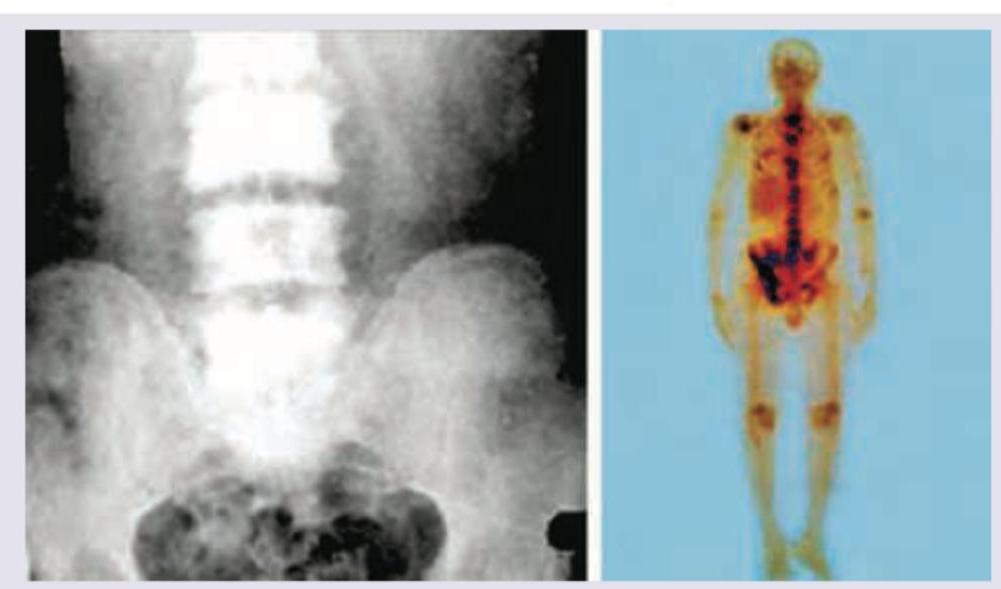
Osteoblastic metastases commonly arise from which primary tumor?
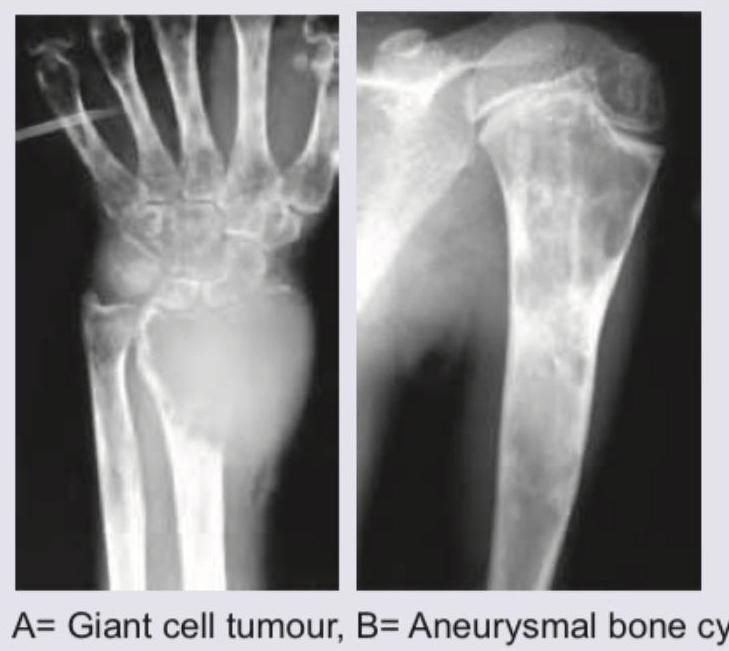
What is the characteristic radiological finding of Ewing's sarcoma?
A geriatric patient presents with a history of a fall in the bathroom, after which she was unable to move. She was found in an externally rotated position of the lower limb. There was tenderness in Scarpa's triangle. X-ray did not reveal a hip fracture. What is the next best step in management?
Which of the following are characteristic radiological features of osteosarcoma?
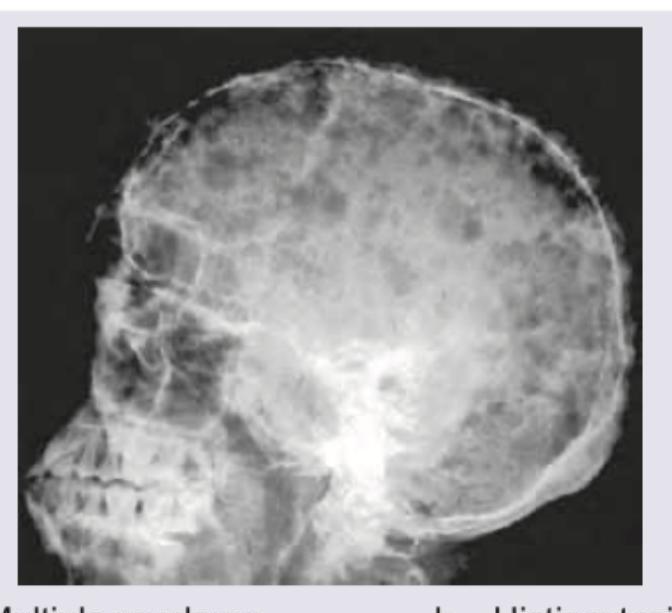
A cotton wool appearance on a radiograph is characteristic of which of the following conditions?
Explanation: **Explanation:** Rickets is a systemic disease characterized by the failure of osteoid mineralization at the growth plates (metaphysis) in children, most commonly due to Vitamin D deficiency. **Why "Subluxation of Epiphysis" is the correct answer:** Subluxation (partial dislocation) of the epiphysis is **not** a feature of rickets. While the growth plate is widened and the zone of provisional calcification is lost, the epiphysis remains in its anatomical position. Epiphyseal displacement or subluxation is more characteristic of conditions like **Scurvy** (due to the "Trummerfeld zone" or scorbutic zone leading to fractures) or **Slipped Capital Femoral Epiphysis (SCFE)**. **Analysis of Incorrect Options (Features of Rickets):** The hallmark of rickets is the accumulation of unmineralized osteoid, leading to softening and expansion of the metaphysis: * **Widening:** The growth plate appears thickened and wide because the cartilage cells fail to mature and calcify. * **Cupping:** The metaphysis assumes a concave or "cup-like" shape instead of its normal flat or convex appearance due to the pressure of the adjacent epiphysis against the softened bone. * **Splaying:** The metaphysis expands laterally (widens) to compensate for the mechanical stress on the weakened bone. **NEET-PG High-Yield Pearls:** * **Earliest Sign:** Fraying (shaggy margins) and rarefaction of the zone of provisional calcification. * **Best Site for X-ray:** Wrist (distal radius/ulna) or Knee. * **Rachitic Rosary:** Palpable/visible enlargement of costochondral junctions (rounded in rickets, sharp/angular in scurvy). * **Healing Sign:** Appearance of a new line of preparatory calcification (the "white line") across the metaphysis.
Explanation: **Explanation:** A **bone bruise (bone marrow contusion)** represents a microscopic injury to the bone architecture, characterized by hemorrhage, edema, and hyperemia within the marrow space, without a macroscopic cortical fracture. **1. Why MRI is the Correct Answer:** MRI is the gold standard and the only imaging modality capable of detecting bone bruises. This is because MRI is highly sensitive to changes in **water content** within the bone marrow. On **T2-weighted images** (specifically fat-suppressed sequences like **STIR**), bone marrow edema appears as an area of high signal intensity (bright), contrasting against the dark background of normal fatty marrow. **2. Why Other Options are Incorrect:** * **Conventional X-ray:** X-rays only detect changes in bone mineral density or cortical continuity. Since bone bruises involve internal marrow changes without cortical disruption, they are invisible on X-rays. * **CT Scan:** While excellent for detecting cortical fractures and complex bony anatomy, CT lacks the soft-tissue contrast necessary to visualize marrow edema. * **PET Scan:** This is primarily used for metabolic activity (oncology/inflammation) and is neither specific nor practical for diagnosing acute traumatic bone bruises. **3. Clinical Pearls for NEET-PG:** * **STIR (Short Tau Inversion Recovery):** This is the most sensitive MRI sequence for identifying bone marrow edema/bruises. * **Mechanism of Injury:** The pattern of a bone bruise often acts as a "geographic footprint," indicating the mechanism of injury (e.g., a bruise on the lateral femoral condyle and posterior tibial plateau is classic for an **ACL tear**). * **Clinical Significance:** Bone bruises are often the cause of persistent pain after trauma when X-rays are negative. They typically resolve within 4–12 weeks.
Explanation: **Explanation:** **Scurvy (Vitamin C Deficiency)** is the correct answer. The **Pelkan spur** (also known as a cortical spur) is a classic radiological sign of scurvy. It occurs due to the outward protrusion of the **Zone of Provisional Calcification** (the white line of Fraenkel) at the metaphysis. Because Vitamin C is essential for collagen synthesis, the osteoid matrix is weak, leading to fractures at the metaphyseal-epiphyseal junction. As the calcified cartilage is pushed outward, it forms a lateral bony spur. **Analysis of Options:** * **Rickets:** Characterized by a failure of mineralization of the osteoid. Key findings include **cupping, fraying, and splaying** of the metaphysis, but not cortical spurs. * **Hypervitaminosis A:** Typically presents with **subperiosteal new bone formation** (periostitis), particularly in the long bones, but does not feature Pelkan spurs. * **Fluorosis:** Characterized by **osteosclerosis** (increased bone density), calcification of ligaments (especially the sacrotuberous and interosseous ligaments), and irregular periosteal bone formation, but not the specific metaphyseal spurs seen in scurvy. **High-Yield Clinical Pearls for Scurvy (NEET-PG):** 1. **White line of Fraenkel:** Dense, thickened zone of provisional calcification. 2. **Trummerfeld zone:** A lucent (scorbutic) zone proximal to the white line representing a "scurvy field" of broken trabeculae. 3. **Wimberger’s Ring Sign:** A thin, sclerotic rim around a lucent epiphysis. 4. **Subperiosteal Hemorrhage:** Leads to lifting of the periosteum, which becomes visible as it calcifies during healing.
Explanation: **Explanation:** **Osteoporosis circumscripta** is a classic radiological hallmark of the **early active (lytic) phase of Paget’s disease** (Osteitis deformans). It typically involves the skull, appearing as well-defined, large, geographic radiolucent areas (usually starting in the frontal or occipital bones) that represent intense osteoclastic activity. As the disease progresses to the mixed phase, these lucencies are replaced by "cotton wool" opacities. **Analysis of Options:** * **Paget’s Disease (Correct):** It is a disorder of bone remodeling. Osteoporosis circumscripta represents the lytic stage in the calvarium. * **Fibrous Dysplasia:** Characteristically shows a **"Ground-glass appearance"** or "shepherd’s crook deformity" of the femur, but not osteoporosis circumscripta. * **Chronic Phenytoin Therapy:** This is associated with **Osteomalacia** (due to Vitamin D metabolism interference), which presents with generalized osteopenia and Looser’s zones (pseudofractures). * **Cushing’s Syndrome:** Leads to generalized **Osteoporosis** due to excess glucocorticoids, often resulting in vertebral compression fractures and "codfish vertebrae," but not localized circumscribed lysis. **High-Yield Clinical Pearls for NEET-PG:** * **Skull Findings in Paget’s:** Osteoporosis circumscripta (Lytic phase) $\rightarrow$ Cotton wool spots (Sclerotic phase) $\rightarrow$ Diploic thickening. * **Biochemical Marker:** Isolated elevation of **Serum Alkaline Phosphatase (ALP)** with normal Calcium and Phosphate levels. * **Complications:** The most dreaded complication is **Osteosarcoma** (seen in <1% of cases). * **Treatment of Choice:** Bisphosphonates (e.g., Zoledronic acid).
Explanation: **Explanation:** **Distal phalangeal tuft resorption**, also known as **acro-osteolysis**, refers to the destruction or thinning of the distal ends of the terminal phalanges. **1. Why Psoriatic Arthropathy is Correct:** Psoriatic arthritis is a classic cause of acro-osteolysis. The underlying mechanism involves chronic inflammation and increased osteoclastic activity. Radiologically, this often presents as the "pencil-in-cup" deformity, where the proximal bone is whittled (resorbed) and the distal bone is cupped. Tuft resorption is a hallmark finding in the distal interphalangeal (DIP) joint involvement characteristic of this condition. **2. Analysis of Incorrect Options:** * **Hypoparathyroidism:** This condition typically presents with increased bone density (osteosclerosis) or basal ganglia calcification, not bone resorption. In contrast, **Hyperparathyroidism** is a major cause of subperiosteal resorption and acro-osteolysis. * **Systemic Lupus Erythematosus (SLE):** SLE primarily causes Jaccoud’s arthropathy (reducible deformities due to ligamentous laxity) without significant erosions or tuft resorption. * **Hyperthyroidism:** While it can cause increased bone turnover and osteoporosis, it does not typically manifest as localized distal phalangeal tuft resorption. **3. High-Yield Clinical Pearls for NEET-PG:** To remember the differential diagnosis for **Acro-osteolysis**, use the mnemonic **"PINCH ME"**: * **P:** Psoriasis, Pyknodysostosis (classic for tuft resorption) * **I:** Injury (Thermal burns/Frostbite) * **N:** Neuropathy (Diabetes, Leprosy) * **C:** Collagen Vascular Disease (Scleroderma/Systemic Sclerosis - *most common cause*) * **H:** Hyperparathyroidism (Subperiosteal resorption) * **M:** Multicentric Reticulohistiocytosis * **E:** Exposure (Vinyl Chloride poisoning)
Explanation: **Explanation:** Bone metastases are broadly classified into **osteoblastic** (bone-forming), **osteolytic** (bone-destroying), or mixed lesions. **Correct Answer: B. Prostate** Prostate cancer is the classic and most common cause of purely **osteoblastic** metastases in males. The tumor cells secrete factors like Bone Morphogenetic Proteins (BMPs) and endothelin-1, which stimulate osteoblast activity, leading to increased bone density (sclerotic lesions) on X-ray or CT. **Analysis of Incorrect Options:** * **A. Breast:** Breast cancer typically presents with **mixed** lesions (both lytic and blastic). While it is the most common cause of blastic metastases in females, it is not as exclusively blastic as prostate cancer. * **C. Lung:** Most lung cancers (especially Non-Small Cell Lung Cancer) produce **osteolytic** lesions. An exception is carcinoid tumors, which can be blastic. * **D. Renal Cell Carcinoma (RCC):** RCC is notorious for causing highly vascular, **purely osteolytic**, and "expansile" (blow-out) lesions. **High-Yield Clinical Pearls for NEET-PG:** * **Most common source of bone mets (Overall):** Breast (due to high prevalence). * **Purely Lytic Metastases:** RCC, Thyroid, Lung, and Multiple Myeloma (Note: Myeloma is "cold" on bone scans). * **Purely Blastic Metastases:** Prostate, Carcinoid, Medulloblastoma, and Hodgkin’s Lymphoma (Ivory vertebra). * **Investigation of Choice:** **MRI** is the most sensitive for detecting early marrow involvement; **Bone Scan (Technetium-99m MDP)** is used for screening the whole body for osteoblastic activity.
Explanation: **Explanation:** **Ewing’s Sarcoma** is a highly malignant small round cell tumor typically occurring in the first and second decades of life. The characteristic radiological finding is the **Onion peel appearance** (Option C). This occurs due to a rapid, aggressive periosteal reaction where the bone deposits multiple concentric layers of new bone in an attempt to contain the fast-growing tumor. It is most commonly seen in the diaphysis of long bones (e.g., femur). **Analysis of Incorrect Options:** * **Option A (Soap bubble appearance):** Characteristic of **Giant Cell Tumor (Osteoclastoma)**, typically seen in the epiphysis of long bones in young adults. It can also be seen in Adamantinoma. * **Option B (Sunray/Sunburst appearance):** Classic for **Osteosarcoma**. It represents spicules of bone forming perpendicular to the cortex along Sharpey’s fibers due to rapid malignant growth. * **Option D (Codman’s triangle):** While seen in Ewing’s sarcoma, it is **not pathognomonic**. It occurs when the periosteum is lifted by the tumor, forming a triangular elevation. It is more classically associated with Osteosarcoma but can occur in any aggressive lesion. **High-Yield NEET-PG Pearls:** * **Translocation:** t(11;22) involving the EWS-FLI1 gene. * **Histology:** Small, round, blue cells with **Homer-Wright rosettes** (though more common in neuroblastoma) and PAS-positive (due to glycogen). * **Location:** Diaphysis (Mid-shaft) of long bones. * **Clinical:** Often mimics osteomyelitis (presents with fever, raised ESR, and local swelling).
Explanation: **Explanation:** The clinical presentation of a geriatric patient with a fall, external rotation of the limb, and tenderness in Scarpa’s triangle is highly suggestive of a **hip fracture** (specifically a femoral neck fracture), even if the initial X-ray is negative. **Why MRI is the Correct Choice:** In the elderly, up to 10% of hip fractures are **occult** (not visible on initial radiographs) due to osteoporotic bone or non-displaced fracture lines. **MRI is the gold standard** and the investigation of choice for occult hip fractures. It has a sensitivity and specificity approaching 100%. It can detect bone marrow edema and fracture lines within 24 hours of injury, which other modalities might miss. **Analysis of Incorrect Options:** * **CT Scan:** While CT is excellent for evaluating complex fracture anatomy and cortical bone, it is less sensitive than MRI for detecting early trabecular stress or non-displaced occult fractures in osteoporotic bone. It is usually the second-line alternative if MRI is contraindicated. * **Ultrasound:** Useful for detecting joint effusions or soft tissue injuries, but it cannot reliably diagnose or rule out an intra-articular hip fracture. * **PET Scan:** This is a functional imaging modality used primarily in oncology and infectious workups; it has no role in the acute management of trauma or suspected fractures. **Clinical Pearls for NEET-PG:** * **Classic Triad of Hip Fracture:** History of fall, shortening of the limb, and **external rotation**. * **Imaging Protocol:** Always start with X-ray (AP view of pelvis with both hips and Lateral view). If X-ray is negative but clinical suspicion is high, proceed to **MRI**. * If MRI is unavailable or contraindicated (e.g., pacemaker), a **CT scan** or a **Bone Scan** (after 48–72 hours) are the next alternatives.
Explanation: **Explanation:** Osteosarcoma is the most common primary malignant bone tumor in children and adolescents, typically occurring at the metaphysis of long bones (most commonly the distal femur). **1. Why Codman’s Triangle is Correct:** Codman’s triangle is a classic radiological sign of an aggressive bone lesion. It occurs when a rapidly growing tumor lifts the periosteum away from the bone cortex. The periosteum attempts to lay down new bone, but the tumor grows too quickly for a complete layer to form, leaving a triangular elevation of reactive bone at the margin of the lesion. While not pathognomonic, it is a hallmark of osteosarcoma. **2. Analysis of Other Options:** * **New bone formation (A):** While osteosarcoma is an osteoid-producing tumor, "new bone formation" is a non-specific term seen in fractures, infections, and benign tumors. It lacks the diagnostic specificity of periosteal reactions. * **Sun ray appearance (B):** This is also a characteristic feature of osteosarcoma (spiculated periosteal reaction). However, in many standardized NEET-PG questions, if both are present, Codman’s triangle is often highlighted as the classic "periosteal elevation" sign. *Note: In clinical practice, both B and C are highly suggestive.* * **Soap bubble appearance (D):** This is the classic radiological description for **Giant Cell Tumor (Osteoclastoma)**, typically seen in the epiphysis of long bones in young adults. **High-Yield Clinical Pearls for NEET-PG:** * **Most common site:** Distal femur > Proximal tibia (around the knee). * **Age group:** Bimodal distribution (10–20 years; >60 years associated with Paget’s disease). * **Other signs:** Cumulus cloud-like opacities (osteoid matrix) and soft tissue mass. * **Genetic association:** Often linked with mutations in the *RB1* (Retinoblastoma) and *TP53* (Li-Fraumeni syndrome) genes. * **Metastasis:** Primarily hematogenous, most commonly to the **lungs** (presents as "cannonball" metastases).
Explanation: **Explanation:** The **"cotton wool appearance"** is a classic radiographic hallmark of **Osteitis deformans**, commonly known as **Paget’s disease of the bone**. This appearance occurs during the late sclerotic (inactive) phase of the disease. It is caused by thickened, disorganized trabeculae and patchy areas of sclerosis superimposed on osteolytic areas, creating dense, white, fluffy opacities that resemble tufts of cotton wool, particularly in the skull. **Analysis of Options:** * **Osteitis deformans (Correct):** Characterized by disordered bone remodeling (excessive resorption followed by excessive formation). Key features include cortical thickening, enlargement of bone, and the "cotton wool" skull. * **Osteopetrosis:** Also known as "Marble Bone Disease," it presents with a diffuse, symmetric increase in bone density. Classic signs include the **"bone-within-bone"** appearance and **"sandwich vertebrae"** (Rugger-jersey spine), but not the patchy cotton wool pattern. * **Peutz-Jeghers Syndrome:** An autosomal dominant genetic disorder characterized by gastrointestinal hamartomatous polyps and mucocutaneous hyperpigmentation. It has no specific radiographic bone findings. * **Seborrheic Keratosis:** A common, benign skin tumor. It is a clinical dermatological diagnosis and does not manifest with radiological bone changes. **High-Yield Clinical Pearls for NEET-PG:** * **Biochemical marker:** Isolated elevation of **Serum Alkaline Phosphatase (ALP)** with normal Calcium and Phosphate levels. * **Skull signs:** "Cotton wool" appearance and **Osteoporosis Circumscripta** (early lytic phase). * **Pelvis signs:** Thickening of the iliopectineal line (**Brim sign**). * **Complications:** High-output heart failure and a 1% risk of transformation into **Osteosarcoma**. * **Treatment:** Bisphosphonates (e.g., Zoledronate) are the drug of choice.
Radiographic Anatomy of Bones and Joints
Practice Questions
Imaging of Fractures and Dislocations
Practice Questions
Arthritides: Inflammatory and Degenerative
Practice Questions
Metabolic Bone Diseases
Practice Questions
Bone and Soft Tissue Tumors
Practice Questions
Congenital Skeletal Anomalies
Practice Questions
Spine Imaging
Practice Questions
Skeletal Infections
Practice Questions
Sports Medicine Imaging
Practice Questions
Imaging of Prostheses and Implants
Practice Questions
Musculoskeletal Ultrasound
Practice Questions
MSK Interventional Procedures
Practice Questions
Get full access to all questions, explanations, and performance tracking.
Start For Free