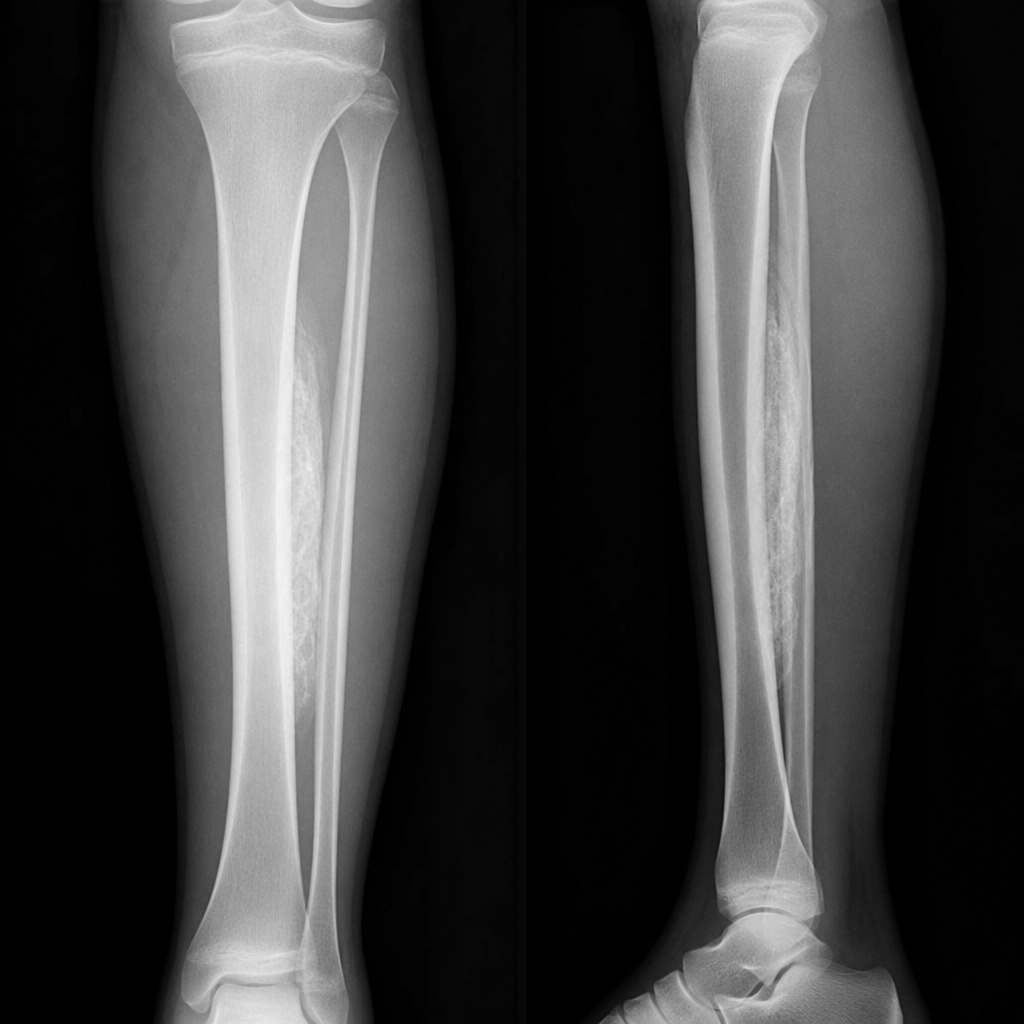
The 'Pelkan spur' is a radiological feature of which of the following conditions?
Tufting of the distal phalanx is characteristically seen in which condition?
Bullet shaped vertebrae are seen in all of the following conditions, EXCEPT:
Which radiological feature is characteristic of osteosarcoma?
Increased radioisotopes are seen in all of the following conditions except:
Stippled epiphysis is seen in which condition?
The following Pelvic Radiograph is seen in which condition?

What anatomical structure is visualized using Stryker's view?
A 60-year-old man presents with bone pain and fatigue. His skull X-ray is shown in the image. This appearance is most suggestive of which of the following conditions?

On X-ray, joint swelling and intra-articular calcification appearance is seen in which condition?
Explanation: **Explanation:** The **Pelkan spur** is a classic radiological sign of **Scurvy** (Vitamin C deficiency). Scurvy leads to defective collagen synthesis, resulting in fragile capillary walls and impaired osteoid formation. The Pelkan spur refers to lateral bony projections (osteophytes) seen at the metaphysis. These occur due to the outward extension of the **Zone of Provisional Calcification** (Frankel’s line) and are often associated with healing metaphyseal fractures or subperiosteal hemorrhages. **Analysis of Options:** * **Scurvy (Correct):** In addition to Pelkan spurs, other high-yield features include **Wimberger’s ring** (sclerotic rim around an osteoporotic epiphysis), **Frankel’s line** (dense metaphyseal band), and the **Trummerfeld zone** (lucent scorbutic zone proximal to the dense line). * **Rickets:** Characterized by "Cupping, Fraying, and Splaying" of the metaphysis, delayed ossification, and widening of the growth plate. It does not feature Pelkan spurs. * **Hemophilia:** Radiological findings typically involve joint destruction (hemophilic arthropathy), widened intercondylar notches in the femur, and "squared-off" patella due to chronic hemarthrosis. **NEET-PG High-Yield Pearls for Scurvy:** 1. **Early Sign:** Generalized osteopenia. 2. **White Line of Frankel:** Represents a thickened zone of provisional calcification. 3. **Subperiosteal Hemorrhage:** Leads to lifting of the periosteum, which becomes visible as it calcifies during healing. 4. **Clinical Triad:** Anemia, Gum bleeding, and Bone pain.
Explanation: **Explanation:** **Psoriatic arthropathy (Option B)** is the correct answer because it characteristically involves the distal interphalangeal (DIP) joints and the distal phalanges. **Tufting of the distal phalanx** (also known as acro-osteolysis or resorption of the terminal tuft) occurs due to inflammatory bone destruction. In Psoriatic Arthritis, this is often associated with the "pencil-in-cup" deformity and "sausage digit" (dactylitis). **Analysis of Incorrect Options:** * **Gout (Option A):** Characterized by "punched-out" erosions with overhanging edges (**Martel’s sign**) and soft tissue tophi. It typically spares the terminal tufts. * **Hypoparathyroidism (Option C):** Usually presents with increased bone density (osteosclerosis) or basal ganglia calcification. It is **Hyperparathyroidism** that causes subperiosteal bone resorption, often seen on the radial aspect of the middle phalanges, not specifically tufting. * **Paget’s Disease (Option D):** Characterized by bone enlargement, cortical thickening, and coarsened trabeculae. While it can affect any bone, it does not typically cause distal phalangeal tufting. **High-Yield Clinical Pearls for NEET-PG:** * **Acro-osteolysis (Tufting resorption) Differential:** Remember the mnemonic **"P-S-C-H-O"**: **P**soriasis, **S**cleroderma (most common cause due to digital ischemia), **C**apital (Vinyl Chloride exposure), **H**yperparathyroidism, and **O**steomyelitis. * **Psoriatic Arthritis X-ray Triad:** DIP joint involvement, asymmetric distribution, and periosteal new bone formation. * **Pencil-in-cup deformity:** Classic finding where the proximal phalanx erodes into a point (pencil) and the distal phalanx base hollows out (cup).
Explanation: **Explanation:** **Bullet-shaped vertebrae** (also known as anterior wedging or tongue-like projections of the vertebrae) are a classic radiological sign characterized by the hypoplasia of the anterosuperior portion of the vertebral body, leading to a rounded or "bullet" appearance. **Why Paget Disease is the Correct Answer:** Paget disease of the bone is characterized by excessive bone remodeling. Radiologically, it presents as **"Picture Frame" vertebrae** (due to peripheral cortical thickening) or **"Ivory" vertebrae** (diffuse sclerosis). It does not cause the developmental anterior wedging seen in bullet-shaped vertebrae. **Analysis of Incorrect Options:** * **Hurler Syndrome (MPS I):** This is the classic cause. It typically involves the **L1 or L2** vertebrae, showing an inferior "beak" or tongue-like projection. * **Morquio Syndrome (MPS IV):** Characterized by universal platyspondyly (flattened vertebrae) with a **central anterior beak**. * **Achondroplasia:** This common cause of dwarfism features bullet-shaped vertebrae in the upper lumbar spine, often associated with posterior scalloping and narrowing of the interpedicular distance. **High-Yield Clinical Pearls for NEET-PG:** * **Inferior Beaking:** Hurler Syndrome, Hunter Syndrome. * **Central Beaking:** Morquio Syndrome (Pathognomonic). * **Picture Frame/Ivory Vertebra:** Paget Disease, Lymphoma, or Hemangioma (Polka-dot sign). * **Codfish Vertebra:** Osteogenesis Imperfecta or severe Osteoporosis. * **H-shaped Vertebra (Lincoln Log):** Sickle Cell Anemia (due to central endplate infarction).
Explanation: Explanation: Osteosarcoma is the most common primary malignant bone tumor in children and adolescents, typically occurring in the metaphyseal region of long bones (most commonly the distal femur) [1]. **Why 'Sunray Appearance' is Correct:** The **Sunray (or Sunburst) appearance** is a classic radiological hallmark of osteosarcoma [3]. It occurs due to a rapid, aggressive periosteal reaction. As the tumor grows quickly, it pushes the periosteum away from the bone; the Sharpey’s fibers are stretched perpendicular to the bone cortex, and ossification occurs along these fibers, creating radiating spicules of new bone that resemble sun rays. **Analysis of Incorrect Options:** * **New bone formation:** While osteosarcoma does produce neoplastic bone, "new bone formation" is a non-specific term seen in many conditions, including fractures, infections (osteomyelitis), and other tumors [1]. * **Cotton wool appearance:** This is characteristic of **Paget’s disease** of the bone (specifically in the skull), representing thickened, disorganized sclerotic patches. * **Osteoid formation:** This is the *histological* hallmark of osteosarcoma (malignant mesenchymal cells producing osteoid), but it is not a specific *radiological* feature. **NEET-PG High-Yield Pearls:** * **Codman’s Triangle:** Another classic sign of osteosarcoma, formed when the periosteum is lifted by the tumor, creating a triangular elevation at the edge [3]. * **Most common site:** Distal femur > Proximal tibia (around the knee) [1]. * **Age distribution:** Bimodal (10–20 years; and >60 years associated with Paget's or post-radiation) [2]. * **Skip lesions:** Medullary metastases within the same bone but separate from the primary tumor (important for staging) [1].
Explanation: **Explanation:** The question refers to **Bone Scintigraphy (Bone Scan)** using **Technetium-99m MDP**. This imaging modality detects areas of increased osteoblastic activity and increased skeletal blood flow, which appear as "hot spots" (increased radioisotope uptake). **Why Pseudoarthrosis is the correct answer:** Pseudoarthrosis (a "false joint" formed by non-union of a fracture) is typically characterized by a lack of metabolic activity and poor blood supply at the fracture site. In chronic, stable cases, there is no active bone remodeling or osteoblastic response, leading to **decreased or normal uptake** (a "cold" or "neutral" spot) rather than increased uptake. **Analysis of Incorrect Options:** * **Primary Bone Tumors:** Most primary bone tumors (e.g., Osteosarcoma, Ewing’s sarcoma) exhibit intense osteoblastic activity and hypervascularity, leading to marked **increased uptake**. * **Osteomyelitis:** Infection triggers an inflammatory response and reactive bone formation. A 3-phase bone scan shows **increased uptake** in all three phases (blood pool, soft tissue, and delayed bone phase). * **Paget’s Disease:** This condition is characterized by excessive and disorganized bone remodeling. It typically shows the **most intense radioisotope uptake** seen in clinical practice, often involving the entire bone (e.g., "Blade of grass" appearance). **High-Yield Clinical Pearls for NEET-PG:** * **Hot Spots (Increased uptake):** Inflammation, infection, trauma, primary/metastatic tumors (except purely lytic ones), and metabolic bone diseases. * **Cold Spots (Decreased uptake):** Avascular necrosis (early stage), Multiple Myeloma (often false negative on bone scan), and Renal Cell Carcinoma metastases. * **Paget’s Disease:** Bone scan is the most sensitive tool to identify the extent of involvement. * **Super Scan:** A bone scan showing intense symmetrical skeletal uptake with faint or absent kidney visualization (seen in Metastatic Prostate CA or Renal Osteodystrophy).
Explanation: **Explanation:** **Stippled epiphysis** (also known as epiphyseal dysgenesis) refers to the appearance of multiple, irregular, punctate calcifications within the cartilaginous epiphysis. 1. **Why Congenital Hypothyroidism is correct:** Thyroid hormone is essential for normal endochondral ossification and skeletal maturation. In congenital hypothyroidism (Cretinism), there is a delay in the appearance of ossification centers. When they finally appear, they do so from multiple small foci rather than a single central nucleus, resulting in a fragmented, "stippled," or "moth-eaten" appearance. This is most commonly seen in the femoral head and the navicular bone. 2. **Why the other options are incorrect:** * **Juvenile Rheumatoid Arthritis:** Characterized by periarticular osteopenia, joint space narrowing, and bony erosions, but not stippled epiphyses. * **Scurvy:** Radiographic features include the Wimberger ring sign (dense periphery of epiphysis), Frankel’s line (dense zone of provisional calcification), and Pelkan spurs. * **Achondroplasia:** Features include rhizomelic shortening of limbs, "trident hand," and narrowing of the interpedicular distance in the lumbar spine. **High-Yield Clinical Pearls for NEET-PG:** * **Differential Diagnosis for Stippled Epiphysis:** 1. **Chondrodysplasia Punctata** (Conradi-Hünermann syndrome) – the classic cause. 2. **Congenital Hypothyroidism.** 3. **Maternal Warfarin ingestion** during pregnancy (Fetal Warfarin Syndrome). 4. **Zellweger Syndrome.** * **Key Sign:** In hypothyroidism, the stippling is a sign of **delayed maturation**, whereas in Chondrodysplasia Punctata, it is a primary calcification disorder.
Explanation: ***Nail Patella Syndrome*** - Characterized by **pathognomonic iliac horns** - bilateral bony projections from the posterior iliac crests visible on AP pelvic radiographs. - This **hereditary osteo-onychodysplasia** presents with distinctive skeletal abnormalities including patellar hypoplasia and elbow dysplasia. *Achondroplasia* - Shows **narrowing of interpedicular distance** in the lumbar spine and **champagne glass pelvis** configuration. - **Iliac horns are not present** - instead demonstrates broad, flared iliac wings with horizontal acetabular roofs. *Osteoarthritis* - Presents with **joint space narrowing**, **osteophytes**, and **subchondral sclerosis** affecting weight-bearing joints. - **No iliac horn formation** - changes are limited to articular surfaces and periarticular bone formation. *Rheumatoid Arthritis* - Shows **symmetric joint erosions** and **osteopenia** with possible **protrusio acetabuli** in advanced cases. - **Absence of iliac horns** - inflammatory changes affect synovial joints without producing bony projections from iliac crests.
Explanation: **Explanation:** **Stryker Notch View** is a specialized radiographic projection used to evaluate the **posterosuperolateral aspect of the humeral head**. It is specifically designed to detect a **Hill-Sachs lesion**, which is a compression fracture of the humeral head caused by its impact against the anterior glenoid rim during an anterior shoulder dislocation. In this view, the patient lies supine with the hand placed on the head, and the X-ray beam is tilted 10° cephalad, making the posterior defect clearly visible. **Analysis of Incorrect Options:** * **B. Internal Auditory Meatus (IAM):** This is best visualized using **Stenver’s view** or **Towne’s view**. CT is currently the gold standard for bony anatomy of the IAM. * **C. Acetabulum:** The specialized views for the acetabulum and pelvic ring are **Judet views** (Iliac and Obturator oblique views). * **D. Optic Foramen:** This is visualized using **Rhese’s view**, where the optic canal appears in the lower outer quadrant of the orbit. **High-Yield Clinical Pearls for NEET-PG:** * **Bankart Lesion:** An injury to the anterior-inferior glenoid labrum; best seen on **West Point view** or MRI. * **Hill-Sachs Lesion:** Best seen on **Stryker’s Notch view**. * **Shoulder Dislocation:** Anterior dislocation is the most common type. The **Axillary view** is crucial to differentiate it from posterior dislocation. * **Light Bulb Sign:** A classic radiographic sign of **posterior shoulder dislocation** seen on AP view due to internal rotation of the humerus.
Explanation: ***Multiple myeloma*** - **Punched-out lytic lesions** (raindrop skull or Swiss-cheese appearance) in a 60-year-old with bone pain and fatigue is classic for multiple myeloma. - **Plasma cell malignancy** commonly causes **hypercalcemia**, **anemia**, and **renal dysfunction** along with characteristic skull lesions. *Eosinophilic granuloma* - Typically presents as a **single well-defined lytic lesion** with **beveled edges** rather than multiple punched-out lesions. - More common in **children and young adults**, not elderly patients with systemic symptoms. *Hyperparathyroidism* - Causes **pepper-pot skull** or **granular osteoporosis** with diffuse bone resorption, not discrete punched-out lesions. - Associated with **elevated calcium** and **PTH levels**, but lesions appear more diffuse and granular. *Acromegaly* - Results in **bone enlargement** and **thickening** due to excess growth hormone, not lytic destruction. - Skull shows **frontal bossing** and **enlarged sinuses**, opposite of the destructive lesions seen here.
Explanation: **Explanation:** **Charcot’s Joint (Neuropathic Arthropathy)** is the correct answer because it is characterized by progressive joint destruction due to a loss of pain and proprioception. On X-ray, it presents with the classic **"6 Ds"**: **D**istention (joint swelling/effusion), **D**isorganization, **D**islocation, **D**ebris (intra-articular calcification/loose bodies), **D**ensity (sclerosis), and **D**estruction. The "intra-articular calcification" mentioned in the question refers to the bony debris and fragmentation resulting from repetitive microtrauma to a denervated joint. **Why other options are incorrect:** * **Osteopetrosis:** Characterized by a generalized increase in bone density ("Marble Bone Disease") and a "bone-within-bone" appearance, but not typically intra-articular calcification or joint swelling. * **Paget’s Disease:** Features include cortical thickening, coarsened trabeculae, and bone enlargement (e.g., "Picture Frame Vertebra"). It is a metabolic bone disease, not primarily a joint-destructive process with debris. * **Rheumatoid Arthritis:** Typically shows periarticular osteopenia, symmetrical joint space narrowing, and marginal erosions. It does not cause the exuberant intra-articular calcification or "debris" seen in Charcot’s joint. **High-Yield Clinical Pearls for NEET-PG:** * **Most common cause:** Diabetes Mellitus (affects foot/ankle). * **Syringomyelia:** Classically affects the shoulder joint. * **Tabes Dorsalis (Syphilis):** Classically affects the knee joint. * **Radiological Hallmark:** The presence of significant joint destruction and debris in a patient who presents with relatively little pain (clinical-radiological dissociation).
Radiographic Anatomy of Bones and Joints
Practice Questions
Imaging of Fractures and Dislocations
Practice Questions
Arthritides: Inflammatory and Degenerative
Practice Questions
Metabolic Bone Diseases
Practice Questions
Bone and Soft Tissue Tumors
Practice Questions
Congenital Skeletal Anomalies
Practice Questions
Spine Imaging
Practice Questions
Skeletal Infections
Practice Questions
Sports Medicine Imaging
Practice Questions
Imaging of Prostheses and Implants
Practice Questions
Musculoskeletal Ultrasound
Practice Questions
MSK Interventional Procedures
Practice Questions
Get full access to all questions, explanations, and performance tracking.
Start For Free