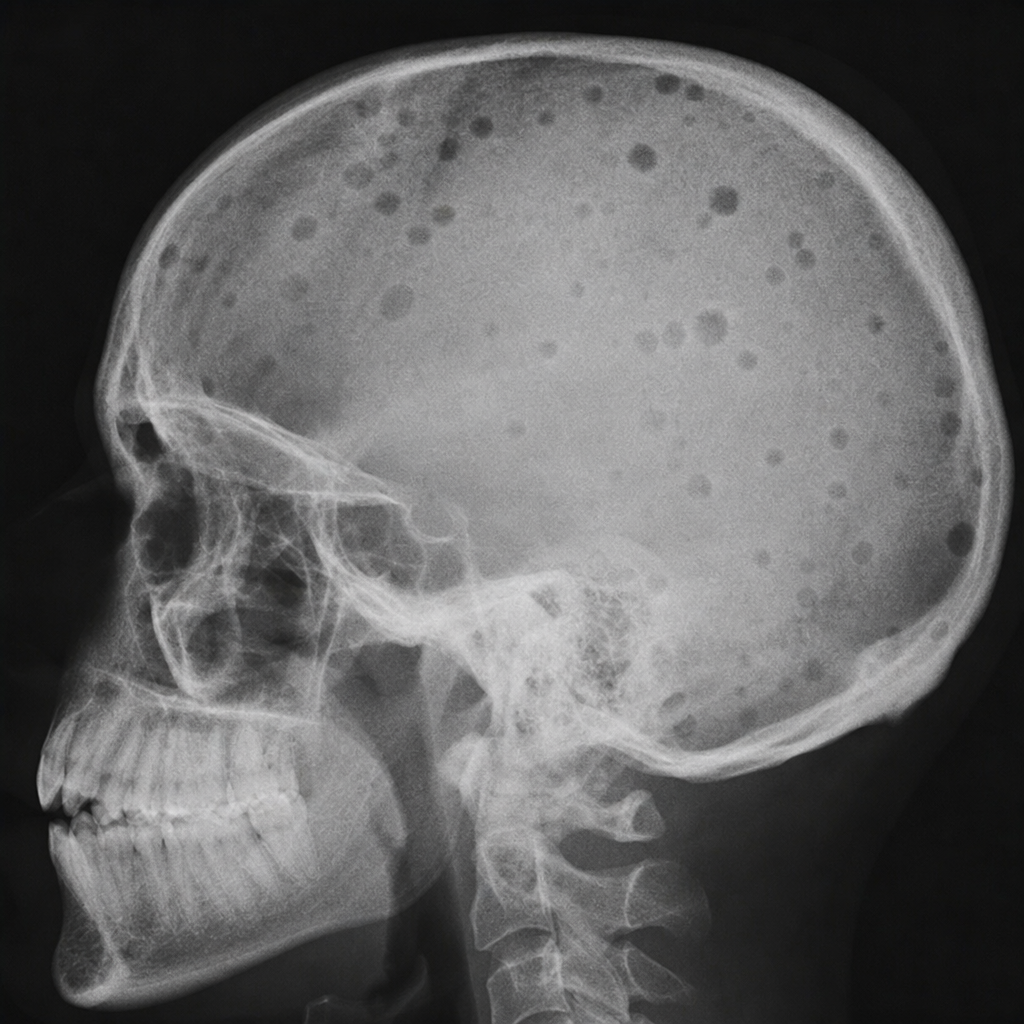
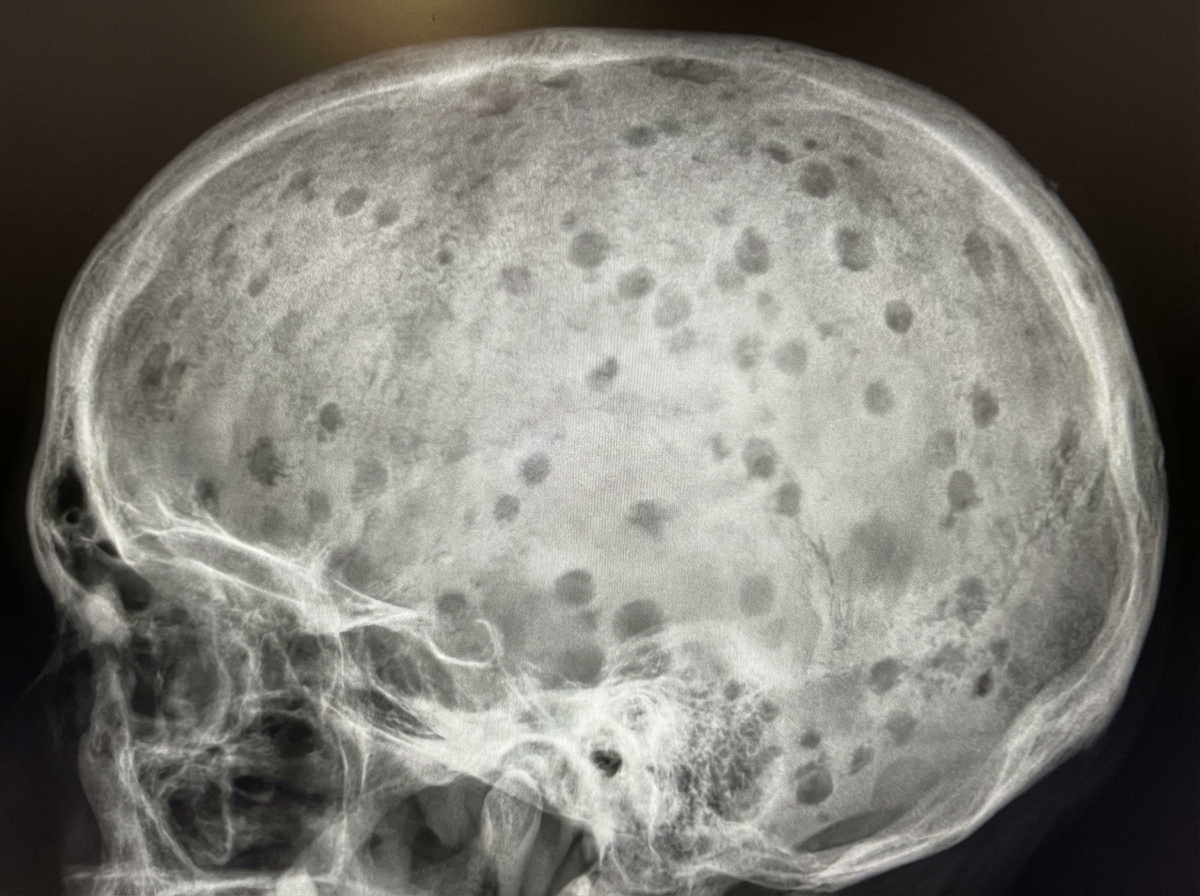
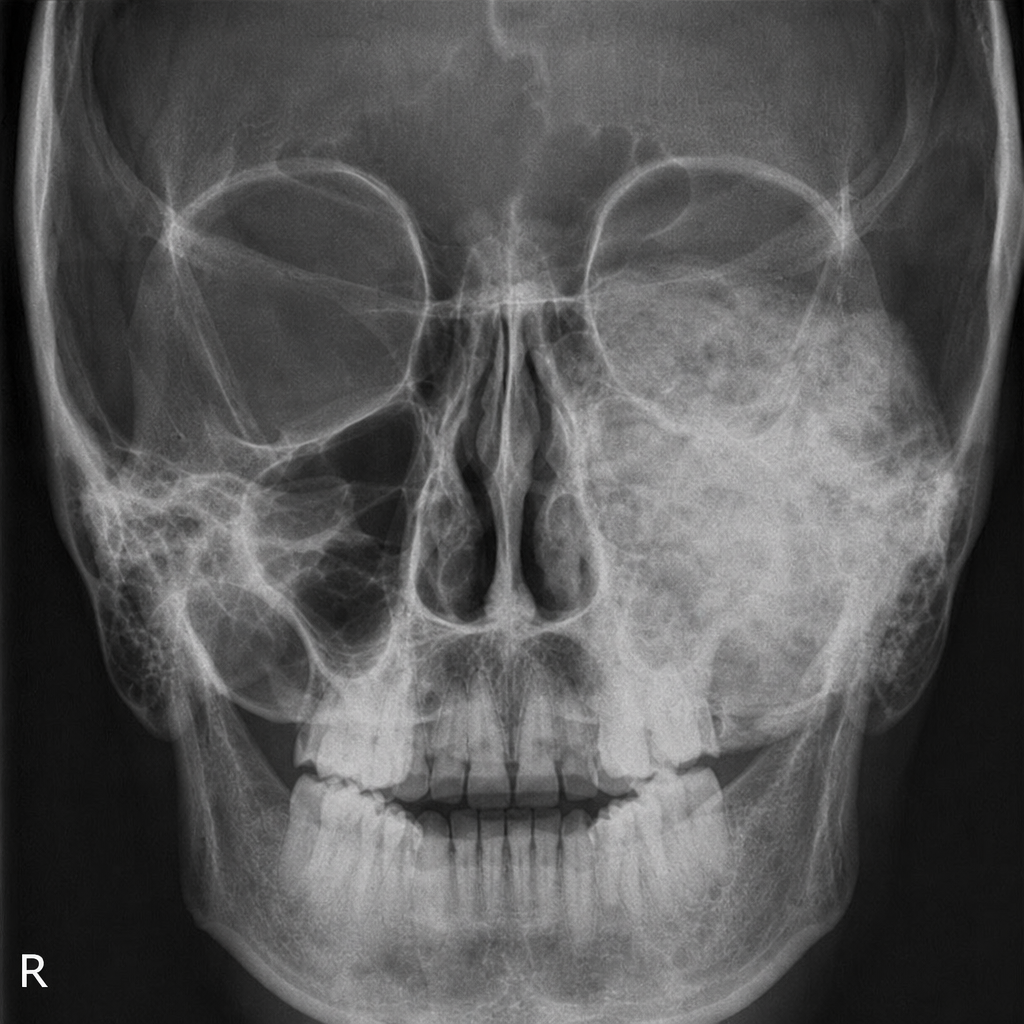
A "sharpened pencil" appearance of the mandibular condyle on a radiograph indicates which of the following conditions?
Which of the following is NOT a radiological finding of hemophilic arthropathy?
All of the following are features of Achondroplasia except?
Which radiographic view is best for visualizing condylar and ramus fractures?
Which of the following statements regarding congenital torticollis is NOT true?
Fraying of the anterior ends of ribs is seen in which condition?
What are the characteristic radiographic changes seen in the alveolar bone?
Which of the following is NOT a radiological feature of scurvy?
The following X-ray has a feature which is characteristic of which condition?

Which one of the following is a recognized X-ray feature of rheumatoid arthritis?
Explanation: **Explanation:** The **"sharpened pencil"** (or "pencil-pointing") appearance of the mandibular condyle is a classic radiographic feature of advanced **Rheumatoid Arthritis (RA)** affecting the Temporomandibular Joint (TMJ). **Why Rheumatoid Arthritis is correct:** RA is a chronic inflammatory systemic disease characterized by synovial hypertrophy (pannus formation). In the TMJ, this pannus causes extensive marginal erosions and destruction of the subchondral bone. As the inflammatory process progresses, the superior and anterior aspects of the condylar head are resorbed, leading to a significant loss of volume. The remaining bone appears thin, pointed, and tapered, resembling a sharpened pencil. **Analysis of Incorrect Options:** * **A. Osteoarthritis:** Typically presents with subchondral sclerosis, osteophyte formation ("lipping"), and subchondral cysts (Ely’s cysts). While it causes flattening of the condyle, it does not produce the symmetric, tapered "pencil" deformity seen in inflammatory erosions. * **C. Infectious Arthritis:** Usually presents with rapid, asymmetric bone destruction, joint space widening (due to effusion), and eventual sequestrum formation or ankylosis, rather than a specific tapered remodeling. * **D. Juvenile Arthritis:** While it can cause condylar destruction, it more commonly leads to micrognathia (bird-face deformity) due to interference with the growth center of the condyle during development. **High-Yield Clinical Pearls for NEET-PG:** * **Pencil-in-cup deformity:** This is distinct from the "sharpened pencil" condyle and is a hallmark of **Psoriatic Arthritis**, typically seen in the distal interphalangeal (DIP) joints. * **TMJ Involvement in RA:** Occurs in over 50% of patients; clinical signs include preauricular tenderness and limited mouth opening. * **Imaging Gold Standard:** While radiographs show the "pencil" sign, **MRI** is the most sensitive modality for detecting early synovial changes and joint effusion in RA.
Explanation: **Explanation:** Hemophilic arthropathy is a chronic joint deformity resulting from recurrent intra-articular bleeding (hemarthrosis). The pathophysiology involves synovial hypertrophy and iron (hemosiderin) deposition, which leads to hypervascularity and cartilage destruction. **Why Option C is correct:** In hemophilic arthropathy of the knee, the **intercondylar notch actually becomes widened (not shortened)**. This occurs because the hypertrophied synovium and chronic inflammation within the notch cause pressure erosion and remodeling of the femoral condyles. **Why the other options are incorrect:** * **A. Patellar squaring:** Chronic hyperemia leads to premature fusion of the growth plates and abnormal remodeling. Squaring of the inferior pole of the patella (Jordan’s sign) is a classic radiological hallmark. * **B. Subchondral cysts:** Recurrent bleeding into the subchondral bone leads to the formation of multiple radiolucent cysts (Geodes), often larger than those seen in osteoarthritis. * **D. Epiphyseal overgrowth:** Increased blood flow (hyperemia) to the joint during the skeletal growth phase causes the epiphyses to enlarge and mature prematurely, often leading to limb length discrepancy. **NEET-PG High-Yield Pearls:** * **Target Joint:** The knee is the most commonly affected joint in hemophilia. * **Arnold-Hilgartner Classification:** Used to stage the severity of hemophilic arthropathy based on X-ray findings. * **MRI:** The gold standard for early detection; it shows **"blooming" artifact** on Gradient Echo (GRE) sequences due to the paramagnetic effect of hemosiderin. * **Differential Diagnosis:** Widened intercondylar notch is also seen in **Juvenile Idiopathic Arthritis (JIA)**, but the presence of dense joint effusions (due to iron) favors hemophilia.
Explanation: **Explanation:** **Achondroplasia** is the most common cause of short-limb dwarfism (rhizomelic shortening). It is an autosomal dominant condition caused by a mutation in the **FGFR3 gene**, leading to impaired endochondral ossification. **Why Wimberger Ring Sign is the correct answer:** The **Wimberger ring sign** is a classic radiological feature of **Scurvy (Vitamin C deficiency)**. It refers to a thin, sclerotic rim surrounding a lucent center in the epiphysis (circular demineralization). It is not associated with achondroplasia. **Analysis of other options (Features of Achondroplasia):** * **Bullet-shaped vertebra:** Seen in the lumbar spine due to anterior wedging/hypoplasia of the vertebral bodies. This often leads to progressive kyphosis and a narrowed interpedicular distance (pathognomonic finding). * **Trident hand:** Characterized by a persistent space between the third and fourth digits, with short, stubby fingers of nearly equal length, resembling a "starfish" or a "trident." * **Champagne glass pelvis:** The pelvis is short and broad with a "square" appearance of the iliac wings (Elephant ear ilia) and a flat, wide pelvic inlet resembling a champagne glass. **High-Yield Clinical Pearls for NEET-PG:** * **Inheritance:** Autosomal Dominant (80% are new mutations related to advanced paternal age). * **Skull:** Frontal bossing with midface hypoplasia and a narrowed foramen magnum (risk of sudden infant death). * **Long Bones:** Rhizomelic shortening (proximal segments like humerus/femur are most affected). * **Differential for Wimberger Sign:** Do not confuse this with **Wimberger’s Sign** (localized erosion of the medial proximal tibial metaphysis), which is seen in **Congenital Syphilis**.
Explanation: **Explanation:** The **Reverse Towne’s view** is the gold standard radiographic projection for visualizing the **mandibular condyles and the ramus**. In this view, the patient is prone with the forehead and nose touching the film, and the X-ray beam is angled cephalad. This positioning causes the condyles to be projected clear of the mastoid processes and the petrous ridges of the temporal bone, providing an unobstructed view of the condylar necks and the ascending ramus. It is particularly useful for detecting medial or lateral displacement of condylar fractures. **Analysis of Incorrect Options:** * **Caldwell View (Occipitofrontal):** Best for visualizing the **frontal sinuses**, orbital rims, and the ethmoid air cells. The petrous ridges overlap the lower third of the orbit in this view. * **Towne’s View (AP Axial):** While similar, the standard Towne’s view is an AP projection used primarily to visualize the **occipital bone** and the zygomatic arches. For mandibular fractures, the "Reverse" (PA) version is preferred as it provides better detail of the condyles with less magnification. * **Water’s View (Occipitomental):** The primary view for **maxillary sinuses**. It is also excellent for evaluating the orbital floor (blow-out fractures) and the zygomatico-maxillary complex (ZMC) fractures. **High-Yield Clinical Pearls for NEET-PG:** * **Mandible Fractures:** The most common site is the **body**, followed by the **condyle**. * **Subcondylar Fractures:** Often result from a blow to the chin (indirect force). * **Imaging Choice:** While Reverse Towne's is the best plain film, **NCCT with 3D reconstruction** is now the gold standard for complex maxillofacial trauma. * **OPG (Orthopantomogram):** The best screening radiograph for the entire mandible.
Explanation: **Explanation:** Congenital Muscular Torticollis (CMT) is a common pediatric musculoskeletal condition characterized by the shortening or fibrosis of the sternocleidomastoid (SCM) muscle, leading to an ipsilateral head tilt and contralateral rotation. **Why Option D is the Correct Answer (The False Statement):** While birth trauma and malpositioning are significant risk factors, congenital torticollis is **not always** associated with breech presentation. Although breech presentation increases the risk due to intrauterine crowding or birth injury, many cases occur following normal cephalic deliveries. Other etiologies include intrauterine compartment syndrome or primary myopathy of the SCM. **Analysis of Incorrect Options (True Statements):** * **Option A:** In approximately 66% (two-thirds) of cases, a firm, non-tender "fibromatosis colli" or SCM mass is palpable within the first few weeks of life. * **Option B:** If left untreated, the persistent positioning leads to **plagiocephaly** (flattening of the skull) and facial asymmetry due to the constant pressure on the developing cranium. * **Option C:** The prognosis is generally excellent; approximately **80-90% of cases resolve spontaneously** or with conservative management (stretching exercises) within the first year of life. **High-Yield Clinical Pearls for NEET-PG:** * **Imaging of Choice:** **Ultrasonography** is the gold standard for diagnosing fibromatosis colli, typically showing a fusiform enlargement of the SCM muscle. * **Clinical Presentation:** The head tilts **toward** the affected side, and the chin rotates **away** from the affected side. * **Differential Diagnosis:** Always rule out Klippel-Feil syndrome (cervical vertebral fusion) or posterior fossa tumors if the presentation is atypical.
Explanation: **Explanation:** **Rickets** is the correct answer because it is characterized by a failure of osteoid mineralization at the growth plates. In the ribs, this occurs at the **costochondral junctions**. The accumulation of unmineralized osteoid causes the bone ends to become soft, widened, and disorganized. Radiologically, this manifests as **fraying** (shaggy margins), **cupping** (concave deformity), and **splaying** (widening) of the anterior rib ends. Clinically, these palpable enlargements are known as the **"Rachitic Rosary."** **Analysis of Incorrect Options:** * **Scurvy (Vitamin C deficiency):** While it also affects the costochondral junctions (Scorbutic Rosary), the radiological features are different. Scurvy presents with "sharp" margins, subperiosteal hemorrhage, and specific signs like the *White line of Frankel* and *Wimberger’s ring sign*, rather than fraying. * **Down Syndrome:** This is associated with skeletal anomalies like a "double" manubrial ossification center and 11 pairs of ribs, but it does not cause fraying of the rib ends. * **Osteoporosis:** This involves a decrease in total bone mass with normal mineralization. It typically presents with cortical thinning and vertebral compression fractures, not growth plate irregularities. **NEET-PG High-Yield Pearls:** * **Earliest sign of Rickets:** Loss of the *line of provisional calcification* at the distal ends of the radius and ulna. * **Rachitic Rosary vs. Scorbutic Rosary:** Rachitic is due to osteoid hypertrophy (painless/rounded); Scorbutic is due to subluxation of the sternum (painful/sharp). * **Key radiological triad for Rickets:** Cupping, Splaying, and Fraying.
Explanation: ### Explanation The correct answer is **D (Both monostotic fibrous dysplasia and segmental odontomaxillary dysplasia)** because both conditions exhibit a characteristic **"ground-glass"** or granular appearance of the alveolar bone, often leading to the displacement of teeth and loss of the normal lamina dura. **1. Monostotic Fibrous Dysplasia (MFD):** In the craniofacial region, MFD involves the replacement of normal bone with fibrous connective tissue interspersed with irregular bony trabeculae. Radiographically, this manifests as a classic **"ground-glass" opacification** with ill-defined borders that blend into the surrounding normal bone. It frequently affects the maxilla, causing expansion of the alveolar process and displacement of the dentition. **2. Segmental Odontomaxillary Dysplasia (SOD):** This is a rare developmental anomaly characterized by unilateral expansion of the posterior maxillary alveolar bone. Radiographically, it shows **thickened trabeculae** oriented in a vertical pattern, giving a granular or ground-glass appearance similar to fibrous dysplasia. A key distinguishing feature is the **absence/agenesis of one or both maxillary premolars** in the affected segment. **Why other options are incorrect:** * **Hemifacial Hyperplasia:** This involves the enlargement of all tissues (bone, soft tissue, and teeth) on one side of the face. While the bone is larger, its internal radiographic architecture and trabecular pattern usually remain normal, unlike the dysplastic changes seen in MFD or SOD. **High-Yield Clinical Pearls for NEET-PG:** * **Ground-glass appearance:** Think Fibrous Dysplasia, SOD, or Hyperparathyroidism (salt and pepper skull). * **SOD vs. MFD:** SOD is strictly unilateral, limited to the maxilla, and associated with missing premolars and skin manifestations (like hypertrichosis or nevus flammeus). * **Fibrous Dysplasia:** Look for the "orange peel" (peau d'orange) texture and the characteristic "Chinese letter" pattern on histology.
Explanation: **Explanation:** Scurvy is caused by a deficiency in Vitamin C, which is essential for collagen synthesis and osteoid formation. The radiological features of scurvy primarily reflect **defective osteoid formation** and **capillary fragility**, rather than the mineralization defects seen in Rickets. **Why Metaphyseal Widening is the Correct Answer:** Metaphyseal widening, fraying, and cupping are the hallmark radiological features of **Rickets**, not Scurvy. In Rickets, there is a failure of mineralization of the growth plate, leading to an accumulation of uncalcified osteoid that causes the metaphysis to expand or "bulge." In Scurvy, the primary issue is a lack of matrix production, leading to brittle bones rather than widened ones. **Analysis of Incorrect Options:** * **Bony thickening:** While generalized osteopenia is common, "thickening" refers to the **White Line of Frankel** (a dense zone of provisional calcification at the metaphysis) which appears relatively thick/opaque compared to the lucent bone. * **Metaphyseal fraying and cupping:** While classically associated with Rickets, mild cupping can occur in Scurvy due to the central depression of the weakened metaphysis under stress (though it is less pronounced than in Rickets). * **Periosteal elevation:** This is a classic sign of Scurvy caused by **subperiosteal hemorrhages** (due to capillary fragility). As the hemorrhage heals, the periosteum lifts and subsequently calcifies. **High-Yield Clinical Pearls for NEET-PG:** * **Wimberger’s Sign:** A dense sclerotic ring surrounding a lucent center in the epiphysis. * **Trummerfeld Zone:** A lucent (scorbutic) zone proximal to the White Line of Frankel. * **Pelkan Spur:** Marginal metaphyseal spurs caused by lateral protrusion of the zone of provisional calcification. * **Key Differentiator:** Rickets = Mineralization defect (Widening); Scurvy = Collagen/Matrix defect (Bleeding & Brittle bones).
Explanation: ***Osteoarthritis*** - Characteristic X-ray features include **joint space narrowing**, **osteophytes** (bone spurs), **subchondral sclerosis**, and **subchondral cysts**. - Typically affects **weight-bearing joints** like knees and hips, showing asymmetric joint involvement with preserved bone density. *Rheumatoid arthritis* - X-ray shows **symmetric joint involvement** with **periarticular osteopenia** and **joint erosions** at margins. - Features include **joint space narrowing** without osteophytes and **swan neck** or **boutonniere deformities** in hands. *Ankylosing spondylitis* - Characteristic **bamboo spine** appearance with **syndesmophytes** connecting vertebral bodies. - Shows **sacroiliac joint fusion** and **squaring of vertebral bodies**, typically affecting the axial skeleton. *Psoriatic arthritis* - X-ray demonstrates **pencil-in-cup deformity** and **asymmetric joint involvement** with **dactylitis**. - Features include **enthesitis** with bone proliferation and **distal interphalangeal joint** involvement unlike rheumatoid arthritis.
Explanation: **Explanation:** Rheumatoid Arthritis (RA) is a chronic, systemic inflammatory disease primarily characterized by symmetric polyarthritis. The hallmark of RA on imaging is the destruction of joint components due to inflammatory **pannus** formation. **Why "Bone Erosions" is correct:** In RA, the synovial membrane becomes inflamed and hypertrophied (pannus). This pannus releases proteolytic enzymes that digest cartilage and bone. The earliest radiographic changes occur at the **"bare areas"**—regions within the joint capsule where the bone is not covered by protective articular cartilage. These **marginal erosions** are a classic diagnostic feature of RA, typically seen first in the MCP and PIP joints of the hands. **Analysis of Incorrect Options:** * **A. Juxta-articular osteosclerosis:** This is a feature of **Osteoarthritis (OA)**. In RA, the characteristic finding is actually juxta-articular **osteopenia** (decreased bone density) due to increased local blood flow and inflammatory cytokines. * **B. Sacroiliitis:** This is the hallmark of **Seronegative Spondyloarthropathies** (e.g., Ankylosing Spondylitis). RA typically spares the sacroiliac joints and the thoracolumbar spine, though it frequently involves the cervical spine (atlantoaxial subluxation). * **D. Peri-articular calcification:** This is commonly seen in metabolic conditions like **CPPD (Pseudogout)** or Scleroderma, but is not a feature of RA. **High-Yield Clinical Pearls for NEET-PG:** * **Earliest X-ray sign of RA:** Soft tissue swelling. * **Earliest bone sign:** Juxta-articular osteopenia (rarefaction). * **Classic Hand Findings:** Symmetric joint space narrowing, marginal erosions, and late-stage deformities (Swan neck, Boutonniere, and Ulnar deviation). * **Joints Spared:** RA typically spares the **Distal Interphalangeal (DIP) joints**, which are instead involved in OA and Psoriatic Arthritis.
Radiographic Anatomy of Bones and Joints
Practice Questions
Imaging of Fractures and Dislocations
Practice Questions
Arthritides: Inflammatory and Degenerative
Practice Questions
Metabolic Bone Diseases
Practice Questions
Bone and Soft Tissue Tumors
Practice Questions
Congenital Skeletal Anomalies
Practice Questions
Spine Imaging
Practice Questions
Skeletal Infections
Practice Questions
Sports Medicine Imaging
Practice Questions
Imaging of Prostheses and Implants
Practice Questions
Musculoskeletal Ultrasound
Practice Questions
MSK Interventional Procedures
Practice Questions
Get full access to all questions, explanations, and performance tracking.
Start For Free