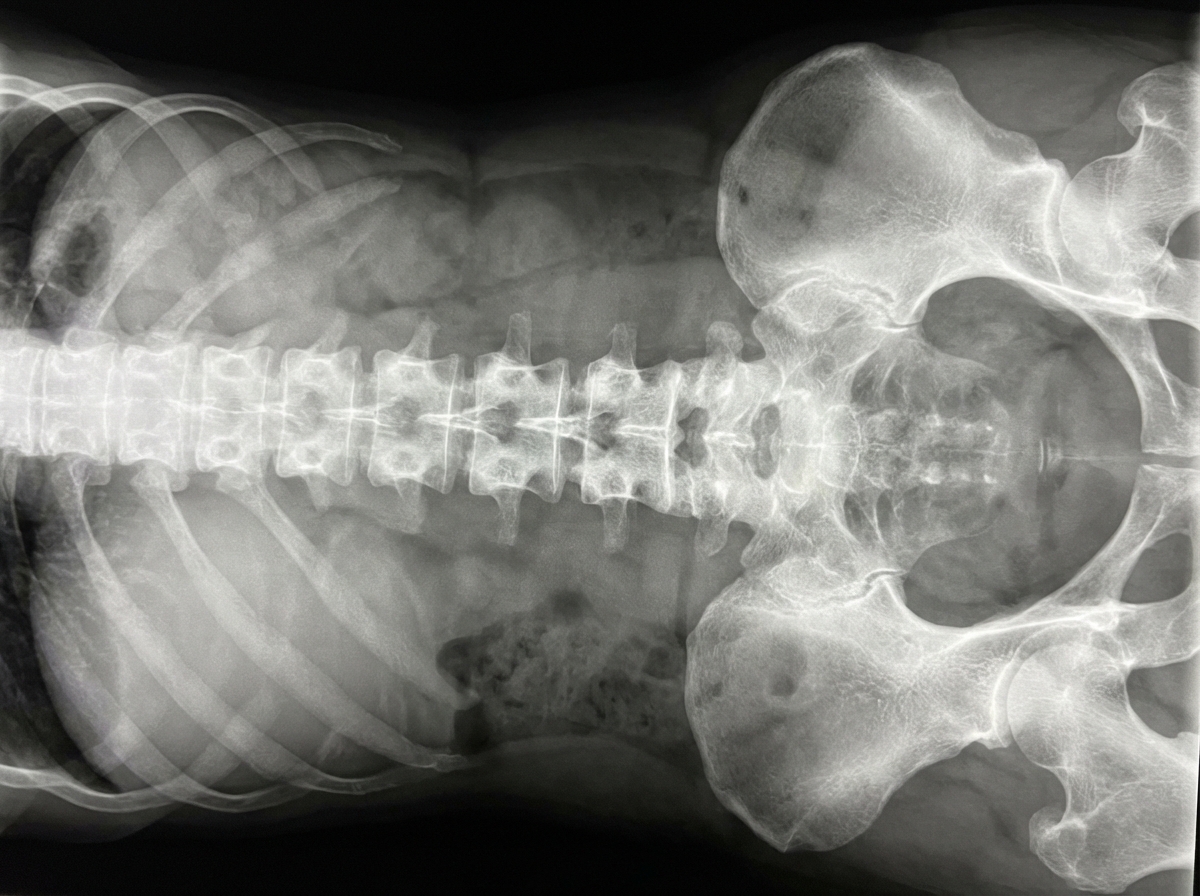
The "codfish" vertebra is not commonly seen in which of the following conditions?
An ill-defined lesion margin is described as:
All of the following are radiological features of tuberculosis of the spine except?
The Insall-Salvati index is used for assessing which anatomical structure?
The angle of Gissane is associated with which bone?
What are the radiological changes observed in Rickets?
Salt and pepper appearance of the skull on X-ray is seen in which of the following conditions?
Radiological appearance of rickets includes all of the following except?
A patient presents with a fall on an outstretched hand. An X-ray is shown below. Which of the following vessels is most likely involved?

What is the most common site for osteoma?
Explanation: **Explanation:** The **"Codfish" vertebra** (also known as biconcave vertebra) refers to a radiological appearance where the superior and inferior surfaces of the vertebral bodies become concave. This occurs when the intervertebral discs, which are under pressure, bulge into the weakened, softened vertebral bodies. **Why Gaucher’s Disease is the correct answer:** In **Gaucher’s disease**, the characteristic spinal deformity is the **"H-shaped" vertebra** (also known as the Reynolds sign). This is caused by microvascular occlusion and central endplate infarction (similar to Sickle Cell Anemia), leading to a sharp, rectangular step-like depression in the center of the endplate, rather than the smooth, generalized biconcavity seen in "codfish" vertebrae. **Analysis of Incorrect Options:** * **Osteoporosis:** This is the most common cause of codfish vertebrae. The loss of bone density leads to generalized weakening, allowing the nucleus pulposus to indent the endplates. * **Osteogenesis Imperfecta:** Due to defective Type I collagen, the bones are abnormally brittle and soft, frequently resulting in multiple biconcave vertebral deformities. * **Renal Osteodystrophy:** This condition involves high-turnover bone disease (osteitis fibrosa cystica) and osteomalacia. The softened osteoid is susceptible to the pressure of the discs, leading to the codfish appearance. **NEET-PG High-Yield Pearls:** * **Codfish Vertebra:** Seen in conditions of **diffuse bone softening** (Osteoporosis, Osteomalacia, Osteogenesis Imperfecta, Hyperparathyroidism). * **H-shaped Vertebra:** Seen in **Sickle Cell Anemia**, **Gaucher’s Disease**, and sometimes Thalassemia. * **Rugger-Jersey Spine:** Classic sign of **Renal Osteodystrophy** (sclerosis of the endplates). * **Picture Frame Vertebra:** Characteristic of **Paget’s Disease**. * **Ivory Vertebra:** Seen in **Hodgkin’s Lymphoma**, Paget’s, and Metastasis (Prostate).
Explanation: **Explanation:** In musculoskeletal radiology, the margin of a bone lesion is the most reliable indicator of its **growth rate** and **biological aggressiveness**. This is categorized using the **Lodwick Classification**. **Why "Blending" is correct:** An **ill-defined or blending margin** (Lodwick Type II or III) occurs when the transition zone between the lesion and the healthy bone is wide and imperceptible. This indicates a rapidly progressing process, such as a **malignant bone tumor** (e.g., Osteosarcoma, Ewing’s sarcoma) or **acute osteomyelitis**. The body does not have enough time to mount a reactive sclerotic response to contain the lesion, causing it to "blend" into the surrounding marrow. **Analysis of Incorrect Options:** * **A. Sclerotic:** This refers to a thick, radio-opaque (white) border of reactive bone. It indicates a very slow-growing, benign process (Lodwick Type IA). * **C. Corticated:** Similar to sclerotic, this is a thin, well-defined sharp border resembling normal cortex. it signifies a benign, slow-growing lesion (e.g., simple bone cyst). * **D. Punched out:** These are well-defined lesions with a narrow zone of transition but *without* a sclerotic rim. They are characteristic of **Multiple Myeloma**. **NEET-PG High-Yield Pearls:** * **Narrow Zone of Transition:** Suggests a benign/slow-growing lesion (Sclerotic/Geographic). * **Wide Zone of Transition:** Suggests an aggressive/malignant lesion (Permeative/Moth-eaten/Blending). * **Lodwick Classification:** The standard system used to grade the aggressiveness of bone destruction based on margins. * **Sunburst appearance & Codman’s triangle:** Often associated with aggressive lesions showing blending margins (e.g., Osteosarcoma).
Explanation: **Explanation:** Tuberculosis of the spine (Pott’s disease) is primarily a **destructive (osteolytic)** process. Understanding the pathophysiology of TB is key to answering this question. **1. Why "Marked osteoblastic response" is the correct answer:** TB is characterized by a lack of proteolytic enzymes, leading to slow bone destruction. Unlike pyogenic (bacterial) osteomyelitis, which often shows significant reactive bone formation (sclerosis/osteoblastic response), TB is predominantly **osteolytic**. Any osteoblastic response or sclerosis in TB is usually minimal and occurs only during the late healing phase. Therefore, a "marked" response is not a feature of active TB. **2. Analysis of incorrect options:** * **Large paraspinal abscess (Option A):** This is a hallmark of TB. Due to the slow progression, the infection often spreads under the longitudinal ligaments, forming large "cold abscesses" (fusiform or psoas abscesses). * **Marked collapse of vertebra (Option B):** As the bone is progressively destroyed and weakened (osteolysis), the weight of the body causes the vertebral body to collapse, often leading to **wedging** and the characteristic **Gibbus deformity**. * **Decreased joint space (Option D):** TB typically starts in the paradiscal region. It destroys the subchondral bone plates, leading to the narrowing and eventual loss of the intervertebral disc space. **Clinical Pearls for NEET-PG:** * **Earliest sign:** Rarefaction (osteopenia) of the vertebral body. * **Most common site:** Lower thoracic and upper lumbar vertebrae. * **Paradiscal type:** The most common pattern of involvement. * **Skip lesions:** TB can involve non-contiguous vertebrae (seen in ~10-15% of cases). * **Imaging Gold Standard:** MRI is the investigation of choice for early diagnosis and evaluating cord compression.
Explanation: The **Insall-Salvati index** is a radiographic measurement used to assess the position of the **patella** (kneecap) relative to the tibia. It is calculated on a lateral knee X-ray (ideally flexed at 30°) by dividing the length of the patellar tendon (LT) by the greatest diagonal length of the patella (LP). * **Normal Index:** 0.8 to 1.2. * **Patella Alta (High-riding patella):** Index >1.2. This is associated with patellar tendon rupture or recurrent patellar subluxation. * **Patella Baja (Low-riding patella):** Index <0.8. This is seen in conditions like Osgood-Schlatter disease, polio, or post-surgical scarring. **Explanation of Incorrect Options:** * **Olecranon (A):** The olecranon is part of the proximal ulna. While its fractures are common in radiology, the Insall-Salvati index does not apply to the elbow. * **Talus (B):** Measurements for the talus include the Boehler’s angle (for calcaneal fractures) or the Talar tilt, but not the Insall-Salvati index. * **Scaphoid (D):** Scaphoid imaging focuses on the "Scaphoid view" and assessing the scapholunate interval or Gilula’s lines. **High-Yield Clinical Pearls for NEET-PG:** * **Modified Insall-Salvati Index:** Uses the length of the posterior articular surface of the patella instead of the whole bone; it is considered more accurate in some cases. * **Other Knee Indices:** The **Blackburne-Peel** and **Caton-Deschamps** indices are alternative methods to assess patellar height. * **Radiology Sign:** A high-riding patella on a lateral X-ray after trauma is a classic sign of a **patellar tendon tear**.
Explanation: The **Angle of Gissane** (also known as the "Crucial Angle") is a vital radiographic landmark used in the evaluation of **calcaneal fractures**. ### 1. Why Calcaneus is Correct The Angle of Gissane is formed by the downward slope of the calcaneal thalami (the floor of the sinus tarsi) and the upward slope of the posterior facet of the calcaneus. On a lateral X-ray, it normally measures between **120° and 145°**. In intra-articular calcaneal fractures, this angle typically increases as the posterior facet is depressed or crushed, signaling a disruption of the subtalar joint. ### 2. Why Other Options are Incorrect * **Talus:** While the talus sits directly above the calcaneus to form the subtalar joint, the specific anatomical landmarks defining the Angle of Gissane are intrinsic to the calcaneus. (Note: The *Angle of Hawkins* is associated with the talus). * **Navicular & Cuboid:** These are midfoot bones. While they are part of the Chopart joint complex along with the calcaneus and talus, they do not contribute to the measurement of Gissane’s angle. ### 3. Clinical Pearls for NEET-PG * **Bohler’s Angle:** Another critical calcaneal measurement (Normal: **20°–40°**). In fractures, Bohler’s angle **decreases**, whereas Gissane’s angle **increases**. * **Mondor’s Sign:** Ecchymosis extending to the sole of the foot, highly suggestive of a calcaneal fracture. * **Associated Injuries:** Always look for "Don Juan Syndrome"—calcaneal fractures are frequently associated with compression fractures of the **lumbar spine (L1)** due to axial loading (e.g., falling from a height). * **Imaging Gold Standard:** While X-rays are initial, **CT scan** is the gold standard for classification (Sanders Classification).
Explanation: **Explanation:** Rickets is a systemic disease of the growing skeleton characterized by deficient mineralization of the osteoid matrix, most commonly due to Vitamin D deficiency. **1. Why Option A is Correct:** The hallmark of Rickets occurs at the **metaphysis**, the site of most active endochondral ossification. Normally, the zone of provisional calcification is a dense, well-defined line where cartilage is replaced by bone. In Rickets, the failure of mineralization leads to the **narrowing or total absence of this zone of provisional calcification**. This results in the characteristic "fraying" (shaggy margins) and "cupping" (concave deformity) of the metaphysis. **2. Why Other Options are Incorrect:** * **Option B (Fracture):** While "Looser’s zones" (pseudofractures) are classic in adult Osteomalacia, they are less common in Rickets. While fractures can occur due to bone fragility, they are not the primary diagnostic radiological change. * **Option C (Pencil-line appearance):** This is a classic feature of **Scurvy** (Wimberger’s ring sign), where the epiphysis has a dense peripheral rim with a lucent center. In Rickets, the epiphysis is typically delayed in appearance or blurred. * **Option D (Bowing):** While bowing of long bones (like Genu Varum) is a clinical and radiological manifestation of Rickets, it is a **late sequela** of weight-bearing on softened bones, not the primary pathological change at the growth plate. **High-Yield Clinical Pearls for NEET-PG:** * **Earliest sign:** Fraying and cupping of the metaphysis (best seen at the distal radius/ulna). * **Widened Growth Plate:** Due to the accumulation of uncalcified osteoid. * **Rachitic Rosary:** Expansion of the osteochondral junctions of the ribs. * **Healing Sign:** The reappearance of the **zone of provisional calcification** is the first sign of recovery after Vitamin D therapy.
Explanation: **Explanation:** **1. Why Hyperparathyroidism is Correct:** The "Salt and Pepper" skull (also known as the "pepper pot" skull) is a classic radiological hallmark of **Hyperparathyroidism** (most commonly the primary form). The underlying mechanism is **excessive Parathyroid Hormone (PTH)**, which stimulates osteoclastic activity. This leads to multiple tiny, well-defined lucencies (resorption of trabecular bone) interspersed with areas of preserved bone or sclerosis. This creates a mottled, granular appearance on a lateral skull X-ray. **2. Why the Other Options are Incorrect:** * **Hypoparathyroidism:** This condition typically presents with increased bone density or intracranial calcifications (especially in the basal ganglia), rather than the resorptive "salt and pepper" pattern. * **Osteopetrosis:** Known as "Marble Bone Disease," it is characterized by a generalized increase in bone density (osteosclerosis) due to defective osteoclast function. The skull would appear uniformly white/opaque. * **Fluorosis:** Chronic fluoride toxicity leads to diffuse osteosclerosis and ligamentous calcification (e.g., sacrotuberous ligament). It does not cause the focal resorptive lucencies seen in hyperparathyroidism. **3. NEET-PG High-Yield Clinical Pearls:** * **Subperiosteal bone resorption:** This is the *most specific* radiological sign of hyperparathyroidism, most commonly seen on the radial aspect of the middle phalanges of the 2nd and 3rd fingers. * **Brown Tumors:** These are non-neoplastic lytic lesions (osteitis fibrosa cystica) found in advanced hyperparathyroidism. * **Rugger Jersey Spine:** Characterized by bands of sclerosis at the superior and inferior endplates of vertebrae, typically seen in secondary hyperparathyroidism (Renal Osteodystrophy). * **Differential Diagnosis:** Do not confuse "Salt and Pepper" skull with the **"Raindrop" skull** (punched-out lytic lesions) seen in Multiple Myeloma.
Explanation: **Explanation:** The correct answer is **D. Pelkan spur**. This is because Pelkan spurs are a characteristic radiological feature of **Scurvy (Vitamin C deficiency)**, not Rickets. **Understanding the Pathology:** * **Rickets (Vitamin D deficiency):** The primary pathology is a failure of osteoid mineralization at the growth plate. This leads to an accumulation of unmineralized matrix, causing the growth plate to widen and the metaphysis to become soft and deformed under mechanical stress. * **Scurvy:** The pathology involves defective collagen synthesis, leading to capillary fragility and subperiosteal hemorrhages. A **Pelkan spur** is a bony outgrowth at the metaphyseal margin caused by the healing of these subperiosteal hemorrhages or the outward protrusion of the "Trummerfeld zone." **Analysis of Options in Rickets:** * **A. Fraying:** Refers to the hazy, thread-like appearance of the metaphyseal margin due to disorganized mineralization. * **B. Cupping:** The metaphysis assumes a concave, cup-like shape as it is pushed against the soft, uncalcified epiphysis. * **C. Splaying:** The widening of the metaphysis due to the lateral expansion of the unmineralized osteoid. **NEET-PG High-Yield Pearls:** 1. **Rickets Key Signs:** Fraying, Cupping, Splaying, Widened growth plate, and **Rachitic Rosary** (enlarged costochondral junctions). 2. **Scurvy Key Signs:** **Wimberger’s ring** (sclerotic epiphysis), **Frankel’s line** (dense zone of provisional calcification), **Trummerfeld zone** (lucent scorbutic zone), and **Pelkan spurs**. 3. **Earliest sign of Rickets:** Fraying and widening of the growth plate, most commonly seen at the **distal radius and ulna**.
Explanation: ***Brachial artery*** - Fall on outstretched hand (FOOSH) typically causes a **supracondylar fracture of the humerus**, where the **brachial artery** runs directly anterior to the elbow joint and is vulnerable to injury from the proximal fracture fragment. - The **brachial artery** is the main vessel crossing the elbow anteriorly, making it the most commonly injured vessel in supracondylar fractures, potentially causing **compartment syndrome** or **Volkmann's ischemic contracture**. *Ulnar artery* - The **ulnar artery** is located more distally in the forearm and medially, making it less vulnerable to injury in supracondylar fractures. - Ulnar artery injuries are more commonly associated with **distal radius fractures** or **direct trauma** to the medial forearm. *Radial artery* - The **radial artery** runs laterally in the forearm and is more commonly injured with **distal radius fractures** (Colles' fracture) rather than supracondylar fractures. - It passes through the **anatomical snuffbox** and is not in the direct path of injury from proximal humeral fracture fragments. *Cubital vein* - The **cubital vein** is a superficial venous structure in the **antecubital fossa** and is not typically injured in supracondylar fractures. - Venous injuries are less clinically significant than arterial injuries and would not cause the **ischemic complications** associated with supracondylar fractures.
Explanation: **Explanation:** **Osteoma** is a benign, slow-growing, osteogenic lesion composed of mature compact or cancellous bone. It is unique because it occurs almost exclusively in the **membranous bones**, making the **Skull and Paranasal Sinuses** (especially the frontal sinus) the most common sites of occurrence. * **Why Skull is correct:** Osteomas typically arise from the periosteum or endosteum of the skull vault and facial bones. The frontal sinus is the most frequently involved paranasal sinus, followed by the ethmoid sinus. Radiologically, they appear as very dense, "ivory-like," well-circumscribed radiopaque masses. * **Why Femur, Humerus, and Tibia are incorrect:** These are long bones (tubular bones) formed by endochondral ossification. While benign bone tumors like Osteoid Osteoma or Osteochondroma are common in these sites, a true **Osteoma** is extremely rare in the appendicular skeleton. **High-Yield Clinical Pearls for NEET-PG:** 1. **Gardner’s Syndrome:** Multiple osteomas (especially of the mandible and skull) are a classic component of Gardner’s Syndrome, which also includes intestinal polyposis (FAP), soft tissue tumors (desmoids), and dental abnormalities. 2. **Radiological Appearance:** They appear as a "button-like" or "ivory" density on X-ray/CT. 3. **Management:** Most are asymptomatic and discovered incidentally; surgery is only indicated if they cause mass effect (e.g., obstructing sinus drainage or causing proptosis). 4. **Differential:** Do not confuse *Osteoma* with *Osteoid Osteoma* (which presents with nocturnal pain relieved by aspirin and occurs in long bones).
Radiographic Anatomy of Bones and Joints
Practice Questions
Imaging of Fractures and Dislocations
Practice Questions
Arthritides: Inflammatory and Degenerative
Practice Questions
Metabolic Bone Diseases
Practice Questions
Bone and Soft Tissue Tumors
Practice Questions
Congenital Skeletal Anomalies
Practice Questions
Spine Imaging
Practice Questions
Skeletal Infections
Practice Questions
Sports Medicine Imaging
Practice Questions
Imaging of Prostheses and Implants
Practice Questions
Musculoskeletal Ultrasound
Practice Questions
MSK Interventional Procedures
Practice Questions
Get full access to all questions, explanations, and performance tracking.
Start For Free