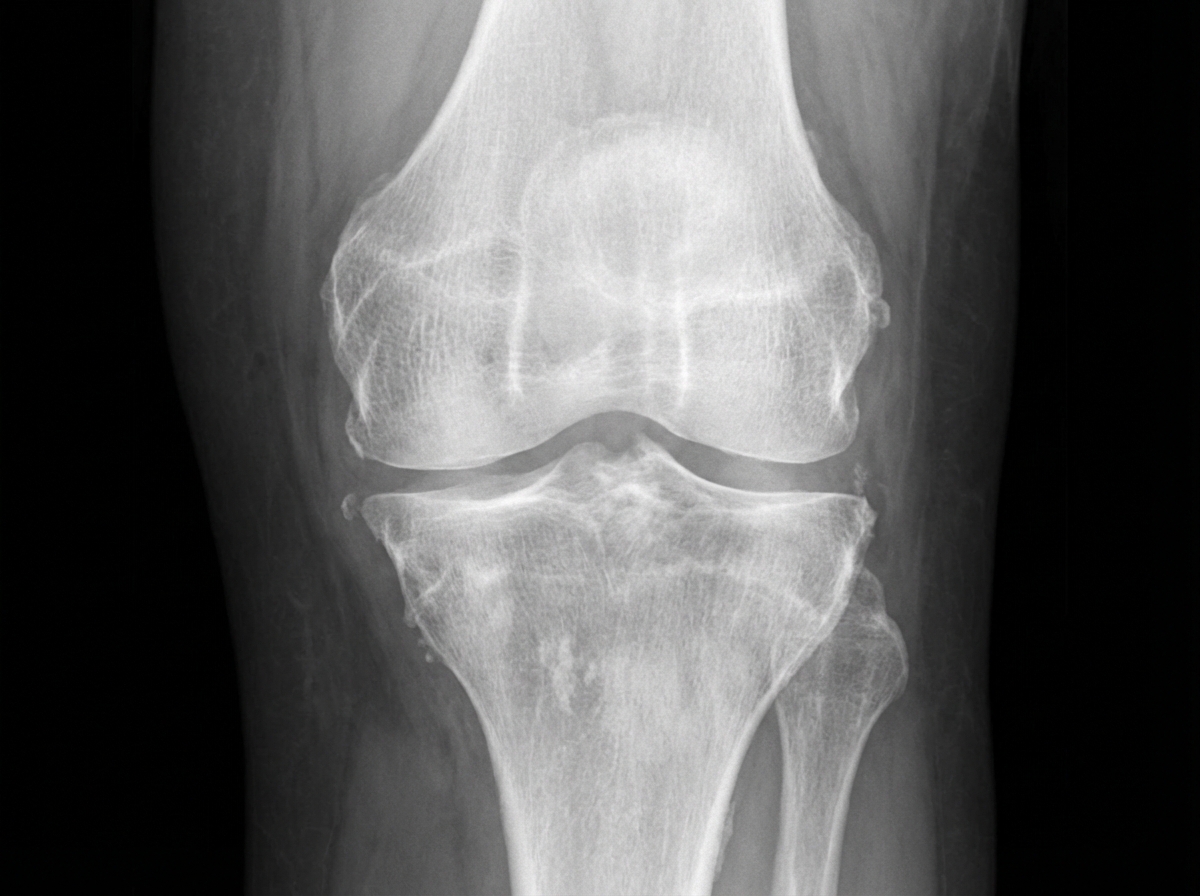
Champagne glass pelvic inlet is seen in which condition?
A 69-year-old female presents with recent onset of mild back pain, kyphosis, and a compression fracture of a vertebral body in the dorsal spine. Spondylotic changes and mildly reduced bone density are noted on X-ray. Laboratory investigations including serum calcium, phosphorus, alkaline phosphatase, ESR, and parathyroid hormone levels are all within normal limits. What is the most likely cause of this woman's bone changes?
Linear striations are typically seen in which of the following vertebral conditions?
Schmorl's nodule is a radiographic finding seen in which of the following conditions?
Acro-osteolysis is seen in which of the following conditions?
Which of the following is NOT a radiological change in mucopolysaccharidosis?
Osteoporosis circumscripta is a radiological finding most commonly seen in which of the following conditions?
Dense calcification is found in which of the following?
Orange peel appearance is a radiographic feature of which of the following conditions?
What is the earliest radiological feature in rheumatoid arthritis?
Explanation: ### Explanation **Correct Answer: C. Achondroplasia** **Achondroplasia** is the most common cause of short-limb dwarfism, resulting from a mutation in the **FGFR3 gene**, which leads to impaired endochondral ossification. The characteristic **"Champagne glass pelvis"** occurs because the pelvic inlet is transversely wide and vertically shallow. This morphology is caused by several factors: * Shortening of the iliac bones (squared "elephant ear" iliac wings). * Horizontal orientation of the acetabular roofs. * A narrow sacrosciatic notch. **Analysis of Incorrect Options:** * **A & B (Cushing's and Addison's):** These are endocrine disorders of the adrenal gland. While Cushing’s can lead to osteoporosis and avascular necrosis, neither condition causes the structural pelvic dysplasias seen in skeletal dysplasias. * **D (Hypothyroidism):** Congenital hypothyroidism (Cretinism) leads to delayed skeletal maturation and epiphyseal dysgenesis (e.g., fragmented "stippled" epiphyses), but it does not produce the specific champagne glass pelvic configuration. **High-Yield Clinical Pearls for NEET-PG:** * **Spine:** Posterior scalloping of vertebrae and **progressive narrowing of the interpedicular distance** (caudally), which is the opposite of normal anatomy. * **Hands:** **Trident hand** (persistent space between the 3rd and 4th digits). * **Skull:** Frontal bossing with midface hypoplasia and a narrowed foramen magnum (risk of sudden infant death). * **Long Bones:** Rhizomelic shortening (proximal segments like the humerus/femur are most affected).
Explanation: ### Explanation The clinical presentation of an elderly female with kyphosis, a vertebral compression fracture, and reduced bone density on X-ray, coupled with **normal biochemical markers**, is classic for **Osteoporosis**. #### Why Osteoporosis is Correct Osteoporosis is characterized by a reduction in total bone mass (both mineral and matrix are decreased), but the remaining bone is chemically normal. Because the process is a quantitative rather than qualitative defect, serum levels of **Calcium, Phosphorus, and Alkaline Phosphatase (ALP) remain normal**. It is the most common cause of pathological vertebral fractures in postmenopausal women. #### Why Other Options are Incorrect * **Myeloma:** While it causes compression fractures in the elderly, it is usually associated with an **elevated ESR**, anemia, and often hypercalcemia or abnormal protein electrophoresis. * **Osteomalacia:** This involves a defect in bone mineralization. It typically presents with **low/normal serum calcium and phosphorus** and **elevated ALP**. Radiologically, it shows "fuzzy" trabeculae and Looser’s zones rather than simple compression fractures. * **Paget’s Disease:** This is characterized by excessive bone remodeling. The hallmark biochemical finding is a **markedly elevated ALP** with normal calcium and phosphorus. X-rays would show cortical thickening and trabecular coarsening (e.g., "Picture frame" vertebra), not just reduced density. #### NEET-PG Clinical Pearls * **Gold Standard Diagnosis:** DEXA Scan (T-score ≤ -2.5). * **Biochemical Profile:** In uncomplicated osteoporosis, Ca, PO₄, and ALP are always **Normal**. * **Most Common Site of Fracture:** Vertebral body (compression fracture), followed by the neck of the femur and Colles’ fracture. * **Radiological Sign:** "Codfish vertebra" (biconcave appearance) due to disk expansion into weakened vertebral bodies.
Explanation: **Explanation:** **Vertebral Hemangiomas** are the most common benign primary tumors of the spine. The characteristic **linear striations** (also known as the **"Corduroy cloth"** or **"Jail-bar"** appearance) occur due to the resorption of horizontal bone trabeculae caused by the vascular channels, followed by the compensatory thickening of the remaining vertical trabeculae to maintain structural integrity. * **On X-ray/CT:** These thickened vertical trabeculae appear as parallel linear densities (Corduroy cloth sign). On axial CT, these look like multiple small dots, known as the **"Polka-dot" sign**. * **On MRI:** They typically show high signal intensity on both T1 and T2 weighted images due to the presence of intralesional fat. **Why other options are incorrect:** * **Vertebral Myeloma:** Typically presents as multiple "punched-out" lytic lesions or generalized osteopenia. It does not show compensatory trabecular thickening. * **Vertebral Lymphangiomas:** These are extremely rare and usually present as cystic, osteolytic lesions without the classic striated pattern. * **Vertebral Metastases:** Usually present as lytic or sclerotic lesions with pedicle involvement (Winking Owl sign). They typically destroy the bone architecture rather than causing organized trabecular thickening. **High-Yield Clinical Pearls for NEET-PG:** * **Most common site:** Thoracic spine. * **Classic Sign (CT/X-ray):** Corduroy cloth sign (Vertical striations). * **Classic Sign (Axial CT):** Polka-dot sign. * **MRI Hallmark:** High T1 and High T2 signal (due to fat content). * **Management:** Most are asymptomatic and discovered incidentally; symptomatic cases may require embolization or vertebroplasty.
Explanation: **Explanation:** **Schmorl’s nodules** represent a specific type of **intervertebral disc herniation** where the nucleus pulposus protrudes vertically through the cartilaginous and bony endplate into the body of the adjacent vertebra. While classic disc prolapse involves horizontal herniation (protrusion/extrusion) into the spinal canal or neural foramina, Schmorl’s nodules are essentially **intravertebral disc herniations**. **Why the other options are incorrect:** * **Spondylolisthesis:** Refers to the forward displacement of one vertebra over another, usually due to spondylolysis (pars interarticularis defect) or degenerative changes. * **Ankylosing spondylitis:** Characterized by "Bamboo spine" due to syndesmophytes, sacroiliitis, and squaring of vertebral bodies, rather than focal endplate herniations. * **Fracture of transverse process:** This is a traumatic bony injury usually resulting from direct impact or avulsion by the psoas muscle, unrelated to disc material migration. **High-Yield Clinical Pearls for NEET-PG:** * **Scheuermann’s Disease:** Multiple Schmorl’s nodules at consecutive levels, associated with thoracic kyphosis and anterior wedging of vertebrae in adolescents, is a classic exam favorite. * **Radiographic Appearance:** They appear as small, well-defined radiolucent indentations in the superior or inferior vertebral endplates, often with a sclerotic rim. * **Clinical Significance:** Most Schmorl’s nodules are asymptomatic and discovered incidentally; however, acute herniations can cause localized back pain. * **Common Site:** Most frequently seen in the thoracolumbar spine.
Explanation: **Explanation:** **Acro-osteolysis** refers to the resorption or destruction of the distal phalanges (tufts) of the fingers or toes. It is a classic radiological sign with a specific differential diagnosis. **Why Scleroderma is Correct:** In **Scleroderma (Systemic Sclerosis)**, acro-osteolysis occurs due to chronic digital ischemia (Raynaud’s phenomenon) and pressure from tightened, atrophic skin (sclerodactyly). It is often associated with **soft tissue calcification (calcinosis cutis)**, which is a hallmark of the CREST syndrome. **Analysis of Incorrect Options:** * **Frostbite:** While severe frostbite can cause digital necrosis, it typically leads to localized bone loss or secondary osteoarthritis rather than the classic progressive tuft resorption seen in systemic diseases. * **Leprosy:** Leprosy causes bone resorption, but it is usually "concentric remodeling" or "licking stick" appearance due to sensory neuropathy and secondary trauma/infection, rather than primary acro-osteolysis. * **Hypoparathyroidism:** This condition is associated with increased bone density (osteosclerosis) or basal ganglia calcification. It is **Hyperparathyroidism** (specifically the subperiosteal resorption) that is associated with acro-osteolysis. **High-Yield Clinical Pearls for NEET-PG:** To remember the causes of acro-osteolysis, use the mnemonic **"PINCH"**: * **P:** Psoriasis / Pyknodysostosis (associated with osteosclerosis and delayed suture closure). * **I:** Injury (Thermal burns, Frostbite). * **N:** Neuropathy (Diabetes, Leprosy). * **C:** Collagen Vascular Disease (Scleroderma). * **H:** Hyperparathyroidism (Primary or Secondary). **Key Distinction:** If a question mentions acro-osteolysis with **soft tissue calcification**, always think **Scleroderma**. If it mentions acro-osteolysis with **short stature and dense bones**, think **Pyknodysostosis**.
Explanation: The radiological hallmark of Mucopolysaccharidosis (MPS), particularly Hurler syndrome (MPS I) and Morquio syndrome (MPS IV), is **Dysostosis Multiplex**. ### **Why Genu Varum is the Correct Answer** In Mucopolysaccharidosis, the characteristic lower limb deformity is **Genu Valgum (knock-knees)**, not Genu varum (bow-legs). This occurs due to metaphyseal dysplasia and ligamentous laxity, which are common features of the disease. Genu varum is more typically associated with conditions like Rickets or Blount’s disease. ### **Analysis of Incorrect Options** * **A. J-shaped sella turcica:** This is a classic finding in MPS. It occurs because of an enlarged pituitary fossa with a shallow, elongated configuration, often due to thickened dura or arachnoid cysts. * **B. Spatulate ribs:** Also known as "oar-shaped" ribs, this refers to the characteristic widening of the anterior ribs with narrowing of the posterior vertebral ends. * **C. Anterior beaking of the vertebrae:** This is a pathognomonic sign. In **Hurler syndrome**, there is **inferior** anterior beaking (leading to kyphosis/gibbus deformity), while in **Morquio syndrome**, there is **central** anterior beaking (platyspondyly). ### **High-Yield Clinical Pearls for NEET-PG** * **Hand Findings:** "Claw hand" deformity with proximal tapering of the metacarpals (bullet-shaped metacarpals). * **Skull:** Macrocephaly with frontal bossing and thickened calvarium. * **Pelvis:** Flared iliac wings with shallow acetabula and femoral head epiphysial dysplasia. * **Morquio Syndrome (MPS IV):** Distinctive for causing severe **Platyspondyly** (flat vertebrae) and **Odontoid hypoplasia**, which carries a high risk of atlantoaxial subluxation.
Explanation: **Explanation:** **Osteoporosis circumscripta** is a pathognomonic radiological feature of the **early active (lytic) phase of Paget’s disease** (Osteitis deformans). It is characterized by well-defined, large, geographic radiolucent areas in the skull, most commonly involving the frontal and occipital bones. These lesions represent intense osteoclastic activity where the outer table of the skull is destroyed, while the inner table is relatively spared. As the disease progresses to the mixed phase, these lucencies are replaced by "cotton wool" appearances due to disordered bone formation. **Analysis of Incorrect Options:** * **B. Osteosarcoma:** Typically presents with aggressive features like a Sunburst periosteal reaction or Codman’s triangle. While Paget’s disease is a risk factor for secondary osteosarcoma, the term "osteoporosis circumscripta" specifically refers to the benign lytic phase of Paget's. * **C. Multiple Myeloma:** Characterized by "punched-out" lytic lesions. These are usually multiple, small, and uniform in size, unlike the large, confluent geographic lucency seen in osteoporosis circumscripta. * **D. Osteomyelitis:** Presents with bone destruction (sequestrum) and new bone formation (involucrum). It does not produce the specific well-demarcated geographic skull lucency associated with Paget's. **High-Yield Clinical Pearls for NEET-PG:** * **Skull Findings in Paget's:** Osteoporosis circumscripta (Lytic phase) → Cotton wool spots (Mixed phase) → Diploic thickening (Sclerotic phase). * **Biochemical Markers:** Elevated **Serum Alkaline Phosphatase (ALP)** with normal Calcium and Phosphorus levels. * **Complications:** Hearing loss (due to bony overgrowth of the internal auditory canal) and high-output heart failure. * **Treatment of Choice:** Bisphosphonates (e.g., Zoledronic acid).
Explanation: ### Explanation **Correct Option: A. Osteosarcoma** The hallmark of **Osteosarcoma** is the production of **osteoid** (immature bone) by malignant cells. This osteoid undergoes mineralization, leading to dense, "cloud-like" or "ivory-like" amorphous calcification within the tumor matrix. On imaging, this is often associated with aggressive features such as the **Codman’s triangle** or a **Sunburst periosteal reaction**, reflecting the rapid elevation of the periosteum and bone formation. **Analysis of Incorrect Options:** * **B. Chondroblastoma:** This is a benign cartilaginous tumor typically found in the **epiphysis**. While it can show calcification, it is classically described as **"chicken-wire" calcification** (thin, reticular patterns), which is not "dense" compared to osteosarcoma. * **C. Synovial Sarcoma:** This is a soft tissue sarcoma. While it shows calcification in about 30% of cases, it is usually **speckled or peripheral** and located within a soft tissue mass near a joint, rather than dense bony mineralization. * **D. Osteoblastoma:** Although it produces osteoid, it is a benign lesion (often >2cm). The mineralization is usually less dense and more organized than the chaotic, dense malignant osteoid seen in Osteosarcoma. **High-Yield Clinical Pearls for NEET-PG:** * **Matrix Patterns:** * *Osteoid matrix:* Cloud-like, dense, ivory-like (Osteosarcoma). * *Chondroid matrix:* Punctate, popcorn-like, comma-shaped, or rings-and-arcs (Chondrosarcoma, Enchondroma). * **Age Group:** Osteosarcoma has a bimodal distribution (10–20 years and >60 years associated with Paget’s disease). * **Location:** Most common site is the **metaphysis** of long bones (distal femur > proximal tibia).
Explanation: **Explanation:** **Hyperparathyroidism (Option A)** is the correct answer. The "orange peel" appearance (also known as the **"salt and pepper"** or **"granular"** appearance) is a classic radiographic feature of the skull in patients with hyperparathyroidism. This occurs due to excessive parathyroid hormone (PTH) causing increased osteoclastic activity, which leads to multiple tiny, punctate areas of bone resorption (lucencies) interspersed with areas of sclerosis. This loss of definition of the inner and outer tables of the skull creates a texture resembling the skin of an orange. **Analysis of Incorrect Options:** * **Ossifying Fibroma (Option B):** Typically presents as a well-demarcated, expansive radiolucency with varying degrees of internal calcification (often described as "ground glass" or "cotton wool"), but not "orange peel." * **Osteogenic Sarcoma (Option C):** Characterized by aggressive bone destruction and periosteal reactions, most notably the **"Sunburst appearance"** or **"Codman’s triangle."** * **Multilocular Cyst (Option D):** Usually presents as a "soap bubble" or "honeycomb" appearance, characteristic of lesions like Ameloblastoma or Central Giant Cell Granuloma. **NEET-PG High-Yield Pearls for Hyperparathyroidism:** 1. **Subperiosteal bone resorption:** The most sensitive and pathognomonic sign, specifically on the radial aspect of the middle phalanges of the 2nd and 3rd fingers. 2. **Brown Tumors:** Osteoclastomas (lytic lesions) that mimic neoplasms. 3. **Rugger-Jersey Spine:** Sclerotic bands at the superior and inferior endplates of vertebrae (common in secondary hyperparathyroidism/renal osteodystrophy). 4. **Resorption of the distal clavicles:** A common early radiographic finding.
Explanation: **Explanation:** Rheumatoid Arthritis (RA) is a chronic inflammatory polyarthritis characterized by synovial hypertrophy (pannus formation). Understanding the chronological progression of imaging findings is crucial for NEET-PG. **1. Why "Peri-articular soft tissue swelling" is correct:** The earliest pathological change in RA is **synovitis**. This inflammation leads to increased fluid and thickening of the joint capsule and surrounding soft tissues. On X-ray, this manifests as a fusiform (spindle-shaped) increase in soft tissue density around the joint. This precedes any bony or cartilaginous changes. **2. Analysis of Incorrect Options:** * **Juxta-articular osteoporosis (B):** This is the **earliest bony change**. It occurs due to increased blood flow (hyperemia) to the inflamed synovium, which stimulates osteoclast activity in the adjacent bone. While early, it occurs after the initial soft tissue swelling. * **Subchondral erosions (D):** These occur as the pannus begins to destroy the bone at the "bare areas" (where the bone is not covered by hyaline cartilage). This is a sign of established disease. * **Decreased joint space (A):** This represents the destruction of articular cartilage. It is a later feature compared to soft tissue swelling and osteoporosis. **Clinical Pearls for NEET-PG:** * **Earliest Sign (Overall):** Peri-articular soft tissue swelling. * **Earliest Bony Sign:** Juxta-articular osteoporosis (also called "peri-articular osteopenia"). * **Earliest Site of Erosions:** The "bare areas" of the joint (marginal erosions). * **Most Sensitive Imaging Modality:** **MRI** is more sensitive than X-ray for detecting early synovitis and bone marrow edema. **Ultrasound** with Power Doppler is also highly effective for detecting early vascularization of the pannus. * **Classic Distribution:** Symmetrical involvement of MCP, PIP, and MTP joints; typically spares the DIP joints.
Radiographic Anatomy of Bones and Joints
Practice Questions
Imaging of Fractures and Dislocations
Practice Questions
Arthritides: Inflammatory and Degenerative
Practice Questions
Metabolic Bone Diseases
Practice Questions
Bone and Soft Tissue Tumors
Practice Questions
Congenital Skeletal Anomalies
Practice Questions
Spine Imaging
Practice Questions
Skeletal Infections
Practice Questions
Sports Medicine Imaging
Practice Questions
Imaging of Prostheses and Implants
Practice Questions
Musculoskeletal Ultrasound
Practice Questions
MSK Interventional Procedures
Practice Questions
Get full access to all questions, explanations, and performance tracking.
Start For Free