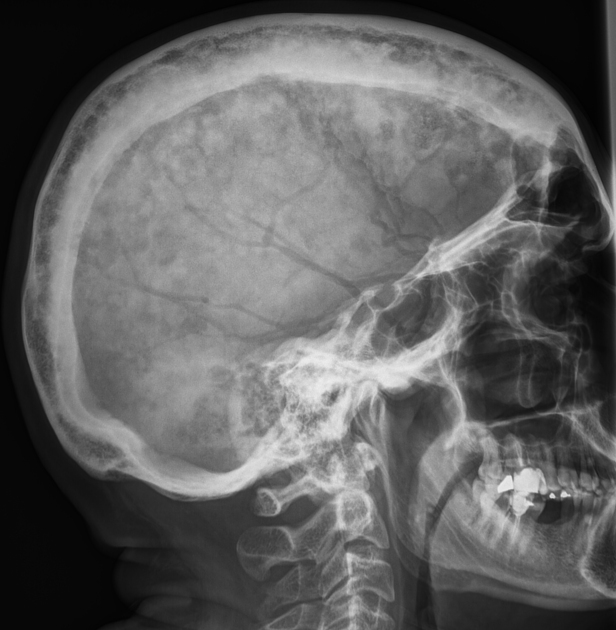
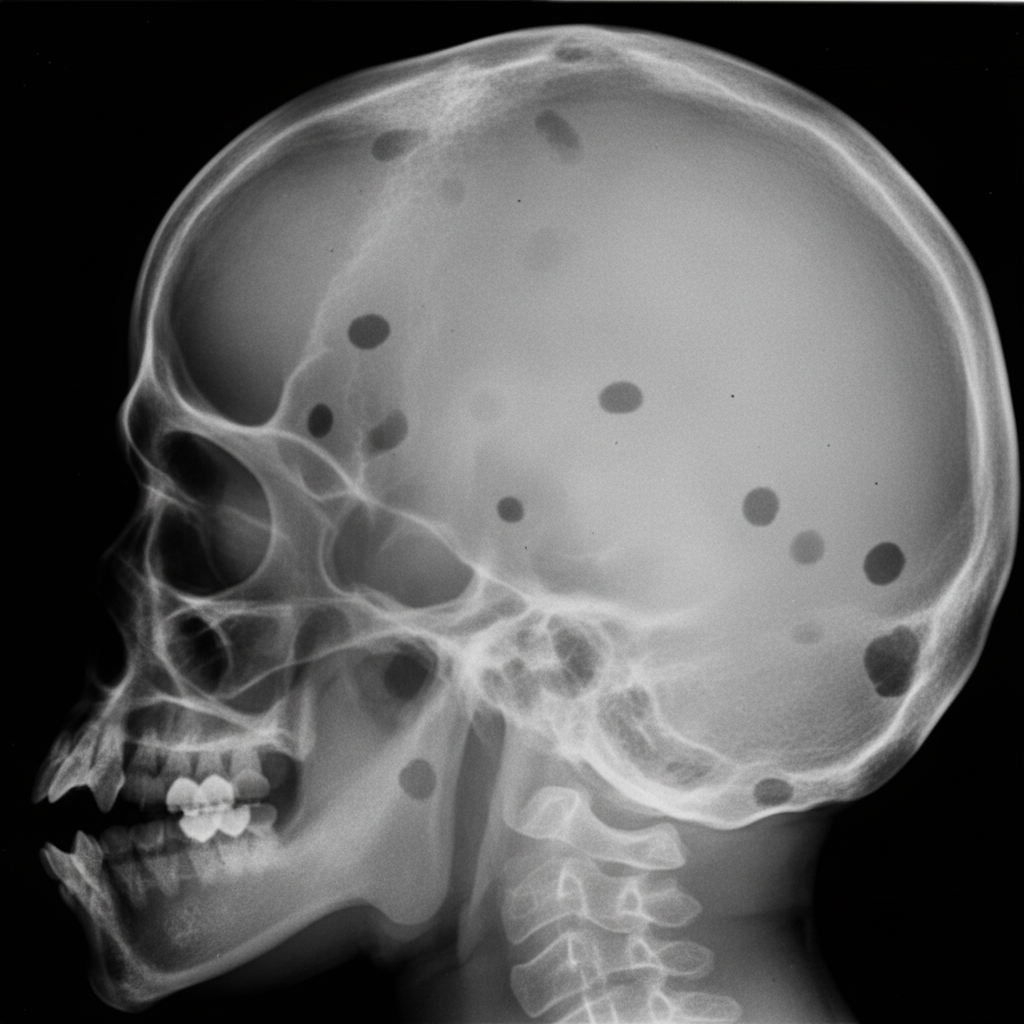
The 'bone in bone' appearance is characteristic of which condition?
The 'bone within a bone' appearance is characteristic of which condition?
Ground glass appearance is seen in which of the following conditions?
Occult fractures of the femoral neck are best diagnosed by:
A panoramic view of the mandible of a patient with a history of trauma shows two fracture lines at the angle of the mandible. What is the most probable cause?
Comment on the provided X-ray image.
Hair-on-end appearance is associated with which of the following conditions?
Stryker's view is used to visualize which abnormality in the shoulder joint?
A cold lesion on a bone scan suggests which of the following?
Which of the following conditions does NOT show a moth-eaten appearance on imaging?
Explanation: **Explanation:** The **'bone in bone' appearance** (also known as *endobone* or *os-in-os*) is a classic radiological hallmark of **Osteopetrosis** (Albers-Schönberg disease). ### 1. Why Osteopetrosis is Correct Osteopetrosis is a genetic disorder characterized by **defective osteoclast function**, leading to impaired bone resorption. This results in the failure of the primary spongiosa to be remodeled into mature bone. The 'bone in bone' appearance occurs due to alternating periods of disease activity and relative quiescence, creating a distinct silhouette of a smaller, miniature bone nested within the host bone (most commonly seen in the vertebrae, pelvis, and short tubular bones). ### 2. Analysis of Incorrect Options * **Active Scurvy:** Characterized by findings like the **Wimberger ring sign** (dense epiphysis), **Frankel line** (dense zone of provisional calcification), and **Pelkan spurs**. It does not feature the 'bone in bone' appearance. * **Acute Myeloid Leukemia (AML):** Typically presents with **metaphyseal lucent bands**, periosteal reactions, or diffuse osteopenia due to marrow infiltration, rather than increased bone density. * **Osteosarcoma:** Classically shows a **Sunburst appearance** or **Codman’s triangle** due to aggressive periosteal reaction and osteoid formation. ### 3. NEET-PG High-Yield Pearls * **Erlenmeyer Flask Deformity:** Another classic sign of Osteopetrosis (also seen in Gaucher disease and Thalassemia). * **Sandwich Vertebrae:** Sclerotic bands at the superior and inferior endplates of the vertebrae (Rugger-Jersey spine is a differential, seen in Renal Osteodystrophy). * **Clinical Complication:** Despite increased density, the bones are brittle and prone to **pathological fractures** and **pancytopenia** (due to marrow space obliteration).
Explanation: ### Explanation **Correct Option: C. Osteopetrosis** Osteopetrosis (Albers-Schönberg disease or Marble Bone Disease) is a genetic disorder characterized by **defective osteoclast function**, leading to failure of normal bone resorption. This results in excessively dense, sclerotic bones. The **'bone within a bone' (endobone)** appearance occurs due to periodic interference with bone formation, where a miniature replica of the bone’s shape is seen inside the cortical boundaries, most commonly in the vertebrae and phalanges. **Why other options are incorrect:** * **A. Osteonecrosis (AVN):** Typically presents with the **'Crescent sign'** (subchondral lucency) or joint space collapse. While sclerosis occurs, it is localized to the epiphysis rather than a generalized 'bone within a bone' pattern. * **B. Osteoporosis:** Characterized by decreased bone density (osteopenia) and cortical thinning. Radiographic findings include **'Picture frame vertebrae'** (due to prominent vertical trabeculae) or 'Codfish vertebrae,' but not internal duplication of bone structure. * **C. Osteomyelitis:** Presents with a **Sequestrum** (dead bone), **Involucrum** (new bone formation), and **Cloaca**. While the involucrum surrounds the sequestrum, it is an irregular inflammatory process, not the organized 'endobone' seen in osteopetrosis. **NEET-PG High-Yield Pearls:** * **Erlenmeyer Flask Deformity:** Another classic sign of Osteopetrosis (also seen in Gaucher’s disease and Thalassemia). * **Sandwich Vertebrae:** Dense bands at the superior and inferior endplates of the vertebrae (Rugger-Jersey spine is a differential, seen in Renal Osteodystrophy). * **Clinical Paradox:** Despite being "dense," the bones are brittle and prone to fractures. Patients often present with anemia and cranial nerve palsies due to narrowed bony foramina.
Explanation: **Explanation:** **Fibrous Dysplasia (FD)** is the classic condition associated with a **"ground-glass" appearance** on imaging. This appearance occurs because normal lamellar bone is replaced by an irregular proliferation of cellular fibrous tissue mixed with disorganized, thin, and curvilinear bony trabeculae (often described histologically as "Chinese letter" patterns). On X-ray or CT, these fine, mineralized spicules are too small to be seen individually, resulting in a characteristic hazy, smoky, or frosted-glass opacity with a smooth texture. **Analysis of Incorrect Options:** * **Inverted Papilloma:** Typically presents as a soft tissue mass in the nasal cavity/paranasal sinuses. While it may cause bony remodeling or pressure erosion, it does not classically exhibit a ground-glass matrix. * **Calcification:** General calcification usually appears as dense, irregular, or clumped radiopacities (e.g., popcorn calcification in chondroid lesions) rather than the uniform, hazy density of ground glass. * **Chronic Osteomyelitis:** Characterized by features like **sequestrum** (dead bone), **involucrum** (new bone formation), and cloacae. It typically shows a moth-eaten or permeative pattern of bone destruction rather than a ground-glass appearance. **High-Yield Clinical Pearls for NEET-PG:** * **McCune-Albright Syndrome:** Triad of Polyostotic Fibrous Dysplasia, Café-au-lait spots ("Coast of Maine" borders), and precocious puberty. * **Mazabraud Syndrome:** Fibrous dysplasia associated with intramuscular myxomas. * **Shepherd’s Crook Deformity:** A classic radiological feature of FD involving the proximal femur due to repeated microfractures. * **Monostotic vs. Polyostotic:** Monostotic (70-80%) is more common; the ribs and femur are frequently involved.
Explanation: **Explanation:** The diagnosis of occult fractures—fractures that are clinically suspected but not visible on initial radiographs—is a high-yield topic in musculoskeletal radiology. **Why MRI is the Correct Answer:** **MRI is the gold standard** and the investigation of choice for occult femoral neck fractures. It boasts nearly **100% sensitivity and specificity**. MRI can detect bone marrow edema (best seen on T2-weighted or STIR sequences) within hours of the injury, long before structural changes or metabolic bone reactions become visible on other modalities. In elderly patients with hip pain after a fall and normal X-rays, MRI is the definitive next step. **Analysis of Incorrect Options:** * **X-Ray:** By definition, an occult fracture is not visible on initial radiographs. X-rays have low sensitivity in the early stages of stress or non-displaced fractures. * **Bone Scan (Scintigraphy):** While highly sensitive, it lacks specificity. Furthermore, in elderly patients, it may take 48–72 hours for "hot spots" (increased tracer uptake) to appear, leading to potential false negatives if performed too early. * **CT Scan:** CT is excellent for evaluating cortical bone and fracture comminution. However, it may miss non-displaced trabecular fractures where there is no cortical break, making it less sensitive than MRI for truly occult injuries. **Clinical Pearls for NEET-PG:** * **Investigation of choice for Stress Fractures:** MRI. * **Most sensitive sequence for Bone Marrow Edema:** STIR (Short Tau Inversion Recovery). * **Management:** If MRI is contraindicated (e.g., pacemaker), a CT scan or Bone Scan is the alternative, but MRI remains the primary answer for "best diagnostic test."
Explanation: ### Explanation **1. Why Oblique Fracture is Correct:** In maxillofacial imaging, particularly on a panoramic radiograph (OPG), an **oblique fracture** of the mandibular angle often presents with two distinct radiolucent lines. This is a classic radiographic phenomenon known as **"doubling" of the fracture line**. It occurs because the fracture plane is not perpendicular to the X-ray beam. Consequently, the beam captures the fracture at both the **buccal (outer) cortex** and the **lingual (inner) cortex** at different levels. These two separate cortical breaks project as two distinct lines on the 2D film, even though only one structural break exists. **2. Why Other Options are Incorrect:** * **Artifact:** While artifacts (like ghost images or patient movement) are common in panoramic views, they typically do not mimic the specific anatomical alignment of cortical breaks seen in mandibular trauma. * **Double Fracture:** A double fracture refers to two separate, distinct fractures at different anatomical sites (e.g., a symphysis fracture and a contralateral condylar fracture). It does not refer to two lines seen at a single anatomical site (the angle). **3. Clinical Pearls for NEET-PG:** * **Mandibular Fractures:** The most common sites are the **Condyle (highest frequency)**, followed by the Body and Angle. * **Ring Bone Rule:** The mandible acts like a ring; if you see one fracture, always look for a second fracture on the contralateral side (often a "Coupe-Contrecoup" injury). * **Imaging Choice:** While OPG is excellent for a screening overview, **NCCT with 3D reconstruction** is the gold standard for evaluating complex mandibular trauma. * **Displacement:** Fractures at the angle are often influenced by the "pull" of the masseter and medial pterygoid muscles, leading to favorable or unfavorable displacement.
Explanation: ### Explanation **Brodie’s Abscess** is a localized form of subacute or chronic osteomyelitis. It typically presents as a well-defined, oval, or "serpiginous" **radiolucent (lytic) lesion** located in the **metaphysis** of long bones (most commonly the tibia). The hallmark radiographic feature is a thick, surrounding rim of **reactive sclerosis** (bone formation), which represents the body’s attempt to wall off the infection. #### Why the other options are incorrect: * **Acute Osteomyelitis:** Radiographic changes are often absent in the first 7–10 days. When present, they show soft tissue swelling, periosteal reaction, and ill-defined bone destruction rather than a well-circumscribed sclerotic-walled cavity. * **Chronic Osteomyelitis:** Characterized by more extensive involvement, including **sequestrum** (dead bone), **involucrum** (new bone sheath), and **cloaca** (opening for pus drainage). It lacks the localized, "abscess-like" appearance of Brodie’s. * **Adamantinoma:** A rare, slow-growing malignant tumor usually found in the **diaphysis** of the tibia. It typically presents with a "soap-bubble" appearance and lacks the characteristic thick sclerotic rim of an infection. #### High-Yield Clinical Pearls for NEET-PG: * **Most common site:** Proximal or distal tibia (metaphysis). * **Most common organism:** *Staphylococcus aureus*. * **Pathognomonic Sign:** The **"Cloaca"** or a **"Channel"** (a radiolucent track extending toward the growth plate) is highly suggestive. * **MRI Finding:** The **"Penumbra Sign"** (a layer of vascularized granulation tissue that appears hyperintense on T1-weighted images) is a characteristic feature used to differentiate it from tumors like Osteoid Osteoma.
Explanation: **Explanation:** The **"Hair-on-end" appearance** (also known as the crew-cut sign) is a classic radiological finding on a lateral skull X-ray. It occurs due to **compensatory extramedullary hematopoiesis** or intense marrow hyperplasia in response to chronic hemolytic anemias. This process causes the expansion of the marrow space (diploic space), which thins the outer table of the skull. The trabeculae then orient themselves perpendicularly to the inner table, creating the appearance of vertical "hairs" standing on end. **Why Aplastic Anemia is the Correct Answer (in the context of this specific question):** While Thalassemia is the *most common* cause of this sign, this question likely follows a specific clinical scenario or a "least likely/except" pattern often seen in NEET-PG. However, strictly speaking, **Aplastic Anemia is characterized by pancytopenia and a "dry" hypocellular marrow.** Therefore, it **does not** cause marrow hyperplasia or extramedullary hematopoiesis. In most standardized exams, Aplastic Anemia is the **incorrect** association for this sign. If the question asks which is *not* associated, Aplastic Anemia is the answer. If the question asks for the *classic* association, Thalassemia is the answer. **Analysis of Options:** * **Thalassemia (Option D):** The most common and classic cause of the hair-on-end appearance. * **Sickle Cell Anemia (Option B):** A frequent cause due to chronic hemolysis and marrow expansion. * **G-6-PD Deficiency (Option A):** Can lead to chronic hemolysis, potentially causing these changes, though less common than Thalassemia. * **Aplastic Anemia (Option C):** Correct because it is the **exception**. It involves marrow failure, not expansion. **High-Yield Clinical Pearls for NEET-PG:** * **Classic Triad for Thalassemia on X-ray:** Hair-on-end skull, "Salt and pepper" skull, and expansion of facial bones (leading to "Chipmunk facies" and malocclusion). * **Differential Diagnosis for Hair-on-end:** Thalassemia (Major), Sickle Cell Anemia, Hereditary Spherocytosis, and occasionally Iron Deficiency Anemia (severe/chronic). * **Key Distinction:** Aplastic anemia shows **increased fat content** on MRI (T1 hyperintensity) due to marrow replacement, the opposite of the hyperactive marrow seen in Thalassemia.
Explanation: **Explanation:** **Stryker’s Notch View** is a specialized radiographic projection used to visualize the **Hill-Sachs lesion**, which is a hallmark of **recurrent anterior shoulder subluxation** or dislocation. 1. **Why the correct answer is right:** A Hill-Sachs lesion is a compression fracture of the posterosuperolateral aspect of the humeral head, caused by impact against the anterior glenoid rim during dislocation. In the Stryker’s view, the patient lies supine with the hand placed on the head (elbow pointing upward). This position profiles the posterolateral humeral head, making it the most sensitive radiographic view for detecting these bony defects. Identifying this lesion is crucial as it confirms a history of instability and predisposes the patient to further subluxations. 2. **Why the incorrect options are wrong:** * **Muscle/Subacromial calcification:** These are best visualized using standard AP views or specialized views like the **Supraspinatus Outlet view** (for impingement) or ultrasound/CT. * **Bicipital groove:** This is best visualized using the **Fisk Axial view** (tangential view), where the patient leans over the table to profile the intertubercular sulcus. **High-Yield Clinical Pearls for NEET-PG:** * **Hill-Sachs Lesion:** Posterolateral humeral head defect (Bankart lesion is the corresponding anteroinferior glenoid labrum injury). * **West Point View:** Another specialized view used to identify bony **Bankart lesions** (glenoid rim fractures). * **Light Bulb Sign:** Seen on AP view in **Posterior Shoulder Dislocation** due to internal rotation of the humerus. * **Standard Trauma Series:** Includes AP, Scapular Y, and Axillary views.
Explanation: **Explanation:** A **bone scan** (Technetium-99m MDP) depends on two factors: blood flow and **osteoblastic activity** (bone formation). A "hot lesion" indicates increased bone turnover, while a **"cold lesion" (photopenia)** occurs when there is localized bone destruction or absent blood supply that prevents the uptake of the radiopharmaceutical. **1. Why Lytic Lesion is correct:** Purely lytic lesions (e.g., Multiple Myeloma, certain metastases like Renal Cell Carcinoma) involve rapid bone destruction without a compensatory osteoblastic response. Because there is no new bone formation to take up the tracer, these appear as "cold" or "punched-out" areas on a scan. **2. Why other options are incorrect:** * **Osteomyelitis:** Typically presents as a "hot lesion" due to increased vascularity and reactive bone formation. (Note: In very early stages or if there is compromised blood flow, it can rarely be cold, but "hot" is the classic finding). * **Osteoblastic lesion:** These (e.g., Prostate cancer mets, Osteoid osteoma) show intense tracer uptake and appear "hot" due to active bone mineral deposition. * **Sequestrum:** While a sequestrum is necrotic bone, the surrounding involucrum and granulation tissue in chronic osteomyelitis usually result in an overall "hot" appearance on a bone scan. **Clinical Pearls for NEET-PG:** * **The "Cold" Differential:** Multiple Myeloma (most common cause of false-negative bone scans), aggressive lytic metastases (RCC, Thyroid), early infarction/Avascular Necrosis (Stage 1), and prosthesis. * **Sensitivity vs. Specificity:** Bone scans are highly sensitive for detecting bone pathology but have low specificity. * **Multiple Myeloma:** Always remember that a Skeletal Survey (X-ray) is preferred over a Bone Scan for Myeloma because the lesions are often cold and missed on scintigraphy.
Explanation: In musculoskeletal radiology, the **"moth-eaten" appearance** refers to a pattern of bone destruction characterized by multiple small, scattered, ill-defined radiolucent holes. This pattern indicates an aggressive, infiltrative process where the bone does not have time to mount a sclerotic response. ### **Why Hemorrhagic Cyst is the Correct Answer** A **Hemorrhagic (Simple) Bone Cyst** typically presents as a **geographic lesion**. Geographic lesions are well-circumscribed, slow-growing, and have a narrow zone of transition, often with a sclerotic rim. They do not exhibit the aggressive, permeative, or moth-eaten destruction seen in malignant or infectious processes. ### **Analysis of Incorrect Options** * **Osteomyelitis:** Acute or subacute pyogenic infections cause rapid bone destruction and cortical tunneling, frequently presenting with a moth-eaten appearance due to the inflammatory response. * **Osteosarcoma:** As a highly aggressive primary bone malignancy, it destroys the trabecular bone in an irregular, infiltrative fashion, classically showing moth-eaten or permeative patterns alongside a periosteal reaction (e.g., Codman’s triangle). * **Odontogenic Keratocyst (OKC):** While often well-defined, large or aggressive OKCs in the mandible can sometimes exhibit "scalloped" borders or a multi-locular, aggressive appearance that mimics moth-eaten destruction in specific clinical contexts, though it is more commonly associated with multiple myeloma or metastases in general radiology. ### **NEET-PG High-Yield Pearls** * **Lodwick Classification:** Used to grade the aggressiveness of bone lesions based on the pattern of destruction (Geographic < Moth-eaten < Permeative). * **Moth-eaten Differential (Mnemonic: M-O-M-E-S):** **M**etastasis, **O**steomyelitis, **M**ultiple Myeloma, **E**wing’s Sarcoma, **S**arcoma (Osteosarcoma/Fibrosarcoma). * **Fallen Fragment Sign:** Pathognomonic for a Simple (Unicameral) Bone Cyst following a pathological fracture.
Radiographic Anatomy of Bones and Joints
Practice Questions
Imaging of Fractures and Dislocations
Practice Questions
Arthritides: Inflammatory and Degenerative
Practice Questions
Metabolic Bone Diseases
Practice Questions
Bone and Soft Tissue Tumors
Practice Questions
Congenital Skeletal Anomalies
Practice Questions
Spine Imaging
Practice Questions
Skeletal Infections
Practice Questions
Sports Medicine Imaging
Practice Questions
Imaging of Prostheses and Implants
Practice Questions
Musculoskeletal Ultrasound
Practice Questions
MSK Interventional Procedures
Practice Questions
Get full access to all questions, explanations, and performance tracking.
Start For Free