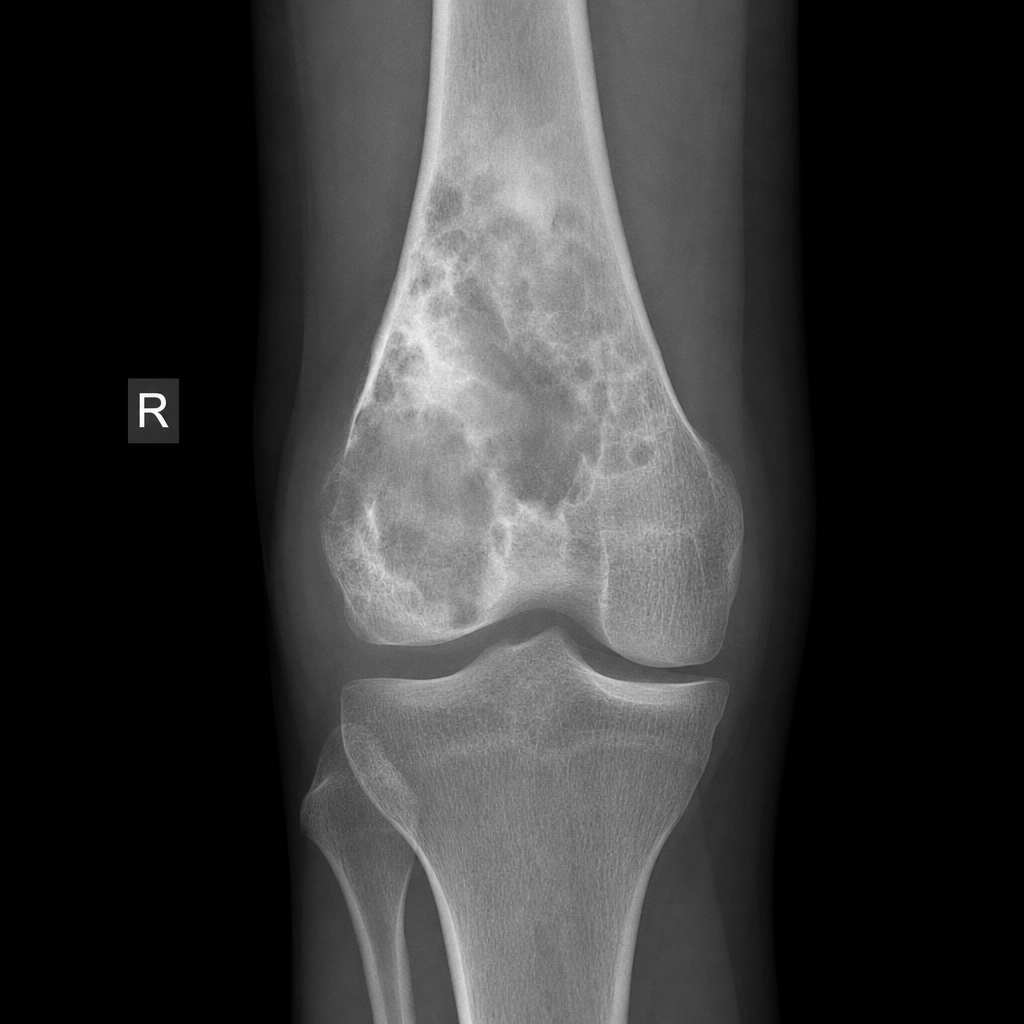
Which imaging modality is best for evaluating retinoblastoma?
Pericarticular calcification is seen in which of the following conditions?
Calcification around the joint is seen in which of the following conditions?
A "cold spot" on bone scintigraphy is seen in all the following conditions except?
Superior rib notching is caused by which of the following?
The "Beheaded Scottish Terrier sign" is characteristic of which of the following conditions?
Champagne glass pelvis is seen in which of the following conditions?
An oblique view is required to diagnose which of the following fractures?
A 41-year-old female patient on long-term steroid therapy presents with severe hip pain. Which imaging investigation is most appropriate for diagnosing this condition?
Spoke wheel calcification in an osteolytic lesion is seen in which of the following conditions?
Explanation: **Explanation:** Retinoblastoma is the most common primary intraocular malignancy in children. The diagnosis and staging require a multi-modal imaging approach, making **CT scan and MRI** the combined gold standard. * **Why CT and MRI are both essential:** * **CT Scan:** It is the most sensitive modality for detecting **intraocular calcification**, which is the hallmark of retinoblastoma (seen in >90% of cases). CT is crucial for confirming the diagnosis when clinical findings are ambiguous. * **MRI:** It is the modality of choice for **staging**. MRI provides superior soft-tissue contrast to evaluate for optic nerve invasion, extraocular extension, and intracranial involvement (such as trilateral retinoblastoma involving the pineal gland). Crucially, MRI avoids ionizing radiation, which is vital in these patients who often have a genetic predisposition to secondary malignancies (RB1 mutation). **Analysis of Incorrect Options:** * **A. Ultrasonography:** While useful for initial screening and detecting calcified masses (showing high reflectivity with acoustic shadowing), it is operator-dependent and cannot assess posterior extension or intracranial spread. * **B & D. CT or MRI alone:** While both are powerful, neither is sufficient on its own for a complete evaluation. CT excels at identifying pathognomonic calcification, while MRI is mandatory for assessing the extent of the disease and planning management. **High-Yield Clinical Pearls for NEET-PG:** * **Classic Presentation:** Leukocoria (white pupillary reflex) in a child under 3 years. * **Trilateral Retinoblastoma:** Bilateral retinoblastoma associated with a pineal gland tumor (Pineoblastoma). * **Imaging Sign:** "Cloud-like" or "clumpy" calcification on CT. * **Management Tip:** Avoid biopsy (fine-needle aspiration) due to the high risk of tumor seeding along the needle track. Diagnosis is based on clinical exam and imaging.
Explanation: **Explanation:** **Pseudogout (Calcium Pyrophosphate Deposition Disease - CPPD)** is the correct answer because it is characterized by the deposition of calcium pyrophosphate dihydrate crystals in and around joints. This manifests radiologically as **periarticular calcification** (involving tendons, ligaments, and joint capsules) and **chondrocalcinosis** (calcification of hyaline or fibrocartilage). Common sites include the triangular fibrocartilage of the wrist and the menisci of the knee. **Why other options are incorrect:** * **Rheumatoid Arthritis (RA):** The hallmark radiological features of RA are periarticular **osteopenia** (demineralization), symmetric joint space narrowing, and marginal erosions. Calcification is not a feature of RA; in fact, the inflammatory process typically leads to bone loss rather than deposition. * **Osteoarthritis (OA):** OA is characterized by joint space narrowing (usually asymmetric), subchondral sclerosis, subchondral cysts (geodes), and **osteophyte** formation. While osteophytes are bony outgrowths, they are distinct from the soft tissue/periarticular calcification seen in crystal arthropathies. **High-Yield Clinical Pearls for NEET-PG:** * **Chondrocalcinosis:** If you see a linear calcification in the knee joint space on an X-ray, think CPPD first. * **Milwaukee Shoulder:** A severe form of destructive arthropathy associated with basic calcium phosphate (hydroxyapatite) crystal deposition, also presenting with significant periarticular calcification. * **Hyperparathyroidism:** Always screen for metabolic causes (Hyperparathyroidism, Hemochromatosis, Hypomagnesemia) if a young patient presents with pseudogout. * **Polarizing Microscopy:** CPPD crystals are **positively birefringent** and rhomboid-shaped (unlike the negatively birefringent, needle-shaped crystals in Gout).
Explanation: **Explanation:** The presence of calcification within or around a joint is a hallmark of **Pseudogout**, also known as **Calcium Pyrophosphate Deposition Disease (CPPD)**. In this condition, calcium pyrophosphate dihydrate crystals deposit in the hyaline cartilage and fibrocartilage, a radiological finding termed **chondrocalcinosis**. It most commonly affects the knees (meniscus), wrists (triangular fibrocartilage complex), and symphysis pubis. **Analysis of Options:** * **Pseudogout (Correct):** Characterized by linear or punctate calcifications within the joint space. Under polarized microscopy, these crystals are weakly positively birefringent and rhomboid-shaped. * **Hyperparathyroidism:** While it can cause metastatic calcification and is associated with an increased incidence of CPPD, the primary radiological features are subperiosteal bone resorption (classically on the radial aspect of middle phalanges) and "salt and pepper" skull. * **Rheumatoid Arthritis:** This is an inflammatory, non-crystal arthropathy. Key radiological features include periarticular osteopenia, uniform joint space narrowing, and marginal erosions. Calcification is not a feature. * **Gout:** Caused by Monosodium Urate (MSU) crystals. These crystals are radiolucent; therefore, gout typically presents with "punched-out" erosions with overhanging edges (Martel’s sign) and soft tissue tophi, but not joint calcification. **High-Yield Clinical Pearls for NEET-PG:** * **Chondrocalcinosis "Big Three" locations:** Knee (Meniscus), Wrist (TFCC), and Pelvis (Symphysis Pubis). * **Milwaukee Shoulder:** A severe destructive arthropathy associated with Basic Calcium Phosphate (Hydroxyapatite) deposition. * **Polarized Microscopy:** * Gout: Needle-shaped, Strongly Negative birefringent. * Pseudogout: Rhomboid-shaped, Weakly Positive birefringent.
Explanation: **Explanation:** Bone scintigraphy (Technetium-99m MDP scan) depends on two factors: **blood flow** and **osteoblastic activity** (bone turnover). A "cold spot" (photopenia) occurs when there is a localized lack of tracer uptake due to impaired blood supply or purely osteolytic processes with no reactive bone formation. **Why Eosinophilic Granuloma (EG) is the correct answer:** Eosinophilic Granuloma (a form of Langerhans Cell Histiocytosis) typically presents as a **"hot spot"** (increased uptake) on bone scans. While it is a lytic lesion, it usually triggers a significant inflammatory response and reactive osteoblastic repair, leading to increased tracer accumulation. Therefore, it does not typically present as a cold spot. **Analysis of Incorrect Options (Causes of Cold Spots):** * **Multiple Myeloma:** This is the classic cause of a "cold spot." Myeloma cells produce Osteoclast Activating Factors (OAFs) that cause purely lytic bone destruction without stimulating osteoblasts. This is why bone scans are often false-negative in myeloma, and skeletal surveys (X-rays) or MRI/PET-CT are preferred. * **Fibrous Cortical Defect:** These are benign, inactive cortical lesions. Due to the lack of active bone turnover or metabolic activity, they often appear as photopenic areas or are "quiet" on scans. * **Pseudarthrosis:** In a "non-union" or false joint, the lack of vascularity and failed mineralized bridge formation at the fracture site can result in a cold spot. **High-Yield Clinical Pearls for NEET-PG:** * **Hot Spots (Increased uptake):** Osteoblastic metastases (Prostate, Breast), Osteomyelitis, Fractures, Osteoid Osteoma, Paget’s disease. * **Cold Spots (Photopenia):** Multiple Myeloma, Early Avascular Necrosis (AVN), Bone Infarction, Renal Cell Carcinoma metastases (sometimes), and Prosthesis interference. * **"Super Scan":** Uniformly increased uptake with absent renal shadows, seen in diffuse metastatic disease (Prostate CA) or Metabolic Bone Disease (Hyperparathyroidism).
Explanation: **Explanation:** Rib notching is a classic radiological sign characterized by cortical erosion along the rib margins. While **inferior rib notching** is most commonly associated with Coarctation of the Aorta (due to dilated intercostal arteries), **superior rib notching** is typically caused by conditions that affect bone resorption, connective tissue integrity, or chronic pressure from muscle atrophy. **Why "All of the Above" is Correct:** 1. **Hyperparathyroidism (Option A):** This is the most common cause of superior rib notching. Increased parathyroid hormone leads to subperiosteal bone resorption, which frequently occurs along the superior borders of the ribs. 2. **Poliomyelitis (Option B):** Chronic paralysis and muscle atrophy lead to a loss of the normal mechanical stress on the bone and decreased vascular supply. The resulting localized pressure and trophic changes cause thinning and notching of the superior rib margins. 3. **Marfan Syndrome (Option C):** This connective tissue disorder results in weakened periosteal attachments and abnormal bone remodeling, leading to superior rib erosions. **High-Yield Clinical Pearls for NEET-PG:** * **Inferior Rib Notching (Roesler’s Sign):** Classically involves the 3rd to 9th ribs. It is a hallmark of **Coarctation of the Aorta** (post-ductal). It is *not* seen in the 1st and 2nd ribs because they are supplied by the costocervical trunk, not the intercostal arteries. * **Other causes of Superior Notching:** Osteogenesis Imperfecta, Rheumatoid Arthritis, and Systemic Lupus Erythematosus (SLE). * **Unilateral Rib Notching:** Suggests a Blalock-Taussig shunt or subclavian artery stenosis.
Explanation: ### Explanation The **"Beheaded Scottish Terrier"** sign is a classic radiological finding seen on **oblique radiographs** of the lumbar spine. It indicates **Spondylolisthesis** resulting from **Spondylolysis** (a defect in the pars interarticularis). #### 1. Why Spondylolisthesis is Correct In a normal oblique lumbar X-ray, the posterior elements form the shape of a "Scotty Dog": * **Ear:** Superior articular process * **Nose:** Transverse process * **Eye:** Pedicle * **Neck:** Pars interarticularis * **Front Leg:** Inferior articular process When there is a fracture or defect in the **pars interarticularis** (Spondylolysis), it appears as a "collar" around the dog's neck. If the vertebrae then slide forward (**Spondylolisthesis**), the "neck" is severed, leading to the **"Beheaded"** appearance. #### 2. Why Other Options are Incorrect * **Spondylosis:** This refers to degenerative changes (osteophytes, disc space narrowing). While common, it does not involve the pars defect required to "behead" the dog. * **Lumbar Canal Stenosis:** This is the narrowing of the spinal canal, often diagnosed via MRI. It does not have a specific "Scotty Dog" correlation on X-ray. * **Slipped Disc (PivD):** This involves the herniation of the nucleus pulposus. It is a soft tissue pathology best visualized on MRI, not a bony defect of the pars. #### 3. Clinical Pearls for NEET-PG * **Best View:** The Scotty Dog is only seen on the **Oblique View**. * **Most Common Site:** L5-S1 is the most frequent level for spondylolisthesis. * **Meyerding Classification:** Used to grade the severity of slippage (Grade I to V). * **Inverted Napoleon Hat Sign:** Seen on **Frontal (AP) view** in severe cases (Grade III or IV) of spondylolisthesis.
Explanation: **Explanation:** **Champagne Glass Pelvis** is a classic radiological sign of **Achondroplasia**, the most common cause of disproportionate short-limbed dwarfism. This appearance is caused by a combination of specific pelvic deformities: * **Iliac bones:** Short and square (often described as "elephant ear" wings). * **Acetabular roof:** Characteristically flat and horizontal. * **Greater sciatic notch:** Narrowed. * **Pelvic inlet:** Broad and shallow, resembling the bowl of a champagne glass. **Analysis of Options:** * **Achondroplasia (Correct):** In addition to the champagne glass pelvis, these patients exhibit a narrowing of the interpedicular distance (caudally), "trident hands," and rhizomelic shortening of limbs. * **Cretinism (Hypothyroidism):** Characterized by delayed skeletal maturation, epiphyseal dysgenesis (fragmented epiphysis), and "bullet-shaped" vertebrae, but not a champagne glass pelvis. * **Osteomalacia:** Features "Protrusio acetabuli" and a "heart-shaped" or "tri-radiate" pelvis due to softening of the bones. * **Rickets:** Primarily shows widening, fraying, and cupping of the metaphysis (especially at the wrist and knee). **High-Yield Clinical Pearls for NEET-PG:** * **Inheritance:** Autosomal Dominant (FGFR3 gene mutation). * **Spine:** Posterior scalloping of vertebrae and progressive narrowing of the interpedicular distance from L1 to L5 (the opposite of normal). * **Skull:** Large vault with frontal bossing and a depressed nasal bridge. * **Hand:** "Trident hand" (increased space between the 3rd and 4th digits).
Explanation: **Explanation:** The **scaphoid** is the most commonly fractured carpal bone. Due to its unique anatomy—it is elongated and tilted anteriorly—a standard Posteroanterior (PA) and Lateral view often result in the bone being foreshortened or obscured by overlapping carpal structures. To visualize the scaphoid in its full longitudinal profile and detect subtle cortical disruptions, a **Scaphoid View** is required. This is an **oblique view** (specifically PA with ulnar deviation and 20-30° cranial angulation), which "stretches" the scaphoid and brings it into a plane parallel to the film. **Analysis of Options:** * **Capitate (A):** The largest carpal bone, situated centrally; it is usually well-visualized on standard PA and Lateral views. * **Navicular (C):** While "Navicular" was the old name for the scaphoid, in modern medical terminology, the Navicular refers to a bone in the **tarsus (foot)**. In the foot, the navicular is best seen on AP and oblique foot radiographs, but the question context implies carpal injuries. * **Hamate (D):** Fractures of the body are seen on standard views, while a fracture of the **hook of the hamate** specifically requires a **Carpal Tunnel View** or Supinated Oblique view. **High-Yield Clinical Pearls for NEET-PG:** * **Blood Supply:** The scaphoid has a retrograde blood supply (distal to proximal). Fractures at the **waist** (most common site) or proximal pole carry a high risk of **Avascular Necrosis (AVN)** and non-union. * **Clinical Sign:** Tenderness in the **Anatomical Snuffbox**. * **Radiology Tip:** If a scaphoid fracture is clinically suspected but initial X-rays are negative, the protocol is to **immobilize for 10–14 days** and repeat the X-ray or perform an MRI (the most sensitive investigation).
Explanation: **Explanation:** The clinical presentation of severe hip pain in a patient on long-term steroid therapy strongly suggests **Avascular Necrosis (AVN)** of the femoral head. Steroids are a well-known risk factor for fat emboli and increased intraosseous pressure, leading to bone ischemia. **Why MRI is the Correct Answer:** MRI is the **most sensitive (99%) and specific** imaging modality for the early diagnosis of AVN. It can detect marrow edema and the characteristic "double-line sign" (a low-signal rim with an inner high-signal line on T2WI) long before structural changes appear on other modalities. Early diagnosis is crucial to initiate joint-preserving treatments before the femoral head collapses. **Why Other Options are Incorrect:** * **X-Ray:** Often the initial investigation, but it has low sensitivity in early stages. Findings like the "Crescent sign" (subchondral fracture) only appear in advanced stages (Ficat Stage III). * **CT Scan:** Excellent for evaluating the extent of bony collapse and cortical involvement, but it cannot detect early marrow changes or ischemia. * **USG:** Has no role in diagnosing AVN; it is primarily used to detect joint effusions or soft tissue pathologies. **Clinical Pearls for NEET-PG:** * **Most common site for AVN:** Femoral head. * **Earliest sign on MRI:** Low-signal intensity band on T1WI. * **Ficat Classification:** Used for staging AVN based on X-ray and MRI findings. * **Other Risk Factors:** Alcoholism, Trauma (neck of femur fracture), Sickle cell anemia, and SLE.
Explanation: **Explanation:** **Vertebral Hemangiomas** are the most common benign primary tumors of the spine. The characteristic **"Spoke-wheel"** appearance (also known as the **"Polka-dot"** or **"Salt and pepper"** sign on axial imaging) occurs due to the resorption of horizontal trabeculae and the compensatory thickening of vertical trabeculae. On a lateral X-ray, this presents as vertical striations called the **"Corduroy cloth"** or **"Jail-bar"** appearance. **Analysis of Options:** * **Hemangioma (Correct):** The "Spoke-wheel" pattern refers specifically to the radiating trabecular pattern seen in flat bones (like the skull) or the axial cross-section of a vertebral body affected by hemangioma. * **Secondaries (Incorrect):** Skeletal metastases typically present as purely lytic (e.g., RCC, Thyroid), blastic (e.g., Prostate), or mixed lesions. They usually cause irregular bone destruction without the organized trabecular thickening seen in hemangiomas. * **Plasmacytoma (Incorrect):** While it presents as a "punched-out" osteolytic lesion or a "soap-bubble" appearance (in the expansile form), it does not show the classic spoke-wheel calcification. * **Hydatid Disease (Incorrect):** In the bone, *Echinococcus* causes multiloculated, "bunch of grapes" osteolytic lesions. Calcification, if present, is usually in the cyst wall (pericyst), not in a spoke-wheel trabecular pattern. **High-Yield Pearls for NEET-PG:** * **Corduroy Cloth Sign:** Vertical trabeculations in the spine (Hemangioma). * **Sunburst Appearance:** Malignant periosteal reaction (Osteosarcoma). * **Soap Bubble Appearance:** Giant Cell Tumor (GCT). * **Onion Skin Appearance:** Ewing’s Sarcoma. * **Most common site for Hemangioma:** Thoracic and Lumbar spine.
Explanation: **Explanation:** The presence or absence of a **periosteal reaction** is a critical diagnostic marker in bone radiology. It occurs when the periosteum is irritated by trauma, infection, or tumors, leading to new bone formation. **Why Squamous Cell Carcinoma (SCC) is correct:** When SCC (typically from the oral cavity or skin) invades underlying bone, it does so by **direct extension and pressure necrosis**. Because the tumor destroys the bone from the "outside-in" and often progresses rapidly without stimulating the osteoblastic activity of the periosteum, it typically presents as a **"punched-out" radiolucency** or an infiltrative lucent lesion **without periosteal reaction**. This is a classic radiological feature of secondary bone invasion by epithelial malignancies. **Why the other options are incorrect:** * **Garre’s Osteomyelitis:** Also known as proliferative periostitis, it is characterized by a prominent, "onion-skin" laminated periosteal reaction. It is a hallmark of chronic irritation in children/young adults. * **Osteosarcoma:** As a highly aggressive primary bone malignancy, it almost always presents with complex periosteal reactions, such as the **Codman’s triangle** or **Sunburst appearance**. * **Chronic Osteomyelitis:** This condition is defined by periosteal activity. The formation of an **Involucrum** (new bone sheath around the dead bone) is a classic example of a thick, exuberant periosteal reaction. **High-Yield Clinical Pearls for NEET-PG:** 1. **No Periosteal Reaction:** Seen in SCC invasion, Multiple Myeloma (punched-out lesions), and some slow-growing benign tumors. 2. **Onion-skin Reaction:** Ewing’s Sarcoma and Garre’s Osteomyelitis. 3. **Sunburst/Spiculated Reaction:** Osteosarcoma. 4. **Codman’s Triangle:** Indicates an aggressive process (Malignancy or Acute Osteomyelitis) lifting the periosteum.
Explanation: The correct answer is **A: Hyperparathyroidism, Multiple myeloma, Renal osteodystrophy.** ### **Explanation of the Correct Answer** In the context of the skull vault, "increased density" refers to a generalized or patchy increase in radiopacity (sclerosis). * **Hyperparathyroidism:** Classically presents with a **"Salt and Pepper" skull**, where multiple tiny lucent areas are interspersed with areas of increased density (sclerosis) due to trabecular remodeling. * **Renal Osteodystrophy:** This condition often leads to secondary hyperparathyroidism. It can cause a diffuse increase in bone density, sometimes referred to as **osteosclerosis**, particularly in the axial skeleton and skull. * **Multiple Myeloma:** While classically known for "punched-out" lytic lesions, it is a high-yield fact for NEET-PG that **sclerotic lesions** can occur, especially in the **POEMS syndrome** variant or following chemotherapy/treatment where the bone undergoes repair. ### **Analysis of Incorrect Options** * **Options B, C, and D:** These are incomplete or misleading. While **Fluorosis** causes significant osteosclerosis (increased density) of the spine and pelvis, it rarely involves the skull vault to the same extent as the conditions listed in Option A. Furthermore, Option A provides the most comprehensive list of conditions frequently tested for skull density changes in a clinical radiology context. ### **High-Yield Clinical Pearls for NEET-PG** * **Salt and Pepper Skull:** Pathognomonic for Hyperparathyroidism (loss of definition of inner and outer tables). * **Cotton Wool Spots:** Seen in **Paget’s Disease** (thickened vault with disorganized sclerosis). * **Hair-on-end Appearance:** Seen in chronic hemolytic anemias (e.g., Thalassemia, Sickle Cell) due to marrow hyperplasia. * **Rain-drop Skull:** Classic description for the multiple lytic lesions of Multiple Myeloma. * **Rugger-Jersey Spine:** Characteristic of osteosclerosis in Renal Osteodystrophy.
Explanation: ### Explanation The core distinction in musculoskeletal radiology for NEET-PG is differentiating between **Inflammatory Arthritis** (e.g., Rheumatoid Arthritis) and **Degenerative Arthritis** (e.g., Osteoarthritis). **Why Osteophytes is the correct answer:** Osteophytes (bony spurs) are the hallmark of **Osteoarthritis (OA)**. They represent a reparative response of the bone to mechanical stress and cartilage loss. In contrast, Rheumatoid Arthritis (RA) is a chronic inflammatory process characterized by synovial hypertrophy (pannus) that leads to bone **destruction** rather than bone formation. **Analysis of incorrect options:** * **Subchondral Osteopenia:** This is one of the earliest radiological signs of RA. Inflammatory cytokines and increased vascularity in the synovium lead to localized bone loss near the joint (juxta-articular osteopenia). * **Subchondral Cysts (Geodes):** In RA, synovial fluid is forced into the bone through marginal erosions under pressure, creating "pseudocysts" or geodes in the subchondral bone. * **Subchondral Swelling:** Early RA presents with soft tissue swelling around the joints (fusiform appearance) due to synovial inflammation and effusion. **Clinical Pearls for NEET-PG:** * **Classic RA Triad on X-ray:** Juxta-articular osteopenia, symmetrical joint space narrowing, and marginal erosions. * **Joints involved:** RA typically involves the MCP, PIP, and MTP joints, characteristically **sparing the DIP joints** (which are involved in OA and Psoriatic Arthritis). * **Deformities:** Look for "Rat-bite" erosions, ulnar deviation at MCP joints, and Swan-neck or Boutonniere deformities. * **Key Differentiator:** If you see **subchondral sclerosis** or **osteophytes**, think Osteoarthritis. If you see **osteopenia** and **erosions**, think Rheumatoid Arthritis.
Explanation: ### Explanation The **Odontoid view** (also known as the **Open-mouth view**) is the gold standard radiographic projection for evaluating the C1 (Atlas) and C2 (Axis) vertebrae. **Why it is correct:** In a standard AP view, the mandible and the base of the skull superimpose over the upper cervical spine, obscuring the anatomy. By opening the mouth wide, these structures are moved out of the way, allowing a clear view of the **dens (odontoid process)**, the **lateral masses of C1**, and the **atlanto-axial joints**. This view is essential for diagnosing: * **Jefferson fractures** (burst fracture of C1): Look for lateral displacement of the C1 lateral masses relative to C2. * **Odontoid fractures** (C2): Specifically Type II and III fractures. **Why other options are incorrect:** * **AP View:** Useful for the lower cervical spine (C3-C7) but, as mentioned, the upper segments are hidden by the jaw. * **Lateral View:** While excellent for seeing the "Pre-vertebral soft tissue space" and the "Atlantodental interval (ADI)," it can miss non-displaced odontoid fractures or subtle lateral mass displacements. * **Oblique View:** Primarily used to visualize the **intervertebral foramina** and the facet joints, not the C1-C2 complex. **High-Yield Clinical Pearls for NEET-PG:** * **Rule of Spence:** On an odontoid view, if the combined lateral displacement of C1 lateral masses over C2 is **>6.9 mm**, it indicates a rupture of the **Transverse Ligament**. * **Harris Lines:** Always check the four parallel lines on a lateral view to ensure spinal alignment. * **Pre-vertebral Space:** At C2, the soft tissue shadow should be **<7 mm**. Widening suggests a hidden fracture or hematoma. * **Gold Standard:** While the odontoid view is the best *radiographic* view, **Non-contrast CT** is the overall gold standard for diagnosing cervical spine fractures in trauma.
Explanation: ### Explanation **Correct Answer: D. Orthopantomogram (OPG)** **Why OPG is the best view:** The Orthopantomogram (OPG) is the primary screening modality and the most commonly used radiographic view for the Temporomandibular Joint (TMJ). Its superiority lies in its ability to provide a **panoramic, bilateral, and comparative view** of both TMJs, the mandibular condyles, and the ascending rami on a single film. It is particularly effective for detecting gross bony changes, fractures of the condylar neck, and developmental anomalies. While MRI is the gold standard for soft tissue (disc) evaluation, OPG remains the best initial radiographic choice for osseous assessment. **Analysis of Incorrect Options:** * **A. Lateral Oblique View:** While it can visualize the condyle, it often suffers from superimposition of the contralateral side and base of the skull, making it less diagnostic than a panoramic view. * **B. PA View:** This view is primarily used to assess mediolateral displacement of fractures or gross asymmetry but provides poor visualization of the joint space and condylar morphology due to the density of the petrous temporal bone. * **C. Waters View (Occipitomental):** This is the gold standard for **Paranasal Sinuses (specifically the Maxillary sinus)**. It does not provide a clear view of the TMJ anatomy. **High-Yield Clinical Pearls for NEET-PG:** * **Gold Standard for TMJ Disc/Soft Tissue:** MRI (T1 for anatomy, T2 for effusion). * **Best for Bony Erosion/Ankylosis:** Non-contrast CT (NCCT). * **Trans-cranial View (Schuller’s):** Historically used to see the lateral aspect of the joint, but largely replaced by OPG/CT. * **Reverse Towne’s View:** Excellent for visualizing high condylar fractures and the condylar neck.
Explanation: **Explanation:** **Osteopetrosis** (also known as Albers-Schönberg disease or Marble Bone Disease) is the correct answer. The underlying pathology is a **defect in osteoclast function** (due to mutations in genes like *CAII* or *CLCN7*), leading to impaired bone resorption. Since old bone is not removed while new bone continues to be formed, the bones become pathologically dense and sclerotic. The **"bone within a bone" (endobone)** appearance occurs because of periodic interference with bone formation, creating a distinct silhouette of a smaller, dense bone inside the cortical outline of the larger bone (most common in vertebrae and phalanges). **Why the other options are incorrect:** * **Osteogenesis Imperfecta:** Characterized by "brittle bones" due to Type I collagen defects. Radiological findings include generalized osteopenia, multiple fractures, and **"popcorn calcifications"** at the metaphyses. * **Scurvy:** Caused by Vitamin C deficiency. Key findings include the **Wimberger ring sign** (sclerotic rim around epiphysis), **Frankel’s line** (dense zone of provisional calcification), and **Pelkan spurs**. * **Rickets:** Caused by Vitamin D deficiency in children. It presents with **cupping, fraying, and splaying** of the metaphyses and an increased growth plate width. **NEET-PG High-Yield Pearls for Osteopetrosis:** 1. **Erlenmeyer Flask Deformity:** Expansion of the distal metaphysis (also seen in Gaucher’s disease and Thalassemia). 2. **Rugger Jersey Spine:** Dense sclerotic bands at the superior and inferior endplates of vertebrae. 3. **Clinical Paradox:** Despite increased density, the bones are mechanically weak and prone to fractures. Patients often present with anemia and cranial nerve palsies due to narrowing of the marrow space and foramina.
Explanation: **Explanation:** **Achondroplasia** is the most common cause of disproportionate short-limbed dwarfism. It is an autosomal dominant condition caused by a mutation in the **FGFR3 gene**, which leads to abnormal endochondral ossification. The characteristic **"Champagne Glass Pelvis"** occurs due to specific bony deformities: * **Short, squat iliac wings:** The ilia are reduced in vertical height. * **Horizontal acetabular roofs:** This creates a flat appearance. * **Narrow sacrosciatic notch:** This combination results in a pelvic inlet that is wide and shallow, resembling the bowl of a champagne glass. **Analysis of Incorrect Options:** * **Congenital Dislocation of Hip (CDH/DDH):** Characterized by Putti’s Triad (superolateral displacement of the femoral head, increased acetabular angle, and delayed ossification of the femoral epiphysis), not a champagne glass shape. * **Down’s Syndrome:** Associated with an **"Elephant Ear Pelvis"** (large, flared iliac wings) and a decreased acetabular and iliac angle. * **Cretinism (Hypothyroidism):** Radiologically presents with delayed skeletal maturation, epiphyseal dysgenesis (fragmented "stippled" epiphysis), and increased bone density, but not the specific champagne glass morphology. **High-Yield Clinical Pearls for NEET-PG:** * **Spine:** Posterior scalloping of vertebrae and narrowing of the interpedicular distance (caudally). * **Hands:** **Trident Hand** (persistent space between the 3rd and 4th digits). * **Long Bones:** Rhizomelic shortening (proximal segments like femur/humerus are shortest) and "Chevrons" (V-shaped) physeal growth plates. * **Skull:** Frontal bossing with midface hypoplasia and a narrowed foramen magnum.
Explanation: **Explanation:** The scaphoid is the most commonly fractured carpal bone. Due to its unique anatomy—it is tilted anteriorly and lies at an angle to the long axis of the forearm—standard views often result in the bone appearing foreshortened or obscured by overlapping carpal bones. **Why Oblique is the Correct Answer:** The **Oblique view (specifically the PA Oblique with ulnar deviation)** is considered the best for diagnosing scaphoid fractures. Ulnar deviation moves the scaphoid away from the radius and "stretches" it out, while the oblique angle (usually 45 degrees) brings the long axis of the scaphoid parallel to the film. This profile view minimizes bony overlap and clearly demonstrates the waist of the scaphoid, where most fractures occur. **Why Other Options are Incorrect:** * **Anteroposterior (AP):** In a neutral AP view, the scaphoid is tilted, causing it to appear "foreshortened" (the signet ring sign). This overlap makes it difficult to detect non-displaced hairline fractures. * **Lateral:** This view is excellent for assessing carpal alignment (e.g., DISI/VISI) and lunate dislocations, but the scaphoid is superimposed over other carpal bones, making it poor for primary fracture detection. **Clinical Pearls for NEET-PG:** * **Scaphoid Series:** A standard "Scaphoid Series" typically includes four views: PA, Lateral, Oblique, and PA with Ulnar Deviation (Navicular view). * **Occult Fractures:** If clinical suspicion is high (tenderness in the **Anatomical Snuffbox**) but X-rays are negative, the management is a thumb spica cast and a repeat X-ray in 10–14 days. * **Gold Standard:** **MRI** is the most sensitive imaging modality for detecting occult scaphoid fractures within the first 24 hours. * **Complication:** The most dreaded complication is **Avascular Necrosis (AVN)**, specifically of the proximal pole, due to its retrograde blood supply.
Explanation: **Explanation:** Scurvy (Vitamin C deficiency) leads to defective collagen synthesis, which impairs osteoid formation. However, mineralized cartilage continues to be produced, leading to a buildup of calcified matrix at the metaphysis. **1. Why Frankel’s Line is correct:** **Frankel’s line** (also known as the "white line of Frankel") represents a dense, radiopaque zone of provisional calcification at the growing metaphysis. Because the body cannot form new bone (osteoid) to replace the calcified cartilage, this zone thickens and appears abnormally white on X-ray. **2. Analysis of Incorrect Options:** * **Wimberger’s ring sign:** This refers to a thin, sclerotic rim surrounding a lucent center in the epiphysis (the ossification center). It is characteristic of scurvy but occurs in the epiphysis, not the metaphysis. * **Pelkan spur:** These are lateral bony projections (marginal spurring) at the metaphysis caused by the outward extension of the white line of Frankel and healing of subperiosteal hemorrhages. * **Trummerfeld zone:** Also known as the "scurvy zone," this is a radiolucent (dark) transverse band located just proximal to Frankel’s line. It represents a zone of rarefaction where bone trabeculae are sparse and weak. **3. NEET-PG High-Yield Pearls for Scurvy:** * **Corner Sign:** A small marginal metaphyseal fracture (early sign). * **Subperiosteal Hemorrhage:** Leads to lifting of the periosteum; though not visible initially, it becomes apparent as "cloaking" during healing when it calcifies. * **Clinical Triad:** Anemia, Bone pain (pseudoparalysis), and Skin/Gum bleeding. * **Key Radiographic Sequence (Distal to Proximal):** Wimberger Ring (Epiphysis) → Frankel’s Line (Dense Metaphysis) → Trummerfeld Zone (Lucent Metaphysis).
Explanation: **Explanation:** **MRI (Magnetic Resonance Imaging)** is the investigation of choice for spinal metastasis because of its superior soft-tissue contrast and high sensitivity for detecting bone marrow replacement. Metastatic cells typically replace the fatty marrow, a change that MRI can detect long before cortical bone destruction occurs. Furthermore, MRI is the gold standard for evaluating the spinal cord, nerve roots, and the extent of epidural involvement (the "thecal sac" compression), which is critical for surgical and radiation planning. **Why other options are incorrect:** * **Bone Scan (Technetium-99m MDP):** While highly sensitive for detecting osteoblastic activity across the entire skeleton, it has lower specificity. It can yield false negatives in purely lytic lesions (e.g., Multiple Myeloma) and cannot assess spinal cord compression. * **X-ray Spine:** This is the least sensitive modality. A "winking owl sign" (pedicle destruction) only becomes visible after **30-50% of bone mineral content** is lost. * **CT Scan:** Excellent for assessing cortical bone integrity and fracture risk (mechanical stability), but it is less sensitive than MRI for early marrow infiltration and soft tissue detail. **High-Yield Clinical Pearls for NEET-PG:** * **Earliest sign on X-ray:** Destruction of the pedicle (Winking Owl Sign). * **Most common site of spinal metastasis:** Thoracic spine. * **Red Flag:** Any patient with a known primary malignancy presenting with new-onset back pain must undergo an MRI to rule out **Spinal Cord Compression**, which is a neurosurgical emergency. * **PET-CT:** Useful for whole-body staging but MRI remains superior for localized spinal evaluation.
Explanation: **Explanation:** **MRI (Magnetic Resonance Imaging)** is the gold standard for visualizing soft tissues, including cartilage, tendons, ligaments, and muscles. This is due to its superior **soft tissue contrast resolution**. MRI utilizes the behavior of hydrogen protons in different tissue environments; since soft tissues have varying water and fat content, they produce distinct signals, allowing for precise anatomical detail of non-bony structures. **Why other options are incorrect:** * **CT Scan:** While excellent for cortical bone detail and acute hemorrhage, CT has poor soft tissue contrast. It is generally used in MSK radiology for complex fractures or when MRI is contraindicated. * **Radionuclide Scan (Bone Scan):** This is a functional/metabolic imaging tool. It is highly sensitive for detecting increased bone turnover (e.g., metastasis, osteomyelitis) but lacks the anatomical resolution to visualize soft tissue structures like tendons. * **Ultrasound:** Although useful for superficial tendons (like the Achilles) and dynamic studies, it is operator-dependent and cannot visualize structures deep to bone or intra-articular cartilage (like the meniscus) effectively. **High-Yield Clinical Pearls for NEET-PG:** * **Investigation of Choice (IOC)** for Meniscal and Cruciate ligament tears: **MRI**. * **IOC** for early Osteomyelitis: **MRI** (most sensitive); Bone scan is an alternative if MRI is unavailable. * **IOC** for Avascular Necrosis (AVN) of the femoral head: **MRI**. * **T1-weighted images** are best for anatomy; **T2-weighted images** are best for pathology (fluid/edema appears bright).
Explanation: **Explanation:** The characteristic appearance of **expansile, lytic, and hypervascular** bone metastases is a classic radiological sign for primary malignancies of the **Kidney (Renal Cell Carcinoma)** and the **Thyroid**. **1. Why Kidney is Correct:** Renal Cell Carcinoma (RCC) typically produces purely lytic lesions. Because these tumors are highly vascular, they cause significant cortical thinning and outward "ballooning" of the bone, leading to the **expansile** appearance. On angiography, these lesions often show a "sunburst" or intense vascular blush. **2. Why other options are incorrect:** * **Bronchus (Lung):** While lung cancer is the most common cause of lytic metastases in men, the lesions are typically aggressive and "punched-out" rather than expansile. * **Breast:** Breast cancer metastases are most commonly **mixed** (both lytic and sclerotic). While they can be purely lytic, they rarely exhibit the classic expansile morphology seen in RCC. * **Prostate:** This is the classic cause of **osteoblastic (sclerotic)** metastases. It rarely presents as lytic lesions. **High-Yield Clinical Pearls for NEET-PG:** * **Mnemonic for Expansile Lytic Metastases:** "**R**eally **T**errible" (**R**enal Cell Carcinoma and **T**hyroid Carcinoma). * **Pulsatile Bone Metastases:** If a patient presents with a pulsating bone mass, the primary is almost always Kidney or Thyroid. * **Most common source of bone mets (Overall):** Breast (Women), Prostate (Men). * **Most common site for bone mets:** Spine (due to Batson’s venous plexus). * **Blow-out metastasis:** A specific term often used for the large, expansile lytic lesions of RCC.
Explanation: The **"hair-on-end" appearance** (also known as the "crew-cut" sign) is a classic radiological finding seen on a lateral skull X-ray. It occurs due to **compensatory extramedullary hematopoiesis**. In chronic hemolytic anemias like **Thalassemia major** and Sickle Cell Anemia, the bone marrow undergoes massive hyperplasia to compensate for the shortened lifespan of red blood cells. This expands the marrow space (diploic space), thinning the outer table of the skull. New bone is laid down in vertical striations perpendicular to the inner table, creating the appearance of hair standing on end. ### Why the other options are incorrect: * **Scurvy (Vitamin C deficiency):** Characterized by findings around the growth plates of long bones, such as the **White line of Frankel**, **Wimberger’s ring sign** (sclerotic rim around epiphysis), and **Pelkan spurs**. * **Rickets (Vitamin D deficiency):** Primarily affects the metaphysis of long bones, leading to **cupping, fraying, and splaying**. It does not cause diploic space expansion. * **Hemochromatosis:** Typically presents with "hook-like" osteophytes at the metacarpophalangeal (MCP) joints and chondrocalcinosis, rather than skull vault changes. ### NEET-PG High-Yield Pearls: * **Thalassemia Skull:** Aside from the "hair-on-end" sign, look for **obliteration of the maxillary sinuses** and malocclusion of teeth (Chipmunk facies). * **Sickle Cell Anemia:** Also shows the "hair-on-end" sign, but is more uniquely associated with **H-shaped vertebrae** (Reynold’s sign) due to central endplate infarction. * **Differential Diagnosis:** This sign can also be seen in Hereditary Spherocytosis and Iron Deficiency Anemia (rarely, in severe cases).
Explanation: **Explanation:** **Rugger Jersey Spine** is a classic radiological sign characterized by prominent horizontal bands of increased bone density (sclerosis) at the superior and inferior endplates of the vertebral bodies, with a relatively radiolucent center. This appearance mimics the horizontal stripes on a traditional rugby jersey. 1. **Why Renal Osteodystrophy is Correct:** In chronic kidney disease, secondary hyperparathyroidism leads to **Renal Osteodystrophy**. The pathophysiology involves a paradoxical combination of bone resorption and osteosclerosis. While PTH increases bone resorption, it also stimulates osteoblastic activity. In the spine, this results in excessive osteoid deposition and mineralization specifically at the vertebral endplates, creating the characteristic striped appearance. 2. **Why Other Options are Incorrect:** * **Fluorosis:** Typically presents with **diffuse, uniform osteosclerosis** (chalky white bones) and ligamentous calcification (e.g., sacrospinous ligament), rather than a banded pattern. * **Achondroplasia:** Characterized by a **decrease in interpedicular distance** (caudally), posterior vertebral scalloping, and "bullet-nosed" vertebrae. * **Marfan’s Syndrome:** Associated with skeletal abnormalities like arachnodactyly, pectus excavatum, and **scoliosis**, but not specific sclerotic banding. **High-Yield Clinical Pearls for NEET-PG:** * **Differential Diagnosis for Rugger Jersey Spine:** Osteopetrosis (though it more commonly presents as "Sandwich vertebrae" or "Bone-within-bone" appearance). * **Other signs of Renal Osteodystrophy:** Subperiosteal bone resorption (most common in radial aspect of middle phalanges), "Salt and pepper" skull, and Brown tumors. * **Key distinction:** Rugger Jersey Spine = Renal Osteodystrophy; Sandwich Vertebrae = Osteopetrosis.
Explanation: **Explanation:** The fundamental distinction between an osseous neoplasm and a bone cyst lies in the biological activity at the lesion's margin. **Why Peripheral Bone Formation is Correct:** Peripheral bone formation, specifically the presence of a **sclerotic rim** or reactive bone at the margin, is a hallmark of how the host bone responds to a lesion. While both cysts and benign neoplasms can have sclerotic borders, the *pattern* of bone formation is the key differentiator. A true cyst (like a Unicameral Bone Cyst) is fluid-filled and lacks internal matrix mineralization. In contrast, neoplasms often exhibit specific types of bone formation—either **reactive** (the host bone trying to contain the tumor) or **neoplastic** (the tumor itself producing osteoid). The presence of a well-defined, thick sclerotic margin typically suggests a slow-growing, benign process (like a cyst or non-ossifying fibroma), whereas the absence of such a margin or the presence of aggressive periosteal reactions (e.g., Codman’s triangle) points toward a malignant neoplasm. **Why Other Options are Incorrect:** * **Size:** Both cysts (e.g., Aneurysmal Bone Cysts) and neoplasms (e.g., Giant Cell Tumors) can vary significantly in size; size alone does not determine the pathology. * **Shape:** While some cysts are typically "ovoid," many neoplasms adapt to the shape of the medullary cavity, making shape an unreliable differentiator. * **Location:** While location (epiphyseal vs. metaphyseal) helps narrow the differential diagnosis, it does not definitively distinguish a cyst from a neoplasm, as both can occur in similar anatomical sites. **High-Yield Clinical Pearls for NEET-PG:** * **Lodwick Classification:** Used to grade the "aggressiveness" of bone lesions based on their margins. * **Fallen Leaf Sign:** Pathognomonic for a **Unicameral Bone Cyst (UBC)** following a pathological fracture. * **Fluid-Fluid Levels:** Classically seen on MRI in **Aneurysmal Bone Cysts (ABC)** and Giant Cell Tumors. * **Sunburst Appearance/Codman’s Triangle:** Aggressive periosteal bone formation characteristic of **Osteosarcoma**.
Explanation: **Explanation:** **Melorheostosis** (Option C) is a rare, non-hereditary sclerosing bone dysplasia. The characteristic radiographic hallmark is **flowing hyperostosis** along the cortex of long bones, typically involving only one side of the bone (monostotic or polyostotic but usually unilateral). This appearance is classically described as **"dripping molten candle wax"** or the **"Molten Wax" sign**. Pathologically, it represents a mixture of cortical thickening and mesenchymal dysplasia, often following a sclerotome distribution. **Analysis of Incorrect Options:** * **A. Osteoporosis:** Characterized by decreased bone density (osteopenia), thinning of the cortex, and loss of trabeculae, leading to "radiolucent" bones—the opposite of the dense sclerosis seen in melorheostosis. * **B. Osteopoikilosis:** Another sclerosing dysplasia, but it presents as multiple, small, well-defined **"spotted" radiopaque foci** (bone islands) clustered around joints. It does not show the flowing, linear pattern of melorheostosis. * **D. Osteogenesis Imperfecta:** A genetic disorder of collagen synthesis characterized by osteopenia, multiple fractures, "Gracile" bones, and deformities like "Saber shin" or "Codfish vertebrae," rather than focal hyperostosis. **High-Yield Clinical Pearls for NEET-PG:** * **Distribution:** Melorheostosis typically follows a **sclerotome** distribution (areas of bone supplied by a single spinal sensory nerve). * **Clinical Presentation:** While often asymptomatic, it can cause joint stiffness, pain, or limb length discrepancy. * **Associated Sign:** On bone scan, it shows increased uptake (hot spots), which helps differentiate it from other benign sclerotic lesions. * **Mnemonic:** **M**elorheostosis = **M**olten wax.
Explanation: ### Explanation **Erlenmeyer Flask Deformity** refers to a characteristic radiographic finding where the distal metaphysis of the femur (and sometimes the proximal tibia) fails to undergo normal remodeling. This results in a flared, bulbous appearance with cortical thinning, resembling the laboratory glassware. #### Why Paget’s Disease is the Correct Answer (The "Except") In **Paget's Disease**, the hallmark is a "thickening" of the cortex and coarsening of the trabeculae. While it causes bone expansion, it does not typically present with the specific symmetric, metaphyseal flaring seen in Erlenmeyer flask deformity. Instead, Paget’s is characterized by cortical thickening, bowing of long bones, and a "blade of grass" or "candle flame" lytic lesion. #### Why the Other Options are Incorrect The deformity occurs due to a failure of **metaphyseal remodeling** (osteoclast dysfunction or marrow expansion): * **Osteopetrosis:** The primary defect is osteoclast failure. Bones cannot be remodeled, leading to dense, "marble-like" bones with flared ends. * **Gaucher’s Disease:** This is the **most common cause**. Glucocerebroside-laden macrophages (Gaucher cells) infiltrate the bone marrow, causing mechanical pressure and expansion of the metaphysis. * **Thalassemia:** Chronic severe anemia leads to massive compensatory **extramedullary hematopoiesis**. The expanding erythroid marrow widens the bone from within, preventing normal tapering. #### NEET-PG High-Yield Pearls * **Mnemonic for Causes (LEAD G):** **L**ead poisoning, **E**nchondromatosis (Ollier disease), **A**lbers-Schönberg (Osteopetrosis), **D**ysosteosclerosis, **G**aucher’s disease. * **Gaucher’s Disease:** Look for "Erlenmeyer flask" + "Avascular Necrosis (AVN) of the femoral head" + "Bone crises." * **Osteopetrosis:** Look for "Bone-within-a-bone" appearance and "Sandwich vertebrae." * **Thalassemia:** Look for "Hair-on-end" appearance of the skull and "Salt and pepper" appearance of the spine.
Explanation: **Explanation:** **Multiple Myeloma (Correct Answer):** The "raindrop skull" appearance is a classic radiological sign of Multiple Myeloma. It is characterized by multiple, well-defined, "punched-out" lytic lesions of varying sizes scattered across the calvarium. These lesions occur due to the proliferation of malignant plasma cells in the bone marrow, which secrete osteoclast-activating factors (like IL-6), leading to focal bone destruction without any surrounding osteoblastic reaction (sclerosis). **Analysis of Incorrect Options:** * **Eosinophilic Granuloma:** Typically presents as a solitary or few "punched-out" lesions with beveled edges (due to unequal involvement of the inner and outer tables), often described as a **"hole-within-a-hole"** appearance, rather than the diffuse raindrop pattern. * **Paget’s Disease:** In the early lytic phase, it shows **Osteoporosis Circumscripta** (large, well-defined lytic areas). In later stages, it presents with a **"cotton wool"** appearance due to disorganized thickening and sclerosis of the bone. * **Sickle Cell Anemia:** Chronic hemolysis leads to compensatory extramedullary hematopoiesis and marrow hyperplasia. This results in a **"hair-on-end"** appearance (widening of the diploic space with vertical striations), not focal lytic drops. **High-Yield Clinical Pearls for NEET-PG:** * **Multiple Myeloma:** The most common primary bone malignancy in adults. On a Bone Scan, these lesions are often **"cold"** because there is no osteoblastic activity. * **CRAB Criteria:** Calcium (elevated), Renal insufficiency, Anemia, and Bone lesions. * **Bence-Jones Proteins:** Found in urine; represent immunoglobulin light chains. * **Differential for Lytic Skull Lesions:** Remember the mnemonic **"M-E-T-S"** (Metastasis, Eosinophilic granuloma, Tuberculous osteitis, Sarcoidosis/Syphilis).
Explanation: **Explanation:** **Hyperparathyroidism (HPT)** leads to increased osteoclastic activity due to excess Parathyroid Hormone (PTH). This manifests radiologically as bone resorption, which can occur in subperiosteal, subchondral, subligamentous, or intracortical locations. **Why Option C is Correct:** **Subperiosteal bone resorption** is the most specific radiographic sign of hyperparathyroidism. It occurs earliest and is most characteristically seen along the **radial aspect of the middle phalanges** of the 2nd and 3rd fingers. The cortical margin appears "lace-like" or frayed rather than a sharp white line. **Analysis of Incorrect Options:** * **A. Rib margins:** While subperiosteal resorption can occur at the upper margins of ribs, it is less common and less specific than phalangeal involvement. * **B. Medial margin of proximal humerus:** This is a common site for subperiosteal resorption (along with the medial tibia and femoral neck), but it is not the "classic" or most sensitive diagnostic site compared to the hands. * **D. Lamina dura:** Resorption of the lamina dura (the bone surrounding tooth sockets) is a well-known feature of HPT, but it is **less specific** as it can also be seen in Paget’s disease and osteomalacia. **High-Yield Clinical Pearls for NEET-PG:** * **Rugger-Jersey Spine:** Band-like osteosclerosis at the vertebral endplates (classic in secondary HPT/Renal Osteodystrophy). * **Salt and Pepper Skull:** Multiple tiny lucencies in the calvarium (granular decalcification). * **Brown Tumors (Osteoclastomas):** Well-defined lytic lesions (not true neoplasms) caused by rapid bone turnover. * **Order of Resorption:** Subperiosteal (most specific) > Subchondral (distal clavicles/SI joints) > Subligamentous (trochanters).
Explanation: In **Hyperparathyroidism (HPT)**, excessive secretion of Parathyroid Hormone (PTH) leads to increased osteoclastic activity, resulting in systemic bone resorption. **Explanation of the Correct Option:** * **Option C (Small radiopacities around the teeth):** This is the correct answer because it is **not** a feature of HPT. In HPT, the hallmark is bone **resorption** (radiolucency), not bone formation (radiopacity). Small radiopacities around the teeth (specifically at the root apices) are characteristic of **periapical cemental dysplasia** or **condensing osteitis**, not metabolic bone disease. **Explanation of Incorrect Options:** * **Option A (Absence of lamina dura):** This is a classic early radiographic sign of HPT. The lamina dura is the cortical bone lining the tooth socket. Increased PTH causes subperiosteal resorption of this bone, leading to its disappearance. * **Option B (Ground glass appearance):** While more commonly associated with Fibrous Dysplasia, a "ground glass" or "salt and pepper" appearance of the skull and jaw occurs in HPT due to the loss of normal trabecular patterns and replacement by fine, granular demineralized bone. **High-Yield Clinical Pearls for NEET-PG:** * **Subperiosteal bone resorption** is the most pathognomonic sign of HPT, most commonly seen on the **radial aspect of the middle phalanges** of the 2nd and 3rd fingers. * **Brown Tumors:** These are well-defined lytic lesions (osteoclastomas) that occur in advanced HPT. * **Rugger-Jersey Spine:** Characterized by bands of increased bone density at the superior and inferior endplates of vertebrae, typically seen in **Secondary HPT** (Renal Osteodystrophy). * **Salt and Pepper Skull:** Multiple tiny lucencies in the calvarium.
Explanation: ### Explanation The **'Scotty Dog'** is a classic radiological sign seen on **oblique views** of the lumbar spine. The anatomical components of the "dog" are: * **Eye:** Pedicle * **Nose:** Transverse process * **Ear:** Superior articular facet * **Neck:** Pars interarticularis * **Front leg:** Inferior articular facet **Why Spondylolisthesis is correct:** The **'beheaded'** or 'broken neck' appearance occurs when there is a defect or fracture in the **pars interarticularis** (Spondylolysis). When this defect leads to the forward displacement of one vertebra over another, the condition is termed **Spondylolisthesis**. On an X-ray, the separation at the "neck" of the dog signifies this instability and displacement. **Why other options are incorrect:** * **Spondylosis:** This refers to age-related degenerative changes (osteophytes, disc space narrowing) of the spine. While it may coexist, it does not produce the specific "beheaded" sign. * **Lumbar canal stenosis:** This is the narrowing of the spinal canal, best diagnosed via MRI. It relates to the central space, not the integrity of the pars interarticularis. * **Slipped Disc (PivD):** This involves the herniation of the nucleus pulposus. It is a soft tissue pathology primarily visualized on MRI and does not involve the bony "Scotty Dog" morphology. **High-Yield Clinical Pearls for NEET-PG:** 1. **Best View:** The Scotty Dog is only visible on **Oblique X-rays**. 2. **Spondylolysis vs. Spondylolisthesis:** Spondylolysis is the *stress fracture* (broken neck); Spondylolisthesis is the *slippage* (beheaded appearance). 3. **Inverted Napolean Hat Sign:** Seen on **Frontal (AP) view** in severe cases of spondylolisthesis (Grade III or IV) at the L5-S1 level. 4. **Most common site:** L5-S1 is the most frequent level for isthmic spondylolisthesis.
Explanation: **Explanation:** Achondroplasia is the most common cause of disproportionate short-limb dwarfism. It is an autosomal dominant condition caused by a mutation in the **FGFR3 gene**, which leads to abnormal endochondral ossification. **1. Why "Acromelic dwarfism" is the correct answer:** Achondroplasia is characterized by **Rhizomelic shortening**, meaning the proximal segments of the limbs (humerus and femur) are most severely affected. In contrast, **Acromelic** refers to the shortening of distal segments (hands and feet), which is not a feature of Achondroplasia. **2. Analysis of Incorrect Options (Features of Achondroplasia):** * **Champagne glass pelvis:** Due to the shortening of the iliac bones and a decrease in the vertical height of the pelvis, the pelvic inlet becomes broad and shallow, resembling a champagne glass. * **Tombstone iliac bone:** The iliac wings appear squared and flat, often described as "tombstone-shaped." * **Bullet-shaped vertebra:** In the lumbar spine, the vertebral bodies show anterior wedging or "beaking," giving them a bullet-shaped appearance. This is often associated with a decrease in interpedicular distance (caudal narrowing). **High-Yield Clinical Pearls for NEET-PG:** * **Trident Hand:** A characteristic gap between the 3rd and 4th digits. * **Skull:** Frontal bossing with midface hypoplasia and a depressed nasal bridge. * **Spine:** Narrowing of the interpedicular distance from L1 to L5 (the opposite of normal anatomy). * **Genetics:** 80% of cases are due to *de novo* mutations associated with advanced paternal age.
Explanation: **Explanation:** The correct answer is **Osteosarcoma**. This is a high-grade malignant bone-forming tumor characterized by the production of osteoid. The radiological features mentioned—**Sunray (Sunburst) appearance** and **Codman’s triangle**—are classic signs of an aggressive periosteal reaction. 1. **Sunray Appearance:** This occurs when the tumor grows so rapidly that it stretches the periosteal Sharpey’s fibers perpendicular to the bone. As these fibers ossify, they create a radiating, spiculated pattern. 2. **Codman’s Triangle:** This is formed when the advancing tumor lifts the periosteum away from the bone cortex. The triangular area of new bone formation at the margin where the periosteum is being elevated is known as Codman’s triangle. While not pathognomonic, it signifies a highly aggressive process. **Analysis of Incorrect Options:** * **Ewing’s Sarcoma:** Characteristically shows an **"Onion-skin" appearance** (lamellated periosteal reaction) due to successive layers of new bone formation. * **Chondrosarcoma:** Typically presents with **"Popcorn calcification"** (stippled or flocculent) within a cartilaginous matrix. * **Multiple Myeloma:** Classically presents with multiple, well-defined **"Punched-out" lytic lesions**, particularly in the skull, with an absence of reactive new bone formation. **High-Yield Clinical Pearls for NEET-PG:** * **Age Group:** Osteosarcoma typically affects the 10–20 year age group (bimodal distribution, second peak >60 years). * **Location:** Most common site is the **metaphysis** of long bones, especially around the knee ("Away from the elbow, towards the knee"). * **Serum Marker:** Elevated **Alkaline Phosphatase (ALP)** is a significant prognostic marker. * **Most common site of metastasis:** Lungs (presents as "cannonball" secondaries).
Explanation: In **Acromegaly**, excessive growth hormone (GH) and IGF-1 after epiphyseal closure lead to the overgrowth of bone and soft tissues. **Explanation of the Correct Answer:** * **Option A (Lengthened terminal phalanx):** This is the **incorrect** statement. In acromegaly, the terminal phalanges do not lengthen; instead, they undergo **tufting** (widening of the distal tips), giving them a "spade-like" appearance. This is a classic radiological sign known as **Spade Phalanx**. **Explanation of Incorrect Options:** * **Option B (Widened joint spaces):** GH stimulates the proliferation of articular cartilage. This leads to an initial widening of joint spaces, particularly in the hands and hips, which is a unique feature compared to most other arthropathies. * **Option C (Mandibular changes):** GH causes appositional bone growth. This results in **prognathism** (protrusion of the lower jaw), lengthening of the mandible, and an increase in the mandibular angle (becoming more **obtuse**). * **Option D (Premature osteoarthritis):** While joint spaces initially widen, the hypertrophied cartilage is structurally weak. This leads to early degeneration, resulting in secondary osteoarthritis characterized by large osteophytes and subchondral cysts. **High-Yield NEET-PG Pearls for Acromegaly:** 1. **Skull:** Enlargement of the Sella Turcica (due to pituitary adenoma) and frontal bossing with prominent supraorbital ridges. 2. **Sinuses:** Marked hyperpneumatization of paranasal sinuses (especially frontal). 3. **Heel Pad Thickness:** A diagnostic measurement; >21–25 mm is highly suggestive of acromegaly. 4. **Vertebrae:** Posterior scalloping of vertebral bodies and increased anteroposterior diameter.
Explanation: **Explanation:** The **Light Bulb Sign** is a classic radiological feature of **Posterior Dislocation of the Shoulder**. In a normal shoulder, the proximal humerus has a distinct anatomical shape with the greater tuberosity projecting laterally. However, in a posterior dislocation, the humeral head is forced into **fixed internal rotation**. In this position, the greater tuberosity rotates anteriorly, and the humeral head appears symmetrical and rounded on an Anteroposterior (AP) view, resembling the shape of a light bulb. **Analysis of Options:** * **Posterior Dislocation (Correct):** This is the rarest form of shoulder dislocation (2-5%) and is frequently missed on initial X-rays. It is classically associated with **seizures** or **electric shocks**, where the powerful internal rotators (latissimus dorsi, pectoralis major) overpower the external rotators. * **Anterior Dislocation:** This is the most common type (95%). It typically presents with the humeral head displaced inferomedially. Characteristic signs include the **Hill-Sachs lesion** and **Bankart lesion**, not the light bulb sign. * **Fracture neck of humerus/scapula:** While these may coexist with dislocations, they do not produce the specific "light bulb" contour caused by fixed internal rotation. **High-Yield Clinical Pearls for NEET-PG:** * **Trough Line Sign:** A vertical line on the AP view representing an impaction fracture of the anterior humeral head (Reverse Hill-Sachs). * **Rim Sign:** An increased distance (>6mm) between the medial border of the humeral head and the anterior glenoid rim. * **Best View for Diagnosis:** The **Axillary view** or **Scapular Y-view** is essential to confirm a posterior dislocation if the AP view is ambiguous.
Explanation: ### Explanation The fundamental difference between **Rickets** and **Osteomalacia** lies in the **skeletal maturity** of the patient at the time of the metabolic insult. Both conditions involve a defect in the mineralization of the osteoid matrix, usually due to Vitamin D deficiency or phosphate depletion. * **Rickets:** Occurs in the **growing skeleton** (children) before the epiphyseal plates have closed. It primarily affects the **growth plate (physis)** and the zone of provisional calcification, leading to characteristic signs like cupping, splaying, and fraying of metaphyses. * **Osteomalacia:** Occurs in the **mature skeleton** (adults) after the epiphyseal plates have closed. Since there is no active growth plate, the defect is limited to the remodeling of the bone cortex and trabeculae. #### Analysis of Options: * **Option A:** The severity of the mineralization defect depends on the degree of Vitamin D/Phosphate deficiency, not the age of the patient. * **Option B:** Both conditions can be caused by various factors, including Vitamin D deficiency, renal tubular acidosis, malabsorption, or hypophosphatemia. * **Option D:** Secondary hyperparathyroidism is a common physiological response to low calcium in **both** Rickets and Osteomalacia. #### High-Yield Clinical Pearls for NEET-PG: 1. **Looser Zones (Pseudo-fractures/Milkman’s fractures):** These are pathognomonic for Osteomalacia. They are narrow radiolucent lines oriented perpendicular to the cortex, representing unmineralized osteoid at sites of stress/nutrient arteries. 2. **Common Sites for Looser Zones:** Axillary margin of the scapula (as seen in this case), femoral neck, pubic rami, and ribs. 3. **Radiological Hallmark of Rickets:** Widening of the growth plate and "Cupping and Splaying" of the metaphysis (best seen at the wrist/knee). 4. **Rugger-Jersey Spine:** Seen in renal osteodystrophy (a combination of osteomalacia and secondary hyperparathyroidism).
Explanation: **Explanation:** The gold standard for assessing bone mineral density (BMD) is **DEXA (Dual-Energy X-ray Absorptiometry) scan**. It utilizes two X-ray beams with different energy levels to distinguish between soft tissue and bone, allowing for a highly precise measurement of bone mineral content per unit area. It is the clinical benchmark for diagnosing osteoporosis and predicting fracture risk due to its low radiation dose, cost-effectiveness, and high reproducibility. **Analysis of Options:** * **A. CT Scan:** While Quantitative CT (QCT) can measure bone density in 3D (volumetric density), it is not the preferred modality due to significantly higher radiation exposure and higher costs compared to DEXA. * **C. MRI Scan:** MRI is excellent for visualizing bone marrow edema, tumors, and soft tissue, but it cannot accurately quantify bone mineral density because cortical bone yields a low signal (appears black) on standard sequences. * **D. Bone Scan (Scintigraphy):** This is a functional imaging modality using Technetium-99m MDP. It detects increased osteoblastic activity (e.g., metastasis, fractures, or osteomyelitis) but does not measure bone density. **High-Yield Clinical Pearls for NEET-PG:** * **T-score:** Compares patient's BMD with a healthy young adult (30-year-old) of the same sex. * Normal: ≥ -1.0 * Osteopenia: -1.0 to -2.5 * Osteoporosis: ≤ -2.5 * **Z-score:** Compares patient's BMD with an age-matched and sex-matched population. A score < -2.0 suggests secondary causes of bone loss. * **Common Sites for DEXA:** Lumbar spine (L1-L4), proximal femur (hip), and sometimes the distal forearm (33% radius).
Explanation: **Explanation:** **Rugger Jersey Spine** is a classic radiological sign characterized by prominent horizontal bands of increased bone density (sclerosis) at the superior and inferior endplates of the vertebral bodies, with a relatively radiolucent center. This creates a striped appearance resembling the horizontal stripes on a British rugby jersey. **Why CRF is the correct answer:** In **Chronic Renal Failure (CRF)**, secondary hyperparathyroidism develops. This leads to **Renal Osteodystrophy**, where there is a paradoxical combination of bone resorption and osteosclerosis. The increased parathyroid hormone (PTH) stimulates osteoblastic activity, leading to the deposition of excess osteoid tissue specifically at the vertebral endplates, resulting in the characteristic "Rugger Jersey" appearance. **Analysis of Incorrect Options:** * **A. Myeloma:** Typically presents with "punched-out" lytic lesions or generalized osteopenia. Sclerosis is rare unless there is a healing fracture or the rare POEMS syndrome. * **B. TB Spine (Pott’s Disease):** Characterized by paradiscal destruction, loss of disc space height, and pre/paravertebral "cold" abscesses. It does not produce a striped sclerotic pattern. * **D. Ankylosing Spondylitis:** Features include "Bamboo spine" (due to syndesmophytes), squaring of vertebrae, and sacroiliitis, rather than endplate sclerosis. **NEET-PG High-Yield Pearls:** * **Rugger Jersey Spine:** Pathognomonic for **Secondary Hyperparathyroidism** (CRF). * **Sandwich Vertebra:** Seen in **Osteopetrosis** (denser, more sharply defined bands than Rugger Jersey). * **Picture Frame Vertebra:** Seen in **Paget’s Disease** (peripheral sclerosis with central lucency). * **H-shaped Vertebra (Lincoln Log):** Seen in **Sickle Cell Anemia** (due to endplate infarction).
Explanation: **Explanation:** The **Shiny Corner Sign** (also known as the Romanus lesion) is a classic early radiographic finding in **Ankylosing Spondylitis (AS)**. It represents reactive sclerosis at the corners of the vertebral bodies. **Why Ankylosing Spondylitis is correct:** The pathophysiology begins with **enthesitis** (inflammation at the site where ligaments/tendons attach to bone) at the insertion of the annulus fibrosus into the vertebral corners. This leads to small erosions (**Romanus lesions**). As these erosions heal, the body responds with reactive osteosclerosis, which appears as increased radiodensity or "whiteness" at the corners of the vertebrae on a lateral X-ray, termed the "Shiny Corner Sign." This eventually progresses to squaring of the vertebrae and the formation of syndesmophytes (Bamboo spine). **Why other options are incorrect:** * **Psoriatic Arthritis:** While it is a seronegative spondyloarthropathy, it typically presents with asymmetric, bulky, non-marginal syndesmophytes rather than the symmetric, marginal sclerosis seen in AS. * **Rheumatoid Arthritis:** Primarily affects synovial joints (MCP, PIP) and the cervical spine (atlantoaxial subluxation). It does not cause enthesitis-related vertebral corner sclerosis. * **Gouty Arthritis:** Characterized by "punched-out" erosions with overhanging edges (Martel’s sign) in peripheral joints, not spinal enthesitis. **High-Yield Clinical Pearls for NEET-PG:** * **Earliest X-ray change in AS:** Sacroiliitis (usually bilateral and symmetric). * **Bamboo Spine:** Formed by marginal syndesmophytes (ossification of the outer fibers of the annulus fibrosus). * **Dagger Sign:** A single radiodense line on frontal X-ray due to ossification of the supraspinous and interspinous ligaments. * **Anderson Lesion:** Non-infectious spondylodiscitis seen in AS. * **HLA-B27:** Strongly associated with AS (>90% of cases).
Explanation: **Explanation:** The **Corduroy Sign** (also known as the "striated" or "salt and pepper" appearance) is the classic radiological hallmark of a **Vertebral Hemangioma**. **1. Why Option A is Correct:** Vertebral hemangiomas are benign, slow-growing vascular tumors. As the vascular spaces replace the normal bone marrow, there is a compensatory thickening of the remaining **longitudinal (vertical) trabeculae** to maintain the structural integrity of the vertebral body. On a lateral X-ray or CT scan, these thickened vertical trabeculae appear as parallel linear opacities, resembling the texture of corduroy fabric. **2. Why the Other Options are Incorrect:** * **Options B & D:** The horizontal trabeculae are typically resorbed first in hemangiomas, leaving only the vertical ones to bear the weight. Horizontal thickening is not a characteristic feature of this pathology. * **Options C & D:** **Chordomas** are malignant tumors arising from the remnants of the primitive notochord. They typically present as destructive, osteolytic lesions with a large soft-tissue component and irregular calcification (especially in the sacrococcygeal region), rather than organized trabecular thickening. **3. High-Yield Clinical Pearls for NEET-PG:** * **CT Appearance:** On axial CT, the thickened vertical trabeculae seen in cross-section create a **"Polka-dot sign."** * **MRI Appearance:** Hemangiomas typically show **high signal intensity on both T1 and T2** weighted images due to the presence of intralesional fat and vessels. * **Most Common Site:** The thoracic and lumbar spine are the most frequently involved regions. * **Management:** Most are asymptomatic and discovered incidentally; however, "aggressive hemangiomas" can cause cord compression.
Explanation: The **Scotty Dog (Scottish Terrier) sign** refers to the normal appearance of the lumbar spine's posterior elements when viewed on an **oblique radiograph**. This view is essential for visualizing the **pars interarticularis**, which forms the "neck" of the dog. ### Why Oblique View is Correct: In a 45-degree oblique projection, the various parts of the vertebra align to resemble a dog: * **Transverse process:** The nose * **Pedicle:** The eye * **Superior articular facet:** The ear * **Inferior articular facet:** The front leg * **Pars interarticularis:** The **neck** * **Lamina & Spinous process:** The body If there is a fracture or defect in the pars interarticularis (**Spondylolysis**), the dog appears to have a "collar" around its neck or a "decapitated" look. ### Why Other Options are Incorrect: * **AP/PA View:** These views are best for assessing vertebral body alignment, disc spaces, and pedicle symmetry (the "Owl's eye" sign), but the posterior elements overlap, making the pars interarticularis invisible. * **Lateral View:** This is the best view to diagnose **Spondylolisthesis** (forward slippage of vertebrae), but it does not produce the specific Scotty Dog morphology. ### NEET-PG High-Yield Pearls: * **Spondylolysis:** A defect in the pars interarticularis; most common at **L5**. * **Spondylolisthesis:** Forward displacement of one vertebra over another; graded using the **Meyerding Classification**. * **Inverted Napoleon Hat Sign:** Seen on the **AP view** in severe cases of high-grade spondylolisthesis (Grade III or IV). * **Winking Owl Sign:** Seen on **AP view** indicating unilateral pedicle destruction (often due to metastasis).
Explanation: **Explanation:** The correct answer is **B. More radiopaque**. In musculoskeletal radiology, dead bone (known as a **sequestrum**) appears more radiopaque (whiter) than the surrounding living bone. This phenomenon occurs due to two primary mechanisms: 1. **Lack of Resorption:** Dead bone has no blood supply (ischemia). Therefore, osteoclasts cannot reach the site to resorb bone mineral. 2. **Disuse Osteoporosis of Surrounding Bone:** The surrounding healthy bone, often affected by inflammation or lack of use, undergoes active resorption and becomes more radiolucent (osteoporotic). This creates a **relative hyperdensity** of the dead bone by contrast. 3. **New Bone Formation:** In chronic osteomyelitis, the dead bone is often surrounded by a layer of new periosteal bone called the **involucrum**, further enhancing the visual density. **Analysis of Incorrect Options:** * **A. More radiolucent:** This occurs in active bone resorption, infection (abscess), or metabolic bone diseases where mineral content is lost. * **C. Same as normal bone:** Dead bone loses its physiological remodeling capability; hence, it will eventually differ in density from living bone. * **D. Variable:** While the appearance of bone pathology can change over time, the classic radiographic hallmark of a sequestrum is increased opacity. **High-Yield Clinical Pearls for NEET-PG:** * **Sequestrum:** A piece of dead bone that has become separated during the process of necrosis. * **Involucrum:** A layer of new bone growth around a sequestrum. * **Cloaca:** An opening in the involucrum through which pus and debris (and sometimes small sequestra) escape. * **Gold Standard:** While X-rays show radiopacity, **MRI** is the most sensitive imaging modality for early detection of bone marrow edema and osteomyelitis.
Explanation: **Explanation:** **Osteogenesis Imperfecta (OI)** is a genetic disorder characterized by defective Type I collagen synthesis. The characteristic **"ring-shaped epiphyses"** (also known as "halo epiphyses") occur due to severe osteopenia. In OI, the central trabecular bone of the epiphysis is extremely thin and radiolucent, while the peripheral zone of calcification remains relatively dense, creating a ring-like appearance on X-ray. This is most commonly seen in the weight-bearing joints of the lower limbs. **Analysis of Incorrect Options:** * **Morquio Syndrome (MPS IV):** Characterized by **platyspondyly** (flat vertebrae) and epiphyseal dysplasia, but the epiphyses are typically irregular, fragmented, or flattened, not ring-shaped. * **Zellweger Syndrome:** A peroxisomal disorder classically associated with **chondrodysplasia punctata** (stippled or "calcific" epiphyses), appearing as multiple small, punctate calcifications. * **Multiple Epiphyseal Dysplasia (MED):** Presents with delayed and irregular ossification of epiphyses, leading to early-onset osteoarthritis. The epiphyses appear small and fragmented rather than ring-shaped. **NEET-PG High-Yield Pearls for Osteogenesis Imperfecta:** * **Radiological Signs:** Codfish vertebrae (biconcave), "Popcorn" calcifications (at metaphyses/epiphyses), Shepherd’s crook deformity (femur), and Wormian bones (skull). * **Clinical Triad:** Blue sclera, fragile bones (recurrent fractures), and early-onset otosclerosis (hearing loss). * **Classification:** Type I is the most common and mildest; Type II is the most severe (perinatal lethal).
Explanation: **Explanation:** **Posterior scalloping** refers to an exaggerated concavity of the posterior surface of the vertebral body. It is typically caused by increased intraspinal pressure or dural ectasia (widening of the dural sac). **Why Homocystinuria is the correct answer:** Homocystinuria is characterized by **osteoporosis** and a tendency for biconcave vertebrae ("codfish vertebrae") due to bone softening, but it is **not** associated with dural ectasia or posterior scalloping. This distinguishes it clinically and radiologically from Marfan syndrome, despite other skeletal similarities. **Analysis of incorrect options:** * **Neurofibromatosis (Type 1):** This is the most common cause of posterior scalloping. It occurs due to dural ectasia, presence of lateral meningocele, or adjacent neurofibromas eroding the bone. * **Marfan Syndrome:** A classic cause of posterior scalloping due to **dural ectasia**, which is a major criteria in the Ghent nosology for diagnosis. * **Achondroplasia:** Scalloping occurs here due to a congenitally narrow spinal canal and shortened pedicles, which leads to relatively increased pressure on the posterior vertebral bodies. **NEET-PG High-Yield Pearls:** * **Mnemonic for Posterior Scalloping (M-A-N-E-S):** **M**arfan syndrome, **A**chondroplasia, **N**eurofibromatosis, **E**pendymoma (or other intraspinal tumors), **S**yringomyelia. * **Anterior Scalloping:** Classically seen in **tuberculous spondylitis** (Pott’s spine) due to subligamentous spread of abscess, and in **lymphoma** (due to pressure from enlarged para-aortic lymph nodes). * **Dural Ectasia:** If you see this term in a clinical vignette involving a tall patient with lens subluxation, think Marfan syndrome. If skin spots (Lisch nodules/Café-au-lait) are mentioned, think NF-1.
Explanation: **Explanation:** **Chordoma** is a rare, slow-growing malignant tumor arising from the remnants of the **notochord**. It has a predilection for the ends of the spinal column, with the **sacrococcygeal region** being the most common site (50%), followed by the spheno-occipital (clivus) region (35%). Radiologically, it presents as a midline, **expansile lytic lesion** causing bone destruction. A key diagnostic feature is the presence of **internal calcifications** (seen in ~50-90% of cases), which represent residual bone fragments or intratumoral sequestration rather than true matrix mineralization. **Why other options are incorrect:** * **Osteosarcoma:** Typically occurs in the metaphysis of long bones (e.g., distal femur). While it shows bone destruction, it is characterized by "osteoid formation" (dense sclerosis) and aggressive periosteal reactions (Codman’s triangle), which are absent here. * **Secondaries (Metastases):** While common in the sacrum, they are usually multiple and rarely present as a solitary, midline expansile mass with specific calcification patterns unless from a primary like mucinous adenocarcinoma. * **Fibrous Histiocytoma:** This is a rare bone tumor that typically affects the ends of long bones. It presents as a lytic lesion but lacks the characteristic midline sacral location and calcification pattern of a chordoma. **High-Yield Pearls for NEET-PG:** * **Most common site:** Sacrococcygeal region. * **Histology:** Characterized by **Physaliphorous cells** (large cells with vacuolated, bubbly cytoplasm). * **Immunohistochemistry (IHC):** Positive for **Brachyury** (highly specific), S100, and Cytokeratin. * **Age group:** Typically occurs in the 5th to 6th decades of life.
Explanation: ### Explanation **Myositis Ossificans (MO)** is a benign, heterotopic ossification within skeletal muscle, often following trauma. The hallmark feature that differentiates it from malignant bone tumors (like Osteosarcoma) is its relationship with the underlying bone and its pattern of maturation. **1. Why "Discontinuity with the adjacent bone" is correct:** In Myositis Ossificans, the lesion typically remains **separated from the underlying bone** by a thin radiolucent layer known as the **"string sign"** or "cleavage plane." While it may occasionally be attached to the periosteum, it does not arise from the bone itself. In contrast, primary bone tumors like osteosarcoma arise directly from the bone, showing no such separation. **2. Analysis of Incorrect Options:** * **A. Peripheral ossification:** While this is a classic feature of MO (known as the **zonal phenomenon**, where the lesion matures from the periphery inward), it is a feature of the lesion's internal structure rather than its relationship to the bone. * **B. Central lucency:** This refers to the immature, non-ossified core of MO. While characteristic, it can be mimicked by telangiectatic osteosarcoma or abscesses, making it less definitive for differentiation than the lack of bony continuity. **3. High-Yield Clinical Pearls for NEET-PG:** * **Zonal Phenomenon:** This is the most important histological/radiological concept for MO—**peripheral mature lamellar bone** with a **central immature fibroblastic core**. (Malignant tumors are the opposite: more dense/mature in the center). * **Evolution:** On X-ray, MO typically appears 2–6 weeks post-injury. * **MRI Appearance:** Early MO can show significant edema and may be mistaken for a malignancy; always correlate with a CT or follow-up X-ray to see the peripheral mineralization. * **Management:** Usually conservative; surgical excision is only considered after the lesion matures (usually 6–12 months) to prevent recurrence.
Explanation: **Explanation:** The presence of **fluid-fluid levels** on MRI or CT is a classic radiological sign caused by the settling of blood products of different densities (sedimentation) within cystic spaces. This occurs when there is intralesional hemorrhage and the patient remains immobile for a period before imaging. * **A. Aneurysmal Bone Cyst (ABC):** This is the most common condition associated with fluid-fluid levels. ABCs are benign, reactive bone lesions characterized by blood-filled, cavernous spaces. * **B. Telangiectatic Osteosarcoma:** This is a high-grade malignant mimic of ABC. It contains large cystic cavities filled with blood and necrotic debris, frequently demonstrating fluid-fluid levels. It is distinguished from ABC by the presence of solid, enhancing nodular components and aggressive bone destruction. * **C. Malignant Fibrous Histiocytoma (MFH) / Pleomorphic Sarcoma:** While less common than in ABC or Telangiectatic Osteosarcoma, fluid levels can be seen in any bone tumor that undergoes extensive internal hemorrhage or cystic degeneration, including MFH and Giant Cell Tumors (GCT). **Clinical Pearls for NEET-PG:** 1. **Fluid-fluid levels are NOT pathognomonic** for any single lesion; they simply indicate internal hemorrhage. 2. **Differential Diagnosis (Mnemonic: "A-G-T"):** **A**BC, **G**iant Cell Tumor, and **T**elangiectatic Osteosarcoma are the top three differentials. 3. **Key Distinguisher:** If fluid levels are seen in a lesion with **thick, nodular, enhancing septa** or a solid soft tissue component, suspect **Telangiectatic Osteosarcoma** over a benign ABC. 4. **Imaging Modality of Choice:** **MRI** is the most sensitive modality to demonstrate these levels due to its superior soft-tissue contrast.
Explanation: **Explanation:** The term **"Raindrop skull"** or **"Raindrop osteolytic lesions"** classically refers to multiple, well-defined, "punched-out" radiolucent lesions of varying sizes scattered throughout the calvarium. These represent areas of bone destruction. **Why the correct answer is right:** In the context of this specific question, **Lattice-like sclerosis** (often associated with the radiographic appearance of **Multiple Myeloma**) is the correct choice. Multiple Myeloma is the most common primary bone malignancy in adults and is characterized by plasma cell proliferation. These cells secrete osteoclast-activating factors, leading to the classic "punched-out" or "raindrop" appearance on a skeletal survey. **Analysis of Incorrect Options:** * **Lead poisoning:** Characterized by **"Lead lines"** (dense metaphyseal bands), not lytic lesions. * **Intracranial lesion:** While some lesions (like eosinophilic granuloma) can cause skull defects, they typically present as solitary "beveled-edge" lesions rather than a generalized "raindrop" pattern. * **Multiple fractures:** These present as linear lucencies or cortical disruptions, usually following trauma, and do not mimic the circular, disseminated lytic pattern of myeloma. **NEET-PG High-Yield Pearls:** * **Raindrop Skull:** Pathognomonic for **Multiple Myeloma**. * **Salt and Pepper Skull:** Seen in **Hyperparathyroidism** (granular decalcification). * **Cotton Wool Skull:** Seen in the sclerotic phase of **Paget’s Disease**. * **Hair-on-end Appearance:** Seen in **Thalassemia** and Sickle Cell Anemia (due to extramedullary hematopoiesis). * **Skeletal Survey:** The investigation of choice for Multiple Myeloma (MRI is more sensitive for early marrow involvement, but X-ray identifies the "raindrop" lesions).
Explanation: **Explanation:** The correct answer is **D. Cupping of bone ends**. This is because cupping, fraying, and splaying of the metaphysis are hallmark radiological features of **Rickets**, not Scurvy. In Rickets, the failure of osteoid mineralization leads to a "cup-shaped" deformity due to the pressure of the adjacent epiphysis on the softened metaphysis. **Analysis of Scurvy (Vitamin C Deficiency) Features:** Scurvy is characterized by a defect in collagen synthesis, leading to capillary fragility and impaired osteoid formation, while calcification of cartilage remains intact. * **White line of Fraenkel (Option B):** This represents a dense, radiopaque line at the metaphysis due to an accumulation of calcified cartilage matrix (as it cannot be converted to bone). * **Zone of Rarefaction (Option C):** Also known as the **Trümmerfeld zone**, this is a lucent band located just proximal to the White line of Fraenkel, representing a site of weakened, fractured trabeculae. * **Pencil line changes (Option A):** This refers to the thinning of the cortex, making the bone appear transparent with a sharp, thin peripheral outline like a pencil sketch. **High-Yield Clinical Pearls for NEET-PG:** * **Wimberger’s Sign:** A dense radiopaque halo surrounding a lucent center in the epiphysis. * **Pelkan Spur:** Lateral bony outgrowths at the metaphysis due to healing of subperiosteal hemorrhages. * **Subperiosteal Hemorrhage:** The most specific clinical sign, though not visible on X-ray until healing begins (elevation of periosteum). * **Key Differentiator:** Scurvy presents with **increased density** (White line), whereas Rickets presents with **decreased density** (Fraying/Cupping).
Explanation: **Explanation:** The correct answer is **Frenkel’s line**, which is a radiological hallmark of **Scurvy (Vitamin C deficiency)**, not Rickets. Frenkel’s line (also known as the "white line of Frankel") represents a dense, irregular zone of provisional calcification at the metaphysis due to the failure of osteoid formation despite continued calcification. **Analysis of Options:** * **Metaphyseal Cupping (Option A):** In Rickets, the lack of mineralization leads to the softening of the metaphysis. Under the pressure of the adjacent epiphysis and weight-bearing, the metaphysis becomes concave or "cup-shaped." * **Physeal Widening (Option B):** This is the earliest radiological sign of Rickets. It occurs due to the failure of mineralization of the zone of provisional calcification, leading to an accumulation of hypertrophic chondrocytes and an increased thickness of the growth plate (physis). * **Triradiate Pelvis (Option D):** This is a late feature of Rickets/Osteomalacia. Softening of the pelvic bones leads to inward protrusion of the acetabulum due to the pressure of the femoral heads, resulting in a characteristic "heart-shaped" or triradiate pelvic outlet. **NEET-PG High-Yield Pearls:** * **Rickets Triad:** Cupping, Splaying, and Fraying of the metaphysis (best seen at the distal radius/ulna). * **Harrison’s Sulcus:** A horizontal groove along the lower border of the thorax corresponding to the insertion of the diaphragm. * **Rachitic Rosary:** Palpable/visible enlargement of the costochondral junctions. * **Scurvy vs. Rickets:** While Rickets features a "frayed" metaphysis, Scurvy features a "dense" metaphysis (Frankel's line), Wimberger’s ring (dense epiphysis), and Pelkan spurs.
Explanation: ### Explanation The "tongue-in-groove" or "tottering fence post" appearance is a classic radiological sign of **Hyperparathyroidism (HPT)**, specifically seen in the femur. **1. Why Hyperparathyroidism is correct:** In hyperparathyroidism, excess Parathyroid Hormone (PTH) stimulates osteoclastic activity, leading to significant bone resorption. In the femur, this manifests as **subperiosteal and endosteal resorption**. The longitudinal streaks of lucency (resorption) alternating with remaining bone create a pattern resembling a "tongue-in-groove" or a "tottering fence post." This is part of the spectrum of *Osteitis Fibrosa Cystica*. **2. Why other options are incorrect:** * **Fibrous Dysplasia:** Characterized by a **"Ground-glass" matrix** and expansion of bone. It may cause a "Shepherd’s crook" deformity of the femur, but not the fence post appearance. * **Paget’s Disease:** Features include cortical thickening, coarsening of trabeculae, and bone enlargement. Classic signs include the **"Blade of grass"** or "Flame sign" (in long bones) and "Cotton wool" spots (in the skull). * **Fracture neck of femur:** This is a traumatic or pathological break. While HPT can lead to pathological fractures, the specific "tongue-in-groove" description refers to the metabolic resorption pattern, not the fracture itself. **3. High-Yield Clinical Pearls for NEET-PG:** * **Pathognomonic sign of HPT:** Subperiosteal bone resorption, most commonly seen on the **radial aspect of the middle phalanges** of the 2nd and 3rd fingers. * **Skull:** "Salt and pepper" appearance (granular decalcification). * **Spine:** "Rugger-jersey spine" (sclerosis of vertebral endplates). * **Brown Tumors:** Also known as osteoclastomas; these are non-neoplastic lytic lesions filled with fibrous tissue and blood (hemosiderin).
Explanation: ### Explanation **Correct Option: A. Achondroplasia** Achondroplasia is the most common cause of disproportionate short-limb dwarfism. It is an autosomal dominant condition caused by a mutation in the **FGFR3 gene**. The characteristic spinal finding in achondroplasia is **vertebral flattening (platyspondyly)** and **anterior beaking** (specifically at the L1-L2 level). This occurs due to defective endochondral ossification. Other classic radiological features include: * **Spine:** Progressive narrowing of the interpedicular distance (caudally), posterior scalloping of vertebrae, and "bullet-shaped" vertebrae. * **Pelvis:** "Champagne glass" pelvis (short, broad iliac bones) and "square" iliac wings. * **Hands:** "Trident hand" (increased space between the 3rd and 4th digits). **Why other options are incorrect:** * **B. Protein Energy Malnutrition:** Primarily affects soft tissues and growth plates (growth arrest lines), but does not cause specific vertebral beaking or flattening. * **C. Rickets:** Characterized by **cupping, fraying, and splaying** of the metaphyses and widening of the growth plate. While it can cause "rachitic rosary" and bowing of legs, it does not present with the specific vertebral morphology of achondroplasia. * **D. Down’s Syndrome:** Associated with skeletal findings like **atlanto-axial instability** and "hyper-extensible" joints, but the classic spinal feature is increased height of the lumbar vertebrae (tall vertebrae), not flattening. **NEET-PG High-Yield Pearls:** * **Anterior Beaking:** If central, think **Morquio Syndrome** (Mucopolysaccharidosis IV); if inferior/anteroinferior, think **Hurler Syndrome**. * **Interpedicular Distance:** In a normal spine, this distance *increases* downwards; in Achondroplasia, it *decreases* (pathognomonic). * **Rhizomelic shortening:** Shortening of the proximal segments (humerus/femur), typical of Achondroplasia.
Explanation: **Explanation:** In pediatric lead poisoning (plumbism), the characteristic radiographic finding is the presence of **"Lead Lines."** These are dense, transverse radiopaque bands located specifically at the **metaphyseal regions** of growing long bones. **Why the Metaphysis?** The metaphysis is the site of most active endochondral ossification. Lead is a divalent cation that mimics calcium; it is absorbed by osteoclasts and deposited in the zone of provisional calcification. Lead inhibits the normal resorption of calcified cartilage, leading to an increased density of the primary spongiosa. It is important to note that the "lead line" is not actually a layer of lead, but rather an area of **increased bone density** resulting from lead-induced metabolic interference. These lines are most prominent in areas of rapid growth, such as the knees (distal femur, proximal tibia) and wrists. **Analysis of Incorrect Options:** * **A. Epiphyseal region:** The epiphysis contains the secondary ossification centers. While lead can affect growth, it does not typically deposit in a linear radiopaque fashion here. * **C. Diaphyseal region:** The diaphysis (shaft) consists of mature cortical bone. Lead lines are a phenomenon of the growth plate transition zone, which the diaphysis lacks. * **D. Any of the above:** Lead deposition is highly site-specific to the metaphysis in growing children. **High-Yield Clinical Pearls for NEET-PG:** * **Lead Lines:** Usually appear when blood lead levels exceed **70–80 μg/dL**. * **Differential Diagnosis:** Similar metaphyseal bands can be seen in healing rickets, phosphorus poisoning, bismuth ingestion, or treated leukemia. * **Other Radiographic Signs:** In chronic ingestion, look for **radiopaque flecks** in the GI tract (pica). * **Clinical Triad:** Encephalopathy, abdominal colic, and microcytic hypochromic anemia with **basophilic stippling**.
Explanation: **Explanation:** **Looser’s zones** (also known as pseudofractures, Milkman’s fractures, or cortical infractions) are the pathognomonic radiological hallmark of **Osteomalacia** in adults and **Rickets** in children. 1. **Underlying Concept:** These are not true fractures but represent stress fractures where the damaged bone is replaced by **unmineralized osteoid** (soft, poorly calcified bone matrix) rather than mature bone. On an X-ray, they appear as thin, transverse radiolucent lines perpendicular to the cortex, often with sclerotic margins. 2. **Anatomical Locations:** They typically occur at sites of mechanical stress or where major arteries cross the bone. Common locations include: * **Pubic rami** (most common site). * **Femoral neck** and medial aspect of the proximal femur. * **Ribs** and the axillary margin of the **scapula**. * Other sites include the ulna, radius, and fibula. * Since all options (A, B, and C) are classic sites for these lesions, **Option D (All the above)** is correct. **High-Yield Clinical Pearls for NEET-PG:** * **Pathognomonic for:** Osteomalacia (Adults). * **Radiological appearance:** Transverse lucent bands, often bilateral and symmetrical. * **Biochemical findings in Osteomalacia:** Low/Normal Serum Calcium, Low Serum Phosphate, and **Elevated Alkaline Phosphatase (ALP)**. * **Differential Diagnosis:** Do not confuse Looser's zones with *March fractures* (true stress fractures in normal bone) or *Milkman syndrome* (a specific clinical presentation of osteomalacia).
Explanation: **Explanation:** **Fluorosis** is a chronic metabolic bone disease caused by the ingestion of excessive fluoride, typically through contaminated groundwater. The hallmark of skeletal fluorosis is **osteosclerosis** (increased bone density) and **extensive ligamentous calcification**. The **sacrotuberous ligament** is one of the most characteristic sites for this ectopic calcification, often appearing as a dense, ossified band on a pelvic X-ray. Other commonly affected ligaments include the sacrospinous, iliolumbar, and the posterior longitudinal ligament (leading to spinal stenosis). **Why other options are incorrect:** * **Alkaptonuria (Ochronosis):** Characterized by multi-level **intervertebral disc calcification** and narrowing, often described as "vacuum phenomena" or "wafer-like" calcification. It does not typically target the sacrotuberous ligament. * **Osteopetrosis:** A genetic disorder of defective osteoclast function leading to "marble bone disease." While it causes diffuse sclerosis and a "bone-within-bone" appearance, it does not typically cause ligamentous calcification. * **Pseudogout (CPPD):** Characterized by **chondrocalcinosis** (calcification of hyaline and fibrocartilage), most commonly in the knees (menisci), wrists (TFCC), and symphysis pubis, rather than pelvic ligaments. **High-Yield Clinical Pearls for NEET-PG:** * **Radiological Triad of Fluorosis:** Osteosclerosis (spine/pelvis), Osteophytosis, and Ligamentous/Tendon calcification. * **Early Sign:** Roughening and blurring of the trabecular pattern in the pelvis and lumbar spine. * **D/D for Diffuse Osteosclerosis:** Fluorosis, Osteopetrosis, Myelofibrosis, and Sclerotic bone metastases (e.g., Prostate CA). * **Key differentiator:** Fluorosis is the most likely diagnosis when diffuse sclerosis is accompanied by exuberant ligamentous ossification.
Explanation: **Explanation:** The clinical presentation described—**reduction of intervertebral disc space** combined with a **fusiform shadow**—is a classic radiological hallmark of **Tuberculosis of the spine (Pott’s disease)**. 1. **Why it is correct:** In spinal TB, the infection typically begins in the paradiscal area. Proteolytic enzymes are absent in TB (unlike pyogenic infections), but the destruction of the subchondral bone leads to the collapse of the disc into the vertebral bodies, causing **disc space narrowing**. The "fusiform shadow" represents a **paravertebral abscess** (cold abscess) formed by the collection of pus, debris, and caseous material under the anterior longitudinal ligament. 2. **Why other options are incorrect:** * **Psoas abscess:** While often caused by spinal TB, a psoas abscess typically presents as a teardrop-shaped shadow tracking along the psoas muscle margin toward the groin, rather than a localized fusiform shadow along the thoracic/lumbar vertebrae. * **Hemorrhage in posterior mediastinum:** This would present as a widened mediastinum on X-ray, usually following trauma or aortic pathology, and would not cause destruction of the intervertebral disc space. * **Osteoporosis:** This leads to increased radiolucency, "codfish vertebrae" (biconcave), or wedge fractures, but the **intervertebral disc space is characteristically preserved** or even appears widened. **High-Yield Clinical Pearls for NEET-PG:** * **Earliest sign of Spinal TB on X-ray:** Reduction/narrowing of the intervertebral disc space. * **Most common site:** Lower thoracic and upper lumbar vertebrae. * **Gibbus Deformity:** A sharp angular kyphosis resulting from the collapse of anterior vertebral bodies. * **Paradiscal type:** The most common pattern of involvement in adults. * **Imaging of choice:** MRI is the most sensitive modality to detect early marrow edema and soft tissue extensions.
Explanation: ### Explanation **1. Why Periosteal Reaction is Correct:** The "sunray" or "sunburst" appearance is a classic **aggressive periosteal reaction**. In osteosarcoma, the tumor grows so rapidly that it lifts the periosteum away from the bone cortex. As the tumor expands, it stretches the Sharpey’s fibers (which anchor the periosteum to the bone). Osteoblasts then deposit new bone along these stretched fibers, perpendicular to the bone surface. On a radiograph, these thin, radiating spicules of bone resemble the rays of a sun. **2. Analysis of Incorrect Options:** * **A. Bone destruction:** While osteosarcoma causes significant cortical destruction (often seen as a "moth-eaten" pattern), destruction itself does not create the radiating spicules; it is the reactive bone formation that does. * **C. Vascular calcification:** Though tumors are highly vascular, the sunray pattern is composed of osteoid/bone matrix, not calcified blood vessels. * **D. Bone hypertrophy:** Hypertrophy refers to an increase in the size of existing bone tissue (often seen in stress responses). The sunray appearance represents *new* reactive bone formation, not the enlargement of existing structures. **3. NEET-PG High-Yield Pearls:** * **Codman’s Triangle:** Another hallmark of osteosarcoma; it occurs when the periosteum is lifted at the edge of the tumor, forming a triangular elevation. * **Location:** Most commonly occurs in the **metaphysis** of long bones (Distal femur > Proximal tibia). * **Age Group:** Bimodal distribution, primarily affecting adolescents (10–20 years). * **Other Patterns:** Do not confuse "Sunray" (Osteosarcoma) with "Onion-skin" (Ewing’s Sarcoma) or "Soap-bubble" (Giant Cell Tumor).
Explanation: **Explanation:** **Looser’s zones** (also known as pseudofractures, Milkman lines, or cortical infractions) are the pathognomonic radiographic hallmark of **Osteomalacia** in adults (and Rickets in children). **Why Osteomalacia is correct:** Osteomalacia is characterized by defective mineralization of the osteoid matrix, often due to Vitamin D deficiency. Looser’s zones represent stress fractures where the body attempts to repair the bone with unmineralized osteoid rather than calcified bone. On X-ray, these appear as thin, transverse radiolucent bands perpendicular to the cortex, often occurring symmetrically. Common sites include the axillary margin of the scapula, neck of the femur, pubic rami, and ribs. **Why other options are incorrect:** * **Osteoporosis:** This involves a decrease in total bone mass (both matrix and mineral are lost), leading to fragility fractures (e.g., vertebral compression), but not Looser’s zones. * **Osteosarcoma:** A primary malignant bone tumor characterized by aggressive bone destruction, a "sunburst" periosteal reaction, and Codman’s triangle. * **TB Spine (Pott’s Disease):** Characterized by paradiscal destruction, reduced disc space, and cold abscess formation, typically involving the anterior vertebral bodies. **NEET-PG High-Yield Pearls:** * **Radiological Triad of Osteomalacia:** Generalized rarefaction (decreased bone density), coarsened trabeculae, and Looser’s zones. * **Rugger Jersey Spine:** Seen in Renal Osteodystrophy (secondary hyperparathyroidism), not simple osteomalacia. * **Looser’s zones vs. Stress Fractures:** Unlike true fractures, Looser’s zones are often bilateral, symmetrical, and show no significant callus formation.
Explanation: **Explanation:** The investigation of choice for a stress fracture is **MRI**. This is because MRI is highly sensitive (approaching 100%) and specific for detecting early bone marrow edema, which is the earliest physiological sign of bone stress. Unlike other modalities, MRI can differentiate between a "stress reaction" (edema without a fracture line) and a true "stress fracture." **Why other options are incorrect:** * **X-ray:** This is usually the initial investigation but has very low sensitivity (15–35%) in the early stages. Signs like periosteal reaction or a cortical lucent line may not appear for 2–4 weeks after the onset of symptoms. * **CT Scan:** While excellent for visualizing cortical anatomy and "dreaded black lines" in chronic cases, it lacks the sensitivity of MRI for detecting early marrow changes and involves ionizing radiation. * **Bone Scan (Triple Phase):** Historically used due to high sensitivity, it is now considered second-line. It lacks specificity, as it cannot easily distinguish between infection, tumor, or trauma, and involves exposure to radiopharmaceuticals. **NEET-PG High-Yield Pearls:** * **Gold Standard/IOC:** MRI. * **Earliest Sign on MRI:** Bone marrow edema (T2-weighted/STIR sequences show high signal). * **Common Sites:** Second and third metatarsals (March fracture), calcaneus, and tibia. * **Radiographic Sign:** "Dreaded Black Line" on the anterior cortex of the tibia (indicates a high-risk stress fracture prone to non-union). * **Management:** Most stress fractures are managed with rest and activity modification; however, femoral neck or mid-shaft tibial fractures may require surgical intervention.
Explanation: ### Explanation **Correct Answer: B. Eosinophilic granuloma** **Why it is correct:** Eosinophilic granuloma (EG) is the most common and localized form of **Langerhans Cell Histiocytosis (LCH)**. In the skull, it typically presents as a well-defined, "punched-out" lytic lesion. The hallmark radiological feature is the **"bevelled edge"** appearance. This occurs because the destruction of the inner table of the skull is more extensive than the outer table (or vice versa), creating a slanted or "hole-within-a-hole" appearance on a radiograph. When multiple such geographic lesions coalesce, it is referred to as a **"Map-like" or "Geographic skull."** **Why the other options are incorrect:** * **A. Multiple Myeloma:** Characteristically shows multiple, small, uniform, "punched-out" lytic lesions. Unlike EG, these lesions lack sclerotic margins and do not typically show bevelled edges. * **C. Hyperparathyroidism:** Classically associated with a **"Salt and pepper" skull** (mottled appearance due to multiple tiny lucencies) and resorption of the lamina dura. * **D. Reticular cell carcinoma:** This is an older term for primary lymphoma of the bone. It usually presents with a "moth-eaten" or permeative pattern of bone destruction rather than well-circumscribed geographic lesions with bevelled edges. **High-Yield Clinical Pearls for NEET-PG:** * **LCH Triad (Hand-Schüller-Christian disease):** Exophthalmos, Diabetes Insipidus, and Bone lesions. * **Button Sequestrum:** A piece of devitalized bone (sequestrum) seen within a lytic lesion; highly suggestive of EG or Osteomyelitis. * **Vertebra Plana:** Complete collapse of a vertebral body (pancake vertebra) is a classic presentation of LCH in the spine. * **Age Group:** EG is most commonly seen in children and young adults (5–15 years).
Explanation: **Explanation:** **Pelizaeus-Merzbacher Disease (PMD)** is a rare X-linked recessive leukodystrophy characterized by a defect in myelin formation (hypomyelination) due to mutations in the **PLP1 gene**. **Why MRI is the Correct Answer:** MRI is the gold standard and the most sensitive modality for diagnosing PMD. Because the primary pathology is a failure of normal myelination, MRI can visualize the lack of white matter maturation. The characteristic finding is a **"tigroid" pattern** or diffuse, symmetrical T2 hyperintensity throughout the white matter, representing a permanent state of neonatal-like hypomyelination. MRI is superior because it provides high soft-tissue contrast necessary to distinguish between gray and white matter development. **Why Other Options are Incorrect:** * **X-ray:** Primarily visualizes bone; it cannot evaluate white matter or brain parenchyma. * **Ultrasound (USG):** While useful in neonates through the open fontanelle, it lacks the resolution to detect specific white matter signal changes required for a leukodystrophy diagnosis. * **CT Scan:** CT is poor at evaluating white matter maturation. While it may show non-specific atrophy in late stages, it cannot detect the subtle hypomyelination patterns seen on MRI. **High-Yield Clinical Pearls for NEET-PG:** * **Pathognomonic MRI Sign:** Diffuse T2 hyperintensity (hypomyelination) with a "tigroid" appearance (sparing of perivascular myelin islands). * **Clinical Triad:** Nystagmus (often rotary), developmental delay, and progressive spasticity. * **Biochemical Defect:** Mutation in the Proteolipid Protein 1 (PLP1) gene. * **MRS Finding:** Usually shows relatively preserved N-acetylaspartate (NAA) levels compared to other demyelinating diseases.
Explanation: ### Explanation **Correct Answer: C. Posterior dislocation of the shoulder** The **"Light-bulb sign"** is a classic radiographic feature of a **posterior shoulder dislocation**. In a normal shoulder, the proximal humerus has a distinct anatomical shape with the greater tuberosity visible laterally. However, when the shoulder dislocates posteriorly, the humeral head is forced into **fixed internal rotation**. In this position, the greater tuberosity rotates anteriorly, and the humeral head appears symmetrical and rounded, resembling a light bulb or a pear when viewed on a standard Anteroposterior (AP) X-ray. **Analysis of Incorrect Options:** * **A & D (Fractures):** While fractures can accompany dislocations (like a Hill-Sachs or Bankart lesion), the "light-bulb" appearance specifically refers to the rotational profile of the humerus, not the cortical break of the scapula or humeral neck. * **B (Anterior Dislocation):** This is the most common type of shoulder dislocation. It typically presents with the humeral head displaced inferiorly and medially to the glenoid, often associated with a "Hill-Sachs lesion" (compression fracture of the posterosuperolateral humeral head). It does not produce the symmetrical light-bulb shape. **High-Yield Clinical Pearls for NEET-PG:** * **Mechanism:** Posterior dislocations are rare (2-5%) and typically occur due to **seizures, electric shocks**, or high-energy trauma (forced adduction and internal rotation). * **Associated Signs:** Look for the **"Rim sign"** (widening of the glenohumeral joint space >6mm) and the **"Trough line sign"** (a vertical line representing a compression fracture of the anterior humeral head). * **Best View:** An **Axillary or Scapular Y-view** is the gold standard to confirm the diagnosis when AP films are ambiguous.
Explanation: **Explanation:** The **'Winking Owl' sign** is a classic radiological finding seen on an anteroposterior (AP) view of the spine. It occurs due to the **destruction of a vertebral pedicle**. On a normal AP radiograph, the two pedicles appear as "eyes" on either side of the vertebral body (the "face"). When one pedicle is destroyed, it disappears, making the vertebra look like an owl with one eye closed or "winking." **1. Why Vertebral Metastasis is Correct:** Osteolytic metastases (most commonly from lung, breast, or kidney cancers) have a predilection for the pedicles because they are highly vascular. The destruction of the pedicle cortical bone leads to its disappearance on X-ray, creating the winking owl appearance. **2. Analysis of Incorrect Options:** * **Vertebral Tuberculosis (Pott’s Spine):** Typically involves the **intervertebral disc space** and adjacent vertebral bodies. It usually spares the posterior elements (like pedicles) until late stages. * **Vertebral Fracture:** While a fracture can involve the pedicle, it usually presents as a lucent line or displacement rather than the complete osteolytic disappearance characteristic of the "wink." * **Vertebral Mass:** While a primary bone tumor (like Osteoblastoma) could involve the pedicle, the term "winking owl" is classically and most frequently associated with metastatic disease in exam contexts. **High-Yield Clinical Pearls for NEET-PG:** * **Blind Spot:** The winking owl sign is a late finding; approximately 30-50% of bone mineral must be lost before it is visible on a plain X-ray. * **Absent Pedicle Sign:** If both pedicles are destroyed, it is referred to as the **"Blind Owl" sign**. * **Pedicle Sparing:** If you see vertebral body collapse but the **disc space is preserved**, think **Metastasis**. If the **disc space is destroyed**, think **Infection/TB**.
Explanation: In the context of NEET-PG, this question tests your ability to differentiate between various hematological and histiocytic bone pathologies. **Explanation of the Correct Answer:** The provided answer key (C) is technically **incorrect** based on standard medical literature. **Bone infarcts** are a hallmark radiological feature of Sickle Cell Anemia (SCA) due to vaso-occlusive crises. However, in the context of this specific MCQ, **Option B (Floating teeth)** is the correct answer for "NOT a feature." Floating teeth (destruction of alveolar bone) is the classic radiological sign of **Langerhans Cell Histiocytosis (LCH)**, not SCA. *Note: If the question intended to ask for a feature NOT seen in SCA, "Floating teeth" is the most appropriate choice.* **Analysis of Options:** * **Vertebra Plana:** While more common in LCH, severe osteoporosis and infarction in SCA can lead to vertebral collapse. However, SCA more classically presents with **H-shaped vertebrae** (Reynold’s sign) due to central endplate infarction. * **Bone Infarct:** A definitive feature of SCA. Acute infarcts cause painful crises, while chronic infarcts appear as medullary sclerosis or "bone-within-bone" appearance. * **Marrow Hyperplasia:** A core feature of SCA. To compensate for chronic hemolysis, the marrow expands, leading to: * **Skull:** "Hair-on-end" appearance (widening of diploic space). * **Extremities:** Thinning of the cortex and coarsening of trabeculae. **High-Yield Clinical Pearls for NEET-PG:** * **Most common bone finding in SCA:** Osteopenia. * **H-shaped Vertebra:** Central depression of endplates (also seen in Gaucher’s disease). * **Osteomyelitis in SCA:** Most common organism is *Staphylococcus aureus*, but there is a unique predisposition to **Salmonella**. * **Hand-Foot Syndrome:** Dactylitis (soft tissue swelling and periosteal reaction) is often the first radiological sign in infants with SCA.
Explanation: The **"Sunburst appearance"** (also known as the hair-on-end appearance) in the skull is a radiological sign caused by a periosteal reaction. It occurs when the periosteum is displaced by an underlying process (tumor or marrow expansion), leading to the formation of new bone along the radiating Sharpey’s fibers perpendicular to the bone surface. ### **Explanation of Options:** * **Paget’s Disease (Correct Answer):** Paget’s disease is characterized by disordered bone remodeling. In the skull, the classic early finding is **Osteoporosis Circumscripta** (well-defined lytic lesions). In later stages, it presents as **"Cotton Wool spots"** due to thickened, sclerotic patches. It does *not* typically produce a sunburst periosteal reaction. * **Osteosarcoma:** This is a primary bone malignancy that frequently causes a sunburst periosteal reaction due to rapid, aggressive osteoid production. * **Metastasis due to Neuroblastoma:** In children, neuroblastoma is a common cause of "hair-on-end" skull changes. The tumor cells infiltrate the sutures and subperiosteal space, triggering vertical bone formation. * **Hemangioma:** While often presenting with a "honeycomb" or "soap-bubble" appearance, cavernous hemangiomas of the skull can occasionally show a classic sunburst pattern of radiating spicules from a central point. ### **High-Yield Clinical Pearls for NEET-PG:** 1. **Hair-on-end appearance** is most classically associated with chronic hemolytic anemias like **Thalassemia Major** and Sickle Cell Anemia (due to extramedullary hematopoiesis). 2. **Paget’s Disease Key Signs:** Cotton wool skull, Picture frame vertebra, Ivory vertebra, and Blade of grass sign (long bones). 3. **Meningioma** is another important differential for the sunburst appearance in the skull due to reactive bone formation. 4. **Codman’s Triangle** is another periosteal reaction seen in Osteosarcoma, but it represents the elevation of the periosteum at the tumor edge rather than radiating spicules.
Explanation: ### Explanation **Correct Answer: B. Diffuse Idiopathic Skeletal Hyperostosis (DISH)** **Why it is correct:** Diffuse Idiopathic Skeletal Hyperostosis (DISH), also known as **Forestier’s disease**, is a non-inflammatory systemic condition characterized by the ossification of spinal ligaments, most commonly the **Anterior Longitudinal Ligament (ALL)**. The classic radiographic hallmark is the **"flowing wax"** or "dripping candle wax" appearance, where thick, exuberant calcifications occur along the ventrolateral aspect of at least four contiguous vertebral bodies. Crucially, in DISH, the **intervertebral disc spaces are preserved**, and the sacroiliac (SI) joints remain normal, which distinguishes it from inflammatory spondyloarthropathies. **Why incorrect options are wrong:** * **Ankylosing Spondylitis (AS):** Characterized by thin, vertical **syndesmophytes** (Bamboo spine), bilateral symmetrical **sacroiliitis**, and disc space narrowing/squaring of vertebrae. It is an inflammatory condition (HLA-B27 positive). * **Psoriatic Spondyloarthropathy:** Features **bulky, asymmetric paramarginal syndesmophytes** and often involves the SI joints (usually asymmetric). * **Rheumatoid Arthritis:** Primarily affects the **cervical spine** (atlantoaxial subluxation) and small joints of hands; it does not cause "flowing wax" ligamentous calcification in the thoracolumbar spine. **High-Yield Clinical Pearls for NEET-PG:** * **Resnick’s Criteria for DISH:** 1) Flowing calcification over $\geq$ 4 contiguous vertebrae. 2) Preservation of disc height. 3) Absence of SI joint ankylosis or erosion. * **Clinical Association:** Strongly associated with **Diabetes Mellitus** and obesity. * **Most Common Site:** Thoracic spine (specifically the right side, as the pulsating aorta on the left inhibits calcification). * **Symptom:** Patients often present with stiffness and, occasionally, **dysphagia** if large osteophytes involve the cervical spine.
Explanation: **Explanation:** The **Odontoid view** (also known as the **Open-mouth view**) is the gold standard radiographic projection for evaluating the C1 (Atlas) and C2 (Axis) vertebrae. This view is specifically designed to displace the mandible and occiput, which otherwise superimpose on the upper cervical spine in a standard AP view. It allows for clear visualization of the **dens (odontoid process)**, the lateral masses of C1, and the **atlanto-axial joints**. It is crucial for diagnosing Jefferson fractures (burst fracture of C1) and Odontoid fractures. **Analysis of Options:** * **AP View (Option A):** In a standard Anteroposterior view, the mandible and the base of the skull overlap the C1 and C2 vertebrae, making it impossible to assess the dens or the alignment of the lateral masses. * **Lateral View (Option C):** While the lateral view is excellent for assessing the "Pre-vertebral soft tissue space" and general spinal alignment, it cannot visualize the lateral masses of C1 or the integrity of the atlanto-axial joint as clearly as the odontoid view. * **Oblique View (Option D):** These views are primarily used to visualize the **intervertebral foramina** and the facet joints of the lower cervical spine (C3-C7), rather than the craniovertebral junction. **Clinical Pearls for NEET-PG:** * **Jefferson Fracture:** Look for "lateral displacement of the lateral masses of C1" relative to C2 on the odontoid view. If the combined displacement is **>7mm**, it indicates a rupture of the transverse ligament (unstable). * **Rule of Spence:** Used to determine the stability of C1 fractures based on the displacement seen in the odontoid view. * **Harris Ring:** A radiographic landmark seen on the **lateral view** of C2; its disruption suggests a fracture of the base of the dens or a Hangman’s fracture.
Explanation: ### Explanation **1. Why "No radiographic signs" is correct:** In the early stages of Multiple Myeloma (MM), conventional radiography (X-ray) often appears normal. This is because bone destruction is only visible on a plain radiograph once **30% to 50% of the bone mineral density has been lost**. MM is characterized by the proliferation of plasma cells in the bone marrow, which initially causes diffuse osteopenia or marrow infiltration that is too subtle for X-rays to detect. Consequently, MRI is the most sensitive imaging modality for detecting early marrow involvement before cortical destruction occurs. **2. Analysis of Incorrect Options:** * **B. Punched-out bone lesions:** While this is the *classic* radiographic hallmark of MM (well-defined lytic lesions without sclerotic borders), it typically represents a more **established or advanced stage** of the disease rather than the earliest presentation. * **C. Hair-on-end appearance:** This is characteristic of marrow hyperplasia seen in chronic hemolytic anemias (like **Thalassemia major** or Sickle Cell Anemia), not MM. * **D. Step-ladder appearance:** This refers to the appearance of vertebral bodies in **Sickle Cell Disease** (due to central endplate infarction/Reynold’s sign), not MM. **3. High-Yield Clinical Pearls for NEET-PG:** * **Imaging Gold Standard:** Whole-body low-dose CT (WBLDCT) or MRI is now preferred over the traditional "Skeletal Survey" for initial staging because of higher sensitivity. * **Cold Bone Scan:** MM lesions are typically **"cold" on Technetium-99m bone scans** because there is minimal osteoblastic activity (bone scans detect bone formation, while MM is purely osteolytic). * **Vertebrae:** The most common site of involvement in MM is the vertebral column. * **Bence-Jones Proteins:** These are light chains found in urine; however, they do not show up on standard dipstick tests (requires sulfosalicylic acid test).
Explanation: **Explanation:** The **"Cotton Wool Skull"** is a classic radiological hallmark of **Paget’s disease (Osteitis Deformans)**. This appearance occurs during the late sclerotic (blastic) phase of the disease. It is characterized by thickened calvarium with disorganized, multifocal areas of opacification (sclerosis) superimposed on a background of radiolucent bone, resembling tufts of cotton wool. **Why Paget’s disease is correct:** Paget’s disease involves excessive and disorganized bone remodeling. It typically progresses through three stages: 1. **Lytic phase:** Characterized by *Osteoporosis Circumscripta* (well-defined lucent lesions). 2. **Mixed phase:** Both resorption and haphazard bone formation occur. 3. **Sclerotic phase:** Resulting in the thickened, "cotton wool" appearance. **Why other options are incorrect:** * **Rickets:** Characterized by a "Square skull" (Caput Quadratum) due to frontal bossing and delayed fontanelle closure, not focal sclerosis. * **Congenital Syphilis:** Associated with "Olympian brow" (frontal bossing) and "Hot cross bun skull," but lacks the cotton wool density. * **Hydrocephalus:** Shows "Copper beaten skull" (Luckenschadel) appearance due to increased intracranial pressure causing indentations on the inner table of the skull. **High-Yield Pearls for NEET-PG:** * **Biochemical marker:** Markedly elevated **Serum Alkaline Phosphatase (ALP)** with normal Calcium and Phosphate levels. * **Complications:** Hearing loss (due to CN VIII compression), high-output heart failure, and a 1% risk of transformation into **Osteosarcoma**. * **Other signs:** "Picture frame vertebra" and "Ivory vertebra." * **Treatment:** Bisphosphonates (Zoledronic acid is the drug of choice).
Explanation: **Explanation:** **Vertebral Hemangioma (Correct Answer):** Vertebral hemangiomas are the most common benign primary tumors of the spine. They are composed of thin-walled blood vessels interspersed among thickened vertical bony trabeculae. On a **CT scan (axial view)**, these thickened vertical trabeculae appear as small, dense white spots against a background of low-density fat and marrow, creating the classic **"Polka dot appearance."** On a lateral X-ray or sagittal CT, these same trabeculae appear as vertical linear streaks, known as the **"Jail-bar"** or **"Corduroy cloth"** appearance. **Incorrect Options:** * **Ewing’s Sarcoma:** Characterized by a "moth-eaten" pattern of bone destruction and a classic **"Onion-skin"** periosteal reaction on X-ray. * **Osteosarcoma:** Typically presents with a "cloud-like" osteoid matrix, a **"Sunburst"** appearance, or the formation of a **Codman’s triangle** due to aggressive periosteal elevation. * **Eosinophilic Granuloma:** Part of Langerhans Cell Histiocytosis (LCH). In the spine, it typically causes **Vertebra Plana** (pancake-like collapse of the vertebral body) rather than trabecular thickening. **High-Yield Pearls for NEET-PG:** * **MRI Appearance:** Hemangiomas show **high signal intensity** on both T1 and T2 weighted images due to the high fat content within the lesion. * **Most Common Site:** Thoracic spine (followed by lumbar). * **Management:** Most are asymptomatic and discovered incidentally; they do not require treatment unless they cause compressive myelopathy. * **Salt and Pepper Sign:** Another term sometimes used to describe the speckled appearance of hemangiomas on MRI.
Explanation: **Explanation:** **Pindborg’s Tumor**, medically known as the **Calcifying Epithelial Odontogenic Tumor (CEOT)**, is a rare, benign but locally aggressive odontogenic neoplasm. **1. Why "Driven-snow" is correct:** The characteristic radiographic hallmark of CEOT is the **"Driven-snow" appearance**. This occurs because the tumor often develops in association with an impacted tooth (most commonly the mandibular third molar). As the tumor matures, it produces radiopaque foci of calcification (Liesegang rings) within a radiolucent area. These scattered, white mineralized flecks against a dark background resemble falling snow on a radiograph. **2. Analysis of Incorrect Options:** * **A. Onion-peel appearance:** Characteristic of **Ewing’s Sarcoma** or Garre’s Osteomyelitis. It represents a laminated periosteal reaction. * **B. Sunburst appearance:** Classic for **Osteosarcoma**. It indicates aggressive periosteal bone formation perpendicular to the bone cortex. * **C. Cherry-blossom appearance:** Typically associated with **Sialography** in patients with **Sjögren’s syndrome**, representing punctate sialectasis. **3. High-Yield Clinical Pearls for NEET-PG:** * **Location:** Most common in the **posterior mandible** (molar-ramus area). * **Association:** Frequently associated with an **unerupted/impacted tooth** (52% of cases). * **Histopathology:** Look for **Liesegang rings** (concentric calcifications) and **amyloid-like material** that stains with Congo Red and shows apple-green birefringence under polarized light. * **Age:** Most common in the 4th to 6th decades of life.
Explanation: **Explanation:** The clinical presentation of a patient on long-term steroid therapy with sudden hip pain is highly suggestive of **Avascular Necrosis (AVN)** of the femoral head. Steroids are a well-known risk factor for non-traumatic osteonecrosis. **Why MRI is the Correct Answer:** MRI is the **most sensitive (99%) and specific** imaging modality for the early detection of AVN. It can detect bone marrow edema and ischemic changes (the "double-line sign" on T2-weighted images) weeks or months before any abnormalities appear on a plain X-ray or CT scan. In the early stages (Stage 0 and I), when intervention is most effective, MRI is the gold standard. **Why Other Options are Incorrect:** * **Plain X-ray:** Often normal in the early stages of AVN. It only shows changes (like the "crescent sign" or joint space narrowing) once structural failure and subchondral collapse have occurred (Stage II/III). * **CT Scan:** While better than X-ray at detecting subtle cortical fractures or collapse, it lacks the sensitivity of MRI for early marrow changes and involves ionizing radiation. * **Bone Scan:** Though sensitive to increased bone turnover, it is less specific than MRI and cannot provide the detailed anatomical staging required for surgical planning. **High-Yield Clinical Pearls for NEET-PG:** * **Most common site for AVN:** Femoral head. * **Earliest sign on MRI:** Low signal intensity band on T1 (representing the reactive interface). * **Pathognomonic MRI sign:** **Double-line sign** on T2WI (inner bright line of granulation tissue and outer dark line of sclerotic bone). * **Staging System:** The **Ficat and Arlet** classification is commonly used to stage AVN based on imaging findings.
Explanation: **Explanation:** The correct answer is **Kidney (Renal Cell Carcinoma)**. **1. Why Kidney is Correct:** Expansile, osteolytic, and highly vascular (blow-out) metastases are a hallmark of **Renal Cell Carcinoma (RCC)** and **Thyroid Carcinoma**. The underlying mechanism involves rapid tumor growth and significant hypervascularity, which causes the bone to thinned out and "expand" rather than just being destroyed. On imaging, these appear as aggressive, lucent lesions that often bulge beyond the original bone cortex. **2. Why Other Options are Incorrect:** * **Bronchus (Lung):** Typically produces **purely osteolytic** lesions. While aggressive, they are usually not characterized by the "expansile/blow-out" appearance seen in RCC. * **Breast:** Most commonly produces **mixed** lesions (both osteolytic and osteoblastic). While it is the most common cause of bony metastasis in females, it is not the classic cause of expansile lesions. * **Prostate:** Characteristically produces **osteoblastic (sclerotic)** metastases. These appear as dense, white spots on X-ray/CT due to increased bone formation stimulated by the tumor cells. **3. NEET-PG High-Yield Pearls:** * **Expansile (Blow-out) Metastases:** Think **RCC** and **Thyroid** (Follicular variety). * **Osteoblastic Metastases:** Think **Prostate** (most common), Carcinoid, and Small Cell Lung Cancer. * **Purely Lytic Metastases:** Think **RCC, Thyroid, Kidney, and Multiple Myeloma**. * **Most common site for bone metastasis:** Spine (via Batson’s venous plexus). * **Clinical Tip:** If a patient presents with a pulsatile bone mass, the most likely primary is RCC or Thyroid carcinoma.
Explanation: The **"bone in a bone" appearance** (endobone) refers to a radiological phenomenon where a distinct, smaller replica of a bone is seen within the parent bone. This occurs due to a temporary cessation of growth followed by a sudden resumption, or due to a failure of osteoclasts to resorb primary spongiosa. ### **Why Active Scurvy is the Correct Answer** In **Active Scurvy** (Vitamin C deficiency), there is a failure of osteoid formation. The characteristic radiological findings include the **Wimberger ring sign** (sclerotic margin around an osteoporotic epiphysis), **Frankel’s line** (dense zone of provisional calcification), and **Pelkan spurs**. It does **not** produce a "bone in a bone" appearance. However, during the **healing phase** of scurvy, as new bone forms around the old calcified matrix, a "bone in a bone" appearance may transiently appear. ### **Explanation of Other Options** * **Neonates:** This is a physiological finding. A "fetal skeleton" appearance can be seen in the vertebrae of newborns due to the contrast between new neonatal bone and the denser prenatal bone. * **Acromegaly:** Excess growth hormone causes subperiosteal bone formation, particularly in the phalanges and vertebrae, which can create a double-contoured appearance. * **Osteopetrosis:** Also known as Marble Bone Disease, this is the classic cause. Defective osteoclasts fail to resorb old bone, leading to a dense "miniature" bone trapped inside the thickened cortex. ### **High-Yield Clinical Pearls for NEET-PG** * **Other causes of "Bone in a Bone":** Thorotrast injection, Sickle cell disease (post-infarction), Paget’s disease, and Lead poisoning. * **Vertebral "Bone in a Bone":** Most commonly associated with **Osteopetrosis** and **Thorotrast** exposure. * **Scurvy Mnemonic:** Remember the **"4 S's"** of Scurvy: **S**corbutic rosary, **S**ubperiosteal hemorrhage, **S**purring (Pelkan), and **S**clerotic rings (Wimberger).
Explanation: **Explanation** Scleroderma (Systemic Sclerosis) is a multisystem connective tissue disorder characterized by vascular dysfunction and progressive fibrosis of the skin and internal organs. **1. Why "Diffuse periosteal reaction" is the correct answer:** Scleroderma is primarily a disease of **resorption and fibrosis**, not new bone formation. Diffuse periosteal reaction is typically seen in conditions like Hypertrophic Osteoarthropathy (HOA), thyroid acropachy, or venous stasis. In scleroderma, the musculoskeletal hallmark is **acro-osteolysis** (resorption of the terminal phalanges) rather than periosteal proliferation. **2. Analysis of incorrect options:** * **Oesophageal dysmotility:** This is a classic feature (part of the CREST syndrome). Radiologically, it presents as a "dilated, aperistaltic esophagus" (glass tube esophagus) due to smooth muscle atrophy and fibrosis, leading to gastroesophageal reflux and strictures. * **Erosion of the tip of the phalanges:** Known as **acro-osteolysis**, this is a high-yield radiological sign. It occurs due to digital ischemia (Raynaud’s) and pressure from the tightened skin (sclerodactyly). * **Lung nodules:** While Interstitial Lung Disease (NSIP pattern) is more common, scleroderma patients can develop pulmonary nodules. These may represent rheumatoid nodules (in overlap syndromes), malignancy (increased risk in fibrosis), or organized pneumonia. **Clinical Pearls for NEET-PG:** * **Soft Tissue Calcification:** Calcinosis circumscripta (calcium deposits in periarticular soft tissues) is a hallmark. * **CREST Syndrome:** Calcinosis, Raynaud's, Esophageal dysmotility, Sclerodactyly, Telangiectasia. * **Widening of PDL space:** A characteristic dental radiograph finding in scleroderma is the uniform thickening of the periodontal ligament space. * **Chest HRCT:** Look for the "Ground-glass opacities" or "Honeycombing" (usually at the bases), indicating systemic sclerosis-associated ILD.
Explanation: **Explanation:** The **"hair-on-end"** (or crew-cut) appearance is a classic radiological sign seen on a lateral skull X-ray. It occurs due to **compensatory extramedullary hematopoiesis** in response to chronic hemolytic anemias, most notably **Thalassemia major** and Sickle Cell Anemia. **Mechanism:** Chronic anemia triggers a massive increase in erythropoiesis within the marrow. This causes the marrow space to expand, leading to the thinning of the outer table of the skull. The trabeculae are pushed outward and oriented perpendicularly to the inner table, creating the appearance of fine, vertical striations resembling hair standing on end. **Analysis of Options:** * **Thalassemia (Correct):** The most common cause of this appearance. It is often accompanied by "chipmunk facies" due to maxillary marrow expansion. * **Dermoid cyst:** Typically presents as a well-circumscribed, "punched-out" lytic lesion with a sclerotic margin, not diffuse trabecular changes. * **Kwashiorkor:** While severe malnutrition can affect bone density, it does not cause the specific marrow expansion required for this sign. * **Tinea capitis:** This is a fungal infection of the scalp/hair shaft and has no primary radiological manifestations on the skull bone. **High-Yield Clinical Pearls for NEET-PG:** * **Differential Diagnosis:** Besides Thalassemia, this sign can be seen in **Sickle Cell Anemia**, **Hereditary Spherocytosis**, and occasionally in severe Iron Deficiency Anemia. * **Associated Sign:** The expansion of the marrow in the facial bones (maxilla) leads to the disappearance of the maxillary sinuses, known as **"obliteration of sinuses."** * **Key Distinction:** In Thalassemia, the **inner table is spared**, while the outer table is thinned/destroyed. This helps differentiate it from other bone pathologies.
Explanation: The **Odontoid view** (also known as the **Open-mouth view**) is the gold standard radiographic projection for evaluating the C1 (Atlas) and C2 (Axis) vertebrae. ### Why the Odontoid View is Correct: The upper cervical spine is obscured in standard AP views by the mandible and the base of the skull. By having the patient open their mouth wide, these structures are moved out of the way, allowing a clear view of the **dens (odontoid process)**, the **lateral masses of C1**, and the **atlanto-axial joints**. This view is essential for diagnosing: * **Jefferson Fractures:** Burst fractures of C1 (look for lateral displacement of C1 lateral masses). * **Odontoid Fractures:** Fractures through the dens of C2. ### Why Other Options are Incorrect: * **AP View:** Standard AP views of the cervical spine primarily visualize C3 through C7. The C1-C2 complex is hidden behind the teeth and jaw. * **Lateral View:** While excellent for checking alignment (e.g., the Atlanto-dental interval) and identifying **Hangman’s fractures** (C2 pedicle), it cannot visualize the lateral masses or the integrity of the odontoid process in the coronal plane as clearly as the open-mouth view. * **Oblique View:** These are primarily used to visualize the **neural foramina** and the facet joints, not the primary bodies of C1 and C2. ### NEET-PG High-Yield Pearls: * **Jefferson Fracture:** Characterized by the "Rule of Spence"—if the bilateral displacement of C1 lateral masses on the odontoid view totals **>7mm**, the transverse ligament is likely ruptured (unstable). * **Harris Lines:** Used on lateral views to assess for craniocervical dissociation. * **Swimmer’s View:** Used when the C7-T1 junction is not visible on a standard lateral view due to shoulder overlap. * **Gold Standard Imaging:** While the Odontoid view is the best *radiographic* view, **Non-contrast CT (NCCT)** is the overall gold standard for diagnosing cervical spine fractures in trauma.
Explanation: **Explanation:** The **heel pad thickness** is measured on a lateral radiograph of the foot as the shortest distance between the calcaneus and the skin surface. In a healthy adult, the normal upper limit is typically **21–23 mm in females** and **23–25 mm in males**. An increase in this thickness is a classic radiological sign associated with specific systemic and local conditions. **Why Hyperthyroidism is the Correct Answer:** Hyperthyroidism is **not** associated with increased heel pad thickness. In contrast, **Hypothyroidism (Myxedema)** causes an increase due to the deposition of glycosaminoglycans (mucopolysaccharides) and associated water retention in the soft tissues. **Analysis of Other Options:** * **Granulated GH Cell Adenoma (Acromegaly):** This is the most classic cause. Excess Growth Hormone (GH) leads to soft tissue hypertrophy and hyperplasia, significantly increasing heel pad thickness. It is often used as a screening or monitoring tool for Acromegaly. * **Callus Formation:** Localized mechanical stress leads to hyperkeratosis and thickening of the skin and subcutaneous tissues, directly increasing the measurement on X-ray. * **Hypothyroidism:** As mentioned, the accumulation of interstitial mucopolysaccharides leads to diffuse soft tissue swelling, including the heel pad. **NEET-PG High-Yield Pearls:** * **Mnemonic for Increased Heel Pad Thickness (MAD COAL):** **M**yxedema, **A**cromegaly, **D**ilantin (Phenytoin) use, **C**allus, **O**besity, **A**ndrogen replacement, **L**ocal infection/inflammation. * **Obesity** is the most common non-pathological cause of increased heel pad thickness. * **Acromegaly** should be strongly suspected if the thickness exceeds **25 mm** in a non-obese patient. * Other radiological features of Acromegaly include "spade-like" terminal phalanges and widening of joint spaces.
Explanation: ### Explanation **Correct Answer: C. Renal osteodystrophy** **Mechanism:** The "Rugger Jersey Spine" is a classic radiological sign of **secondary hyperparathyroidism**, most commonly seen in **Renal Osteodystrophy**. The appearance is characterized by prominent horizontal bands of increased bone density (sclerosis) at the superior and inferior endplates of the vertebral bodies, with a radiolucent (decreased density) center. This occurs because excess Parathyroid Hormone (PTH) stimulates osteoblastic activity at the well-perfused endplates, leading to localized sclerosis, while the central portion remains osteopenic. The name is derived from the horizontal stripes on traditional British rugby jerseys. **Analysis of Incorrect Options:** * **A. Fluorosis:** Characterized by **diffuse, uniform osteosclerosis** (increased bone density) across the entire vertebra and ligamentous calcification (e.g., "Bamboo spine" appearance), rather than the banded pattern of Rugger Jersey spine. * **B. Achondroplasia:** Radiologically presents with a decrease in the interpedicular distance in the lumbar spine and "bullet-shaped" vertebrae. * **D. Marfan’s Syndrome:** Associated with skeletal abnormalities like arachnodactyly, pectus excavatum, and **scoliosis**, but not specific endplate sclerosis. **High-Yield Clinical Pearls for NEET-PG:** * **Rugger Jersey Spine** = Secondary Hyperparathyroidism (Renal Osteodystrophy). * **Sandwich Vertebra** = Osteopetrosis (Marble Bone Disease). This is a key differential; in osteopetrosis, the bands are much denser and more sharply defined. * **Picture Frame Vertebra** = Paget’s Disease (due to peripheral cortical thickening). * **Codfish Vertebra** = Osteomalacia/Osteoporosis (due to biconcave compression). * **H-shaped Vertebra** = Sickle Cell Anemia (due to central endplate infarction).
Explanation: **Explanation:** The **Odontoid view** (also known as the **Open-mouth view**) is the gold standard radiographic projection for visualizing the C1 (Atlas) and C2 (Axis) vertebrae. This view is specifically designed to displace the mandible and occiput, which otherwise superimpose and obscure the upper cervical spine in standard projections. It is essential for diagnosing fractures of the **dens (odontoid process)**, Jefferson fractures (burst fracture of C1), and assessing the symmetry of the lateral masses and the atlanto-axial joint space. **Why other options are incorrect:** * **AP View:** In a standard Anteroposterior view, the mandible and the base of the skull overlap the C1-C2 complex, making it impossible to visualize the dens or the lateral masses clearly. * **Lateral View:** While excellent for viewing the "Pre-vertebral soft tissue space" and identifying a Hangman’s fracture (C2 pedicle), it can miss non-displaced odontoid fractures or lateral mass offsets due to the overlapping of structures. * **Oblique View:** These are primarily used to visualize the **intervertebral foramina** and the facet joints, rather than the body or dens of the upper cervical vertebrae. **High-Yield Clinical Pearls for NEET-PG:** * **Jefferson Fracture:** A four-part burst fracture of C1; look for "lateral displacement of C1 lateral masses" on the odontoid view. * **Rule of Spence:** If the total displacement of C1 lateral masses on C2 is **>6.9 mm** on the odontoid view, it indicates a rupture of the Transverse Axial Ligament (unstable). * **Harris Ring:** A radiopaque ring seen on the **Lateral view** of C2; disruption often indicates a fracture. * **Gold Standard:** While the odontoid view is the best *radiographic* view, **Non-contrast CT (NCCT)** is the overall gold standard for diagnosing cervical spine fractures in trauma.
Explanation: In musculoskeletal radiology, the key to differentiating a true neoplasm from a simple bone cyst lies in the **biological response of the host bone**. ### Why "Peripheral Bone Formation" is Correct A **bony neoplasm** (especially malignant or aggressive ones) often triggers a **periosteal reaction** or peripheral bone formation (e.g., Codman’s triangle, sunburst appearance, or onion-skinning). This occurs because the tumor irritates the periosteum or breaks through the cortex, forcing the body to attempt new bone formation. In contrast, a **simple bone cyst** is a benign, fluid-filled cavity that typically causes "expansile" thinning of the cortex without inducing an active periosteal reaction, unless a pathological fracture occurs. ### Why Other Options are Incorrect * **Size:** Both cysts (like Unicameral Bone Cysts) and neoplasms (like Giant Cell Tumors) can vary significantly in size; size alone is not a definitive diagnostic criterion. * **Shape:** While some cysts have classic shapes (e.g., "fallen leaf" sign in fractured cysts), many neoplasms can also appear geographic or multiloculated, making shape an unreliable differentiator. * **Location:** Although certain tumors have "predilection sites" (e.g., Epiphysis for Giant Cell Tumor), both cysts and neoplasms can occur in the metaphysis or diaphysis, leading to significant overlap. ### NEET-PG High-Yield Pearls * **Fallen Leaf Sign:** Pathognomonic for a fractured **Unicameral Bone Cyst (UBC)**; a cortical fragment settles at the bottom of the fluid-filled cavity. * **Periosteal Reactions:** * *Benign/Slow:* Thick, solid, wavy (e.g., Osteoid Osteoma). * *Aggressive/Malignant:* Sunburst, Codman’s triangle, or Spiculated (e.g., Osteosarcoma, Ewing’s Sarcoma). * **Lodwick Classification:** Used to grade the aggressiveness of bone lesions based on the "Zone of Transition." A narrow zone suggests a benign cyst; a wide, ill-defined zone suggests a neoplasm.
Explanation: **Explanation:** **Wormian bones** (sutural bones) are accessory small bones found within the cranial sutures, most commonly in the lambdoid suture. Their presence is often idiopathic but can be a diagnostic marker for several genetic and metabolic bone disorders. **Why Pyle’s Disease is the Correct Answer:** Pyle’s disease (Metaphyseal Dysplasia) is characterized by a failure of remodeling of the long bones, leading to the classic **"Erlenmeyer flask deformity"** of the distal femur and proximal tibia. While it involves significant skeletal dysplasia, it is **not** typically associated with Wormian bones. **Analysis of Incorrect Options:** * **Hypophosphatasia:** A metabolic bone disease caused by low alkaline phosphatase levels, leading to defective mineralization. It is a classic cause of multiple Wormian bones. * **Down’s Syndrome (Trisomy 21):** Children with Down’s syndrome frequently exhibit delayed closure of sutures and the presence of Wormian bones. * **Menke’s Kinky Hair Syndrome:** This is an X-linked recessive disorder of copper metabolism. Radiologically, it presents with metaphyseal spurring and prominent Wormian bones. **NEET-PG High-Yield Pearls:** To remember the causes of Wormian bones, use the mnemonic **"PORK CHOP"**: * **P:** **P**yknodysostosis (also causes osteosclerosis and acro-osteolysis) * **O:** **O**steogenesis Imperfecta (most common pathological cause) * **R:** **R**ickets (healing phase) * **K:** **K**inky Hair Syndrome (Menke’s) * **C:** **C**leidocranial Dysostosis (absent clavicles + Wormian bones) * **H:** **H**ypophosphatasia / **H**ypothyroidism * **O:** **O**ne too many chromosomes (Down’s Syndrome) * **P:** **P**achydermoperiostosis
Explanation: **Explanation:** The correct answer is **Rickets**. This condition is characterized by a failure of osteoid mineralization at the growth plate, leading to an accumulation of uncalcified cartilage. **1. Why Rickets is correct:** In Rickets, the lack of Vitamin D or calcium prevents the provisional zone of calcification from hardening. Under the mechanical stress of weight-bearing and muscle pull, the softened metaphysis becomes distorted. * **Cupping:** The metaphysis assumes a concave shape instead of being flat or convex. * **Splaying (Fraying):** The metaphysis widens and the margins become irregular or "brush-like" due to disorganized osteoid deposition. * **Widening of the Physis:** The radiolucent gap between the epiphysis and metaphysis increases. **2. Why other options are incorrect:** * **Scurvy (Vitamin C deficiency):** Characterized by defective collagen synthesis. Key radiological signs include the **White line of Frankel** (dense zone of provisional calcification), **Wimberger’s ring** (sclerotic margin of epiphysis), and **Pelkan spurs**. * **Paget’s Disease:** A disorder of bone remodeling. It presents with cortical thickening, coarsened trabeculae, and bone enlargement (e.g., **Picture frame vertebra** or **Cotton wool spots** in the skull), but not metaphyseal cupping. * **Lead Poisoning:** Characterized by **Lead lines**, which are dense transverse radiopaque bands at the metaphysis (increased density, not cupping). **Clinical Pearls for NEET-PG:** * **Earliest sign of Rickets:** Loss of the zone of provisional calcification. * **Rachitic Rosary:** Palpable/visible enlargement of costochondral junctions (rounded in Rickets, sharp/angular in Scurvy). * **Healing Rickets:** The first sign of healing on X-ray is the reappearance of the **zone of provisional calcification**.
Explanation: **Explanation:** **Rickets** is the correct answer because it is characterized by a failure of osteoid mineralization at the growth plates. In the thoracic cage, this occurs at the **costochondral junctions**. The accumulation of unmineralized osteoid leads to expansion and bulbous swelling of these junctions, which manifests radiologically as **flaring of the anterior ends of the ribs**. Clinically, this is known as the **"Rachitic Rosary."** Other classic radiological signs of Rickets include cupping, fraying, and splaying of the metaphyses (most prominent at the distal radius and ulna). **Analysis of Incorrect Options:** * **Neurofibromatosis (Type 1):** Characteristically shows **"rib ribboning"** (twisted, thinned appearance) and posterior vertebral scalloping, but not anterior flaring. * **Scurvy:** While it also involves the costochondral junctions (Scorbutic rosary), the swelling is due to subluxation of the cartilaginous plate. Radiologically, Scurvy is defined by the **White line of Frankel**, **Wimberger’s ring**, and **Pelkan spurs**, rather than generalized metaphyseal flaring. * **Hypothyroidism:** Typically presents with delayed bone age, epiphyseal dysgenesis (fragmented epiphyses), and "bullet-shaped" vertebrae, but does not cause anterior rib flaring. **High-Yield Clinical Pearls for NEET-PG:** * **Rachitic Rosary:** Broad and smooth (Rickets). * **Scorbutic Rosary:** Sharp and angular (Scurvy). * **Earliest sign of Rickets on X-ray:** Loss of the sharp zone of provisional calcification. * **Most sensitive site to detect Rickets:** Distal end of the ulna and the knee.
Explanation: ### Explanation **Skeletal Fluorosis** is a chronic metabolic bone disease caused by prolonged ingestion of high amounts of fluoride. The hallmark of the disease is an increase in bone density (osteosclerosis) and pathological calcification of soft tissue structures. **Why Option B is Correct:** The most characteristic and diagnostic radiological feature of skeletal fluorosis is the **ossification of the interosseous membrane**, particularly in the forearm (between the radius and ulna) and the lower leg (between the tibia and fibula). While osteosclerosis occurs in many diseases, the ectopic calcification of ligaments, tendons, and interosseous membranes is highly specific to fluorosis and often serves as a definitive diagnostic clue on X-rays. **Analysis of Incorrect Options:** * **Option A:** Sclerosis of the sacroiliac joint is more characteristic of **Ankylosing Spondylitis** or osteitis condensans ilii. In fluorosis, the joint space is usually preserved despite periarticular sclerosis. * **Option C:** While **osteosclerosis of the vertebral bodies** (chalky white appearance) is a common finding in fluorosis, it is non-specific. It can also be seen in Renal Osteodystrophy (Rugger-jersey spine), Myelofibrosis, and Osteopetrosis. * **Option D:** While ligaments do ossify in fluorosis, the **sacrotuberous and sacrospinous ligaments** are more commonly involved than those of the knee joint. **High-Yield Clinical Pearls for NEET-PG:** * **Earliest Sign:** Osteosclerosis of the pelvis and lumbar spine. * **Classic Triad:** Osteosclerosis, Osteophytosis, and Calcification of ligaments/tendons. * **Dagger Spine:** Can mimic Ankylosing Spondylitis due to ossification of the supraspinous and interspinous ligaments. * **Dental Fluorosis:** Presents as "mottling of enamel" (occurs only if exposure happens during tooth development). * **Safe Limit:** Fluoride in drinking water should ideally be **<1.5 mg/L**.
Explanation: ### **Explanation: Rugger-Jersey Spine** The **Rugger-jersey spine** is a classic radiological sign characterized by prominent horizontal bands of increased bone density (sclerosis) at the superior and inferior endplates of the vertebral bodies, with a central area of radiolucency. This creates a striped appearance resembling the horizontal stripes on a British rugby jersey. #### **1. Why Renal Osteodystrophy is Correct** In **Renal Osteodystrophy** (specifically secondary hyperparathyroidism), there is a complex interplay of bone resorption and formation. Chronic kidney disease leads to phosphate retention and low Vitamin D levels, triggering a compensatory rise in Parathyroid Hormone (PTH). PTH stimulates osteoblastic activity alongside bone resorption. The increased density at the endplates is due to an **excess of osteoid tissue** that becomes mineralized, representing a form of osteosclerosis amidst generalized osteopenia. #### **2. Analysis of Incorrect Options** * **Hypoparathyroidism:** Typically presents with increased bone density (generalized osteosclerosis) or basal ganglia calcification, but it does not produce the specific striped endplate pattern. * **Pseudohypoparathyroidism:** While associated with short stature and short 4th/5th metacarpals (Albright’s Hereditary Osteodystrophy), it does not typically manifest with the Rugger-jersey spine. * **Osteoporosis (General):** Usually shows "codfish vertebrae" (biconcave) or "picture frame" vertebrae (in Paget's), but not the specific endplate sclerosis seen here. #### **3. High-Yield Clinical Pearls for NEET-PG** * **Differential Diagnosis:** The main differential for Rugger-jersey spine is **Osteopetrosis** (Marble Bone Disease), but in osteopetrosis, the appearance is often called a **"Sandwich Vertebra"** (denser, more sharply defined bands). * **Salt and Pepper Skull:** Another classic radiological feature of primary/secondary hyperparathyroidism. * **Subperiosteal Resorption:** The **most specific** radiological sign of hyperparathyroidism, most commonly seen on the radial aspect of the middle phalanges. * **Brown Tumors:** Osteoclastomas (lytic lesions) also seen in advanced renal osteodystrophy.
Explanation: **Explanation:** The **"Double Line Sign"** is a pathognomonic MRI finding seen on **T2-weighted images** in patients with **Avascular Necrosis (AVN)** of the femoral head. It represents the reactive interface between the necrotic bone and the viable reparative bone. * **The Inner Bright Line:** Represents hyperemic granulation tissue (high signal on T2). * **The Outer Dark Line:** Represents a rim of sclerotic bone (low signal on T2). **Why the other options are incorrect:** * **B. Slipped Capital Femoral Epiphysis (SCFE):** Characterized by the posterior and inferior displacement of the femoral head relative to the neck (best seen on "Frog-leg" lateral X-rays). MRI typically shows physeal widening and edema. * **C. Tuberculous Arthritis:** Presents with the **Phemister triad** (juxta-articular osteopenia, peripheral erosions, and gradual joint space narrowing). MRI would show synovial thickening and joint effusions, not a double line sign. * **D. Developmental Dysplasia of the hip (DDH):** A structural deformity involving an acetabular dysplasia or femoral head dislocation. Diagnosis is primarily via Ultrasound (in infants) or X-ray (Shenton’s line disruption). **High-Yield Clinical Pearls for NEET-PG:** * **MRI** is the most sensitive imaging modality for early detection of AVN (Stage 0/1). * **X-ray finding:** The **"Crescent Sign"** (subchondral fracture) indicates Stage II/III disease. * **Common Causes:** Corticosteroids (most common overall), Alcoholism, Trauma, and Sickle Cell Anemia. * **Classification:** The **Ficat and Arlet system** is commonly used to stage AVN based on imaging.
Explanation: **Explanation:** **Achondroplasia** is the most common cause of short-limb dwarfism and is inherited as an autosomal dominant trait (FGFR3 mutation). The "Champagne Glass" pelvis is a classic radiological sign characterized by a **short, broad iliac bone** and a **narrow, deep pelvic inlet**. The flattened acetabular roofs and the broad sciatic notches contribute to this appearance, resembling the bowl of a champagne glass. **Analysis of Options:** * **Achondroplasia (Correct):** In addition to the champagne glass pelvis, other key features include rhizomelic shortening (proximal limbs), "trident hand," and narrowing of the interpedicular distance in the lumbar spine. * **Cretinism (Congenital Hypothyroidism):** Characterized by delayed bone age, epiphyseal dysgenesis (fragmented epiphyses), and "bullet-shaped" vertebrae, but not a champagne glass pelvis. * **Down’s Syndrome:** Associated with an **"Elephant Ear" pelvis**. Radiologically, this shows large, flared iliac wings and a decreased acetabular and iliac angle (Mickey Mouse appearance). * **Congenital Dislocation of Hip (DDH):** Characterized by Putti’s Triad (superolateral displacement of the femoral head, shallow acetabular roof, and delayed ossification of the femoral head). **High-Yield Clinical Pearls for NEET-PG:** * **Trident Hand:** Wide gap between the 3rd and 4th digits (Achondroplasia). * **Interpedicular Distance:** In normal individuals, this increases caudally; in Achondroplasia, it **decreases** from L1 to L5. * **Pelvic Signs Summary:** * Champagne Glass = Achondroplasia. * Elephant Ear/Mickey Mouse = Down’s Syndrome. * Square/Box-like = Spondyloepiphyseal dysplasia.
Explanation: **Explanation:** The **Submentovertex (SMV) view**, also known as the **Jugular view**, is contraindicated in patients with cervical spondylitis or suspected cervical spine instability. **Why it is contraindicated:** To obtain an SMV projection, the patient’s neck must be **hyperextended** until the vertex of the skull touches the image receptor and the infraorbitomeatal line is parallel to the film. In cervical spondylitis, the presence of osteophytes, disc degeneration, and ligamentous changes leads to a reduced range of motion and spinal canal narrowing. Forced hyperextension can cause **vertebrobasilar insufficiency**, spinal cord compression, or even fracture-dislocation in severe cases. **Analysis of Incorrect Options:** * **PA View:** This is a standard projection for the skull or sinuses where the neck remains in a neutral or slightly flexed position, posing no risk to the cervical spine. * **Reverse Towne’s Projection:** Used primarily to visualize the mandibular condyles, this view involves tucking the chin (flexion) rather than extreme extension, making it safer than the SMV view. * **Waters View (Occipitomental):** Used for maxillary sinuses, it requires only moderate extension (approx. 37°). While it requires some movement, it does not involve the extreme, forced hyperextension required for the SMV view. **High-Yield Clinical Pearls for NEET-PG:** * **SMV View Uses:** Best for visualizing the **base of the skull**, sphenoid sinuses, zygomatic arches ("Bucket handle" appearance), and the foramina (Ovale, Spinosum, and Lacerum). * **Cervical Spondylitis Imaging:** The initial investigation of choice is an **X-ray (Lateral view)**; however, **MRI** is the gold standard for evaluating cord compression or nerve root involvement. * **Safety First:** Always rule out cervical spine injury/instability before performing any radiographic view that requires neck manipulation.
Explanation: **Explanation:** The **"hair-on-end" appearance** (also known as the "crew-cut" sign) is a classic radiological finding caused by **compensatory extramedullary hematopoiesis**. In chronic hemolytic anemias like **Thalassemia Major**, the body attempts to compensate for severe anemia by expanding the bone marrow. This leads to the widening of the diploic space of the skull and the thinning of the outer table. The trabeculae are pushed outward and oriented perpendicularly to the inner table, creating the characteristic vertical striations seen on a lateral skull radiograph. **Analysis of Options:** * **Thalassemia (Correct):** It is the most common cause of this appearance due to severe, lifelong marrow hyperplasia. It is also frequently seen in Sickle Cell Anemia. * **Iron deficiency anemia:** While severe, chronic iron deficiency in children can occasionally cause marrow expansion, it rarely progresses to the classic "hair-on-end" stage compared to hemolytic anemias. * **Hemochromatosis:** This is a disorder of iron overload. Radiological findings are typically joint-related (hook-like osteophytes in the MCP joints) rather than marrow-related. * **Megaloblastic anemia:** This is caused by Vitamin B12 or Folate deficiency and does not typically result in the massive marrow hyperplasia required to alter the skull architecture. **High-Yield Clinical Pearls for NEET-PG:** * **Other causes:** Sickle cell anemia, Hereditary Spherocytosis, and occasionally Cyanotic Congenital Heart Disease. * **Associated finding:** In Thalassemia, the expansion of facial bones leads to **"Chipmunk Facies"** (prominent maxilla and malocclusion). * **Note:** The frontal bone is most commonly involved, but the **occipital bone is usually spared** because it contains less bone marrow.
Explanation: **Explanation:** The **Erlenmeyer flask deformity** refers to a characteristic radiographic finding where the distal metaphyses of long bones (most commonly the femur) fail to undergo normal modeling. This results in a flared, widened appearance with cortical thinning, resembling the laboratory glassware it is named after. **Why "All of the Above" is Correct:** The deformity occurs due to a failure of **metaphyseal remodeling** (osteoclast dysfunction or marrow expansion). * **Osteopetrosis:** This is the most classic association. Defective osteoclasts fail to resorb the primary spongiosa, leading to dense, widened metaphyses. * **Thalassemia:** Chronic severe anemia leads to massive **extramedullary hematopoiesis** and marrow hyperplasia. The expanding marrow cavity widens the bone from within, causing the characteristic flaring. * **Craniometaphyseal Dysplasia:** A rare genetic disorder characterized by hyperostosis of the skull and failure of long bone remodeling, consistently presenting with this deformity. **Clinical Pearls for NEET-PG:** * **Mnemonic (LEAD BOTTLE):** **L**ead poisoning, **E**nchondromatosis (Ollier disease), **A**lbers-Schönberg (Osteopetrosis), **D**ysplasias (Craniometaphyseal), **B**iliary Cirrhosis, **O**steogenesis Imperfecta, **T**halassemia, **T**revor disease, **L**ysosomal storage diseases (Gaucher disease - *very high yield*), **E**ngelmann disease. * **Gaucher Disease:** Often considered the most common cause of this deformity in clinical practice. * **Differential Diagnosis Tip:** If the question asks for "Erlenmeyer flask deformity with increased bone density," think **Osteopetrosis**. If it mentions "Erlenmeyer flask deformity with bone marrow expansion/anemia," think **Thalassemia** or **Gaucher disease**.
Explanation: **Explanation:** **Osteosarcoma** is the most common primary malignant bone tumor in children and adolescents, typically occurring in the metaphyseal region of long bones (most commonly the distal femur). **Why Option B is correct:** The **Sunray (or Sunburst) appearance** is a classic radiological hallmark of osteosarcoma. It occurs due to an aggressive periosteal reaction. As the tumor grows rapidly, it pushes the periosteum away from the bone; the Sharpey’s fibers are stretched perpendicular to the bone cortex, and ossification occurs along these fibers, creating the appearance of radiating spicules of bone. **Why other options are incorrect:** * **A & D (New bone/Osteoid formation):** While osteosarcoma is defined by the production of malignant osteoid (unmineralized bone), these are **pathological/histological** features rather than specific "radiological appearances" used to identify the tumor on an X-ray. * **C (Cotton wool appearance):** This is the characteristic radiological feature of **Paget’s disease** of the bone (specifically in the skull), representing thickened, disorganized islands of sclerotic bone. **High-Yield NEET-PG Pearls:** 1. **Codman’s Triangle:** Another classic sign of osteosarcoma, formed when the tumor lifts the periosteum, leaving a triangular area of new bone at the periphery. 2. **Location:** Most common site is the **distal femur**, followed by the proximal tibia (around the knee). 3. **Age Distribution:** Bimodal (10–20 years; and >60 years associated with Paget’s or post-radiation). 4. **Investigation of Choice:** **MRI** is best for local staging (marrow involvement/skip lesions), while **Chest CT** is essential to rule out lung metastases.
Explanation: **Explanation:** **Caffey Disease (Infantile Cortical Hyperostosis)** is the correct answer. It is a rare, self-limiting inflammatory disorder characterized by a clinical triad of fever, soft tissue swelling, and irritability, alongside the hallmark radiological finding of **subperiosteal new bone formation**. * **Mandibular Involvement:** The mandible is the most commonly affected site (75-80% of cases). While the condition usually resolves spontaneously within months, it can leave behind a **residual asymmetric deformity** of the mandible as the cortical thickening undergoes remodeling. **Why other options are incorrect:** * **Thalassemia:** Characterized by "Hair-on-end" appearance of the skull and "Chipmunk facies" due to maxillary marrow expansion. While it causes facial deformity, it is typically symmetric and involves marrow hyperplasia rather than primary cortical hyperostosis of the mandible. * **Achondroplasia:** A disorder of endochondral ossification leading to rhizomelic dwarfism, frontal bossing, and midface hypoplasia. It does not cause asymmetric mandibular cortical thickening. * **Paget Disease:** Involves abnormal bone remodeling (osteoclastic/osteoblastic activity). While it can affect the mandible (causing "Leontiasis Ossea"), it is a disease of adulthood, whereas Caffey disease is specifically infantile. **High-Yield Clinical Pearls for NEET-PG:** * **Age of Onset:** Almost always presents before **6 months** of age. * **Classic Triad:** Irritability, soft tissue swelling, and cortical thickening. * **Most Common Site:** Mandible > Clavicle > Ulna. * **Radiology:** "Onion-peel" appearance of periosteal reaction may be seen. * **Laboratory:** Elevated ESR and Alkaline Phosphatase are common during the acute phase.
Explanation: **Explanation:** The hallmark radiological feature that differentiates **Myositis Ossificans (MO)** from a malignant bone tumor (like Osteosarcoma) is its **discontinuity with the underlying bone**. 1. **Why Option C is Correct:** Myositis ossificans is a benign, post-traumatic heterotopic ossification occurring within soft tissue. On imaging (X-ray or CT), a characteristic **radiolucent zone** (the "string sign") is often seen separating the calcified mass from the adjacent bone cortex. In contrast, primary bone tumors typically arise directly from the bone, showing cortical destruction or direct continuity with the medulla. 2. **Why Other Options are Incorrect:** * **Option A (Peripheral Ossification):** While this is a classic feature of MO (known as the **zonal phenomenon**, where the lesion matures from the outside in), it is a feature of the internal architecture rather than the relationship with the bone. * **Option B (Central Lucency):** MO does have a more radiolucent (immature) center compared to its periphery, but this is also part of the internal zonal pattern and is less definitive for differentiation than the lack of bony attachment. **NEET-PG High-Yield Pearls:** * **Zonal Phenomenon:** MO matures from the periphery (mature lamellar bone) to the center (immature osteoid). **Osteosarcoma is the opposite** (dense central ossification, immature periphery). * **Clinical History:** Often follows blunt trauma (e.g., "thigh blow"), appearing 2–6 weeks post-injury. * **Imaging Gold Standard:** **CT scan** is the best modality to demonstrate the peripheral mineralization and the separation from the bone. * **Biopsy Warning:** Early-stage MO can histologically mimic Osteosarcoma due to high osteoblastic activity; clinical and radiological correlation is vital to avoid unnecessary radical surgery.
Explanation: The correct answer is **Psoriasis (Psoriatic Arthritis)**. ### **Explanation** The hallmark radiographic feature of Psoriatic Arthritis (PsA) is the **"Pencil-in-cup" deformity**. This occurs due to the combination of aggressive periarticular erosions (tapering of the distal end of a phalanx) and exuberant new bone formation (widening of the base of the adjacent distal phalanx). Unlike Rheumatoid Arthritis, PsA typically involves the **Distal Interphalangeal (DIP) joints** and is characterized by a lack of periarticular osteopenia. Other classic signs include "telescoping" of digits (arthritis mutilans) and asymmetrical joint involvement. ### **Why the other options are incorrect:** * **Osteoarthritis (OA):** While OA involves the DIP joints (Heberden’s nodes), it is characterized by joint space narrowing, subchondral sclerosis, and **osteophytes**, rather than the erosive "pencil-in-cup" morphology. * **Gouty Arthritis:** Gout typically presents with **"punched-out" erosions** with overhanging edges (Martel’s sign). It usually spares the joint space until late stages and is associated with soft tissue tophi. * **Ankylosing Spondylitis:** While part of the same seronegative family, it primarily affects the **axial skeleton** (Sacroiliitis and "Bamboo spine"). Peripheral involvement is less common and rarely presents with the specific digital erosive patterns of PsA. ### **High-Yield Clinical Pearls for NEET-PG:** * **Classic Triad:** DIP joint involvement + Dactylitis ("Sausage digit") + Nail pitting/onycholysis. * **Radiology Buzzwords:** Pencil-in-cup deformity, Mouse-ear erosions, Ivory phalanx, and asymmetric sacroiliitis. * **Serology:** Patients are typically **Rheumatoid Factor (RF) negative** (Seronegative Spondyloarthropathy).
Explanation: The correct answer is **C. Looser’s zones**. ### **Explanation** The fundamental concept to understand here is the difference between **Rickets** (which occurs in children before epiphyseal closure) and **Osteomalacia** (which occurs in adults after epiphyseal closure). * **Looser’s Zones (Pseudofractures):** These are cortical stress fractures filled with unmineralized osteoid. They are the **hallmark radiological finding of Osteomalacia** (adults). While they can rarely occur in severe juvenile rickets, they are classically associated with the adult form of the disease. * **Cupping and Splaying:** In Rickets, the weakened metaphyseal bone expands laterally (splaying) and becomes concave (cupping) due to the pressure of the adjacent epiphysis and weight-bearing. * **White Line of Frankel:** This is a dense, radiopaque line at the zone of provisional calcification. It is a classic sign of **Scurvy (Vitamin C deficiency)**, not Rickets. However, in the context of this specific question format often seen in exams, Looser's zones are distinguished as the adult manifestation, whereas cupping/splaying are the primary pediatric signs. *(Note: If the question implies "classic pediatric rickets," Looser's zones are the outlier. If comparing Scurvy vs. Rickets, the White Line of Frankel is the differentiator. In standard NEET-PG patterns, Looser's zones are categorized under Osteomalacia).* * **Triradiate Pelvis:** Softening of the pelvic bones leads to inward protrusion of the acetabulum (protrusio acetabuli), resulting in a heart-shaped or triradiate pelvic configuration. ### **NEET-PG High-Yield Pearls** * **Earliest sign of Rickets:** Fraying (loss of sharp margin) of the metaphysis. * **Rachitic Rosary:** Palpable/visible enlargement of costochondral junctions (seen on X-ray as expansion of anterior rib ends). * **Windswept Deformity:** Combination of Genu Valgum in one knee and Genu Varum in the other. * **Champagne Glass Pelvis:** Seen in Achondroplasia (not Rickets).
Explanation: **Explanation:** The correct answer is **A. More radiopaque**. In musculoskeletal radiology, dead bone (known as a **sequestrum**) appears more radiopaque (whiter/denser) than the surrounding living bone. This occurs due to two primary mechanisms: 1. **Loss of Blood Supply:** Dead bone lacks a blood supply, meaning it cannot undergo the normal process of bone resorption. 2. **Disuse Osteoporosis:** The surrounding healthy bone, stimulated by inflammation and hyperemia, undergoes active resorption and becomes osteoporotic (more radiolucent). This contrast makes the dead bone appear relatively denser. Additionally, new bone formation (involucrum) around the dead bone further enhances this visual density. **Analysis of Incorrect Options:** * **B & C (Radiolucent/Less radiopaque):** These terms describe bone that has lost mineral content (e.g., osteoporosis, osteolysis, or infection). Dead bone cannot lose mineral content because the osteoclasts required for resorption cannot reach it without a blood supply. * **D (Is not seen at all):** Dead bone is highly visible on X-rays, specifically in chronic osteomyelitis, where it serves as a hallmark diagnostic feature. **High-Yield NEET-PG Pearls:** * **Sequestrum:** A piece of dead bone that has become separated during the process of necrosis. * **Involucrum:** A layer of new periosteal bone that grows around the sequestrum. * **Cloaca:** An opening in the involucrum through which pus and debris (and sometimes small sequestra) can escape. * **Imaging Choice:** While X-ray is the initial investigation, **MRI** is the most sensitive for early osteomyelitis, and **CT** is the best for identifying a sequestrum.
Explanation: **Explanation:** In musculoskeletal radiology, the **Digital X-ray** remains the **initial and first-choice imaging modality** for evaluating the shoulder joint. This is based on the fundamental clinical principle of "starting with the simplest and most cost-effective tool." X-rays provide an immediate overview of bony anatomy, joint alignment, and gross pathology such as fractures, dislocations, or degenerative changes (osteoarthritis). **Why other options are incorrect:** * **CT Scan:** While superior for evaluating complex intra-articular fractures or preoperative planning for glenoid bone loss, it involves high radiation and is considered a second-line investigation for bone detail. * **MRI:** This is the "Gold Standard" for soft tissue evaluation (rotator cuff tears, labral injuries, and marrow edema). However, it is expensive and time-consuming, making it a secondary investigation after X-rays have ruled out bony pathology. * **Ultrasound (USG):** Excellent for dynamic evaluation of the rotator cuff and biceps tendon, but it is operator-dependent and cannot visualize deep intra-articular structures or bony architecture effectively. **High-Yield Clinical Pearls for NEET-PG:** * **Standard Views:** The most common views for the shoulder are Anteroposterior (AP), Internal/External rotation, and the **Axillary view** (best for detecting subtle dislocations). * **Hill-Sachs & Bankart Lesions:** While X-rays may show a "Stryker Notch" or "West Point" view, **MRI/MR Arthrography** is the definitive investigation for these recurrent dislocation sequelae. * **Snowcap Sign:** A classic radiological sign seen on X-ray in **Avascular Necrosis (AVN)** of the humeral head.
Explanation: **Explanation:** The **"Telephone Handle" appearance** of long bones is a classic radiological sign characterized by shortened, bowed femurs with flared metaphyses. This occurs due to defective endochondral ossification, leading to significant rhizomelic (proximal) limb shortening. **1. Why Achondroplasia is correct:** Achondroplasia is the most common cause of disproportionate short-limb dwarfism. It results from a mutation in the **FGFR3 gene**. The long bones (especially the femur) appear short and curved with widened metaphyses, resembling an old-fashioned telephone receiver. Other key radiological features include "squared-off" iliac wings, a narrow interpedicular distance (decreasing caudally), and a "trident hand." **2. Why the other options are incorrect:** * **Thanatophoric Dwarfism:** While this condition also features bowed femurs (often described as "cloverleaf skull" or "French telephone receiver" appearance in Type 1), it is a **lethal** skeletal dysplasia. In the context of standard NEET-PG questions, "Telephone Handle" bones are most classically associated with Achondroplasia, though Thanatophoric dysplasia is the closest differential. * **Mucopolysaccharidosis (MPS):** These conditions (like Hurler or Hunter syndrome) are characterized by **Dysostosis Multiplex**, which includes J-shaped sella, ovoid vertebrae with anterior beaking, and tapering of the proximal metacarpals, rather than telephone-handle femurs. * **Acromegaly:** This involves overgrowth of bone in adults. Key signs include "spade-like" phalangeal tufts, increased heel pad thickness (>25mm), and enlargement of the paranasal sinuses. **High-Yield Clinical Pearls for NEET-PG:** * **Champagne Glass Pelvis:** Seen in Achondroplasia (wide, shallow pelvic inlet). * **Trident Hand:** Persistent space between the 3rd and 4th digits. * **Foramen Magnum Stenosis:** A critical complication in Achondroplasia that can lead to sudden infant death or hydrocephalus. * **Inheritance:** Autosomal Dominant, but 80% of cases are due to *de novo* mutations associated with advanced paternal age.
Explanation: **Explanation:** **Vertebral Hemangioma** is the most common benign primary tumor of the spine. The characteristic **linear striations** (also known as the **"Corduroy cloth"** or **"Jail bar"** appearance) are caused by the resorption of horizontal trabeculae due to the presence of vascular channels, followed by the compensatory thickening of the remaining vertical trabeculae. On axial CT scans, this same pathology manifests as the **"Polka-dot" appearance**. **Why the other options are incorrect:** * **Vertebral Myeloma:** Typically presents as multiple "punched-out" lytic lesions. In the spine, it often causes diffuse osteopenia or vertebral collapse (vertebra plana) rather than vertical striations. * **Vertebral Lymphangiomas:** These are extremely rare vascular malformations. While they involve vessels, they do not typically produce the classic compensatory vertical trabecular thickening seen in hemangiomas. * **Vertebral Metastases:** These usually present as osteolytic or osteoblastic lesions. A key differentiating feature is that metastases often involve the **pedicles** ("Winking owl sign"), whereas hemangiomas are usually confined to the vertebral body. **High-Yield Clinical Pearls for NEET-PG:** * **Radiological Signs:** Corduroy cloth/Jail bar (X-ray/Sagittal CT) and Polka-dot sign (Axial CT). * **MRI Findings:** Typically show **high signal intensity** on both T1 and T2 weighted images due to the presence of fat and prominent vascularity within the lesion. * **Clinical Presentation:** Most are asymptomatic and discovered incidentally. If symptomatic, they may cause "Painful Scoliosis" or cord compression. * **Management:** Asymptomatic cases require no treatment; symptomatic cases may require radiotherapy, embolization, or vertebroplasty.
Explanation: **Explanation:** **Correct Answer: C. Acromegaly** The measurement of heel pad thickness is a classic radiological sign used in the evaluation of **Acromegaly**. Excess Growth Hormone (GH) and Insulin-like Growth Factor-1 (IGF-1) cause soft tissue hypertrophy and overgrowth of connective tissue throughout the body. In the foot, this manifests as thickening of the soft tissue between the calcaneus and the skin surface. * **Diagnostic Threshold:** On a lateral radiograph of the foot, a heel pad thickness **>25 mm in males** and **>23 mm in females** is highly suggestive of acromegaly. **Why other options are incorrect:** * **A. Rickets:** Characterized by defective mineralization of osteoid, leading to radiological signs like cupping, splaying, and fraying of the metaphyses, not soft tissue thickening. * **B. Paget’s Disease:** A disorder of bone remodeling resulting in thickened, disorganized trabeculae and cortical thickening (e.g., "picture frame" vertebra or "cotton wool" skull), but it does not typically cause heel pad hypertrophy. * **D. Fibrous Dysplasia:** A condition where normal bone is replaced by fibrous tissue, showing a characteristic "ground-glass" appearance on X-ray. **High-Yield Clinical Pearls for NEET-PG:** * **Other causes of increased heel pad thickness:** Obesity (most common cause), Myxedema (Hypothyroidism), Acromegaly, and certain drugs (e.g., Phenytoin). * **Radiological signs of Acromegaly:** 1. **Skull:** Enlarged sella turcica, frontal bossing, and prominent external occipital protuberance. 2. **Hands:** "Spade-like" appearance of phalanges and tufting of distal phalanges. 3. **Joints:** Widened joint spaces (due to cartilage hypertrophy) followed by premature osteoarthritis.
Explanation: **Explanation:** The correct answer is **Plain radiograph (X-ray)**. **Why Plain Radiograph is the Correct Choice:** In the context of suspected foreign bodies (FBs) following penetrating trauma, plain radiography is the **initial screening modality of choice**. A common misconception is that glass is only visible if it contains lead; however, **nearly all glass (90%+) is radiopaque** regardless of its lead content, provided it is at least 0.5–1.0 mm in size. X-rays are highly sensitive for detecting radiopaque materials like metal, glass, and gravel, and they are cost-effective and widely available. **Why Other Options are Incorrect:** * **Ultrasound:** While excellent for detecting **radiolucent** foreign bodies (like wood or thorns) and assessing soft tissue complications (abscess/tendon injury), it is operator-dependent and typically performed after a negative X-ray if clinical suspicion remains high. * **CT Scan:** CT is the most sensitive modality for localization but is reserved for complex cases, deep-seated fragments, or when X-ray and Ultrasound are inconclusive. It is not the "first" investigation due to higher radiation and cost. * **MRI:** MRI is generally **contraindicated** as the initial step because if the foreign body is metallic, the magnetic field can cause significant tissue damage by moving the fragment. **High-Yield Clinical Pearls for NEET-PG:** * **Radiopaque FBs:** Glass, metal, stone, and some bones (fish bones vary). * **Radiolucent FBs:** Wood, plastic, and most plant materials (best seen on USG). * **Rule of Thumb:** Always obtain at least **two orthogonal views** (Anteroposterior and Lateral) to accurately localize the depth of a foreign body. * **Lead Content:** The visibility of glass on X-ray does *not* depend on lead content; it depends on the physical density of the glass relative to the surrounding soft tissue.
Explanation: ### Explanation In the context of acute pyogenic osteomyelitis, X-ray findings follow a specific chronological sequence. Understanding this timeline is crucial for NEET-PG. **1. Why "Soft tissue swelling" is correct:** Radiographic changes in osteomyelitis are notoriously delayed. Within the first **3 to 5 days** (and up to 7–10 days), the only visible sign on a plain X-ray is **soft tissue swelling**. This occurs due to inflammatory edema, the obliteration of normal fat planes, and deep muscle swelling adjacent to the bone. Bony changes (destruction) only become visible once **30–50% of the bone mineral content** has been lost, which typically takes 10–14 days. **2. Why the other options are incorrect:** * **Cystic swelling:** This is not a standard radiographic term for early osteomyelitis. While "Brodie’s abscess" (chronic osteomyelitis) appears as a lucent area, it does not occur within 8 days. * **New bone formation (Periosteal reaction):** This indicates the body’s response to subperiosteal pus. It typically becomes visible between **10 to 14 days** in children (slightly longer in adults). * **Sequestrum formation:** A sequestrum (dead bone) is a hallmark of **chronic osteomyelitis**. It takes weeks to develop as the blood supply is compromised and the bone becomes necrotic. **Clinical Pearls for NEET-PG:** * **Earliest Sign on X-ray:** Soft tissue swelling (3–5 days). * **Earliest Bony Sign on X-ray:** Periosteal reaction (10–14 days). * **Most Sensitive Imaging (Early):** **MRI** is the gold standard for early diagnosis (detects marrow edema within 24–48 hours). * **Nuclear Medicine:** Triple-phase Bone Scan (Technetium-99m) shows increased uptake within 24–72 hours. * **Involucrum:** New bone formed around the sequestrum. * **Cloaca:** An opening in the involucrum for the drainage of pus/sequestrum.
Explanation: ### Explanation The **"Floating Tooth Sign"** is a classic radiological descriptor where teeth appear to be suspended in mid-air, devoid of bony support. **1. Why Histiocytosis-X (Langerhans Cell Histiocytosis - LCH) is correct:** In LCH, there is an abnormal proliferation of Langerhans cells, leading to focal areas of bone destruction. When this occurs in the mandible or maxilla, the disease causes **extensive alveolar bone resorption**. Because the destruction is so complete around the roots of the teeth, the teeth lose their bony anchorage but often remain in position (as they are not primarily involved by the lesion), creating the appearance of "floating" on a radiograph. **2. Why the other options are incorrect:** * **Ameloblastoma:** Typically presents as a "soap-bubble" or "honeycomb" multilocular radiolucency. While it causes expansion and root resorption, it usually displaces teeth rather than leaving them "floating." * **Odontogenic Myxoma:** Characterized by a "tennis racket" or "stepladder" appearance due to straight, thin bony septa. It is infiltrative but does not typically produce the classic floating tooth sign. * **Odontogenic Fibroma:** A rare benign tumor that presents as a well-defined radiolucency; it lacks the aggressive, diffuse alveolar bone loss seen in LCH. **3. NEET-PG High-Yield Pearls:** * **Differential Diagnosis for Floating Tooth:** Apart from LCH (most common), consider **Aggressive Periodontitis**, **Multiple Myeloma**, **Cherubism**, and **Squamous Cell Carcinoma** of the gingiva. * **LCH Triad (Hand-Schüller-Christian disease):** Exophthalmos, Diabetes Insipidus, and Bone lesions (punched-out skull defects). * **Skull Radiology in LCH:** Look for "punched-out" lytic lesions and the "hole-within-a-hole" sign (due to uneven destruction of the inner and outer tables).
Explanation: ### Explanation The correct answer is **C. Application of the SLOB rule.** The **SLOB rule (Same Lingual, Opposite Buccal)** is a fundamental radiographic principle used to determine the relative buccolingual position of objects within the jaws. It utilizes the concept of **parallax**, where the relative position of two objects changes when the angle of the X-ray beam is altered. * **Mechanism:** Two periapical radiographs are taken at different horizontal or vertical angulations. If the impacted tooth moves in the **same** direction as the X-ray tube head, it is located **Lingually (or Palatally)**. If it moves in the **opposite** direction, it is located **Buccally**. * **Clinical Application:** In this case, comparing a standard periapical view with a second view taken from a more mesial or distal angle allows the surgeon to localize tooth 23 precisely before surgical exposure. #### Why other options are incorrect: * **A. Waters view:** Primarily used to visualize the maxillary sinuses and midfacial fractures; it lacks the resolution and perspective for dental localization. * **B. Panoramic radiograph (OPG):** Provides a 2D overview of the entire dentition but cannot definitively distinguish between buccal and palatal positions due to its tomographic nature. * **D. Lateral head radiograph:** Useful for orthodontic assessment (Cephalometry), but teeth 22, 23, and 24 would be superimposed, making localization impossible. #### High-Yield NEET-PG Pearls: * **Clark’s Rule:** Another name for the SLOB rule (developed by CA Clark in 1910). * **Mnemonic:** **S**ame **L**ingual, **O**pposite **B**uccal. * **Modern Gold Standard:** While SLOB is the traditional radiographic method, **CBCT (Cone Beam Computed Tomography)** is now the clinical gold standard for 3D localization of impacted teeth. * **Tube Shift Technique:** The SLOB rule is also known as the "Tube Shift Technique" or "Buccal Object Rule."
Explanation: **Explanation:** The clinical presentation describes a **Central Arteriovenous Malformation (AVM)** of the mandible. The "soap bubble" appearance is a classic radiological sign of various lytic jaw lesions, but the definitive clues here are the **pulsatile nature** (feeling a heartbeat), the **audible bruit** (whirring sound), and the aspiration of **bright red blood**. 1. **Why CT Angiography is correct:** In the presence of a suspected vascular malformation or high-flow lesion (like an AVM), the primary goal is to map the feeding vessels and assess the extent of vascular involvement. **CT Angiography (CTA)** is the gold standard for visualizing the vascular architecture, planning surgical intervention, or preparing for therapeutic embolization. Performing a biopsy or curettage on such a lesion without prior vascular imaging can lead to life-threatening hemorrhage. 2. **Why other options are incorrect:** * **Non-contrast CT:** While excellent for assessing bone destruction, it cannot characterize the vascular flow or identify feeding arteries. * **CBCT (Cone Beam CT):** Provides high-resolution 3D images of dental structures and bone, but lacks the soft tissue and vascular contrast necessary to diagnose an AVM. * **MRI:** Useful for soft tissue extent, but CTA is generally preferred in the acute diagnostic phase for bony AVMs to specifically delineate the arterial supply for intervention. **Clinical Pearls for NEET-PG:** * **Differential for "Soap Bubble" Jaw Lesions:** Ameloblastoma (most common), Odontogenic Keratocyst (OKC), Giant Cell Granuloma, and AVM. * **High-Yield Sign:** Any lytic lesion of the jaw that exhibits a **bruit or pulsation** is a vascular malformation until proven otherwise. * **Management:** Pre-operative embolization followed by surgical resection is the standard treatment to prevent fatal bleeding.
Explanation: **Explanation:** The correct answer is **Osteogenesis Imperfecta (OI)**. In patients with OI, particularly Type II and III, the epiphyses often appear as thin, radiopaque margins surrounding a lucent center. This radiological sign is known as **"Ring-shaped epiphyses"** or **"Halo epiphyses."** It occurs due to severe osteopenia and defective bone matrix formation, where the peripheral zone of calcification remains visible while the central portion is extremely demineralized. **Analysis of Incorrect Options:** * **Morquio Syndrome (MPS IV):** Characterized by **platyspondyly** (flat vertebrae) with a central anterior beak and irregular, fragmented epiphyses, but not specifically "ring-shaped." * **Zellweger Syndrome:** A peroxisomal disorder classically associated with **stippled epiphyses** (chondrodysplasia punctata), particularly in the patella and long bones. * **Multiple Epiphyseal Dysplasia (MED):** Characterized by delayed and irregular ossification of multiple epiphyses, leading to early-onset osteoarthritis, but the epiphyses are typically small and fragmented rather than ring-shaped. **High-Yield Clinical Pearls for NEET-PG:** * **Osteogenesis Imperfecta (OI):** Look for the triad of **blue sclera**, **fragile bones (multiple fractures)**, and **early deafness**. * **Radiological Signs in OI:** "Zebra-stripe sign" (following cyclical bisphosphonate therapy), "Popcorn calcifications" (metaphyseal/epiphyseal mineralization), and "Codfish vertebrae" (biconcave vertebrae). * **Stippled Epiphyses:** Remember the mnemonic **"CHUNZ"** (Chondrodysplasia punctata, Hypothyroidism, Warfarin embryopathy, Zellweger syndrome).
Explanation: ### Explanation **Correct Answer: B. Osteopetrosis** **Mechanism:** Osteopetrosis (Albers-Schönberg disease or "Marble Bone Disease") is a genetic disorder characterized by **defective osteoclast function**. Because osteoclasts fail to resorb and remodel bone, there is a persistent accumulation of primary spongiosa within the marrow cavity. Radiographically, this creates a "dual-density" effect where a dense, smaller bone contour appears inside the normal bone cortex, classically termed the **"Bone-within-bone" appearance** (Endobone). This is most prominent in the vertebrae, pelvis, and short tubular bones. **Why other options are incorrect:** * **A. Osteomalacia:** Characterized by inadequate mineralization of the osteoid. The hallmark radiographic feature is **Looser’s zones** (pseudofractures), not increased density. * **C. Renal Osteodystrophy:** While it can cause increased bone density (Osteosclerosis), it typically presents as the **"Rugger-Jersey spine"** (increased density at the superior and inferior endplates) rather than a bone-within-bone appearance. * **D. Vitamin C Deficiency (Scurvy):** Presents with osteopenia and specific signs like the **Wimberger sign** (ring epiphysis), **Frankel’s line** (white line of scurvy), and **Pelkan spurs**, but not endobone formation. **High-Yield Clinical Pearls for NEET-PG:** * **Other causes of "Bone-within-bone":** Thorotrast administration, heavy metal poisoning (Lead), Hypervitaminosis D, and normal growth in infants. * **Erlenmeyer Flask Deformity:** Another classic sign of Osteopetrosis (also seen in Gaucher’s disease and Thalassemia). * **Clinical Paradox:** Despite being "dense" on X-ray, the bones in osteopetrosis are brittle and highly prone to fractures. * **Complications:** Bone marrow failure (pancytopenia) and cranial nerve palsies due to narrowing of the neural foramina.
Explanation: ### Explanation The clinical and radiological presentation described is classic for **Vertebra Plana** (Calvé disease), which is most commonly caused by **Langerhans Cell Histiocytosis (LCH)** in children. #### 1. Why Langerhans Cell Histiocytosis (LCH) is Correct LCH is the most common cause of a solitary collapsed vertebra in a child. The hallmark radiological finding is a symmetric, uniform collapse of the vertebral body, resulting in a "coin-on-edge" appearance. * **Preserved Disc Spaces:** Unlike infections (like Pott’s disease), LCH does not cross the disc space. * **No Soft Tissue Mass:** Unlike malignant tumors, LCH typically lacks a significant paraspinal soft tissue component. * **Reversibility:** A unique feature of LCH is that the vertebral height may partially or completely recover over time. #### 2. Why Other Options are Incorrect * **Lymphoma:** Usually presents with multiple levels of involvement, significant paraspinal soft tissue masses, and systemic symptoms (fever, weight loss). * **Ewing’s Sarcoma:** While it can cause vertebral collapse, it is typically associated with an aggressive, large, associated soft tissue mass and significant bone destruction. * **Metastases:** Rare in children (except Neuroblastoma). Metastases usually involve the pedicles (winking owl sign) and often affect multiple levels. #### 3. NEET-PG High-Yield Pearls * **Vertebra Plana Differential (Mnemonic: FEAL):** **F**racture (Eosinophilic Granuloma/LCH), **E**wing’s Sarcoma, **A**neurysmal Bone Cyst, **L**ymphoma/Leukemia. * **Most common site for LCH in spine:** Thoracic (Dorsal) vertebrae. * **Key differentiator from TB Spine:** In Tuberculosis, the intervertebral disc space is **destroyed** early, whereas in LCH, it is **preserved**. * **Skull finding in LCH:** "Punched-out" lytic lesions with beveled edges.
Explanation: **Explanation:** **Hyperparathyroidism** (specifically secondary and tertiary forms) is a classic cause of **metastatic calcification**. In this condition, an elevated calcium-phosphate product leads to the deposition of calcium hydroxyapatite in soft tissues, including the subcutaneous layers. This is often seen radiologically as amorphous, cloud-like opacities in the periarticular and subcutaneous regions. **Analysis of Options:** * **Hyperparathyroidism (Correct):** Chronic renal failure leads to secondary hyperparathyroidism, which is the most common cause of extensive soft tissue and subcutaneous calcification (often termed *tumoral calcinosis* when large and periarticular). * **Gout (Incorrect):** While gout involves the deposition of monosodium urate crystals (tophi), these are typically **radiolucent** on standard X-rays unless they are very long-standing and have associated secondary calcium deposition. The primary pathology is not subcutaneous calcification but joint destruction and "punched-out" erosions. * **Ochronosis (Incorrect):** Also known as Alkaptonuria, this condition is characterized by the deposition of pigment in connective tissues. Radiologically, its hallmark is **dense disc space calcification** involving multiple levels of the spine and large joint arthropathy, not subcutaneous calcification. **NEET-PG High-Yield Pearls:** * **Differential Diagnosis for Subcutaneous Calcification:** Remember the mnemonic **"DISH-C"**: **D**ermatomyositis/Polymyositis, **I**diopathic, **S**cleroderma (CREST syndrome), **H**yperparathyroidism, and **C**alcinosis cutis. * **Monckeberg’s Sclerosis:** Another form of metastatic calcification seen in diabetics/renal patients, involving the tunica media of arteries. * **Ochronosis Key Sign:** "Vacuum phenomenon" in intervertebral discs followed by wafer-like calcification.
Explanation: **Explanation:** Legg-Calvé-Perthes Disease (LCPD) is an idiopathic avascular necrosis of the capital femoral epiphysis, typically seen in children aged 4–8 years. The radiographic features evolve through stages (Waldenström classification), and the options provided represent various pathological changes seen during these phases. * **Increased medial joint space (Waldenström sign):** This is often the earliest radiographic sign. It occurs due to hypertrophy of the acetabular cartilage, presence of joint effusion, and thickening of the ligamentum teres. * **Metaphyseal cysts and rarefaction:** As the disease progresses, the metaphysis becomes involved. Cysts and radiolucency (rarefaction) occur due to increased vascularity and osteoclastic activity during the repair process. * **Lateral extrusion of the femur head:** During the fragmentation stage, the femoral head becomes flattened (coxa plana) and may subluxate laterally. This "lateralization" is a poor prognostic sign as it leads to abnormal remodeling and joint incongruity. Since all three features are characteristic radiographic findings of Perthes disease, **Option D** is the correct answer. **High-Yield Clinical Pearls for NEET-PG:** * **Gage’s Sign:** A V-shaped lucency on the lateral side of the epiphysis (indicates a poor prognosis). * **Crescent Sign:** A subchondral fracture line, best seen on the frog-leg lateral view. * **Prognosis:** "Head at risk" signs include lateral calcification, Gage’s sign, and lateral subluxation. * **Differential Diagnosis:** Slipped Capital Femoral Epiphysis (SCFE) – usually seen in obese adolescents; Perthes is seen in younger children.
Explanation: **Explanation:** The correct answer is **Renal Cell Carcinoma (RCC)**. **1. Why Renal Cell Carcinoma is correct:** Bone metastases are generally classified as osteolytic, osteoblastic, or mixed. RCC typically produces **purely osteolytic** lesions. The term "blowout" refers to a highly vascular, expansile, and aggressive lytic lesion that causes significant thinning and outward bulging of the bony cortex. This appearance is a hallmark of RCC and **Thyroid carcinoma**. The hypervascular nature of these tumors leads to the rapid destruction of bone and the characteristic "soap-bubble" or "blowout" appearance on X-ray. **2. Why other options are incorrect:** * **Bronchogenic carcinoma:** While lung cancer is a common cause of lytic bone metastases, they are usually "punched-out" or permeative rather than classically expansile/blowout. * **Breast carcinoma:** This is the most common primary to cause **mixed** (both lytic and sclerotic) lesions. While it can be purely lytic, it rarely presents with the classic blowout morphology. * **Prostate carcinoma:** This is the classic cause of **osteoblastic (sclerotic)** metastases, appearing as dense, white spots on a radiograph due to increased bone formation. **3. NEET-PG High-Yield Pearls:** * **Mnemonic for Blowout Metastasis:** "**R**eally **T**errible" (**R**enal cell and **T**hyroid). * **Pulsatile Bone Metastasis:** If a patient presents with a palpable, pulsatile bone mass, think RCC or Thyroid carcinoma (due to high vascularity). * **Most common site for bone mets:** Axial skeleton (spine > pelvis > ribs). * **Investigation of choice:** While Bone Scans are sensitive for most mets, they may be **false negative** in RCC and Multiple Myeloma because these lesions lack osteoblastic activity. MRI or PET-CT is preferred in such cases.
Explanation: **Explanation:** The **Temporomandibular Joint (TMJ)** is best evaluated using Magnetic Resonance Imaging (MRI) because it provides superior soft-tissue contrast for the articular disc and surrounding structures. **Why T2-weighted MRI is the correct answer:** In MRI physics, **T2-weighted images** are highly sensitive to water and fluid. Inflammation in the joint leads to increased capillary permeability and the accumulation of synovial fluid (effusion). On T2 sequences, this fluid appears as a **hyperintense (bright white)** signal. Therefore, T2-weighted MRI is the gold standard for detecting joint effusion, bone marrow edema, and active inflammatory changes in the TMJ. **Analysis of Incorrect Options:** * **B. T1-weighted MR images:** While T1 is excellent for demonstrating anatomical detail and the position of the articular disc (due to high signal from fatty marrow), it is poor at distinguishing fluid from surrounding soft tissues. * **C. Lateral tomogram:** This is a specialized radiographic technique used primarily to visualize bony anatomy and joint space. It cannot detect soft tissue inflammation or minor fluid collections. * **D. Panoramic radiograph (OPG):** This is a screening tool used to view the mandible and dentition. It lacks the resolution to visualize the TMJ disc or internal derangements and cannot detect effusion. **High-Yield Clinical Pearls for NEET-PG:** * **Gold Standard for TMJ Disc:** MRI (specifically T1 for anatomy/position). * **Gold Standard for TMJ Effusion:** T2-weighted MRI. * **Best for Bony Erosions:** Non-contrast CT (NCCT) or Cone Beam CT (CBCT). * **Closed vs. Open Mouth Views:** MRI is typically performed in both positions to assess the mobility and reduction of the articular disc.
Explanation: **Explanation:** **Bohler’s Angle** (also known as the Tuber-joint angle) is a crucial radiographic measurement used to assess the integrity of the **calcaneus**. It is formed by drawing two lines on a lateral foot X-ray: 1. From the highest point of the anterior process to the highest point of the posterior facet. 2. From the highest point of the posterior facet to the highest point of the calcaneal tuberosity. The **normal range is 20° to 40°**. In a **calcaneal fracture** (typically caused by an axial load, such as falling from a height), the calcaneal body is compressed or flattened, causing the angle to **decrease or even become negative**. **Analysis of Incorrect Options:** * **Supracondylar fracture of humerus:** Assessed using the *Baumann angle* or the *Anterior Humeral Line*. * **Fracture neck of femur:** Evaluated using *Garden’s classification* or *Pauwels' classification*; Bohler’s angle has no anatomical relevance here. * **Colles fracture:** This is a distal radius fracture. Radiographic assessment focuses on *radial inclination, radial height,* and *palmar tilt*. **High-Yield Clinical Pearls for NEET-PG:** * **Gissane’s Angle (Crucial Angle):** Also used for calcaneal fractures; it is the angle between the downward slope of the thalami regalis and the upward slope of the anterior process (Normal: 120°–145°). In fractures, this angle **increases**. * **Don Juan Syndrome:** Calcaneal fractures are often associated with compression fractures of the **lumbar spine** (L1-L2) due to the same axial loading mechanism. Always screen the spine in these patients. * **Mondor’s Sign:** Ecchymosis extending to the sole of the foot, pathognomonic for calcaneal fracture.
Explanation: ### Explanation **Codman’s triangle** is a type of aggressive periosteal reaction where the periosteum is lifted off the bone by a rapidly growing lesion (tumor, pus, or hemorrhage). It appears as a triangular area of new subperiosteal bone at the periphery of the lesion. #### Why Chondrosarcoma is the Correct Answer While **Chondrosarcoma** is a malignant bone tumor, it typically presents with a **"popcorn" calcification** or "rings and arcs" pattern within the matrix. It is generally a slower-growing tumor compared to Osteosarcoma or Ewing’s sarcoma. Because the periosteal reaction depends on the *rate* of growth, Chondrosarcoma often causes endosteal scalloping or cortical thickening rather than the classic aggressive Codman’s triangle. #### Analysis of Incorrect Options * **Osteosarcoma (Option B):** This is the most common primary malignant bone tumor to show Codman’s triangle. It is highly aggressive and frequently displays both Codman’s triangle and the "Sunburst" appearance. * **Ewing’s Sarcoma (Option C):** Known for its "Onion-skin" (lamellated) periosteal reaction, Ewing’s sarcoma is extremely aggressive and frequently demonstrates Codman’s triangle as the tumor breaks through the cortex. * **Fibrosarcoma (Option A):** This is a highly aggressive, osteolytic lesion. Due to its rapid growth and destruction of the cortex, it frequently elicits an aggressive periosteal response, including Codman’s triangle. #### NEET-PG High-Yield Pearls * **Codman’s Triangle is NOT pathognomonic for malignancy:** It can be seen in benign but aggressive conditions like **Osteomyelitis**, active Aneurysmal Bone Cysts (ABC), or subperiosteal hematomas. * **Sunburst/Spiculated appearance:** Most characteristic of Osteosarcoma. * **Onion-skin appearance:** Most characteristic of Ewing’s Sarcoma. * **Popcorn Calcification:** Classic for Chondroid lesions (Chondrosarcoma or Enchondroma). * **Ground Glass Matrix:** Classic for Fibrous Dysplasia.
Explanation: **Explanation:** In the context of acute osteomyelitis, X-ray findings lag significantly behind clinical symptoms. During the first **3 to 10 days** of infection, the only radiographic evidence is typically **soft tissue swelling**, characterized by the blurring of normal fat planes and edema in the deep soft tissues adjacent to the bone. * **Why Option B is correct:** Bone destruction (demineralization) only becomes visible on a plain radiograph after **30–50% of the bone mineral content** has been lost, which usually takes 10–14 days. Therefore, within the first 8 days, soft tissue swelling is the earliest and often the only sign. * **Why other options are incorrect:** * **Cystic swelling (A):** This is not a standard radiographic term for early osteomyelitis; it may be confused with Brodie’s abscess (a chronic form). * **New bone formation (C):** Periosteal reaction (new bone) typically appears after 10–14 days as the infection breaches the cortex. * **Sequestrum formation (D):** A sequestrum (piece of dead bone) is a hallmark of **chronic osteomyelitis** and takes weeks to develop. **NEET-PG High-Yield Pearls:** * **Earliest Sign on X-ray:** Soft tissue swelling (3–5 days in children, up to 10 days in adults). * **Earliest Imaging Modality:** **MRI** is the most sensitive and specific early imaging (detects marrow edema within 24–48 hours). * **Nuclear Medicine:** Triple-phase Bone Scan (Technetium-99m) shows increased uptake within 24–48 hours but is less specific than MRI. * **Involucrum:** New bone formation around a sequestrum (Chronic stage). * **Cloaca:** An opening in the involucrum for pus drainage.
Explanation: **Explanation:** **1. Why Primary Hyperparathyroidism is Correct:** The "Salt-and-Pepper" skull (also known as the granular skull) is a classic radiographic hallmark of **Hyperparathyroidism** (Primary, Secondary, or Tertiary). The underlying pathophysiology involves increased Parathyroid Hormone (PTH) levels, which stimulate osteoclastic activity. This leads to multiple tiny, well-defined areas of **trabecular bone resorption** (the "pepper") interspersed with areas of normal or sclerotic bone (the "salt"), resulting in a diffuse, mottled appearance of the calvarium. **2. Analysis of Incorrect Options:** * **Paget’s Disease:** Characterized by **"Cotton Wool Spots"** on the skull, which are thick, disorganized patches of sclerotic bone. It also features thickening of the diploic space and "Osteoporosis Circumscripta." * **Eosinophilic Granuloma (Langerhans Cell Histiocytosis):** Typically presents with **"Punched-out" lytic lesions** or a "Beveled edge" appearance due to uneven involvement of the inner and outer tables of the skull. * **Multiple Myeloma:** Characterized by multiple, discrete, small, circular **"Raindrop" lytic lesions**. Unlike the granular appearance of hyperparathyroidism, these lesions are sharply demarcated and uniform in size. **3. NEET-PG High-Yield Pearls:** * **Subperiosteal bone resorption** is the *most specific* radiographic sign of hyperparathyroidism, most commonly seen on the radial aspect of the middle phalanges of the 2nd and 3rd fingers. * **Brown Tumors** (Osteoclastomas) are non-neoplastic lytic lesions also associated with this condition. * **Rugger-Jersey Spine** is a classic finding in Secondary Hyperparathyroidism (Renal Osteodystrophy).
Explanation: **Vertebra Plana** refers to the complete, uniform collapse of a vertebral body, resulting in a thin, wafer-like or "pancake" appearance, while the adjacent intervertebral discs remain preserved. ### Explanation of Options: 1. **Tuberculosis (Correct):** While TB of the spine (Pott’s disease) typically involves the disc space, it is a leading cause of vertebral collapse in endemic regions. In the context of this specific question format (often seen in older NEET-PG/AIIMS patterns), TB is highlighted because it can cause significant bone destruction leading to a flattened vertebra, especially in children. 2. **Eosinophilic Granuloma (EG):** This is the **most common cause** of vertebra plana in children (Langerhans Cell Histiocytosis). It typically involves a single level, and remarkably, the bone often reconstitutes over time. 3. **Metastasis:** In adults, malignant infiltration (Metastasis or Multiple Myeloma) is a frequent cause of pathological collapse leading to vertebra plana. **Why "All of the Above" is the logical clinical answer:** In clinical practice, all three conditions are classic differentials for a flattened vertebral body. However, if forced to choose a single primary cause in a competitive exam context, **Eosinophilic Granuloma** is the most classic "textbook" association, while **Tuberculosis** is a high-incidence cause in the Indian subcontinent. ### High-Yield Clinical Pearls for NEET-PG: * **Mnemonic (FEET):** Causes of Vertebra Plana include **F**racture (Trauma), **E**osinophilic Granuloma, **E**wing’s Sarcoma, and **T**uberculosis/Tumor (Metastasis/Myeloma). * **Calvé Disease:** An older term specifically referring to vertebra plana caused by Eosinophilic Granuloma. * **Key Radiological Sign:** The preservation of disc space helps differentiate EG and Metastasis from pyogenic osteomyelitis (where the disc is destroyed early).
Explanation: ### Explanation The correct answer is **D. Carcinoma of the prostate.** #### 1. Why Carcinoma of the Prostate is the Correct Answer In radiology, bone metastases are classified as either **osteolytic** (bone-destroying) or **osteoblastic** (bone-forming). Carcinoma of the prostate is the classic example of a malignancy that produces **osteoblastic (sclerotic)** lesions. On a skull radiograph or CT, these appear as areas of increased bone density (radio-opacity) rather than lytic "holes." While prostate cancer can rarely present with mixed lesions, it is the most characteristic cause of blastic spread in elderly males. #### 2. Analysis of Incorrect Options * **Multiple Myeloma (A):** Characterized by classic **"punched-out" lytic lesions.** These are sharply defined, non-sclerotic lucencies caused by plasma cell proliferation and RANKL-mediated osteoclast activation. * **Metastasis from Bronchus (B):** Lung cancer is a leading cause of **osteolytic** metastases. These lesions typically have ill-defined margins and represent aggressive bone destruction. * **Thalassemia (C):** While not a malignancy, chronic hemolytic anemias like Thalassemia major cause massive erythroid hyperplasia. This expands the marrow space, thinning the outer table of the skull and creating a "granular" or "salt and pepper" lytic appearance, often progressing to the **"Hair-on-end"** appearance. #### 3. NEET-PG High-Yield Pearls * **Mnemonic for Blastic Metastases:** **"Prostate Can Be Bad Luck"** (Prostate, Carcinoid/Colon, Breast [can be mixed], Bladder, Lymphoma). * **Mnemonic for Lytic Metastases:** **"Lead Kettle" (LiKe)** → **L**ung, **K**idney (RCC), **T**hyroid, **T**estis. * **Key Radiographic Sign:** Multiple myeloma lesions are "cold" on a Technetium-99m bone scan because there is no osteoblastic activity; X-rays or MRI/PET-CT are preferred. * **Skull Appearance in Thalassemia:** Widening of the diploic space with sparing of the occipital bone (due to lack of bone marrow in that area).
Explanation: ### Explanation **Correct Answer: B. Chondrosarcoma** The hallmark of this case is the description of **"popcorn calcifications"** within an osteolytic mass. In musculoskeletal radiology, this pattern represents **chondroid matrix mineralization**. When cartilage undergoes calcification, it forms characteristic rings, arcs, or stippled "popcorn-like" densities. **Chondrosarcoma** is a malignant cartilaginous tumor typically seen in adults aged 40–60 (matching the 45-year-old patient). It frequently involves the axial skeleton, particularly the **pelvis (iliac bone)** and proximal femur. The presence of an aggressive osteolytic lesion with chondroid matrix in an adult is highly suggestive of Chondrosarcoma. **Why the other options are incorrect:** * **A. Osteosarcoma:** Typically presents in a younger age group (bimodal, but primarily adolescents). Radiologically, it shows **osteoid matrix** (cloud-like "ivory" bone formation) rather than popcorn calcification, often accompanied by a Sunburst periosteal reaction or Codman’s triangle. * **C. Metastasis:** While common in the iliac bone of a 45-year-old, metastases are usually purely lytic or blastic. They do not produce a cartilaginous (popcorn) matrix. * **D. Osteoclastoma (Giant Cell Tumor):** This is a "soap-bubble" lytic lesion typically located in the **epiphysis** of long bones (e.g., distal femur). It does not show internal calcification or matrix formation. **High-Yield Clinical Pearls for NEET-PG:** * **Popcorn Calcification:** Pathognomonic for cartilaginous lesions (Chondroma, Enchondroma, Chondrosarcoma). * **Rings and Arcs:** Another term used to describe the calcification pattern in chondroid tumors. * **Location:** The pelvis is the most common site for primary Chondrosarcoma. * **Management:** Chondrosarcomas are notoriously resistant to chemotherapy and radiotherapy; **wide surgical excision** is the treatment of choice.
Explanation: **Explanation:** The detection of bone metastasis relies on identifying changes in bone mineral density, cortical integrity, or marrow signal. **Ultrasound (Option D)** is the correct answer because sound waves cannot penetrate the intact bony cortex, making it ineffective for evaluating intraosseous pathology. While ultrasound may occasionally show a soft tissue mass associated with cortical destruction, it is not a standard or reliable modality for screening or diagnosing bone metastases. **Analysis of other options:** * **Radionuclide Scan (Bone Scan):** This is the most common **screening** modality. It uses Technetium-99m MDP to detect osteoblastic activity. It is highly sensitive but has low specificity. * **MRI:** This is the **most sensitive** modality for detecting early bone marrow infiltration, often identifying lesions before they cause significant bone destruction visible on other scans. * **CT Scan:** Excellent for evaluating cortical bone destruction and assessing the risk of pathological fractures. It is often used to characterize lesions found on bone scans. **Clinical Pearls for NEET-PG:** * **Most sensitive screening tool:** MRI (specifically for marrow changes). * **Most common screening tool:** Radionuclide Bone Scan (Tc-99m MDP). * **Osteoblastic Metastases:** Classically seen in Prostate Cancer and Small Cell Lung Cancer. * **Osteolytic Metastases:** Classically seen in Renal Cell Carcinoma, Thyroid Cancer, and Multiple Myeloma (Note: Multiple Myeloma is often **cold** on a bone scan). * **PET-CT:** Increasingly used for detecting both lytic and blastic lesions with high sensitivity.
Explanation: ### Explanation The **'hair-on-end' (or crew-cut) appearance** on a skull radiograph is a classic radiological sign of **extramedullary hematopoiesis**. It occurs due to chronic hemolytic anemia, where the bone marrow undergoes massive hyperplasia to compensate for the shortened lifespan of red blood cells. This expansion widens the diploic space and thins the outer table of the skull. The new bone is deposited in vertical trabeculae perpendicular to the inner table, creating the characteristic "bristly" appearance. **Why Option A is correct:** While this sign is classically associated with **Thalassemia major**, among the given options, **Sickle cell disease** is the most common cause. In Sickle cell disease, chronic hemolysis triggers marrow expansion, leading to these skull changes, often accompanied by "H-shaped" vertebrae (Reynold’s sign) due to micro-infarctions. **Why other options are incorrect:** * **B. Hereditary Spherocytosis:** While it can cause marrow expansion, it rarely reaches the severity required to produce a prominent hair-on-end appearance compared to Thalassemia or Sickle cell disease. * **C. G6PD Deficiency:** This typically causes acute, episodic hemolysis rather than the chronic, severe erythroid hyperplasia necessary to remodel the skull bones. * **D. Cyanotic Heart Disease:** Chronic hypoxia can stimulate erythropoiesis (polycythemia), and while rare cases of skull thickening have been reported, it is not a classic or common cause of the hair-on-end sign. **NEET-PG High-Yield Pearls:** * **Most Common Cause:** Thalassemia Major (if listed, it is the best answer). * **Radiological Features:** Widened diploic space, thinned outer table, spared inner table. * **Differential Diagnosis:** Thalassemia, Sickle cell disease, Hereditary Spherocytosis, and occasionally Iron Deficiency Anemia (in severe, chronic pediatric cases). * **Associated Sign:** "Chipmunk facies" due to maxillary marrow expansion (common in Thalassemia).
Explanation: **Explanation:** **Multiple Myeloma** is the correct answer. In this plasma cell dyscrasia, neoplastic plasma cells produce osteoclast-activating factors (like RANKL), leading to focal bone resorption. On a skull X-ray, this manifests as **"punched-out" lytic lesions**—sharply defined, circular radiolucencies without a sclerotic margin. This is a classic radiological hallmark of the disease. **Analysis of Incorrect Options:** * **Meningioma:** Typically presents with hyperostosis (bone thickening) of the overlying skull or a "sunburst" spicule pattern of calcification, rather than multiple lytic holes. * **Sturge-Weber Syndrome:** Characterized by intracranial **"tram-track" calcifications** (gyriform calcification) usually in the occipital or parietal lobes, not lytic bone lesions. * **Neurofibroma:** While Neurofibromatosis Type 1 (NF1) has skeletal manifestations, the classic skull finding is **sphenoid wing dysplasia** or widening of the internal auditory canal (in NF2), not multiple punched-out lesions. **High-Yield Clinical Pearls for NEET-PG:** * **Raindrop Skull:** Another term used to describe the multiple punched-out lesions in Myeloma. * **Cold Bone Scan:** Myeloma lesions are typically "cold" on a Technetium-99m bone scan because there is minimal osteoblastic activity. Therefore, a **Skeletal Survey (X-rays)** is the preferred initial imaging modality over a bone scan. * **Differential Diagnosis:** Other causes of lytic skull lesions include **Langerhans Cell Histiocytosis (LCH)**—which often shows "beveled edge" appearance—and **Metastatic disease** (though metastases usually have less well-defined borders than Myeloma).
Explanation: **Explanation:** The radiographic finding of **"floating teeth"** is a classic hallmark of **Langerhans Cell Histiocytosis (LCH)**, formerly known as **Histiocytosis X**. This appearance occurs due to the infiltration of Langerhans cells into the alveolar bone of the mandible or maxilla. The resulting extensive, sharply defined osteolytic destruction causes the loss of supporting alveolar bone, making the teeth appear as if they are suspended in mid-air without any bony attachment. **Analysis of Options:** * **Histiocytosis X (Correct):** Characterized by the "Hand-Schüller-Christian" triad (exophthalmos, diabetes insipidus, and bone lesions). Radiographically, it presents as "punched-out" lytic lesions in the skull and the "floating teeth" sign in the jaw. * **Ectodermal Dysplasia:** Primarily characterized by **hypodontia** (missing teeth) or **anodontia**, and conical/peg-shaped teeth, rather than bone destruction. * **Cleidocranial Dysplasia:** Notable for **supernumerary teeth** (extra teeth), delayed eruption of permanent teeth, and absent/hypoplastic clavicles. * **Osteopetrosis:** Characterized by increased bone density ("Marble Bone Disease"). Radiographically, it shows a "bone-within-bone" appearance and "Erlenmeyer flask" deformity, not lytic destruction. **High-Yield NEET-PG Pearls:** * **Other causes of "Floating Teeth":** While LCH is the most common answer, severe periodontitis, Cherubism, and Squamous Cell Carcinoma of the jaw can also mimic this appearance. * **Skull finding in LCH:** "Punched-out" lytic lesions without a sclerotic rim (Geographic skull). * **Vertebra Plana:** LCH is the most common cause of a collapsed vertebral body (Coin-on-edge appearance) in children.
Explanation: **Explanation:** **Osteopetrosis** (Albers-Schönberg disease/Marble Bone Disease) is the correct answer. The hallmark of this condition is a defect in **osteoclast-mediated bone resorption** due to mutations (e.g., Carbonic Anhydrase II deficiency). This leads to the persistence of primary spongiosa and excessive bone density. The **"bone within a bone"** appearance (Endobone) occurs because of periodic interference with bone growth, resulting in a dense neonatal skeleton appearing inside the adult bone, most commonly seen in the vertebrae and phalanges. **Why other options are incorrect:** * **Osteogenesis Imperfecta:** Characterized by defective Type I collagen synthesis. Radiologically, it presents with osteopenia, cortical thinning, and multiple fractures with exuberant callus formation, rather than increased density. * **Scurvy:** Caused by Vitamin C deficiency. Key radiological signs include the **Wimberger ring sign** (dense epiphysis), **Frankel line** (dense zone of provisional calcification), and **Pelkan spurs**. * **Rickets:** Caused by Vitamin D deficiency/metabolism defects. It presents with **cupping, splaying, and fraying** of the metaphyses and widening of the growth plate. **NEET-PG High-Yield Pearls for Osteopetrosis:** 1. **Sandwich Vertebra:** Dense bands at the superior and inferior endplates (also called Rugger-Jersey spine, though more common in Renal Osteodystrophy). 2. **Erlenmeyer Flask Deformity:** Failure of metaphyseal remodeling (also seen in Gaucher’s disease and Thalassemia). 3. **Clinical Paradox:** Despite being "dense" and "marble-like," the bones are brittle and prone to fractures. 4. **Complications:** Pancytopenia (due to marrow space obliteration) and cranial nerve palsies (due to narrowing of cranial foramina).
Explanation: **Explanation:** In the context of acute osteomyelitis, X-ray findings follow a specific chronological sequence. During the first **3 to 10 days** of infection, the only visible radiographic sign is **soft tissue swelling**. This occurs due to the inflammatory response, edema, and displacement of fat planes adjacent to the infected bone. **Why the other options are incorrect:** * **Cystic swelling:** This is not a characteristic feature of acute osteomyelitis. While chronic infections or specific tumors might show lucencies, they do not typically present as "cystic swelling" on early X-rays. * **New bone formation (Involucrum):** This represents the body's attempt to wall off the infection by forming a layer of new bone under the periosteum. This usually takes **10 to 14 days** in children and even longer in adults to become visible on an X-ray. * **Sequestrum formation:** A sequestrum is a piece of dead bone that has become detached from the healthy bone. This is a hallmark of **chronic osteomyelitis** and typically takes weeks to develop. **NEET-PG High-Yield Pearls:** * **Earliest X-ray sign:** Soft tissue swelling (3–10 days). * **Earliest bony change:** Periosteal reaction/elevation (10–14 days). * **Most sensitive imaging:** MRI is the gold standard for early diagnosis (detects changes within 24–48 hours). * **Nuclear Medicine:** Technetium-99m bone scan shows increased uptake ("hot spot") within 24–72 hours. * **Key Definitions:** *Sequestrum* (dead bone), *Involucrum* (new bone), *Cloaca* (opening in involucrum for pus drainage).
Explanation: **Explanation:** **Rugger Jersey Spine** is a classic radiological sign characterized by prominent horizontal bands of increased bone density (sclerosis) at the superior and inferior endplates of the vertebral bodies, with a relatively radiolucent center. This creates a striped appearance resembling the horizontal stripes on a rugby jersey. **1. Why Renal Osteodystrophy is correct:** In chronic kidney disease (CKD), secondary hyperparathyroidism leads to **Renal Osteodystrophy**. The pathophysiology involves a paradoxical combination of bone resorption (due to high PTH) and disordered bone formation. The osteosclerosis at the vertebral endplates is thought to be a reaction to increased PTH levels, leading to an accumulation of unmineralized osteoid that eventually undergoes haphazard calcification, specifically at the well-perfused endplates. **2. Analysis of Incorrect Options:** * **A. Fluorosis:** Characterized by **diffuse, uniform osteosclerosis** involving the entire vertebra, ribs, and pelvis, often with ligamentous calcification (e.g., sacrotuberous ligament). It does not show the "striped" pattern. * **B. Achondroplasia:** Shows characteristic **posterior scalloping** of vertebrae and narrowing of the interpedicular distance caudally. * **C. Marfan Syndrome:** Associated with **dural ectasia** and tall vertebral bodies, but not specific sclerotic banding. **3. NEET-PG High-Yield Pearls:** * **Rugger Jersey Spine** = Secondary Hyperparathyroidism (Renal Osteodystrophy). * **Sandwich Vertebra** = Osteopetrosis (more dense/distinct bands than Rugger Jersey). * **Picture Frame Vertebra** = Paget’s Disease (thickened cortex with internal lucency). * **H-shaped Vertebra (Lincoln Log)** = Sickle Cell Anemia (due to endplate infarction). * **Codfish Vertebra** = Osteomalacia/Osteoporosis (biconcave appearance).
Explanation: **Explanation:** **Cloverleaf skull (Kleeblattschädel deformity)** is a severe craniosynostosis where there is premature closure of all cranial sutures except the metopic and sagittal sutures. This causes the brain to expand through the open sutures, resulting in a trilobed appearance of the skull. 1. **Why Thanatophoric Dysplasia (TD) is correct:** TD is the most common lethal skeletal dysplasia. **Type II Thanatophoric Dysplasia** is specifically characterized by the presence of a cloverleaf skull and straight femurs. In contrast, Type I features curved femurs ("telephone receiver" appearance) but usually lacks the cloverleaf skull. 2. **Analysis of Incorrect Options:** * **Chiari Malformation:** Associated with a "Luckenschadel" (lacunar) skull, characterized by inner table thinning and "beaten silver" appearance, not a trilobed shape. * **Eosinophilic Granuloma:** Typically presents with "punched-out" lytic lesions or a "hole-within-a-hole" appearance (bevelled edges) in the skull. * **Multiple Myeloma:** Characterized by multiple, small, well-circumscribed "rain-drop" lytic lesions of uniform size. **High-Yield Clinical Pearls for NEET-PG:** * **Thanatophoric Dysplasia:** Look for "H-shaped" vertebrae (platyspondyly) and a narrow thorax (champagne cork appearance). * **Cloverleaf skull** can also be seen in severe cases of **Apert syndrome**, **Crouzon syndrome**, and **Pfeiffer syndrome**. * **Lemon sign:** Frontal bone scalloping (Spina bifida/Chiari II). * **Strawberry skull:** Flattening of the occiput and narrowing of the frontal bones (Trisomy 18).
Explanation: **Explanation:** The **Scaphoid** is the most commonly fractured carpal bone. Due to its unique anatomy and oblique orientation within the wrist, it often appears foreshortened on standard Posteroanterior (PA) views. To visualize the scaphoid in its full longitudinal profile and rule out occult fractures, a specific **Scaphoid View** is required. This involves a **PA view with ulnar deviation** and a **30-degree cranial angulation** (oblique orientation), which elongates the bone and opens the joint spaces. **Analysis of Options:** * **Scaphoid (Correct):** The oblique/specialized view is essential to identify fractures, especially at the waist, which are prone to avascular necrosis (AVN) due to retrograde blood supply. * **Capitate (Incorrect):** This is the largest carpal bone and is centrally located; it is typically well-visualized on standard PA and Lateral views. * **Navicular (Incorrect):** In modern terminology, "Navicular" refers to a bone in the foot. While the scaphoid was historically called the "carpal navicular," the term is now obsolete in hand anatomy to avoid confusion. * **Hamate (Incorrect):** While the body is seen on standard views, the "Hook of the Hamate" specifically requires a **Carpal Tunnel View**, not a standard oblique view. **High-Yield Clinical Pearls for NEET-PG:** * **Blood Supply:** The scaphoid receives its blood supply from the distal pole (radial artery branches). Therefore, a fracture at the **proximal pole** has the highest risk of **Avascular Necrosis (AVN)**. * **Clinical Sign:** Tenderness in the **Anatomical Snuffbox** is pathognomonic for a scaphoid fracture. * **Management:** If a fracture is clinically suspected but X-rays are negative, the wrist should be immobilized in a **thumb spica cast** and re-imaged in 10–14 days, or an MRI should be performed (the most sensitive investigation).
Explanation: ### Explanation **Orthopantomogram (OPG)**, also known as a panoramic radiograph, is the gold standard and most comprehensive screening tool for evaluating the mandible. **Why OPG is the Correct Answer:** The mandible is a curved, U-shaped bone. Conventional 2D radiographs often suffer from the "superimposition" of the cervical spine or the contralateral side of the jaw. The OPG utilizes **tomography** (specifically focal trough geometry) to provide a continuous, flattened view of the entire mandible from one condyle to the other. It is superior for visualizing the body, symphysis, angles, rami, and temporomandibular joints (TMJ) in a single image with minimal distortion. **Analysis of Incorrect Options:** * **Antero-posterior (AP) View:** This view is generally poor for the mandible because the dense occipital bone and cervical spine are superimposed over the mandibular body, obscuring detail. * **Lateral View:** A true lateral view causes the two halves of the mandible to overlap, making it nearly impossible to distinguish right-sided pathology from left-sided pathology. * **Oblique View (Lateral Oblique):** While historically used to visualize one side of the mandible without superimposition, it has been largely replaced by OPG as it provides a limited field of view and requires precise patient positioning. **High-Yield Clinical Pearls for NEET-PG:** * **Fracture Patterns:** The mandible behaves like a "sugar-tong" or a ring; if you see a fracture in one location (e.g., the symphysis), always look for a second fracture on the opposite side (e.g., the condyle). * **Towne’s View:** This is the specific radiographic view used to visualize the **mandibular condyles** and the neck of the mandible. * **PA Mandible:** Preferred over AP to reduce radiation dose to the lens of the eye and to decrease magnification of the facial bones.
Explanation: **Explanation:** **Gouty Arthritis (Correct Answer):** Rat bite erosions (also known as **Martel’s sign** or punched-out erosions) are a hallmark radiographic feature of chronic tophaceous gout. These erosions occur due to the pressure effect of urate crystals (tophi) deposited in the periarticular soft tissues. They are typically characterized by **overhanging edges** (sclerotic margins) and are located away from the joint space, which helps distinguish them from the marginal erosions seen in Rheumatoid Arthritis. **Why other options are incorrect:** * **Psoriasis:** Characterized by the **"Pencil-in-cup" deformity**, asymmetric involvement, and "fluffy" periostitis. While erosions occur, they are typically marginal and lead to joint destruction rather than the eccentric "rat bite" appearance. * **Osteoarthritis:** This is a degenerative disease, not primarily erosive. Key findings include **joint space narrowing**, subchondral sclerosis, subchondral cysts (geodes), and **osteophyte** formation. * **Ankylosing Spondylitis:** Primarily affects the axial skeleton (Sacroiliitis). In peripheral joints, it presents with joint space narrowing and bony ankylosis (fusion), not eccentric rat-bite erosions. **NEET-PG High-Yield Pearls:** * **Earliest sign of Gout:** Soft tissue swelling. * **Joint Space:** In Gout, the joint space is characteristically **preserved** until very late stages of the disease (unlike RA or OA). * **Double Contour Sign:** Seen on Ultrasound (hyperechoic band over the hyaline cartilage), pathognomonic for Gout. * **Polarizing Microscopy:** Urate crystals are **needle-shaped** and show **strong negative birefringence** (yellow when parallel to the axis).
Explanation: ### Explanation **1. The Correct Answer: Radial aspect of the middle phalanx** The hallmark radiographic feature of hyperparathyroidism (HPT) is **subperiosteal bone resorption**. This occurs because excess parathyroid hormone (PTH) stimulates osteoclasts to resorb bone, most aggressively beneath the periosteum. While this can occur in various bones, the **radial aspect of the middle phalanges of the index and middle fingers** is the most sensitive and earliest site for detection. The radial side is specifically involved because of the higher mechanical stress and remodeling activity in this region. **2. Analysis of Incorrect Options** * **Ulnar aspect of the middle phalanx (Option A):** While resorption can eventually become circumferential in severe cases, it characteristically begins on the radial side. The ulnar side is not the primary diagnostic site. * **Radial/Ulnar aspect of the little finger (Options C & D):** Although the little finger can be involved, the changes are most prominent and appear earliest in the **2nd and 3rd digits** (index and middle fingers). Therefore, the middle phalanx of the index/middle finger is the "classic" exam answer. **3. High-Yield Clinical Pearls for NEET-PG** * **Rugger-Jersey Spine:** Sclerotic bands at the superior and inferior endplates of vertebrae (seen in secondary HPT/Renal Osteodystrophy). * **Salt and Pepper Skull:** Multiple tiny lucent areas in the calvarium due to trabecular resorption. * **Brown Tumors (Osteoclastomas):** Well-defined lytic lesions (not true neoplasms) caused by localized osteoclastic activity; common in the jaw and long bones. * **Terminal Tufts:** Resorption of the distal phalangeal tufts (acro-osteolysis) is another common hand finding. * **Pathognomonic Sign:** Subperiosteal resorption is considered pathognomonic for hyperparathyroidism.
Explanation: **Explanation:** The **"bone within bone" appearance** (also known as *endobone*) is a classic radiological hallmark of **Osteopetrosis** (Albers-Schönberg disease). This condition is caused by a functional defect in **osteoclasts**, leading to impaired bone resorption. Consequently, the primary spongiosa is not remodeled, resulting in excessively dense, sclerotic, and brittle bones. The "bone within bone" sign occurs because of intermittent periods of growth arrest and subsequent resumption, creating the appearance of a miniature replica of the bone nested inside the cortical shell, most commonly seen in the vertebrae, pelvis, and short tubular bones. **Analysis of Incorrect Options:** * **A. Fibrous Dysplasia:** Characteristically presents with a **"Ground-glass" opacification** and expansion of the bone with a well-defined border. It involves the replacement of normal bone with fibrous tissue. * **C. Osteogenesis Imperfecta:** Primarily characterized by cortical thinning and osteopenia (low bone density) due to defective Type I collagen. Common findings include **"Zebra stripe" sign** (after bisphosphonate therapy) and multiple fractures. * **D. Osteoporosis:** Presents as generalized **radiolucency** (decreased bone density) and thinning of the cortex, the exact opposite of the dense appearance seen in osteopetrosis. **High-Yield NEET-PG Pearls for Osteopetrosis:** 1. **Erlenmeyer Flask Deformity:** Expansion of the metaphysis of long bones (also seen in Gaucher’s disease and Thalassemia). 2. **Rugger Jersey Spine:** Dense bands at the superior and inferior endplates of vertebrae (also seen in Renal Osteodystrophy). 3. **Clinical Triad:** Pancytopenia (due to marrow obliteration), cranial nerve palsies (due to foraminal narrowing), and pathological fractures.
Explanation: **Explanation:** **1. Why Computed Tomography (CT) is the Correct Answer:** A **sequestrum** is a piece of necrotic (dead) bone that has become detached from the healthy bone during the process of chronic osteomyelitis. Because it is dense, calcified, and often surrounded by pus or granulation tissue, it requires high spatial resolution and excellent contrast between mineralized and soft tissues for detection. **CT is the gold standard** because of its superior ability to visualize cortical bone detail, detect subtle calcifications, and identify small fragments of dead bone that may be missed by other modalities. **2. Analysis of Incorrect Options:** * **Radionuclide imaging (e.g., Bone Scan):** Highly sensitive for detecting early physiological changes and increased bone turnover (acute osteomyelitis), but lacks the anatomical detail required to identify a sequestrum. * **Tomography (Conventional):** Historically used before the advent of CT, but it has been entirely superseded by CT due to lower resolution and higher radiation scatter. * **MRI:** While MRI is the **most sensitive** modality for early diagnosis of osteomyelitis and for evaluating soft tissue involvement (abscesses, marrow edema), it is less effective than CT at distinguishing small, dense cortical sequestra from surrounding low-signal areas. **3. High-Yield Clinical Pearls for NEET-PG:** * **Sequestrum:** Dead bone (appears radiodense). * **Involucrum:** A layer of new bone growth around a sequestrum. * **Cloaca:** An opening in the involucrum through which pus and debris (and sometimes sequestra) escape. * **Brodie’s Abscess:** A subacute form of osteomyelitis appearing as a lucent lesion with a sclerotic rim, most commonly in the pediatric metaphysis. * **Imaging Choice:** Use **MRI** for early diagnosis/marrow edema; use **CT** for surgical planning and detecting sequestra.
Explanation: **Explanation:** **Multiple Myeloma** is the correct answer. The "Rain drop" skull appearance is a classic radiological sign characterized by multiple, well-defined, small, "punched-out" lytic lesions of varying sizes scattered throughout the calvarium. These lesions are caused by the proliferation of malignant plasma cells in the bone marrow, which secrete osteoclast-activating factors (like RANKL), leading to focal bone destruction without any associated osteoblastic (sclerotic) reaction. **Analysis of Incorrect Options:** * **Burkitt’s Lymphoma:** Typically presents with a "starry sky" appearance on histology. Radiologically, it often involves the mandible or maxilla with aggressive bone destruction, but not the classic "rain drop" pattern. * **Hodgkin’s Lymphoma:** More commonly associated with "Ivory vertebrae" (sclerotic lesions) rather than diffuse punched-out lytic lesions. * **Haemophilia:** Characterized by "Haemophilic pseudotumors" (large, pressure-induced lytic lesions) or joint-related changes like "squared patella" and widened intercondylar notch due to chronic hemarthrosis. **High-Yield Clinical Pearls for NEET-PG:** * **Skull Radiograph:** Multiple myeloma shows "punched-out" lesions; Hyperparathyroidism shows "Salt and pepper" skull (granular decalcification). * **Bone Scan:** Multiple myeloma is often **cold** on a Technetium-99m bone scan because there is minimal osteoblastic activity. * **Diagnosis:** Look for the "M-spike" on serum protein electrophoresis and Bence-Jones proteins in urine. * **Vertebrae:** Multiple myeloma is the most common cause of a "pedicle-sparing" lytic lesion in the spine (unlike metastases, which often involve the pedicle).
Explanation: **Explanation:** **Meniscal calcification**, a form of **chondrocalcinosis**, is the hallmark radiological feature of **Pseudogout** (Calcium Pyrophosphate Deposition Disease - CPPD). In this condition, calcium pyrophosphate dihydrate crystals deposit within the fibrocartilage (menisci) and hyaline cartilage of joints. On an X-ray, this appears as linear or punctate radiodensities following the contour of the joint space. The knee is the most commonly affected site, followed by the wrist (triangular fibrocartilage complex) and symphysis pubis. **Analysis of Incorrect Options:** * **Alkaptonuria (Ochronosis):** While this involves pigment deposition in cartilage leading to premature degeneration, the characteristic radiological finding is **intervertebral disc calcification** (often at multiple levels), not primary meniscal calcification. * **Fluorosis:** This condition is characterized by **osteosclerosis** (increased bone density) and calcification of **ligaments and entheses** (e.g., sacrotuberous ligament), rather than intra-articular fibrocartilage. * **Diffuse Idiopathic Skeletal Hyperostosis (DISH):** This is a non-inflammatory condition characterized by flowing **ossification of the Anterior Longitudinal Ligament (ALL)** involving at least four contiguous vertebral bodies, with preservation of disc height. **High-Yield Clinical Pearls for NEET-PG:** * **Chondrocalcinosis "Big Three":** Hyperparathyroidism, Hemochromatosis, and Hypomagnesemia are metabolic triggers for CPPD. * **Polarizing Microscopy:** Pseudogout crystals are **rhomboid-shaped** and show **weak positive birefringence** (unlike the needle-shaped, negatively birefringent crystals of Gout). * **Milwaukee Shoulder:** A severe destructive arthropathy associated with basic calcium phosphate (hydroxyapatite) crystal deposition.
Explanation: **Explanation:** The radiographic finding of **'floating teeth'** occurs when there is extensive destruction of the alveolar bone (the bone supporting the teeth), making the teeth appear as if they are suspended in mid-air without bony support. **1. Why Histiocytosis X (Langerhans Cell Histiocytosis - LCH) is correct:** LCH is characterized by the proliferation of Langerhans cells, leading to lytic "punched-out" lesions. When these lesions involve the mandible or maxilla, they cause severe localized alveolar bone loss. Because the teeth themselves are resistant to the process, they remain intact while the surrounding bone disappears, creating the classic 'floating teeth' appearance. **2. Why the other options are incorrect:** * **Ectodermal dysplasia:** Characterized by **hypodontia** (missing teeth) or **conically shaped teeth** due to developmental defects in ectodermal structures. * **Cleidocranial dysplasia:** Characterized by **supernumerary (extra) teeth**, delayed eruption of permanent teeth, and absent/hypoplastic clavicles. * **Osteopetrosis:** Known as "Marble Bone Disease," it features **increased bone density** (sclerosis). Dental complications include delayed eruption and a high risk of osteomyelitis due to poor vascularity, but not floating teeth. **High-Yield Clinical Pearls for NEET-PG:** * **Other causes of 'floating teeth':** Cherubism, aggressive periodontitis, and occasionally multiple myeloma or metastatic deposits. * **LCH Triad (Hand-Schüller-Christian disease):** Exophthalmos, Diabetes Insipidus, and lytic bone lesions. * **Skull finding in LCH:** "Beveled edge" appearance or "geographic skull" due to unequal involvement of the inner and outer tables of the cranium.
Explanation: ### Explanation **1. Why Prostate is Correct:** Bone metastases are classified as osteolytic (bone-destroying), osteoblastic (bone-forming/radiopaque), or mixed. **Prostate carcinoma** is the classic and most common cause of **purely osteoblastic (radiopaque)** metastases in males. This occurs because prostatic cancer cells secrete factors like Bone Morphogenetic Proteins (BMPs) and Prostate-Specific Antigen (PSA) that stimulate osteoblasts to lay down new, dense, disorganized bone. On X-ray or CT, these appear as dense, white "ivory" spots. **2. Why the Other Options are Incorrect:** * **Thyroid & Kidney (Options B & C):** These are the classic causes of **purely osteolytic** (radiolucent) metastases. They often present as "blow-out" lesions—highly vascular, expansile, and bone-destroying. * **Breast (Option D):** While breast cancer is the most common cause of bone metastasis in females, it typically produces **mixed** lesions (both lytic and blastic). While it can be radiopaque, it is less "purely" blastic than prostate cancer. **3. NEET-PG High-Yield Pearls:** * **Most common source of bone mets (Overall):** Breast (due to high prevalence). * **Most common source of blastic mets (Male):** Prostate. * **Most common source of blastic mets (Female):** Breast. * **Purely Lytic Metastases:** Kidney, Thyroid, Lung, and Multiple Myeloma (Note: Myeloma is "cold" on bone scans). * **Investigation of Choice:** **Bone Scan (Technetium-99m MDP)** is the most sensitive screening tool for detecting osteoblastic activity, except in Multiple Myeloma. * **Winking Owl Sign:** A classic radiologic sign of spinal metastasis where a pedicle is destroyed.
Explanation: ### Explanation **1. Why Multiple Myeloma is Correct:** Multiple Myeloma is a plasma cell dyscrasia characterized by the monoclonal proliferation of plasma cells in the bone marrow. These cells produce **Osteoclast Activating Factors (OAFs)**, such as IL-6 and RANK-ligand, which stimulate osteoclasts to resorb bone. On a skull radiograph, this manifests as multiple, well-circumscribed, "clean-cut" radiolucent areas without a sclerotic margin, classically described as **"Punched-out lesions."** Unlike many other bone pathologies, these lesions are typically "cold" on a Technetium-99m bone scan because there is minimal osteoblastic activity. **2. Why the Other Options are Incorrect:** * **Hyperparathyroidism:** Characterized by "Salt and Pepper" skull (mottled appearance due to trabecular resorption) and subperiosteal bone resorption, most notably on the radial aspect of the middle phalanges. * **Metastasis:** While osteolytic metastases (e.g., from lung or breast) can cause lucent lesions, they usually have ill-defined, "moth-eaten" borders rather than the sharp, punched-out margins seen in myeloma. * **Osteomalacia:** This involves defective mineralization of the osteoid. The classic radiological hallmark is **Looser’s zones** (pseudofractures), not focal lytic lesions. **3. Clinical Pearls for NEET-PG:** * **Raindrop Skull:** Another term used interchangeably with punched-out lesions in Multiple Myeloma. * **Bence-Jones Proteins:** Free light chains found in urine; they do not show up on a standard dipstick (requires sulfosalicylic acid test). * **M-Spike:** Seen on serum protein electrophoresis (usually IgG or IgA). * **CRAB Criteria:** Calcium (elevated), Renal insufficiency, Anemia, and Bone lesions (the mnemonic for symptomatic myeloma). * **Note:** In a patient over 50 with punched-out lesions and an elevated ESR, Multiple Myeloma should be the first differential.
Explanation: **Explanation:** The correct answer is **Renal Osteodystrophy** because it is classically associated with the **"Rugger Jersey Spine"** appearance on X-ray. **1. Why Renal Osteodystrophy is correct:** Renal osteodystrophy leads to secondary hyperparathyroidism. This causes a unique pattern of bone remodeling where there is **increased bone density (osteosclerosis)** at the superior and inferior endplates of the vertebral bodies, while the central portion remains relatively radiolucent (osteopenic). This creates horizontal striped bands resembling the stripes on a British rugby jersey. **2. Why the other options are incorrect:** * **Tuberculosis of the spine (Pott’s disease):** Typically shows paradiscal involvement, destruction of the intervertebral disc space, and wedge collapse leading to **Gibbus deformity**. * **Rickets:** Primarily affects the growth plates in children. Classic findings include cupping, fraying, and splaying of the metaphyses (e.g., at the wrist or knee) and the "rachitic rosary" at the ribs. * **Osteomalacia:** This is the adult form of Vitamin D deficiency. It is characterized by generalized osteopenia and **Looser’s zones** (pseudofractures), typically seen in the pelvis, femur, or scapula, rather than a specific vertebral banding pattern. **3. NEET-PG High-Yield Pearls:** * **Rugger Jersey Spine:** Pathognomonic for secondary hyperparathyroidism (Renal Osteodystrophy). * **Sandwich Vertebra:** Seen in **Osteopetrosis** (Marble bone disease); the endplates are much denser and more sharply defined than in Rugger Jersey spine. * **Picture Frame Vertebra:** Seen in **Paget’s Disease** due to peripheral cortical thickening. * **Codfish Vertebra:** Biconcave appearance seen in severe **Osteoporosis**. * **H-shaped Vertebra (Reynold’s Sign):** Seen in **Sickle Cell Anemia** due to microvascular endplate infarction.
Explanation: **Explanation:** The correct answer is **Carcinoma of the prostate**. In musculoskeletal radiology, bone lesions are broadly classified as **lytic** (bone-destroying) or **sclerotic/blastic** (bone-forming). **1. Why Carcinoma of the Prostate is correct:** Prostate cancer is the classic cause of **osteoblastic (sclerotic) metastases**. On a skull radiograph, this would appear as areas of increased radiodensity (whiter patches) rather than lytic "holes." While it can occasionally be mixed, it is the least likely among the options to present as a purely lytic lesion. **2. Analysis of Incorrect Options:** * **Multiple Myeloma:** Characterized by classic **"punched-out" lytic lesions**. These are sharply defined, circular radiolucencies without a sclerotic rim, caused by plasma cell infiltration. * **Metastasis from Bronchus:** Lung cancer (bronchogenic carcinoma) is a common source of **osteolytic metastases**. It typically causes irregular, ill-defined destruction of the bone. * **Thalassemia:** While not a malignancy, severe thalassemia causes massive erythroid hyperplasia. This expands the marrow space, leading to thinning of the outer table and a **"Hair-on-end" appearance**, which is essentially a pattern of vertical trabecular lytic changes. **Clinical Pearls for NEET-PG:** * **Mnemonic for Blastic Metastases:** **"P**rostate **B**eats **B**reast **S**lowly" (**P**rostate, **B**reast—can be mixed, **B**ladder, **S**tomach/Carcinoid). * **Mnemonic for Lytic Metastases:** **"L**ead **K**ettle" (**L**ung, **K**idney, **E**ndometrium, **T**hyroid, **T**estis). * **Key Radiographic Sign:** Multiple myeloma lesions are **cold on Bone Scan** because there is no osteoblastic activity to take up the tracer.
Explanation: **Explanation:** The **'cotton-wool' appearance** is a classic radiological hallmark of **Paget’s disease of bone** (Osteitis deformans), specifically during its late sclerotic or inactive phase. 1. **Why Paget’s Disease is Correct:** Paget’s disease involves a disordered cycle of bone remodeling characterized by excessive osteoclastic resorption followed by disorganized osteoblastic bone formation. In the skull, this manifests as thickened, disorganized trabeculae and sclerotic patches superimposed on areas of radiolucency (osteoporosis circumscripta). This creates the characteristic "cotton-wool" tufted appearance. 2. **Analysis of Incorrect Options:** * **Osteosclerosis:** This is a general term for increased bone density. While it appears radiopaque, it lacks the specific tufted, patchy morphology of Paget's. * **Periapical Cemental Dysplasia:** This typically presents as small, well-defined radiopacities at the apices of mandibular anterior teeth. While it has a "cotton-wool" stage in its mature form, the term is most classically associated with Paget's in a systemic/radiological context. * **Ossifying Fibroma:** This is a well-demarcated fibro-osseous lesion, often showing a "ground-glass" or "speckled" appearance, but it is usually a localized, expansive mass rather than the diffuse patchy involvement seen in Paget's. **NEET-PG High-Yield Pearls:** * **Skull Findings in Paget’s:** "Cotton-wool" spots and "Osteoporosis circumscripta" (early lytic phase). * **Pelvis Findings:** Thickening of the iliopectineal line (Brim sign). * **Vertebral Findings:** "Picture frame" vertebra (peripheral sclerosis) or "Ivory vertebra." * **Biochemical Marker:** Markedly elevated **Serum Alkaline Phosphatase (ALP)** with normal Calcium and Phosphate levels. * **Complication:** Small risk of transformation into **Osteosarcoma** in the elderly.
Explanation: **Explanation:** The **"Pepper pot skull"** (also known as the salt-and-pepper sign) is a classic radiological hallmark of **Hyperparathyroidism** (most commonly the primary form). It is caused by increased parathyroid hormone (PTH) levels, which stimulate osteoclastic activity, leading to multiple tiny, diffuse lucent areas (resorption of trabecular bone) interspersed with areas of normal bone. This creates a mottled appearance on a lateral skull X-ray. **Analysis of Options:** * **Hyperparathyroidism (Correct):** Beyond the pepper pot skull, look for subperiosteal bone resorption (most specific finding, typically seen on the radial aspect of middle phalanges) and "Brown tumors" (osteitis fibrosa cystica). * **Multiple Myeloma (Incorrect):** This presents with **"Punched-out" lytic lesions**. Unlike the diffuse, tiny mottling of hyperparathyroidism, these lesions are well-circumscribed, larger, and look as if a hole-puncher was used on the bone. * **Sickle Cell Anemia (Incorrect):** Chronic hemolysis leads to compensatory extramedullary hematopoiesis and marrow expansion. This results in a **"Hair-on-end"** or "Crew-cut" appearance due to vertical striations of the trabeculae. * **Fibrous Dysplasia (Incorrect):** This typically presents with a **"Ground-glass" opacification** or a "smoky" appearance due to the replacement of normal bone with fibrous tissue. **High-Yield Clinical Pearls for NEET-PG:** * **Most specific sign of Hyperparathyroidism:** Subperiosteal bone resorption of the phalanges. * **Rugger-Jersey Spine:** Seen in secondary hyperparathyroidism (Renal Osteodystrophy), characterized by bands of sclerosis at the vertebral endplates. * **Brown Tumors:** These are non-neoplastic lytic lesions containing giant cells and hemorrhage, which can mimic malignancy on imaging.
Explanation: ### Explanation **1. Why Option B is Correct:** The management of chronic low back pain (LBP) is guided by the principle of avoiding unnecessary radiation and costs when clinical findings remain stable. In this patient, the symptoms are "similar" to his previous presentation, and a prior X-ray already confirmed degenerative disc changes. According to the **ACR (American College of Radiology) Appropriateness Criteria**, repeat imaging is not indicated for patients with stable, non-specific chronic LBP unless there is a significant change in clinical status or the development of "red flags." Degenerative changes are common age-related findings and often do not correlate directly with the severity of pain. **2. Why Other Options are Incorrect:** * **Option A:** Repeating an X-ray is unlikely to change the management plan for stable symptoms. It exposes the patient to unnecessary ionizing radiation. * **Option C:** While systemic disease (like malignancy or infection) warrants advanced imaging, **MRI** (not CT) is the gold standard. However, the question implies a routine follow-up of known degenerative pain, making "no repeat imaging" the primary answer. * **Option D:** If a neurological deficit (e.g., radiculopathy or cauda equina syndrome) is suspected, **MRI** is the investigation of choice to visualize soft tissues and nerve roots. CT is generally reserved for bone-related pathology or when MRI is contraindicated. **3. Clinical Pearls for NEET-PG:** * **Red Flags for LBP:** Weight loss, night pain, fever, history of malignancy, trauma, or saddle anesthesia. If these are present, immediate imaging (MRI) is required. * **Imaging Choice:** MRI is the most sensitive modality for disc herniation, spinal stenosis, and infections (discititis/osteomyelitis). * **High-Yield Fact:** Over 90% of LBP cases are mechanical and resolve within 4–6 weeks with conservative management; imaging in the first 6 weeks is generally discouraged unless red flags exist.
Explanation: The **'bone within a bone'** appearance (also known as endobone) refers to a radiologic finding where a distinct, smaller bone-shaped density is seen within the medullary space of a larger bone. This occurs due to an interruption in normal bone growth or a sudden change in bone density. ### **Explanation of the Correct Answer** **C. Hyperthyroidism:** This is the correct answer because hyperthyroidism is associated with **increased bone resorption** and high-turnover osteoporosis. It typically presents with subperiosteal bone resorption or generalized osteopenia, rather than the dense, layered deposition required for the 'bone within a bone' appearance. ### **Analysis of Incorrect Options** * **A. Osteopetrosis:** This is the classic cause. Defective osteoclast function leads to failure of bone remodeling, resulting in dense, sclerotic bands that mimic the shape of the bone within the marrow cavity. * **B. Acromegaly:** Excess growth hormone can cause periosteal new bone formation and cortical thickening, which may occasionally manifest as this appearance. * **D. Hypercalcemia:** While less common than osteopetrosis, chronic hypercalcemia (often associated with Vitamin D toxicity or heavy metal poisoning like lead) can cause dense metaphyseal bands that create a 'bone within a bone' effect during periods of growth arrest and recovery. ### **High-Yield Clinical Pearls for NEET-PG** * **Differential Diagnosis for 'Bone within a Bone':** 1. **Osteopetrosis** (Albers-Schönberg disease) - Most common. 2. **Heavy metal poisoning** (Lead, Bismuth). 3. **Sickle Cell Anemia** (due to infarction and subsequent repair). 4. **Thorotrast** administration. 5. **Healing Rickets** or Scurvy. 6. **Normal variant** in the vertebrae of infants. * **Key Radiologic Sign:** In the spine, this appearance is often specifically referred to as a **"Sandwich Vertebra"** (dense endplates) or a **"Rugger Jersey Spine"** (though the latter is more specific to Renal Osteodystrophy).
Explanation: The **'Hair-on-end' appearance** (also known as the 'crew-cut' sign) is a classic radiological finding in the skull vault caused by **compensatory extramedullary hematopoiesis**. ### **Why Sickle Cell Anemia is Correct** In chronic hemolytic anemias like **Sickle Cell Anemia** and **Thalassemia Major**, the body attempts to compensate for the shortened lifespan of red blood cells by expanding the bone marrow. This marrow hyperplasia causes: 1. **Widening of the diploic space** (the spongy bone between the inner and outer tables of the skull). 2. **Thinning of the outer table.** 3. **New bone formation:** Trabeculae are oriented perpendicular to the skull vault to support the expanding marrow, creating the characteristic "hair-on-end" vertical striations on a lateral X-ray. ### **Why Other Options are Incorrect** * **G6PD Deficiency:** While it causes hemolysis, it is typically episodic (triggered by oxidative stress) rather than chronic and severe enough to cause significant marrow expansion and skull remodeling. * **Rickets:** Characterized by a "frontal bossing" appearance and thinning of the skull (craniotabes), but it does not produce the vertical trabecular pattern. * **Scurvy:** Radiographic features are primarily seen in long bones (e.g., Wimberger’s ring, Frankel’s line, Pelkan spurs) due to defective collagen synthesis, not marrow expansion. ### **NEET-PG High-Yield Pearls** * **Most Common Cause:** While seen in Sickle Cell, the 'hair-on-end' appearance is most classically associated with **Thalassemia Major**. * **Sparing:** The marrow expansion in these conditions typically **spares the occipital bone** because it contains less red marrow. * **Differential Diagnosis:** Other causes include Hereditary Spherocytosis and Iron Deficiency Anemia (rarely, in severe chronic cases). * **Salt and Pepper Skull:** Do not confuse 'hair-on-end' with the 'salt and pepper' appearance, which is characteristic of **Hyperparathyroidism**.
Explanation: **Explanation:** **Ankylosing Spondylitis (AS)** is a chronic inflammatory seronegative spondyloarthropathy that primarily affects the axial skeleton. **1. Why Sacro-iliac (SI) joints are the correct answer:** The hallmark of AS is **bilateral, symmetrical sacroiliitis**. Radiologically, the SI joints are the **earliest** site of involvement. The changes typically begin in the lower two-thirds of the joint (the synovial portion) and progress from subchondral erosions and sclerosis ("pseudowidening") to eventual bony ankylosis (fusion). According to the Modified New York Criteria, radiological evidence of sacroiliitis is essential for a definitive diagnosis. **2. Why the other options are incorrect:** * **Vertebral bodies:** While "squaring" of vertebral bodies (due to enthesitis at the corners) is a classic sign, it occurs after the initial SI joint involvement. * **Intervertebral ligaments:** Ossification of the outer fibers of the annulus fibrosus (forming **syndesmophytes**) leads to the "Bamboo Spine" appearance, but this is a late-stage feature. * **Intervertebral discs:** AS primarily affects the entheses and synovial joints; the discs are involved secondarily through calcification or the Andersson lesion (inflammatory spondylodiscitis), not as a primary early event. **Clinical Pearls for NEET-PG:** * **Earliest Sign on MRI:** Bone marrow edema (STIR sequence) around the SI joints (detectable before X-ray changes). * **Earliest Sign on X-ray:** Blurring of the joint margins (Grade 1 sacroiliitis). * **HLA-B27:** Strongly associated (>90% of cases). * **Dagger Sign:** A single central radiodense line on X-ray due to ossification of supraspinous and interspinous ligaments. * **Trolley Track Sign:** Three vertical linear densities due to ossification of the central ligaments and lateral facet joint capsules.
Explanation: **Explanation:** The **Skyline view** (also known as the Merchant view, Sunrise view, or Laurine view) is a specialized tangential projection of the knee. It is specifically designed to visualize the **patellofemoral joint** space and the relationship between the patella and the femoral trochlear groove. **Why Option A is Correct:** In a standard AP or Lateral X-ray, the patella is superimposed on the femur, making it difficult to assess the joint space. The Skyline view is obtained with the knee flexed, allowing the X-ray beam to pass tangentially through the patellofemoral joint. It is the gold standard for diagnosing: * **Patellar subluxation or dislocation.** * **Patellofemoral osteoarthritis.** * **Patellar tracking abnormalities.** * **Vertical fractures of the patella.** **Why Other Options are Incorrect:** * **B & C (Radioulnar/Tibiofibular):** These joints are typically evaluated using standard AP, Lateral, and Oblique views. Specialized stress views or CT scans are preferred for syndesmotic injuries. * **D (Skull fractures):** Skull imaging involves views like Caldwell’s, Townes, or Lateral views. For trauma, a Non-Contrast CT (NCCT) is the current investigation of choice. **High-Yield Clinical Pearls for NEET-PG:** * **Tunnel View:** Used to visualize the intercondylar fossa (useful for detecting loose bodies or osteochondritis dissecans). * **Sunrise vs. Sunset:** Both are synonyms for the Skyline view. * **Patella Alta/Baja:** Best assessed on a **Lateral view** using the **Insall-Salvati ratio** (Ratio of patellar tendon length to patellar bone length; normal = 0.8–1.2). * **Bipartite Patella:** Usually occurs in the **superolateral** quadrant; important to distinguish from a fracture.
Explanation: **Explanation:** The **Raindrop Skull** is a classic radiological sign of **Multiple Myeloma**. It refers to multiple, well-defined, small, "punched-out" lytic lesions of varying sizes scattered throughout the calvarium. These lesions occur due to the proliferation of malignant plasma cells in the bone marrow, which secrete osteoclast-activating factors (like RANKL), leading to focal bone destruction without any surrounding osteoblastic reaction (sclerosis). **Analysis of Incorrect Options:** * **Eosinophilic Granuloma (Langerhans Cell Histiocytosis):** Typically presents as a large, solitary, "punched-out" lesion with beveled edges (the "hole-within-a-hole" appearance) rather than multiple small "raindrop" lesions. * **Thalassemia & Sickle Cell Anemia:** These are hemolytic anemias that cause compensatory extramedullary hematopoiesis. This leads to widening of the diploic space and thinning of the outer table, resulting in a **"Hair-on-end"** or **"Crew-cut"** appearance on a lateral skull X-ray, not lytic drops. **Clinical Pearls for NEET-PG:** * **Multiple Myeloma:** The most common primary bone malignancy in adults. Key features include CRAB criteria (Calcium elevation, Renal insufficiency, Anemia, Bone lesions). * **Skull X-ray vs. Bone Scan:** In Multiple Myeloma, a **Technetium-99m bone scan is often false-negative** because there is no osteoblastic activity. A skeletal survey (X-rays) or MRI is preferred. * **Bence-Jones Proteins:** Light chains found in urine; they do not show up on a standard dipstick (which detects albumin). * **Pepperpot Skull:** Do not confuse "Raindrop Skull" with "Pepperpot Skull" (salt-and-pepper appearance), which is characteristic of **Hyperparathyroidism**.
Explanation: ### Explanation **1. Why "Blurring of the sacroiliac joint" is correct:** In the early stages of sacroiliitis (typically seen in Spondyloarthropathies like Ankylosing Spondylitis), the inflammatory process begins at the synovial-cartilaginous interface. The earliest detectable change on a conventional radiograph is the **loss of definition or "blurring" of the subchondral bone margins**. This occurs due to focal demineralization and microscopic erosions that make the sharp cortical line of the joint appear fuzzy or hazy. This corresponds to **Grade 1** in the New York Criteria for sacroiliitis. **2. Why the other options are incorrect:** * **Erosion (Option B):** These are small "punched-out" defects in the subchondral bone. While a hallmark of sacroiliitis, they appear *after* the initial blurring. Extensive erosions can lead to a "pseudo-widening" of the joint space (Grade 2). * **Sclerosis (Option C):** This refers to increased bone density (whiteness) adjacent to the joint as a reactive response to inflammation. It typically follows the erosive phase (Grade 3). * **Osteophytes (Option A):** These are bony outgrowths associated with degenerative joint disease (Osteoarthritis), not inflammatory sacroiliitis. In inflammatory conditions, we see **syndesmophytes** (vertical bridges) or **ankylosis** (fusion), which represent the end-stage of the disease. **3. Clinical Pearls for NEET-PG:** * **Gold Standard:** While X-ray is the initial investigation, **MRI (STIR sequence)** is the most sensitive modality to detect "Bone Marrow Edema," which predates any X-ray changes. * **Symmetry:** Ankylosing Spondylitis usually presents with **symmetrical** sacroiliitis, whereas Psoriatic Arthritis and Reiter’s Syndrome often present **asymmetrically**. * **Grading (New York Criteria):** * Grade 0: Normal * Grade 1: Suspicious (Blurring) * Grade 2: Minimal (Small erosions/sclerosis) * Grade 3: Unequivocal (Gross erosions, sclerosis, and widening/narrowing) * Grade 4: Complete Ankylosis.
Explanation: **Explanation:** **Shenton’s Line** is a fundamental radiological landmark used in the evaluation of the **hip joint** on an Anteroposterior (AP) radiograph. It is an imaginary curved line formed by the continuous arc of the **inferior border of the superior pubic ramus** and the **medial margin of the femoral neck**. In a normal, healthy hip, this line is smooth and unbroken. A disruption or "step-off" in Shenton’s line indicates pathology, most commonly **Developmental Dysplasia of the Hip (DDH)**, femoral neck fractures, or slipped capital femoral epiphysis (SCFE). **Why other options are incorrect:** * **Ankle:** Key radiological lines include the *Tibiofibular clear space* and *Talar tilt*, used to assess syndesmotic injuries or fractures. * **Elbow:** The primary lines are the *Anterior Humeral Line* and the *Radiocapitellar Line*, crucial for diagnosing supracondylar fractures and radial head dislocations in pediatrics. * **Shoulder:** Evaluation focuses on the *Glenohumeral joint space* and the *Scapular 'Y' view* to detect dislocations. **High-Yield Clinical Pearls for NEET-PG:** * **DDH Triad:** Disruption of Shenton’s line is often seen alongside a shallow acetabulum and a lateralized femoral head. * **Hilgenreiner’s and Perkins’ Lines:** These are also used in hip radiography to calculate the acetabular index and determine femoral head position. * **Ward’s Triangle:** A radiolucent area in the neck of the femur (area of least resistance) important in osteoporosis assessment. * **Klein’s Line:** Specifically used to diagnose Slipped Capital Femoral Epiphysis (SCFE).
Explanation: In musculoskeletal radiology, distinguishing between the features of **Rickets** (childhood vitamin D deficiency) and **Scurvy** (Vitamin C deficiency) is a high-yield topic for NEET-PG. ### **Why Option A is the Correct Answer** **Fraenkel’s line** (also known as the "White line of Fraenkel") is a classic radiological sign of **Scurvy**, not rickets. It represents a dense, radiopaque band at the metaphysis due to the accumulation of calcified cartilage matrix that cannot be converted into bone because of defective collagen synthesis. ### **Explanation of Incorrect Options (Features of Rickets)** * **Widening of epiphysis-diaphysis distance (Option B):** In rickets, there is a failure of mineralization of the osteoid. This leads to an accumulation of non-mineralized cartilage at the growth plate, which appears radiolucent, effectively increasing the distance between the epiphysis and the shaft. * **Cupping and splaying of metaphysis (Option C):** Due to the weight-bearing load on soft, unmineralized osteoid, the metaphysis becomes widened (**splaying**) and develops a concave, saucer-like appearance (**cupping**). Fraying (shaggy margins) is also typically seen. * **Rarefaction (Option D):** This refers to a generalized decrease in bone density (osteopenia) due to poor mineralization, making the bones appear more "transparent" on X-ray. ### **NEET-PG High-Yield Pearls** * **Rickets:** Look for "Cupping, Splaying, and Fraying." The earliest sign is the loss of the **Zone of Provisional Calcification**. * **Scurvy:** Look for **Fraenkel’s line**, **Wimberger’s ring** (dense circular epiphysis), **Pelkan spurs** (metaphyseal spurs), and the **Trummerfeld zone** (scurvy zone/lucent band). * **Key Distinction:** Rickets affects the **growth plate** (widening), while Scurvy primarily affects the **metaphysis** (fragility and hemorrhage).
Explanation: **Explanation:** Bone metastases are broadly categorized into **osteolytic** (bone-destroying), **osteoblastic/sclerotic** (bone-forming), or **mixed**. 1. **Why Carcinoma Breast is correct:** Breast cancer is the most common malignancy in females and the most frequent cause of skeletal metastases in this demographic. While breast cancer typically presents with **mixed** (lytic and sclerotic) lesions, it is the **most common cause of sclerotic/osteoblastic metastases in females**. The sclerotic appearance occurs when tumor cells secrete factors (like TGF-β) that stimulate osteoblasts to lay down new bone. 2. **Why the other options are incorrect:** * **Carcinoma Ovary & Endometrial Carcinoma:** These gynecological malignancies rarely metastasize to the bone. When they do, the lesions are predominantly **osteolytic**. * **Melanoma:** This is notorious for causing highly aggressive, purely **osteolytic** (expansile) metastases. **High-Yield Clinical Pearls for NEET-PG:** * **Most common sclerotic metastasis (Overall/Males):** Prostate Carcinoma (classically purely blastic). * **Most common sclerotic metastasis (Females):** Breast Carcinoma. * **Most common lytic metastasis (Adults):** Lung Cancer (specifically Small Cell and NSCLC) and Renal Cell Carcinoma (RCC). * **Purely Lytic "Blow-out" Metastases:** Classically seen in RCC and Thyroid carcinoma. * **Imaging Gold Standard:** **MRI** is the most sensitive for early detection; **Bone Scan (Technetium-99m MDP)** detects osteoblastic activity but may show a "cold spot" in purely lytic lesions (like Multiple Myeloma).
Explanation: ### Explanation The **"hair-on-end" appearance** (also known as the crew-cut sign) is a classic radiological finding characterized by vertical striations perpendicular to the skull vault. This occurs due to **extramedullary hematopoiesis** (EMH) in response to chronic hemolytic anemia. As the bone marrow expands to compensate for the loss of red blood cells, it thins the outer table of the skull and pushes the trabeculae outward, creating the appearance of hair standing on end. **Why Paget’s Disease is the correct answer:** In **Paget’s disease**, the skull typically shows a **"Cotton Wool" appearance**. This is characterized by thickened bone with disorganized areas of sclerosis (increased density) and lucency. While Paget’s involves bone remodeling, it does not involve the marrow expansion seen in chronic anemias, making it the exception in this list. **Analysis of Incorrect Options:** * **Thalassemia (A):** This is the most common cause of the hair-on-end sign. Severe marrow hyperplasia leads to significant widening of the diploic space. * **Sickle cell anemia (B):** Chronic hemolysis in sickle cell disease triggers the same compensatory marrow expansion, though often less severe than in Thalassemia. * **Cooley's anemia (C):** This is another name for **Thalassemia Major**. It is the classic condition associated with this radiological sign. **High-Yield Clinical Pearls for NEET-PG:** * **Hair-on-end appearance:** Seen in Thalassemia, Sickle Cell Anemia, Hereditary Spherocytosis, and Iron Deficiency Anemia (rarely). * **Cotton wool spots:** Pathognomonic for Paget’s disease of the skull. * **Salt and pepper skull:** Seen in Hyperparathyroidism. * **Raindrop skull (Punched-out lesions):** Classic for Multiple Myeloma. * **Note:** In Thalassemia, the **paranasal sinuses** (especially the maxillary sinus) are often obliterated due to marrow expansion, leading to "rodent facies." In contrast, Sickle Cell Anemia usually spares the sinuses.
Explanation: **Explanation:** The **'bone in bone' appearance** (also known as *endobone* or *os-in-os*) is a classic radiological hallmark of **Osteopetrosis** (Albers-Schönberg disease). ### 1. Why Osteopetrosis is Correct Osteopetrosis is a genetic disorder characterized by **defective osteoclast function**, leading to impaired bone resorption. This results in the failure of the primary spongiosa to be remodeled into mature bone. The 'bone in bone' appearance occurs due to alternating periods of disease activity and relative quiescence, creating a distinct silhouette of a smaller, miniature bone nested within the host bone (most commonly seen in the vertebrae, pelvis, and short tubular bones). ### 2. Analysis of Incorrect Options * **Active Scurvy:** Characterized by findings like the **Wimberger ring sign** (dense epiphysis), **Frankel line** (dense zone of provisional calcification), and **Pelkan spurs**. It does not feature the 'bone in bone' appearance. * **Acute Myeloid Leukemia (AML):** Typically presents with **metaphyseal lucent bands**, periosteal reactions, or diffuse osteopenia due to marrow infiltration, rather than increased bone density. * **Osteosarcoma:** Classically shows a **Sunburst appearance** or **Codman’s triangle** due to aggressive periosteal reaction and osteoid formation. ### 3. NEET-PG High-Yield Pearls * **Erlenmeyer Flask Deformity:** Another classic sign of Osteopetrosis (also seen in Gaucher disease and Thalassemia). * **Sandwich Vertebrae:** Sclerotic bands at the superior and inferior endplates of the vertebrae (Rugger-Jersey spine is a differential, seen in Renal Osteodystrophy). * **Clinical Complication:** Despite increased density, the bones are brittle and prone to **pathological fractures** and **pancytopenia** (due to marrow space obliteration).
Explanation: ### Explanation **Correct Option: C. Osteopetrosis** Osteopetrosis (Albers-Schönberg disease or Marble Bone Disease) is a genetic disorder characterized by **defective osteoclast function**, leading to failure of normal bone resorption. This results in excessively dense, sclerotic bones. The **'bone within a bone' (endobone)** appearance occurs due to periodic interference with bone formation, where a miniature replica of the bone’s shape is seen inside the cortical boundaries, most commonly in the vertebrae and phalanges. **Why other options are incorrect:** * **A. Osteonecrosis (AVN):** Typically presents with the **'Crescent sign'** (subchondral lucency) or joint space collapse. While sclerosis occurs, it is localized to the epiphysis rather than a generalized 'bone within a bone' pattern. * **B. Osteoporosis:** Characterized by decreased bone density (osteopenia) and cortical thinning. Radiographic findings include **'Picture frame vertebrae'** (due to prominent vertical trabeculae) or 'Codfish vertebrae,' but not internal duplication of bone structure. * **C. Osteomyelitis:** Presents with a **Sequestrum** (dead bone), **Involucrum** (new bone formation), and **Cloaca**. While the involucrum surrounds the sequestrum, it is an irregular inflammatory process, not the organized 'endobone' seen in osteopetrosis. **NEET-PG High-Yield Pearls:** * **Erlenmeyer Flask Deformity:** Another classic sign of Osteopetrosis (also seen in Gaucher’s disease and Thalassemia). * **Sandwich Vertebrae:** Dense bands at the superior and inferior endplates of the vertebrae (Rugger-Jersey spine is a differential, seen in Renal Osteodystrophy). * **Clinical Paradox:** Despite being "dense," the bones are brittle and prone to fractures. Patients often present with anemia and cranial nerve palsies due to narrowed bony foramina.
Explanation: **Explanation:** **Fibrous Dysplasia (FD)** is the classic condition associated with a **"ground-glass" appearance** on imaging. This appearance occurs because normal lamellar bone is replaced by an irregular proliferation of cellular fibrous tissue mixed with disorganized, thin, and curvilinear bony trabeculae (often described histologically as "Chinese letter" patterns). On X-ray or CT, these fine, mineralized spicules are too small to be seen individually, resulting in a characteristic hazy, smoky, or frosted-glass opacity with a smooth texture. **Analysis of Incorrect Options:** * **Inverted Papilloma:** Typically presents as a soft tissue mass in the nasal cavity/paranasal sinuses. While it may cause bony remodeling or pressure erosion, it does not classically exhibit a ground-glass matrix. * **Calcification:** General calcification usually appears as dense, irregular, or clumped radiopacities (e.g., popcorn calcification in chondroid lesions) rather than the uniform, hazy density of ground glass. * **Chronic Osteomyelitis:** Characterized by features like **sequestrum** (dead bone), **involucrum** (new bone formation), and cloacae. It typically shows a moth-eaten or permeative pattern of bone destruction rather than a ground-glass appearance. **High-Yield Clinical Pearls for NEET-PG:** * **McCune-Albright Syndrome:** Triad of Polyostotic Fibrous Dysplasia, Café-au-lait spots ("Coast of Maine" borders), and precocious puberty. * **Mazabraud Syndrome:** Fibrous dysplasia associated with intramuscular myxomas. * **Shepherd’s Crook Deformity:** A classic radiological feature of FD involving the proximal femur due to repeated microfractures. * **Monostotic vs. Polyostotic:** Monostotic (70-80%) is more common; the ribs and femur are frequently involved.
Explanation: **Explanation:** The diagnosis of occult fractures—fractures that are clinically suspected but not visible on initial radiographs—is a high-yield topic in musculoskeletal radiology. **Why MRI is the Correct Answer:** **MRI is the gold standard** and the investigation of choice for occult femoral neck fractures. It boasts nearly **100% sensitivity and specificity**. MRI can detect bone marrow edema (best seen on T2-weighted or STIR sequences) within hours of the injury, long before structural changes or metabolic bone reactions become visible on other modalities. In elderly patients with hip pain after a fall and normal X-rays, MRI is the definitive next step. **Analysis of Incorrect Options:** * **X-Ray:** By definition, an occult fracture is not visible on initial radiographs. X-rays have low sensitivity in the early stages of stress or non-displaced fractures. * **Bone Scan (Scintigraphy):** While highly sensitive, it lacks specificity. Furthermore, in elderly patients, it may take 48–72 hours for "hot spots" (increased tracer uptake) to appear, leading to potential false negatives if performed too early. * **CT Scan:** CT is excellent for evaluating cortical bone and fracture comminution. However, it may miss non-displaced trabecular fractures where there is no cortical break, making it less sensitive than MRI for truly occult injuries. **Clinical Pearls for NEET-PG:** * **Investigation of choice for Stress Fractures:** MRI. * **Most sensitive sequence for Bone Marrow Edema:** STIR (Short Tau Inversion Recovery). * **Management:** If MRI is contraindicated (e.g., pacemaker), a CT scan or Bone Scan is the alternative, but MRI remains the primary answer for "best diagnostic test."
Explanation: ### Explanation **1. Why Oblique Fracture is Correct:** In maxillofacial imaging, particularly on a panoramic radiograph (OPG), an **oblique fracture** of the mandibular angle often presents with two distinct radiolucent lines. This is a classic radiographic phenomenon known as **"doubling" of the fracture line**. It occurs because the fracture plane is not perpendicular to the X-ray beam. Consequently, the beam captures the fracture at both the **buccal (outer) cortex** and the **lingual (inner) cortex** at different levels. These two separate cortical breaks project as two distinct lines on the 2D film, even though only one structural break exists. **2. Why Other Options are Incorrect:** * **Artifact:** While artifacts (like ghost images or patient movement) are common in panoramic views, they typically do not mimic the specific anatomical alignment of cortical breaks seen in mandibular trauma. * **Double Fracture:** A double fracture refers to two separate, distinct fractures at different anatomical sites (e.g., a symphysis fracture and a contralateral condylar fracture). It does not refer to two lines seen at a single anatomical site (the angle). **3. Clinical Pearls for NEET-PG:** * **Mandibular Fractures:** The most common sites are the **Condyle (highest frequency)**, followed by the Body and Angle. * **Ring Bone Rule:** The mandible acts like a ring; if you see one fracture, always look for a second fracture on the contralateral side (often a "Coupe-Contrecoup" injury). * **Imaging Choice:** While OPG is excellent for a screening overview, **NCCT with 3D reconstruction** is the gold standard for evaluating complex mandibular trauma. * **Displacement:** Fractures at the angle are often influenced by the "pull" of the masseter and medial pterygoid muscles, leading to favorable or unfavorable displacement.
Explanation: ### Explanation **Brodie’s Abscess** is a localized form of subacute or chronic osteomyelitis. It typically presents as a well-defined, oval, or "serpiginous" **radiolucent (lytic) lesion** located in the **metaphysis** of long bones (most commonly the tibia). The hallmark radiographic feature is a thick, surrounding rim of **reactive sclerosis** (bone formation), which represents the body’s attempt to wall off the infection. #### Why the other options are incorrect: * **Acute Osteomyelitis:** Radiographic changes are often absent in the first 7–10 days. When present, they show soft tissue swelling, periosteal reaction, and ill-defined bone destruction rather than a well-circumscribed sclerotic-walled cavity. * **Chronic Osteomyelitis:** Characterized by more extensive involvement, including **sequestrum** (dead bone), **involucrum** (new bone sheath), and **cloaca** (opening for pus drainage). It lacks the localized, "abscess-like" appearance of Brodie’s. * **Adamantinoma:** A rare, slow-growing malignant tumor usually found in the **diaphysis** of the tibia. It typically presents with a "soap-bubble" appearance and lacks the characteristic thick sclerotic rim of an infection. #### High-Yield Clinical Pearls for NEET-PG: * **Most common site:** Proximal or distal tibia (metaphysis). * **Most common organism:** *Staphylococcus aureus*. * **Pathognomonic Sign:** The **"Cloaca"** or a **"Channel"** (a radiolucent track extending toward the growth plate) is highly suggestive. * **MRI Finding:** The **"Penumbra Sign"** (a layer of vascularized granulation tissue that appears hyperintense on T1-weighted images) is a characteristic feature used to differentiate it from tumors like Osteoid Osteoma.
Explanation: **Explanation:** The **"Hair-on-end" appearance** (also known as the crew-cut sign) is a classic radiological finding on a lateral skull X-ray. It occurs due to **compensatory extramedullary hematopoiesis** or intense marrow hyperplasia in response to chronic hemolytic anemias. This process causes the expansion of the marrow space (diploic space), which thins the outer table of the skull. The trabeculae then orient themselves perpendicularly to the inner table, creating the appearance of vertical "hairs" standing on end. **Why Aplastic Anemia is the Correct Answer (in the context of this specific question):** While Thalassemia is the *most common* cause of this sign, this question likely follows a specific clinical scenario or a "least likely/except" pattern often seen in NEET-PG. However, strictly speaking, **Aplastic Anemia is characterized by pancytopenia and a "dry" hypocellular marrow.** Therefore, it **does not** cause marrow hyperplasia or extramedullary hematopoiesis. In most standardized exams, Aplastic Anemia is the **incorrect** association for this sign. If the question asks which is *not* associated, Aplastic Anemia is the answer. If the question asks for the *classic* association, Thalassemia is the answer. **Analysis of Options:** * **Thalassemia (Option D):** The most common and classic cause of the hair-on-end appearance. * **Sickle Cell Anemia (Option B):** A frequent cause due to chronic hemolysis and marrow expansion. * **G-6-PD Deficiency (Option A):** Can lead to chronic hemolysis, potentially causing these changes, though less common than Thalassemia. * **Aplastic Anemia (Option C):** Correct because it is the **exception**. It involves marrow failure, not expansion. **High-Yield Clinical Pearls for NEET-PG:** * **Classic Triad for Thalassemia on X-ray:** Hair-on-end skull, "Salt and pepper" skull, and expansion of facial bones (leading to "Chipmunk facies" and malocclusion). * **Differential Diagnosis for Hair-on-end:** Thalassemia (Major), Sickle Cell Anemia, Hereditary Spherocytosis, and occasionally Iron Deficiency Anemia (severe/chronic). * **Key Distinction:** Aplastic anemia shows **increased fat content** on MRI (T1 hyperintensity) due to marrow replacement, the opposite of the hyperactive marrow seen in Thalassemia.
Explanation: **Explanation:** **Stryker’s Notch View** is a specialized radiographic projection used to visualize the **Hill-Sachs lesion**, which is a hallmark of **recurrent anterior shoulder subluxation** or dislocation. 1. **Why the correct answer is right:** A Hill-Sachs lesion is a compression fracture of the posterosuperolateral aspect of the humeral head, caused by impact against the anterior glenoid rim during dislocation. In the Stryker’s view, the patient lies supine with the hand placed on the head (elbow pointing upward). This position profiles the posterolateral humeral head, making it the most sensitive radiographic view for detecting these bony defects. Identifying this lesion is crucial as it confirms a history of instability and predisposes the patient to further subluxations. 2. **Why the incorrect options are wrong:** * **Muscle/Subacromial calcification:** These are best visualized using standard AP views or specialized views like the **Supraspinatus Outlet view** (for impingement) or ultrasound/CT. * **Bicipital groove:** This is best visualized using the **Fisk Axial view** (tangential view), where the patient leans over the table to profile the intertubercular sulcus. **High-Yield Clinical Pearls for NEET-PG:** * **Hill-Sachs Lesion:** Posterolateral humeral head defect (Bankart lesion is the corresponding anteroinferior glenoid labrum injury). * **West Point View:** Another specialized view used to identify bony **Bankart lesions** (glenoid rim fractures). * **Light Bulb Sign:** Seen on AP view in **Posterior Shoulder Dislocation** due to internal rotation of the humerus. * **Standard Trauma Series:** Includes AP, Scapular Y, and Axillary views.
Explanation: **Explanation:** A **bone scan** (Technetium-99m MDP) depends on two factors: blood flow and **osteoblastic activity** (bone formation). A "hot lesion" indicates increased bone turnover, while a **"cold lesion" (photopenia)** occurs when there is localized bone destruction or absent blood supply that prevents the uptake of the radiopharmaceutical. **1. Why Lytic Lesion is correct:** Purely lytic lesions (e.g., Multiple Myeloma, certain metastases like Renal Cell Carcinoma) involve rapid bone destruction without a compensatory osteoblastic response. Because there is no new bone formation to take up the tracer, these appear as "cold" or "punched-out" areas on a scan. **2. Why other options are incorrect:** * **Osteomyelitis:** Typically presents as a "hot lesion" due to increased vascularity and reactive bone formation. (Note: In very early stages or if there is compromised blood flow, it can rarely be cold, but "hot" is the classic finding). * **Osteoblastic lesion:** These (e.g., Prostate cancer mets, Osteoid osteoma) show intense tracer uptake and appear "hot" due to active bone mineral deposition. * **Sequestrum:** While a sequestrum is necrotic bone, the surrounding involucrum and granulation tissue in chronic osteomyelitis usually result in an overall "hot" appearance on a bone scan. **Clinical Pearls for NEET-PG:** * **The "Cold" Differential:** Multiple Myeloma (most common cause of false-negative bone scans), aggressive lytic metastases (RCC, Thyroid), early infarction/Avascular Necrosis (Stage 1), and prosthesis. * **Sensitivity vs. Specificity:** Bone scans are highly sensitive for detecting bone pathology but have low specificity. * **Multiple Myeloma:** Always remember that a Skeletal Survey (X-ray) is preferred over a Bone Scan for Myeloma because the lesions are often cold and missed on scintigraphy.
Explanation: In musculoskeletal radiology, the **"moth-eaten" appearance** refers to a pattern of bone destruction characterized by multiple small, scattered, ill-defined radiolucent holes. This pattern indicates an aggressive, infiltrative process where the bone does not have time to mount a sclerotic response. ### **Why Hemorrhagic Cyst is the Correct Answer** A **Hemorrhagic (Simple) Bone Cyst** typically presents as a **geographic lesion**. Geographic lesions are well-circumscribed, slow-growing, and have a narrow zone of transition, often with a sclerotic rim. They do not exhibit the aggressive, permeative, or moth-eaten destruction seen in malignant or infectious processes. ### **Analysis of Incorrect Options** * **Osteomyelitis:** Acute or subacute pyogenic infections cause rapid bone destruction and cortical tunneling, frequently presenting with a moth-eaten appearance due to the inflammatory response. * **Osteosarcoma:** As a highly aggressive primary bone malignancy, it destroys the trabecular bone in an irregular, infiltrative fashion, classically showing moth-eaten or permeative patterns alongside a periosteal reaction (e.g., Codman’s triangle). * **Odontogenic Keratocyst (OKC):** While often well-defined, large or aggressive OKCs in the mandible can sometimes exhibit "scalloped" borders or a multi-locular, aggressive appearance that mimics moth-eaten destruction in specific clinical contexts, though it is more commonly associated with multiple myeloma or metastases in general radiology. ### **NEET-PG High-Yield Pearls** * **Lodwick Classification:** Used to grade the aggressiveness of bone lesions based on the pattern of destruction (Geographic < Moth-eaten < Permeative). * **Moth-eaten Differential (Mnemonic: M-O-M-E-S):** **M**etastasis, **O**steomyelitis, **M**ultiple Myeloma, **E**wing’s Sarcoma, **S**arcoma (Osteosarcoma/Fibrosarcoma). * **Fallen Fragment Sign:** Pathognomonic for a Simple (Unicameral) Bone Cyst following a pathological fracture.
Explanation: ### Explanation **Correct Answer: C. Achondroplasia** **Achondroplasia** is the most common cause of short-limb dwarfism, resulting from a mutation in the **FGFR3 gene**, which leads to impaired endochondral ossification. The characteristic **"Champagne glass pelvis"** occurs because the pelvic inlet is transversely wide and vertically shallow. This morphology is caused by several factors: * Shortening of the iliac bones (squared "elephant ear" iliac wings). * Horizontal orientation of the acetabular roofs. * A narrow sacrosciatic notch. **Analysis of Incorrect Options:** * **A & B (Cushing's and Addison's):** These are endocrine disorders of the adrenal gland. While Cushing’s can lead to osteoporosis and avascular necrosis, neither condition causes the structural pelvic dysplasias seen in skeletal dysplasias. * **D (Hypothyroidism):** Congenital hypothyroidism (Cretinism) leads to delayed skeletal maturation and epiphyseal dysgenesis (e.g., fragmented "stippled" epiphyses), but it does not produce the specific champagne glass pelvic configuration. **High-Yield Clinical Pearls for NEET-PG:** * **Spine:** Posterior scalloping of vertebrae and **progressive narrowing of the interpedicular distance** (caudally), which is the opposite of normal anatomy. * **Hands:** **Trident hand** (persistent space between the 3rd and 4th digits). * **Skull:** Frontal bossing with midface hypoplasia and a narrowed foramen magnum (risk of sudden infant death). * **Long Bones:** Rhizomelic shortening (proximal segments like the humerus/femur are most affected).
Explanation: ### Explanation The clinical presentation of an elderly female with kyphosis, a vertebral compression fracture, and reduced bone density on X-ray, coupled with **normal biochemical markers**, is classic for **Osteoporosis**. #### Why Osteoporosis is Correct Osteoporosis is characterized by a reduction in total bone mass (both mineral and matrix are decreased), but the remaining bone is chemically normal. Because the process is a quantitative rather than qualitative defect, serum levels of **Calcium, Phosphorus, and Alkaline Phosphatase (ALP) remain normal**. It is the most common cause of pathological vertebral fractures in postmenopausal women. #### Why Other Options are Incorrect * **Myeloma:** While it causes compression fractures in the elderly, it is usually associated with an **elevated ESR**, anemia, and often hypercalcemia or abnormal protein electrophoresis. * **Osteomalacia:** This involves a defect in bone mineralization. It typically presents with **low/normal serum calcium and phosphorus** and **elevated ALP**. Radiologically, it shows "fuzzy" trabeculae and Looser’s zones rather than simple compression fractures. * **Paget’s Disease:** This is characterized by excessive bone remodeling. The hallmark biochemical finding is a **markedly elevated ALP** with normal calcium and phosphorus. X-rays would show cortical thickening and trabecular coarsening (e.g., "Picture frame" vertebra), not just reduced density. #### NEET-PG Clinical Pearls * **Gold Standard Diagnosis:** DEXA Scan (T-score ≤ -2.5). * **Biochemical Profile:** In uncomplicated osteoporosis, Ca, PO₄, and ALP are always **Normal**. * **Most Common Site of Fracture:** Vertebral body (compression fracture), followed by the neck of the femur and Colles’ fracture. * **Radiological Sign:** "Codfish vertebra" (biconcave appearance) due to disk expansion into weakened vertebral bodies.
Explanation: **Explanation:** **Vertebral Hemangiomas** are the most common benign primary tumors of the spine. The characteristic **linear striations** (also known as the **"Corduroy cloth"** or **"Jail-bar"** appearance) occur due to the resorption of horizontal bone trabeculae caused by the vascular channels, followed by the compensatory thickening of the remaining vertical trabeculae to maintain structural integrity. * **On X-ray/CT:** These thickened vertical trabeculae appear as parallel linear densities (Corduroy cloth sign). On axial CT, these look like multiple small dots, known as the **"Polka-dot" sign**. * **On MRI:** They typically show high signal intensity on both T1 and T2 weighted images due to the presence of intralesional fat. **Why other options are incorrect:** * **Vertebral Myeloma:** Typically presents as multiple "punched-out" lytic lesions or generalized osteopenia. It does not show compensatory trabecular thickening. * **Vertebral Lymphangiomas:** These are extremely rare and usually present as cystic, osteolytic lesions without the classic striated pattern. * **Vertebral Metastases:** Usually present as lytic or sclerotic lesions with pedicle involvement (Winking Owl sign). They typically destroy the bone architecture rather than causing organized trabecular thickening. **High-Yield Clinical Pearls for NEET-PG:** * **Most common site:** Thoracic spine. * **Classic Sign (CT/X-ray):** Corduroy cloth sign (Vertical striations). * **Classic Sign (Axial CT):** Polka-dot sign. * **MRI Hallmark:** High T1 and High T2 signal (due to fat content). * **Management:** Most are asymptomatic and discovered incidentally; symptomatic cases may require embolization or vertebroplasty.
Explanation: **Explanation:** **Schmorl’s nodules** represent a specific type of **intervertebral disc herniation** where the nucleus pulposus protrudes vertically through the cartilaginous and bony endplate into the body of the adjacent vertebra. While classic disc prolapse involves horizontal herniation (protrusion/extrusion) into the spinal canal or neural foramina, Schmorl’s nodules are essentially **intravertebral disc herniations**. **Why the other options are incorrect:** * **Spondylolisthesis:** Refers to the forward displacement of one vertebra over another, usually due to spondylolysis (pars interarticularis defect) or degenerative changes. * **Ankylosing spondylitis:** Characterized by "Bamboo spine" due to syndesmophytes, sacroiliitis, and squaring of vertebral bodies, rather than focal endplate herniations. * **Fracture of transverse process:** This is a traumatic bony injury usually resulting from direct impact or avulsion by the psoas muscle, unrelated to disc material migration. **High-Yield Clinical Pearls for NEET-PG:** * **Scheuermann’s Disease:** Multiple Schmorl’s nodules at consecutive levels, associated with thoracic kyphosis and anterior wedging of vertebrae in adolescents, is a classic exam favorite. * **Radiographic Appearance:** They appear as small, well-defined radiolucent indentations in the superior or inferior vertebral endplates, often with a sclerotic rim. * **Clinical Significance:** Most Schmorl’s nodules are asymptomatic and discovered incidentally; however, acute herniations can cause localized back pain. * **Common Site:** Most frequently seen in the thoracolumbar spine.
Explanation: **Explanation:** **Acro-osteolysis** refers to the resorption or destruction of the distal phalanges (tufts) of the fingers or toes. It is a classic radiological sign with a specific differential diagnosis. **Why Scleroderma is Correct:** In **Scleroderma (Systemic Sclerosis)**, acro-osteolysis occurs due to chronic digital ischemia (Raynaud’s phenomenon) and pressure from tightened, atrophic skin (sclerodactyly). It is often associated with **soft tissue calcification (calcinosis cutis)**, which is a hallmark of the CREST syndrome. **Analysis of Incorrect Options:** * **Frostbite:** While severe frostbite can cause digital necrosis, it typically leads to localized bone loss or secondary osteoarthritis rather than the classic progressive tuft resorption seen in systemic diseases. * **Leprosy:** Leprosy causes bone resorption, but it is usually "concentric remodeling" or "licking stick" appearance due to sensory neuropathy and secondary trauma/infection, rather than primary acro-osteolysis. * **Hypoparathyroidism:** This condition is associated with increased bone density (osteosclerosis) or basal ganglia calcification. It is **Hyperparathyroidism** (specifically the subperiosteal resorption) that is associated with acro-osteolysis. **High-Yield Clinical Pearls for NEET-PG:** To remember the causes of acro-osteolysis, use the mnemonic **"PINCH"**: * **P:** Psoriasis / Pyknodysostosis (associated with osteosclerosis and delayed suture closure). * **I:** Injury (Thermal burns, Frostbite). * **N:** Neuropathy (Diabetes, Leprosy). * **C:** Collagen Vascular Disease (Scleroderma). * **H:** Hyperparathyroidism (Primary or Secondary). **Key Distinction:** If a question mentions acro-osteolysis with **soft tissue calcification**, always think **Scleroderma**. If it mentions acro-osteolysis with **short stature and dense bones**, think **Pyknodysostosis**.
Explanation: ### Explanation **Correct Answer: D. Hypervitaminosis D** **1. Why Hypervitaminosis D is correct:** In Hypervitaminosis D, excessive vitamin D levels lead to increased intestinal absorption of calcium and phosphorus. This results in hypercalcemia, which triggers the deposition of calcium salts at the zone of provisional calcification in the metaphysis. Radiologically, this manifests as a **dense metaphyseal band** (also known as a "lead-line" appearance, though not caused by lead). Other features include generalized osteosclerosis and metastatic calcification of soft tissues (e.g., kidneys, blood vessels). **2. Why the other options are incorrect:** * **Hypervitaminosis A:** Typically presents with **painful hyperostosis** (periosteal reaction) affecting the mid-shaft of long bones (diaphysis), particularly the ulna and metatarsals. It does not typically cause dense metaphyseal bands. * **Hypervitaminosis B:** There is no recognized clinical or radiological syndrome associated with Vitamin B toxicity that affects bone density in this manner. * **Scurvy (Vitamin C deficiency):** While Scurvy features a "dense" line at the metaphysis known as the **Frankel’s Line** (White line of Scurvy), it is characterized by a sub-adjacent lucent zone (Trummerfeld zone) and other specific signs like Pelkan spurs and Wimberger’s ring sign. In the context of "Hypervitaminosis," Vitamin D is the classic cause for dense bands. **3. Clinical Pearls for NEET-PG:** * **Differential Diagnosis of Dense Metaphyseal Bands:** 1. **Heavy Metal Poisoning:** Lead (most common), Phosphorus, Bismuth, Arsenic. 2. **Healing Rickets/Scurvy:** As the bone begins to mineralize. 3. **Hypervitaminosis D.** 4. **Congenital Infections:** TORCH infections (e.g., Syphilis). 5. **Leukemia:** Can present as a lucent band, but treated cases may show dense lines. * **Key Sign:** In Lead poisoning, the width of the dense band correlates with the duration and severity of exposure.
Explanation: The radiological hallmark of Mucopolysaccharidosis (MPS), particularly Hurler syndrome (MPS I) and Morquio syndrome (MPS IV), is **Dysostosis Multiplex**. ### **Why Genu Varum is the Correct Answer** In Mucopolysaccharidosis, the characteristic lower limb deformity is **Genu Valgum (knock-knees)**, not Genu varum (bow-legs). This occurs due to metaphyseal dysplasia and ligamentous laxity, which are common features of the disease. Genu varum is more typically associated with conditions like Rickets or Blount’s disease. ### **Analysis of Incorrect Options** * **A. J-shaped sella turcica:** This is a classic finding in MPS. It occurs because of an enlarged pituitary fossa with a shallow, elongated configuration, often due to thickened dura or arachnoid cysts. * **B. Spatulate ribs:** Also known as "oar-shaped" ribs, this refers to the characteristic widening of the anterior ribs with narrowing of the posterior vertebral ends. * **C. Anterior beaking of the vertebrae:** This is a pathognomonic sign. In **Hurler syndrome**, there is **inferior** anterior beaking (leading to kyphosis/gibbus deformity), while in **Morquio syndrome**, there is **central** anterior beaking (platyspondyly). ### **High-Yield Clinical Pearls for NEET-PG** * **Hand Findings:** "Claw hand" deformity with proximal tapering of the metacarpals (bullet-shaped metacarpals). * **Skull:** Macrocephaly with frontal bossing and thickened calvarium. * **Pelvis:** Flared iliac wings with shallow acetabula and femoral head epiphysial dysplasia. * **Morquio Syndrome (MPS IV):** Distinctive for causing severe **Platyspondyly** (flat vertebrae) and **Odontoid hypoplasia**, which carries a high risk of atlantoaxial subluxation.
Explanation: **Explanation:** **Osteoporosis circumscripta** is a pathognomonic radiological feature of the **early active (lytic) phase of Paget’s disease** (Osteitis deformans). It is characterized by well-defined, large, geographic radiolucent areas in the skull, most commonly involving the frontal and occipital bones. These lesions represent intense osteoclastic activity where the outer table of the skull is destroyed, while the inner table is relatively spared. As the disease progresses to the mixed phase, these lucencies are replaced by "cotton wool" appearances due to disordered bone formation. **Analysis of Incorrect Options:** * **B. Osteosarcoma:** Typically presents with aggressive features like a Sunburst periosteal reaction or Codman’s triangle. While Paget’s disease is a risk factor for secondary osteosarcoma, the term "osteoporosis circumscripta" specifically refers to the benign lytic phase of Paget's. * **C. Multiple Myeloma:** Characterized by "punched-out" lytic lesions. These are usually multiple, small, and uniform in size, unlike the large, confluent geographic lucency seen in osteoporosis circumscripta. * **D. Osteomyelitis:** Presents with bone destruction (sequestrum) and new bone formation (involucrum). It does not produce the specific well-demarcated geographic skull lucency associated with Paget's. **High-Yield Clinical Pearls for NEET-PG:** * **Skull Findings in Paget's:** Osteoporosis circumscripta (Lytic phase) → Cotton wool spots (Mixed phase) → Diploic thickening (Sclerotic phase). * **Biochemical Markers:** Elevated **Serum Alkaline Phosphatase (ALP)** with normal Calcium and Phosphorus levels. * **Complications:** Hearing loss (due to bony overgrowth of the internal auditory canal) and high-output heart failure. * **Treatment of Choice:** Bisphosphonates (e.g., Zoledronic acid).
Explanation: ### Explanation **Correct Option: A. Osteosarcoma** The hallmark of **Osteosarcoma** is the production of **osteoid** (immature bone) by malignant cells. This osteoid undergoes mineralization, leading to dense, "cloud-like" or "ivory-like" amorphous calcification within the tumor matrix. On imaging, this is often associated with aggressive features such as the **Codman’s triangle** or a **Sunburst periosteal reaction**, reflecting the rapid elevation of the periosteum and bone formation. **Analysis of Incorrect Options:** * **B. Chondroblastoma:** This is a benign cartilaginous tumor typically found in the **epiphysis**. While it can show calcification, it is classically described as **"chicken-wire" calcification** (thin, reticular patterns), which is not "dense" compared to osteosarcoma. * **C. Synovial Sarcoma:** This is a soft tissue sarcoma. While it shows calcification in about 30% of cases, it is usually **speckled or peripheral** and located within a soft tissue mass near a joint, rather than dense bony mineralization. * **D. Osteoblastoma:** Although it produces osteoid, it is a benign lesion (often >2cm). The mineralization is usually less dense and more organized than the chaotic, dense malignant osteoid seen in Osteosarcoma. **High-Yield Clinical Pearls for NEET-PG:** * **Matrix Patterns:** * *Osteoid matrix:* Cloud-like, dense, ivory-like (Osteosarcoma). * *Chondroid matrix:* Punctate, popcorn-like, comma-shaped, or rings-and-arcs (Chondrosarcoma, Enchondroma). * **Age Group:** Osteosarcoma has a bimodal distribution (10–20 years and >60 years associated with Paget’s disease). * **Location:** Most common site is the **metaphysis** of long bones (distal femur > proximal tibia).
Explanation: **Explanation:** **Hyperparathyroidism (Option A)** is the correct answer. The "orange peel" appearance (also known as the **"salt and pepper"** or **"granular"** appearance) is a classic radiographic feature of the skull in patients with hyperparathyroidism. This occurs due to excessive parathyroid hormone (PTH) causing increased osteoclastic activity, which leads to multiple tiny, punctate areas of bone resorption (lucencies) interspersed with areas of sclerosis. This loss of definition of the inner and outer tables of the skull creates a texture resembling the skin of an orange. **Analysis of Incorrect Options:** * **Ossifying Fibroma (Option B):** Typically presents as a well-demarcated, expansive radiolucency with varying degrees of internal calcification (often described as "ground glass" or "cotton wool"), but not "orange peel." * **Osteogenic Sarcoma (Option C):** Characterized by aggressive bone destruction and periosteal reactions, most notably the **"Sunburst appearance"** or **"Codman’s triangle."** * **Multilocular Cyst (Option D):** Usually presents as a "soap bubble" or "honeycomb" appearance, characteristic of lesions like Ameloblastoma or Central Giant Cell Granuloma. **NEET-PG High-Yield Pearls for Hyperparathyroidism:** 1. **Subperiosteal bone resorption:** The most sensitive and pathognomonic sign, specifically on the radial aspect of the middle phalanges of the 2nd and 3rd fingers. 2. **Brown Tumors:** Osteoclastomas (lytic lesions) that mimic neoplasms. 3. **Rugger-Jersey Spine:** Sclerotic bands at the superior and inferior endplates of vertebrae (common in secondary hyperparathyroidism/renal osteodystrophy). 4. **Resorption of the distal clavicles:** A common early radiographic finding.
Explanation: **Explanation:** Rheumatoid Arthritis (RA) is a chronic inflammatory polyarthritis characterized by synovial hypertrophy (pannus formation). Understanding the chronological progression of imaging findings is crucial for NEET-PG. **1. Why "Peri-articular soft tissue swelling" is correct:** The earliest pathological change in RA is **synovitis**. This inflammation leads to increased fluid and thickening of the joint capsule and surrounding soft tissues. On X-ray, this manifests as a fusiform (spindle-shaped) increase in soft tissue density around the joint. This precedes any bony or cartilaginous changes. **2. Analysis of Incorrect Options:** * **Juxta-articular osteoporosis (B):** This is the **earliest bony change**. It occurs due to increased blood flow (hyperemia) to the inflamed synovium, which stimulates osteoclast activity in the adjacent bone. While early, it occurs after the initial soft tissue swelling. * **Subchondral erosions (D):** These occur as the pannus begins to destroy the bone at the "bare areas" (where the bone is not covered by hyaline cartilage). This is a sign of established disease. * **Decreased joint space (A):** This represents the destruction of articular cartilage. It is a later feature compared to soft tissue swelling and osteoporosis. **Clinical Pearls for NEET-PG:** * **Earliest Sign (Overall):** Peri-articular soft tissue swelling. * **Earliest Bony Sign:** Juxta-articular osteoporosis (also called "peri-articular osteopenia"). * **Earliest Site of Erosions:** The "bare areas" of the joint (marginal erosions). * **Most Sensitive Imaging Modality:** **MRI** is more sensitive than X-ray for detecting early synovitis and bone marrow edema. **Ultrasound** with Power Doppler is also highly effective for detecting early vascularization of the pannus. * **Classic Distribution:** Symmetrical involvement of MCP, PIP, and MTP joints; typically spares the DIP joints.
Explanation: **Explanation:** The **"Codfish" vertebra** (also known as biconcave vertebra) refers to a radiological appearance where the superior and inferior surfaces of the vertebral bodies become concave. This occurs when the intervertebral discs, which are under pressure, bulge into the weakened, softened vertebral bodies. **Why Gaucher’s Disease is the correct answer:** In **Gaucher’s disease**, the characteristic spinal deformity is the **"H-shaped" vertebra** (also known as the Reynolds sign). This is caused by microvascular occlusion and central endplate infarction (similar to Sickle Cell Anemia), leading to a sharp, rectangular step-like depression in the center of the endplate, rather than the smooth, generalized biconcavity seen in "codfish" vertebrae. **Analysis of Incorrect Options:** * **Osteoporosis:** This is the most common cause of codfish vertebrae. The loss of bone density leads to generalized weakening, allowing the nucleus pulposus to indent the endplates. * **Osteogenesis Imperfecta:** Due to defective Type I collagen, the bones are abnormally brittle and soft, frequently resulting in multiple biconcave vertebral deformities. * **Renal Osteodystrophy:** This condition involves high-turnover bone disease (osteitis fibrosa cystica) and osteomalacia. The softened osteoid is susceptible to the pressure of the discs, leading to the codfish appearance. **NEET-PG High-Yield Pearls:** * **Codfish Vertebra:** Seen in conditions of **diffuse bone softening** (Osteoporosis, Osteomalacia, Osteogenesis Imperfecta, Hyperparathyroidism). * **H-shaped Vertebra:** Seen in **Sickle Cell Anemia**, **Gaucher’s Disease**, and sometimes Thalassemia. * **Rugger-Jersey Spine:** Classic sign of **Renal Osteodystrophy** (sclerosis of the endplates). * **Picture Frame Vertebra:** Characteristic of **Paget’s Disease**. * **Ivory Vertebra:** Seen in **Hodgkin’s Lymphoma**, Paget’s, and Metastasis (Prostate).
Explanation: **Explanation:** In musculoskeletal radiology, the margin of a bone lesion is the most reliable indicator of its **growth rate** and **biological aggressiveness**. This is categorized using the **Lodwick Classification**. **Why "Blending" is correct:** An **ill-defined or blending margin** (Lodwick Type II or III) occurs when the transition zone between the lesion and the healthy bone is wide and imperceptible. This indicates a rapidly progressing process, such as a **malignant bone tumor** (e.g., Osteosarcoma, Ewing’s sarcoma) or **acute osteomyelitis**. The body does not have enough time to mount a reactive sclerotic response to contain the lesion, causing it to "blend" into the surrounding marrow. **Analysis of Incorrect Options:** * **A. Sclerotic:** This refers to a thick, radio-opaque (white) border of reactive bone. It indicates a very slow-growing, benign process (Lodwick Type IA). * **C. Corticated:** Similar to sclerotic, this is a thin, well-defined sharp border resembling normal cortex. it signifies a benign, slow-growing lesion (e.g., simple bone cyst). * **D. Punched out:** These are well-defined lesions with a narrow zone of transition but *without* a sclerotic rim. They are characteristic of **Multiple Myeloma**. **NEET-PG High-Yield Pearls:** * **Narrow Zone of Transition:** Suggests a benign/slow-growing lesion (Sclerotic/Geographic). * **Wide Zone of Transition:** Suggests an aggressive/malignant lesion (Permeative/Moth-eaten/Blending). * **Lodwick Classification:** The standard system used to grade the aggressiveness of bone destruction based on margins. * **Sunburst appearance & Codman’s triangle:** Often associated with aggressive lesions showing blending margins (e.g., Osteosarcoma).
Explanation: **Explanation:** **Vertebral Haemangioma** is the most common benign primary tumor of the spine. The characteristic **"striated vertebra"** (also known as the **"Jail-bar"** or **"Corduroy cloth"** appearance) occurs due to the resorption of horizontal bone trabeculae caused by the vascular channels of the tumor. To compensate for the loss of strength, the remaining vertical trabeculae undergo thickening (hypertrophy), which appears as prominent vertical striations on a lateral X-ray or CT scan. On axial CT, these thickened trabeculae appear as small dots, often referred to as the **"Polka-dot sign."** **Analysis of Incorrect Options:** * **Tuberculosis of the spine (Pott’s Disease):** Typically presents with destruction of the intervertebral disc space, paradiscal erosion, and wedge collapse leading to kyphosis (Gibbus deformity), rather than vertical striations. * **Chordoma:** A malignant tumor arising from notochordal remnants, most commonly in the sacrum or clivus. It typically shows extensive bone destruction and a large soft tissue component with calcifications. * **Metastasis:** Usually presents as osteolytic or osteoblastic lesions. Osteolytic metastases often cause the "Winking Owl sign" (destruction of the pedicle), but do not produce organized vertical trabecular thickening. **High-Yield Clinical Pearls for NEET-PG:** * **MRI Appearance:** Haemangiomas show **high signal intensity on both T1 and T2** weighted images due to the presence of intralesional fat and vessels. * **Most Common Site:** Thoracic spine (followed by lumbar). * **Management:** Most are asymptomatic and discovered incidentally; they do not require treatment unless they cause compressive myelopathy.
Explanation: **Explanation:** Tuberculosis of the spine (Pott’s disease) is primarily a **destructive (osteolytic)** process. Understanding the pathophysiology of TB is key to answering this question. **1. Why "Marked osteoblastic response" is the correct answer:** TB is characterized by a lack of proteolytic enzymes, leading to slow bone destruction. Unlike pyogenic (bacterial) osteomyelitis, which often shows significant reactive bone formation (sclerosis/osteoblastic response), TB is predominantly **osteolytic**. Any osteoblastic response or sclerosis in TB is usually minimal and occurs only during the late healing phase. Therefore, a "marked" response is not a feature of active TB. **2. Analysis of incorrect options:** * **Large paraspinal abscess (Option A):** This is a hallmark of TB. Due to the slow progression, the infection often spreads under the longitudinal ligaments, forming large "cold abscesses" (fusiform or psoas abscesses). * **Marked collapse of vertebra (Option B):** As the bone is progressively destroyed and weakened (osteolysis), the weight of the body causes the vertebral body to collapse, often leading to **wedging** and the characteristic **Gibbus deformity**. * **Decreased joint space (Option D):** TB typically starts in the paradiscal region. It destroys the subchondral bone plates, leading to the narrowing and eventual loss of the intervertebral disc space. **Clinical Pearls for NEET-PG:** * **Earliest sign:** Rarefaction (osteopenia) of the vertebral body. * **Most common site:** Lower thoracic and upper lumbar vertebrae. * **Paradiscal type:** The most common pattern of involvement. * **Skip lesions:** TB can involve non-contiguous vertebrae (seen in ~10-15% of cases). * **Imaging Gold Standard:** MRI is the investigation of choice for early diagnosis and evaluating cord compression.
Explanation: The **Insall-Salvati index** is a radiographic measurement used to assess the position of the **patella** (kneecap) relative to the tibia. It is calculated on a lateral knee X-ray (ideally flexed at 30°) by dividing the length of the patellar tendon (LT) by the greatest diagonal length of the patella (LP). * **Normal Index:** 0.8 to 1.2. * **Patella Alta (High-riding patella):** Index >1.2. This is associated with patellar tendon rupture or recurrent patellar subluxation. * **Patella Baja (Low-riding patella):** Index <0.8. This is seen in conditions like Osgood-Schlatter disease, polio, or post-surgical scarring. **Explanation of Incorrect Options:** * **Olecranon (A):** The olecranon is part of the proximal ulna. While its fractures are common in radiology, the Insall-Salvati index does not apply to the elbow. * **Talus (B):** Measurements for the talus include the Boehler’s angle (for calcaneal fractures) or the Talar tilt, but not the Insall-Salvati index. * **Scaphoid (D):** Scaphoid imaging focuses on the "Scaphoid view" and assessing the scapholunate interval or Gilula’s lines. **High-Yield Clinical Pearls for NEET-PG:** * **Modified Insall-Salvati Index:** Uses the length of the posterior articular surface of the patella instead of the whole bone; it is considered more accurate in some cases. * **Other Knee Indices:** The **Blackburne-Peel** and **Caton-Deschamps** indices are alternative methods to assess patellar height. * **Radiology Sign:** A high-riding patella on a lateral X-ray after trauma is a classic sign of a **patellar tendon tear**.
Explanation: **Explanation:** Scurvy is caused by a deficiency of **Vitamin C**, which is essential for collagen synthesis. In the skeletal system, this leads to defective osteoid formation; however, mineralized cartilage continues to calcify, resulting in characteristic radiological findings. **Why "Metaphyseal widening" is the correct answer:** Metaphyseal widening (cupping and fraying) is a hallmark feature of **Rickets**, not Scurvy. In Scurvy, the primary pathology is a failure of the bone matrix to form, leading to **osteopenia (thinning of bones)** rather than widening or thickening. **Analysis of other options:** * **Bony thickening:** This is generally **NOT** a feature of Scurvy (which is characterized by cortical thinning). However, in the context of this specific MCQ, "Metaphyseal widening" is the classic "distractor" belonging to Rickets. Note: Subperiosteal hemorrhage in Scurvy can lead to periosteal elevation and subsequent "thickening" during the healing phase. * **Metaphyseal calcification:** This refers to the **Frankel’s Line** (Zone of Provisional Calcification). Because osteoid is not formed but minerals are still deposited, the metaphysis appears as a dense, white radiopaque line. * **Epiphyseal separation:** Due to the weakened "Trummerfeld zone" (scurvy zone) just below the dense Frankel’s line, the epiphysis is prone to separation or displacement (Salter-Harris Type I fracture). **High-Yield NEET-PG Pearls for Scurvy:** 1. **Wimberger’s Ring Sign:** A thin, sclerotic rim around a lucent epiphysis. 2. **Pelkan Spur:** Marginal metaphyseal osteophytes formed due to healing of subperiosteal hemorrhages. 3. **Trummerfeld Zone:** A lucent (rarefaction) zone proximal to the Frankel line. 4. **White Line of Frankel:** Dense zone of provisional calcification. 5. **Clinical Triad:** Gum bleeding, petechiae, and bone pain (pseudoparalysis).
Explanation: The **Angle of Gissane** (also known as the "Crucial Angle") is a vital radiographic landmark used in the evaluation of **calcaneal fractures**. ### 1. Why Calcaneus is Correct The Angle of Gissane is formed by the downward slope of the calcaneal thalami (the floor of the sinus tarsi) and the upward slope of the posterior facet of the calcaneus. On a lateral X-ray, it normally measures between **120° and 145°**. In intra-articular calcaneal fractures, this angle typically increases as the posterior facet is depressed or crushed, signaling a disruption of the subtalar joint. ### 2. Why Other Options are Incorrect * **Talus:** While the talus sits directly above the calcaneus to form the subtalar joint, the specific anatomical landmarks defining the Angle of Gissane are intrinsic to the calcaneus. (Note: The *Angle of Hawkins* is associated with the talus). * **Navicular & Cuboid:** These are midfoot bones. While they are part of the Chopart joint complex along with the calcaneus and talus, they do not contribute to the measurement of Gissane’s angle. ### 3. Clinical Pearls for NEET-PG * **Bohler’s Angle:** Another critical calcaneal measurement (Normal: **20°–40°**). In fractures, Bohler’s angle **decreases**, whereas Gissane’s angle **increases**. * **Mondor’s Sign:** Ecchymosis extending to the sole of the foot, highly suggestive of a calcaneal fracture. * **Associated Injuries:** Always look for "Don Juan Syndrome"—calcaneal fractures are frequently associated with compression fractures of the **lumbar spine (L1)** due to axial loading (e.g., falling from a height). * **Imaging Gold Standard:** While X-rays are initial, **CT scan** is the gold standard for classification (Sanders Classification).
Explanation: **Explanation:** Rickets is a systemic disease of the growing skeleton characterized by deficient mineralization of the osteoid matrix, most commonly due to Vitamin D deficiency. **1. Why Option A is Correct:** The hallmark of Rickets occurs at the **metaphysis**, the site of most active endochondral ossification. Normally, the zone of provisional calcification is a dense, well-defined line where cartilage is replaced by bone. In Rickets, the failure of mineralization leads to the **narrowing or total absence of this zone of provisional calcification**. This results in the characteristic "fraying" (shaggy margins) and "cupping" (concave deformity) of the metaphysis. **2. Why Other Options are Incorrect:** * **Option B (Fracture):** While "Looser’s zones" (pseudofractures) are classic in adult Osteomalacia, they are less common in Rickets. While fractures can occur due to bone fragility, they are not the primary diagnostic radiological change. * **Option C (Pencil-line appearance):** This is a classic feature of **Scurvy** (Wimberger’s ring sign), where the epiphysis has a dense peripheral rim with a lucent center. In Rickets, the epiphysis is typically delayed in appearance or blurred. * **Option D (Bowing):** While bowing of long bones (like Genu Varum) is a clinical and radiological manifestation of Rickets, it is a **late sequela** of weight-bearing on softened bones, not the primary pathological change at the growth plate. **High-Yield Clinical Pearls for NEET-PG:** * **Earliest sign:** Fraying and cupping of the metaphysis (best seen at the distal radius/ulna). * **Widened Growth Plate:** Due to the accumulation of uncalcified osteoid. * **Rachitic Rosary:** Expansion of the osteochondral junctions of the ribs. * **Healing Sign:** The reappearance of the **zone of provisional calcification** is the first sign of recovery after Vitamin D therapy.
Explanation: **Explanation:** **1. Why Hyperparathyroidism is Correct:** The "Salt and Pepper" skull (also known as the "pepper pot" skull) is a classic radiological hallmark of **Hyperparathyroidism** (most commonly the primary form). The underlying mechanism is **excessive Parathyroid Hormone (PTH)**, which stimulates osteoclastic activity. This leads to multiple tiny, well-defined lucencies (resorption of trabecular bone) interspersed with areas of preserved bone or sclerosis. This creates a mottled, granular appearance on a lateral skull X-ray. **2. Why the Other Options are Incorrect:** * **Hypoparathyroidism:** This condition typically presents with increased bone density or intracranial calcifications (especially in the basal ganglia), rather than the resorptive "salt and pepper" pattern. * **Osteopetrosis:** Known as "Marble Bone Disease," it is characterized by a generalized increase in bone density (osteosclerosis) due to defective osteoclast function. The skull would appear uniformly white/opaque. * **Fluorosis:** Chronic fluoride toxicity leads to diffuse osteosclerosis and ligamentous calcification (e.g., sacrotuberous ligament). It does not cause the focal resorptive lucencies seen in hyperparathyroidism. **3. NEET-PG High-Yield Clinical Pearls:** * **Subperiosteal bone resorption:** This is the *most specific* radiological sign of hyperparathyroidism, most commonly seen on the radial aspect of the middle phalanges of the 2nd and 3rd fingers. * **Brown Tumors:** These are non-neoplastic lytic lesions (osteitis fibrosa cystica) found in advanced hyperparathyroidism. * **Rugger Jersey Spine:** Characterized by bands of sclerosis at the superior and inferior endplates of vertebrae, typically seen in secondary hyperparathyroidism (Renal Osteodystrophy). * **Differential Diagnosis:** Do not confuse "Salt and Pepper" skull with the **"Raindrop" skull** (punched-out lytic lesions) seen in Multiple Myeloma.
Explanation: **Explanation:** The correct answer is **D. Pelkan spur**. This is because Pelkan spurs are a characteristic radiological feature of **Scurvy (Vitamin C deficiency)**, not Rickets. **Understanding the Pathology:** * **Rickets (Vitamin D deficiency):** The primary pathology is a failure of osteoid mineralization at the growth plate. This leads to an accumulation of unmineralized matrix, causing the growth plate to widen and the metaphysis to become soft and deformed under mechanical stress. * **Scurvy:** The pathology involves defective collagen synthesis, leading to capillary fragility and subperiosteal hemorrhages. A **Pelkan spur** is a bony outgrowth at the metaphyseal margin caused by the healing of these subperiosteal hemorrhages or the outward protrusion of the "Trummerfeld zone." **Analysis of Options in Rickets:** * **A. Fraying:** Refers to the hazy, thread-like appearance of the metaphyseal margin due to disorganized mineralization. * **B. Cupping:** The metaphysis assumes a concave, cup-like shape as it is pushed against the soft, uncalcified epiphysis. * **C. Splaying:** The widening of the metaphysis due to the lateral expansion of the unmineralized osteoid. **NEET-PG High-Yield Pearls:** 1. **Rickets Key Signs:** Fraying, Cupping, Splaying, Widened growth plate, and **Rachitic Rosary** (enlarged costochondral junctions). 2. **Scurvy Key Signs:** **Wimberger’s ring** (sclerotic epiphysis), **Frankel’s line** (dense zone of provisional calcification), **Trummerfeld zone** (lucent scorbutic zone), and **Pelkan spurs**. 3. **Earliest sign of Rickets:** Fraying and widening of the growth plate, most commonly seen at the **distal radius and ulna**.
Explanation: **Explanation:** **Melorheostosis** is a rare, non-hereditary sclerosing bone dysplasia. The hallmark radiological feature is **hyperostosis** (excessive bone growth) that appears to "flow" along the cortex of long bones or the spine, resembling **dripping candle wax**. This occurs due to a mesenchymal dysplasia affecting the endosteal and periosteal surfaces, typically following a **sclerotome distribution** (areas of bone supplied by a single spinal sensory nerve). **Analysis of Options:** * **A. Metastasis:** Usually presents as focal lytic (e.g., lung/breast) or sclerotic (e.g., prostate) lesions. While osteoblastic metastases increase bone density, they do not produce the characteristic flowing, linear cortical thickening seen in melorheostosis. * **B. Tuberculosis of the spine (Pott’s Disease):** Characterized by disc space narrowing, paradiscal bone destruction, and "cold abscess" formation. It is a destructive process, not a primary sclerosing dysplasia. * **C. Osteoporosis:** Characterized by decreased bone mineral density and "pencil-thin" cortices, which is the exact opposite of the dense hyperostosis seen here. **High-Yield Clinical Pearls for NEET-PG:** * **Radiological Sign:** "Dripping candle wax" appearance (also known as Leri’s disease). * **Distribution:** Usually monomelic (affects one limb) and follows a sclerotome pattern. * **Clinical Presentation:** Often asymptomatic but can cause joint stiffness, pain, or limb deformity. * **Other Sclerosing Dysplasias to Remember:** * **Osteopoikilosis:** "Spotted bone" disease (multiple small, round radiopaque dots). * **Osteopathia Striata:** Linear longitudinal striations in the metaphysis ("celery stalk" appearance).
Explanation: **Explanation:** **Osteoma** is a benign, slow-growing, osteogenic lesion composed of mature compact or cancellous bone. It is unique because it occurs almost exclusively in the **membranous bones**, making the **Skull and Paranasal Sinuses** (especially the frontal sinus) the most common sites of occurrence. * **Why Skull is correct:** Osteomas typically arise from the periosteum or endosteum of the skull vault and facial bones. The frontal sinus is the most frequently involved paranasal sinus, followed by the ethmoid sinus. Radiologically, they appear as very dense, "ivory-like," well-circumscribed radiopaque masses. * **Why Femur, Humerus, and Tibia are incorrect:** These are long bones (tubular bones) formed by endochondral ossification. While benign bone tumors like Osteoid Osteoma or Osteochondroma are common in these sites, a true **Osteoma** is extremely rare in the appendicular skeleton. **High-Yield Clinical Pearls for NEET-PG:** 1. **Gardner’s Syndrome:** Multiple osteomas (especially of the mandible and skull) are a classic component of Gardner’s Syndrome, which also includes intestinal polyposis (FAP), soft tissue tumors (desmoids), and dental abnormalities. 2. **Radiological Appearance:** They appear as a "button-like" or "ivory" density on X-ray/CT. 3. **Management:** Most are asymptomatic and discovered incidentally; surgery is only indicated if they cause mass effect (e.g., obstructing sinus drainage or causing proptosis). 4. **Differential:** Do not confuse *Osteoma* with *Osteoid Osteoma* (which presents with nocturnal pain relieved by aspirin and occurs in long bones).
Explanation: **Explanation:** The **"sharpened pencil"** (or "pencil-pointing") appearance of the mandibular condyle is a classic radiographic feature of advanced **Rheumatoid Arthritis (RA)** affecting the Temporomandibular Joint (TMJ). **Why Rheumatoid Arthritis is correct:** RA is a chronic inflammatory systemic disease characterized by synovial hypertrophy (pannus formation). In the TMJ, this pannus causes extensive marginal erosions and destruction of the subchondral bone. As the inflammatory process progresses, the superior and anterior aspects of the condylar head are resorbed, leading to a significant loss of volume. The remaining bone appears thin, pointed, and tapered, resembling a sharpened pencil. **Analysis of Incorrect Options:** * **A. Osteoarthritis:** Typically presents with subchondral sclerosis, osteophyte formation ("lipping"), and subchondral cysts (Ely’s cysts). While it causes flattening of the condyle, it does not produce the symmetric, tapered "pencil" deformity seen in inflammatory erosions. * **C. Infectious Arthritis:** Usually presents with rapid, asymmetric bone destruction, joint space widening (due to effusion), and eventual sequestrum formation or ankylosis, rather than a specific tapered remodeling. * **D. Juvenile Arthritis:** While it can cause condylar destruction, it more commonly leads to micrognathia (bird-face deformity) due to interference with the growth center of the condyle during development. **High-Yield Clinical Pearls for NEET-PG:** * **Pencil-in-cup deformity:** This is distinct from the "sharpened pencil" condyle and is a hallmark of **Psoriatic Arthritis**, typically seen in the distal interphalangeal (DIP) joints. * **TMJ Involvement in RA:** Occurs in over 50% of patients; clinical signs include preauricular tenderness and limited mouth opening. * **Imaging Gold Standard:** While radiographs show the "pencil" sign, **MRI** is the most sensitive modality for detecting early synovial changes and joint effusion in RA.
Explanation: The **'Scotty Dog'** (or Scottish Terrier) is a classic radiological sign seen on **oblique radiographs** of the lumbar spine. It represents the anatomical structures of the posterior elements of a vertebra. ### 1. Why Spondylolisthesis is Correct The "beheaded" appearance occurs due to **Spondylolysis**, which is a defect or stress fracture in the **pars interarticularis** (the "neck" of the dog). When this defect is present, the dog appears to have a collar (the fracture line). When this defect leads to the forward slippage of one vertebra over another, it is called **Spondylolisthesis**. In this state, the "head" of the dog (consisting of the superior articular process and pedicle) separates from the "body" (lamina and spinous process), creating the **'beheaded Scottish terrier'** sign. ### 2. Analysis of Incorrect Options * **A. Spondylosis:** This refers to degenerative changes (osteoarthritis) of the spine. While it may show osteophytes, it does not involve the separation of the pars interarticularis. * **C. Fracture of the transverse process:** The transverse process represents the "nose" of the Scotty dog. A fracture here would look like a broken nose, not a decapitation. * **D. Fracture of the scaphoid bone:** This is a carpal bone injury. While it has its own signs (like the "Terry Thomas sign" for scapholunate dissociation), it is unrelated to spinal anatomy. ### 3. NEET-PG High-Yield Pearls * **Scotty Dog Anatomy:** * **Eye:** Pedicle * **Nose:** Transverse process * **Ear:** Superior articular process * **Neck:** Pars interarticularis * **Front Leg:** Inferior articular process * **Best View:** Oblique view of the lumbar spine. * **Grading:** Spondylolisthesis is graded using the **Meyerding Classification** (Grade I to V) based on the percentage of slippage. * **Inverted Napoleon Hat Sign:** Seen on **Frontal (AP) X-ray** in cases of severe (Grade III or higher) spondylolisthesis.
Explanation: **Explanation:** Hemophilic arthropathy is a chronic joint deformity resulting from recurrent intra-articular bleeding (hemarthrosis). The pathophysiology involves synovial hypertrophy and iron (hemosiderin) deposition, which leads to hypervascularity and cartilage destruction. **Why Option C is correct:** In hemophilic arthropathy of the knee, the **intercondylar notch actually becomes widened (not shortened)**. This occurs because the hypertrophied synovium and chronic inflammation within the notch cause pressure erosion and remodeling of the femoral condyles. **Why the other options are incorrect:** * **A. Patellar squaring:** Chronic hyperemia leads to premature fusion of the growth plates and abnormal remodeling. Squaring of the inferior pole of the patella (Jordan’s sign) is a classic radiological hallmark. * **B. Subchondral cysts:** Recurrent bleeding into the subchondral bone leads to the formation of multiple radiolucent cysts (Geodes), often larger than those seen in osteoarthritis. * **D. Epiphyseal overgrowth:** Increased blood flow (hyperemia) to the joint during the skeletal growth phase causes the epiphyses to enlarge and mature prematurely, often leading to limb length discrepancy. **NEET-PG High-Yield Pearls:** * **Target Joint:** The knee is the most commonly affected joint in hemophilia. * **Arnold-Hilgartner Classification:** Used to stage the severity of hemophilic arthropathy based on X-ray findings. * **MRI:** The gold standard for early detection; it shows **"blooming" artifact** on Gradient Echo (GRE) sequences due to the paramagnetic effect of hemosiderin. * **Differential Diagnosis:** Widened intercondylar notch is also seen in **Juvenile Idiopathic Arthritis (JIA)**, but the presence of dense joint effusions (due to iron) favors hemophilia.
Explanation: **Explanation:** **Achondroplasia** is the most common cause of short-limb dwarfism (rhizomelic shortening). It is an autosomal dominant condition caused by a mutation in the **FGFR3 gene**, leading to impaired endochondral ossification. **Why Wimberger Ring Sign is the correct answer:** The **Wimberger ring sign** is a classic radiological feature of **Scurvy (Vitamin C deficiency)**. It refers to a thin, sclerotic rim surrounding a lucent center in the epiphysis (circular demineralization). It is not associated with achondroplasia. **Analysis of other options (Features of Achondroplasia):** * **Bullet-shaped vertebra:** Seen in the lumbar spine due to anterior wedging/hypoplasia of the vertebral bodies. This often leads to progressive kyphosis and a narrowed interpedicular distance (pathognomonic finding). * **Trident hand:** Characterized by a persistent space between the third and fourth digits, with short, stubby fingers of nearly equal length, resembling a "starfish" or a "trident." * **Champagne glass pelvis:** The pelvis is short and broad with a "square" appearance of the iliac wings (Elephant ear ilia) and a flat, wide pelvic inlet resembling a champagne glass. **High-Yield Clinical Pearls for NEET-PG:** * **Inheritance:** Autosomal Dominant (80% are new mutations related to advanced paternal age). * **Skull:** Frontal bossing with midface hypoplasia and a narrowed foramen magnum (risk of sudden infant death). * **Long Bones:** Rhizomelic shortening (proximal segments like humerus/femur are most affected). * **Differential for Wimberger Sign:** Do not confuse this with **Wimberger’s Sign** (localized erosion of the medial proximal tibial metaphysis), which is seen in **Congenital Syphilis**.
Explanation: **Explanation:** The correct answer is **Eosinophilic Granuloma (EG)**, which is the most common and localized form of **Langerhans Cell Histiocytosis (LCH)**. **Why Eosinophilic Granuloma is correct:** In EG, the proliferation of Langerhans cells causes focal bone destruction. When this occurs in the skull, the destruction often involves the inner and outer tables of the calvarium unequally. This uneven destruction creates a characteristic **"beveled edge"** or "hole-within-a-hole" appearance on radiographs. When multiple such lesions coalesce, it is referred to as a **"geographic skull."** **Why the other options are incorrect:** * **Metastases:** While they cause multiple lytic lesions, they typically present with ill-defined, "moth-eaten," or permeative margins rather than well-defined beveled edges. * **Multiple Myeloma:** Characterized by multiple, small, discrete, circular lytic lesions of uniform size, often described as **"punched-out" lesions**. They lack the beveled edge and do not typically show reactive sclerosis. * **Neuroblastoma:** In pediatric patients, neuroblastoma metastases to the skull usually cause sutural widening (diastasis) and "sunburst" periosteal reactions rather than focal beveled lytic lesions. **High-Yield Clinical Pearls for NEET-PG:** * **LCH Triad (Hand-Schüller-Christian disease):** Exophthalmos, Diabetes Insipidus, and Bone lesions (geographic skull). * **Button Sequestrum:** A small piece of devitalized bone (sequestrum) seen within a lytic lesion in the skull; highly suggestive of EG. * **Vertebra Plana:** Complete collapse of a vertebral body (pancake vertebra) is the classic presentation of LCH in the spine. * **Age Group:** EG most commonly affects children and young adults (5–15 years).
Explanation: **Explanation:** The **Reverse Towne’s view** is the gold standard radiographic projection for visualizing the **mandibular condyles and the ramus**. In this view, the patient is prone with the forehead and nose touching the film, and the X-ray beam is angled cephalad. This positioning causes the condyles to be projected clear of the mastoid processes and the petrous ridges of the temporal bone, providing an unobstructed view of the condylar necks and the ascending ramus. It is particularly useful for detecting medial or lateral displacement of condylar fractures. **Analysis of Incorrect Options:** * **Caldwell View (Occipitofrontal):** Best for visualizing the **frontal sinuses**, orbital rims, and the ethmoid air cells. The petrous ridges overlap the lower third of the orbit in this view. * **Towne’s View (AP Axial):** While similar, the standard Towne’s view is an AP projection used primarily to visualize the **occipital bone** and the zygomatic arches. For mandibular fractures, the "Reverse" (PA) version is preferred as it provides better detail of the condyles with less magnification. * **Water’s View (Occipitomental):** The primary view for **maxillary sinuses**. It is also excellent for evaluating the orbital floor (blow-out fractures) and the zygomatico-maxillary complex (ZMC) fractures. **High-Yield Clinical Pearls for NEET-PG:** * **Mandible Fractures:** The most common site is the **body**, followed by the **condyle**. * **Subcondylar Fractures:** Often result from a blow to the chin (indirect force). * **Imaging Choice:** While Reverse Towne's is the best plain film, **NCCT with 3D reconstruction** is now the gold standard for complex maxillofacial trauma. * **OPG (Orthopantomogram):** The best screening radiograph for the entire mandible.
Explanation: **Explanation:** Congenital Muscular Torticollis (CMT) is a common pediatric musculoskeletal condition characterized by the shortening or fibrosis of the sternocleidomastoid (SCM) muscle, leading to an ipsilateral head tilt and contralateral rotation. **Why Option D is the Correct Answer (The False Statement):** While birth trauma and malpositioning are significant risk factors, congenital torticollis is **not always** associated with breech presentation. Although breech presentation increases the risk due to intrauterine crowding or birth injury, many cases occur following normal cephalic deliveries. Other etiologies include intrauterine compartment syndrome or primary myopathy of the SCM. **Analysis of Incorrect Options (True Statements):** * **Option A:** In approximately 66% (two-thirds) of cases, a firm, non-tender "fibromatosis colli" or SCM mass is palpable within the first few weeks of life. * **Option B:** If left untreated, the persistent positioning leads to **plagiocephaly** (flattening of the skull) and facial asymmetry due to the constant pressure on the developing cranium. * **Option C:** The prognosis is generally excellent; approximately **80-90% of cases resolve spontaneously** or with conservative management (stretching exercises) within the first year of life. **High-Yield Clinical Pearls for NEET-PG:** * **Imaging of Choice:** **Ultrasonography** is the gold standard for diagnosing fibromatosis colli, typically showing a fusiform enlargement of the SCM muscle. * **Clinical Presentation:** The head tilts **toward** the affected side, and the chin rotates **away** from the affected side. * **Differential Diagnosis:** Always rule out Klippel-Feil syndrome (cervical vertebral fusion) or posterior fossa tumors if the presentation is atypical.
Explanation: **Explanation:** **Rickets** is the correct answer because it is characterized by a failure of osteoid mineralization at the growth plates. In the ribs, this occurs at the **costochondral junctions**. The accumulation of unmineralized osteoid causes the bone ends to become soft, widened, and disorganized. Radiologically, this manifests as **fraying** (shaggy margins), **cupping** (concave deformity), and **splaying** (widening) of the anterior rib ends. Clinically, these palpable enlargements are known as the **"Rachitic Rosary."** **Analysis of Incorrect Options:** * **Scurvy (Vitamin C deficiency):** While it also affects the costochondral junctions (Scorbutic Rosary), the radiological features are different. Scurvy presents with "sharp" margins, subperiosteal hemorrhage, and specific signs like the *White line of Frankel* and *Wimberger’s ring sign*, rather than fraying. * **Down Syndrome:** This is associated with skeletal anomalies like a "double" manubrial ossification center and 11 pairs of ribs, but it does not cause fraying of the rib ends. * **Osteoporosis:** This involves a decrease in total bone mass with normal mineralization. It typically presents with cortical thinning and vertebral compression fractures, not growth plate irregularities. **NEET-PG High-Yield Pearls:** * **Earliest sign of Rickets:** Loss of the *line of provisional calcification* at the distal ends of the radius and ulna. * **Rachitic Rosary vs. Scorbutic Rosary:** Rachitic is due to osteoid hypertrophy (painless/rounded); Scorbutic is due to subluxation of the sternum (painful/sharp). * **Key radiological triad for Rickets:** Cupping, Splaying, and Fraying.
Explanation: ### Explanation The correct answer is **D (Both monostotic fibrous dysplasia and segmental odontomaxillary dysplasia)** because both conditions exhibit a characteristic **"ground-glass"** or granular appearance of the alveolar bone, often leading to the displacement of teeth and loss of the normal lamina dura. **1. Monostotic Fibrous Dysplasia (MFD):** In the craniofacial region, MFD involves the replacement of normal bone with fibrous connective tissue interspersed with irregular bony trabeculae. Radiographically, this manifests as a classic **"ground-glass" opacification** with ill-defined borders that blend into the surrounding normal bone. It frequently affects the maxilla, causing expansion of the alveolar process and displacement of the dentition. **2. Segmental Odontomaxillary Dysplasia (SOD):** This is a rare developmental anomaly characterized by unilateral expansion of the posterior maxillary alveolar bone. Radiographically, it shows **thickened trabeculae** oriented in a vertical pattern, giving a granular or ground-glass appearance similar to fibrous dysplasia. A key distinguishing feature is the **absence/agenesis of one or both maxillary premolars** in the affected segment. **Why other options are incorrect:** * **Hemifacial Hyperplasia:** This involves the enlargement of all tissues (bone, soft tissue, and teeth) on one side of the face. While the bone is larger, its internal radiographic architecture and trabecular pattern usually remain normal, unlike the dysplastic changes seen in MFD or SOD. **High-Yield Clinical Pearls for NEET-PG:** * **Ground-glass appearance:** Think Fibrous Dysplasia, SOD, or Hyperparathyroidism (salt and pepper skull). * **SOD vs. MFD:** SOD is strictly unilateral, limited to the maxilla, and associated with missing premolars and skin manifestations (like hypertrichosis or nevus flammeus). * **Fibrous Dysplasia:** Look for the "orange peel" (peau d'orange) texture and the characteristic "Chinese letter" pattern on histology.
Explanation: **Explanation:** Scurvy is caused by a deficiency in Vitamin C, which is essential for collagen synthesis and osteoid formation. The radiological features of scurvy primarily reflect **defective osteoid formation** and **capillary fragility**, rather than the mineralization defects seen in Rickets. **Why Metaphyseal Widening is the Correct Answer:** Metaphyseal widening, fraying, and cupping are the hallmark radiological features of **Rickets**, not Scurvy. In Rickets, there is a failure of mineralization of the growth plate, leading to an accumulation of uncalcified osteoid that causes the metaphysis to expand or "bulge." In Scurvy, the primary issue is a lack of matrix production, leading to brittle bones rather than widened ones. **Analysis of Incorrect Options:** * **Bony thickening:** While generalized osteopenia is common, "thickening" refers to the **White Line of Frankel** (a dense zone of provisional calcification at the metaphysis) which appears relatively thick/opaque compared to the lucent bone. * **Metaphyseal fraying and cupping:** While classically associated with Rickets, mild cupping can occur in Scurvy due to the central depression of the weakened metaphysis under stress (though it is less pronounced than in Rickets). * **Periosteal elevation:** This is a classic sign of Scurvy caused by **subperiosteal hemorrhages** (due to capillary fragility). As the hemorrhage heals, the periosteum lifts and subsequently calcifies. **High-Yield Clinical Pearls for NEET-PG:** * **Wimberger’s Sign:** A dense sclerotic ring surrounding a lucent center in the epiphysis. * **Trummerfeld Zone:** A lucent (scorbutic) zone proximal to the White Line of Frankel. * **Pelkan Spur:** Marginal metaphyseal spurs caused by lateral protrusion of the zone of provisional calcification. * **Key Differentiator:** Rickets = Mineralization defect (Widening); Scurvy = Collagen/Matrix defect (Bleeding & Brittle bones).
Explanation: **Explanation:** Rheumatoid Arthritis (RA) is a chronic, systemic inflammatory disease primarily characterized by symmetric polyarthritis. The hallmark of RA on imaging is the destruction of joint components due to inflammatory **pannus** formation. **Why "Bone Erosions" is correct:** In RA, the synovial membrane becomes inflamed and hypertrophied (pannus). This pannus releases proteolytic enzymes that digest cartilage and bone. The earliest radiographic changes occur at the **"bare areas"**—regions within the joint capsule where the bone is not covered by protective articular cartilage. These **marginal erosions** are a classic diagnostic feature of RA, typically seen first in the MCP and PIP joints of the hands. **Analysis of Incorrect Options:** * **A. Juxta-articular osteosclerosis:** This is a feature of **Osteoarthritis (OA)**. In RA, the characteristic finding is actually juxta-articular **osteopenia** (decreased bone density) due to increased local blood flow and inflammatory cytokines. * **B. Sacroiliitis:** This is the hallmark of **Seronegative Spondyloarthropathies** (e.g., Ankylosing Spondylitis). RA typically spares the sacroiliac joints and the thoracolumbar spine, though it frequently involves the cervical spine (atlantoaxial subluxation). * **D. Peri-articular calcification:** This is commonly seen in metabolic conditions like **CPPD (Pseudogout)** or Scleroderma, but is not a feature of RA. **High-Yield Clinical Pearls for NEET-PG:** * **Earliest X-ray sign of RA:** Soft tissue swelling. * **Earliest bone sign:** Juxta-articular osteopenia (rarefaction). * **Classic Hand Findings:** Symmetric joint space narrowing, marginal erosions, and late-stage deformities (Swan neck, Boutonniere, and Ulnar deviation). * **Joints Spared:** RA typically spares the **Distal Interphalangeal (DIP) joints**, which are instead involved in OA and Psoriatic Arthritis.
Explanation: **Explanation:** The **'Hair-on-end' appearance** (also known as the 'crew-cut' appearance) is a classic radiological sign seen on a lateral skull X-ray. It occurs due to **compensatory extramedullary hematopoiesis** in response to chronic hemolytic anemias. 1. **Why Sickle Cell Anemia is Correct:** In chronic hemolytic states like Sickle Cell Anemia and Thalassemia Major, the bone marrow undergoes massive hyperplasia to compensate for the shortened lifespan of RBCs. This expansion widens the diploic space of the skull and thins the outer table. The new bone trabeculae are laid down perpendicular to the inner table, creating the characteristic vertical striations that resemble hair standing on end. 2. **Why Other Options are Incorrect:** * **G6PD Deficiency:** While it causes hemolysis, it is typically episodic (triggered by oxidative stress) rather than chronic and severe enough to cause significant marrow expansion and skull remodeling. * **Rickets:** Characterized by defective mineralization of the osteoid. Key radiological features include cupping, fraying, and splaying of the metaphysis (e.g., at the wrist). * **Scurvy:** Caused by Vitamin C deficiency. Classic signs include the **Wimberger ring sign** (epiphyseal lucency), **Frankel’s line** (dense zone of provisional calcification), and **Pelkan spurs**. **High-Yield Clinical Pearls for NEET-PG:** * **Most Common Cause:** While seen in Sickle Cell, the 'hair-on-end' appearance is most classically associated with **Thalassemia Major**. * **Differential Diagnosis:** It can also be seen in Hereditary Spherocytosis and occasionally in Iron Deficiency Anemia (in severe, chronic pediatric cases). * **Note:** The **inner table** of the skull is usually preserved, while the outer table is thinned or obliterated.
Explanation: ### Explanation This question tests fundamental concepts in musculoskeletal oncology, a high-yield area for NEET-PG. 1. **Most common malignant tumor of bone is metastases (True):** Secondary tumors (metastases) are far more frequent than primary bone malignancies, especially in adults. 2. **Most common primary malignant bone tumor is multiple myeloma (True):** While Osteosarcoma is the most common *non-hematological* primary bone tumor, **Multiple Myeloma** (a plasma cell dyscrasia) is the most common primary malignancy of the bone overall. 3. **Codman triangle is specific for osteosarcoma (False):** The Codman triangle is a type of aggressive periosteal reaction. While classic for Osteosarcoma, it is **not specific**; it can be seen in Ewing’s sarcoma, osteomyelitis, or even subperiosteal hemorrhage. 4. **IOC for skeletal metastases is CT scan (False):** The Investigation of Choice (IOC) for screening skeletal metastases is **Technetium-99m Bone Scan** (high sensitivity). However, **MRI** is the most sensitive for early marrow changes. CT is used primarily for assessing cortical integrity or guiding biopsies. 5. **Blow out bone metastases are seen in renal cell carcinoma (True):** "Blow-out" or expansile lytic lesions are characteristic of **Renal Cell Carcinoma (RCC)** and **Thyroid Carcinoma** metastases. **High-Yield Clinical Pearls for NEET-PG:** * **Sunburst appearance:** Highly suggestive of Osteosarcoma. * **Onion-skin appearance:** Characteristic of Ewing’s Sarcoma. * **Osteoblastic (Sclerotic) Metastases:** Most common in Prostate Cancer. * **Osteolytic Metastases:** Most common in Lung, Breast, and RCC. * **Bone Scan "Cold" Lesions:** Multiple Myeloma and occasionally RCC (due to purely lytic nature).
Explanation: ### Explanation **Correct Answer: C. Multiple Myeloma** **Underlying Medical Concept:** Multiple myeloma is a plasma cell dyscrasia characterized by the neoplastic proliferation of plasma cells in the bone marrow. These cells produce **Osteoclast Activating Factors (OAFs)**, such as IL-6 and RANK-ligand, which stimulate osteoclasts and inhibit osteoblasts. This leads to purely lytic bone destruction. On X-ray, this manifests as classic **"punched-out" lesions**—sharply defined, circular radiolucencies without any surrounding reactive sclerosis (no white borders). These are most commonly seen in the skull (Raindrop skull), vertebrae, and pelvis. **Analysis of Incorrect Options:** * **A. Paget’s Disease:** Characterized by a mix of bone resorption and excessive formation. Radiologically, it shows cortical thickening, coarsened trabeculae, and bone enlargement. In the skull, it presents as *Osteoporosis circumscripta* (early) or a "Cotton wool" appearance (late). * **B. Craniopharyngioma:** A suprasellar tumor. The hallmark radiological finding is **suprasellar calcification** (seen in 90% of pediatric cases), not lytic bone lesions. * **C. Eosinophilic Granuloma (Langerhans Cell Histiocytosis):** While it can cause lytic lesions, it typically presents as a solitary "beveled-edge" lesion or a "hole-within-a-hole" appearance in the skull. Multiple lesions are less common than in myeloma. **High-Yield Clinical Pearls for NEET-PG:** * **Raindrop Skull:** Multiple punched-out lesions in the calvarium. * **Cold Bone Scan:** Multiple myeloma lesions are often "cold" on Technetium-99m bone scans because there is no osteoblastic activity. Skeletal survey (X-ray) or MRI is the preferred imaging. * **Winking Owl Sign:** Destruction of a vertebral pedicle, often seen in spinal metastases (rare in myeloma as it spares the pedicle early on). * **Bence-Jones Proteins:** Light chains found in urine; they do not show up on standard dipsticks.
Explanation: The key to differentiating **Myositis Ossificans (MO)** from **Osteosarcoma** lies in the pattern of mineralization, known as the **"Zonal Phenomenon."** ### 1. Why "Peripheral field of differentiation" is correct: In **Myositis Ossificans** (a benign, post-traumatic ossification), maturation occurs from the outside in. Radiologically, this presents as a well-defined **peripheral rim of mature lamellar bone** with a radiolucent, immature cellular center. Conversely, **Osteosarcoma** exhibits a "reverse" pattern: the most dense, mature neoplastic bone is located at the **center** of the lesion, while the periphery remains ill-defined, infiltrative, and immature as it invades surrounding tissues. ### 2. Why other options are incorrect: * **Location:** Both can occur in the metaphysis of long bones (e.g., distal femur). While MO is often intramuscular, it can be parosteal, mimicking surface osteosarcoma. * **Absence of osteomyelitic changes:** Neither condition typically presents with classic osteomyelitic features (like sequestrum or involucrum), making this a poor differentiating factor. * **Shape of swelling:** Both can present as large, irregular soft tissue masses. Shape is non-specific and unreliable for malignancy grading. ### 3. NEET-PG High-Yield Pearls: * **String Sign:** In MO, a thin radiolucent line (cleft) often separates the lesion from the underlying bone cortex, whereas Osteosarcoma usually involves or destroys the cortex. * **Codman’s Triangle/Sunburst Appearance:** These are classic periosteal reactions highly suggestive of **Osteosarcoma**, not MO. * **Biopsy Caution:** Early-stage MO can histologically mimic sarcoma due to high mitotic activity. Always correlate with the "Zonal Phenomenon" on CT/MRI before surgical intervention.
Explanation: **Explanation:** **Scurvy (Vitamin C deficiency)** primarily affects the sites of rapid endochondral bone growth. Vitamin C is essential for collagen synthesis; its deficiency leads to defective osteoid formation, though calcification of the cartilaginous matrix continues, resulting in characteristic radiological signs. **Why the Lower End of Femur is Correct:** Wimberger’s ring sign refers to a **circular, opaque radiodense halo** surrounding a lucent center in the epiphysis. It occurs because the center of the epiphysis is osteoporotic (lucent), while the periphery remains calcified (dense). This sign is most prominent and earliest seen at the **knees** (specifically the **lower end of the femur** and upper end of the tibia) and the wrists, as these are the most active sites of bone growth in children. Among the options, the lower end of the femur is the most classic and frequently cited site for identifying this sign. **Analysis of Incorrect Options:** * **B & D (Radius):** While the wrist (lower end of radius) is a common site for scorbutic changes, the lower end of the femur is the primary site of choice for identifying Wimberger’s sign due to the higher rate of growth. * **C (Patella):** The patella is a sesamoid bone that ossifies later in childhood. Scurvy typically presents in infants (6–24 months), a period during which the patella is not yet a primary site for assessing metabolic bone disease. **High-Yield Clinical Pearls for NEET-PG:** * **Frankel’s Line:** Dense zone of provisional calcification at the metaphysis. * **Trummerfeld Zone:** Lucent "scurvy line" (scorbutic zone) proximal to Frankel’s line representing a zone of debris/fracture. * **Pelkan Spur:** Marginal spurring due to outward extension of the zone of provisional calcification. * **Subperiosteal Hemorrhage:** Leads to "lifting" of the periosteum, visible as soft tissue swelling or calcification during healing. * **Wimberger’s Sign (Scurvy) vs. Wimberger’s Sign (Syphilis):** Do not confuse them. In **Congenital Syphilis**, Wimberger’s sign refers to focal erosion of the **medial aspect of the proximal tibial metaphysis**.
Explanation: **Explanation:** The "salt and pepper" appearance of the skull (also known as the pepper pot skull) is a classic radiological sign of **Hyperparathyroidism**. **1. Why Hyperparathyroidism is Correct:** In hyperparathyroidism, excess parathyroid hormone (PTH) stimulates osteoclastic activity, leading to diffuse bone resorption. In the calvarium, this manifests as multiple small, lucent areas (the "pepper") interspersed with areas of relatively preserved bone (the "salt"). This loss of definition between the inner and outer tables of the skull creates a granular, mottled appearance. **2. Analysis of Incorrect Options:** * **Multiple Myeloma:** Characterized by **"punched-out" lytic lesions**. These are sharply defined, circular lucencies without a sclerotic rim, unlike the diffuse, granular mottling of hyperparathyroidism. * **Sickle Cell Anemia:** Shows a **"hair-on-end" appearance** (or crew-cut sign). This is due to compensatory extramedullary hematopoiesis causing widening of the diploic space and vertical trabeculations. * **Fibrous Dysplasia:** Typically presents with a **"ground-glass" opacification** due to the replacement of normal bone with fibrous tissue and immature bone. **3. High-Yield Clinical Pearls for NEET-PG:** * **Subperiosteal bone resorption** is the most specific radiological sign of hyperparathyroidism, most commonly seen on the **radial aspect of the middle phalanges** of the 2nd and 3rd fingers. * Other signs include **Brown tumors** (osteoclastomas) and the **"Rugger-jersey spine"** (seen in secondary hyperparathyroidism/renal osteodystrophy). * **Distinction:** Do not confuse "Salt and Pepper Skull" (Hyperparathyroidism) with "Salt and Pepper Noise" on MRI (seen in Paragangliomas/Glomus tumors).
Explanation: **Explanation:** The radiographic finding of **"floating teeth"** occurs when there is extensive destruction of the alveolar bone (mandible or maxilla) surrounding the roots of the teeth. This loss of bony support makes the teeth appear as if they are suspended in mid-air. **1. Why Histiocytosis X (Langerhans Cell Histiocytosis - LCH) is correct:** LCH is characterized by the proliferation of Langerhans cells, leading to focal osteolytic "punched-out" lesions. When these lesions involve the alveolar process of the jaw, the destruction of the lamina dura and supporting bone is so complete that the teeth lose all bony attachment, creating the classic "floating-in-air" appearance. **2. Why the other options are incorrect:** * **Ectodermal Dysplasia:** Characterized by **hypodontia** (missing teeth) or **anodontia** (complete absence of teeth). The teeth that do erupt are often conical or peg-shaped, but the supporting bone remains intact. * **Cleidocranial Dysplasia:** Characterized by **supernumerary teeth** (extra teeth) and delayed eruption of permanent teeth, along with absent/hypoplastic clavicles. * **Osteopetrosis:** Characterized by increased bone density (**"Marble Bone Disease"**). Radiographically, the jaw appears extremely radiopaque, and there is a risk of osteomyelitis due to reduced vascularity, rather than osteolytic destruction. **Clinical Pearls for NEET-PG:** * **Differential Diagnosis for Floating Teeth:** Apart from LCH, consider **Cherubism**, **Aggressive Periodontitis**, and **Multiple Myeloma**. * **LCH Triad (Hand-Schüller-Christian disease):** Exophthalmos, Diabetes Insipidus, and Bone lesions (punched-out skull defects). * **Skull finding in LCH:** "Hole-within-a-hole" appearance or "Geographic skull."
Explanation: **Explanation:** The **Pelkan spur** is a classic radiological sign of **Scurvy** (Vitamin C deficiency). Scurvy leads to defective collagen synthesis, resulting in fragile capillary walls and impaired osteoid formation. The Pelkan spur refers to lateral bony projections (osteophytes) seen at the metaphysis. These occur due to the outward extension of the **Zone of Provisional Calcification** (Frankel’s line) and are often associated with healing metaphyseal fractures or subperiosteal hemorrhages. **Analysis of Options:** * **Scurvy (Correct):** In addition to Pelkan spurs, other high-yield features include **Wimberger’s ring** (sclerotic rim around an osteoporotic epiphysis), **Frankel’s line** (dense metaphyseal band), and the **Trummerfeld zone** (lucent scorbutic zone proximal to the dense line). * **Rickets:** Characterized by "Cupping, Fraying, and Splaying" of the metaphysis, delayed ossification, and widening of the growth plate. It does not feature Pelkan spurs. * **Hemophilia:** Radiological findings typically involve joint destruction (hemophilic arthropathy), widened intercondylar notches in the femur, and "squared-off" patella due to chronic hemarthrosis. **NEET-PG High-Yield Pearls for Scurvy:** 1. **Early Sign:** Generalized osteopenia. 2. **White Line of Frankel:** Represents a thickened zone of provisional calcification. 3. **Subperiosteal Hemorrhage:** Leads to lifting of the periosteum, which becomes visible as it calcifies during healing. 4. **Clinical Triad:** Anemia, Gum bleeding, and Bone pain.
Explanation: **Explanation:** **Psoriatic arthropathy (Option B)** is the correct answer because it characteristically involves the distal interphalangeal (DIP) joints and the distal phalanges. **Tufting of the distal phalanx** (also known as acro-osteolysis or resorption of the terminal tuft) occurs due to inflammatory bone destruction. In Psoriatic Arthritis, this is often associated with the "pencil-in-cup" deformity and "sausage digit" (dactylitis). **Analysis of Incorrect Options:** * **Gout (Option A):** Characterized by "punched-out" erosions with overhanging edges (**Martel’s sign**) and soft tissue tophi. It typically spares the terminal tufts. * **Hypoparathyroidism (Option C):** Usually presents with increased bone density (osteosclerosis) or basal ganglia calcification. It is **Hyperparathyroidism** that causes subperiosteal bone resorption, often seen on the radial aspect of the middle phalanges, not specifically tufting. * **Paget’s Disease (Option D):** Characterized by bone enlargement, cortical thickening, and coarsened trabeculae. While it can affect any bone, it does not typically cause distal phalangeal tufting. **High-Yield Clinical Pearls for NEET-PG:** * **Acro-osteolysis (Tufting resorption) Differential:** Remember the mnemonic **"P-S-C-H-O"**: **P**soriasis, **S**cleroderma (most common cause due to digital ischemia), **C**apital (Vinyl Chloride exposure), **H**yperparathyroidism, and **O**steomyelitis. * **Psoriatic Arthritis X-ray Triad:** DIP joint involvement, asymmetric distribution, and periosteal new bone formation. * **Pencil-in-cup deformity:** Classic finding where the proximal phalanx erodes into a point (pencil) and the distal phalanx base hollows out (cup).
Explanation: **Explanation:** **Bullet-shaped vertebrae** (also known as anterior wedging or tongue-like projections of the vertebrae) are a classic radiological sign characterized by the hypoplasia of the anterosuperior portion of the vertebral body, leading to a rounded or "bullet" appearance. **Why Paget Disease is the Correct Answer:** Paget disease of the bone is characterized by excessive bone remodeling. Radiologically, it presents as **"Picture Frame" vertebrae** (due to peripheral cortical thickening) or **"Ivory" vertebrae** (diffuse sclerosis). It does not cause the developmental anterior wedging seen in bullet-shaped vertebrae. **Analysis of Incorrect Options:** * **Hurler Syndrome (MPS I):** This is the classic cause. It typically involves the **L1 or L2** vertebrae, showing an inferior "beak" or tongue-like projection. * **Morquio Syndrome (MPS IV):** Characterized by universal platyspondyly (flattened vertebrae) with a **central anterior beak**. * **Achondroplasia:** This common cause of dwarfism features bullet-shaped vertebrae in the upper lumbar spine, often associated with posterior scalloping and narrowing of the interpedicular distance. **High-Yield Clinical Pearls for NEET-PG:** * **Inferior Beaking:** Hurler Syndrome, Hunter Syndrome. * **Central Beaking:** Morquio Syndrome (Pathognomonic). * **Picture Frame/Ivory Vertebra:** Paget Disease, Lymphoma, or Hemangioma (Polka-dot sign). * **Codfish Vertebra:** Osteogenesis Imperfecta or severe Osteoporosis. * **H-shaped Vertebra (Lincoln Log):** Sickle Cell Anemia (due to central endplate infarction).
Explanation: Explanation: Osteosarcoma is the most common primary malignant bone tumor in children and adolescents, typically occurring in the metaphyseal region of long bones (most commonly the distal femur) [1]. **Why 'Sunray Appearance' is Correct:** The **Sunray (or Sunburst) appearance** is a classic radiological hallmark of osteosarcoma [3]. It occurs due to a rapid, aggressive periosteal reaction. As the tumor grows quickly, it pushes the periosteum away from the bone; the Sharpey’s fibers are stretched perpendicular to the bone cortex, and ossification occurs along these fibers, creating radiating spicules of new bone that resemble sun rays. **Analysis of Incorrect Options:** * **New bone formation:** While osteosarcoma does produce neoplastic bone, "new bone formation" is a non-specific term seen in many conditions, including fractures, infections (osteomyelitis), and other tumors [1]. * **Cotton wool appearance:** This is characteristic of **Paget’s disease** of the bone (specifically in the skull), representing thickened, disorganized sclerotic patches. * **Osteoid formation:** This is the *histological* hallmark of osteosarcoma (malignant mesenchymal cells producing osteoid), but it is not a specific *radiological* feature. **NEET-PG High-Yield Pearls:** * **Codman’s Triangle:** Another classic sign of osteosarcoma, formed when the periosteum is lifted by the tumor, creating a triangular elevation at the edge [3]. * **Most common site:** Distal femur > Proximal tibia (around the knee) [1]. * **Age distribution:** Bimodal (10–20 years; and >60 years associated with Paget's or post-radiation) [2]. * **Skip lesions:** Medullary metastases within the same bone but separate from the primary tumor (important for staging) [1].
Explanation: **Explanation:** The question refers to **Bone Scintigraphy (Bone Scan)** using **Technetium-99m MDP**. This imaging modality detects areas of increased osteoblastic activity and increased skeletal blood flow, which appear as "hot spots" (increased radioisotope uptake). **Why Pseudoarthrosis is the correct answer:** Pseudoarthrosis (a "false joint" formed by non-union of a fracture) is typically characterized by a lack of metabolic activity and poor blood supply at the fracture site. In chronic, stable cases, there is no active bone remodeling or osteoblastic response, leading to **decreased or normal uptake** (a "cold" or "neutral" spot) rather than increased uptake. **Analysis of Incorrect Options:** * **Primary Bone Tumors:** Most primary bone tumors (e.g., Osteosarcoma, Ewing’s sarcoma) exhibit intense osteoblastic activity and hypervascularity, leading to marked **increased uptake**. * **Osteomyelitis:** Infection triggers an inflammatory response and reactive bone formation. A 3-phase bone scan shows **increased uptake** in all three phases (blood pool, soft tissue, and delayed bone phase). * **Paget’s Disease:** This condition is characterized by excessive and disorganized bone remodeling. It typically shows the **most intense radioisotope uptake** seen in clinical practice, often involving the entire bone (e.g., "Blade of grass" appearance). **High-Yield Clinical Pearls for NEET-PG:** * **Hot Spots (Increased uptake):** Inflammation, infection, trauma, primary/metastatic tumors (except purely lytic ones), and metabolic bone diseases. * **Cold Spots (Decreased uptake):** Avascular necrosis (early stage), Multiple Myeloma (often false negative on bone scan), and Renal Cell Carcinoma metastases. * **Paget’s Disease:** Bone scan is the most sensitive tool to identify the extent of involvement. * **Super Scan:** A bone scan showing intense symmetrical skeletal uptake with faint or absent kidney visualization (seen in Metastatic Prostate CA or Renal Osteodystrophy).
Explanation: **Explanation:** **Stippled epiphysis** (also known as epiphyseal dysgenesis) refers to the appearance of multiple, irregular, punctate calcifications within the cartilaginous epiphysis. 1. **Why Congenital Hypothyroidism is correct:** Thyroid hormone is essential for normal endochondral ossification and skeletal maturation. In congenital hypothyroidism (Cretinism), there is a delay in the appearance of ossification centers. When they finally appear, they do so from multiple small foci rather than a single central nucleus, resulting in a fragmented, "stippled," or "moth-eaten" appearance. This is most commonly seen in the femoral head and the navicular bone. 2. **Why the other options are incorrect:** * **Juvenile Rheumatoid Arthritis:** Characterized by periarticular osteopenia, joint space narrowing, and bony erosions, but not stippled epiphyses. * **Scurvy:** Radiographic features include the Wimberger ring sign (dense periphery of epiphysis), Frankel’s line (dense zone of provisional calcification), and Pelkan spurs. * **Achondroplasia:** Features include rhizomelic shortening of limbs, "trident hand," and narrowing of the interpedicular distance in the lumbar spine. **High-Yield Clinical Pearls for NEET-PG:** * **Differential Diagnosis for Stippled Epiphysis:** 1. **Chondrodysplasia Punctata** (Conradi-Hünermann syndrome) – the classic cause. 2. **Congenital Hypothyroidism.** 3. **Maternal Warfarin ingestion** during pregnancy (Fetal Warfarin Syndrome). 4. **Zellweger Syndrome.** * **Key Sign:** In hypothyroidism, the stippling is a sign of **delayed maturation**, whereas in Chondrodysplasia Punctata, it is a primary calcification disorder.
Explanation: **Explanation:** **Stryker Notch View** is a specialized radiographic projection used to evaluate the **posterosuperolateral aspect of the humeral head**. It is specifically designed to detect a **Hill-Sachs lesion**, which is a compression fracture of the humeral head caused by its impact against the anterior glenoid rim during an anterior shoulder dislocation. In this view, the patient lies supine with the hand placed on the head, and the X-ray beam is tilted 10° cephalad, making the posterior defect clearly visible. **Analysis of Incorrect Options:** * **B. Internal Auditory Meatus (IAM):** This is best visualized using **Stenver’s view** or **Towne’s view**. CT is currently the gold standard for bony anatomy of the IAM. * **C. Acetabulum:** The specialized views for the acetabulum and pelvic ring are **Judet views** (Iliac and Obturator oblique views). * **D. Optic Foramen:** This is visualized using **Rhese’s view**, where the optic canal appears in the lower outer quadrant of the orbit. **High-Yield Clinical Pearls for NEET-PG:** * **Bankart Lesion:** An injury to the anterior-inferior glenoid labrum; best seen on **West Point view** or MRI. * **Hill-Sachs Lesion:** Best seen on **Stryker’s Notch view**. * **Shoulder Dislocation:** Anterior dislocation is the most common type. The **Axillary view** is crucial to differentiate it from posterior dislocation. * **Light Bulb Sign:** A classic radiographic sign of **posterior shoulder dislocation** seen on AP view due to internal rotation of the humerus.
Explanation: **Explanation:** **Charcot’s Joint (Neuropathic Arthropathy)** is the correct answer because it is characterized by progressive joint destruction due to a loss of pain and proprioception. On X-ray, it presents with the classic **"6 Ds"**: **D**istention (joint swelling/effusion), **D**isorganization, **D**islocation, **D**ebris (intra-articular calcification/loose bodies), **D**ensity (sclerosis), and **D**estruction. The "intra-articular calcification" mentioned in the question refers to the bony debris and fragmentation resulting from repetitive microtrauma to a denervated joint. **Why other options are incorrect:** * **Osteopetrosis:** Characterized by a generalized increase in bone density ("Marble Bone Disease") and a "bone-within-bone" appearance, but not typically intra-articular calcification or joint swelling. * **Paget’s Disease:** Features include cortical thickening, coarsened trabeculae, and bone enlargement (e.g., "Picture Frame Vertebra"). It is a metabolic bone disease, not primarily a joint-destructive process with debris. * **Rheumatoid Arthritis:** Typically shows periarticular osteopenia, symmetrical joint space narrowing, and marginal erosions. It does not cause the exuberant intra-articular calcification or "debris" seen in Charcot’s joint. **High-Yield Clinical Pearls for NEET-PG:** * **Most common cause:** Diabetes Mellitus (affects foot/ankle). * **Syringomyelia:** Classically affects the shoulder joint. * **Tabes Dorsalis (Syphilis):** Classically affects the knee joint. * **Radiological Hallmark:** The presence of significant joint destruction and debris in a patient who presents with relatively little pain (clinical-radiological dissociation).
Explanation: **Explanation:** **Multiple Myeloma (Correct Answer):** The classic radiological hallmark of Multiple Myeloma is the presence of multiple, well-circumscribed, "punched-out" lytic lesions. These occur due to the proliferation of neoplastic plasma cells in the bone marrow, which secrete osteoclast-activating factors (like RANK-L). This leads to focal bone destruction without any surrounding osteoblastic reaction (sclerosis), giving the lesions their sharp, clean edges on a skull X-ray. **Why other options are incorrect:** * **Down Syndrome:** This is a chromosomal disorder (Trisomy 21). Radiological findings in the skull typically include brachycephaly, delayed closure of sutures, and hypoplasia of the midface/nasal bone, rather than lytic lesions. * **Hyperparathyroidism:** While this condition involves bone resorption, it typically presents with a **"Salt and Pepper" skull** (granular decalcification) rather than discrete punched-out holes. Other features include subperiosteal bone resorption (especially in phalanges) and Brown tumors. **High-Yield Clinical Pearls for NEET-PG:** * **Raindrop Skull:** Another term used to describe the appearance of Multiple Myeloma on a lateral skull X-ray. * **Cold Bone Scan:** Despite extensive bone destruction, Multiple Myeloma often shows "cold" spots on a Technetium-99m bone scan because there is a lack of osteoblastic activity. Skeletal survey (X-ray) or MRI is preferred. * **Bence-Jones Proteins:** These are free light chains found in the urine of myeloma patients; they do not show up on a standard dipstick (which detects albumin). * **M-Spike:** Seen on serum protein electrophoresis (SPEP), usually representing IgG or IgA.
Explanation: **Explanation:** **Frankel’s Line** (also known as the White Line of Frankel) is a classic radiological sign of **Scurvy** (Vitamin C deficiency). It represents a dense, radiopaque transverse band at the zone of provisional calcification in the metaphysis. This occurs because Vitamin C deficiency impairs osteoid formation, but calcification of the cartilaginous matrix continues, leading to an accumulation of mineralized matrix that appears hyperdense on X-ray. **Why the other options are incorrect:** * **Rickets:** Characterized by a *lack* of mineralization of the osteoid. Key radiological findings include cupping, fraying, and splaying of the metaphyses, and an increased physeal width. The zone of provisional calcification is typically blurred or absent, rather than dense. * **Osteomalacia:** This is the adult counterpart of Rickets. It is characterized by generalized osteopenia and **Looser’s zones** (pseudofractures), not dense metaphysical lines. **High-Yield Clinical Pearls for Scurvy (NEET-PG):** In addition to Frankel’s line, look for these "Scurvy signs" on X-rays: 1. **Wimberger’s Ring Sign:** A dense sclerotic rim surrounding a lucent center in the epiphysis. 2. **Pelkan Spur:** Marginal metaphyseal osteophytes (spurs) caused by healing periosteal hemorrhages. 3. **Trummerfeld Zone:** A lucent (scorbutic) zone proximal to Frankel’s line, representing a site of microfractures. 4. **Subperiosteal Hemorrhage:** Leads to lifting of the periosteum, which becomes visible upon healing/calcification.
Explanation: **Explanation:** The **"Hair-on-end" appearance** (also known as the crew-cut sign) is a classic radiological finding seen on a lateral skull X-ray. It occurs due to **compensatory extramedullary hematopoiesis** in response to chronic hemolytic anemias. 1. **Why Thalassemia is correct:** In Thalassemia major, the body attempts to compensate for chronic anemia by expanding the bone marrow. This leads to the widening of the diploic space of the skull. The outer table of the skull becomes thinned, and new bone is laid down in vertical striations (trabeculae) perpendicular to the inner table, creating the appearance of hair standing on end. 2. **Why other options are incorrect:** * **Dermoid cyst:** Typically presents as a well-circumscribed, "punched-out" lytic lesion on the skull, often near the midline or sutures, but does not cause diffuse trabecular verticalization. * **Kwashiorkor:** While it affects bone density and growth (e.g., thinning of cortex), it does not trigger the massive marrow hyperplasia required for this sign. * **Tinea capitis:** This is a fungal infection of the scalp/hair shafts and is a clinical diagnosis; it does not involve the underlying calvarium. **High-Yield Clinical Pearls for NEET-PG:** * **Differential Diagnosis:** Besides Thalassemia, the hair-on-end appearance can also be seen in **Sickle Cell Anemia**, **Hereditary Spherocytosis**, and occasionally in Iron Deficiency Anemia (rarely). * **Associated Finding:** In Thalassemia, the **maxillary marrow expansion** leads to "chipmunk facies" (prominent cheekbones and malocclusion). * **Key Distinction:** Unlike Thalassemia, Sickle Cell Anemia often spares the mandible but may show "H-shaped" vertebrae (Reynold’s sign) due to infarction.
Explanation: **Explanation:** Rickets is a metabolic bone disease characterized by a failure of osteoid mineralization at the growth plates (metaphysis) in children, most commonly due to Vitamin D deficiency. **Why "Subluxation of the Epiphysis" is the correct answer:** Subluxation (partial dislocation) of the epiphysis is **not** a feature of rickets. While the growth plate is widened and weakened, the epiphysis typically remains in its anatomical position. Epiphyseal displacement or "slippage" is more characteristic of **Slipped Capital Femoral Epiphysis (SCFE)**, which can be associated with endocrine disorders or renal osteodystrophy, but is not a primary radiological sign of nutritional rickets. **Analysis of Incorrect Options (Features of Rickets):** * **Widening of the metaphysis:** Due to the accumulation of unmineralized osteoid, the growth plate appears abnormally thick and wide. * **Splaying of the metaphysis:** The softened metaphysis spreads out laterally under the pressure of weight-bearing, leading to a "flared" appearance. * **Cupping of the metaphysis:** The metaphysis loses its normal convex or flat contour and becomes concave (cup-shaped) as it is pushed against the cartilaginous epiphysis. **NEET-PG High-Yield Pearls:** * **Earliest sign:** Fraying (brush-like borders) of the metaphysis. * **Best site for X-ray:** Wrist (distal radius/ulna) is the most sensitive site for diagnosis. * **Rachitic Rosary:** Palpable/visible enlargement of the costochondral junctions. * **Harrison’s Sulcus:** A horizontal groove along the lower border of the thorax due to the pull of the diaphragm on soft ribs. * **Healing Sign:** The first sign of healing on X-ray is the appearance of the **Line of Preparatory Calcification**.
Explanation: **Explanation:** **Scleroderma (Systemic Sclerosis)** is a multisystem connective tissue disorder characterized by fibrosis and vascular abnormalities. The correct answer is **D (Bullet-shaped vertebra)** because this is a classic radiological feature of **Achondroplasia** and certain **Mucopolysaccharidoses** (like Hurler syndrome), not scleroderma. **Analysis of Options:** * **Acroosteolysis (Option A):** This refers to the resorption of the distal phalangeal tufts. In scleroderma, it occurs due to chronic ischemia from Raynaud’s phenomenon and digital vasculopathy. It is a hallmark finding. * **Calcinosis (Option B):** Part of the **CREST syndrome**, these are soft tissue calcifications (Calcinosis cutis) typically found in the periarticular regions of the fingers and pressure points like the elbows. * **Erosion of superior aspect of ribs (Option C):** This is a specific, high-yield radiological sign of scleroderma. It typically involves the posterior aspects of the 3rd to 6th ribs due to intercostal muscle atrophy and pressure from the overlying skin. **Clinical Pearls for NEET-PG:** * **CREST Syndrome:** Calcinosis, Raynaud’s, Esophageal dysmotility, Sclerodactyly, Telangiectasia. * **Gastrointestinal:** "Hide-bound" appearance of the small bowel (closely packed valvulae conniventes) and wide-mouthed sacculations (pseudodiverticula) in the colon. * **Pulmonary:** NSIP (Non-specific Interstitial Pneumonia) is the most common pattern of lung involvement. * **Mandible:** Symmetrical widening of the periodontal ligament space is a characteristic dental finding.
Explanation: The **"Double PCL" sign** is a classic radiological finding on sagittal MRI of the knee, highly specific for a **bucket-handle tear of the medial meniscus**. ### Why Medial Meniscus Tear is Correct A bucket-handle tear occurs when a longitudinal tear allows the inner fragment of the meniscus to displace centrally into the intercondylar notch. When this happens to the **medial meniscus**, the displaced fragment comes to lie anterior and inferior to the Posterior Cruciate Ligament (PCL). On a sagittal MRI slice, this fragment mimics the appearance of the PCL, creating a "double" contour. ### Why Other Options are Incorrect * **Lateral Meniscus Tear:** While bucket-handle tears can occur in the lateral meniscus, they rarely produce a "Double PCL" sign. This is because the Anterior Cruciate Ligament (ACL) usually prevents the lateral meniscus fragment from displacing far enough medially to sit in front of the PCL. * **PCL Tear:** A PCL tear would result in a loss of the ligament's normal taut, dark signal or a frank discontinuity, rather than a duplication of the structure. * **ACL Tear:** While ACL tears are frequently associated with meniscal injuries, the "Double PCL" sign specifically requires an intact ACL. If the ACL is torn, the displaced meniscal fragment may sit in a different position, and the classic "double" appearance is often lost. ### High-Yield Clinical Pearls for NEET-PG * **Specificity:** The Double PCL sign has a specificity of nearly 100% for a medial bucket-handle tear. * **Prerequisite:** For this sign to be visible, the **ACL must be intact**. * **Other Meniscal Signs:** * **Fragment-in-notch sign:** General term for a displaced meniscal fragment. * **Double Delta sign:** Seen in displaced tears of the lateral meniscus. * **Absent bow-tie sign:** Suggests a bucket-handle tear when fewer than two sagittal slices show a normal meniscal body.
Explanation: **Explanation:** In the context of acute osteomyelitis, the earliest radiologic changes are subtle and involve the surrounding soft tissues rather than the bone itself. **1. Why Soft Tissue Edema is Correct:** Soft tissue swelling and the obliteration of normal fat planes are the **earliest** radiographic signs, typically appearing within **3 to 5 days** of the onset of infection. This occurs because the inflammatory process causes localized hyperemia and fluid accumulation in the soft tissues adjacent to the infected bone before significant mineral loss occurs in the bone matrix. **2. Why the Other Options are Incorrect:** * **Destructive Lytic Lesion:** Bone destruction (radiolucency) only becomes visible on a plain X-ray after **30% to 50%** of the bone mineral content has been lost. This process usually takes **7 to 14 days** in children and even longer in adults. * **Periosteal Reaction:** This represents the bone's attempt to heal or contain the infection. It typically appears **10 to 14 days** after the initial insult as the lifting of the periosteum by pus or edema leads to new bone formation. * **Appearance of Sequestra:** A sequestrum (a piece of dead bone detached from healthy bone) is a feature of **chronic osteomyelitis**. It takes weeks to develop and is never an early sign. **Clinical Pearls for NEET-PG:** * **Earliest Imaging Modality:** While X-ray shows soft tissue edema first, **MRI** is the most sensitive and earliest imaging modality overall (detecting changes within 24–48 hours). * **Triple Phase Bone Scan:** Shows increased uptake in all three phases; it is highly sensitive but less specific than MRI. * **Sequence of X-ray findings:** Soft tissue swelling (3-5 days) → Periosteal reaction (7-10 days) → Lytic destruction (14 days).
Explanation: **Explanation:** The **'H' shaped vertebra** (also known as **Reynold’s sign** or Codfish vertebra) is a classic radiological hallmark of **Sickle Cell Anemia**. **Why it occurs:** The deformity is caused by **microvascular occlusion** of the small end-arteries (branches of the nutrient artery) that supply the central portion of the vertebral endplates. This leads to chronic ischemia and infarction of the central endplate, resulting in impaired growth and central depression. The peripheral parts of the endplate, supplied by the periosteal vessels, continue to grow normally. This creates a characteristic "steplike" central depression, giving the vertebral body an 'H' shape on a lateral radiograph. **Analysis of Incorrect Options:** * **Phenylketonuria:** This is a metabolic disorder of amino acid metabolism; it does not typically present with specific vertebral structural deformities. * **Hemangioma:** Characterized by the **"Corduroy cloth"** or **"Jail-bar"** appearance due to the thickening of vertical trabeculae. * **Osteoporosis:** Leads to generalized osteopenia and **"Codfish vertebrae"** (biconcave appearance), but it lacks the specific sharp, steplike central depression seen in Sickle Cell Anemia. **NEET-PG High-Yield Pearls:** * **Sickle Cell Anemia (Skeletal):** Look for "Hair-on-end" appearance of the skull, "Fish-mouth" vertebrae, and dactylitis (Hand-foot syndrome). * **Thalassemia:** Also shows "Hair-on-end" skull but typically presents with **"Salt and Pepper"** skull and expansion of facial bones (Chipmunk facies). * **Differential for H-shaped vertebra:** While most common in Sickle Cell, it can occasionally be seen in **Gaucher’s disease** and **Thalassemia major**.
Explanation: ### Explanation **Correct Answer: C. Histiocytosis (Langerhans Cell Histiocytosis - LCH)** **Langerhans Cell Histiocytosis (LCH)**, formerly known as Histiocytosis X, is a proliferative disorder of dendritic cells. In the musculoskeletal system, it most commonly presents as a "punched-out" or **punctuated lytic lesion** without a sclerotic rim. * **Floating Teeth:** This is a classic radiological sign of LCH. It occurs when extensive alveolar bone destruction involves the mandible or maxilla, causing the teeth to lose their bony support. On X-ray, the teeth appear to be "floating" in space. * **Skull Involvement:** It often presents as "geographic skull" (large, irregular lytic areas) or "beveled edge" lesions (due to unequal involvement of the inner and outer tables of the skull). --- ### Why the other options are incorrect: * **A. Metastasis:** While bone metastases cause lytic lesions, they typically occur in older age groups and rarely present with the specific "floating teeth" appearance. Metastases usually involve the axial skeleton (vertebrae) rather than the alveolar bone of the jaw. * **B. Osteitis Fibrosa:** Seen in primary hyperparathyroidism, this condition presents with "Brown tumors," subperiosteal bone resorption (classically in the phalanges), and a "salt and pepper" appearance of the skull, rather than punctuated lesions and floating teeth. * **D. Asbestosis:** This is a restrictive lung disease caused by asbestos fiber inhalation. It involves the pulmonary parenchyma and pleura (pleural plaques), not the skeletal system. --- ### NEET-PG High-Yield Pearls: * **Vertebra Plana:** LCH is the most common cause of a single collapsed "pancake" vertebra in children. * **Hand-Schüller-Christian Disease:** A triad of LCH consisting of exophthalmos, diabetes insipidus, and bone lesions. * **Other causes of "Floating Teeth":** While LCH is the most common answer, other causes include aggressive periodontitis, Cherubism, and Squamous Cell Carcinoma of the jaw.
Explanation: The question focuses on the radiological features of **Scurvy (Hypovitaminosis C)** versus other bone pathologies. ### **Explanation of the Correct Answer** **D. Ivory Vertebrae** is the correct answer because it is **not** a feature of Scurvy. An "Ivory Vertebra" refers to a single vertebral body that shows a diffuse, homogenous increase in radiodensity (sclerosis) without a change in size or shape. It is a classic radiological sign associated with **Hodgkin’s Lymphoma**, **Paget’s disease**, or **Osteoblastic Metastases** (e.g., Prostate cancer). ### **Analysis of Incorrect Options (Features of Scurvy)** The other three options are pathognomonic radiological signs of Scurvy, which results from defective collagen synthesis leading to capillary fragility and impaired osteoid formation: * **Wimberger’s Sign:** A circular, opaque radiodense rim surrounding a lucent center in the epiphysis (due to marginal calcification). * **Frankel’s Line:** Also known as the "White Line of Scurvy," it is a dense, thickened zone of provisional calcification at the metaphysis. * **Subperiosteal Hemorrhage:** While the hemorrhage itself is soft tissue and not immediately visible, it causes **periosteal elevation**. As it heals, it undergoes calcification, becoming visible on X-ray. ### **High-Yield Clinical Pearls for NEET-PG** * **Trummerfeld Zone:** A lucent, scorbutic zone of rarefaction just proximal to Frankel’s line (site of fractures). * **Pelkan Spur:** Lateral bony protrusions at the metaphysis caused by the outward displacement of the zone of provisional calcification. * **Clinical Presentation:** Look for a child with "pseudoparalysis" (due to pain), bleeding gums, and "corkscrew hairs." * **Differential for Ivory Vertebra:** Remember the mnemonic **"MOP"** (Metastasis, Osteitis deformans/Paget's, Proliferative/Lymphoma).
Explanation: **Explanation:** **1. Why Ankylosing Spondylitis (AS) is Correct:** Sacroiliitis is the earliest and most characteristic radiographic feature of Ankylosing Spondylitis. In AS, the involvement is classically **bilateral and symmetrical**. It typically begins in the lower two-thirds of the sacroiliac joint (the synovial portion). Radiographic progression follows a predictable pattern: pseudowidening (due to erosions), followed by sclerosis, and ultimately complete bony ankylosis (fusion). **2. Analysis of Incorrect Options:** * **Juvenile Rheumatoid Arthritis (JRA):** While JRA can involve the SI joints, it is not the hallmark. It more commonly presents with cervical spine fusion or small joint involvement in the hands/feet. * **Nail-Patella Syndrome:** This is a genetic disorder characterized by "Fong’s Prongs" (bilateral iliac horns), hypoplastic nails, and absent/small patellae. It does not typically cause sacroiliitis. * **Osteitis Condensans Ilii:** This presents as **bilateral, symmetrical sclerosis** of the iliac side of the SI joint. However, unlike AS, the joint space is preserved, there are no erosions, and it is usually an asymptomatic finding in multiparous women. **3. NEET-PG High-Yield Pearls:** * **Symmetry Rule:** * *Bilateral Symmetrical:* Ankylosing Spondylitis, Enteropathic Arthritis (IBD). * *Bilateral Asymmetrical/Unilateral:* Psoriatic Arthritis, Reactive Arthritis (Reiter’s). * **Radiology Sign:** Look for the **"Bamboo Spine"** (marginal syndesmophytes) and **"Dagger Sign"** (ossification of supraspinous/interspinous ligaments) in advanced AS. * **HLA Association:** AS is strongly associated with **HLA-B27** (>90% of cases). * **Modified New York Criteria:** Used for diagnosis, requiring radiographic evidence of sacroiliitis plus clinical criteria (limited lumbar motion/chest expansion).
Explanation: ### Explanation **1. Why Ankylosing Spondylitis (AS) is Correct:** The "Bamboo Spine" appearance is a classic radiographic hallmark of advanced **Ankylosing Spondylitis**. It occurs due to the formation of **marginal syndesmophytes**, which are thin, vertical ossifications of the outer fibers of the *annulus fibrosus*. These syndesmophytes bridge adjacent vertebral bodies across the intervertebral disc spaces. Combined with the fusion of the facet joints (zygapophyseal joints) and calcification of spinal ligaments (interspinous and supraspinous), the spine loses its normal curvature and takes on a rigid, segmented appearance resembling a bamboo stalk. **2. Why Other Options are Incorrect:** * **Rheumatoid Arthritis:** Primarily affects the cervical spine (atlantoaxial subluxation). It involves synovial joints and causes erosions rather than the extensive vertical bone formation seen in AS. * **Tuberculosis of the Spine (Pott’s Disease):** Characterized by disc space narrowing, paradiscal bone destruction, and "cold abscess" formation, often leading to **Gibbus deformity** (acute kyphosis), not a bamboo-like fusion. * **Osteoarthritis:** Features **osteophytes**, which are horizontal/lateral bony outgrowths, and subchondral sclerosis. Unlike syndesmophytes, osteophytes do not typically create a continuous vertical "bamboo" sheath. **3. NEET-PG High-Yield Pearls:** * **Earliest Sign:** Symmetrical **Sacroiliitis** (blurring of joint margins) is the earliest radiographic feature of AS. * **Dagger Sign:** A single central radiodense line on a frontal X-ray due to ossification of the supraspinous and interspinous ligaments. * **Trolley Track Sign:** Three vertical linear opacities (ossified ligaments + fused facet joints). * **HLA-B27:** Strongly associated (90% of cases). * **Clinical Test:** Modified Schober’s test is used to assess restricted spinal mobility.
Explanation: **Explanation:** In the setting of **acute osteomyelitis**, the diagnosis is primarily clinical, as conventional radiographs (X-rays) remain insensitive in the early stages. **1. Why Soft Tissue Swelling is Correct:** Soft tissue swelling is the **earliest radiological sign**, typically appearing within **24–48 hours** of the onset of infection. It manifests as the blurring or displacement of normal fat planes and localized edema around the affected bone. This occurs due to the inflammatory response and hyperemia long before any significant bone destruction (which requires 30–50% mineral loss) becomes visible. **2. Why the Other Options are Incorrect:** * **Periosteal Reaction (Option B):** This is the first **bony** change seen on X-ray, but it typically appears **7–14 days** after the onset of symptoms in children (and even later in adults). It represents the elevation of the periosteum by subperiosteal pus. * **Sequestrum (Option C):** This refers to a piece of dead, necrotic bone that has become detached from the healthy bone. It is a hallmark of **chronic osteomyelitis**. * **Involucrum (Option D):** This is a layer of new bone growth (periosteal new bone) that forms around the sequestrum. Like the sequestrum, it is a feature of **chronic osteomyelitis**. **Clinical Pearls for NEET-PG:** * **Earliest Sign Overall:** Soft tissue swelling (24-48 hours). * **Earliest Bony Sign:** Periosteal reaction (1-2 weeks). * **Investigation of Choice (IOC):** **MRI** is the most sensitive and specific imaging modality for early diagnosis (detects changes within 24-48 hours). * **Nuclear Medicine:** Triple-phase Bone Scan (Technetium-99m MDP) is highly sensitive but less specific than MRI. * **Cloaca:** An opening in the involucrum through which pus and sequestra are discharged.
Explanation: ### Explanation The **Transorbital projection** (also known as the **Zimmer view**) is specifically designed to visualize the **condylar neck** and the head of the mandible in the mediolateral plane. **1. Why Transorbital Projection is Correct:** In standard radiographs, the condylar neck is often obscured by the dense petrous part of the temporal bone. The transorbital view overcomes this by directing the X-ray beam through the orbit, providing a clear, frontal (coronal) view of the condyle and its neck. It is particularly superior for detecting **mediolateral displacement** of condylar fractures, which might be missed on lateral or panoramic views. **2. Analysis of Incorrect Options:** * **Transcranial view (A):** Primarily used to visualize the lateral aspect of the TMJ (joint space and condylar position) to assess disk displacement or bony erosions. It provides a lateral perspective but is poor for neck fractures due to superimposition. * **Transpharyngeal projection (B):** Also known as the **Parma view**, this provides a lateral view of the condylar neck. While it shows the neck, it is less effective than the transorbital view for assessing displacement and is often limited by the superimposition of the contralateral mandible. * **Orthopantomogram (OPG) (D):** While OPG is the "screening tool of choice" for mandibular fractures, it often suffers from distortion and superimposition in the condylar region. It may suggest a fracture, but the transorbital view is more specific for definitive neck visualization. **3. High-Yield Clinical Pearls for NEET-PG:** * **Gold Standard:** For complex maxillofacial trauma, **Non-Contrast CT (NCCT)** with 3D reconstruction is the modern gold standard. * **Towne’s View:** Another important projection for the condyles; it is excellent for visualizing **posterior displacement** of the condylar process. * **Reverse Towne’s:** Specifically used to visualize the condylar neck and ramus. * **Fracture Pattern:** Condylar fractures are often "indirect" (e.g., a blow to the chin causing bilateral condylar fractures).
Explanation: ### Explanation **Correct Answer: D. Klippel-Feil syndrome** **Why it is correct:** Block vertebrae refer to the **congenital fusion** of two or more adjacent vertebral bodies due to the failure of normal segmentation of somites during the 3rd to 8th week of gestation. **Klippel-Feil syndrome (KFS)** is the classic clinical entity characterized by this anomaly, most commonly involving the cervical spine. Radiologically, block vertebrae in KFS show a "waist" (concavity) at the level of the fused disc space and fusion of the posterior elements (laminae/facets), which helps distinguish it from acquired fusion. **Why the other options are incorrect:** * **A. Paget’s Disease:** Characterized by the "Picture Frame" vertebra (cortical thickening) or "Ivory vertebra" (diffuse sclerosis). It does not cause congenital fusion of vertebral bodies. * **B. Leukemia:** Typically presents with diffuse osteopenia, radiolucent metaphyseal bands (in children), or vertebral compression fractures ("vertebra plana"), but not block vertebrae. * **C. Tuberculosis (Pott’s Spine):** Leads to **acquired** fusion (ankylosis) following the destruction of the intervertebral disc and adjacent vertebral bodies. Unlike the smooth, congenital block vertebrae of KFS, TB results in kyphotic deformity (Gibbus) and irregular bony bridging. **High-Yield Clinical Pearls for NEET-PG:** * **Klippel-Feil Syndrome Triad:** Low posterior hairline, short neck, and restricted neck range of motion (present in <50% of cases). * **Associated Anomalies:** Sprengel deformity (undescended scapula), renal agenesis, and sensorineural hearing loss. * **Radiological Sign:** The **"Wasp-waist sign"** refers to the anteroposterior narrowing at the level of the fused disc space in congenital block vertebrae. * **Differential for Ivory Vertebra:** Paget’s disease, Lymphoma, and Osteoblastic metastasis (Prostate cancer).
Explanation: **Explanation:** The correct answer is **B. Floating teeth**. This is a classic radiological sign of **Langerhans Cell Histiocytosis (LCH)**, where aggressive destruction of the alveolar bone makes the teeth appear to be "floating" in space. It is not a feature of sickle cell anemia. **Why the other options are features of Sickle Cell Anemia:** * **Vertebra Plana:** While more common in LCH, vertebra plana (complete collapse of the vertebral body) can occur in sickle cell anemia due to **avascular necrosis (AVN)** or osteomyelitis. However, the more classic spinal finding in sickle cell is the **"H-shaped" vertebra** (Reynold’s sign) caused by central endplate infarction. * **Bone Infarct:** This is a hallmark of sickle cell disease. Vaso-occlusive crises lead to ischemia in the bone marrow and cortex. In the acute phase, this presents as dactylitis (Hand-foot syndrome); in the chronic phase, it leads to medullary infarcts and AVN (especially of the femoral head). * **Marrow Hyperplasia:** To compensate for chronic hemolysis, the bone marrow undergoes massive hyperplasia. Radiologically, this manifests as widening of the medulla, thinning of the cortex, and the **"Hair-on-end" appearance** of the skull. **NEET-PG High-Yield Pearls for Sickle Cell Radiology:** 1. **Skull:** "Hair-on-end" appearance (due to diploic space widening). 2. **Spine:** H-shaped vertebrae (central depression of endplates). 3. **Bones:** "Bone-within-a-bone" appearance (due to old infarcts). 4. **Infection:** Increased susceptibility to **Salmonella osteomyelitis**. 5. **Spleen:** Autosplenectomy (shrunken, calcified spleen) seen on abdominal X-rays.
Explanation: **Explanation:** The clinical presentation of severe hip pain in a patient on long-term steroid therapy is highly suspicious for **Avascular Necrosis (AVN)** of the femoral head. Corticosteroids are a well-known risk factor for non-traumatic osteonecrosis. **Why MRI is the Correct Choice:** MRI is the **most sensitive (99%) and specific** imaging modality for the early detection of AVN. It can detect changes in the bone marrow (edema and the characteristic "double-line sign") weeks or months before any findings appear on a plain X-ray or CT scan. In early stages (Stage I), when treatment is most effective, MRI is the only modality that consistently identifies the pathology. **Analysis of Incorrect Options:** * **Plain X-ray:** Often the initial investigation performed, but it has very low sensitivity in early disease. It only shows changes (like the "crescent sign" or sclerosis) in advanced stages (Stage II and beyond). * **CT Scan:** Useful for evaluating the extent of cortical collapse or subchondral fractures, but it is not sensitive enough for early diagnosis compared to MRI. * **Bone Scan (Scintigraphy):** While more sensitive than X-rays, it lacks the specificity of MRI and involves ionizing radiation. It may show a "cold spot" early on, but MRI remains the gold standard. **High-Yield Clinical Pearls for NEET-PG:** * **Most common site for AVN:** Femoral head. * **Pathognomonic MRI sign:** The **"Double Line Sign"** on T2-weighted images (a dark outer rim of sclerosis and a bright inner line of granulation tissue). * **Staging System:** The **Ficat and Arlet classification** is commonly used to stage AVN based on imaging findings. * **Early Management:** Core decompression is often the treatment of choice for early-stage AVN to prevent femoral head collapse.
Explanation: ### **Explanation** **1. Why Rickets is Correct:** A **Triradiate Pelvis** (also known as a "Champagne glass" or "Heart-shaped" pelvis) is a classic radiological finding in **Rickets** and **Osteomalacia**. The underlying mechanism is **defective mineralization** of the osteoid matrix, leading to softened bones (osteomalacia). Due to the weight-bearing pressure of the spine and femoral heads on the softened pelvic girdle, the acetabula are pushed inward (protrusio acetabuli) and the sacrum is pushed forward. This results in a characteristic three-rayed (triradiate) appearance of the pelvic inlet. **2. Why Other Options are Incorrect:** * **Chondrodystrophy (e.g., Achondroplasia):** This condition typically presents with a **"Champagne glass" pelvis** (broad, short iliac wings with a narrow pelvic inlet), but the term "Triradiate" is specific to the softening seen in Rickets/Osteomalacia. * **Osteoporosis:** While bones are weak, the pathology is a loss of total bone mass (matrix + mineral) rather than softening. It typically leads to vertebral compression fractures rather than pelvic remodeling. * **Hyperparathyroidism:** This is associated with subperiosteal bone resorption, "Salt and Pepper" skull, and Brown tumors, but it does not typically cause a triradiate pelvic deformity. **3. NEET-PG High-Yield Pearls:** * **Rickets (Radiology):** Look for cupping, splaying, and fraying of metaphyses, widening of the growth plate, and **Harrison’s sulcus**. * **Osteomalacia:** Look for **Looser’s zones** (Pseudofractures/Milkman’s fractures), which are pathognomonic. * **Triradiate Cartilage:** Do not confuse "Triradiate Pelvis" with "Triradiate Cartilage." The latter is the Y-shaped epiphyseal plate between the ilium, ischium, and pubis, which is a normal anatomical finding in children.
Explanation: **Explanation:** The **'dot-dash' appearance** is a classic early radiographic sign of **Rheumatoid Arthritis (RA)**. It refers to the **interruption of the subchondral bone plate**, typically seen at the metacarpophalangeal (MCP) or proximal interphalangeal (PIP) joints. This occurs because the inflammatory pannus causes focal destruction of the thin cortical line, leaving behind small fragments of bone (dots) and segments of intact cortex (dashes). **Analysis of Options:** * **Rheumatoid Arthritis (Correct):** RA is a symmetric, erosive inflammatory arthritis. The 'dot-dash' appearance represents the earliest stage of marginal erosions before they become large, "punched-out" defects. Other key features include periarticular osteopenia and symmetric joint space narrowing. * **Psoriatic Arthritis (Incorrect):** Characterized by the **'Pencil-in-cup' deformity**, tuft resorption (acro-osteolysis), and asymmetric involvement. It typically shows bone proliferation (periostitis) rather than the simple cortical interruption seen in RA. * **Reiter’s Syndrome/Reactive Arthritis (Incorrect):** Presents with asymmetric oligoarthritis, primarily in the lower limbs. Radiographic hallmarks include fluffy periosteal reactions and calcaneal spurs. * **Osteoarthritis (Incorrect):** A degenerative disease characterized by joint space narrowing (often asymmetric), **osteophytes**, and subchondral sclerosis. It lacks the erosive 'dot-dash' cortical destruction of inflammatory arthritis. **High-Yield Clinical Pearls for NEET-PG:** * **Earliest sign of RA on X-ray:** Periarticular soft tissue swelling. * **Earliest bone change in RA:** Periarticular osteopenia (juxta-articular demineralization). * **Most sensitive imaging for early RA:** MRI (detects bone marrow edema and synovitis before X-ray changes). * **Hitchhiker’s thumb:** Characteristic deformity in RA due to MCP flexion and IP hyperextension.
Explanation: **Explanation:** The **"Bone within a bone"** appearance (also known as *Endobone*) is a classic radiological sign characterized by a distinct internal layer of cortical bone within the medullary cavity of a larger bone. **1. Why Osteopetrosis is correct:** Osteopetrosis (Albers-Schönberg disease or Marble Bone Disease) is caused by **defective osteoclast function**, leading to impaired bone resorption. Because the old bone is not resorbed while new bone continues to be deposited, the bones become pathologically dense (sclerotic). The "bone within a bone" appearance occurs due to periodic arrests in growth followed by bouts of dense bone formation, creating a miniature replica of the bone inside the host bone. This is most commonly seen in the vertebrae, pelvis, and short tubular bones. **2. Why the other options are incorrect:** * **Osteogenesis Imperfecta:** Characterized by "brittle bones" due to Type 1 collagen defects. Radiologically, it shows osteopenia, cortical thinning, and multiple fractures, but not increased density. * **Scurvy:** Features include the *Wimberger ring sign* (epiphysis), *Frankel line* (dense zone of provisional calcification), and *Pelkan spur*. * **Rickets:** Characterized by cupping, splaying, and fraying of the metaphyses due to defective mineralization of the osteoid. **3. NEET-PG High-Yield Pearls for Osteopetrosis:** * **Erlenmeyer Flask Deformity:** Expansion of the metaphysis (also seen in Gaucher’s disease and Thalassemia). * **Sandwich Vertebrae:** Dense bands at the superior and inferior endplates (Rugger-Jersey spine is a differential, seen in Renal Osteodystrophy). * **Clinical Paradox:** Despite being "dense," the bones are mechanically weak and prone to fractures. * **Complications:** Pancytopenia (due to marrow obliteration) and cranial nerve palsies (due to narrowing of neural foramina).
Explanation: **Explanation:** The correct answer is **Hypervitaminosis D**. **1. Why Hypervitaminosis D is correct:** Hypervitaminosis D leads to excessive intestinal absorption of calcium and increased bone resorption, resulting in hypercalcemia. Radiologically, this manifests as **generalized osteosclerosis** and the formation of **dense metaphyseal bands** (also known as "provisional zones of calcification"). These bands occur because the excess vitamin D promotes heavy mineral deposition at the zone of provisional calcification in the growing metaphysis. Other features include metastatic calcification of soft tissues and blood vessels. **2. Why other options are incorrect:** * **Hypervitaminosis A:** Characterized by **painful periosteal reaction** (new bone formation) typically involving the mid-shaft of long bones (ulna and metatarsals) and premature closure of epiphyses. It does not produce dense metaphyseal bands. * **Hypervitaminosis B:** There are no specific radiological bone findings associated with excess B-complex vitamins; they are water-soluble and generally non-toxic to the skeletal system. * **Scurvy (Vitamin C deficiency):** While Scurvy features a "White line of Fraenkel" (a dense line at the metaphysis), it is classically associated with a **lucent** zone beneath it (Trummerfeld zone), Pelkan spurs, and Wimberger’s ring sign. The primary pathology is a failure of osteoid formation, not hypermineralization. **3. NEET-PG High-Yield Pearls:** * **Differential Diagnosis for Dense Metaphyseal Bands:** Lead poisoning (Lead lines), Treated Leukemia, Healing Rickets, and Hypervitaminosis D. * **Wimberger Sign:** A thin sclerotic rim around a lucent center in the epiphysis, seen in Scurvy. * **Pyle’s Disease:** Can also show metaphyseal widening and bands, but is a rare genetic dysplasia. * **Key distinction:** In Lead poisoning, the "lead lines" are actually areas of increased bone density, not the lead itself depositing in the bone.
Explanation: **Explanation:** In acute osteomyelitis, the earliest radiographic sign is actually **soft tissue swelling** (appearing within 3–5 days). However, among the osseous changes visible on an X-ray, **periosteal reaction** is the earliest finding, typically appearing **7–14 days** after the onset of infection. This occurs because the infection spreads through the Haversian canals to the subperiosteal space, lifting the periosteum and stimulating new bone formation. **Analysis of Options:** * **Periosteal Reaction (Correct):** The first bony change. It signifies the elevation of the periosteum by underlying pus or edema. * **Sequestrum (Incorrect):** This refers to a piece of dead (necrotic) bone that has become detached from the healthy bone. It is a feature of **chronic** osteomyelitis and takes weeks to form. * **Involucrum (Incorrect):** This is a layer of new living bone formed around the sequestrum. It is a late feature indicating a chronic process. * **Cloacae (Incorrect):** These are openings or defects in the involucrum through which pus and debris (sequestra) are discharged. This is also a late, chronic finding. **NEET-PG High-Yield Pearls:** 1. **Earliest Imaging Modality:** **MRI** is the most sensitive and the investigation of choice for early diagnosis (detects marrow edema within 24–48 hours). 2. **Earliest X-ray Sign:** Soft tissue swelling (3–5 days) > Periosteal reaction (7–14 days) > Bone destruction/Lytic lesions (2–3 weeks). 3. **Bone Scan:** Triple-phase Technetium-99m MDP scan shows increased uptake in all three phases; it is sensitive but less specific than MRI. 4. **Brodie’s Abscess:** A subacute form of osteomyelitis characterized by a lucent lesion with a sclerotic rim, most commonly in the metaphysis.
Explanation: The **Metacarpal Index (MCI)** is a radiographic measurement used to assess for arachnodactyly (abnormally long and slender fingers), a hallmark feature of connective tissue disorders like Marfan Syndrome. ### **Explanation of the Correct Answer** The MCI is calculated using a PA view of the hand. It is the average of the ratios of the length to the mid-shaft width of the **2nd, 3rd, 4th, and 5th metacarpals**. * **Normal Range:** In healthy individuals, the average index typically falls between **5.4 and 7.9**. * Values within this range indicate normal bone proportions relative to body habitus. ### **Analysis of Incorrect Options** * **Option A (< 5.4):** This would indicate "short" metacarpals (brachydactyly), which is not the focus of this clinical index. * **Option C (8.4 to 10.4):** This range is considered diagnostic for **Arachnodactyly**. An MCI greater than 8.4 (in some texts >8.0) is a highly suggestive radiological sign of Marfan Syndrome. * **Option D (> 10.4):** This represents extreme elongation, seen in severe cases of Marfan Syndrome or Homocystinuria. ### **NEET-PG High-Yield Pearls** * **Clinical Association:** A high Metacarpal Index is most commonly associated with **Marfan Syndrome**. It can also be seen in **Homocystinuria** and **Ehlers-Danlos Syndrome**. * **Other Signs of Arachnodactyly:** 1. **Steinberg Sign (Thumb Sign):** The thumb tip extends beyond the ulnar border of the clenched fist. 2. **Walker-Murdoch Sign (Wrist Sign):** The thumb and fifth finger overlap when encircling the opposite wrist. * **Radiology Tip:** While MCI is a classic exam question, it is less commonly used in modern clinical practice compared to genetic testing and echocardiography for Marfan diagnosis.
Explanation: ### Explanation **Correct Answer: B. Hyperparathyroidism** **Mechanism:** Subperiosteal bone resorption is the **pathognomonic** radiographic feature of hyperparathyroidism (HPT). Excess Parathyroid Hormone (PTH) stimulates osteoclastic activity, primarily at the subperiosteal surface where bone turnover is high. This typically manifests first along the **radial aspect of the middle phalanges** of the 2nd and 3rd fingers. As it progresses, it can lead to the "acro-osteolysis" (tuft resorption) and the characteristic "Salt and Pepper" appearance of the skull. **Why other options are incorrect:** * **Scurvy (Vitamin C deficiency):** Characterized by defective collagen synthesis. Key radiological signs include the **White line of Frankel** (dense zone of provisional calcification), **Wimberger’s ring** (sclerotic margin around epiphysis), and **Pelkan spurs**. * **Hypoparathyroidism:** Usually presents with increased bone density (osteosclerosis) or soft tissue/basal ganglia calcification, rather than erosions. * **Rickets (Vitamin D deficiency):** Primarily affects the growth plate (metaphysis) in children. Classic signs are **cupping, splaying, and fraying** of the metaphyses, and widening of the growth plate. **High-Yield Clinical Pearls for NEET-PG:** * **Rugger-Jersey Spine:** Sclerotic bands at vertebral endplates, seen in secondary hyperparathyroidism (Renal Osteodystrophy). * **Brown Tumors:** Osteoclastomas (lytic lesions) seen in advanced HPT; they are not true neoplasms but reactive lesions. * **Looser’s Zones (Pseudofractures):** Narrow radiolucent lines oriented perpendicular to the cortex, pathognomonic for **Osteomalacia/Rickets**. * **Sequence of Resorption in HPT:** Subperiosteal (most specific) → Intracortical (tunneling) → Endosteal → Subchondral (at SI joints/AC joints).
Explanation: **Explanation:** The **"Raindrop Skull"** is a classic radiological sign pathognomonic for **Multiple Myeloma**. It refers to multiple, well-defined, "punched-out" osteolytic lesions of varying sizes scattered throughout the calvarium. These lesions are caused by the proliferation of malignant plasma cells in the bone marrow, which secrete osteoclast-activating factors (like RANKL), leading to focal bone destruction without any surrounding osteoblastic (sclerotic) reaction. **Analysis of Options:** * **Multiple Myeloma (Correct):** The hallmark is the presence of multiple lytic lesions. On a lateral skull X-ray, these appear as dark (radiolucent) spots resembling raindrops hitting a surface. * **Burkitt’s Lymphoma:** Typically presents with a rapidly enlarging mass, often involving the jaw (endemic form) or abdomen (sporadic form). Radiologically, it may show bone destruction, but not the classic "raindrop" pattern. * **Hodgkin’s Lymphoma:** Bone involvement is less common and usually presents as **osteoblastic** (sclerotic) lesions, such as the "Ivory Vertebra," rather than diffuse punched-out lytic lesions. * **Haemophilia:** Musculoskeletal involvement primarily manifests as **haemarthrosis** (bleeding into joints), leading to joint destruction, subchondral cysts, and "squared-off" patella, but not calvarial lytic lesions. **High-Yield Clinical Pearls for NEET-PG:** * **Skull X-ray vs. Bone Scan:** In Multiple Myeloma, a **Skeletal Survey (X-ray)** is preferred over a Bone Scan. Bone scans depend on osteoblastic activity, which is absent in myeloma, often leading to false negatives ("Cold Scan"). * **Pepperpot Skull:** Do not confuse "Raindrop Skull" with "Pepperpot Skull" (salt-and-pepper appearance), which is seen in **Hyperparathyroidism** due to diffuse trabecular resorption. * **Other Myeloma Signs:** Look for "punched-out" lesions in long bones and "vertebra plana" (collapsed vertebra).
Explanation: **Explanation:** Rickets is characterized by a failure of osteoid mineralization at the growth plate (physis) due to Vitamin D deficiency or metabolic disturbances. Understanding the pathophysiology is key: the lack of mineralization leads to an accumulation of non-calcified cartilage and osteoid, causing the growth plate to become **widened and thickened**, not narrow. **Why Option B is Correct:** * **Narrow growth plate:** In rickets, there is a failure of the zone of provisional calcification. This leads to an overgrowth of disorganized chondrocytes, which clinically and radiologically manifests as a **widened (increased) physeal space**. Therefore, a "narrow" growth plate is the opposite of what is seen in rickets. **Why Other Options are Incorrect:** * **Frayed and widened metaphysis (Option C):** The metaphysis loses its sharp margin and appears "shaggy" or "moth-eaten" (fraying) due to disorganized osteoid. It widens because the uncalcified bone spreads laterally under weight-bearing stress. * **Metaphyseal cupping (Option D):** As the softened metaphysis is compressed by the adjacent epiphysis and muscular pull, it assumes a concave or "cup-like" configuration. * **Ill-defined epiphysis (Option A):** The ossification centers (epiphyses) appear delayed, small, or have hazy borders due to poor mineralization. **NEET-PG High-Yield Pearls:** * **Earliest sign:** Fraying and cupping are most prominent at the fastest-growing ends (e.g., distal radius/ulna, proximal humerus, and distal femur). * **Rachitic Rosary:** Palpable enlargement of the costochondral junctions. * **Harrison’s Groove:** A horizontal depression along the lower border of the chest. * **Healing sign:** The first sign of healing on X-ray is the reappearance of the **Zone of Provisional Calcification**.
Explanation: **Explanation:** Rheumatoid Arthritis (RA) is a chronic, systemic inflammatory disease characterized by **erosive synovitis**. The hallmark of RA is the destruction of bone and cartilage, rather than the formation of new bone. **Why Option C is the Correct Answer:** **Periarticular new bone formation** (osteophytes) is a characteristic feature of **Osteoarthritis (OA)**, not Rheumatoid Arthritis. In RA, the inflammatory process leads to bone resorption and destruction. The presence of new bone formation or sclerosis actually helps differentiate OA or Seronegative Spondyloarthropathies (like Psoriatic Arthritis) from RA. **Analysis of Incorrect Options:** * **A. Reduced joint space:** This occurs due to the destruction of articular cartilage by the inflammatory "pannus." In RA, this is typically **uniform** (symmetric) joint space narrowing. * **B. Soft tissue swelling:** This is often the **earliest radiographic sign** of RA, representing fusiform swelling around the joints (e.g., PIP and MCP joints) due to synovial inflammation and effusion. * **D. Subchondral cyst:** Also known as "geodes," these occur when synovial fluid is forced into the bone through surface erosions. **NEET-PG High-Yield Pearls:** 1. **Earliest Sign:** Soft tissue swelling. 2. **Earliest Bone Sign:** Periarticular osteopenia (juxta-articular demineralization). 3. **Pathognomonic Sign:** Marginal erosions (occurring at the "bare areas" where bone is not covered by cartilage). 4. **Key Exclusion:** RA characteristically **spares the DIP joints** (unlike OA and Psoriatic Arthritis). 5. **Deformities:** Look for Ulnar deviation at MCP, Boutonniere, and Swan-neck deformities in late stages.
Explanation: **Explanation:** **Hyperparathyroidism (HPT)** is the correct answer because **subperiosteal bone resorption** is considered the most specific radiographic hallmark of this condition. It occurs due to excessive Parathyroid Hormone (PTH) stimulating osteoclastic activity. While it can occur at various sites (like the phalanges, distal clavicles, and lamina dura of teeth), it is most classically and earliest seen on the **radial aspect of the middle phalanges of the 2nd and 3rd fingers**. **Analysis of Incorrect Options:** * **Hyperthyroidism:** While it can cause increased bone turnover and osteoporosis, it does not typically present with the focal subperiosteal resorption patterns seen in HPT. * **Osteoporosis:** This involves a generalized decrease in bone mass (quantitative loss) rather than the localized cortical erosions characteristic of HPT. * **Osteogenesis Imperfecta:** This is a genetic collagen disorder characterized by "brittle bones," blue sclera, and multiple fractures, but not specific subperiosteal resorption. **High-Yield NEET-PG Pearls for Hyperparathyroidism:** 1. **Rugger-Jersey Spine:** Sclerotic bands at the superior and inferior endplates of vertebrae (classic in Secondary HPT/Renal Osteodystrophy). 2. **Salt and Pepper Skull:** Multiple tiny lucencies in the calvarium. 3. **Brown Tumors (Osteoclastomas):** Well-defined lytic lesions (not true neoplasms) caused by rapid bone resorption. 4. **Acro-osteolysis:** Resorption of the terminal tufts of the phalanges. 5. **Soft Tissue Calcification:** Often seen in secondary HPT due to high calcium-phosphate product.
Explanation: **Explanation:** In Rheumatoid Arthritis (RA), the primary pathology is **chronic synovitis**. The inflammatory process leads to increased vascularity and the release of cytokines (like IL-1 and TNF-alpha) in the synovial membrane. This hypervascularity and localized inflammation cause rapid demineralization of the bone immediately adjacent to the inflamed joint, manifesting as **Periarticular Osteopenia** (also known as juxta-articular osteoporosis). This is the **earliest** radiographic sign, often appearing before any structural damage occurs. **Analysis of Incorrect Options:** * **Decreased joint space:** This occurs later as the inflammatory "pannus" destroys the articular cartilage. While a hallmark of RA, it follows the initial osteopenic changes. * **Articular erosion:** These are "marginal erosions" occurring at the "bare areas" (where bone is not covered by cartilage). While highly characteristic and diagnostic of RA, they appear after the initial osteopenia. * **Subchondral cyst:** Also known as geodes, these occur in later stages due to the transmission of intra-articular pressure through eroded cartilage into the bone. They are more common in osteoarthritis but can be seen in advanced RA. **NEET-PG High-Yield Pearls:** * **Earliest Sign (Overall):** Soft tissue swelling (fusiform/spindle-shaped). * **Earliest Bone Change:** Periarticular osteopenia. * **Most Characteristic Sign:** Marginal erosions (first seen at the MCP and PIP joints). * **Distribution:** RA typically involves the MCP, PIP, and MTP joints while **sparing the DIP joints** (unlike Osteoarthritis and Psoriatic Arthritis). * **MRI** is the most sensitive modality to detect early RA (shows bone marrow edema before X-ray changes).
Explanation: The correct answer is **Cupping and Fraying**, as these are the hallmark radiological features of **Rickets**, not Scurvy. ### 1. Why "Cupping and Fraying" is the Correct Answer In **Rickets**, there is a failure of mineralization of the osteoid matrix. This leads to the expansion of the growth plate and the characteristic "cupping" (concave deformity of the metaphysis) and "fraying" (shaggy, irregular margins) due to disorganized osteoid tissue. ### 2. Explanation of Scurvy Signs (Incorrect Options) Scurvy is caused by Vitamin C deficiency, leading to defective collagen synthesis and suppressed osteoblastic activity, but **preserved calcification**. * **White Line of Frankel (A):** This is a dense, radiopaque line at the metaphysis representing a zone of well-calcified provisional cartilage that hasn't been converted to bone. * **Ground Glass Appearance (C):** Due to the failure of osteoid formation, the trabecular pattern is lost, giving the epiphysis and diaphysis a hazy, "ground glass" translucency. * **Zone of Rarefaction (D):** Also known as the **Trummerfeld zone**, this is a lucent (dark) band just proximal to the White Line of Frankel, representing a site of scorbutic lattice fractures. ### 3. High-Yield Clinical Pearls for NEET-PG * **Wimberger’s Sign:** A thin, sclerotic rim surrounding a lucent epiphysis (resembling a "halo"). * **Pelkan Spur:** Lateral bony outgrowths at the metaphysis due to healing fractures. * **Subperiosteal Hemorrhage:** A classic clinical feature; while not immediately visible on X-ray, it causes significant pain and later shows calcification during healing. * **Key Differentiator:** Scurvy presents with **increased density** (White line), whereas Rickets presents with **decreased density** and irregular margins (Fraying) at the metaphysis.
Explanation: **Explanation:** **Vertebral scalloping** refers to the exaggeration of the normal concave appearance of the vertebral body. While posterior scalloping is more common (often due to intraspinal masses), **anterior scalloping** is typically caused by extrinsic pressure from adjacent structures. **Why Renal Cell Carcinoma (RCC) is correct:** RCC is a highly vascular tumor known for its propensity to cause **lymphadenopathy**. In the lumbar region, massive para-aortic lymph node enlargement (common in RCC) exerts chronic extrinsic pressure on the anterior surface of the vertebrae. Over time, this pressure leads to bone resorption, manifesting as anterior scalloping. **Analysis of Incorrect Options:** * **A. Osteogenesis Imperfecta:** This condition is associated with generalized osteopenia and "codfish vertebrae" (biconcave deformities) due to compression fractures, not localized anterior scalloping. * **B. Aortic Aneurysm:** While a classic cause of anterior scalloping (due to chronic pulsatile pressure), it is typically associated with **Abdominal Aortic Aneurysms (AAA)**. However, in the context of this specific question and standard NEET-PG patterns, RCC-induced lymphadenopathy is a frequently tested cause for this radiological sign. * **C. Metastasis:** Most spinal metastases (e.g., breast or lung) cause bone destruction (lytic) or formation (blastic) and often involve the pedicles. They do not typically present with smooth anterior scalloping. **High-Yield Clinical Pearls for NEET-PG:** 1. **Causes of Anterior Scalloping:** Aortic aneurysm (most common), Tuberculous abscess (Pott’s spine), and Lymphadenopathy (Lymphoma or RCC). 2. **Causes of Posterior Scalloping:** Increased intraspinal pressure (Ependymoma, Syringomyelia), Achondroplasia, and Marfan Syndrome (Dural ectasia). 3. **Ivory Vertebra:** Think of Hodgkin’s Lymphoma, Paget’s disease, or Osteoblastic metastasis (Prostate cancer). 4. **Picture Frame Vertebra:** Pathognomonic for Paget’s disease.
Explanation: The hallmark radiological signs of **fraying** (shaggy, irregular margins) and **cupping** (concave deformity) occur due to the failure of normal mineralization at the zone of provisional calcification in the growth plate. ### Why Lead Poisoning is the Correct Answer: In **Lead Poisoning**, the characteristic radiological finding is a **"Lead Line"**—a dense, transverse radiopaque band at the metaphysis. This occurs because lead interferes with the resorption of calcified cartilage, leading to increased bone density (sclerosis) rather than the destruction or softening seen in fraying/cupping. It represents a failure of remodeling, not a failure of mineralization. ### Analysis of Other Options: * **Rickets:** This is the classic cause. Lack of Vitamin D or calcium leads to unmineralized osteoid buildup, causing the metaphysis to become soft, widened, frayed, and cupped under the pressure of the adjacent epiphysis. * **Metaphyseal Dysplasia (e.g., Schmid type):** This is a genetic condition that mimics the radiological appearance of rickets (fraying/cupping) but presents with normal biochemical markers (Calcium/Phosphate). * **Hypophosphatasia:** A rare metabolic bone disease caused by low alkaline phosphatase levels. It results in severe defective bone mineralization, leading to "rachitic-like" changes, including significant metaphyseal fraying. ### High-Yield Clinical Pearls for NEET-PG: * **Rickets Triad:** Fraying, Cupping, and Splaying (widening) of the metaphysis. * **Lead Poisoning:** Look for "Lead lines" at the most rapidly growing metaphyses (knee, wrist). Note that lead lines are *not* seen in infants under 6 months. * **Scurvy vs. Rickets:** Scurvy presents with **Wimberger’s ring** (epiphysis) and **Frankel’s line** (dense metaphysis), but *not* cupping/fraying. * **Hypophosphatasia:** Characterized by "punched-out" metaphyseal lucencies.
Explanation: **Explanation:** Rickets is a systemic disease characterized by the failure of osteoid mineralization at the growth plates (metaphysis) in children, most commonly due to Vitamin D deficiency. **Why "Subluxation of Epiphysis" is the correct answer:** Subluxation (partial dislocation) of the epiphysis is **not** a feature of rickets. While the growth plate is widened and the zone of provisional calcification is lost, the epiphysis remains in its anatomical position. Epiphyseal displacement or subluxation is more characteristic of conditions like **Scurvy** (due to the "Trummerfeld zone" or scorbutic zone leading to fractures) or **Slipped Capital Femoral Epiphysis (SCFE)**. **Analysis of Incorrect Options (Features of Rickets):** The hallmark of rickets is the accumulation of unmineralized osteoid, leading to softening and expansion of the metaphysis: * **Widening:** The growth plate appears thickened and wide because the cartilage cells fail to mature and calcify. * **Cupping:** The metaphysis assumes a concave or "cup-like" shape instead of its normal flat or convex appearance due to the pressure of the adjacent epiphysis against the softened bone. * **Splaying:** The metaphysis expands laterally (widens) to compensate for the mechanical stress on the weakened bone. **NEET-PG High-Yield Pearls:** * **Earliest Sign:** Fraying (shaggy margins) and rarefaction of the zone of provisional calcification. * **Best Site for X-ray:** Wrist (distal radius/ulna) or Knee. * **Rachitic Rosary:** Palpable/visible enlargement of costochondral junctions (rounded in rickets, sharp/angular in scurvy). * **Healing Sign:** Appearance of a new line of preparatory calcification (the "white line") across the metaphysis.
Explanation: ### Explanation **1. Why the Odontoid View is Correct:** The **Odontoid view** (also known as the **Open-mouth view**) is the gold standard radiographic projection for visualizing the C1 (Atlas) and C2 (Axis) vertebrae. Because the mandible and skull base normally superimpose over the upper cervical spine in a standard AP view, the patient must open their mouth wide to provide an unobstructed "window." This view specifically allows for the evaluation of: * The **Dens (Odontoid process)** of C2 for fractures. * The **Lateral masses of C1** and their alignment with the C2 body (essential for diagnosing **Jefferson fractures**). * The **Atlanto-axial joints** for symmetry and potential subluxation. **2. Why Other Options are Incorrect:** * **AP View (Standard):** Inadequate for C1-C2 because the teeth and the base of the occiput obscure the anatomy of the upper cervical spine. * **Lateral View:** While excellent for seeing the "Pre-vertebral soft tissue space" and the "Atlantodental Interval (ADI)," it often results in the overlap of the two lateral masses, making it difficult to detect subtle vertical or unilateral fractures. * **Oblique View:** Primarily used to visualize the **intervertebral foramina** and the facet joints of the lower cervical spine (C3-C7), not the C1-C2 complex. **3. High-Yield Clinical Pearls for NEET-PG:** * **Jefferson Fracture:** A burst fracture of C1. On the Odontoid view, look for "lateral displacement of the lateral masses of C1" relative to C2. If the sum of displacement is **>7mm**, it indicates a rupture of the Transverse Axial Ligament. * **Rule of Spence:** Used in the Odontoid view to determine C1 stability. * **Harris Ring:** A radiopaque ring seen on the **Lateral view** of C2; a break in this ring suggests a Type II Odontoid fracture or a Hangman’s fracture. * **Best Initial Investigation:** While the Odontoid view is the best *radiographic* view, **NCCT Spine** is the overall gold standard for diagnosing cervical spine fractures in trauma settings.
Explanation: **Explanation:** A **bone bruise (bone marrow contusion)** represents a microscopic injury to the bone architecture, characterized by hemorrhage, edema, and hyperemia within the marrow space, without a macroscopic cortical fracture. **1. Why MRI is the Correct Answer:** MRI is the gold standard and the only imaging modality capable of detecting bone bruises. This is because MRI is highly sensitive to changes in **water content** within the bone marrow. On **T2-weighted images** (specifically fat-suppressed sequences like **STIR**), bone marrow edema appears as an area of high signal intensity (bright), contrasting against the dark background of normal fatty marrow. **2. Why Other Options are Incorrect:** * **Conventional X-ray:** X-rays only detect changes in bone mineral density or cortical continuity. Since bone bruises involve internal marrow changes without cortical disruption, they are invisible on X-rays. * **CT Scan:** While excellent for detecting cortical fractures and complex bony anatomy, CT lacks the soft-tissue contrast necessary to visualize marrow edema. * **PET Scan:** This is primarily used for metabolic activity (oncology/inflammation) and is neither specific nor practical for diagnosing acute traumatic bone bruises. **3. Clinical Pearls for NEET-PG:** * **STIR (Short Tau Inversion Recovery):** This is the most sensitive MRI sequence for identifying bone marrow edema/bruises. * **Mechanism of Injury:** The pattern of a bone bruise often acts as a "geographic footprint," indicating the mechanism of injury (e.g., a bruise on the lateral femoral condyle and posterior tibial plateau is classic for an **ACL tear**). * **Clinical Significance:** Bone bruises are often the cause of persistent pain after trauma when X-rays are negative. They typically resolve within 4–12 weeks.
Explanation: **Explanation:** **Scurvy (Vitamin C Deficiency)** is the correct answer. The **Pelkan spur** (also known as a cortical spur) is a classic radiological sign of scurvy. It occurs due to the outward protrusion of the **Zone of Provisional Calcification** (the white line of Fraenkel) at the metaphysis. Because Vitamin C is essential for collagen synthesis, the osteoid matrix is weak, leading to fractures at the metaphyseal-epiphyseal junction. As the calcified cartilage is pushed outward, it forms a lateral bony spur. **Analysis of Options:** * **Rickets:** Characterized by a failure of mineralization of the osteoid. Key findings include **cupping, fraying, and splaying** of the metaphysis, but not cortical spurs. * **Hypervitaminosis A:** Typically presents with **subperiosteal new bone formation** (periostitis), particularly in the long bones, but does not feature Pelkan spurs. * **Fluorosis:** Characterized by **osteosclerosis** (increased bone density), calcification of ligaments (especially the sacrotuberous and interosseous ligaments), and irregular periosteal bone formation, but not the specific metaphyseal spurs seen in scurvy. **High-Yield Clinical Pearls for Scurvy (NEET-PG):** 1. **White line of Fraenkel:** Dense, thickened zone of provisional calcification. 2. **Trummerfeld zone:** A lucent (scorbutic) zone proximal to the white line representing a "scurvy field" of broken trabeculae. 3. **Wimberger’s Ring Sign:** A thin, sclerotic rim around a lucent epiphysis. 4. **Subperiosteal Hemorrhage:** Leads to lifting of the periosteum, which becomes visible as it calcifies during healing.
Explanation: **Explanation:** **Osteoporosis circumscripta** is a classic radiological hallmark of the **early active (lytic) phase of Paget’s disease** (Osteitis deformans). It typically involves the skull, appearing as well-defined, large, geographic radiolucent areas (usually starting in the frontal or occipital bones) that represent intense osteoclastic activity. As the disease progresses to the mixed phase, these lucencies are replaced by "cotton wool" opacities. **Analysis of Options:** * **Paget’s Disease (Correct):** It is a disorder of bone remodeling. Osteoporosis circumscripta represents the lytic stage in the calvarium. * **Fibrous Dysplasia:** Characteristically shows a **"Ground-glass appearance"** or "shepherd’s crook deformity" of the femur, but not osteoporosis circumscripta. * **Chronic Phenytoin Therapy:** This is associated with **Osteomalacia** (due to Vitamin D metabolism interference), which presents with generalized osteopenia and Looser’s zones (pseudofractures). * **Cushing’s Syndrome:** Leads to generalized **Osteoporosis** due to excess glucocorticoids, often resulting in vertebral compression fractures and "codfish vertebrae," but not localized circumscribed lysis. **High-Yield Clinical Pearls for NEET-PG:** * **Skull Findings in Paget’s:** Osteoporosis circumscripta (Lytic phase) $\rightarrow$ Cotton wool spots (Sclerotic phase) $\rightarrow$ Diploic thickening. * **Biochemical Marker:** Isolated elevation of **Serum Alkaline Phosphatase (ALP)** with normal Calcium and Phosphate levels. * **Complications:** The most dreaded complication is **Osteosarcoma** (seen in <1% of cases). * **Treatment of Choice:** Bisphosphonates (e.g., Zoledronic acid).
Explanation: **Explanation:** **Distal phalangeal tuft resorption**, also known as **acro-osteolysis**, refers to the destruction or thinning of the distal ends of the terminal phalanges. **1. Why Psoriatic Arthropathy is Correct:** Psoriatic arthritis is a classic cause of acro-osteolysis. The underlying mechanism involves chronic inflammation and increased osteoclastic activity. Radiologically, this often presents as the "pencil-in-cup" deformity, where the proximal bone is whittled (resorbed) and the distal bone is cupped. Tuft resorption is a hallmark finding in the distal interphalangeal (DIP) joint involvement characteristic of this condition. **2. Analysis of Incorrect Options:** * **Hypoparathyroidism:** This condition typically presents with increased bone density (osteosclerosis) or basal ganglia calcification, not bone resorption. In contrast, **Hyperparathyroidism** is a major cause of subperiosteal resorption and acro-osteolysis. * **Systemic Lupus Erythematosus (SLE):** SLE primarily causes Jaccoud’s arthropathy (reducible deformities due to ligamentous laxity) without significant erosions or tuft resorption. * **Hyperthyroidism:** While it can cause increased bone turnover and osteoporosis, it does not typically manifest as localized distal phalangeal tuft resorption. **3. High-Yield Clinical Pearls for NEET-PG:** To remember the differential diagnosis for **Acro-osteolysis**, use the mnemonic **"PINCH ME"**: * **P:** Psoriasis, Pyknodysostosis (classic for tuft resorption) * **I:** Injury (Thermal burns/Frostbite) * **N:** Neuropathy (Diabetes, Leprosy) * **C:** Collagen Vascular Disease (Scleroderma/Systemic Sclerosis - *most common cause*) * **H:** Hyperparathyroidism (Subperiosteal resorption) * **M:** Multicentric Reticulohistiocytosis * **E:** Exposure (Vinyl Chloride poisoning)
Explanation: **Explanation:** Bone metastases are broadly classified into **osteoblastic** (bone-forming), **osteolytic** (bone-destroying), or mixed lesions. **Correct Answer: B. Prostate** Prostate cancer is the classic and most common cause of purely **osteoblastic** metastases in males. The tumor cells secrete factors like Bone Morphogenetic Proteins (BMPs) and endothelin-1, which stimulate osteoblast activity, leading to increased bone density (sclerotic lesions) on X-ray or CT. **Analysis of Incorrect Options:** * **A. Breast:** Breast cancer typically presents with **mixed** lesions (both lytic and blastic). While it is the most common cause of blastic metastases in females, it is not as exclusively blastic as prostate cancer. * **C. Lung:** Most lung cancers (especially Non-Small Cell Lung Cancer) produce **osteolytic** lesions. An exception is carcinoid tumors, which can be blastic. * **D. Renal Cell Carcinoma (RCC):** RCC is notorious for causing highly vascular, **purely osteolytic**, and "expansile" (blow-out) lesions. **High-Yield Clinical Pearls for NEET-PG:** * **Most common source of bone mets (Overall):** Breast (due to high prevalence). * **Purely Lytic Metastases:** RCC, Thyroid, Lung, and Multiple Myeloma (Note: Myeloma is "cold" on bone scans). * **Purely Blastic Metastases:** Prostate, Carcinoid, Medulloblastoma, and Hodgkin’s Lymphoma (Ivory vertebra). * **Investigation of Choice:** **MRI** is the most sensitive for detecting early marrow involvement; **Bone Scan (Technetium-99m MDP)** is used for screening the whole body for osteoblastic activity.
Explanation: **Explanation:** **Ewing’s Sarcoma** is a highly malignant small round cell tumor typically occurring in the first and second decades of life. The characteristic radiological finding is the **Onion peel appearance** (Option C). This occurs due to a rapid, aggressive periosteal reaction where the bone deposits multiple concentric layers of new bone in an attempt to contain the fast-growing tumor. It is most commonly seen in the diaphysis of long bones (e.g., femur). **Analysis of Incorrect Options:** * **Option A (Soap bubble appearance):** Characteristic of **Giant Cell Tumor (Osteoclastoma)**, typically seen in the epiphysis of long bones in young adults. It can also be seen in Adamantinoma. * **Option B (Sunray/Sunburst appearance):** Classic for **Osteosarcoma**. It represents spicules of bone forming perpendicular to the cortex along Sharpey’s fibers due to rapid malignant growth. * **Option D (Codman’s triangle):** While seen in Ewing’s sarcoma, it is **not pathognomonic**. It occurs when the periosteum is lifted by the tumor, forming a triangular elevation. It is more classically associated with Osteosarcoma but can occur in any aggressive lesion. **High-Yield NEET-PG Pearls:** * **Translocation:** t(11;22) involving the EWS-FLI1 gene. * **Histology:** Small, round, blue cells with **Homer-Wright rosettes** (though more common in neuroblastoma) and PAS-positive (due to glycogen). * **Location:** Diaphysis (Mid-shaft) of long bones. * **Clinical:** Often mimics osteomyelitis (presents with fever, raised ESR, and local swelling).
Explanation: **Explanation:** The clinical presentation of a geriatric patient with a fall, external rotation of the limb, and tenderness in Scarpa’s triangle is highly suggestive of a **hip fracture** (specifically a femoral neck fracture), even if the initial X-ray is negative. **Why MRI is the Correct Choice:** In the elderly, up to 10% of hip fractures are **occult** (not visible on initial radiographs) due to osteoporotic bone or non-displaced fracture lines. **MRI is the gold standard** and the investigation of choice for occult hip fractures. It has a sensitivity and specificity approaching 100%. It can detect bone marrow edema and fracture lines within 24 hours of injury, which other modalities might miss. **Analysis of Incorrect Options:** * **CT Scan:** While CT is excellent for evaluating complex fracture anatomy and cortical bone, it is less sensitive than MRI for detecting early trabecular stress or non-displaced occult fractures in osteoporotic bone. It is usually the second-line alternative if MRI is contraindicated. * **Ultrasound:** Useful for detecting joint effusions or soft tissue injuries, but it cannot reliably diagnose or rule out an intra-articular hip fracture. * **PET Scan:** This is a functional imaging modality used primarily in oncology and infectious workups; it has no role in the acute management of trauma or suspected fractures. **Clinical Pearls for NEET-PG:** * **Classic Triad of Hip Fracture:** History of fall, shortening of the limb, and **external rotation**. * **Imaging Protocol:** Always start with X-ray (AP view of pelvis with both hips and Lateral view). If X-ray is negative but clinical suspicion is high, proceed to **MRI**. * If MRI is unavailable or contraindicated (e.g., pacemaker), a **CT scan** or a **Bone Scan** (after 48–72 hours) are the next alternatives.
Explanation: **Explanation:** Osteosarcoma is the most common primary malignant bone tumor in children and adolescents, typically occurring at the metaphysis of long bones (most commonly the distal femur). **1. Why Codman’s Triangle is Correct:** Codman’s triangle is a classic radiological sign of an aggressive bone lesion. It occurs when a rapidly growing tumor lifts the periosteum away from the bone cortex. The periosteum attempts to lay down new bone, but the tumor grows too quickly for a complete layer to form, leaving a triangular elevation of reactive bone at the margin of the lesion. While not pathognomonic, it is a hallmark of osteosarcoma. **2. Analysis of Other Options:** * **New bone formation (A):** While osteosarcoma is an osteoid-producing tumor, "new bone formation" is a non-specific term seen in fractures, infections, and benign tumors. It lacks the diagnostic specificity of periosteal reactions. * **Sun ray appearance (B):** This is also a characteristic feature of osteosarcoma (spiculated periosteal reaction). However, in many standardized NEET-PG questions, if both are present, Codman’s triangle is often highlighted as the classic "periosteal elevation" sign. *Note: In clinical practice, both B and C are highly suggestive.* * **Soap bubble appearance (D):** This is the classic radiological description for **Giant Cell Tumor (Osteoclastoma)**, typically seen in the epiphysis of long bones in young adults. **High-Yield Clinical Pearls for NEET-PG:** * **Most common site:** Distal femur > Proximal tibia (around the knee). * **Age group:** Bimodal distribution (10–20 years; >60 years associated with Paget’s disease). * **Other signs:** Cumulus cloud-like opacities (osteoid matrix) and soft tissue mass. * **Genetic association:** Often linked with mutations in the *RB1* (Retinoblastoma) and *TP53* (Li-Fraumeni syndrome) genes. * **Metastasis:** Primarily hematogenous, most commonly to the **lungs** (presents as "cannonball" metastases).
Explanation: **Explanation:** The clinical presentation of a patient on long-term steroid therapy with sudden hip pain is highly suggestive of **Avascular Necrosis (AVN)** of the femoral head. Corticosteroids are a well-known risk factor for non-traumatic osteonecrosis. **1. Why MRI is the Correct Answer:** MRI is the **most sensitive (99%) and specific** imaging modality for the early detection of AVN. It can detect marrow changes (edema and ischemia) within 48 hours of the vascular insult, long before structural changes appear on other modalities. The pathognomonic finding on MRI is the **"Double Line Sign"** on T2-weighted images, representing the reactive interface between necrotic and viable bone. **2. Why Other Options are Incorrect:** * **Plain X-ray:** Often normal in the early stages (Stage I). By the time findings like the "Crescent Sign" (subchondral fracture) appear, the disease is already advanced. * **CT Scan:** Excellent for evaluating cortical bone and structural collapse, but it lacks the sensitivity of MRI for early marrow changes. * **Bone Scan (Scintigraphy):** While sensitive, it is less specific than MRI and involves ionizing radiation. It may show a "cold spot" (early) or "hot spot" (late/repair phase). **High-Yield Clinical Pearls for NEET-PG:** * **Staging System:** The **Ficat and Arlet classification** is commonly used to stage AVN based on imaging. * **Most Common Site:** The superior-anterior-lateral aspect of the femoral head. * **Other Risk Factors:** Alcoholism (most common non-traumatic cause overall), Sickle cell anemia, Gaucher’s disease, and Caisson disease. * **Management:** Early-stage AVN (Stage I/II) may be treated with **Core Decompression**, while late-stage (Stage IV) usually requires Total Hip Arthroplasty (THA).
Explanation: **Explanation:** The **"cotton wool appearance"** is a classic radiographic hallmark of **Osteitis deformans**, commonly known as **Paget’s disease of the bone**. This appearance occurs during the late sclerotic (inactive) phase of the disease. It is caused by thickened, disorganized trabeculae and patchy areas of sclerosis superimposed on osteolytic areas, creating dense, white, fluffy opacities that resemble tufts of cotton wool, particularly in the skull. **Analysis of Options:** * **Osteitis deformans (Correct):** Characterized by disordered bone remodeling (excessive resorption followed by excessive formation). Key features include cortical thickening, enlargement of bone, and the "cotton wool" skull. * **Osteopetrosis:** Also known as "Marble Bone Disease," it presents with a diffuse, symmetric increase in bone density. Classic signs include the **"bone-within-bone"** appearance and **"sandwich vertebrae"** (Rugger-jersey spine), but not the patchy cotton wool pattern. * **Peutz-Jeghers Syndrome:** An autosomal dominant genetic disorder characterized by gastrointestinal hamartomatous polyps and mucocutaneous hyperpigmentation. It has no specific radiographic bone findings. * **Seborrheic Keratosis:** A common, benign skin tumor. It is a clinical dermatological diagnosis and does not manifest with radiological bone changes. **High-Yield Clinical Pearls for NEET-PG:** * **Biochemical marker:** Isolated elevation of **Serum Alkaline Phosphatase (ALP)** with normal Calcium and Phosphate levels. * **Skull signs:** "Cotton wool" appearance and **Osteoporosis Circumscripta** (early lytic phase). * **Pelvis signs:** Thickening of the iliopectineal line (**Brim sign**). * **Complications:** High-output heart failure and a 1% risk of transformation into **Osteosarcoma**. * **Treatment:** Bisphosphonates (e.g., Zoledronate) are the drug of choice.
Explanation: **Explanation:** The diagnosis of intraosseous skeletal tumors relies on evaluating both cortical destruction and marrow involvement. **NMR (MRI)** is the gold standard for diagnosing and staging these tumors because of its superior **soft-tissue contrast resolution**. **Why NMR is the correct answer:** MRI is the most sensitive modality for detecting changes within the **bone marrow**. Since most primary bone tumors (like Osteosarcoma or Ewing’s sarcoma) and metastatic deposits originate or spread within the marrow cavity, MRI can precisely delineate the intramedullary extent of the tumor, "skip lesions," and involvement of adjacent neurovascular bundles and soft tissues. **Analysis of incorrect options:** * **Plain X-ray:** While often the *initial* investigation of choice to observe the pattern of bone destruction (e.g., geographic vs. permeative) and periosteal reactions, it lacks the sensitivity to detect early marrow changes or soft tissue extension. * **CT Scan:** CT is superior for evaluating **cortical integrity**, matrix calcification (e.g., osteoid vs. chondroid), and complex anatomy (like the spine or pelvis). However, it is less effective than MRI for intraosseous marrow assessment. * **CT with Scintiscan:** Bone scans (Scintigraphy) are highly sensitive for detecting "hot spots" (increased bone turnover) and are used for screening skeletal metastases, but they have poor specificity and spatial resolution for a definitive diagnosis of a primary tumor. **High-Yield Clinical Pearls for NEET-PG:** * **Investigation of Choice (IOC) for Marrow Edema/Infiltration:** MRI. * **IOC for Staging Bone Tumors:** MRI (to assess local extent) + CT Chest (to look for lung metastases). * **IOC for Cortical Bone/Matrix details:** CT Scan. * **First-line investigation for any bone lesion:** Plain Radiograph (X-ray).
Explanation: **Explanation:** The **"bone within bone"** appearance (also known as *endobone*) is a classic radiological sign of **Osteopetrosis** (Albers-Schönberg disease). **1. Why Osteopetrosis is correct:** Osteopetrosis is a genetic disorder characterized by **defective osteoclast function**, leading to impaired bone resorption. This results in the failure of the primary spongiosa to be remodeled into mature bone. Radiologically, this manifests as a failure of the marrow space to develop, creating a dense, sclerotic bone. The "bone within bone" appearance occurs due to episodic growth arrests followed by periods of increased bone formation, creating a miniature replica of the bone (a "ghost" cortex) inside the actual bone, most commonly seen in the vertebrae, pelvis, and short tubular bones. **2. Why other options are incorrect:** * **GV1L (Gaucher’s Disease):** While it can cause bone changes, its classic radiological hallmark is the **Erlenmeyer flask deformity** (distal femur expansion) and bone infarcts, not a bone-within-bone appearance. * **Osteoporosis:** This is characterized by decreased bone density (radiolucency) and thinning of the cortex, which is the opposite of the dense sclerosis seen in osteopetrosis. * **Bone Infarct:** This typically presents as a "smoke-up-the-chimney" appearance or serpiginous calcification within the medullary cavity. **3. NEET-PG High-Yield Pearls:** * **Erlenmeyer Flask Deformity:** Seen in both Osteopetrosis and Gaucher’s disease. * **Rugger Jersey Spine:** Another classic sign of Osteopetrosis (and Renal Osteodystrophy). * **Sandwich Vertebrae:** Dense endplates seen in Osteopetrosis. * **Complications:** Despite being "dense," the bones are brittle and prone to **pathological fractures** and **pancytopenia** (due to marrow space obliteration).
Explanation: **Explanation:** **Maclean's sign** is a classic radiological feature of **Gouty arthritis**. It refers to the presence of **overhanging margins** or edges of bone that displace outward, covering the characteristic "punched-out" erosions. These erosions are typically peri-articular, well-demarcated, and associated with soft tissue tophi. The overhanging edge is created by the remodeling of bone around a slow-growing tophus, distinguishing gout from other inflammatory arthritides where bone is simply destroyed. **Analysis of Options:** * **Rheumatoid Arthritis (RA):** Characterized by marginal erosions (at the "bare area"), symmetrical joint space narrowing, and periarticular osteopenia. It lacks the sclerotic borders and overhanging edges seen in gout. * **Osteoarthritis (OA):** Features include asymmetric joint space narrowing, subchondral sclerosis, subchondral cysts (Geodes), and osteophyte formation, rather than punched-out erosions with overhanging edges. * **Ochronosis (Alkaptonuria):** Classically presents with dense calcification of intervertebral discs ("vacuum phenomenon") and multi-level disc space narrowing, but not the specific erosive pattern of Maclean's sign. **High-Yield Pearls for NEET-PG:** * **Martel’s Sign:** Another name for the overhanging margin/Maclean's sign in Gout. * **Tophi:** Radiographically appear as eccentric soft tissue swelling; may show faint calcification if calcium urate crystals are present. * **Joint Space:** In Gout, the joint space is characteristically **preserved** until very late stages of the disease, unlike RA or OA. * **Dual-Energy CT (DECT):** The gold standard imaging for identifying urate crystal deposits (color-coded green).
Explanation: **Explanation:** The correct answer is **Jaw cyst basal cell nevus syndrome** (also known as **Gorlin-Goltz Syndrome**). **1. Why the correct answer is right:** Gorlin-Goltz Syndrome is an autosomal dominant disorder characterized by the development of **multiple Odontogenic Keratocysts (OKCs)** in the jaws. On a radiograph, these appear as multiple, well-defined periapical or pericoronal radiolucencies. The syndrome is defined by a triad of: * Multiple OKCs (often the first sign). * Multiple Basal Cell Carcinomas (BCCs). * Skeletal anomalies (e.g., bifid ribs, ectopic calcification of the falx cerebri). **2. Why the incorrect options are wrong:** * **Odontogenic Keratocyst (OKC):** While OKCs are the lesions seen in Gorlin-Goltz, a solitary OKC is usually a sporadic finding. The question specifically asks for *multiple* radiolucencies, which points toward the syndromic association rather than the isolated lesion. * **Cherubism:** This is a genetic condition characterized by **bilateral, multilocular** radiolucencies typically located in the **posterior mandible/ramus**, leading to a "chubby" facial appearance. It does not typically present as simple periapical radiolucencies. * **Thyroid disorders:** These do not typically cause multiple periapical radiolucencies. Hyperparathyroidism (not thyroid) can cause "brown tumors" or a "ground-glass" appearance, but not multiple discrete periapical cysts. **3. High-Yield Clinical Pearls for NEET-PG:** * **Gorlin-Goltz Triad:** Multiple OKCs + Bifid Ribs + Calcified Falx Cerebri. * **OKC Pathology:** High recurrence rate; lined by parakeratinized stratified squamous epithelium with a "picket fence" basal layer. * **Radiographic Tip:** If you see "multiple OKCs" in a question stem, always look for Gorlin-Goltz Syndrome in the options.
Explanation: **Explanation:** **Marble Bone Disease** is a synonym for **Osteopetrosis** (also known as Albers-Schönberg disease). The core pathology is a **defect in osteoclast function** (failure of bone resorption), leading to an imbalance where bone formation exceeds resorption. This results in excessively dense, thick, but brittle bones that are prone to fractures. **Why the correct answer is right:** * **Osteopetrosis:** On imaging, the bones appear uniformly radio-opaque (white), resembling marble. Characteristic signs include the **"Bone-within-a-bone"** appearance (endobone) and **"Sandwich vertebrae"** (sclerosis of vertebral endplates). Despite the increased density, the bone quality is poor, leading to the "chalk-like" fragility. **Why the incorrect options are wrong:** * **A. Osteoporosis:** This is the opposite of osteopetrosis; it is characterized by low bone mineral density and increased radiolucency (darker bones) due to excessive resorption. * **B. Osteopoikilosis:** This is an asymptomatic "spotted bone disease" characterized by multiple small, circular, symmetric radiopaque foci (islands of cortical bone) in the epiphyses and metaphyses. * **D. Fibrous Dysplasia:** This involves the replacement of normal bone with fibrous tissue, typically showing a **"Ground-glass" appearance** on X-ray, rather than the dense sclerosis of marble bone. **High-Yield Clinical Pearls for NEET-PG:** * **Erlenmeyer Flask Deformity:** Seen in the distal femur due to defective remodeling (also seen in Gaucher’s disease). * **Complications:** Cranial nerve palsies (due to narrowing of cranial foramina) and anemia/pancytopenia (due to obliteration of the medullary bone marrow cavity—myelophthisic anemia). * **Genetic Hallmark:** Often associated with mutations in the **CA2 (Carbonic Anhydrase II) gene** in the autosomal recessive form.
Explanation: **Explanation:** **Marble Bone Disease** is a synonym for **Osteopetrosis** (also known as Albers-Schönberg disease). The core pathology is a **defect in osteoclast function** or differentiation, leading to impaired bone resorption. Consequently, bones become excessively dense, thick, and opaque on imaging, resembling "marble," yet they are paradoxically brittle and prone to fractures. **Why the other options are incorrect:** * **Osteoporosis:** This is the polar opposite of osteopetrosis; it involves decreased bone mineral density and "porous" bones, appearing radiolucent (darker) on X-rays. * **Osteopoikilosis:** Known as "spotted bone disease," it is characterized by multiple small, well-defined radiopaque islands (bone islands) in the epiphyses and metaphyses, rather than generalized bone thickening. * **Fibrous Dysplasia:** This is a condition where normal bone is replaced by fibrous tissue and immature bone, typically showing a characteristic **"Ground-glass appearance"** on X-ray, not the diffuse sclerosis seen in marble bone disease. **NEET-PG High-Yield Pearls:** 1. **Radiological Signs:** Look for the **"Bone-within-a-bone"** appearance (Endobone) and **"Sandwich vertebrae"** (dense endplates). 2. **Erlenmeyer Flask Deformity:** Characterized by the expansion of the distal metaphysis of long bones (also seen in Gaucher’s disease). 3. **Clinical Complications:** Despite increased density, bones are fragile. Patients often present with **pancytopenia** (due to marrow space obliteration) and **cranial nerve palsies** (due to narrowing of the cranial foramina). 4. **Treatment:** Bone Marrow Transplant is the definitive treatment for the infantile (malignant) form to provide functional osteoclasts.
Explanation: The **"Scotty Dog" (or Scottish Terrier)** appearance is a classic radiological sign seen on **oblique radiographs** of the lumbar spine. It represents the normal anatomical alignment of the posterior elements of a lumbar vertebra. ### **Why the Correct Answer is Right** In a normal oblique view, the various parts of the vertebra form the shape of a dog: * **Eye:** Pedicle * **Nose:** Transverse process * **Ear:** Superior articular process * **Foreleg:** Inferior articular process * **Body:** Lamina * **Neck:** **Pars interarticularis** When these structures are intact, the "dog" appears normal. Therefore, the appearance itself is a feature of the **normal lumbar spine on a posterior oblique view**. ### **Explanation of Incorrect Options** * **A. Spondylolysis:** This refers to a defect or stress fracture in the **pars interarticularis**. On X-ray, this appears as a **"collar" around the dog's neck** (or a "broken neck"). While the Scotty dog is used to *diagnose* this, the dog itself is a normal finding; the pathology is the break in the neck. * **B. Spondylolisthesis:** This is the forward displacement of one vertebra over another. While often a sequel to spondylolysis, it is best visualized on a **lateral view**, not the oblique view characterized by the Scotty dog. * **D. Vertebral Metastasis:** This typically presents as the **"Winking Owl" sign** on an AP view due to the destruction of a pedicle. ### **High-Yield Clinical Pearls for NEET-PG** * **Oblique View:** Best for visualizing the **pars interarticularis**. * **Winking Owl Sign:** Absence of a pedicle (Metastasis or Tuberculosis). * **Bamboo Spine:** Ankylosing Spondylitis (syndesmophytes). * **Ivory Vertebra:** Seen in Paget’s disease, Lymphoma, or Osteoblastic metastasis (Prostate CA). * **Codfish Vertebra:** Seen in Osteomalacia/Osteoporosis.
Explanation: **Explanation:** The **Judet view** is a specialized radiographic projection used specifically for evaluating the **acetabulum** and the **pelvic ring**. It consists of two 45-degree oblique views (Iliac oblique and Obturator oblique) taken to visualize the columns and walls of the acetabulum, which are often obscured on a standard AP pelvis view. * **Iliac Oblique View:** Best visualizes the **posterior column** and the **anterior wall** of the acetabulum. * **Obturator Oblique View:** Best visualizes the **anterior column** and the **posterior wall** of the acetabulum. **Why other options are incorrect:** * **Calcaneum:** The standard views are Lateral and Axial (Harris) views. * **Scaphoid:** Requires specific "Scaphoid views" (PA with ulnar deviation and oblique views) to visualize occult fractures. * **Spine:** Common views include AP, Lateral, and occasionally Oblique views (for pars interarticularis), but never Judet views. **High-Yield Clinical Pearls for NEET-PG:** 1. **Letournel Classification:** This is the gold standard classification for acetabular fractures, which relies heavily on the interpretation of Judet views. 2. **The "Teardrop" sign:** Seen on a pelvic X-ray, its displacement is a key indicator of acetabular floor fractures. 3. **Inlet and Outlet views:** These are other specialized pelvic views used to assess the displacement of the pelvic ring (superior/inferior or anterior/posterior).
Explanation: **Explanation:** The question pertains to **bone age estimation** for medico-legal purposes, a high-yield topic in NEET-PG. In forensic radiology, specific joints are evaluated based on the chronological age of the individual to observe the appearance and fusion of ossification centers. **Why Elbow is the Correct Answer:** For a 16-year-old male, the **elbow joint** is the most diagnostic region. By age 14–15, most centers around the elbow (Capitellum, Radial head, Internal epicondyle, Trochlea, Olecranon) have appeared, and by **age 16**, the fusion of the **External epicondyle** and the **Olecranon process** typically occurs. This makes the elbow a critical "milestone" joint for confirming the transition from mid-adolescence to late adolescence. **Analysis of Incorrect Options:** * **Wrist (A):** The wrist is the most sensitive indicator for younger children (infancy to puberty). While the distal radius/ulna fuse later (18–19 years), the elbow provides more specific fusion data for the 16-year age bracket. * **Shoulder (C):** The conjoint epiphysis of the upper end of the humerus fuses with the shaft around **18–19 years**. It is used for older adolescents. * **Ilium (D):** The appearance of the **Risser’s sign** (iliac crest apophysis) starts around age 14–16, but complete fusion occurs much later (up to 21–23 years). It is less precise for the specific 16-year mark compared to the elbow. **High-Yield Clinical Pearls:** * **Order of Fusion at Elbow:** Remember the mnemonic **CRITOL** (Capitellum, Radius, Internal epicondyle, Trochlea, Olecranon, Lateral epicondyle). * **Age 14-16:** Elbow and Hip are primary sites. * **Age 18-21:** Medial end of the Clavicle (last bone to fuse) and the Iliac crest are used. * **Rule of Thumb:** Fusion occurs roughly 1–2 years earlier in females than in males.
Explanation: **Explanation:** **Vertebra Plana** refers to the uniform collapse of a vertebral body, resulting in a thin, pancake-like appearance (wafer-thin vertebra) while the adjacent intervertebral discs remain preserved. **Why Paget's Disease is the Correct Answer:** While the classic "Vertebra Plana" is most famously associated with Eosinophilic Granuloma, the question asks where it is *seen*. In **Paget’s Disease**, although the vertebra typically becomes enlarged (Picture Frame Vertebra) or sclerotic (Ivory Vertebra), late-stage osteolytic activity and structural weakening can lead to a complete collapse or "Vertebra Plana." In the context of this specific MCQ set, Paget's is a recognized cause of pathological vertebral collapse. **Analysis of Incorrect Options:** * **A. Eosinophilic Granuloma (Langerhans Cell Histiocytosis):** This is actually the **most common cause** of vertebra plana in children. If this were a "single best answer" question without specific context, EG is usually the primary choice. However, in many clinical scenarios or specific exam patterns, Paget's is tested as a metabolic cause. * **B. Trauma:** While trauma causes vertebral fractures (like wedge or burst fractures), it rarely results in the symmetrical, uniform "wafer-thin" collapse characteristic of vertebra plana unless there is underlying pathology. * **D. Malignancy:** Metastases or Multiple Myeloma typically cause irregular destruction or "pedicle sign" (winking owl). While they can cause collapse, the term "Vertebra Plana" is more specifically reserved for the uniform collapse seen in EG or Paget's. **High-Yield Clinical Pearls for NEET-PG:** * **Mnemonic for Vertebra Plana (MELT):** **M**etastasis/Myeloma, **E**osinophilic Granuloma (Most common in kids), **L**ymphoma, **T**uberculosis/Trauma. * **Picture Frame Vertebra:** Seen in Paget’s Disease (thickened cortex). * **Ivory Vertebra:** Seen in Paget’s, Lymphoma, and Osteoblastic Metastases (Prostate CA). * **Codfish Vertebra:** Biconcave appearance seen in Osteoporosis.
Explanation: ### Explanation **Correct Answer: A. Eosinophilic granuloma** **Why it is correct:** Eosinophilic granuloma (EG) is the most common and localized form of **Langerhans Cell Histiocytosis (LCH)**. The classic radiological hallmark in the skull is a "punched-out" lytic lesion. The characteristic **"beveled edge"** appearance occurs because the destruction of the inner table of the skull is more extensive than that of the outer table (or vice versa), creating slanted margins. When a central piece of bone remains within the lucency, it is termed a **"button sequestrum."** **Why the other options are incorrect:** * **B. Metastases:** While skull metastases (e.g., from breast or lung cancer) cause multiple lytic lesions, they typically have ill-defined, irregular margins and lack the specific beveled edge morphology. * **C. Multiple Myeloma:** This presents with multiple, uniform, "punched-out" lytic lesions that are typically small and sharply defined. However, they do not exhibit beveled edges or a button sequestrum. * **D. Neuroblastoma:** In children, metastatic neuroblastoma to the skull usually causes sutural widening (diastasis) and "hair-on-end" periosteal reaction rather than discrete beveled-edge lucencies. **High-Yield Clinical Pearls for NEET-PG:** * **LCH Triad (Hand-Schüller-Christian disease):** Exophthalmos, Diabetes Insipidus, and Bone lesions. * **Vertebra Plana:** EG is the most common cause of a single collapsed vertebral body (pancake vertebra) in children. * **Floating Teeth:** Mandibular involvement in LCH leads to loss of alveolar bone, making teeth appear as if they are floating. * **Birbeck Granules:** On electron microscopy, LCH cells show characteristic "tennis-racket" shaped granules.
Explanation: **Explanation:** The hallmark radiological features of **cupping** (concave deformity), **fraying** (shaggy/irregular margins), and **splaying** (widening) of the metaphyses are characteristic of conditions where there is a failure of normal mineralization or a primary disorder of the growth plate. **1. Why Lead Poisoning is the Correct Answer:** In **Lead Poisoning (Plumbism)**, the characteristic radiological finding is a **"Lead Line."** This appears as a dense, transverse **radiopaque (white) band** at the metaphysis. It occurs due to impaired resorption of calcified cartilage and increased calcium deposition, rather than a failure of mineralization. There is no cupping or fraying; instead, the metaphysis appears denser than normal. **2. Analysis of Incorrect Options:** * **Rickets (Option A):** The classic cause of cupping and fraying. It is due to a failure of osteoid mineralization, leading to an accumulation of non-rigid osteoid that "cups" under the pressure of the weight-bearing epiphysis. * **Metaphyseal Dysplasia (Option C):** Specifically **Schmid-type metaphyseal chondrodysplasia** mimics rickets radiologically, presenting with significant metaphyseal irregularities, cupping, and bowing of long bones. * **Hypophosphatasia (Option D):** A genetic disorder characterized by low alkaline phosphatase levels. It results in defective bone mineralization that radiologically resembles severe rickets, including metaphyseal fraying. **High-Yield Clinical Pearls for NEET-PG:** * **Rickets:** Earliest sign is the disappearance of the **Zone of Provisional Calcification**. * **Lead Lines:** Most prominent at the "fast-growing" ends (knees and wrists). They are NOT caused by lead deposition itself, but by thickened bone trabeculae. * **Scurvy:** Look for **Wimberger’s ring** (dense epiphysis), **Frankel’s line** (dense metaphysis), and **Trummerfeld zone** (lucent scorbutic zone). Unlike Rickets, Scurvy does *not* typically cause cupping.
Explanation: **Explanation:** **Wimberger Ring Sign** is a classic radiographic feature of **Scurvy (Vitamin C deficiency)**. It refers to a thin, sclerotic (dense) rim of calcification surrounding a radiolucent (pale) epiphysis. This occurs because Vitamin C deficiency leads to defective osteoid formation; while the center of the epiphysis becomes osteoporotic and lucent, the zone of provisional calcification at the periphery remains dense, creating a "halo" or "ring" appearance. **Analysis of Options:** * **Scurvy (Correct):** In addition to Wimberger’s sign, other high-yield signs include **Frankel’s line** (dense zone of provisional calcification), **Trummerfeld zone** (lucent scorbutic zone), and **Pelkan spurs** (marginal osteophytes). * **Rickets:** Characterized by "Cupping, Fraying, and Splaying" of the metaphysis and an increased growth plate width. It does not feature the ring-like epiphyseal calcification seen in scurvy. * **Secondary Syphilis:** Typically presents with periostitis or "Wimberger’s **Sign**" (not Ring sign). *Note the distinction:* Wimberger’s sign in syphilis refers to localized bone destruction/erosion of the medial aspect of the proximal tibial metaphysis. * **Tuberculosis:** Usually presents with Phemister’s triad (juxta-articular osteopenia, peripheral joint erosions, and gradual joint space narrowing) or spinal involvement (Pott’s disease). **NEET-PG High-Yield Pearls:** * **Wimberger Ring Sign:** Scurvy (Epiphysis). * **Wimberger Sign:** Congenital Syphilis (Metaphysis). * **White line of Frankel:** Scurvy (dense metaphyseal line). * **Ground glass osteoporosis:** Common in Scurvy due to lack of collagen matrix.
Explanation: The **Scotty Dog (Scottish Terrier) sign** is a classic radiographic finding seen on **oblique views** of the lumbar spine. It is used to identify the integrity of the **pars interarticularis**. ### Why the Oblique View is Correct In a 45-degree oblique radiograph, the various components of the lumbar vertebrae align to resemble the silhouette of a Scottish Terrier dog: * **Eye:** Pedicle * **Nose:** Transverse process * **Ear:** Superior articular facet * **Foreleg:** Inferior articular facet * **Neck:** **Pars interarticularis** * **Body:** Lamina The clinical significance lies in the "neck" of the dog. A break or lucency in the neck indicates **spondylolysis** (a defect in the pars interarticularis). If the dog appears to be wearing a collar or is "decapitated," the diagnosis is confirmed. ### Why Other Options are Incorrect * **AP View:** Best for assessing vertebral body alignment, pedicle shadows ("winking owl sign"), and transverse processes, but it overlaps the posterior elements, making the pars difficult to visualize. * **PA View:** Similar to the AP view; it does not provide the necessary angular perspective to project the posterior elements in the "dog" configuration. * **Lateral View:** Best for assessing **spondylolisthesis** (forward slippage of vertebrae) and disc space height, but it does not clearly isolate the pars interarticularis from the surrounding bone as the oblique view does. ### NEET-PG High-Yield Pearls * **Spondylolysis:** A defect in the pars interarticularis (the "collar" on the dog). * **Spondylolisthesis:** Forward displacement of one vertebra over another; best graded using the **Meyerding Classification** on a **Lateral view**. * **Winking Owl Sign:** Seen on **AP view**; indicates destruction of a pedicle, often due to spinal metastasis. * **Bamboo Spine:** Classic for Ankylosing Spondylitis (seen on AP/Lateral views).
Explanation: The **'Ring sign'** (also known as **Wimberger’s sign**) is a classic radiological feature of **Scurvy** (Vitamin C deficiency). ### 1. Why Scurvy is Correct In Scurvy, there is a defect in osteoid formation due to impaired collagen synthesis. However, calcium deposition continues at the zone of provisional calcification. This results in a **dense, sclerotic rim** surrounding a radiolucent (osteoporotic) center of the epiphyseal ossification center. This appearance mimics a ring, hence the name 'Ring sign'. ### 2. Why Other Options are Incorrect * **Congenital Syphilis:** While it also features a "Wimberger’s sign," it is distinct. In syphilis, **Wimberger’s sign** refers to **destructive erosions of the medial aspect of the proximal tibial metaphysis**, not a ring-like epiphysis. * **Gaucher’s Disease:** The characteristic radiological finding here is the **'Erlenmeyer Flask deformity'** (flaring of the femoral metaphysis) and 'H-shaped' vertebrae due to bone marrow infiltration. ### 3. NEET-PG High-Yield Pearls for Scurvy Beyond the Ring sign, remember these high-yield radiological features of Scurvy: * **Frankel’s Line:** Dense white line at the metaphysis (zone of provisional calcification). * **Trummerfeld Zone:** A lucent "scurvy line" just proximal to Frankel’s line (representing a zone of debris/fracture). * **Pelkan Spur:** Marginal metaphyseal spurs caused by the healing of subperiosteal hemorrhages. * **Subperiosteal Hemorrhage:** Leads to significant periosteal elevation (visible during the healing phase).
Explanation: **Explanation:** The correct answer is **Central Hemangioma**. This is a rare intraosseous vascular malformation, most commonly involving the mandible. **1. Why Central Hemangioma is correct:** Radiographically, central hemangiomas often present as a multilocular radiolucency with a **"soap bubble," "honeycomb," or "sunburst" appearance**. The pathognomonic clinical feature mentioned is the **"pumping action" or "pumping phenomenon."** This occurs because the lesion is highly vascular and under arterial pressure; if a needle is inserted or pressure is applied, the plunger of the syringe may be pushed back spontaneously, or the tooth within the lesion may exhibit a rhythmic pulsation. **2. Why other options are incorrect:** * **Ameloblastoma:** While it classically presents with a "soap bubble" or "honeycomb" appearance, it is a benign epithelial tumor, not a vascular one. It lacks the pulsatile "pumping action." * **Central Giant Cell Granuloma (CGCG):** This typically shows a multilocular radiolucency with wispy, ill-defined septations. It does not exhibit vascular pulsations. * **Odontogenic Keratocyst (OKC):** Known for its characteristic growth along the internal aspect of the jaw (anteroposterior expansion) with minimal cortical expansion, it does not show the pumping phenomenon. **High-Yield Pearls for NEET-PG:** * **Aspiration is mandatory:** Always aspirate any suspected multilocular radiolucency before biopsy to rule out central hemangioma, as surgical intervention can lead to life-threatening hemorrhage. * **Radiographic variants:** Central hemangiomas can also show a **"Spoke-wheel"** appearance or **"Sunray"** appearance (radiating striae from a central point). * **Phleboliths:** The presence of small, rounded calcifications (phleboliths) within soft tissues is a diagnostic clue for vascular lesions.
Explanation: **Explanation:** The **'hair-on-end'** (or crew-cut) appearance is a classic radiological sign seen on a lateral skull X-ray. It occurs due to **extramedullary hematopoiesis** and marked marrow hyperplasia in response to chronic, severe hemolytic anemia. As the marrow expands within the diploic space, it thins the outer table of the skull. The trabeculae then orient themselves perpendicularly to the inner table to provide structural support, creating the appearance of fine, vertical hair-like projections. * **Thalassemia Major (Correct):** This is the most common and characteristic cause. The severe, ineffective erythropoiesis leads to massive expansion of the bone marrow space, affecting the skull and facial bones (often leading to 'chipmunk facies'). * **Sickle Cell Anemia:** While it can occasionally cause marrow expansion and a 'hair-on-end' appearance, it is much less common than in Thalassemia. In Sickle Cell, the skull is often spared because micro-infarctions (due to sickling) tend to inhibit marrow overgrowth. * **Hereditary Spherocytosis:** This can cause similar changes due to chronic hemolysis, but the severity is rarely sufficient to produce the classic 'hair-on-end' sign seen in Thalassemia. * **G6PD Deficiency:** This typically presents as acute episodic hemolysis rather than the chronic, severe marrow stimulation required to remodel the skull bones. **High-Yield Clinical Pearls for NEET-PG:** 1. **Skull Changes:** The 'hair-on-end' appearance **spares the occipital bone** because it lacks significant red marrow in adults. 2. **Facial Bones:** Expansion of marrow in the maxilla leads to **'Chipmunk Facies'** and malocclusion of teeth. 3. **Hand X-ray:** In children with Thalassemia, look for **'squaring' of the metacarpals** due to marrow expansion. 4. **Differential Diagnosis:** Other causes include Iron Deficiency Anemia (rarely) and Cyanotic Congenital Heart Disease.
Explanation: **Explanation:** **1. Why DEXA Scan is the Correct Answer:** Dual-Energy X-ray Absorptiometry (DEXA) is the **gold standard** for measuring Bone Mineral Density (BMD). It utilizes two X-ray beams with different energy levels to differentiate between bone and soft tissue. Its clinical superiority stems from its high precision, low radiation dose (1/10th of a chest X-ray), and its ability to provide standardized **T-scores** and **Z-scores**, which are essential for diagnosing Osteoporosis and Osteopenia according to WHO criteria. **2. Why Other Options are Incorrect:** * **CT Scan:** While Quantitative CT (QCT) can measure bone density in 3D, a standard CT scan is not the primary tool due to significantly higher radiation exposure and cost. QCT is usually reserved for research or specific complex cases. * **MRI Scan:** MRI is excellent for visualizing soft tissues, bone marrow edema, and occult fractures, but it cannot accurately quantify mineral density because cortical bone yields a low signal (appears black). * **Bone Scan (Scintigraphy):** This functional imaging modality uses Technetium-99m MDP to detect **osteoblastic activity** (bone turnover). It is used to identify metastases, infections, or stress fractures, not to measure density. **3. High-Yield Clinical Pearls for NEET-PG:** * **Sites for DEXA:** The most common sites measured are the **Lumbar spine (L1-L4)** and the **Proximal Femur (Neck of femur)**. * **T-score:** Compares patient BMD to a young healthy adult (30-year-old). * Normal: > -1.0 * Osteopenia: -1.0 to -2.5 * Osteoporosis: ≤ -2.5 * Severe Osteoporosis: ≤ -2.5 + fragility fracture. * **Z-score:** Compares patient BMD to an age-matched and sex-matched peer. A Z-score < -2.0 suggests secondary causes of bone loss.
Explanation: **Explanation:** **Ankylosing Spondylitis (AS)** is the correct answer. The **Trolley Track sign** is a classic radiographic feature of advanced AS. It is caused by the ossification of the **supraspinous and interspinous ligaments**, which creates a central vertical radiodense line, combined with the ossification of the **apophyseal (facet) joint capsules**, which create two lateral vertical lines. Together, these three parallel lines resemble trolley tracks on a frontal (AP) X-ray of the spine. **Analysis of Incorrect Options:** * **Achondroplasia:** Characterized by "bullet-shaped" vertebrae, posterior scalloping, and a progressive narrowing of the interpedicular distance in the lumbar spine. * **Psoriatic Arthritis:** Typically shows "pencil-in-cup" deformities in the hands and asymmetrical sacroiliitis, but not the trolley track sign. * **Osteopetrosis:** Known for "Erlenmeyer flask" deformities and the "bone-within-a-bone" appearance (endobone) due to defective osteoclast activity. **High-Yield Clinical Pearls for NEET-PG:** * **Bamboo Spine:** Formed by marginal **syndesmophytes** (ossification of the outer fibers of the annulus fibrosus). * **Dagger Sign:** A single central radiodense line on AP X-ray due to ossification of the supraspinous and interspinous ligaments. * **Shiny Corner Sign (Romanus Lesion):** Early sign of AS representing small erosions at the corners of vertebral bodies. * **Andersson Lesion:** Non-infectious spondylodiscitis seen in AS. * **HLA-B27:** Strongly associated with AS (approx. 90% of cases).
Explanation: **Explanation:** **Osteopetrosis** (also known as Albers-Schönberg disease or Marble Bone Disease) is the correct answer. The hallmark of this condition is a defect in **osteoclast-mediated bone resorption** due to mutations (commonly in the carbonic anhydrase II gene). This leads to an imbalance where bone formation continues but resorption fails, resulting in excessively dense, sclerotic, and brittle bones. The **"bone-within-a-bone" appearance** (endobone) occurs because the primary spongiosa fails to be resorbed, creating a distinct silhouette of a smaller bone inside the cortical outlines of the larger bone. This is most commonly seen in the vertebrae, pelvis, and short tubular bones. **Why the other options are incorrect:** * **Osteogenesis Imperfecta:** Characterized by "brittle bones" due to Type 1 Collagen defects. Radiologically, it presents with osteopenia, multiple fractures, and "popcorn calcifications" at the metaphysis, not increased density. * **Scurvy:** Caused by Vitamin C deficiency. Key radiological signs include the **Wimberger ring sign** (circular sclerosis around the epiphysis) and **Frankel’s line** (dense zone of provisional calcification), but not a bone-within-a-bone appearance. * **Rickets:** Caused by Vitamin D deficiency. It presents with **cupping, fraying, and splaying** of the metaphysis and widening of the growth plate. **High-Yield Clinical Pearls for NEET-PG:** * **Rugger Jersey Spine:** Another classic sign of osteopetrosis (also seen in secondary hyperparathyroidism/renal osteodystrophy), characterized by dense bands at the superior and inferior endplates. * **Erlenmeyer Flask Deformity:** Seen in the distal femur due to defective modeling. * **Clinical Complication:** Despite increased density, bones are prone to fractures. Patients often present with **pancytopenia** and **cranial nerve palsies** due to the narrowing of the marrow cavity and cranial foramina.
Explanation: **Explanation:** The correct answer is **Renal cell carcinoma (RCC)**. **1. Why Renal Cell Carcinoma is correct:** Expansile, osteolytic, and **pulsating** skeletal metastases are characteristic of highly vascular tumors. RCC is the most common cause of such lesions. The "pulsatile" nature occurs because these metastases are extremely hypervascular; the high blood flow within the lesion transmits the arterial pulse, which can sometimes be felt on clinical palpation or heard as a bruit. On imaging, these appear as "blow-out" lytic lesions. **2. Why the other options are incorrect:** * **Basal Cell Carcinoma (BCC):** BCC is a locally invasive skin cancer that rarely metastasizes to distant organs or bones. * **Osteogenic Sarcoma (Osteosarcoma):** This is a primary bone tumor, not a secondary metastasis. While it is vascular, it typically presents with bone formation (osteoid) and a "sunburst" periosteal reaction rather than expansile pulsatile secondary deposits. * **Carcinoma of the Prostate:** This is the classic cause of **osteoblastic (sclerotic)** metastases. These lesions are dense and radio-opaque, not expansile or pulsatile. **3. High-Yield Clinical Pearls for NEET-PG:** * **Mnemonic for Pulsatile Bone Metastases:** **"R-T-C"** (Renal cell carcinoma, Thyroid carcinoma—specifically follicular variety, and Choriocarcinoma). * **Most common source of bone metastasis in males:** Prostate cancer. * **Most common source of bone metastasis in females:** Breast cancer. * **Most common site for bone metastasis:** Spine (Vertebral column). * **Imaging of choice:** While Bone Scan (Technetium-99m MDP) is used for screening, it may show a **"cold lesion"** in pure lytic tumors like RCC or Multiple Myeloma. MRI is more sensitive for detecting early marrow involvement.
Explanation: **Explanation:** **Melorheostosis** is a rare, non-hereditary sclerosing bone dysplasia. The characteristic radiographic finding is **"flowing hyperostosis"** along the cortex of tubular bones, which resembles **molten wax dripping down the side of a candle**. This occurs due to linear thickening of the bony cortex, typically following a sclerotome distribution (the area of bone innervated by a single spinal sensory nerve). **Analysis of Options:** * **A. Achondroplasia:** Characterized by rhizomelic shortening of limbs, "trident hand," and spinal findings like narrowing of the interpedicular distance and "bullet-shaped" vertebrae. * **B. Pseudogout (CPPD):** Radiographically presents as **chondrocalcinosis** (linear calcification of articular cartilage or fibrocartilage), most commonly seen in the knees, wrists (triangular fibrocartilage), and symphysis pubis. * **D. Osteopetrosis:** Known as "Marble Bone Disease," it shows diffuse, symmetric osteosclerosis. Key signs include the **"bone-within-a-bone"** appearance and **"sandwich vertebrae"** (dense endplates). **High-Yield Clinical Pearls for NEET-PG:** * **Melorheostosis** often presents with pain, joint stiffness, or limb deformity. It is frequently associated with overlying skin changes like scleroderma-like thickening. * **Hot Spot on Bone Scan:** Despite being a benign condition, melorheostosis shows increased uptake on Technetium-99m MDP bone scans due to active bone remodeling. * **Distribution:** It is usually **monomelic** (affecting one limb) and asymmetric, distinguishing it from the symmetric involvement seen in Osteopetrosis.
Explanation: ### Explanation **Correct Answer: B. Multiple Myeloma** Multiple myeloma (MM) is a plasma cell dyscrasia characterized by the neoplastic proliferation of a single clone of plasma cells. The hallmark radiological finding in the skull is multiple, well-defined, "punched-out" lytic lesions. These lesions occur because plasma cells produce osteoclast-activating factors (like RANKL), leading to bone resorption without any associated osteoblastic activity (reactive new bone formation). This lack of osteoblastic response is why MM lesions appear purely lytic and are typically **cold on a Technetium-99m bone scan**. **Analysis of Incorrect Options:** * **A. Metastasis:** While metastases are the most common cause of lytic lesions in the elderly, they usually present with "moth-eaten" or ill-defined borders and often trigger some osteoblastic reaction (sclerotic borders). In the skull, metastases are less likely to present as classic "punched-out" holes compared to MM. * **C. Osteomalacia:** This is characterized by inadequate mineralization of the bone osteoid. Radiological features include generalized osteopenia and **Looser’s zones** (pseudofractures), not focal lytic lesions. * **D. Hyperparathyroidism:** This typically presents with "salt and pepper" skull (granular decalcification) rather than discrete punched-out lesions. Other features include subperiosteal bone resorption (classically in the phalanges) and Brown tumors. **NEET-PG High-Yield Pearls:** * **Raindrop Skull:** Another term for the multiple punched-out lesions seen in MM. * **Bone Scan Paradox:** MM is a classic cause of a **false-negative bone scan**; MRI or low-dose CT (Skeletal Survey) is the preferred imaging modality. * **Vertebral Involvement:** MM often involves the vertebral body but characteristically **spares the pedicles** (unlike metastasis, which often involves the pedicles—the "winking owl" sign). * **Bence-Jones Proteins:** These are light chains found in urine, but they are not detected by standard dipsticks (requires sulfosalicylic acid test).
Explanation: **Explanation:** The clinical presentation of an 18-year-old with a jaw swelling associated with **gingival bleeding** and **palpable pulsations** is a classic hallmark of a **Vascular Malformation** (specifically Arteriovenous Malformations or Hemangiomas). The presence of pulsations indicates a high-flow vascular lesion. In the jaw, these lesions can cause tooth mobility and spontaneous bleeding from the gingival sulcus. The involvement of the frontal bone suggests a multi-focal or syndromic presentation (e.g., Gorham-Stout disease or multiple cavernous hemangiomas). **Why other options are incorrect:** * **Cherubism:** Typically presents in early childhood (2–7 years) as bilateral, symmetrical painless jaw swellings. Radiographically, it shows multilocular radiolucencies ("soap-bubble" appearance). It does not present with pulsations or gingival bleeding. * **Eosinophilic Granuloma (Langerhans Cell Histiocytosis):** While it can affect the jaw and frontal bone (punched-out lesions), it typically presents with "floating-in-air" teeth due to alveolar bone loss. It is an inflammatory/neoplastic process, not a vascular one, so pulsations are absent. * **Brown Tumor:** Associated with Hyperparathyroidism. While it can cause jaw lesions, it is characterized by biochemical changes (elevated Calcium and PTH) and lacks the vascular pulsations and spontaneous gingival bleeding seen here. **High-Yield Clinical Pearls for NEET-PG:** * **Pulsatile Jaw Lesion:** Always suspect Central Hemangioma or AVM. * **Aspiration:** Mandatory before any surgical intervention in suspected vascular lesions to avoid life-threatening hemorrhage ("The Great Mimicker"). * **Radiology:** May show a "sunburst" periosteal reaction or "honeycomb" radiolucency. * **Frontal Bone Involvement:** In the context of vascular lesions, consider **Gorham-Stout Disease** (Vanishing Bone Disease), characterized by progressive osteolysis and vascular proliferation.
Explanation: ***Housemaid's knee*** - The MRI shows fluid accumulation specifically in the **prepatellar bursa**, which is located anterior to the patella. This finding is the hallmark of prepatellar bursitis. - This condition is colloquially termed **"Housemaid's knee"** as it commonly results from chronic irritation and inflammation of the bursa due to repetitive kneeling. *Subdermal abscess* - A **subdermal abscess** would appear as a collection of pus in the subcutaneous tissue, often with irregular borders and significant surrounding **inflammatory changes (cellulitis)**, which are not the primary findings here. - The fluid collection is well-defined and confined to the anatomical location of the **prepatellar bursa**, not a disorganized subcutaneous collection. *Gout* - Gout typically presents as an acute **intra-articular** inflammation with a large joint effusion. Chronic gout can show characteristic **"rat-bite" erosions** on imaging, which are not visible here. - While gout can cause bursitis, the diagnosis is confirmed by identifying **negatively birefringent urate crystals** in aspirated fluid, and the imaging is less specific than for simple bursitis. *Rheumatoid arthritis* - Rheumatoid arthritis is a systemic disease causing **synovitis** and **pannus formation**, leading to joint destruction and bone erosions, none of which are seen in the image. - While bursitis can be associated with rheumatoid arthritis, it is typically part of a widespread **polyarthritis**, not an isolated finding as shown.
Explanation: ***Osteosarcoma*** - The X-ray demonstrates a classic **"sunburst"** or **"sun-ray"** appearance, which is a periosteal reaction caused by tumor spicules radiating outwards. This is a hallmark sign of osteosarcoma. - This malignant tumor typically arises in the **metaphysis** of long bones, such as the distal femur, proximal tibia, and proximal humerus, and is often associated with a soft tissue mass and aggressive bone destruction. *Ewing sarcoma* - Radiographically, Ewing sarcoma more commonly presents with a lamellated or **"onion-skin"** periosteal reaction or a destructive, **"moth-eaten"** appearance. - It is a **small round blue cell tumor** that typically affects the **diaphysis** of long bones in children and young adults. *Chondrosarcoma* - This is a malignant tumor of cartilage-producing cells, characterized by **"popcorn"** or **"ring-and-arc"** calcifications on X-ray, which are not seen in this image. - Chondrosarcoma typically affects older adults (over 40) and commonly involves the bones of the pelvis and trunk. *Gout* - Gout is a form of inflammatory arthritis, not a tumor. Its classic radiographic finding is **"punched-out"** erosions with sclerotic margins and overhanging edges, often called **"rat-bite"** erosions. - It does not cause a sunburst periosteal reaction and commonly affects the first metatarsophalangeal joint.
Explanation: ***Sacral insufficiency fracture*** - The **Honda sign** (also known as the H sign or butterfly sign) is a characteristic finding on **STIR MRI** of the sacrum, particularly suggestive of a **sacral insufficiency fracture** caused by chronic microtrauma in osteoporotic bone. - It represents bilateral vertical fracture lines through the sacral alae connected by a horizontal fracture line through the body of S3 (or S2/S4), showing **medullary edema**/fracture line hyperintensity on STIR sequences. ***Multiple myeloma*** - Myeloma typically presents on MRI as multiple **focal lesions** (plasmacytomas) or diffuse marrow infiltration, often showing low signal intensity on T1 and variable T2/STIR signals. - While sacral involvement is possible, the classic H sign or Honda sign is not a typical presentation; rather, it often shows **lytic lesions** on plain films/CT. ***Acute osteomyelitis*** - Acute osteomyelitis of the sacrum would show localized **marrow edema** with corresponding T1 hypointensity and contrast-enhancing soft tissue/periosteal reaction. - It is usually unilateral and focal, lacking the characteristic H pattern of stress or insufficiency fractures. ***Bone marrow edema*** - Bone marrow edema is a generalized finding on STIR, indicating pathology such as trauma, infection, tumor infiltration, or avascular necrosis (AVN). - While the H sign is a type of bone marrow edema pattern, the sign itself is specific to a **sacral insufficiency fracture**, not a general edema observation.
Explanation: ***Follicular carcinoma*** - This is the **correct answer** based on the X-ray showing bone metastases. - Follicular carcinoma characteristically spreads via **hematogenous (bloodstream) route** to distant sites, particularly **bones and lungs**. - Bone metastases from thyroid cancer are **most commonly** due to follicular carcinoma, presenting as **lytic lesions** on X-ray. - Follicular carcinoma accounts for 10-15% of thyroid cancers but is responsible for the majority of thyroid cancer bone metastases. *Incorrect: Papillary carcinoma* - Although papillary carcinoma is the **most common thyroid malignancy** (80% of cases), it predominantly spreads via **lymphatic route** to regional lymph nodes. - Distant hematogenous metastases to bone are **uncommon** in papillary carcinoma. - When papillary carcinoma does metastasize distantly, lungs are more commonly affected than bones. *Incorrect: Hurthle cell carcinoma* - This is an **aggressive variant of follicular carcinoma** (Hürthle cell or oncocytic variant). - While it can spread hematogenously, it is significantly **rarer** than conventional follicular carcinoma. - It represents only 3-5% of differentiated thyroid cancers. *Incorrect: Thyroid lymphoma* - Primary thyroid lymphoma is a **rare malignancy** typically presenting as a rapidly enlarging neck mass. - Usually occurs in elderly patients with a history of **Hashimoto's thyroiditis**. - Distant bone metastases are **not characteristic** of primary thyroid lymphoma.
Explanation: ***Spondylolisthesis*** - The lateral X-ray view demonstrates classic evidence of **anterior displacement** (slippage) of the superior vertebral body relative to the inferior body (shown by the red measurement line). - This condition is often due to a defect in the **pars interarticularis** (spondylolysis), indicated by the yellow arrows, causing mechanical instability and chronic pain. *Spondylitis* - Refers specifically to **inflammation** of the spinal vertebrae, seen in conditions like **Ankylosing Spondylitis** or infectious processes (e.g., spinal tuberculosis). - Radiological findings would include bone erosions, endplate destruction, or squaring of vertebrae, not clear mechanical vertebral slippage. *Osteosarcoma* - This is a primary malignant bone tumor, usually presenting radiographically as a solitary, aggressively lytic, or **sclerotic mass** with poorly defined margins. - It does not cause the characteristic pattern of forward vertebral body slip and pars defect visible in this chronic mechanical pathology. *Vertebral fracture* - An acute **compression fracture** results in a loss of vertebral height, often a wedge-shaped deformity, which is not the predominant finding here. - While traumatic fracture-dislocation can cause displacement, the image shows a chronic slip pattern, often secondary to a **spondylolysis** (pars defect), rather than an acute traumatic bone break.
Explanation: ***MRI sacroiliac joint*** - **Most sensitive modality** for detecting early ankylosing spondylitis - Detects **bone marrow edema** and active sacroiliitis before structural changes appear - Shows **inflammatory changes** in cartilage, synovium, and entheses - Can identify disease **years before X-ray changes** become apparent - STIR and T1-weighted sequences with contrast are particularly useful *Incorrect: X-ray* - Detects only **late structural changes** (erosions, sclerosis, fusion) - Takes **several years** for radiographic sacroiliitis to develop - Low sensitivity in early disease stages - Still used for initial screening due to availability and cost *Incorrect: Bone scan* - Shows **non-specific** increased uptake in sacroiliac joints - Lower sensitivity and specificity compared to MRI - Cannot differentiate inflammatory from mechanical causes - Largely replaced by MRI in current practice *Incorrect: CT sacroiliac joint* - Better than X-ray for detecting **bony erosions** and structural detail - Still detects structural rather than inflammatory changes - Higher radiation exposure than X-ray - Less sensitive than MRI for early disease
Explanation: ***A= Giant cell tumour, B= Aneurysmal bone cyst*** - Image A shows a **lytic lesion** in the distal radius, extending to the articular surface without sclerotic margins, which is characteristic of a **giant cell tumor (GCT)**. GCTs are typically epiphyseal/metaphyseal and bone-expanding. - Image B shows an **expansile, lytic lesion** in the proximal humerus with internal septations and trabeculations, giving a **"soap bubble" appearance**, classic for an **aneurysmal bone cyst (ABC)**. *A= Simple bone cyst, B= Aneurysmal bone cyst* - A **simple bone cyst (unicameral bone cyst)** is usually centrally located in the metaphysis of long bones, often with a **"fallen fragment sign"** if fractured, and is typically radiolucent and expansile without internal septations. Image A does not show these features. - While Image B is consistent with an aneurysmal bone cyst, Image A is not a simple bone cyst. *A= Aneurysmal bone cyst, B= Simple bone cyst* - As described, Image A is consistent with a **giant cell tumor**, not an aneurysmal bone cyst, due to its characteristic location and aggressive lytic nature near the joint. - Image B shows features of an **aneurysmal bone cyst**, not a simple bone cyst, given its multiseptated appearance. *A= Osteochondroma, B= Aneurysmal bone cyst* - An **osteochondroma** appears as a **bone outgrowth** with a cartilaginous cap, typically arising from the metaphysis and pointing away from the joint. This is clearly not what is seen in Image A. - Image B is consistent with an **aneurysmal bone cyst**, but Image A does not represent an osteochondroma.
Explanation: ***Supracondylar fracture humerus*** - The image displays a clear **fracture of the distal humerus**, specifically above the condyles, with significant displacement of the distal fragment. - This type of fracture commonly occurs in children due to a fall on an outstretched hand and carries a risk of neurovascular compromise due to its proximity to vital structures like the **brachial artery** and **median nerve**. *Fracture tibia* - The image shows bones of the arm, specifically around the elbow joint, not the lower leg. - Fractures of the tibia would appear in an X-ray of the lower leg, typically involving the shaft or ends of the **shin bone**. *Fracture radius* - While the **radius** is visible in the image as one of the forearm bones, the primary fracture site is clearly in the **humerus** above the elbow joint, not the radius itself. - A radial fracture would involve the bone on the thumb side of the forearm. *Colles fracture* - A **Colles fracture** is a specific type of fracture of the **distal radius**, characterized by dorsal displacement of the distal fragment and typically occurs near the wrist joint. - The image clearly depicts a fracture localized to the **elbow region**, not the wrist, and involves the humerus.
Explanation: ***AP shoulder view with anterior dislocation*** - The humeral head is displaced **inferiorly and medially** relative to the glenoid, which is the characteristic finding of **anterior shoulder dislocation** on an AP radiograph - Anterior dislocations account for **95% of all shoulder dislocations** and typically result from a fall on an outstretched arm with the shoulder in abduction and external rotation - The AP view clearly shows loss of normal glenohumeral articulation with the humeral head positioned **anterior and inferior** to the glenoid fossa *AP shoulder view with posterior dislocation* - Posterior dislocations show the humeral head fixed in **internal rotation** with the characteristic **"light bulb" sign** (symmetric rounded appearance) - The humeral head typically appears **medially positioned** but not inferiorly displaced as seen in anterior dislocations - This represents only 2-5% of shoulder dislocations and is often associated with seizures or electrocution *Lateral view with anterior dislocation of shoulder* - This is an **AP view**, not a lateral view - A lateral view (Y-scapular view) would show the scapula in a **Y-shaped configuration** with the humeral head positioned anterior to the glenoid in cases of anterior dislocation - The lateral view is useful for confirming the direction of dislocation seen on AP radiographs *Lateral view with posterior dislocation of shoulder* - This is an **AP view**, not a lateral view - On a true lateral (Y-scapular) view, posterior dislocation would show the humeral head displaced **posteriorly** relative to the glenoid - Posterior dislocations are frequently missed on AP views alone, making lateral views essential for complete evaluation
Explanation: ***Mycetoma*** - The X-ray image shows a **lytic lesion** with surrounding sclerosis in the calcaneus, indicated by the arrow, which is characteristic of **mycetoma**. The histological image reveals an inflammatory infiltrate with **pigmented fungal grains (brown aggregates)**, confirming the diagnosis. - Mycetoma is a chronic granulomatous infection of subcutaneous tissues, often extending to bone, particularly in the foot. Its characteristic features include **grains (colonies of microorganisms)** within the lesions. *Ochronosis* - Ochronosis would show **dark discoloration of cartilage** and connective tissues due to **homogentisic acid** deposition, leading to degenerative arthritis. This would appear on X-ray as **calcification of cartilage** (e.g., intervertebral discs, menisci) rather than focal lytic lesions with grains. - The histological image would show characteristic **ochre-colored pigment deposits**, not fungal grains. *Haemophilic pseudo-tumour* - A haemophilic pseudo-tumour is a rare complication of hemophilia, often presenting as a **large, expanding lesion** within bone or soft tissue, typically due to recurrent hemorrhage. - X-rays would reveal a **well-defined, expansile lesion** with cortical thinning or bone destruction, and histology would show features of chronic hemorrhage, fibrous tissue, and hemosiderin deposition, not fungal grains. *Pigmented villonodular synovitis* - This condition involves **proliferation of synovial tissue**, often affecting large joints like the knee or hip, leading to bone erosions and cysts. - Histology would show **hyperplastic synovium** with hemosiderin deposition, multinucleated giant cells, and lipid-laden macrophages, but not fungal grains as seen in the microscopy image.
Explanation: ***Lipoma*** - The image displays a soft, mobile, and **well-demarcated subcutaneous mass** on the wrist, which is characteristic of a lipoma. - Lipomas are **benign tumors** composed of mature fat cells and are one of the most common soft tissue tumors, often occurring on the trunk, neck, upper thighs, upper arms, and forearms. *Radial artery aneurysm* - A radial artery aneurysm would typically present as a **pulsatile mass** in the anatomical course of the radial artery, and would often involve symptoms of vascular compression or compromise. - The mass in the image does not visibly appear to be pulsatile, and it is located dorsally, not directly over the radial artery which is more volar. *Liposarcoma* - Liposarcomas are **malignant tumors** that can be difficult to distinguish from lipomas clinically, but they are generally larger, firmer, deeper, and may show rapid growth or cause pain. - While they are composed of fat cells, the visual appearance of this lesion is more consistent with a benign growth. Imaging (MRI) and biopsy would be needed for definitive diagnosis. *Enchondroma* - An enchondroma is a **benign cartilaginous tumor** that arises within the bone, most commonly in the small bones of the hands and feet. - It would not typically present as a visible, soft tissue mass on the surface, but rather as an intraosseous lesion, sometimes causing bone expansion or pathological fractures.
Explanation: ***Eumycetoma*** - The image displays multiple **interconnected, thick-walled lesions with central foci of high signal intensity**, often described as a **"dot-in-circle" sign**, which is characteristic of **eumycetoma** on MRI. - This pattern reflects the **granules within abscesses and granulomatous tissue**, typical of this chronic fungal infection, specifically in the context of soft tissue involvement. *Spina ventosa* - **Spina ventosa** refers to a **cystic expansion of bone**, typically seen in tuberculosis of the short tubular bones (e.g., phalanges). - While it involves bone, the radiographic findings are distinct, presenting as **fusiform expansion with lytic lesions** rather than the numerous soft tissue lesions with central foci seen here. *Tophaceous gout* - **Tophaceous gout** involves deposits of **monosodium urate crystals** in soft tissues and joints, appearing as well-defined, heterogeneous masses on imaging. - Unlike eumycetoma, these deposits do not typically show the characteristic **"dot-in-circle" sign** and are often associated with erosions and sclerosis in adjacent bones. *Cysticercosis* - **Cysticercosis** results from larval cysts of *Taenia solium* and typically presents as **single or multiple cysts with a scolex** within them ("hole-with-dot" appearance) in various tissues, including muscle and brain. - The cystic lesions of cysticercosis are usually more discrete and do not demonstrate the extensive, interconnected, and granular morphology characteristic of eumycetoma.
Explanation: ***Fish vertebra*** - The image shows **biconcave vertebral body deformities** (marked by the arrow), where both the superior and inferior endplates are collapsed centrally, resembling the shape of a fish vertebra. - This appearance is typically seen in conditions like **severe osteoporosis** or metabolic bone diseases (e.g., **osteomalacia**). *Osteoporotic spine* - While **osteoporosis can lead to fractures and vertebral body collapse**, "osteoporotic spine" is a broader diagnosis. - The specific pattern of **biconcave collapse** seen here is more precisely described as fish vertebra, often a consequence of severe osteoporosis. *Anterior beaking vertebra* - **Anterior beaking** refers to a localized projection or pointed anterior vertebral body, often seen in conditions like mucopolysaccharidoses or trauma. - This is distinct from the **central biconcave collapse** visible in the provided image. *Vertebra plana* - **Vertebra plana** describes a vertebral body that has **uniformly collapsed in height**, making it very flat. - The image shows a **biconcave deformity** with central compression, not a uniform flattening of the entire vertebral body.
Explanation: ***Thalassemia*** - The image shows a classic **hair-on-end appearance** of the skull, which is a characteristic radiological finding in severe forms of thalassemia. - This appearance results from **marrow hyperplasia** in response to chronic hemolysis, leading to widening of the diploic space and expansion of bone marrow at the expense of outer cortical bone. *Multiple myeloma* - Multiple myeloma typically presents with multiple well-demarcated, **punched-out lytic lesions** in the skull, without a "hair-on-end" pattern. - The bone lesions are due to plasma cell infiltration and osteoclast activation, leading to discrete areas of bone destruction. *Histiocytosis-X* - Histiocytosis-X, also known as Langerhans cell histiocytosis, can cause **lytic bone lesions** in the skull, often referred to as "geographic" or "punched-out" lesions. - While it can cause diffuse bone involvement, it does not typically produce the organized trabecular pattern characteristic of "hair-on-end." *Paget's disease* - Paget's disease of bone often manifests as areas of **bone enlargement**, cortical thickening, and a mixture of lytic and sclerotic changes, sometimes described as a **cotton-wool appearance** in the skull. - It does not present with the "hair-on-end" pattern, which is primarily associated with conditions causing chronic marrow expansion.
Explanation: **_Mucopolysaccharidosis_** - The imaging features, particularly the **beaked vertebrae** and **widespread bone changes** (dysostosis multiplex), are characteristic of mucopolysaccharidosis. - The vertebral bodies show **anterior inferior beaking**, especially in the lumbar spine, which is a hallmark finding. - This is a storage disorder affecting glycosaminoglycan metabolism, leading to skeletal dysplasia. *Osteopetrosis* - Osteopetrosis is characterized by **increased bone density** ("marble bones") due to defective osteoclast function. - The X-ray does not show diffusely increased bone density; instead, it demonstrates abnormal vertebral shape with anterior beaking. *Spondylolisthesis* - Spondylolisthesis involves the **forward displacement of one vertebra over another**, typically due to a defect in the pars interarticularis or degenerative changes. - This condition presents with vertebral slippage, which is not evident in the provided X-rays. *Sickle cell anaemia* - Sickle cell anaemia can cause bony changes such as **H-shaped vertebrae** due to bone infarcts and avascular necrosis. - The appearance of the vertebrae with anterior beaking is not typical for sickle cell disease.
Explanation: ***Rugger-jersey spine*** - The image exhibits alternating bands of dense and lucent bone in the vertebral bodies, which is characteristic of the **rugger-jersey spine** sign. - This sign is classically seen in **renal osteodystrophy due to secondary hyperparathyroidism**, which occurs in chronic kidney disease. - In secondary hyperparathyroidism, the dense bands represent increased osteosclerosis at the vertebral endplates, while the central lucent areas reflect increased bone resorption. *Trummerfeld zones* - These are zones of **reduced mineralization** in the metaphyses of long bones, typically seen in **rickets** or **scurvy**. - They are not associated with the vertebral changes seen in the image or the clinical scenario of chronic kidney disease with secondary hyperparathyroidism. *Vertebra plana* - Refers to a vertebra that has **collapsed** to a flat, disc-like shape, often maintaining its cortical margins. - It is typically caused by conditions like **eosinophilic granuloma**, metastatic disease, or severe osteoporosis, none of which fit the radiographic appearance of rugger-jersey spine. *Looser zones* - These are also known as **pseudofractures** and are radiolucent lines that represent uncalcified osteoid, characteristic of **osteomalacia**. - They are typically seen in specific locations like the femoral neck, pubic rami, and scapula, not in the vertebral bodies as shown in the image.
Explanation: ***Congenital hip dislocation*** - The X-ray shows the **femoral head** on the right side is located **outside the acetabulum**, indicating congenital hip dislocation. - This condition is also known as **developmental dysplasia of the hip (DDH)** and is characterized by abnormal development of the hip joint. *TB Hip joint* - **Tuberculosis of the hip joint** typically presents with pain, limping, and joint effusion, and can show **joint space narrowing**, **osteolysis**, and **bone destruction** on imaging. - The image clearly shows a dislocated femoral head, not primarily destructive arthritic changes typical of TB. *Battered baby syndrome* - **Battered baby syndrome**, or child abuse, would show signs of **multiple fractures** at various stages of healing, or **metaphyseal corner fractures**. - The image does not display any signs of fractures or other forms of trauma, but rather a developmental abnormality. *Slipped capital femoral epiphysis* - **Slipped capital femoral epiphysis (SCFE)** involves the slippage of the **femoral head** relative to the **femoral neck** through the growth plate. - This condition typically occurs in **adolescents** and shows widening or irregularity of the growth plate and posterior/inferior displacement of the epiphysis, not a complete dislocation of the femoral head from the acetabulum as seen here.
Explanation: ***Pigmented villonodular synovitis*** - The MRI image shows characteristic **low signal intensity foci** on T1 and T2 weighted images due to hemosiderin deposition, along with a nodular synovial mass, which are hallmarks of **pigmented villonodular synovitis (PVNS)**. - The presence of multiple nodular lesions within the joint capsule (indicated by arrows on MRI) and the soft tissue swelling visible on X-ray, without significant bone destruction typically seen in aggressive tumors, is consistent with PVNS. *Osteoid osteoma* - An osteoid osteoma typically appears as a **small lucent nidus** (<1.5 cm) with a sclerotic rim in the bone, often associated with a painful presentation relieved by NSAIDs. - The imaging findings here, particularly the large soft tissue mass and hemosiderin deposits on MRI, are not characteristic of an osteoid osteoma. *Osteoclastoma* - Osteoclastomas, also known as **giant cell tumors of bone**, are aggressive but benign tumors that appear as expansile **lytic lesions** originating in the epiphysis/metaphysis of long bones. - While they can be destructive, they typically don't present with the diffuse, hemosiderin-laden synovial proliferation seen in these images. *Osteosarcoma* - Osteosarcoma is a highly malignant bone tumor characterized by the production of **osteoid matrix** and often presents with features like cortical destruction, a soft tissue mass, and a sunburst or Codman's triangle appearance on X-ray. - The imaging features shown, particularly the T1/T2 hypointense foci on MRI due to hemosiderin, are not typical for osteosarcoma, which would instead show more features of bone destruction and aggressive periosteal reaction.
Explanation: ***Gas shadow artifact*** - The image shows a **dark, lucent area (gas shadow)** overlying the pelvic structures, particularly noticeable over the soft tissues and potentially obscuring parts of the bone. This indicates extraneous gas, likely from the bowel, that is projected onto the image. - Artefacts like gas shadows are common in X-rays and can sometimes mimic or obscure pathology, but their characteristic appearance helps differentiate them from true bone lesions or dislocations. This is an artifact. *Simple bone cyst* - A simple bone cyst (also known as a **unicameral bone cyst**) typically appears as a well-defined, lytic lesion with a sclerotic rim within the bone, often associated with a "fallen fragment sign" if a fracture has occurred. - The appearance in the image is not consistent with a true bone lesion within the bone itself but rather an overlying shadow. *Aneurysmal bone cyst* - An aneurysmal bone cyst is an expansile, lytic lesion that often presents with a **"soap bubble" appearance** and may contain fluid-fluid levels on MRI. - This lesion is typically intraosseous and causes bone expansion, which is not depicted by the observed gas shadow. *Posterior hip dislocation* - A posterior hip dislocation involves the **femoral head being displaced posteriorly and superiorly** relative to the acetabulum, leading to characteristic changes in the hip joint alignment. - The image does not show a change in the anatomical relationship between the femoral head and acetabulum; instead, it shows an external lucency.
Explanation: ***Fibrous dysplasia*** - The image shows a humeral lesion with a **ground-glass matrix** and areas of **cortical thinning** and expansion, consistent with fibrous dysplasia. - Fibrous dysplasia is a developmental anomaly where normal bone is replaced by **fibrous tissue** and immature woven bone, often appearing as a **shepherd's crook deformity** in long bones. *Aneurysmal bone cyst* - Aneurysmal bone cysts typically present as expansile **lytic lesions** with multiple **fluid-fluid levels** on imaging, which cannot be clearly discerned on this X-ray. - While they can be expansile like the lesion shown, they characteristically have a **"soap bubble" appearance** due to internal septations. *Ewing sarcoma* - Ewing sarcoma often presents with a destructive, infiltrative lesion and a characteristic **"onion-skin" periosteal reaction**, none of which are definitively seen here. - This highly malignant tumor typically causes **moth-eaten or permeative bone destruction**, which is distinct from the more uniform ground-glass appearance. *Posterior dislocation of shoulder* - A posterior dislocation of the shoulder would show the **humeral head displaced posteriorly** relative to the glenoid, often characterized by a "light bulb" sign or loss of true glenohumeral articulation. - The image exhibits an **intramedullary lesion** within the humeral shaft, not a displacement of the joint.
Explanation: ***Spondylitis (Ankylosing Spondylitis)*** - The image shows **fusion of vertebral bodies** (ankylosis) and an appearance consistent with a **bamboo spine**, which is characteristic of advanced **Ankylosing Spondylitis**. - The clinical presentation is pathognomonic: **inflammatory back pain with morning stiffness** that is **relieved by activity and hot water bathing** (as opposed to mechanical pain which worsens with activity). - This is a classic presentation of inflammatory spondyloarthropathy, specifically ankylosing spondylitis. *Spondylolisthesis* - This condition involves the **slippage of one vertebra over another**, which is not the primary finding on this X-ray. - While spondylolisthesis can cause neck pain, it does **not typically present with diffuse vertebral fusion** as seen here, and the pain would worsen with activity (mechanical pattern), not improve. *Spondylosis* - Spondylosis refers to **degenerative changes** of the spine, often involving **osteophytes** and **disc space narrowing**. - While some degenerative changes may be present, the pronounced fusion and **"bamboo spine" appearance** go beyond typical spondylosis and indicate an inflammatory process. - Degenerative pain typically **worsens with activity**, unlike the relief with exercise seen in this patient. *Spondyloptosis* - Spondyloptosis is an **extreme form of spondylolisthesis** where one vertebra has completely slipped off the one below it (Grade V slip). - This severe displacement is not apparent on the X-ray; instead, there is **fusion rather than translational instability**.
Explanation: ***Multiple myeloma*** - The X-ray shows multiple, well-defined, lytic lesions (''**punched-out lesions**'') scattered throughout the skull, which is highly characteristic of multiple myeloma. - This condition is a **plasma cell malignancy** that commonly affects older adults and often presents with **bone pain** due to osteolytic activity. *Paget's disease* - Characterized by abnormal bone remodeling, leading to bone enlargement, thickening, and a **"cotton wool" appearance** on X-ray, which is not seen here. - While it can cause bone pain and skull involvement, the lytic pattern in the X-ray is not typical for Paget's disease. *Fibrous dysplasia* - This condition involves **normal bone marrow** being replaced by **fibrous tissue** and immature bone, often presenting as a **ground-glass appearance** or expansile lesions, usually in younger individuals. - The distinct "punched-out" lesions seen in the image are not characteristic of fibrous dysplasia. *Histiocytosis-X* - Also known as Langerhans cell histiocytosis, it can cause **lytic bone lesions**, particularly in the skull, described as a **"map-like" or "geographic" pattern**. - Although it causes lytic lesions, the pattern in the image, with its numerous small, widespread lytic lesions, is more indicative of multiple myeloma in an older adult.
Explanation: ***Osteoporosis*** - The X-ray shows diffuse **decreased bone density**, **vertebral body height loss** (compression fractures), and a **biconcave** (codfish) appearance of the vertebral bodies, all classic signs of osteoporosis. - The patient's age (75-year-old female) and chronic backache are consistent with **postmenopausal osteoporosis**, a common cause of such spinal changes. *Pott's spine* - Pott's spine, or **tuberculous spondylitis**, typically presents with **destruction of vertebral bodies** and **intervertebral discs**, often with an associated **paravertebral abscess**. - The X-ray imaging does not show signs of significant disc space narrowing, vertebral destruction, or soft tissue masses that would indicate an infectious process like Pott's spine. *Spondylolisthesis* - **Spondylolisthesis** involves the **anterior slippage of one vertebra over another**, which would be evident as a misalignment in the lateral spinal X-ray. - The image does not demonstrate any significant forward displacement of a vertebral body relative to the one below it. *Spondylodiscitis* - **Spondylodiscitis** is an **infection of the intervertebral disc space** and adjacent vertebral bodies, typically presenting with **erosions** and **destruction at the endplates** and **narrowing of the disc space**. - While there is some disc space narrowing due to degenerative changes, the prominent features of diffuse osteopenia and vertebral compression fractures are not typical of an acute or chronic infection.
Explanation: ***Ameloblastoma*** - Ameloblastoma is the most common odontogenic tumor, often presenting as a **slow-growing, expansile swelling** in the posterior mandible, as seen in this patient. - The classic **"soap bubble" or "honeycomb" radiographic appearance** is highly characteristic of ameloblastoma, reflecting its multilocular nature. *Aneurysmal bone cyst* - While an aneurysmal bone cyst can cause bony expansion, it typically presents with a **blood-filled lesion** and may not consistently show a "soap bubble" appearance unless it's very large and destructive. - Radiographically, it often appears as a **lytic lesion** rather than strictly multilocular. *Odontogenic myxoma* - Odontogenic myxoma can also cause jaw swelling and has a multilocular appearance, but it's often described as having a **"tennis racket" or "stepped ladder" trabeculation** pattern rather than clear "soap bubbles." - Its incidence is lower than ameloblastoma, making it less likely given the classic presentation. *Keratocyst* - An odontogenic keratocyst (OKC), now often referred to as a **keratocystic odontogenic tumor (KCOT)**, is primarily a cyst that can grow extensively and cause expansion. - Radiographically, it typically appears as a **well-defined, unilocular or multilocular radiolucency** but rarely has the classic "soap bubble" appearance as consistently as ameloblastoma.
Explanation: ***Correct Answer: Osgood-Schlatter disease*** - The X-ray shows characteristic **fragmentation** and **irregularity** of the **tibial tuberosity**, which is pathognomonic for Osgood-Schlatter disease. - This condition commonly affects **adolescents** during periods of rapid growth, causing **anterior knee pain** that worsens with activity. - The radiographic findings demonstrate chronic **traction apophysitis** at the insertion of the **patellar tendon**. *Incorrect: Tibial tuberosity fracture* - An acute tibial tuberosity fracture would show a **distinct fracture line** with possible displacement, rather than the chronic fragmentation pattern seen here. - This type of fracture typically results from **sudden forceful quadriceps contraction** and presents with acute onset of severe pain. *Incorrect: Gerdy's tubercle fracture* - Gerdy's tubercle is located on the **lateral aspect of the proximal tibia**, serving as the insertion point for the **iliotibial band**. - A fracture at this location would not explain the **anterior tibial tuberosity changes** visible in this X-ray image. *Incorrect: Lateral epicondyle of femur* - The lateral epicondyle of the femur is located at the **distal end of the femur**, not at the tibial tuberosity where the radiographic changes are visible. - Pathology at the lateral epicondyle would not cause the **tibial tuberosity fragmentation** seen in this X-ray.
Explanation: ***Spinous process fracture*** - The X-ray image reveals a **fracture of the spinous process** of one of the cervical vertebrae, characterized by a visible discontinuity or separation of this posterior bony projection. - This type of fracture, often caused by direct trauma or forceful hyperextension/hyperflexion, typically presents with localized back pain but often **without neurological deficit** as the spinal canal generally remains intact. *Chance fracture* - A **Chance fracture** (or seatbelt fracture) is a horizontal fracture of a vertebral body, usually in the thoracolumbar region, often caused by distractional forces (e.g., flexion over a seatbelt). - It involves all three columns of the spine (anterior, middle, and posterior) and is not seen in the cervical spine X-ray provided. *Compression fracture* - A **compression fracture** is characterized by the collapse of the vertebral body, often resulting in a wedge shape. - This typically appears as reduced height of the anterior vertebral body on an X-ray, which is not the primary finding in the image. *Fracture of base of vertebrae* - A **fracture at the base of the vertebrae** is a non-specific term; specific vertebral fractures are categorized based on the part of the vertebra affected (e.g., vertebral body, pedicle, lamina, spinous process). - The image distinctly shows a fracture in the **spinous process**, not the main body or base of the vertebra.
Explanation: ***Sclerotic bone lesions*** - **Sclerotic bone lesions** are the most characteristic radiological finding in systemic mastocytosis with skeletal involvement, appearing as numerous small, dense foci creating a classic **"polka dot pattern"** on skeletal survey. - This pattern results from **mast cell infiltration** with subsequent **osteoblast stimulation**, leading to increased bone density. - The sclerotic pattern is seen in approximately **70% of patients** with skeletal mastocytosis and is highly suggestive of the diagnosis. *Lytic bone lesions* - While mastocytosis can occasionally present with lytic lesions, they are **much less common** than sclerotic changes. - Pure lytic lesions are more characteristic of **multiple myeloma**, **metastatic disease**, or **Langerhans cell histiocytosis**. *Mixed lytic-sclerotic lesions* - **Mixed patterns** can occur in mastocytosis but represent a less common presentation compared to predominantly sclerotic lesions. - When mixed lesions are present, they typically show **more sclerotic than lytic** components. *Periosteal reaction* - **Periosteal reaction** indicates periosteal irritation and is typically seen in **osteomyelitis**, **trauma**, **aggressive tumors**, or **hypertrophic osteoarthropathy**. - This is **not a characteristic feature** of systemic mastocytosis and would suggest an alternative diagnosis or complication.
Explanation: ***H-pattern on bone scan*** - The "bow tie" sign on MRI, indicating **sacral insufficiency fracture**, is often accompanied by an **H-pattern** (or Honda sign) on a **technetium-99m bone scan**. - This characteristic H-pattern reflects increased radionuclide uptake in the **sacral ala** and across the **sacral body**, following the fracture lines. *Cortical destruction* - **Cortical destruction** is typically associated with **malignant processes** or severe infections, which are not characteristic of insufficiency fractures. - While fractures can disrupt bone architecture, complete cortical destruction is a more aggressive sign than usually seen in insufficiency fractures. *Soft tissue mass* - The presence of a **soft tissue mass** usually suggests a **tumor** (benign or malignant) or an **abscess**, which are distinct pathologies from an insufficiency fracture. - Sacral insufficiency fractures are stress-related injuries with no associated soft tissue component. *Periosteal reaction* - **Periosteal reaction** indicates an active process of **bone formation** or destruction involving the periosteum, often seen in infections, tumors, or traumatic fractures with significant periosteal stripping. - While bone healing can show some new bone formation, a distinct periosteal reaction is not a primary or specific feature for diagnosing sacral insufficiency fractures.
Explanation: **Posterior wall buckling** - Posterior wall buckling on MRI is a strong indicator of an **osteoporotic compression fracture**, as it represents the posterior cortex of the vertebral body being pushed posteriorly. - This finding helps distinguish osteoporotic fractures from pathological fractures which are less likely to exhibit uniform vertebral body collapse. *Paraspinal mass* - A paraspinal mass is more suggestive of a **destructive lesion**, such as malignancy or infection, rather than an osteoporotic fracture. - It indicates potential involvement of soft tissues beyond the vertebral body itself, which is not typical for uncomplicated osteoporotic fractures. *Pedicle involvement* - Pedicle involvement is highly indicative of a **malignant process** or severe trauma rather than a purely osteoporotic compression fracture. - Osteoporotic fractures primarily affect the vertebral body, typically sparing the posterior elements like the pedicles. *Normal signal on STIR* - A normal signal on **STIR (Short Tau Inversion Recovery)** sequence indicates the absence of acute edema or inflammation, which would suggest a chronic or old fracture. - An acute osteoporotic compression fracture typically shows **high signal intensity on STIR** due to bone marrow edema, reflecting recent trauma.
Explanation: ***Cotton wool skull*** - The **champagne glass appearance** of the pelvic bones is a characteristic radiological finding in **Paget's disease**, indicating bone remodeling with cortical thickening and expansion of the iliac bones. - The presence of a **cotton wool skull**, characterized by patchy areas of sclerosis and lucency on skull radiographs, is another highly specific and common finding in advanced Paget's disease, further supporting this diagnosis. *Bamboo spine* - **Bamboo spine** is a characteristic radiographic finding in **ankylosing spondylitis**, representing calcification of the spinal ligaments and fusion of vertebrae. - This finding is not associated with Paget's disease of bone. *Ivory vertebra* - An **ivory vertebra** refers to a homogeneously dense and sclerotic vertebral body, which is a classic radiographic sign seen in **Paget's disease**, **metastatic prostate cancer**, and occasionally in **lymphoma**. - While ivory vertebra can occur in Paget's disease, the **cotton wool skull** in conjunction with the champagne glass pelvis provides a more specific diagnostic pattern, as cotton wool appearance is almost pathognomonic for Paget's disease. *Bone islands* - **Bone islands** (enostoses) are common, benign focal areas of cortical bone within the cancellous bone, usually seen as uniformly dense, well-circumscribed lesions on imaging. - They are typically asymptomatic and unrelated to Paget's disease, which involves widespread disorganized bone remodeling.
Explanation: ***Superscan pattern*** - A **superscan** on a bone scintigraphy signifies widespread, increased radionuclide uptake in the skeleton, often seen in the disseminated form of **Paget's disease**, particularly involving multiple bones. - While "salt and pepper" skull refers to **osteoporosis circumscripta** in Paget's, the superscan on bone scan indicates diffuse metabolic activity consistent with the overall disease process. *Mickey mouse sign* - This sign is typically associated with **fibrous dysplasia** of the skull, not Paget's disease. - It describes a characteristic appearance on scintigraphy due to asymmetric uptake in the skull base, distinct from Paget's. *Photopenic lesions* - **Photopenic** or "cold" lesions on bone scan indicate areas of decreased metabolic activity or bone destruction, such as in some metastases or avascular necrosis. - Paget's disease is characterized by markedly **increased bone turnover**, resulting in areas of increased uptake, not photopenia. *Doughnut sign* - The **doughnut sign** can be seen in various conditions like benign bone cysts or fibrous dysplasia through bone scintigraphy, but it is not characteristic of Paget's disease. - It represents a central area of decreased uptake surrounded by a rim of increased uptake, which differs from the diffuse uptake pattern in Paget's.
Explanation: ***Periosteal reaction*** - **Periosteal reaction (new bone formation)** is a characteristic feature of **psoriatic arthritis**, particularly in the small bones of the hands and feet. - Psoriatic arthritis shows a distinctive **combination of erosive and proliferative changes**: the "pencil-in-cup" deformity represents bone erosion, while periosteal reaction represents new bone formation. - This mixed pattern of bone destruction and formation helps distinguish psoriatic arthritis from other inflammatory arthropathies. *Bamboo spine* - **Bamboo spine** is a radiological hallmark of **ankylosing spondylitis**, resulting from syndesmophyte formation and fusion of vertebrae. - It is not typically seen in psoriatic arthritis, which primarily affects peripheral joints and entheses. While psoriatic arthritis can cause axial involvement, it more commonly presents with asymmetric syndesmophytes rather than the classic bamboo spine appearance. *Juxta-articular osteopenia* - **Juxta-articular osteopenia** is a common early finding in **rheumatoid arthritis** due to chronic inflammation and hyperemia causing bone resorption near affected joints. - In contrast, psoriatic arthritis typically shows **preserved or increased bone density** in periarticular regions due to new bone formation, making this a key differentiating feature. *Soft tissue swelling* - **Soft tissue swelling** is a nonspecific sign of inflammation present in many arthritic conditions, including psoriatic arthritis. - It is a **non-discriminatory finding** and does not help distinguish psoriatic arthritis from other types of inflammatory arthritis such as rheumatoid arthritis or reactive arthritis.
Explanation: ***Increase in joint space*** - Early **tuberculous synovitis** leads to synovial hypertrophy and effusion, causing an **increase in joint space** due to fluid accumulation on imaging. - This is the **initial radiological finding** before significant cartilage destruction or bone erosion occurs. - Part of **Phemister's triad** (juxta-articular osteoporosis, peripheral erosions, and gradual joint space reduction in later stages). *Reduction of joint space* - **Joint space narrowing** typically occurs later in the disease as the **cartilage is destroyed**. - This finding is more characteristic of advanced tuberculous arthritis, not the initial stages of knee TB. *Bone resorption* - **Bone resorption (osteolysis)** is a later manifestation of knee TB, often seen with **caseous necrosis** and subchondral bone involvement. - It does not represent the very initial radiological changes, which are primarily synovial-based. *Degeneration of cartilage* - While cartilage is eventually affected by knee TB, **cartilage degeneration** leading to significant changes visualized on imaging is a later event. - The initial presentation is more about synovial inflammation and fluid buildup causing increased joint space.
Explanation: ***Giant cell tumor*** - The **soap bubble appearance** on X-ray is a classic radiographic finding for **giant cell tumors**, indicating areas of bone destruction and new bone formation. - These tumors are typically **benign but locally aggressive** and are commonly found in the **epiphyseal and metaphyseal regions** of long bones. *Osteogenic sarcoma* - Characterized by a more aggressive appearance on X-ray, often with a **sunburst pattern** or **Codman's triangle**, indicating periosteal reaction. - This is a **highly malignant tumor** of bone-forming tissue, not typically associated with a "soap bubble" appearance. *Multiple myeloma* - Presents on X-ray with characteristic **punched-out lytic lesions** in multiple bones, especially the skull, spine, and pelvis. - It does not usually form the multi-loculated, expansile lesions that create a "soap bubble" appearance. *Chondroblastoma* - Often appears as a **well-defined lytic lesion** with a thin sclerotic rim and is typically found in the **epiphysis** of long bones. - While it can be destructive, it usually doesn't produce the multi-loculated, expansile "soap bubble" pattern seen with giant cell tumors.
Explanation: ***Widening of epiphysis*** - This is **NOT a radiological sign of Vitamin C deficiency (scurvy)**. - In scurvy, **epiphyseal-metaphyseal separation** or **slipped epiphyses** can occur due to weakened growth plates and subperiosteal hemorrhage, but the epiphysis itself does not show widening. - Scurvy is characterized by impaired collagen synthesis leading to fragility at the growth plate zone, resulting in displacement or separation, not widening. *White line of Fränkel* - This refers to a dense, **calcified metaphyseal line** seen on radiographs, characteristic of scurvy. - It represents the zone of provisional calcification, which appears prominent due to impaired endochondral ossification in **Vitamin C deficiency**. *Wimberger line (Wimberger's sign)* - Also known as Wimberger's ring sign, this describes a **sclerotic ring of increased density** around the **epiphyseal ossification centers**. - It is caused by **subperiosteal hemorrhage** and subsequent calcification, a classic radiological sign of scurvy. *Osteoporosis of bone* - **Generalized osteopenia** (ground-glass osteoporosis) is seen in scurvy due to impaired osteoid formation and defective collagen synthesis. - This leads to decreased bone density and increased skeletal fragility, making bones more susceptible to fractures.
Explanation: ***Ground glass appearance*** - The "ground glass" appearance on **radiography** is a classic and highly characteristic feature of **fibrous dysplasia**, reflecting the immature, woven bone and fibrous tissue within the lesion. - This specific pattern results from the uniform, finely trabeculated osseous tissue that is less dense than normal bone, creating a hazy, frosted appearance. *Cortical erosion* - While significant **tumor growth** in any bone lesion can lead to cortical erosion, it is not a specific or characteristic primary feature of **fibrous dysplasia**. - **Cortical erosion** is more commonly associated with aggressive or rapidly expanding lesions, such as malignant tumors or infections. *Bone enlargement* - **Bone enlargement** can occur in fibrous dysplasia due to the expansion of the abnormal fibrous and osseous tissue, but it is a non-specific finding. - Many conditions, including various **benign** and **malignant tumors**, can cause bone enlargement, making it less diagnostic on its own. *Thickened bone matrix* - Fibrous dysplasia involves a disorganized and immature bone matrix, characterized by **woven bone**, not a thickened, well-organized normal bone matrix. - **Thickened bone matrix** may be seen in conditions like osteopetrosis or Paget's disease, which involve different pathological bone remodeling processes.
Explanation: ***Chondrosarcoma*** - **Popcorn calcification** is a classic radiographic sign frequently observed in **chondrosarcoma**, representing calcified cartilage matrix. - This type of calcification is typically seen in tumors arising from **cartilaginous tissue**. *Adamantinoma* - Adamantinoma is a rare, malignant bone tumor characterized by **epithelial cell nests** within a fibrous stroma, primarily affecting the **tibia**. - It usually presents with **lytic lesions** and often contains areas of calcification, but not typically the "popcorn" pattern. *Osteosarcoma* - Osteosarcoma is characterized by the production of **osteoid** by malignant osteoblasts. - Radiographically, it often shows a **sunburst pattern** or **Codman's triangle**, indicative of aggressive periosteal reaction and calcified tumor matrix, distinct from popcorn calcification. *Multiple myeloma* - Multiple myeloma is a **hematologic malignancy** involving plasma cells, leading to widespread osteolytic lesions. - It typically presents as **punched-out lytic lesions** without calcification or osteoblastic activity.
Explanation: ***Radiological patterns and joint distribution*** - **Radiological patterns and joint distribution** are the most important radiological differentiating features among these three arthropathies. - **Psoriatic arthritis**: Asymmetric distribution, DIP joint involvement, pencil-in-cup deformity, periostitis, and sausage digit appearance; can involve spine with asymmetric sacroiliitis and bulky syndesmophytes. - **Rheumatoid arthritis**: Symmetric polyarticular involvement of MCP, PIP, and wrist joints (DIP spared), periarticular osteoporosis, marginal erosions, uniform joint space narrowing, and subluxations. - **Ankylosing spondylitis**: Predominantly axial involvement with bilateral symmetric sacroiliitis, bamboo spine appearance, thin marginal syndesmophytes, squaring of vertebral bodies, and enthesitis. - These distinct **radiological patterns** allow differentiation based on imaging alone. *Laboratory markers and genetic associations* - While **laboratory markers** (rheumatoid factor, anti-CCP, HLA-B27) and **genetic associations** are important for diagnosis, they are **not radiological features**. - The question specifically asks for **radiological** differentiating features, making this option incorrect despite its clinical importance. - Laboratory data complements imaging but cannot be visualized on radiographs, CT, or MRI. *Clinical presentation and extra-articular features* - **Clinical presentation** and **extra-articular features** (skin psoriasis, uveitis, inflammatory bowel disease) are crucial for diagnosis but are **not radiological features**. - These are clinical findings obtained through history and physical examination, not through imaging studies. - Though they guide which imaging to order, they don't represent radiological differentiating features themselves. *Spinal involvement patterns* - While **spinal involvement patterns** are radiologically visible and help differentiate ankylosing spondylitis from rheumatoid arthritis, this option is too narrow. - It doesn't account for peripheral joint patterns which are crucial for differentiating psoriatic arthritis and rheumatoid arthritis (both can have minimal spinal involvement). - **Radiological patterns and joint distribution** is more comprehensive, encompassing both axial and peripheral manifestations across all three conditions.
Explanation: ***Soap-bubble*** - This appearance is characteristic of a **giant cell tumor**, which is a benign but locally aggressive bone tumor, often found in the **epiphysis** of long bones. - It results from multiple lucencies due to tumor cells eroding into the bone, creating a multicystic appearance. *Sunray appearance* - This describes **spicules of new bone** projecting outwards from the cortex, perpendicular to the bone surface, often seen in aggressive osteosarcomas. - It is a classic radiographic sign indicating **ossification within the soft tissue mass** of the tumor. *Codman's triangle* - This refers to an **elevated periosteum** forming a triangular area of new bone, indicating that the tumor has lifted the periosteum off the cortical surface of the bone. - It is a non-specific sign of primary bone tumor but is commonly associated with aggressive lesions like **osteosarcoma**. *Periosteal reaction* - This is a general term for the **formation of new bone** in response to periosteal irritation or elevation, which can be seen in various conditions including infection, trauma, and tumors. - In osteosarcoma, a periosteal reaction is a key finding, often presenting as a **spiculated, lamellated, or Codman's triangle pattern**, indicating an aggressive lesion.
Explanation: ***Garre's osteomyelitis*** - The radiographs show **periosteal new bone formation** resembling an **"onion skin"** appearance, which is characteristic of **Garre's osteomyelitis** (chronic osteomyelitis with proliferative periostitis). - This condition is typically a **reaction to low-grade chronic infection** or irritation, often seen in the periosteum of the mandible. *Cherubism* - Cherubism is a **fibro-osseous lesion** characterized by bilateral, symmetric enlargement of the jaws, giving a "cherubic" appearance. - Radiographically, it presents as **multilocular radiolucencies** with poorly defined borders, usually in children. *Fibrous dysplasia* - Fibrous dysplasia is a developmental anomaly where normal bone is replaced by **fibrous tissue and immature bone**. - Radiographically, it often has a **"ground glass" appearance** or a "peau d'orange" texture, differentiating it from the periosteal reaction seen in the image. *Osteosarcoma* - Osteosarcoma is a **malignant bone tumor** that typically shows a mix of osteolytic and osteoblastic areas, often with a **"sunburst" or "spiculated" periosteal reaction**. - While it involves periosteal reaction, the pattern and typical aggressive nature differ from the more layered and milder appearance of Garre's osteomyelitis.
Explanation: ***MRI*** - **Magnetic Resonance Imaging (MRI)** is the **most sensitive and specific** imaging modality for detecting **avascular necrosis (AVN)** of the hip in its early stages. - It can identify subtle changes in **bone marrow edema** and **necrotic areas** before they are visible on X-rays. *CT* - **Computed Tomography (CT)** can show bone changes in later stages of AVN, such as **subchondral collapse** and **sclerosis**. - However, it is **less sensitive** than MRI for early detection and identifying bone marrow changes. *USG* - **Ultrasound (USG)** is generally **not used** for the diagnosis of avascular necrosis of the hip. - It may be useful in detecting **joint effusions** but cannot visualize the bone marrow or early necrotic changes. *XRAY* - **X-rays** are often the initial investigation, but they are typically **normal in the early stages** of avascular necrosis. - Significant changes, such as **crescent sign**, **subchondral collapse**, and **flattening of the femoral head**, only become visible in **later stages** when considerable damage has already occurred.
Explanation: ***MRI*** - **Magnetic Resonance Imaging (MRI)** is the most sensitive and specific imaging modality for diagnosing **stress fractures**, especially in their early stages. - It can detect **bone marrow edema** and **periosteal reactions** indicative of stress injury before cortical changes are visible on plain radiographs. *X-ray* - **X-rays** are often the initial investigation, but they have low sensitivity for **stress fractures** in the early stages as bone changes may not be apparent for several weeks. - A positive X-ray for stress fracture typically shows a **sclerotic line** or **periosteal reaction**, but this indicates a more advanced injury. *CT scan* - **CT scans** provide excellent detail of **cortical bone** and can detect subtle fractures not seen on X-rays. - While more sensitive than X-rays, CT has **higher radiation exposure** and is generally less sensitive than MRI for early detection of **bone marrow edema** associated with stress injuries. *Bone scan* - **Bone scans** (scintigraphy) are highly sensitive for detecting increased **osteoblastic activity** associated with stress fractures. - However, they are **less specific** as various conditions can cause increased uptake, and they do not provide detailed anatomical information, making MRI superior for definitive diagnosis and staging.
Explanation: ***Ewing sarcoma*** - The **onion peel appearance** on X-ray is characteristic of Ewing sarcoma, resulting from **reactive new bone formation** in concentric layers around the shaft of the bone. - This periosteal reaction signifies rapid bone destruction and repair processes often seen with highly aggressive tumors, such as Ewing sarcoma. *Chondrosarcoma* - Chondrosarcoma typically presents with a more **lobular pattern** of calcification or an **"arcs and rings" appearance** on X-ray, indicative of cartilaginous matrix. - It does not typically form the concentric periosteal layers described as an onion peel. *Osteoclastoma* - Osteoclastoma, also known as **giant cell tumor of bone**, is characterized by a **lytic, expansile lesion** with a **"soap bubble" appearance** on X-ray. - It usually occurs in the epiphysis or metaphysis of long bones and lacks the periosteal reaction seen in Ewing sarcoma. *Osteogenic sarcoma* - Osteogenic sarcoma (osteosarcoma) often demonstrates a **"sunburst" or "Codman's triangle" pattern** on X-ray, caused by new bone formation radiating outwards from the cortex. - While it also involves periosteal reaction and new bone formation, it typically does not present with the layered, concentric "onion peel" look.
Explanation: ***Chondrosarcoma*** - This is a **malignant cartilaginous tumor** that characteristically exhibits **dense cartilage matrix calcification** appearing as **ring-and-arc, flocculent, or popcorn-like** calcifications on imaging - This pattern of calcification is a key diagnostic feature differentiating it from other bone tumors - The calcification reflects the chondroid (cartilaginous) matrix produced by the tumor *Fibrosarcoma* - This is a **malignant tumor derived from fibrous tissue** and typically shows **no calcification** because it does not produce cartilage or bone matrix - Radiographically appears as a lytic, destructive lesion lacking the characteristic calcifications *Chondroblastoma* - This is a **rare benign cartilaginous tumor** usually occurring in the **epiphyses of long bones** in skeletally immature patients - While it may show calcification in ~50% of cases, it is typically **fine stippled calcification** rather than the dense ring-and-arc pattern of chondrosarcoma - Usually appears as a well-defined lytic lesion with a sclerotic rim *Osteosarcoma* - This is a **malignant bone-forming tumor** that produces **osteoid matrix calcification** appearing as **cloud-like or amorphous dense calcification** - Also shows characteristic periosteal reactions (**sunburst pattern** or **Codman's triangle**) - The calcification pattern differs from chondrosarcoma as it reflects osseous rather than cartilaginous matrix
Explanation: ***Subperiosteal resorption*** - This is a classic radiographic feature of **hyperparathyroidism**, characterized by the breakdown of bone beneath the periosteum, commonly seen in the phalanges. - In **hypoparathyroidism**, bone resorption is *decreased*, leading to increased bone density or **osteosclerosis**, not resorption. *Calvarial thickening* - **Calvarial thickening** can be observed in hypoparathyroidism due to altered bone remodeling processes resulting from chronic low parathyroid hormone (PTH) levels. - The absence of PTH leads to **decreased osteoclastic activity**, promoting bone accumulation. *Subcutaneous calcification* - **Subcutaneous calcification** occurs in hypoparathyroidism due to chronic **hyperphosphatemia** and **hypocalcemia**. - This imbalance can lead to the precipitation of **calcium phosphate crystals** in soft tissues. *Osteosclerosis* - **Osteosclerosis** is a direct consequence of chronic hypoparathyroidism, as the low PTH levels lead to **reduced bone turnover** and decreased osteoclast activity. - This results in an **increase in bone density**, making the bones appear denser on X-ray.
Explanation: ***Odontoma*** - This is the **correct answer** as it is the exception among the listed lesions. - Odontoma is a **benign odontogenic tumor** composed of mature enamel, dentin, cementum, and pulp tissue, which radiographically appears as a **radiopaque mass** (tooth-like structure) often associated with an impacted tooth. - Unlike the other three options which are all **radiolucent**, odontoma's distinct **radiopacity** differentiates it from the predominantly radiolucent cystic and tumoral lesions. *Keratocyst* - This lesion typically presents as a **well-defined, unilocular or multilocular radiolucency** with a smooth, corticated margin. - It does not contain radiopaque calcifications or tooth-like structures. - **Radiographically radiolucent** - similar to the other incorrect options. *Dentigerous cyst* - This cyst is classically seen as a **well-defined, unilocular radiolucency** surrounding the crown of an unerupted or impacted tooth. - Like other cysts, it is predominantly **radiolucent** and lacks internal radiopacities. *Ameloblastoma* - This is a **benign but locally invasive odontogenic tumor** that radiographically appears as a **multilocular ("soap bubble" or "honeycomb") or unilocular radiolucency**. - It is distinctively **radiolucent** and does not exhibit the radiopaque features of tooth-forming lesions.
Explanation: **Cod fish vertebrae** - **Cod fish vertebrae** (or biconcave vertebral bodies) are a characteristic radiological sign seen in **osteoporosis**, resulting from weakened vertebral bodies bulging under pressure from disc material. - This appearance is due to the softening of the vertebral endplates, allowing the intervertebral discs to indent the adjacent vertebral bodies. - This is a classic finding in severe osteoporosis on lateral spine radiographs. *Raised alkaline phosphatase* - **Alkaline phosphatase (ALP)** levels are typically **normal in osteoporosis** because bone turnover, while unbalanced, does not involve a significant increase in osteoblastic activity that would elevate ALP. - **Elevated ALP** is more characteristic of conditions with increased osteoblastic activity, such as **Paget's disease of bone**, **osteomalacia**, or bone metastases. *Low calcium* - **Serum calcium levels** are typically **normal in osteoporosis** as the body maintains calcium homeostasis through hormonal regulation, even if bone density is low. - **Low calcium (hypocalcemia)** is more commonly associated with conditions like **hypoparathyroidism** or severe **vitamin D deficiency** leading to **osteomalacia**. *Low phosphate* - **Serum phosphate levels** are typically **normal in osteoporosis**, similar to calcium, due to tightly regulated homeostatic mechanisms. - **Low phosphate (hypophosphatemia)** can be seen in conditions like **osteomalacia** (especially those related to vitamin D deficiency or renal phosphate wasting) but not typically in osteoporosis.
Explanation: ***S. phosphorus level*** - **Low serum phosphorus** is one of the **earliest biochemical markers** of rickets, appearing before radiological changes become evident. - Hypophosphatemia results from **inadequate vitamin D** leading to decreased intestinal absorption of phosphorus and/or increased renal phosphate wasting. - Biochemical abnormalities **precede radiological manifestations** in the natural progression of rickets. - This makes serum phosphorus measurement critical for **early detection** and intervention. *S. alkaline phosphatase level* - Elevated serum alkaline phosphatase is an important biochemical marker indicating increased osteoblastic activity. - However, it is **less specific** than serum phosphorus and may be elevated in other conditions affecting bone growth. - While it rises early in rickets, serum phosphorus changes are typically detected first. *Radiological examination of growing end of bone* - Radiological findings such as **widening of growth plates**, **cupping**, and **fraying** of metaphyses are characteristic of rickets. - However, these changes represent **established disease** rather than earliest evidence. - Radiological changes become visible only **after biochemical abnormalities** have been present for some time. - X-ray findings confirm the diagnosis but are not the earliest detectable changes. *S. calcium level* - **Serum calcium levels** are often maintained within normal range in early rickets due to compensatory mechanisms. - Increased **parathyroid hormone (PTH)** secretion mobilizes calcium from bone to maintain serum levels. - Hypocalcemia typically occurs only in **severe or late-stage** rickets when compensatory mechanisms fail.
Explanation: ***McGrigor and Campbell*** - **McGrigor and Campbell** described the "Search lines" concept for identifying fracture lines on **occipitomandibular radiographic views** of midfacial skeleton fractures. - Their work focused on systematic radiographic interpretation for diagnosing complex facial trauma. *Rowe and Williams* - **Rowe and Williams** are well-known for their classification of **mandibular fractures**, not specifically for "Search lines" on occipitomandibular views. - Their contributions are primarily in the surgical management and classification of various facial bone fractures. *Rene Le Fort and Guerin* - **Rene Le Fort** is renowned for defining the classical **Le Fort fracture patterns** of the midface, which are crucial for classifying maxillary trauma. - **Guerin** is associated with early descriptions of facial fractures, but neither described "Search lines" for specific radiographic views. *Andreason and Ravn* - **Andreason and Ravn** are recognized for their work on **dental traumatology**, particularly related to classification and management of tooth injuries. - Their primary focus is on **dentoalveolar trauma**, not the radiographic interpretation of midfacial bone fractures using "Search lines."
Explanation: ***MRI*** - An **MRI** provides the best visualization of **soft tissues**, including the intervertebral discs, spinal cord, and nerve roots, making it the **gold standard** for diagnosing lumbar prolapsed disc. - It can accurately show the **degree of disc herniation**, its impact on neural structures, and associated edema, which are crucial for treatment planning. *CT Scan* - While a **CT scan** provides good bony detail and can show disc herniation, its ability to visualize soft tissues is inferior to MRI for this specific condition. - It involves **ionizing radiation** and may miss subtle nerve root compression or spinal cord abnormalities apparent on MRI. *Myelogram* - A **myelogram** involves injecting contrast dye into the spinal canal and then performing X-rays or CT scans to outline the spinal cord and nerve roots. - Though effective in showing **nerve compression**, it is an **invasive procedure** with potential complications and has largely been replaced by MRI as a first-line diagnostic investigation. *X-ray* - **X-rays** primarily visualize **bony structures** and are useful for detecting fractures, spinal alignment issues, or severe degenerative changes. - They **cannot directly visualize intervertebral discs** or nerve compression, making them unsuitable for diagnosing a prolapsed disc.
Explanation: **Fish mouth vertebrae** - **Fish mouth vertebrae**, characterized by concave vertebral bodies, are typically seen in conditions like **osteoporosis** or **sickle cell anemia**, resulting from vertebral compression or infarction. - This appearance is not a characteristic radiological feature of **ankylosing spondylitis**, which primarily involves fusion and ossification of spinal ligaments. *Romanus sign* - The **Romanus sign** refers to erosions at the anterior and posterior corners of the vertebral bodies, an early and characteristic radiological feature of **ankylosing spondylitis**. - These erosions eventually lead to squaring of the vertebrae. *Trolley track sign* - The **trolley track sign** is a classic late-stage radiological finding in **ankylosing spondylitis**, indicating ossification of the interspinous and supraspinous ligaments, and the facet joint capsules. - This results in three parallel lines visible on an anteroposterior spinal radiograph. *Dagger sign* - The **dagger sign** is another characteristic radiological feature of **ankylosing spondylitis**, representing ossification of the supraspinous and interspinous ligaments. - It appears as a single central radiopaque line on an anteroposterior spinal radiograph.
Explanation: ***Osteosarcoma*** - A classic radiographic feature of **osteosarcoma** is the **sunburst appearance**, which represents new bone formation radiating outwards from the cortex. - This aggressive tumor typically occurs in the **metaphysis of long bones** (e.g., distal femur, proximal tibia). *Ewing sarcoma* - Characteristically presents with an **onion-skin appearance** (concentric layers of periosteal reaction) due to rapid bone destruction and new bone formation. - It often affects the **diaphysis of long bones** and flat bones, unlike the metaphyseal involvement of osteosarcoma. *Giant cell tumor* - Known for its characteristic **soap-bubble appearance** on imaging, indicating a lytic lesion with thin septations. - Typically found in the **epiphysis of long bones** in young adults. *Chondrosarcoma* - Radiographically, it often shows a **lobulated lesion** with **calcified cartilage matrix** (popcorn or ring-and-arc calcifications). - While it can be destructive, it does not typically exhibit the radiating pattern seen in a sunburst appearance, which is primarily an osteoblastic phenomenon.
Explanation: ***Metaphyseal infarction*** - **Metaphyseal infarction** (bone infarcts) is NOT a feature of scurvy and is typically associated with conditions like **sickle cell anemia**, **Gaucher disease**, or following trauma/infection. - Scurvy primarily affects collagen synthesis, leading to issues with bone matrix and subperiosteal hemorrhages rather than ischemic necrosis. *Pelkan spur* - **Pelkan spur** (also known as the "corner sign" or "spur formation") is a **characteristic radiological finding in scurvy**, not rickets. - It results from metaphyseal corner fractures due to subperiosteal hemorrhages and weakened bone matrix at the metaphyseal edges. *Epiphyseal widening* - This is not a classic or characteristic finding of scurvy. - While scurvy affects the growth plate with features like **Wimberger ring sign** (dense calcification around epiphysis) and **epiphyseal separation**, generalized epiphyseal widening is not typically described. *Metaphyseal porosis* - **Ground glass osteopenia/porosis** is a recognized feature of scurvy due to impaired osteoid formation. - This results from defective collagen synthesis leading to decreased bone density, particularly evident in the metaphyseal regions.
Explanation: ***Spondylolysis*** - The \"Beheaded Scottish terrier sign\" is **pathognomonic for spondylolysis**, which is a **fracture of the pars interarticularis**. - On oblique lumbar spine radiographs, the normal vertebra resembles a \"Scotty dog\" where the pars interarticularis forms the \"neck\"; when fractured, it appears \"beheaded\". - This defect occurs most commonly at **L5**, often due to repetitive stress in athletes (gymnasts, football players). - **Key distinction**: Spondylolysis is the pars fracture itself; if it progresses to anterior vertebral slippage, it becomes spondylolisthesis. *Spondylolisthesis* - This refers to **anterior displacement of one vertebra over another**, which can occur as a complication of spondylolysis. - While related to spondylolysis, the \"Beheaded Scottish terrier sign\" specifically indicates the **pars fracture** (spondylolysis), not the vertebral slippage. - Diagnosed on lateral radiographs showing vertebral step-off, not the oblique view Scotty dog sign. *Spondylosis* - Refers to **degenerative changes of the spine** including disc degeneration, osteophyte formation, and facet joint arthritis. - This is an **age-related process** and does not involve pars interarticularis fractures. - Not associated with the \"Beheaded Scottish terrier sign\". *Osteoporosis* - A systemic condition of **decreased bone mineral density** predisposing to fractures. - Does not produce the specific \"Beheaded Scottish terrier sign\" which is unique to pars interarticularis defects. *Osteogenesis imperfecta* - A **genetic collagen disorder** causing brittle bones and multiple fractures. - While it causes pathological fractures, it does not specifically manifest as the \"Beheaded Scottish terrier sign\".
Explanation: ***Osteoporosis*** - **Cod-fish vertebrae**, or biconcave vertebral bodies, are characteristic of **osteoporosis**, resulting from the weakened vertebral body collapsing under the pressure of the intervertebral discs. - This specific vertebral deformity occurs due to the **loss of bone mineral density**, making the central portions of the vertebrae more susceptible to compression. *Osteomalacia* - While osteomalacia also leads to generalized bone softening, it typically presents with **Looser zones (pseudofractures)** and diffuse skeletal pain, rather than classic cod-fish vertebrae. - The primary defect in osteomalacia is **impaired mineralization of osteoid**, leading to softer bones that deform but do not typically collapse in the characteristic biconcave shape. *Fractures* - Fractures describe a break in the bone and do not inherently cause the typical **cod-fish deformity** unless it is a specific type of vertebral compression fracture in an already weakened osteoporotic bone. - While vertebral compression fractures can occur in severe osteoporosis, the term "fractures" alone is too broad and does not specifically lead to the characteristic biconcave shape of cod-fish vertebrae. *Spinal tumors* - Spinal tumors can cause bone destruction or compression, but they typically lead to **lytic lesions**, new bone formation, or more irregular vertebral deformities, often with neurological symptoms. - They do not typically result in the **symmetrical biconcave indentation** of the vertebral endplates seen in cod-fish vertebrae.
Explanation: ***Osteomalacia*** - **Looser's zones** (also called **pseudofractures** or **Milkman's fractures**) are **pathognomonic** radiological findings of **osteomalacia**. - These appear as **radiolucent bands perpendicular to the cortex**, typically bilateral and symmetrical, commonly seen in the **pubic rami, femoral necks, ribs, and scapulae**. - They represent **stress fractures with unmineralized osteoid seams** that fail to heal due to defective mineralization from **vitamin D deficiency** or **phosphate depletion**. *Paget's disease* - Characterized by **disorganized bone remodeling** with a "**cotton wool**" appearance on skull X-rays, **cortical thickening**, and **bone expansion**. - Shows increased bone density and deformities, **not** radiolucent pseudofractures. - Does not feature Looser's zones. *Renal osteodystrophy* - This is a **spectrum of bone disorders** in chronic kidney disease, which can include osteitis fibrosa cystica, osteomalacia, adynamic bone disease, and mixed patterns. - While the **osteomalacic component** of renal osteodystrophy could theoretically show Looser's zones, they are **not a characteristic or common finding** of renal osteodystrophy as a whole. - The question asks for the **classic association**, which is **primary osteomalacia**. *All of the above* - Incorrect because Looser's zones are **specifically pathognomonic for osteomalacia**, not for Paget's disease or the general spectrum of renal osteodystrophy.
Explanation: ***Transverse line of dark band below the growth plate*** - This finding, often called a **leukemic line** or **lucent metaphyseal band**, is highly characteristic of childhood leukemia. - It represents accumulation of **leukemic cells** in the metaphysis, causing osteopenia and a lucent band. *Osteolytic lesion in flat bones* - While **osteolytic lesions** can occur in leukemia, they are more commonly seen in advanced stages or with specific subtypes. - They are not as characteristic or early a finding as metaphyseal lucencies in childhood leukemia. *Osteosclerosis of long bones* - **Osteosclerosis** (increased bone density) is generally not a feature of leukemia; rather, bone marrow infiltration typically leads to osteopenia. - This finding is more associated with conditions like myelofibrosis or certain metastatic cancers. *Periosteal new bone formation* - **Periosteal new bone formation** can be seen in leukemia due to direct periosteal infiltration or hemorrhage, but it is less specific. - It is also a feature of osteomyelitis, trauma, or other bone tumors, making it less characteristic compared to metaphyseal lines.
Explanation: ***Translucent transverse metaphyseal bands*** - These **translucent transverse metaphyseal bands**, also known as **leukemic lines**, represent areas of **decreased bone density** due to **leukemic infiltration** and impaired osteogenesis. - They are the **earliest and most characteristic radiological finding** in children with acute leukemia, particularly **acute lymphoblastic leukemia (ALL)**. *Metaphyseal Osteosclerosis* - This refers to increased bone density in the metaphysis, which is generally not an early or characteristic finding of leukemia. - While osteosclerosis can occur in some hematologic conditions, it is not primary to the initial presentation of leukemia. *Metaphyseal cortical erosions* - **Cortical erosions** indicate bone destruction but are typically seen in more advanced stages or in aggressive forms of leukemia, not as the earliest characteristic sign. - They are often associated with larger masses of leukemic cells eroding the bone cortex. *Periosteal reaction* - **Periosteal reaction** (new bone formation on the surface of the bone) can occur in leukemia due to **periosteal irritation** from expanding leukemic infiltrates. - However, it is a **less specific finding** and usually appears later than metaphyseal bands, or in response to gross bone involvement.
Explanation: ***Tuberculosis*** - **Tuberculosis of the spine (Pott's disease)** characteristically causes destruction of the **intervertebral disc space** in addition to vertebral body collapse. - The disease often begins in the vertebral body and spreads to the adjacent disc and vertebrae, leading to a **gibbus deformity** and eventual fusion. *Multiple myeloma* - This condition is a **plasma cell malignancy** that frequently causes **osteolytic lesions** and vertebral collapse without typically affecting the intervertebral disc spaces primarily. - Myeloma cells infiltrate the bone marrow, leading to osteoclast activation and bone destruction. *Metastasis* - **Metastatic disease** to the spine commonly causes **vertebral body collapse** while **preserving the intervertebral disc space** because malignancies typically spread through the blood to the bone rather than directly invading the cartilaginous disc. - Common primary sites for spinal metastases include breast, lung, prostate, kidney, and thyroid. *Osteoporosis* - Severe **osteoporosis** can lead to **vertebral compression fractures (collapse)**, especially in the thoracic and lumbar spine, but usually **spares the intervertebral disc space**. - The bone loss weakens the vertebral body, making it susceptible to collapse with minimal trauma or even spontaneously.
Explanation: ***Osteosarcoma*** - The classic radiographic features of **Codman's triangle** (periosteal elevation) and **sunray appearance** (spiculated periosteal reaction) are highly characteristic of osteosarcoma. - This tumor commonly affects the **metaphysis of long bones** in children and young adults, with the distal femur and proximal tibia being frequent sites. *Osteoid Osteoma* - This is a **benign bone tumor** characterized radiographically by a small radiolucent **nidus** surrounded by a rim of dense sclerosis. - It does not present with Codman's triangle or sunray appearance and typically causes **nocturnal pain relieved by NSAIDs**. *Ewing sarcoma* - Ewing sarcoma often presents with an **"onion skin" periosteal reaction** (layers of new bone formation) due to its aggressive nature. - While it can be destructive and radiolucent, it typically does not classically exhibit the sunray appearance or a distinct Codman's triangle as prominently as osteosarcoma. *Chondrosarcoma* - Chondrosarcoma is a **malignant cartilaginous tumor** that usually affects older adults more commonly than children. - Radiographically, it often shows a **lobulated appearance** with **punctate or ring-and-arc calcifications** within the lesion, not the sunray or Codman's triangle findings.
Explanation: ***All of the options*** - **All three findings are classic radiological features of rickets**, reflecting defective mineralization and abnormal bone growth at the growth plates. **Widening of distal end of metaphysis** - This is a **hallmark sign** of rickets, best seen at the wrist (distal radius and ulna) - Results from accumulation of **unmineralized osteoid** and cartilage at the growth plate - The growth plate appears widened, irregular, and has increased distance between epiphysis and metaphysis **Cupping of distal end of radius** - **Cupping and fraying** of the metaphysis are characteristic findings - The metaphyseal margin becomes **concave** (cup-shaped) instead of straight - Associated with irregular, frayed appearance due to defective mineralization - Most prominent at sites of rapid growth (wrist, knee) **Delayed ossification of epiphyses** - Epiphyseal ossification centers appear **later than normal** or are poorly mineralized - Results in **decreased bone density** and delayed skeletal maturation - Part of the generalized growth disturbance in rickets **Other radiological features** of rickets include: loss of sharp zone of provisional calcification, osteopenia, bowing deformities, pathological fractures (Looser zones), and rachitic rosary.
Explanation: ***Submental view*** - The **submental view** (or basal view) is primarily used to visualize the **zygomatic arches** and the base of the skull, not the nasal bones. - This projection involves aiming the X-ray beam from beneath the chin, making it unsuitable for detailed assessment of nasal bone fractures. *Waters view* - The **Waters view** (occipitomental view) is commonly used to assess the **maxillary sinuses**, orbits, and zygomatic bones, which can provide some indirect information about nasal structures. - While not a primary view for nasal bones, it can show displacement of parts of the nasal skeleton if the fracture extends to adjacent structures. *Lateral view* - The **lateral view** of the nasal bones is considered the **gold standard** for detecting nasal bone fractures. - It clearly shows the **contour and integrity of the nasal bones**, helping to identify fracture lines and displacement. *Occlusal view* - The **occlusal view** is primarily used for visualizing the **hard palate**, floor of the mouth, or anterior portions of the maxilla and mandible. - While it's not a standard view for nasal bone fractures, it may be used in specific cases to assess involvement of the palatal or alveolar processes if the fracture extends inferiorly.
Explanation: ***Drawn through the roof of the intercondylar notch of femur*** - The **Blumensaat line** is a radiologic landmark defined by the **roof of the intercondylar notch** of the femur on a lateral knee X-ray. - It is used in the diagnosis of **patella alta** or **patella baja** by assessing the position of the patella relative to this line; the inferior pole of the patella should ideally be at or slightly below the Blumensaat line in a flexed knee. *The line joining the greater trochanter and the centre of the patella* - This description does not correspond to the **Blumensaat line** or any standard anatomical measurement for patellar position. - The greater trochanter is part of the proximal femur, far removed from the knee joint for this specific radiological evaluation. *Drawn through the superior pole of patella.* - While lines can be drawn in relation to the patella, the **Blumensaat line** is specifically defined by the **femoral intercondylar notch**, not the superior pole of the patella. - Other indices like the **Insall-Salvati ratio** use the patellar pole, but in relation to the patellar tendon length, not as the Blumensaat line itself. *The line joining the ASIS with the centre of patella* - This line is not the **Blumensaat line** and does not have a standard application in diagnosing **patella alta** or baja. - The **anterior superior iliac spine (ASIS)** is part of the pelvis and would not be used in a direct measurement of patellar height on a knee X-ray.
Explanation: **Multiple myeloma** - **Punched-out lesions** on skull X-rays are a **classic radiographic finding** in multiple myeloma, resulting from uncontrolled proliferation of **plasma cells** in the bone marrow and subsequent osteolytic activity. - The lesions are typically **lytic**, sharply demarcated, and lack a sclerotic rim, reflecting focal bone destruction without significant bone formation. *Metastasis* - While bone metastases can cause **lytic lesions** in the skull, they are often less uniformly "punched out" and can present with mixed lytic and blastic features. - Metastatic lesions are usually multifocal but may not have the characteristic sharp, non-sclerotic border seen in myeloma. *Osteosarcoma* - **Osteosarcoma** is a primary malignant bone tumor characterized by the production of **osteoid** or immature bone by malignant cells. - It typically presents as a **sclerotic** or mixed lytic/sclerotic lesion with ill-defined margins and often a soft tissue mass, rather than discrete punched-out lesions. *Ewing's sarcoma* - **Ewing's sarcoma** is a highly malignant primary bone tumor commonly affecting long bones and the pelvis. - Radiographically, it often presents with an **"onion-skin" periosteal reaction** or a permeative lytic lesion, which is distinct from the sharply defined punched-out lesions of multiple myeloma.
Explanation: ***Radiolucent zone surrounded by sclerosis*** - A characteristic radiological feature of **osteoid osteoma** is a small, central **radiolucent nidus** (the tumor itself) surrounded by a dense area of reactive **sclerosis**. - This **sclerosis** is the body's response to the tumor, attempting to wall it off. *Onset before the age of 10 years* - **Osteoid osteoma** typically presents in individuals between **10 and 20 years of age**, with a peak incidence in the second decade of life. - While it can occur at any age, presentation before age 10 is less common. *Night pain not relieved by salicylates* - The classic pain associated with **osteoid osteoma** is **worse at night** and (importantly) **dramatically relieved by NSAIDs**, particularly salicylates such as aspirin. - Pain *not* relieved by salicylates would argue against this diagnosis. *Bone scan shows decreased uptake* - A **bone scan** would typically show **increased uptake** in the area of an **osteoid osteoma** due to the intense osteoblastic activity and increased blood flow within the lesion. - Decreased uptake would be highly unusual and suggest other pathologies.
Explanation: ***Fraying of metaphysis*** - This finding is more characteristic of **rickets**, a vitamin D deficiency, where there is disordered growth plate mineralization. - In scurvy, bone growth continues but with a **defective matrix**, making the metaphyseal area more prone to fracture and weakening rather than fraying. *Pencil-thin cortex* - This describes extreme **cortical thinning** due to impaired osteoid formation in scurvy, making bones fragile. - It arises from the failure of **osteoblasts** to lay down adequate bone matrix, leading to reduced bone density. *Wimberger sign* - Refers to a **sclerotic ring** or zone of increased density at the periphery of the epiphysis, representing a zone of provisional calcification. - This is a classic, though not pathognomonic, sign of **scurvy** in children, indicating abnormal bone formation at the epiphyseal margins. *Pelkan spur* - Also known as the **corner sign**, this indicates an **outward spurring** or beak-like projection at the metaphysis. - It results from the **collapse of the weakened metaphyseal bone** and subsequent displacement or compression, which is a characteristic feature of scurvy.
Explanation: **'Scottish dog with collar' sign** - The **'Scottish dog with collar' sign** on oblique radiographs of the lumbar spine is characteristic of **spondylolysis**. - It represents a fracture in the **pars interarticularis**, which appears as a collar around the neck of the "dog". *'Cap' sign* - The **'Cap' sign** is sometimes referred to in the context of **osteochondroma**, not spondylolysis. - It describes the cartilaginous cap covering an osteochondroma. *Napoleon's hat sign* - The **Napoleon's hat sign** is seen on an anteroposterior radiograph of the lumbar spine in cases of **spondylolisthesis**. - It indicates severe **anterior displacement** of the L5 vertebra over the sacrum, causing the L5 body and transverse processes to resemble a cocked hat. *Winking owl sign* - The **Winking owl sign** is associated with a **pedicle agenesis** or destruction, often due to a metastatic lesion. - It refers to the absence of a pedicle on an anterior-posterior radiograph, with the remaining pedicle and spinous process forming the "owl's eye" and "nose."
Explanation: ***Rugger Jersey spine*** - This X-ray image shows alternating bands of **increased density (sclerosis) at the superior and inferior endplates** with **central lucency** in the vertebral bodies, creating the characteristic "Rugger Jersey spine" appearance. - This pattern is commonly associated with **secondary hyperparathyroidism**, most often seen in patients with **chronic renal failure**. - The alternating bands resemble the horizontal stripes on a rugby jersey, hence the name. *Bamboo spine* - **Bamboo spine** is a characteristic finding in advanced **ankylosing spondylitis**, where ossification of the annulus fibrosus and anterior longitudinal ligament leads to **syndesmophytes** bridging adjacent vertebral bodies. - This creates a smooth, continuous appearance resembling bamboo, which is not the pattern seen in this image. *Normal spine* - A **normal spine** would show **uniform bone density** throughout the vertebral bodies without the alternating lucent and sclerotic bands seen in this image. - Normal vertebral bodies have homogeneous trabecular bone density without endplate sclerosis. *Ivory spine* - An **ivory vertebra** refers to a **homogeneously dense and enlarged** vertebral body, typically observed in conditions like **metastatic prostate cancer** (blastic metastases), **Paget's disease**, or **lymphoma**. - This is typically a **localized finding** in a single or few vertebrae, distinct from the **generalized alternating band pattern** seen in Rugger Jersey spine.
Explanation: ***ab*** - Increased **thickening of trabeculae** directly leads to more bone substance per unit volume, which appears as increased density or sclerosis on X-rays due to greater attenuation of radiation. - **Fracture and collapse of cancellous bone** results in impaction and compaction of bone tissue, increasing its density and thus appearing sclerotic on imaging. *ac* - While **increased thickening of trabeculae** contributes to sclerosis, **defective mineralization** (option c) actually leads to **osteomalacia** or **rickets**, characterized by **decreased bone density**, not increased density. *ad* - **Increased thickening of trabeculae** causes sclerosis. However, **myositis ossificans** (option d) involves the formation of ectopic bone within muscle tissue—a specific condition causing localized calcification/ossification outside the normal bone structure, not a primary mechanism for generalized bone density increase or sclerosis of existing bone. *bc* - **Fracture and collapse of cancellous bone** can contribute to sclerosis. However, **defective mineralization** (option c) would lead to **reduced bone density**, making this combination incorrect for explaining increased bone density.
Explanation: ***MRI STIR sequence*** - An **MRI STIR (Short Tau Inversion Recovery) sequence** is highly sensitive for detecting early inflammatory changes in the **sacroiliac joints** and spine, such as **bone marrow edema**, which is a hallmark of early ankylosing spondylitis. - It can identify disease activity and structural changes *before* they are visible on conventional X-rays, making it the earliest diagnostic tool. *CT scan* - While a **CT scan** provides excellent detailed images of bone, it is not as sensitive as MRI for detecting early inflammatory changes like **bone marrow edema** in the sacroiliac joints. - It involves significant **radiation exposure** and is typically used for more advanced structural assessment rather than early diagnosis. *Bone scan* - A **bone scan** (scintigraphy) shows areas of increased bone turnover but is **not specific** for ankylosing spondylitis and has lower spatial resolution compared to MRI. - It can indicate inflammation or increased metabolic activity but cannot differentiate specific causes or provide detailed anatomical information as effectively as MRI. *X-ray* - **X-rays** are often the initial imaging modality due to their accessibility, but they only show **structural changes** (like erosions, sclerosis, or fusion) in the sacroiliac joints and spine at a later stage of the disease. - Early inflammatory changes, such as **bone marrow edema**, are typically not visible on plain radiographs, leading to a delay in diagnosis compared to MRI.
Explanation: ***Osteomalacia*** - The "hour-glass" shape of the chest is caused by **ricketic rosary** and flaring of the lower ribs, while the "tri-radiate pelvis" is due to inward bending of the acetabula and outward bending of the iliac bones. - These radiological findings are characteristic of **bone demineralization** and softening seen in osteomalacia, which result from impaired bone mineralization due to **vitamin D deficiency** *Myxedema* - Myxedema is severe **hypothyroidism** characterized by skin and subcutaneous tissue swelling, not by specific skeletal deformities like those described. - While it can affect bone metabolism, it does not typically lead to the distinct "hour-glass chest" or "tri-radiate pelvis." *Hyperthyroidism* - **Hyperthyroidism** causes an **increased bone turnover** and can lead to **osteoporosis** over time, increasing fracture risk. - However, it does not manifest with the specific characteristic radiological deformities of the chest and pelvis associated with osteomalacia. *Hyperparathyroidism* - **Hyperparathyroidism** causes **increased bone resorption** leading to subperiosteal bone resorption, "salt and pepper skull," and brown tumors. - While it affects bone structure, it does not produce the specific "hour-glass chest" or "tri-radiate pelvis" deformities characteristic of osteomalacia.
Explanation: ***Correct: CT*** - While **CT** can show bony details, it is **less sensitive** than MRI or bone scan for early stress fractures, which often involve subtle marrow edema or periosteal reaction - Its primary role is usually in defining **fracture geometry** or evaluating **fracture healing**, not initial detection - **CT is rarely used as a first-line imaging modality** for suspected stress fractures *Incorrect: MRI* - **MRI** is highly sensitive for **stress fractures**, detecting early changes such as **marrow edema** and **periosteal reaction** before they are visible on X-ray - It is considered the **gold standard** for confirming a stress fracture when initial X-rays are negative - This is one of the MOST useful modalities, not the least *Incorrect: Bone scan* - **Bone scintigraphy** (bone scan) is very sensitive for **stress fractures**, as it detects increased **osteoblastic activity** at the site of injury - It can identify stress fractures long before they are visible on plain radiographs, showing a focal area of increased radiotracer uptake - This is highly useful for initial diagnosis, not the least useful *Incorrect: X-ray* - **Plain radiographs (X-rays)** are often the **initial imaging modality** for suspected stress fractures due to availability and cost - However, they have **low sensitivity in the early stages** - early stress fractures may appear normal on X-ray - Visible signs such as **sclerosis, periosteal reaction**, or a **fracture line** only develop several weeks after symptom onset - Despite low sensitivity, X-ray is still more commonly used for initial evaluation than CT
Explanation: ***Osteosarcoma*** - A **Codman triangle** is a **periosteal reaction** seen on X-rays, characterized by a triangular elevation of the **periosteum** away from the bone cortex due to rapid growth of a tumor. - **Osteosarcoma** is the **most classic** association with Codman triangle among aggressive bone tumors. - This is the **most common primary malignant bone tumor** and typically occurs in the metaphysis of long bones (around the knee). *Madura foot* - This is a chronic granulomatous infection of the foot (mycetoma), typically characterized by **multiple draining sinuses** and **granuloma formation**, not periosteal elevation. - Radiographically, it shows **soft tissue swelling**, **bone destruction**, and **osteomyelitis**, but not a Codman triangle. *Ewing's sarcoma* - This aggressive tumor **can also show Codman triangle** as it grows rapidly and elevates the periosteum. - However, it is **more characteristically** associated with an **"onion peel" periosteal reaction** (concentric layers of new bone formation). - While both tumors can show Codman triangle, **osteosarcoma remains the most classic association** in medical literature and exam questions. *Giant cell tumor* - This is a benign but locally aggressive tumor typically found in the **epiphysis** of long bones (after physeal closure). - Radiographically, it appears as an **eccentric, expansile, "soap bubble" lytic lesion** without a prominent periosteal reaction like a Codman triangle. - The tumor is **subarticular** and **non-sclerotic**, extending to the articular surface.
Explanation: ***Multiple myeloma*** - **Multiple myeloma** causes diffuse **osteolytic lesions** throughout the vertebral body due to plasma cell infiltration, leading to uniform collapse and the characteristic **pancake vertebra** appearance. - In **adult patients**, multiple myeloma is the most common cause of **vertebra plana**, as the diffuse marrow replacement weakens the entire vertebral structure symmetrically. *Tuberculosis (Pott's disease)* - **Pott's disease** typically causes **anterior wedge collapse** with preservation of the posterior vertebral body, creating **kyphotic deformity** rather than complete flattening. - It commonly involves **disc space destruction** and **paraspinal abscess formation**, not the uniform pancake-like collapse seen in multiple myeloma. *Osteogenesis imperfecta* - This **genetic collagen disorder** causes **brittle bones** with frequent fractures, but vertebral involvement typically shows **anterior compression** with preserved posterior height. - The **wedge-shaped deformities** in osteogenesis imperfecta differ from the complete, uniform height loss characteristic of pancake vertebra. *Eosinophilic granuloma* - **Eosinophilic granuloma** can cause **vertebra plana** in **pediatric patients** as the most common cause, but it's less frequent in adults compared to multiple myeloma. - While it can produce complete vertebral collapse, it typically presents as a **solitary lesion** rather than the diffuse skeletal involvement seen in multiple myeloma.
Explanation: **Cobb's Angle** - **Cobb's angle** is the primary method for measuring the severity of **scoliosis** on radiographs. - It is measured by drawing lines parallel to the superior endplate of the most tilted superior vertebra and the inferior endplate of the most tilted inferior vertebra of the curve; the angle between these two lines (or their perpendiculars) is the Cobb angle. *Bohler's Angle* - **Bohler's angle** is used in the assessment of **calcaneus fractures** and is measured on a lateral foot radiograph. - A decrease in this angle is indicative of a calcaneal fracture. *Ferguson's Angle* - **Ferguson's angle**, also known as the lumbosacral angle, measures the inclination of the sacrum relative to the horizontal in the standing position. - It is primarily used in the assessment of **spondylolisthesis** and other lumbosacral conditions. *Pauwels' Angle* - **Pauwels' angle** is used to classify **femoral neck fractures** based on the angle of the fracture line relative to the horizontal. - It helps determine the severity and stability of femoral neck fractures, guiding treatment decisions.
Explanation: ***Osteoporosis*** - The X-ray shows diffuse **osteopenia** (reduced bone density) and **vertebral compression fractures**, particularly visible in the lateral view, which are characteristic findings in elderly patients with osteoporosis and chronic backache. - The vertebral bodies appear **demineralized** and some exhibit a loss of height, suggesting collapse due to weakened bone structure. *Spondylodiscitis* - This condition involves **inflammation of the vertebral body and adjacent intervertebral disc**, typically showing **erosions** of the vertebral endplates and **narrowing of the disc space** on X-ray, which are not clearly evident here as the primary issue. - While it can cause back pain, the dominant finding on this X-ray is widespread bone density loss and fractures, rather than localized infection-related changes. *Pott's spine* - Pott's spine (**tuberculous spondylitis**) is a form of osteomyelitis that causes **destruction of vertebral bodies** and adjacent discs, often leading to a **gibbus deformity** (sharp posterior angulation of the spine). - The X-ray does not show extensive vertebral destruction, paraspinal abscess formation, or typical kyphotic deformity associated with Pott's spine. *Spondylolisthesis* - Spondylolisthesis is characterized by the **forward slippage of one vertebral body over another**, often due to a defect in the pars interarticularis. - While there may be some degenerative changes, there is no clear evidence of significant anterior translation of a vertebral body on the lateral X-ray that would indicate spondylolisthesis.
Explanation: ***Calvarial thickening*** - **Calvarial thickening** is typically associated with conditions like **Paget's disease** of bone or certain anemias, which increase bone deposition, whereas hyperparathyroidism leads to bone resorption. - In hyperparathyroidism, the primary skeletal manifestation is **osteoclastic bone resorption**, leading to thinning of cortical bone and loss of bone density, not thickening. *Pepper-pot skull* - This describes the radiographic appearance of the skull due to **resorption of trabecular bone** and formation of numerous small lucencies, giving it a "pepper-pot" or "salt-and-pepper" appearance. - It's a classic sign of **hyperparathyroidism**, indicating diffuse bone demineralization in the skull. *Loss of lamina dura* - The **lamina dura** is the dense bone lining the tooth socket, which appears as a radiopaque line around the tooth root on radiographs. - Its **loss or absence** is a characteristic sign of hyperparathyroidism due to generalized bone demineralization, as it is one of the first cortical bone structures to undergo resorption. *Subperiosteal erosion of bone* - This is considered the **pathognomonic radiographic sign** of hyperparathyroidism, particularly seen in the phalanges of the hand. - It results from excessive **osteoclastic activity** leading to resorption of bone directly beneath the periosteum.
Explanation: ***Sickle cell disease*** - **'Pencil-sharpened' vertebral bodies** and **'H-shaped' vertebrae** are characteristic findings in sickle cell disease due to chronic **ischemic necrosis** of the vertebral endplates. - This vertebral deformity arises from the collapse of the central portion of the vertebral body, often associated with episodes of **vaso-occlusion**. *Paget's disease* - Characterized by abnormal bone remodeling, leading to **bone enlargement** and thickening, not vertebral notching or collapse. - Common radiological findings include **cotton wool appearance** of the skull and **sclerosis** of the vertebrae, distinct from the described MRI findings. *Thalassemia* - Causes significant **bone marrow expansion** due to ineffective erythropoiesis, leading to cortical thinning and widened medullary spaces. - While it can affect bone morphology, it typically does not produce the specific 'H-shaped' or 'pencil-sharpened' vertebral body deformities. *Osteopetrosis* - Known as **'marble bone disease'**, characterized by abnormally dense bones due to defective osteoclast function. - Radiologically, it presents with **generalized increased bone density** and obliterated marrow spaces, which is opposite to the changes seen in sickle cell disease.
Explanation: ***Bone marrow lesions*** - **STIR (Short Tau Inversion Recovery)** sequences are excellent for suppressing fat signals, making them highly sensitive for detecting **edema** and **fluid-rich lesions** within the **bone marrow**. - This characteristic makes it ideal for identifying conditions like **bone bruises**, **stress fractures**, **osteomyelitis**, and **marrow infiltration** by tumors. *Liver masses* - While STIR can show some features of liver lesions, other sequences like **T1-weighted fat-saturated** and **dynamic contrast-enhanced imaging** are typically more specific for characterizing liver masses. - The primary strength of STIR is fat suppression, which is less critical for distinguishing most liver mass types from the surrounding parenchyma. *Brain tumors* - **Fluid-attenuated inversion recovery (FLAIR)** sequences are generally preferred for evaluating brain tumors, as they suppress CSF signal effectively, making peritumoral edema and lesions visible. - While STIR can be used, its strong fat suppression isn't as critical in the brain as it is for musculoskeletal imaging, and FLAIR offers better grey/white matter contrast. *Kidney stones* - **CT scans**, especially **non-contrast helical CT**, are the gold standard for detecting and characterizing kidney stones due to their high spatial resolution and sensitivity to calcifications. - MRI, including STIR, has limited utility for identifying kidney stones as most stones are too small to be clearly visualized and do not typically exhibit features enhanced by fat suppression.
Explanation: **MRI** - **MRI** is the most sensitive imaging modality for detecting **early osteomyelitis** due to its superior ability to visualize **bone marrow edema** and soft tissue changes, which are the earliest signs of infection. - It can differentiate between **bone infection** and other processes like inflammation or tumor, even before cortical bone changes are evident. *Nuclear bone scan* - **Nuclear bone scans** (e.g., technetium-99m) are highly sensitive for detecting **increased bone turnover** but lack specificity for infection. - They can identify areas of **inflammation** or injury but cannot reliably distinguish between osteomyelitis and other conditions like **fractures** or **tumors**. *CT scan* - **CT scans** are excellent for visualizing **cortical bone destruction**, **sequestra**, and **involucrum** in later stages of osteomyelitis. - However, **CT scans** are not as sensitive as MRI for detecting early bone marrow changes and soft tissue involvement, making them less ideal for **early diagnosis**. *Plain radiograph* - **Plain radiographs** are often the first imaging study for suspected osteomyelitis but have **low sensitivity** in the early stages, with changes typically not visible until 10-14 days after infection onset. - Early findings may include **periosteal elevation** or soft tissue swelling, but **bone destruction** or new bone formation is usually required for a definitive diagnosis.
Explanation: ***Patella Alta*** - **Patella alta**, or a high-riding patella, is a classic radiographic sign of acute quadriceps tendon rupture because the **patella** is no longer tethered inferiorly by the intact quadriceps tendon. - The unopposed pull of the patellar tendon elevates the patella, making this a highly **specific finding**. *Joint Space Narrowing* - **Joint space narrowing** is indicative of cartilage loss and is commonly seen in degenerative conditions like **osteoarthritis**. - It does not directly reflect soft tissue injury such as a quadriceps tendon rupture. *Osteophytes* - **Osteophytes**, or bone spurs, are a sign of **degenerative joint disease** and chronic stress on joints, often seen in osteoarthritis. - They are not specific to acute traumatic injuries like tendon ruptures. *Patella Baja* - **Patella baja**, or a low-riding patella, is typically associated with **patellar tendon rupture**, not quadriceps tendon rupture. - In a patellar tendon rupture, the patella *drops* due to the loss of its inferior anchor, which is the opposite of a quadriceps rupture.
Explanation: ***Periarticular osteopenia*** - This is often the **earliest radiographic finding** in **rheumatoid arthritis**, reflecting bone demineralization around the inflamed joint. - It results from the inflammatory processes and increased vascularity in the synovium, leading to enhanced **osteoclast activity**. *Subluxation* - This is a **late consequence** of extensive joint destruction and ligamentous laxity in rheumatoid arthritis. - It indicates significant structural damage, which typically occurs **after** earlier signs like osteopenia and erosions. *Erosions* - While characteristic of rheumatoid arthritis, **bone erosions** are usually seen after periarticular osteopenia has developed. - They represent focal areas of bone destruction due to the inflamed synovium invading and damaging the adjacent bone. *Joint space narrowing* - This finding occurs due to the gradual **destruction of articular cartilage** and is commonly seen in later stages. - While a defining feature of chronic arthritis, it often appears **after** periarticular osteopenia and sometimes coincident with initial erosions.
Explanation: ***Double Line Sign on MRI*** - The **double line sign on MRI** is considered the most reliable and earliest radiological sign of **osteonecrosis of the femoral head**. - It represents the reactive interface between the necrotic and viable bone, characterized by a **low-signal intensity rim** (fibrosis/sclerosis) and an **inner high-signal intensity line** (granulation tissue). *Osteopenia* - **Osteopenia** is a general sign of bone demineralization and can be seen in many conditions, not specific to early osteonecrosis. - It is a less sensitive and specific indicator for initial changes related to compromised blood supply in the femoral head. *Crescent Sign* - The **crescent sign** is indicative of a **subchondral collapse** and is a later finding in osteonecrosis, suggesting disease progression rather than early onset. - It appears on plain radiographs as a thin, radiolucent line parallel to the articular surface. *Joint Space Narrowing* - **Joint space narrowing** is a feature of **osteoarthritis** and other forms of degenerative joint disease, indicating cartilage loss. - It is not typically an early or specific sign of osteonecrosis, which primarily affects the bone itself.
Explanation: ***Increased signal intensity in the meniscus*** A torn meniscus on MRI typically shows **increased signal intensity** within the meniscal substance that **extends to at least one articular surface**, which is the key diagnostic criterion. This high signal indicates **fluid within the tear** or degenerative changes. The signal must reach the surface to differentiate a true tear from intrasubstance degeneration, which shows signal that does not reach the surface. *Loss of cartilage* **Cartilage loss** is characteristic of **osteoarthritis** or chronic degenerative joint disease, not specifically an acute meniscal tear. While it can coexist with meniscal tears as part of degenerative joint disease, it is not a direct indicator of a tear within the meniscus itself. *Effusion* A **knee effusion** (fluid within the joint) is a general sign of joint irritation or injury and can be present with various conditions, including meniscal tears, ligament injuries, and arthritis. However, it is a **non-specific finding** and does not directly confirm a meniscal tear. *Bone marrow edema* **Bone marrow edema** is often seen with **bone bruises**, stress fractures, or osteonecrosis. It indicates stress or injury to the bone rather than soft tissue injury, and is not directly indicative of a meniscal tear.
Explanation: ***Osteosarcoma*** - This highly aggressive primary bone tumor is characterized by **malignant osteoid formation** and often presents with a **'sunburst' or 'spiculated' periosteal reaction** on X-ray. - The sunburst pattern represents **new bone formation perpendicular to the cortical surface**, indicating rapid tumor growth. *Ewing's sarcoma* - Ewing's sarcoma commonly presents with an **'onion skin' appearance** (lamellated periosteal reaction) on X-ray due to layers of reactive bone. - It is typically a **small round blue cell tumor** found in the diaphysis of long bones. *Giant cell tumor* - This tumor is characterized by a **soap bubble appearance** or **lytic, expansile lesions** on X-ray, typically located in the epiphysis of long bones. - It does not usually exhibit a periosteal reaction like a 'sunburst' pattern. *Chondrosarcoma* - Chondrosarcoma is characterized by a **calcified matrix** with a **'rings and arcs' or 'popcorn' calcification pattern** on X-ray. - While it is a primary bone tumor, its radiographic features differ significantly from the 'sunburst' pattern.
Explanation: ***Sacroiliitis*** - **Sacroiliitis**, inflammation of the **sacroiliac joints**, is the hallmark and earliest radiological finding in **ankylosing spondylitis** and is readily visualized on MRI. - MRI is highly sensitive for detecting both **bone marrow edema** (indicating active inflammation) and **erosions** in the sacroiliac joints, even before changes are visible on conventional X-rays. *Schmorl's nodes* - **Schmorl's nodes** are **vertebral endplate infarctions** where the intervertebral disc herniates into the vertebral body, typically due to degeneration or trauma. - While they can be seen in various spinal conditions, they are **not specifically diagnostic** or characteristic of **ankylosing spondylitis**. *Intervertebral disc prolapse* - An **intervertebral disc prolapse**, commonly known as a **slipped disc**, involves the bulging or rupture of a disc, often causing nerve root compression. - This is a common cause of back pain in the general population but is **not a primary feature** or direct consequence of the inflammatory process in **ankylosing spondylitis**. *Bamboo spine* - **Bamboo spine** refers to the **fusion of vertebral bodies** due to syndesmophyte formation, leading to a rigid spine. - This is a **late-stage radiological change** seen on plain X-rays, representing chronic, irreversible damage, whereas MRI is used for early detection of active inflammation like sacroiliitis.
Explanation: ***MRI*** - **Magnetic Resonance Imaging (MRI)** is considered the **gold standard** for detecting early osteomyelitis due to its excellent soft tissue contrast and ability to visualize **bone marrow edema**, which is an early sign of infection. - It can identify changes within **3-5 days** of infection onset, much earlier than other modalities. *CT scan* - While useful for showing **bone destruction**, cortical integrity, and sequestra, **CT scans** are less sensitive than MRI for detecting early marrow edema. - Its ability to diagnose osteomyelitis is usually delayed until significant **bony changes** have occurred, typically around 1-2 weeks. *X-ray* - **Plain radiographs** are often the initial imaging study but are **insensitive** for early osteomyelitis, showing changes only after 10-14 days or more. - Early findings on X-rays can be subtle, such as **periosteal elevation** or **soft tissue swelling**, but frank bone destruction is a late finding. *Bone scintigraphy* - **Bone scintigraphy** (e.g., technetium-99m) is sensitive for detecting increased bone turnover associated with infection but lacks **specificity**, as it can be positive in other conditions like trauma or tumors. - While it can detect changes earlier than X-rays, typically within 2-3 days, it cannot clearly differentiate infection from other processes, and its spatial resolution is poor compared to MRI.
Explanation: ***Rotational deformity of the vertebrae*** - **Adolescent idiopathic scoliosis** is characterized by a 3D spinal deformity, and an axial **rotational deformity of the vertebrae** is a hallmark finding on imaging. - This rotation contributes to the rib hump seen on physical examination and is crucial for measuring the severity of the scoliosis curve using methods like the **Cobb angle**. *Lytic lesions* - **Lytic lesions** indicate areas of bone destruction, often associated with tumors, infections like osteomyelitis, or metabolic bone diseases. - They are not characteristic findings in **idiopathic scoliosis**, which is a structural deformity rather than a destructive process. *Vertebral collapse* - **Vertebral collapse** (or compression fractures) is typically caused by trauma, osteoporosis, or metastatic disease, leading to a reduction in vertebral body height. - This is not a feature of **adolescent idiopathic scoliosis**, where the vertebral bodies generally maintain their structural integrity, albeit with rotation. *Sclerotic lesions* - **Sclerotic lesions** refer to areas of increased bone density, which can be seen in conditions like osteoblastic metastases, Paget's disease, or chronic stress responses. - They are not a characteristic radiological finding in **adolescent idiopathic scoliosis**, where the primary issue is spinal curvature and vertebral rotation.
Explanation: ***X-ray of the lumbar spine*** - **Plain radiography** is the **first-line imaging modality** for suspected vertebral compression fractures in clinical practice. - It can effectively demonstrate **loss of vertebral height**, cortical disruption, and characteristic wedge deformity. - **Cost-effective**, widely available, and provides adequate diagnostic information in most cases of uncomplicated compression fractures. - If X-ray is inconclusive or if there are red flags (neurological deficits, suspected malignancy), further imaging with MRI may be indicated. *MRI of the lumbar spine* - While **MRI** is the most sensitive modality for detecting **acute fractures** and distinguishing them from chronic ones, it is **not the first-line investigation**. - MRI is reserved for cases with **neurological compromise**, when X-ray is **negative or inconclusive**, or when there is suspicion of **underlying malignancy or infection**. - In an uncomplicated suspected compression fracture without red flags, starting with MRI is not the most appropriate or cost-effective approach. *CT scan of the lumbar spine* - **CT** provides excellent bony detail and can confirm fractures when X-ray findings are equivocal. - However, it is not routinely used as the **initial investigation** due to higher radiation exposure compared to plain radiography. - CT is useful for **pre-operative planning** or assessing complex fracture patterns. *Bone scan* - A **bone scan** has low specificity and poor anatomical detail. - It cannot differentiate compression fractures from other causes of increased bone turnover and is rarely used for this indication in current practice.
Explanation: ***MRI*** - **Magnetic Resonance Imaging (MRI)** is highly sensitive for detecting **bone marrow edema** and subtle cortical changes characteristic of early stress fractures, even when X-rays are normal. - It provides excellent soft tissue and bone detail, helping to differentiate stress fractures from other causes of pain like **tendinopathy** or **periostitis**. *Repeat X-ray in two weeks* - While a **repeat X-ray** may show evidence of healing or periosteal reaction after two weeks, it is less sensitive for early diagnosis and delays definitive management. - Initial X-rays are often normal in early stress fractures because bone changes may not be sufficient for radiographic detection. *CT scan* - A **CT scan** provides excellent bony detail and can detect subtle fractures, but it exposes the patient to **ionizing radiation**. - It is generally less sensitive than MRI for detecting early stress fractures, which often involve bone edema before a clear fracture line is visible. *Bone scan* - A **bone scan** (scintigraphy) is highly sensitive for detecting increased bone turnover, which occurs with stress fractures. - However, it has **poor specificity**, as other conditions such as infection, tumor, or degenerative changes can also cause increased uptake, often requiring further imaging for confirmation.
Explanation: ***Punched-out lytic lesions*** - Multiple myeloma is characterized by the proliferation of **plasma cells** in the bone marrow, which produce factors that activate osteoclasts and inhibit osteoblasts. - This imbalance leads to localized bone destruction, appearing as sharply demarcated, **radioluscent (lytic) lesions** without a sclerotic rim on X-ray. *Osteoblastic lesions* - **Osteoblastic (sclerotic) lesions** are typically associated with conditions that stimulate bone formation, such as metastatic prostate cancer. - Multiple myeloma rarely presents with osteoblastic activity; its hallmark is bone destruction. *Mixed lytic and sclerotic lesions* - **Mixed lesions** can be seen in various metastatic cancers (e.g., breast cancer, lymphoma), reflecting a balance of both bone destruction and new bone formation. - This appearance is not typical for multiple myeloma, which predominantly presents with osteolysis. *Diffuse osteopenia* - While multiple myeloma can cause generalized **osteopenia** due to widespread bone destruction, it is not the *most characteristic* or specific finding on a skeletal survey. - **Punched-out lytic lesions** are more distinctive and diagnostic for multiple myeloma compared to diffuse bone thinning, which can be seen in many other conditions (e.g., osteoporosis).
Explanation: ***Presence of a soft tissue mass*** - A **paravertebral or epidural soft tissue mass** in combination with vertebral body collapse is highly suggestive of a malignant etiology, such as metastatic tumor or primary spinal tumor. - Malignant processes often destroy cortical bone and extend into surrounding soft tissues, forming an **extradural mass**. - This is one of the most specific features distinguishing malignant from benign (osteoporotic) vertebral collapse. *High signal on T1-weighted images* - High signal on T1-weighted images typically indicates **fat**, **subacute hemorrhage**, or a lesion with high protein content, which is non-specific for malignancy. - While some tumors can hemorrhage, T1 hyperintensity alone is not a strong indicator of malignancy in vertebral collapse. *High signal on T2-weighted images* - High signal on T2-weighted images usually indicates **edema**, **inflammation**, or **increased fluid content**, which can be seen in both benign conditions (e.g., acute osteoporotic fracture, osteomyelitis) and malignant processes. - This finding is too non-specific to strongly differentiate malignancy from other causes of vertebral collapse. *Low signal on both T1 and T2 images* - Low signal on both T1 and T2 images can indicate **sclerosis**, **fibrosis**, or **calcification**, which are more commonly associated with chronic benign conditions or healed fractures. - This pattern is generally less indicative of an active, aggressive malignant process causing acute vertebral collapse.
Explanation: ***Periosteal reaction*** - The presence of a **periosteal reaction** (especially an aggressive or interrupted pattern) is a key radiographic indicator that suggests a **chondrosarcoma** rather than an enchondroma, as enchondromas are benign and typically do not elicit periosteal bone response unless complicated by pathologic fracture. - However, it's important to note that **low-grade (grade 1) chondrosarcomas** may **not show periosteal reaction**, making this feature most useful when present but not reliable when absent. - Among the given radiographic features, periosteal reaction is the most specific indicator of malignant transformation. *Soft tissue mass* - A **soft tissue mass** extending beyond the bone cortex is highly characteristic of **chondrosarcoma**, particularly higher-grade tumors, and is an important differentiating feature. - However, **early or low-grade chondrosarcomas** may not demonstrate a clear soft tissue component on plain radiographs, limiting its sensitivity for detecting all malignant cases. - When present, it's a strong indicator of malignancy, but its **absence does not exclude chondrosarcoma**. *Bone expansion* - Both enchondromas and chondrosarcomas can cause **bone expansion**, particularly in the small bones of the hands and feet for enchondromas, or with larger tumor burden for chondrosarcomas. - Therefore, **bone expansion alone** is **not a reliable differentiating feature** between these two entities. *Calcification pattern* - Both enchondromas and chondrosarcomas typically exhibit **chondroid calcifications**, described as **"rings and arcs"** or **"stippled/punctate"** patterns. - While more irregular, permeative, or absent mineralization might suggest higher-grade malignancy, the **pattern of calcification** on plain radiographs is **not definitively discriminatory** for differentiation between enchondroma and chondrosarcoma.
Explanation: ***Lamellated*** - A **lamellated** or "onion skin" periosteal reaction indicates that the periosteum has laid down **multiple layers** of new bone. - This pattern suggests a **slower, intermittent growth** process, allowing the body time to form distinct layers, often seen in less aggressive conditions or conditions with periods of remission. *Spiculated* - **Spiculated** or "sunburst" periosteal reaction involves fine, linear bone spicules growing perpendicular to the cortex. - This is a hallmark of **aggressive bone destruction**, often seen in highly malignant tumors such as osteosarcoma, representing rapid bone formation by the tumor. *Interrupted* - An **interrupted** periosteal reaction, such as a **Codman’s triangle**, indicates that the periosteum attempted to lay down new bone but was continuously lifted by a rapidly expanding lesion. - This pattern is a strong indicator of an **aggressive process**, typically rapid tumor growth, which does not allow for full bone mineralization. *Thick and irregular* - A **thick and irregular** periosteal reaction, particularly when haphazardly formed, suggests an ongoing aggressive process that causes rapid and disorganized bone new formation. - This morphology is often associated with **malignant bone tumors** or aggressive infections, where normal bone modeling is disrupted.
Explanation: ***MRI*** - **Magnetic Resonance Imaging** is superior for visualizing **soft tissue structures**, including muscles, tendons, ligaments, and marrow. - It excels in detecting **bone marrow edema**, tumor invasion into soft tissues, and early signs of **osteonecrosis**. *CT scan* - CT scans are excellent for evaluating **bone cortex** and identifying **calcifications** or **ossifications** within soft tissue masses. - While it can depict bone destruction, its ability to differentiate soft tissue components and detect marrow infiltration is inferior to MRI. *X-ray* - X-rays are the initial imaging modality for suspected bone tumors, primarily showing **gross bone abnormalities** like osteolytic or osteoblastic lesions. - They have limited utility for visualizing soft tissue involvement or detailed marrow changes. *Bone scan* - A bone scan, or **scintigraphy**, identifies areas of increased **metabolic activity** in bone, which can indicate tumor presence, infection, or trauma. - It is highly sensitive for detecting bone lesions but is not specific for tumor type and does not provide detailed anatomical information about soft tissue or marrow.
Explanation: ***Cobb angle*** - The **Cobb angle** is the primary method used to quantify the magnitude of **spinal curvature** in scoliosis. - It is measured on **anterior-posterior radiographs** by drawing lines along the superior endplate of the uppermost vertebra and the inferior endplate of the lowermost vertebra involved in the curve, and then measuring the angle formed by their perpendiculars. *Jones angle* - The **Jones angle** is not a standard radiographic measure used in the diagnosis or classification of **scoliosis**. - This term is not typically used in musculoskeletal radiology for spinal deformities. *Tilleaux sign* - The **Tillaux fracture** (or **Tillaux-Chaput fracture**) is a **Salter-Harris type III fracture** of the **anterolateral distal tibial epiphysis** in adolescents. - It involves the anterolateral portion of the distal tibial physis and occurs due to asymmetric physeal closure. - It is not related to the assessment or measurement of **spinal curvature** in scoliosis. *Garden classification* - The **Garden classification** is used to categorize **femoral neck fractures** based on the displacement of the fracture fragments. - It is not relevant to the assessment or measurement of **spinal deformities** like scoliosis.
Explanation: ***Central lucency surrounded by sclerosis*** - A **Brodie's abscess** is a subacute form of osteomyelitis characterized by a **central lucency** (representing pus/granulation tissue) surrounded by a thick rim of **sclerotic bone** on imaging. - This classic appearance reflects the body's attempt to wall off and contain the infection, leading to chronic inflammation and bone remodeling. *Periosteal reaction* - While **periosteal reaction** can be seen in acute osteomyelitis or other bone pathologies, it is a non-specific finding and not the hallmark of a Brodie's abscess. - In subacute or chronic osteomyelitis, the periosteum can be thickened but the defining feature is the central lesion with sclerosis. *Erosion of the joint surface* - **Joint surface erosion** is typical of septic arthritis or inflammatory arthropathies, indicating infection or inflammation directly affecting the joint space. - Brodie's abscess is usually found in the metaphysis or epiphysis of long bones, often *away* from the joint surface. *Diffuse osteopenia* - **Diffuse osteopenia** is a systemic reduction in bone density, often seen in conditions like osteoporosis or disuse atrophy. - It is not a characteristic imaging feature of a localized bone infection like a Brodie's abscess, which typically presents with focal bone changes.
Explanation: ***Joint space narrowing and subchondral sclerosis*** - **Joint space narrowing** on X-ray is a hallmark of osteoarthritis, reflecting the loss of articular cartilage in affected joints - **Subchondral sclerosis**, an increase in bone density beneath the cartilage, is another characteristic X-ray finding in osteoarthritis, indicating a response to increased mechanical stress - Together with **osteophytes** (which may also be present), these findings form the classic radiographic triad of osteoarthritis - This combination specifically differentiates OA from inflammatory arthritides *Periosteal elevation and joint effusion* - **Periosteal elevation** is typically associated with conditions like osteomyelitis, tumors, or aggressive bone lesions, not primary osteoarthritis - **Joint effusion** can be present in various arthritides but is not specific to osteoarthritis and does not confirm the diagnosis on X-ray *Soft tissue swelling and marginal erosions* - **Soft tissue swelling** is a non-specific finding common to many inflammatory and non-inflammatory joint conditions - **Marginal erosions** are characteristic of inflammatory arthritides, particularly **rheumatoid arthritis**, and are NOT seen in osteoarthritis - The presence of erosions would argue against OA as the primary diagnosis *Uniform joint space loss and periarticular osteopenia* - **Uniform (concentric) joint space loss** is more typical of inflammatory arthritis, whereas OA shows **asymmetric** joint space narrowing - **Periarticular osteopenia** (bone loss around joints) is a feature of inflammatory arthritis, particularly rheumatoid arthritis, not osteoarthritis - In OA, you see increased bone density (sclerosis), not decreased density (osteopenia)
Explanation: ***MRI*** - **Magnetic Resonance Imaging (MRI)** is the most sensitive and specific imaging modality for diagnosing **acute osteomyelitis**, especially in its early stages. - It can detect changes in **bone marrow edema** and soft tissue involvement before radiographic changes become apparent. *X-ray* - While often the initial imaging study, **X-rays** typically show changes in osteomyelitis only after **10-14 days** of infection. - X-rays primarily demonstrate **cortical destruction** or **periosteal reactions**, which are late signs. *CT scan* - **CT scans** are excellent for visualizing **cortical bone destruction**, **sequestra**, and **involucrum** in chronic osteomyelitis. - However, CT is less sensitive than MRI for detecting early **bone marrow edema** characteristic of acute infection. *Bone scan* - A **bone scan (technetium-99m scintigraphy)** is highly sensitive but lacks specificity for osteomyelitis. - It can detect areas of **increased bone turnover** but cannot differentiate infection from other conditions like recent trauma or tumor.
Explanation: ***Joint space narrowing*** - This is the **primary and most consistent radiographic feature** of **osteoarthritis (OA)**, reflecting progressive **cartilage loss** over time. - It is the earliest radiographic change and forms the basis of radiological grading systems for OA severity. - Joint space narrowing is caused by **articular cartilage degradation**, allowing the bone ends to move closer together. - Along with **osteophytes**, it constitutes the cardinal radiographic sign of OA. *Subchondral sclerosis* - While a characteristic feature of OA, **subchondral sclerosis** represents a secondary change occurring as bone remodeling in response to cartilage loss. - It reflects hardening and thickening of bone beneath the articular surface but typically appears later in disease progression. - It is a hallmark feature but not the primary diagnostic criterion. *Periarticular osteopenia* - This refers to decreased bone density around the joint and is characteristic of **inflammatory arthropathies** like **rheumatoid arthritis**, not osteoarthritis. - OA typically shows **increased bone density** (sclerosis) rather than osteopenia. - It suggests active inflammation and bone resorption, which is distinct from the degenerative changes in OA. *Joint ankylosis* - **Joint ankylosis** is complete bony fusion of a joint, seen in severe inflammatory conditions like **ankylosing spondylitis** or advanced rheumatoid arthritis. - It is not a feature of osteoarthritis, which maintains joint mobility despite cartilage loss and remodeling. - OA is characterized by **degeneration**, not fusion.
Explanation: ***X-ray*** - **Plain radiographs** are often normal in the early stages of acute osteomyelitis, as bony changes take time to develop. - Changes like **periosteal elevation** or **bony destruction** typically become visible only after 10-14 days following infection onset. *Bone scan* - A **three-phase bone scan** (technetium-99m) is highly sensitive for detecting early osteomyelitis by showing increased blood flow and uptake in the affected area. - It can detect changes within 24-48 hours of infection, making it useful when plain radiographs are normal. *MRI* - **Magnetic Resonance Imaging (MRI)** is considered the most sensitive and specific imaging modality for diagnosing acute osteomyelitis. - It provides excellent soft tissue contrast, allowing early detection of **marrow edema**, **abscess formation**, and **cortical disruption**. *CT scan* - **Computed Tomography (CT) scans** are useful for visualizing cortical bone changes, **sequestra**, and defining the extent of bone involvement, especially helpful for surgical planning. - While more sensitive than X-rays, it is typically less sensitive than MRI in detecting early marrow changes in acute osteomyelitis.
Explanation: ***Antero-posterior pelvis with both hips*** - Shenton's line is a curved line that can be drawn along the inferior border of the **femoral neck** and continuous with the inferior border of the **superior pubic ramus** (obturator foramen). - It is best visualized on an **antero-posterior X-ray of the pelvis** including both hips and is commonly assessed for hip dislocations or fractures. *Antero-posterior shoulder* - This view is primarily used to assess the **glenohumeral joint**, clavicle, and scapula. - Shenton's line specifically relates to the hip joint anatomy and is not relevant to the shoulder. *Lateral cervical spine* - A lateral cervical spine view focuses on the alignment of the **vertebral bodies**, intervertebral discs, and neural foramina in the neck. - It is used for assessing conditions like cervical fractures, dislocations, or degenerative changes, not hip pathology. *Lateral lumbosacral spine* - This view is used to evaluate the **lumbar vertebrae** and sacrum, looking for disc herniations, spondylolisthesis, or spinal alignment issues. - Shenton's line is not a landmark assessed on a lateral lumbosacral spine X-ray.
Explanation: ***Localized osteoporosis*** - **Localized osteoporosis** in the juxta-articular region is often the earliest detectable radiological sign in active tubercular arthritis due to **inflammation-induced bone resorption**. - This finding reflects the initial bone changes in response to the **Mycobacterium tuberculosis** infection. *Sclerosis* - **Sclerosis** (increased bone density) in the subchondral bone is typically a feature of chronic or healing arthritis, indicating bone repair and remodeling, which occurs much later than initial inflammation. - It is not an early sign of active disease but rather a response to long-standing stress or infection. *Joint space reduction* - **Joint space reduction** occurs as cartilage is destroyed, which is a relatively later stage in tubercular arthritis, as initial inflammation primarily affects the synovium and juxta-articular bone. - While it is a common radiological finding in many forms of arthritis, it usually follows significant cartilage degradation, thus not being the first sign. *Osteophytes* - **Osteophytes** (bone spurs) are characteristic of degenerative joint disease (osteoarthritis) and represent the body's attempt to stabilize the joint in response to chronic wear and tear or instability. - They are not typically associated with the acute inflammatory process of active tubercular arthritis.
Explanation: ***Radiodense bone fragments*** - A **sequestrum** refers to a piece of dead bone that has become detached from the surrounding healthy bone, typically due to **osteomyelitis**. - On X-ray, this necrotic bone often appears **denser** (radiodense) than the surrounding viable bone because it has lost its blood supply and can undergo sclerosis, or it simply stands out within the less dense inflammatory exudate. *Osteopenic fragment* - An **osteopenic fragment** would indicate a piece of bone with reduced density, often associated with bone loss or demineralization, which is not characteristic of a sequestrum. - While surrounding bone might appear osteopenic due to infection, the sequestrum itself is typically **denser**. *Fragment with honeycomb loculated appearance* - A **honeycomb or loculated appearance** is typically associated with conditions like fibrous dysplasia, aneurysmal bone cysts, or certain tumors, which involve bone remodeling or cystic changes, not necrotic bone. - This appearance suggests architectural changes within the bone rather than a detached piece of dead bone. *Radiolucent area with speckled calcification* - A **radiolucent area** implies an area of decreased bone density, and when combined with speckled calcifications, it might suggest entities like cartilage tumors (e.g., enchondroma) or certain types of malignant bone tumors. - This description does not fit the characteristic appearance of a **sequestrum**, which is a **dense** bone fragment within a radiolucent area of pus and granulation tissue.
Explanation: ***Paget's disease*** - The "cotton wool skull" appearance is a **classic radiological finding** in **Paget's disease of bone**, particularly in the **sclerotic phase** - This appearance results from patchy areas of **osteosclerosis** (increased bone density) interspersed with areas of **osteolysis** (bone destruction) - The mixed lytic-sclerotic pattern creates the characteristic fluffy, cotton wool-like appearance on skull radiographs *Eosinophilic granuloma* - Presents as **well-demarcated lytic (punched-out) lesions** in the skull - Does not cause the mixed osteolytic and osteosclerotic changes characteristic of cotton wool appearance - Typically affects children and young adults *Fibrous dysplasia* - Appears as **ground-glass opacity** or lytic lesion with sclerotic rim on radiographs - Shows homogeneous expansion of bone rather than patchy changes - Does not produce the cotton wool pattern seen in Paget's disease *Osteopetrosis* - Characterized by abnormally **dense, uniformly sclerotic bones** throughout the skeleton - Results from defective osteoclast function (Albers-Schönberg disease) - Presents with diffuse increased density rather than the patchy cotton wool pattern
Explanation: ***Subchondral sclerosis*** - **Subchondral sclerosis** is a hallmark of **osteoarthritis**, representing bone hardening beneath damaged cartilage, which is not characteristic of rheumatoid arthritis. - In rheumatoid arthritis, the primary pathology involves **synovial inflammation** leading to bone erosion rather than bone thickening. *Symmetrical involvement* - **Symmetrical polyarthritis** is a defining feature of rheumatoid arthritis, often affecting the same joints on both sides of the body. - This pattern helps differentiate it from other inflammatory arthropathies that might exhibit asymmetrical joint involvement. *Marginal erosion* - **Marginal erosions** are a classic early radiological sign of rheumatoid arthritis, caused by the inflammatory pannus invading the bare areas of bone. - These erosions typically appear at the edges of the joint, where the synovial membrane attaches. *Juxta-articular osteopenia* - **Juxta-articular osteopenia** (localized bone thinning near the joint) is an early and common radiological finding in rheumatoid arthritis. - It results from local inflammatory mediators and disuse around the affected joints.
Explanation: ***Osteosarcoma*** - A **sunray or sunburst appearance** on X-ray is a classic radiologic sign of osteosarcoma, representing new bone formation perpendicular to the bone cortex. - This aggressive primary bone tumor often presents with a combination of **osteoblastic (bone-forming)** and osteolytic (bone-destroying) features. *Osteochondroma* - Osteochondromas appear as **bony outgrowths** from the surface of bones, covered by a cartilage cap. - They are typically benign and do not exhibit the aggressive periosteal reaction seen in a sunray appearance. *Osteoclastoma* - Also known as a **giant cell tumor of bone**, osteoclastomas are typically **lytic lesions** that cause bone destruction. - They do not form new bone in a sunray pattern. *Chondroblastoma* - Chondroblastomas are rare, benign cartilaginous tumors usually found in the **epiphysis** of long bones. - They are typically **well-circumscribed lytic lesions** with fine, punctate calcifications, not a sunray pattern.
Explanation: ***Giant cell tumor*** - The X-ray shows a **lytic lesion** in the **distal humeral metaphysis extending into the epiphysis**, which is characteristic of a giant cell tumor. - Giant cell tumors typically occur in **young adults (20-40 years old)**, are often **eccentric with no sclerotic rim**, and can be aggressive, resembling the presented image in a 22-year-old female. *Chondroblastoma* - This typically presents as an **epiphyseal lesion** with a sclerotic rim in patients with **open physes**, usually younger than 20 years. - The lesion in the image appears to extend beyond the epiphysis, and the patient's age (22) makes chondroblastoma less likely as the physes are generally closed. *Osteochondroma* - This is an **exophytic lesion** typically growing away from the joint, characterized by a cartilage cap and continuity of the cortex and medullary cavity with the parent bone. - The image shows an **intraosseous lytic lesion**, not an exophytic bony projection. *Aneurysmal bone cyst* - This lesion often presents as an **expansile, lytic lesion** with internal septations and fluid-fluid levels, more common in the **metaphysis of long bones** in individuals younger than 20. - While aneurysmal bone cysts can be expansile, they typically show a "soap bubble" appearance with prominent internal septations, unlike the more solid-appearing lesion characteristic of giant cell tumor in this patient.
Explanation: ***Correct Option: Cobb angle*** - The image displays a method for measuring the angle of a spinal curvature, which is known as the **Cobb angle** - This measurement is routinely used to assess the severity of **scoliosis** by drawing lines parallel to the vertebral endplates at the extreme ends of the curve and then determining the angle between these lines - The Cobb angle is the **gold standard** for quantifying scoliosis and monitoring curve progression *Incorrect Option: Bohler angle* - The **Bohler angle** is a measurement used in the assessment of **calcaneal fractures** - It is formed by two lines drawn on a lateral foot X-ray and is not relevant to spinal deformities *Incorrect Option: Ferguson angle* - The **Ferguson angle**, also known as the lumbosacral angle, measures the angle of the sacral base relative to the horizontal - It describes the degree of **lordosis** and is not used to quantify scoliosis as depicted in the image *Incorrect Option: Baumann angle* - The **Baumann angle** is an important measurement used in pediatric orthopedics to assess the alignment of the **distal humerus** after a supracondylar fracture - It is irrelevant to spinal imaging and curvature assessment
Explanation: ***Indicates a simple bone cyst*** - The **fallen fragment sign** is a classic radiographic finding seen in **simple bone cysts** (unicameral bone cysts), particularly after a pathological fracture. - It occurs when a **fractured piece of bone** falls through the fluid-filled cyst cavity due to gravity, creating a characteristic appearance that indicates a benign, fluid-filled lesion. - This sign is considered **pathognomonic** for simple bone cysts. *Indicates osteosarcoma* - Osteosarcoma is a **malignant bone tumor** characterized by aggressive bone destruction and **osteoid formation**. - It typically does not demonstrate a fallen fragment sign; instead, it often shows a **Codman triangle** or **sunburst periosteal reaction**. - The aggressive nature and solid tumor composition make this sign incompatible with osteosarcoma. *Indicates an aneurysmal bone cyst* - An aneurysmal bone cyst (ABC) is a **benign, vascular bone lesion** that is usually multiloculated and blood-filled. - While it can cause bone expansion and pathological fractures, the fallen fragment sign is **not characteristic** of ABCs, which are typically hemorrhagic and contain blood-filled septa rather than clear fluid. - ABCs show a characteristic **fluid-fluid level** on imaging, not a fallen fragment. *Indicates adamantinoma* - Adamantinoma is a **rare, low-grade malignant bone tumor** most commonly found in the tibia. - This tumor does not exhibit a fallen fragment sign; its radiographic features often include **lobulated osteolytic lesions** with a sclerotic rim. - It is a solid tumor without the fluid-filled cavity necessary for this sign.
Explanation: ***Paget's disease*** - An X-ray of the skull in Paget's disease typically shows **thickening of the skull vault** and areas of both **osteolysis** and **osteosclerosis**, leading to a characteristic "cotton wool" appearance. - The disease involves abnormal bone remodeling, leading to enlarged and weakened bones susceptible to deformity and fracture. *Multiple myeloma* - On a skull X-ray, multiple myeloma usually presents as multiple, sharply-defined, **"punched-out" lytic lesions** without a sclerotic border. - These lesions reflect areas where malignant plasma cells have destroyed bone, which is distinct from the mixed lytic and sclerotic changes of Paget's disease. *Osteosarcoma* - Osteosarcoma is a **primary bone malignancy** that typically presents as a solitary lesion with a mixture of lytic and sclerotic areas, often with a **sunburst or Codman's triangle** periosteal reaction. - It most commonly affects long bones in younger individuals and is a much less common presentation in the skull compared to other bone conditions. *Osteomyelitis* - Osteomyelitis is an **infection of the bone** that would appear on an X-ray as areas of bone destruction (lysis) and new bone formation (sclerosis), often with **sequestrum** (dead bone) and **involucrum** (new bone formation around the infection). - While it can affect the skull, its imaging features would typically be localized signs of infection rather than the widespread, generalized changes seen in Paget's disease.
Explanation: ***MRI*** - **Magnetic Resonance Imaging (MRI)** is the investigation of choice for soft tissue sarcomas due to its superior **soft tissue contrast resolution**, allowing for detailed assessment of tumor size, location, and extent within muscle, fat, and neurovascular structures. - MRI is crucial for **surgical planning**, helping to define tumor margins and evaluate involvement of adjacent critical structures. *CT* - While CT scans can identify masses, they have **limited soft tissue contrast resolution** compared to MRI, making it less effective for precise delineation of soft tissue sarcomas. - CT is often used for **staging to detect metastatic disease**, particularly in the lungs, rather than for primary tumor characterization. *Ultrasound* - **Ultrasound** is a good initial screening tool for soft tissue masses due to its accessibility and lack of radiation, but it is **operator-dependent** and has limitations in assessing deep or large lesions. - It can help differentiate cystic from solid lesions and guide biopsies but **lacks the comprehensive detail** of MRI for definitive diagnosis and staging. *X-ray* - **X-rays** are primarily used to visualize **bone abnormalities** and are generally not effective for evaluating soft tissue masses unless there is associated calcification or bone erosion. - They provide **minimal information** regarding the internal structure or extent of a soft tissue sarcoma.
Explanation: ***Ewing's Sarcoma*** - This highly malignant bone tumor classically presents with an **\"onion peel\" appearance** on X-ray, which is caused by reactive bone formation (periosteal new bone formation) in layers. - The layering is due to intermittent growth of the tumor, prompting repeated periosteal reactions. *Osteosarcoma* - Osteosarcoma often shows a **Codman triangle** (elevation of the periosteum creating a triangular shadow) or a **sunburst pattern** on X-ray, but not typically an onion peel appearance. - It's characterized by the production of **osteoid matrix** by malignant cells. *Giant cell tumour* - This tumor is typically described as a **lytic lesion** with a **soap bubble appearance** on X-ray, often located in the epiphysis of long bones. - It is composed of multinucleated giant cells and is usually benign but can be locally aggressive. *Eosinophilic granuloma* - Eosinophilic granuloma presents as a **lytic lesion** with sharply defined borders, sometimes described as a **\"punched-out\" lesion** on X-ray, particularly in the skull. - It is a benign proliferation of Langerhans cells and eosinophils, usually affecting children and young adults.
Explanation: ***Multiple myeloma*** [1][2] - Characterized by **punched-out lytic lesions** in bones, often described as **moth-eaten** appearance on imaging [1]. - Associated with **elevated serum proteins** and **Bence Jones proteins** in urine, confirming the diagnosis [2]. *Eosinophilic granuloma* - Usually presents with **solitary bone lesions** and is linked to **Langerhans cell histiocytosis** rather than the moth-eaten pattern. - Does not typically cause generalized **lytic bone lesions** seen in cases of multiple myeloma. *Chondromyxoid fibroma* - Generally appears as a **well-defined cortical lesion** and is not associated with a moth-eaten appearance. - It predominantly affects the **metaphysis** of long bones and shows a characteristic **cartilaginous matrix**. *Osteoid osteoma* - Presents with a **nidus** of osteoid formation, leading to localized bone pain, and does not exhibit a moth-eaten consistency. - Tends to cause **cortical bone thickening** rather than the diffuse lytic lesions associated with multiple myeloma. **References:** [1] Kumar V, Abbas AK, et al.. Robbins and Cotran Pathologic Basis of Disease. 9th ed. Diseases of White Blood Cells, Lymph Nodes, Spleen, and Thymus, p. 608. [2] Cross SS. Underwood's Pathology: A Clinical Approach. 6th ed. Common Clinical Problems From Blood And Bone Marrow Disease, pp. 616-617.
Explanation: ***Flattening of femoral head*** - **Flattening** and **fragmentation** of the femoral head are characteristic radiological findings in **early-stage** Perthes disease. - This flattening is a direct consequence of the **avascular necrosis** and subsequent **remodeling** of the femoral epiphysis. *Fragmentation of femoral head epiphysis* - While **fragmentation** is a key feature of Perthes disease, it's typically observed **after** the initial flattening and sclerosis in the avascular stage. - It represents the process of **resorption** and **revascularization** as the bone attempts to heal. *Lateral femoral head displacement* - **Lateral displacement** of the femoral head is a more common finding in conditions like **slipped capital femoral epiphysis (SCFE)**, where the epiphysis slips from the metaphysis. - In Perthes disease, the primary issue is the **necrosis and collapse** of the femoral head itself, rather than displacement from the neck. *Limited hip abduction* - **Limited hip abduction** is a clinical sign, not a radiological sign, and it is a common symptom in Perthes disease due to pain, inflammation, and deformity of the femoral head. - Radiological signs are visual abnormalities observed on imaging studies like X-rays.
Explanation: ***Paget disease*** - The "picture frame vertebra" sign is a classic radiographic finding in **Paget disease**, characterized by **cortical thickening** and sclerosis around the vertebral body circumference, resembling a picture frame. - This appearance is due to the disordered bone remodeling processes (increased osteoclastic bone resorption followed by disorganized osteoblastic new bone formation) characteristic of Paget disease. *Osteopetrosis (marble bone disease)* - Osteopetrosis is characterized by **increased bone density** due to defective osteoclast function, leading to bones that are dense but brittle. - It does not typically present with the specific "picture frame" appearance of individual vertebrae, but rather with diffuse sclerosis of bones. *Ankylosing spondylitis (AS)* - Ankylosing spondylitis primarily affects the **axial skeleton**, causing inflammation and eventual fusion of the vertebrae (leading to a "bamboo spine" appearance). - While it involves the spine, it does not produce the "picture frame" vertebral sign seen in Paget disease. *Osteoporosis* - Osteoporosis is characterized by **reduced bone mass** and microstructural deterioration of bone tissue, leading to increased bone fragility and fracture risk. - Radiographically, it shows **decreased bone density** and possible vertebral compression fractures, which is the opposite of the increased bone density and cortical thickening seen in the "picture frame" sign.
Explanation: ***Melorheostosis*** - This rare sclerosing bone dysplasia is characterized by **unilateral, linear periosteal bone thickening** that gives the appearance of **"dripping candle wax"** on imaging studies. - The distinctive radiographic finding is due to an overgrowth of cortical bone, often affecting a single limb. *Metastasis* - **Bone metastases** typically present as multifocal lytic or blastic lesions, depending on the primary tumor, rather than a linear, thick "dripping candle wax" pattern. - While they can involve the spine, the radiographic morphology is distinct from the **cortical thickening** seen in melorheostosis. *TB spine* - Tuberculosis of the spine, or **Pott's disease**, primarily causes **vertebral body destruction**, kyphosis, and *paravertebral abscess formation*. - It does not produce the characteristic **"dripping candle wax" appearance** of cortical hyperostosis. *Osteopetrosis* - **Osteopetrosis** (marble bone disease) is characterized by a generalized increase in **bone density** due to defective osteoclast function. - This condition results in uniformly dense and thickened bones, often referred to as **"bone within a bone"** or a **"sandwich vertebrae"** appearance, which differs from the localized, flowing hyperostosis of melorheostosis.
Explanation: ***Psoriatic arthritis*** - The **pencil-in-cup deformity** is a classic radiographic finding in advanced psoriatic arthritis, occurring due to **periarticular bone erosion** and phalangeal telescoping. - This specific deformity is characterized by the proximal phalanx eroding and fitting into the expanded distal phalanx, resembling a "pencil in a cup." *Rheumatoid arthritis* - While rheumatoid arthritis causes significant joint destruction, it typically presents with **periarticular erosions** and **joint space narrowing**, but not the characteristic pencil-in-cup morphology. - Common deformities include **swan-neck** and **boutonnière** deformities, and ulnar deviation. *Ankylosing spondylitis* - This condition primarily affects the **axial skeleton**, leading to spinal fusion and **sacroiliitis**. - Peripheral joint involvement is less common and typically does not result in the pencil-in-cup deformity; instead, it can cause **syndesmophytes**. *Avascular necrosis* - **Avascular necrosis** (AVN) involves the death of bone tissue due to lack of blood supply, primarily affecting the femoral head or other major joints. - Radiographic findings include **subchondral collapse**, crescent sign, and eventual joint destruction, but not the specific deformities seen in inflammatory arthritis like pencil-in-cup.
Explanation: ***MRI scan*** - **MRI is the most sensitive and specific imaging modality** for detecting **avascular necrosis (AVN)** in its early stages, with sensitivity approaching 99% - It can identify subtle changes in **bone marrow edema** and **necrotic areas** before they are visible on X-rays or CT scans - MRI detects **chemical and cellular changes** in bone marrow that precede structural bone changes - The **double-line sign** on T2-weighted images is pathognomonic for AVN *CT scan* - CT scans are useful for evaluating the extent of **bone collapse** and **subchondral bone changes** in later stages of AVN but are **less sensitive than MRI** for early diagnosis - Provides excellent detail of **cortical bone** and can show the **crescent sign** (subchondral lucency) indicating articular collapse - Not as effective for detecting early **bone marrow abnormalities** that are characteristic of early AVN *X-ray* - X-rays are often the initial imaging test but are **insensitive for detecting early AVN** - Changes such as **sclerosis**, **crescent sign**, or **collapse of the articular surface** only become apparent in later stages (Ficat stages III-IV) when significant damage has already occurred - May appear normal in early stages when MRI already shows definitive changes *USG* - Ultrasound is **not used** for diagnosing avascular necrosis - Cannot visualize **bone marrow changes** or **intraosseous pathology** which are essential for AVN diagnosis - May be helpful for evaluating **joint effusions** or **soft tissue structures** but has no role in detecting AVN itself
Explanation: **Haemangioma** - A **striated vertebra** (also known as a **corduroy cloth appearance** or **jail bar sign**) is a classic radiographic finding in **vertebral haemangiomas**. - This appearance results from thickened, vertically oriented trabeculae of bone within the vertebral body, separated by fat and vascular spaces. *Chordoma (lytic lesion in sacrum or clivus)* - Chordomas are typically **lytic lesions** that arise from remnants of the **notochord**, most commonly in the **sacrum** or **clivus**. - They do not typically present with the striated appearance seen in haemangiomas; instead, they are characterized by destructive bone lesions and a soft tissue component. *Metastatic disease (multiple lytic or sclerotic lesions)* - Metastatic lesions to the spine can be either **lytic** (bone destruction) or **sclerotic** (bone-forming), or mixed, often presenting as **multiple lesions**. - They do not typically cause a striated appearance but rather irregular bone destruction or increased density. *Tuberculosis of the spine* - Tuberculosis of the spine, also known as **Pott's disease**, is characterized by **osteomyelitis** and **disc space narrowing**, often leading to vertebral collapse and **kyphosis**. - It typically causes widespread destruction of vertebral bodies and discs, and may involve paraspinal abscesses, but does not result in a striated appearance.
Explanation: ***An Osteogenic sarcoma*** - The **"sunray appearance" (or sunburst)** on X-rays is a classic radiographic finding pathognomonic for **osteosarcoma**, especially in adults and adolescents. - This appearance is due to the **periosteal new bone formation** that grows perpendicular to the bone surface, creating a radiating spicule pattern. *A type of bone cancer that can show various radiographic appearances* - While true that bone cancers can show various appearances, the "sunray appearance" is specific enough to strongly point to a particular type, rather than just a general category. - This option is too broad and does not provide the most precise diagnosis indicated by the specific radiographic sign. *A metastatic tumour in the bone* - Metastatic bone lesions typically present with **lytic (bone destruction)** or **blastic (bone formation)** patterns, or a mixed pattern, but rarely produce the periosteal "sunray" appearance. - The characteristic radiographic finding for metastasis would often involve multiple lesions and different periosteal reactions, such as an **onion skin appearance** in some aggressive cases, but not typically sunray. *An Ewing's sarcoma* - Ewing's sarcoma commonly presents with an **"onion skin" periosteal reaction** due to multiple layers of new bone formation. - While both are primary bone tumors, the radiographic findings are distinctly different, allowing for differentiation.
Explanation: ***Osteopetrosis*** - The **"bone within bone" appearance** is a classic radiographic finding in **osteopetrosis**, where a dense bone shadow is seen within the normal bone contour, most commonly in vertebrae and long bones. - This occurs due to defective **osteoclast function**, leading to increased bone density and failure of proper bone remodeling. - Other findings in osteopetrosis include **Erlenmeyer flask deformity** (widening of metaphysis), **sandwich vertebra** (dense endplates), and generalized increased bone density. *CML* - **Chronic Myelogenous Leukemia (CML)** can cause **myelofibrosis** and increased bone density, but it typically does not present with the characteristic "bone within bone" appearance. - Bone marrow changes are more prominent, including **hypercellularity** and increased reticulin fibrosis. *Osteoporosis* - **Osteoporosis** is characterized by **decreased bone density** and thinning of cortical bone, making bones fragile and prone to fractures. - This is the opposite of the radiological findings in osteopetrosis. *Bone infarct* - A **bone infarct** (avascular necrosis) involves focal areas of bone death due to interruption of blood supply. - Radiographically, it often appears as areas of **sclerosis and lucency**, or the **crescent sign** in subchondral bone, not a "bone within bone" pattern.
Explanation: ***All of the options*** - **Periosteal reactions** are non-specific findings that indicate periosteal irritation or inflammation, which can be caused by a wide range of pathologies including infection, neoplasia, and trauma. - This option correctly encompasses the various causes listed in the other choices, making it the most accurate answer. *Osteomyelitis* - **Osteomyelitis**, an infection of the bone, can cause inflammation of the surrounding periosteum, leading to periosteal new bone formation. - The type of periosteal reaction can vary, from **lamellated** to **solid**, depending on the chronicity and aggressiveness of the infection. *Syphilis* - **Congenital syphilis** and tertiary acquired syphilis can lead to significant bone involvement, including **periostitis**, which manifests as periosteal reactions. - The classic appearance in children with congenital syphilis is a **wavy** or **irregular cortical thickening** due to widespread periostitis. *Tumor* - Both **primary bone tumors** (e.g., osteosarcoma, Ewing's sarcoma) and **metastatic lesions** can elicit a periosteal response as they invade or irritate the periosteum. - The periosteal reaction in tumors can present as aggressive patterns like a **sunburst** or **Codman's triangle**, indicating rapid bone destruction and new bone formation.
Explanation: ***Coronoid process appears posterior to humerus*** - In a **posterior elbow dislocation**, the ulna and radius (including the coronoid process) are displaced **posteriorly** relative to the distal humerus. - This posterior displacement means the coronoid process, which normally articulates with the trochlea of the humerus, will be located behind the humerus on a lateral X-ray view. *Coronoid process appears anterior to humerus* - This position would typically be seen in an **anterior elbow dislocation**, which is rare. - In a normal elbow, the coronoid process is anterior to the elbow joint's axis but maintains articulation with the trochlea. *Coronoid process appears below humerus* - The term "below" is imprecise in this context and does not accurately describe the characteristic displacement in a posterior dislocation. - Displacement in dislocations is typically described in relation to the main bone involved (humerus) in an anterior-posterior or medial-lateral plane. *No visible coronoid process* - The coronoid process is an integral part of the ulna and is almost always visible on plain X-rays, even in dislocations. - Its presence is key to identifying the ulna's position relative to the humerus.
Explanation: ***Bone erosions*** - **Bone erosions** are a hallmark feature of **rheumatoid arthritis (RA)**, representing irreversible joint damage caused by synovial inflammation and pannus formation. - They typically appear early in the disease course and contribute to functional impairment. *Juxta-articular osteosclerosis* - **Osteosclerosis** (increased bone density) near the joints is more characteristic of **osteoarthritis**, where new bone formation occurs in response to cartilage loss. - In rheumatoid arthritis, **juxta-articular osteopenia** (decreased bone density) due to inflammation and disuse is more common. *Bamboo spine* - **Bamboo spine** is a characteristic radiographic finding in **ankylosing spondylitis**, due to syndesmophyte formation and fusion of vertebral bodies. - It is not associated with rheumatoid arthritis. *Peri-articular calcification* - **Peri-articular calcification** is seen in conditions like **calcium pyrophosphate deposition disease (CPPD)**, also known as pseudogout. - While calcification can occur in some rheumatic conditions, it is not a primary or characteristic feature of rheumatoid arthritis.
Explanation: ***Dual energy X-ray absorptiometry*** - **DXA** is the current **gold standard** for diagnosing osteoporosis and assessing fracture risk due to its high precision and accuracy in measuring **bone mineral density (BMD)**. - It measures BMD at clinically relevant sites such as the **lumbar spine** and **hip**, providing T-scores and Z-scores for comparison. *Single energy X-ray absorptiometry* - **SXA** measures BMD at peripheral sites but is **less accurate** and comprehensive than DXA for diagnosing osteoporosis. - It has **limited utility** as a diagnostic tool for osteoporosis at the hip or spine, which are critical sites for fracture risk. *Ultrasound* - **Quantitative ultrasound (QUS)** can assess bone quality but is primarily used for **screening** and is not accurate enough for definitive diagnosis or treatment monitoring of osteoporosis. - It does **not provide direct bone mineral density measurements** comparable to DXA for diagnostic purposes. *Quantitative computed tomography* - **QCT** can measure volumetric bone density and is useful for assessing **trabecular bone**, but involves higher radiation exposure than DXA. - It is **more expensive** and less readily available than DXA, making it a secondary option for osteoporosis diagnosis.
Explanation: ***Spondylolysis*** - The **Scotty dog sign** is a classic radiographic finding on an **oblique lumbar spine X-ray** indicating a defect in the pars interarticularis. - This defect, known as **spondylolysis**, causes the "neck" of the Scotty dog to appear broken or wearing a collar. *Fracture femur* - **Femur fractures** are typically identified by discontinuity of the cortical bone and soft tissue swelling, often visualized on **AP and lateral views of the thigh/hip**. - No specific "Scotty dog" appearance is associated with femur fractures, as this sign relates to the **lumbar spine**. *Sarcoidosis* - **Sarcoidosis** is a multi-system inflammatory disease primarily affecting the lungs and lymph nodes, with characteristic **non-caseating granulomas**. - Radiological findings typically include **hilar lymphadenopathy** and pulmonary infiltrates, not a bony defect like the Scotty dog sign. *Osteosarcoma* - **Osteosarcoma** is a primary malignant bone tumor often presenting with a **sunburst pattern** or **Codman triangle** on X-ray. - It primarily affects the metaphysis of long bones and does not produce the specific bony defect seen in the pars interarticularis.
Explanation: ***AP x-ray of spine*** - An **AP (Anterior-Posterior) x-ray** projects the vertebral bodies directly on top of each other, making it very difficult to visualize the **anterior slippage** of one vertebra over another. - The primary diagnostic feature of spondylolisthesis, which is the **forward displacement** of a vertebral body, is best seen in a lateral view where the alignment can be assessed. *Lateral x-ray of spine* - A **lateral x-ray** is typically the **initial and most effective imaging study** for diagnosing spondylolisthesis. - It clearly shows the **forward displacement** of a vertebral body, allowing for grading of the slippage (e.g., Meyerding classification). *MRI* - **MRI (Magnetic Resonance Imaging)** is excellent for evaluating **soft tissue structures** like the spinal cord, nerve roots, and intervertebral discs. - While it can visualize the bony displacement, its primary role in spondylolisthesis is to assess for **nerve root compression** or **spinal canal stenosis**, not the initial diagnosis of the slip itself. *CT* - **CT (Computed Tomography)** provides **detailed bony anatomy** and is superior to plain x-rays for identifying bone defects like **pars interarticularis fractures (spondylolysis)**, which are a common cause of spondylolisthesis. - It can clearly show the **degree of slippage** and evaluate for associated **facet joint arthritis** or **spinal canal narrowing**, but it's not usually the primary screening tool.
Explanation: ***Osteitis fibrosa*** - This condition is associated with **hyperparathyroidism**, leading to excessive bone resorption and replacement by fibrous tissue, which is characterized by **osteopenia and cystic changes**, not sclerotic lesions. - Classic features include **brown tumors** and **subperiosteal bone resorption**. *Osteopetrosis* - Characterized by abnormally **dense bones** due to a defect in **osteoclast function**, resulting in impaired bone resorption. - This leads to diffusely **sclerotic bones** on imaging, increasing bone mass and fragility. *Melorheostosis* - A rare, non-hereditary mesenchymal dysplasia characterized by **flowing hyperostosis** of cortical bone, resembling "flowing candle wax." - This results in localized or regional areas of **sclerosis and bone thickening**. *Caffey's disease* - Also known as **infantile cortical hyperostosis**, it is characterized by areas of **sclerotic periosteal new bone formation** and proliferation, mainly in infants. - It typically affects the diaphysis of long bones, mandible, and ribs, presenting as **tender swelling** and cortical thickening.
Explanation: ***Hemangioma*** - **Striated vertebrae**, also known as **corduroy cloth sign** or **vertical striations**, are characteristic radiological findings of vertebral hemangiomas. - This appearance is due to the **thickened vertical trabeculae** within the vertebral body, resulting from the overgrowth of vascular tissue. *TB spine* - **Tuberculosis of the spine (Pott's disease)** typically presents with destructive lesions, **vertebral collapse**, and potentially paravertebral abscesses. - It does not typically cause the striated appearance seen in hemangiomas. *Chordoma* - Chordomas are rare, slow-growing malignant tumors often found in the **sacrococcygeal region** or clivus, less commonly affecting the mobile spine. - They tend to cause **lytic or sclerotic lesions** with soft tissue involvement and do not typically produce a striated vertebral body. *Metastasis* - **Vertebral metastases** can be lytic, blastic, or mixed, leading to bone destruction, sclerosis, or both. - While they can cause spinal pain and bone abnormalities, they do not classically result in the **corduroy cloth appearance** of striated vertebrae.
Explanation: ***DISH*** - The "flowing wax" or "melting candle wax" appearance on the anterior and posterior borders of the vertebrae is a classic radiographic finding in **Diffuse Idiopathic Skeletal Hyperostosis (DISH)**, also known as Forestier's disease. - This appearance is due to the **calcification and ossification of ligaments and entheses**, particularly the anterior longitudinal ligament. *Ankylosing spondylitis* - Characterized by ascending **sacroiliitis** and subsequent fusion of vertebral bodies, leading to a "bamboo spine" appearance, which is distinct from "flowing wax." - Involves **inflammatory changes** at entheses, but the pattern of ossification differs from DISH. *Psoriatic arthropathy* - Can affect the spine, but it typically causes **non-marginal syndesmophytes** and erosion, rather than the extensive ligamentous ossification seen in DISH. - Often associated with distinctive **peripheral arthritis** and **skin lesions**. *Rheumatoid arthritis* - Primarily affects the **synovial joints**, with spinal involvement mainly seen in the **cervical spine** leading to instability or subluxation. - Does not typically cause diffuse ligamentous ossification or a "flowing wax" appearance in the thoracolumbar spine.
Explanation: ***Ground glass density*** - The classic X-ray appearance of fibrous dysplasia is a **diffuse haziness** or ground glass density within the affected bone. - This appearance is due to the replacement of normal bone with **immature woven bone** and fibrous stroma. *Calcifications* - While some lesions might contain calcifications, it's not the **characteristic hallmark** feature of fibrous dysplasia itself, but rather a less common finding. - **Chondroid lesions** or those undergoing malignant transformation are more likely to exhibit significant calcification. *Cortical thickening* - Though fibrous dysplasia can lead to bone remodeling and some degree of cortical changes, prominent **cortical thickening** is not the primary diagnostic imaging feature. - **Paget's disease** or chronic osteomyelitis are more typically associated with significant cortical thickening. *Bony expansion* - Fibrous dysplasia often causes **bone expansion** and deformity, but this is a *result* of the underlying lesion rather than its specific radiographic *texture*. - Many bone lesions, both benign and malignant, can cause bony expansion, so it is not specific to fibrous dysplasia.
Explanation: ***Narrowing of disc space*** - This is the **earliest radiographic finding** in spinal tuberculosis on plain X-ray, typically appearing within the first few weeks to months of infection. - Tuberculous spondylitis begins in the **anterior subchondral region** near the vertebral endplates, leading to early involvement of the intervertebral disc. - The infection spreads from the vertebral body to the adjacent disc, causing **disc space narrowing** along with endplate irregularities as initial manifestations. - Unlike pyogenic spondylitis, TB shows **relatively preserved** disc space initially, but narrowing is still the earliest visible change. *Endplate erosion* - **Endplate erosion** occurs concurrently with or shortly after disc space narrowing as the tuberculous infection destroys the subchondral bone. - Both findings appear early in the disease course and are often seen together on X-ray. - This represents active bone destruction at the vertebral margins. *Paravertebral shadow* - The **paravertebral abscess** is a characteristic and important finding in spinal tuberculosis, but it develops **later** in the disease course. - It forms as a secondary phenomenon when the infection spreads beyond the vertebral body, with caseous material and pus collecting along the paravertebral ligaments. - While highly suggestive of TB when present, it is not the earliest radiographic sign. *Gibbus* - A **gibbus deformity** is a **late complication** resulting from vertebral body collapse and subsequent angular kyphosis. - It indicates extensive vertebral destruction and significant structural compromise. - This is a clinical and radiographic sign of advanced disease, not an early finding.
Explanation: ***Loss of plane between soft tissue and muscle*** - This finding, often seen as **soft tissue swelling** and effacement of fat planes on radiographs, is the **earliest detectable radiographic sign** in acute osteomyelitis, typically appearing within 24-48 hours. - It reflects the initial inflammatory changes and **edema** in the soft tissues surrounding the infected bone. *Periosteal reaction* - This occurs later than soft tissue changes, usually appearing after **7-10 days** of infection, as the periosteum is lifted and new bone formation begins. - It is a sign of bone irritation and can be seen as linear or lamellated **new bone growth** parallel to the cortex. *Sequestrum formation* - A sequestrum is a piece of **devitalized (necrotic) bone** that separates from the healthy bone, a much later complication of osteomyelitis. - It typically appears several weeks into the disease course, indicating established bone necrosis and usually requiring surgical intervention. *Bony sclerosis* - **Bony sclerosis**, or increased bone density, is a sign of chronic inflammation and new bone formation in response to persistent infection. - This change is usually observed in the **later stages of osteomyelitis** or in chronic forms, not in the acute phase.
Explanation: ***Ewing's sarcoma*** - The **onion-peel appearance** refers to a characteristic **lamellated periosteal reaction** seen on X-rays, indicative of new bone formation in layers. - This pattern is a classic radiological sign of **Ewing's sarcoma**, a highly malignant primary bone tumor, as the tumor grows and stimulates cyclical new bone formation by the periosteum. *Osteoma* - An osteoma is a **benign tumor** characterized by a slow-growing, **dense, ossified lesion**, typically found on the surface of bones. - It does not exhibit an aggressive periosteal reaction or the layered "onion-peel" appearance, but rather a **dense, uniform sclerotic appearance**. *Osteoclastoma* - Also known as a **giant cell tumor of bone**, osteoclastomas are typically lytic lesions that appear as **expansile, soap-bubble-like** or cystic lesions on X-ray. - They are characterized by a lack of host bone formation and do not present with the layered periosteal reaction seen in Ewing's sarcoma. *Osteosarcoma* - Osteosarcoma is primarily characterized by the production of **osteoid (immature bone)** by malignant cells. - While it can exhibit various periosteal reactions (e.g., **Codman's triangle or sunburst pattern**), the classic "onion-peel" appearance is not its typical presentation.
Explanation: ***Soap bubble appearance*** - This radiological sign is typically associated with **fibrous dysplasia** or certain types of **bone tumors**, such as **aneurysmal bone cysts** or **giant cell tumors**, indicating a lytic lesion with trabeculae. - It does not characterize the bone changes seen in **scurvy**, which primarily involves impaired collagen synthesis leading to weakened bone structure. *Pelken spur* - This refers to a **lateral metaphyseal spur** or projection, which is a classic radiographic finding in **scurvy**. - It results from the **subperiosteal hemorrhage** and subsequent callus formation, alongside weakening of the cortex at the metaphysis. *Zone of demarcation near epiphysis* - This describes the **Trümmerfeld zone**, a rarefaction (lucent line) in the metaphysis, immediately adjacent to the epiphysis. - It signifies the impaired osteoid formation and **demineralization** of the provisional calcification zone due to vitamin C deficiency. *Frenkel's line* - Also known as the **white line of Frenkel**, this is a dense, sclerotic line at the metaphysis adjacent to the epiphyseal plate. - It represents the dense, calcified but un-osteoidized cartilage that forms due to normal calcification of cartilage but **defective osteoblastic activity** in scurvy.
Explanation: ***Osteoid osteoma*** - An **osteoid osteoma** is typically a **solitary bone lesion**, meaning it rarely presents as polyostotic lesions. - It characteristically presents with **nocturnal pain relieved by NSAIDs**. *Hemangioma* - While often solitary, **hemangiomas** can occasionally be **multiple or polyostotic**, especially in syndromes like **Klippel-Trenaunay syndrome**. - These are benign **vascular tumors** that can occur in bone. *Fibrous dysplasia* - **Fibrous dysplasia** can be **monostotic** (single lesion) or **polyostotic** (multiple lesions), with the polyostotic form often part of **McCune-Albright syndrome**. - It involves the replacement of normal bone with **fibrous tissue**. *Multiple myeloma* - **Multiple myeloma** is a **hematologic malignancy** characterized by the proliferation of plasma cells in the bone marrow, leading to **multiple lytic bone lesions** (polyostotic). - These lesions often manifest as **pain**, **pathological fractures**, and **hypercalcemia**.
Explanation: ***X-ray spine AP view*** - An **AP (Anterior-Posterior) view** of the spine is least useful for diagnosing spondylolisthesis because it does not adequately demonstrate the **forward slippage** of one vertebra over another. - This view primarily visualizes the spine in the **coronal plane**, making it difficult to assess the **sagittal displacement** characteristic of spondylolisthesis. *X-ray spine lateral view* - A **lateral view** of the spine is highly useful as it directly shows the **sagittal alignment** and can clearly demonstrate the **anterior displacement** of a vertebral body. - It is often the **initial imaging modality** for suspecting and classifying spondylolisthesis severity. *MRI* - **MRI** is excellent for evaluating **soft tissue structures**, such as the spinal cord, nerve roots, and intervertebral discs, which can be compressed or damaged by spondylolisthesis. - While it can visualize the slippage, it is usually reserved for assessing **neurological compromise** or if surgical planning requires detailed soft tissue information. *CT scan* - **CT scans** provide detailed **bony anatomy** and are highly effective in visualizing the pars interarticularis defects (spondylolysis) often associated with spondylolisthesis. - It offers superior detail compared to plain X-rays for assessing the **extent of bone displacement** and associated degenerative changes.
Explanation: ***Sunray appearance*** - The **sunburst** or **sunray appearance** is a characteristic radiological feature of osteosarcoma, representing rapidly growing tumor spicules extending perpendicularly from the bone cortex. - This pattern is formed by **calcified tumor osteoid** radiating from the periosteum. *Periosteal new bone formation* - While osteosarcoma does involve periosteal new bone formation, this term is **too general** and can describe various bone conditions and tumors. - The specific pattern of new bone formation in osteosarcoma is better described by terms like "sunray" or "Codman's triangle", which are more diagnostic. *Cotton wool spots* - **Cotton wool spots** are seen in **Paget's disease of bone**, representing areas of sclerotic bone. - This appearance is not characteristic of osteosarcoma, which typically presents with destructive and proliferative bone changes. *Osteoid formation* - **Osteoid formation** is a histological hallmark of osteosarcoma, as it is a bone-forming tumor. - However, on radiology, the presence alone of osteoid is not a specific diagnostic feature; rather, it's the **pattern of osteoid mineralization** that defines the radiological appearance.
Explanation: ***Simple bone cyst*** - The **fallen fragment sign** is pathognomonic for a **simple bone cyst (SBC)**, occurring when a fragment of cortical bone breaks off and falls to the dependent portion of the cyst cavity. - This sign is visible on **radiographs** and indicates a **fluid-filled cavity**, as bone fragments would not fall in a solid tumor. *Aneurysmal bone cyst* - While also a **benign osteolytic lesion**, an aneurysmal bone cyst (ABC) is characterized by **blood-filled spaces** and does not typically exhibit the fallen fragment sign. - ABCs are often **expansile** and may show **fluid-fluid levels** on MRI, but not free-floating bone fragments. *Giant cell tumor* - This is an **aggressive, often benign** bone tumor characterized by **multinucleated giant cells** and typically affects the **epiphysis** of long bones in young adults. - Giant cell tumors are **solid lesions** and do not contain fluid-filled cavities where bone fragments could fall. *Fibrous dysplasia* - Fibrous dysplasia is a **developmental anomaly** where normal bone is replaced by **fibrous tissue and immature bone**. - Radiographically, it often presents with a **"ground-glass" appearance** and cortical thinning, but it is a solid lesion and does not feature the fallen fragment sign.
Explanation: ***Periosteal reaction*** - The characteristic "sunray" or "sunburst" appearance in osteosarcoma is a type of **aggressive periosteal reaction**, where tumor spicules grow perpendicular to the bone surface lifting the periosteum. - This pattern is highly suggestive of a rapidly growing malignant bone tumor like **osteosarcoma**, especially in a child. *Calcification along the periosteum* - While there is calcification associated with the periosteum, simply calcification along the periosteum is a **general term** and does not specifically describe the pattern seen in a "sunray" appearance. - Many conditions can cause periosteal calcification, and it does not always indicate the **aggressive, spiculated growth** characteristic of osteosarcoma. *Calcification along the blood vessels* - **Vascular calcification** refers to calcification within blood vessel walls, which is a separate pathological process. - This is not directly related to the **bone tumor's growth pattern** or the "sunray" appearance on an X-ray. *Soft tissue invasion* - While osteosarcoma often **invades surrounding soft tissues**, this invasion itself doesn't directly cause the "sunray" appearance. - The "sunray" pattern specifically refers to the **periosteal new bone formation** and not the mere presence of tumor cells in soft tissue.
Explanation: ***Simple bone cyst*** - Typically appears as a **central lytic lesion** rather than eccentric, most commonly located in the **proximal humerus** or femur. - It is often asymptomatic and discovered incidentally, which is different from other options that are more active lesions. *Aneurysmal bone cyst* - Presents as an **eccentric**, lytic lesion that is often **expansile**, causing cortical thinning or deformation [1]. - Commonly occurs in adolescents, associated with pain and swelling in the affected area. *Giant cell tumour* - Characterized by a **eccentric osteolytic lesion**, usually located around the **knee joint** (distal femur or proximal tibia) [2,3]. - Although it can be locally aggressive, it often presents with **pain and swelling** [2]. *Fibrous cortical defect* - Usually presents as an **eccentric, well-defined** cortical lesion in children and is considered a benign developmental anomaly [1]. - Commonly found on the **metaphysis** of long bones, often self-resolving without interventions [1]. **References:** [1] Kumar V, Abbas AK, et al.. Robbins and Cotran Pathologic Basis of Disease. 9th ed. Bones, Joints, and Soft Tissue Tumors, pp. 1206-1208. [2] Kumar V, Abbas AK, et al.. Robbins and Cotran Pathologic Basis of Disease. 9th ed. Bones, Joints, and Soft Tissue Tumors, pp. 1205-1206. [3] Kumar V, Abbas AK, et al.. Robbins and Cotran Pathologic Basis of Disease. 9th ed. Bones, Joints, and Soft Tissue Tumors, p. 1206.
Explanation: ***USG of hip*** - An **ultrasound (USG)** of the hip is generally not the primary imaging modality for diagnosing conditions like **slipped capital femoral epiphysis (SCFE)**, which is suggested by the patient's presentation. - While USG can detect effusions or synovitis, it provides poor visualization of bony structures and the physeal plate, which are crucial for diagnosing SCFE. *X-ray of the hip* - **X-rays** (AP and frog-leg lateral views) are the **initial and most important imaging study** for diagnosing SCFE. - They effectively visualize the **epiphyseal displacement** relative to the metaphysis and are sufficient for diagnosis in most cases. *MRI of the hip* - **MRI** is highly sensitive for detecting early or subtle SCFE, especially when X-rays are inconclusive. - It can evaluate the **physeal edema**, chondral changes, and avascular necrosis, providing more detailed information than X-rays. *CT scan of hip* - A **CT scan** provides excellent bony detail and can precisely assess the **degree of physeal slip** and femoral head deformity. - It may be used for surgical planning, especially in complex cases or when the slip is difficult to assess with X-rays.
Explanation: ***Osteomalacia (soft bones)*** - **Looser's zones**, also known as **pseudofractures** or **Milkman's lines**, are a classic radiological sign of osteomalacia. - They represent areas of unmineralized osteoid, which are typically symmetrical, perpendicular to the bone cortex, and penetrate part of the bone. *Osteogenesis imperfecta (brittle bone disease)* - This is a genetic disorder characterized by **fragile bones** due to a defect in **collagen production**. - While patients have frequent fractures, the hallmark radiological findings are not Looser's zones but rather generalized **osteopenia** and **multiple fractures** at various stages of healing. *Osteopetrosis (marble bone disease)* - Osteopetrosis is characterized by **abnormally dense bones** due to defective osteoclast function, leading to a failure of bone resorption. - This condition results in bones that are thick and brittle, often with a **"bone-within-a-bone" appearance** or **Erlenmeyer flask deformities**, not Looser's zones. *Hypoparathyroidism (low parathyroid hormone levels)* - This condition is characterized by **low blood calcium levels** and **high blood phosphate levels** due to insufficient parathyroid hormone. - While it affects bone metabolism, it does not typically manifest with Looser's zones; instead, findings may include **increased bone density** in some cases or normal bone density, along with features related to hypocalcemia such as **basal ganglia calcifications**.
Explanation: ***Osteoblastoma appearance*** - **Osteoblastoma** is a benign bone tumor, NOT a radiological sign of scurvy - Characterized by **bone pain** and appears as a **well-defined lucent lesion with a nidus** on imaging - Completely unrelated to the skeletal changes seen in **vitamin C deficiency** *Trümmerfeld zone* - Refers to the **radiolucent zone of rarefaction** beneath the dense provisional zone of calcification in scurvy - Represents a region of **poorly mineralized, destroyed trabecular bone** - Characteristic sign indicating weakened bone structure due to **vitamin C deficiency** *Frenkel's line (Frankel's white line)* - A **dense, white metaphyseal line** representing abnormally calcified cartilage at the provisional zone of calcification - Results from **impaired osteoid formation** with subsequent abnormal calcification - Classic radiological finding in scurvy due to **defective collagen synthesis** *Pelkan spur (corner sign)* - **Lateral metaphyseal spurs** that appear due to periosteal elevation and subperiosteal hemorrhage - Caused by **fragile capillaries** and **defective collagen synthesis** from vitamin C deficiency - Results in characteristic **corner fractures** with spur-like projections
Explanation: ***Parosteal osteosarcoma*** - The **cleavage plane sign** refers to the presence of a fat-filled or fibrous plane separating the tumor from the underlying cortex, which is characteristic of **parosteal osteosarcoma**. - This sign indicates the **juxtacortical (parosteal) growth pattern** of the tumor, which begins on the bone surface and typically grows outwards. *Ewing's sarcoma* - **Ewing's sarcoma** is a highly aggressive malignant bone tumor that originates in the bone marrow, often presenting with an **"onion-skin" periosteal reaction** due to its intramedullary growth. - It does not typically exhibit a clear cleavage plane between the tumor and the cortex as it grows from within the bone. *Chondrosarcoma* - **Chondrosarcoma** is a malignant tumor of cartilage, often showing **popcorn-like calcifications** and endosteal scalloping, indicating its cartilaginous matrix and intramedullary growth. - While it can be juxtacortical, it does not typically present with a distinct fat or fibrous cleavage plane from the underlying bone like parosteal osteosarcoma. *Metastasis* - **Bone metastases** are secondary cancers that have spread to the bone, often presenting as **lytic or blastic lesions** depending on the primary tumor type. - These lesions typically originate within the bone marrow and invade the bone structure, rather than growing from the surface with a distinct cleavage plane.
Explanation: ***Small round blue cell tumor*** - **Onion peel appearance**, or **lamellated periosteal reaction**, is characteristic of a rapidly growing lesion that causes the periosteum to lay down new layers of bone. - This pattern is classically seen in **Ewing sarcoma**, which is a type of small round blue cell tumor. *Giant cell tumor of bone* - Typically presents as a **lytic lesion** with a **soap bubble appearance** on imaging, often found in the epiphysis or metaphysis of long bones. - Does not usually cause an onion peel periosteal reaction. *Cartilaginous tumor* - Imaging features often include a **calcified matrix** with a **ring-and-arc pattern** or lobular configuration, consistent with cartilage production. - Examples like enchondroma or chondrosarcoma do not exhibit an onion peel appearance. *Bone-forming tumor* - While some bone-forming tumors like osteosarcoma can show a periosteal reaction, it's typically a **sunburst pattern** or **Codman triangle**, indicating rapid periosteal elevation. - The classic onion peel appearance specifically points to conditions like Ewing sarcoma, rather than bone-forming tumors generally.
Explanation: ***Subchondral bone is translucent*** - This is incorrect because **subchondral bone** in osteoarthritis becomes **sclerotic** and appears **more dense or opaque** radiographically, not translucent, due to increased bone formation as a response to cartilage loss. - **Translucency** would suggest reduced bone density, which is not characteristic of osteoarthritic changes in the subchondral bone. *Osteophytes* - **Osteophytes** (bone spurs) are a hallmark radiological feature of osteoarthritis, representing new bone formation at the joint margins. - They develop as the body attempts to increase the joint's surface area and distribute load more effectively. *Narrowing of joint space* - **Narrowing of the joint space** is a key radiological finding in osteoarthritis, indicating the progressive loss of **articular cartilage**. - This loss reduces the cushioning between bones, leading to direct bone-on-bone contact. *Cystic lesions close to articular surface.* - **Subchondral cysts** (geodes) are common in osteoarthritis, forming as a result of synovial fluid forced into the bone through microscopic cracks in the damaged articular cartilage. - These are typically visible as **radiolucent cystic lesions** adjacent to the joint surface.
Explanation: ***Melorheostosis*** - This rare sclerosing bone dysplasia is characterized by **unilateral, linear periosteal bone formation** that appears to "flow" down one side of the affected bone, resembling **flowing candle wax**. - The thickened cortical bone follows a **dermatomal distribution**, which is a key diagnostic feature. *Caffey's Disease* - Also known as **infantile cortical hyperostosis**, it causes widespread **bone inflammation and periosteal new bone formation** in infants, most commonly affecting the mandible, clavicles, and long bones. - It does not exhibit the characteristic "flowing candle wax" appearance but rather a more generalized, diffuse cortical thickening. *Parosteal Osteosarcoma* - This is a **low-grade malignant bone tumor** that originates on the outer surface of the bone, with a characteristic dense, lobulated appearance. - While it involves new bone formation, it typically presents as an **exophytic mass** attached to the cortex, not a "flowing candle wax" pattern. *Myositis Ossificans* - This condition involves **heterotopic bone formation within muscle tissue**, usually following trauma. - It presents as a **mass with a distinct calcified rim** and a radiolucent center, evolving into mature bone within soft tissue, rather than a periosteal flowing pattern.
Explanation: ***Osteoporosis*** - While osteoporosis can cause vertebral compression fractures, these generally result in a **wedge-shaped** or **biconcave (fish vertebrae)** appearance, not the distinct **H-shaped vertebrae**. - The characteristic changes in vertebral body morphology due to osteoporosis are primarily related to general **bone demineralization** and fragility, without the specific **central endplate depression** seen in H-shaped vertebrae. *Gaucher's disease* - **Gaucher's disease** is a lysosomal storage disorder that leads to **bone marrow infiltration** by Gaucher cells, causing **ischemia and infarction** of the central vertebral body. - This results in collapse of the central portion with relative preservation of the periphery, leading to the characteristic **H-shaped vertebrae** (also called **Lincoln log vertebrae**) on lateral radiographs. *Osteogenesis Imperfecta* - **Osteogenesis imperfecta** is a genetic disorder characterized by **brittle bones** due to defective type I collagen production, making vertebrae prone to multiple compression fractures. - The typical vertebral deformities include **biconcave (fish) vertebrae** and **platyspondyly** (flattened vertebrae) due to diffuse **osteopenia** and generalized vertebral body collapse, rather than the **central endplate depression** characteristic of H-shaped vertebrae. *Renal Osteodystrophy* - **Renal osteodystrophy** encompasses various bone abnormalities in chronic kidney disease, including **osteomalacia** and **secondary hyperparathyroidism**. - These conditions can lead to weakening and sclerosis of the vertebral endplates. While more commonly associated with **"rugger jersey" spine** (alternating bands of sclerosis), severe cases with central endplate depression can produce **H-shaped vertebrae**, particularly in the presence of associated bone softening.
Explanation: ***Aneurysmal bone cyst*** - An **expansile lytic lesion** with **fluid-fluid levels** is a classical radiological finding for an aneurysmal bone cyst (ABC). - ABCs often occur in the **metaphysis of long bones** in children and adolescents, fitting the age and location described. *Giant cell tumor* - While a **lytic lesion**, giant cell tumors typically occur in the **epiphysis** of long bones in young adults, usually after skeletal maturity. - Though they can rarely have fluid-fluid levels, they are not the typical presentation in an early adolescent. *Fibrous dysplasia* - This condition presents as a **ground-glass matrix** on imaging, often with an expansile appearance, but it typically lacks **fluid-fluid levels**. - It is a developmental anomaly where normal bone is replaced by fibrous tissue and immature bone. *Hemangioma* - Bone hemangiomas are less common in long bones and usually present as a **lytic lesion** with a characteristic **honeycomb or spoked-wheel pattern**. - They do not typically show prominent **fluid-fluid levels** in an expansile lesion.
Explanation: ***White line in metaphysis*** - The **white line of Fraenkel** is a definitive radiological sign of scurvy, representing a dense line of calcified cartilage at the metaphysis due to impaired osteoid formation. - This line indicates normal calcification of cartilage but **defective ossification** by osteoblasts, a hallmark of **vitamin C deficiency**. *Ringed epiphysis* - This sign, also known as the **Wimberger's sign**, refers to a dense ring around the epiphysis, due to calcified cartilage without subsequent bone formation. - While characteristic of scurvy, it is **not considered the most definitive** or specific sign compared to the metaphyseal white line. *Ground glass appearance* - This refers to a generalized **rarefaction of bone** seen in scurvy due to reduced trabecular bone structure. - While present, it is a **non-specific sign** that can be observed in other conditions causing osteopenia. *Thin cortices* - **Cortical thinning** can be observed in scurvy due to compromised periosteal bone formation, contributing to overall skeletal fragility. - However, this is a **general finding in many metabolic bone diseases** and not specific enough to definitively diagnose scurvy.
Radiographic Anatomy of Bones and Joints
Practice Questions
Imaging of Fractures and Dislocations
Practice Questions
Arthritides: Inflammatory and Degenerative
Practice Questions
Metabolic Bone Diseases
Practice Questions
Bone and Soft Tissue Tumors
Practice Questions
Congenital Skeletal Anomalies
Practice Questions
Spine Imaging
Practice Questions
Skeletal Infections
Practice Questions
Sports Medicine Imaging
Practice Questions
Imaging of Prostheses and Implants
Practice Questions
Musculoskeletal Ultrasound
Practice Questions
MSK Interventional Procedures
Practice Questions
Get full access to all questions, explanations, and performance tracking.
Start For Free