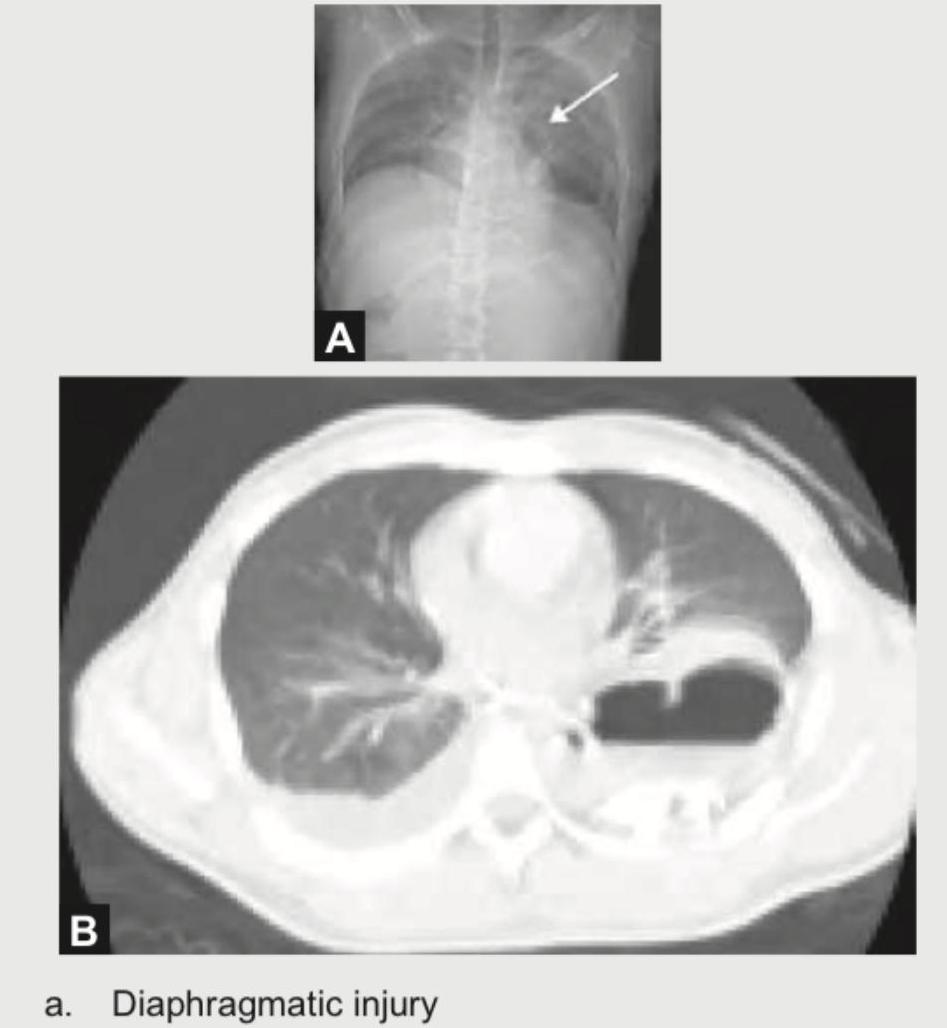
What is the imaging modality of choice in the setting of head trauma?
A patient presents to the emergency department with abdominal pain. What is the MOST significant diagnosis?

Pneumatocele is seen in fracture of which sinus?
The dependant viscera sign is seen in which of the following conditions?
Computed tomography (CT) is useful in the formulation of a treatment plan of blow-out fractures because:
What is the investigation of choice for the evaluation of upper abdominal trauma in a patient with stable vitals?
Which of the following appears hyperdense on CT?
Which radiographic view best visualizes zygoma fractures?
Pneumocephalus is most commonly seen with fractures of which anatomical structure?
Tear drop sign is seen in:
Explanation: **Explanation:** In the acute setting of head trauma, **Non-Contrast Computed Tomography (NCCT) of the head** is the gold standard and the initial imaging modality of choice. **Why Option A is correct:** 1. **Speed and Accessibility:** Helical (spiral) CT is rapid, which is critical for unstable trauma patients. 2. **Acute Hemorrhage:** It is highly sensitive for detecting acute intracranial hemorrhage (which appears hyperdense/white). 3. **Bony Injuries:** It provides excellent visualization of skull fractures. 4. **No Contrast Needed:** IV contrast is avoided initially because it can extravasate or mimic the appearance of acute blood, making it difficult to differentiate a bleed from enhancement. **Why other options are incorrect:** * **Option B:** Contrast is generally avoided in trauma as it obscures acute blood and adds unnecessary time and risk of nephropathy/anaphylaxis. * **Option C:** While MRI is more sensitive for Diffuse Axonal Injury (DAI) and subacute changes, it is time-consuming, expensive, and difficult to monitor unstable patients inside the magnet. * **Option D:** Skull X-rays have a low sensitivity for intracranial pathology; a "normal" X-ray does not rule out a life-threatening intracranial bleed. **High-Yield Clinical Pearls for NEET-PG:** * **Epidural Hematoma (EDH):** Biconvex/Lens-shaped, does not cross sutures, usually involves the Middle Meningeal Artery. * **Subdural Hematoma (SDH):** Crescent-shaped, crosses sutures, involves tearing of cortical bridging veins. * **GCS Threshold:** Imaging is generally indicated if GCS <15 two hours after injury. * **Windowing:** Always evaluate the "Bone Window" to look for subtle fractures and the "Blood Window" to identify small hemorrhages.
Explanation: ***Superior mesenteric artery embolus*** - **Acute mesenteric ischemia** from SMA embolus requires **immediate surgical intervention** (within 6-8 hours) to prevent bowel necrosis and death. - **CT angiography** shows **filling defect** in the SMA with **decreased bowel wall enhancement** and potential **pneumatosis intestinalis**. *Superior mesenteric vein thrombosis* - Causes **venous congestion** rather than arterial ischemia, progressing more **slowly** than arterial embolus. - **CT shows thrombus** in the SMV with **bowel wall thickening** and **mesenteric edema**, but less immediately life-threatening. *Aortic dissection* - Presents with **tearing chest/back pain** radiating to the abdomen, not primarily abdominal pain. - **CT shows intimal flap** and **false lumen** in the aorta, but may not cause immediate bowel ischemia. *Leaking aortic aneurysm* - Typically presents with **hypotension** and **pulsatile abdominal mass** rather than isolated abdominal pain. - **CT shows retroperitoneal hematoma** and **aortic wall irregularity**, but bowel perfusion usually remains intact.
Explanation: **Explanation:** A **pneumatocele** (specifically an intracranial pneumatocele or pneumocephalus) refers to the presence of air within the cranial cavity. This occurs when there is a breach in the barriers separating the paranasal sinuses from the intracranial space. **Why Frontal Sinus is the Correct Answer:** The **frontal sinus** is the most common site associated with post-traumatic pneumatocele. This is because the posterior wall of the frontal sinus is in direct contact with the anterior cranial fossa. A fracture involving the **posterior table** of the frontal sinus, accompanied by a tear in the underlying **dura mater**, creates a "one-way valve" mechanism. This allows air to be forced into the intracranial space (often due to coughing, sneezing, or nose-blowing) but prevents it from escaping, leading to an accumulation of air. **Analysis of Incorrect Options:** * **Maxillary Sinus:** Fractures here typically lead to subcutaneous emphysema or air in the soft tissues of the cheek, but not intracranial pneumatocele, as it is not adjacent to the cranial vault. * **Ethmoid Sinus:** While ethmoid fractures (lamina papyracea) can cause orbital emphysema or occasionally pneumocephalus, they are statistically less common causes of large pneumatoceles compared to the frontal sinus. * **Sphenoid Sinus:** Fractures here can cause pneumocephalus or CSF rhinorrhea, but they are less frequent and often associated with high-energy basilar skull fractures rather than isolated pneumatoceles. **High-Yield Clinical Pearls for NEET-PG:** * **Mount Fuji Sign:** A classic radiological sign on CT head where tension pneumocephalus causes compression of the frontal lobes, resembling the peaks of Mt. Fuji. * **Most common cause of Pneumocephalus:** Trauma (Skull base fractures). * **CSF Rhinorrhea:** Frequently co-exists with frontal or ethmoid sinus fractures; the presence of "Target" or "Halo" sign on a pillowcase is a classic clinical indicator. * **Investigation of Choice:** Non-Contrast CT (NCCT) Head is the gold standard for detecting intracranial air.
Explanation: ### Explanation **1. Why Diaphragmatic Rupture is Correct:** The **Dependent Viscera Sign** is a classic CT finding in **traumatic diaphragmatic rupture**. Under normal conditions, the diaphragm supports the abdominal organs (liver, spleen, and stomach), keeping them away from the posterior chest wall. When the diaphragm is ruptured, this support is lost. Consequently, the abdominal viscera "fall" posteriorly due to gravity and lie in direct contact with the posterior ribs or the posterior thoracic wall. This sign is highly specific (approx. 95%) for blunt diaphragmatic injury. **2. Analysis of Incorrect Options:** * **B. Fractured Bronchus:** This typically presents with the "Fallen Lung Sign" (the lung falls away from the hilum towards the dependent part of the hemithorax) and persistent pneumothorax despite chest tube drainage. * **C. Pneumoperitoneum:** This refers to free air in the peritoneal cavity. Key radiological signs include the Rigler sign (double wall sign), Cupola sign, or Football sign on an X-ray. * **D. Diaphragmatic Hernia:** While a rupture is a type of acquired hernia, the "Dependent Viscera Sign" specifically refers to the acute traumatic loss of diaphragmatic integrity where organs collapse against the posterior wall. Congenital hernias (like Bochdalek) usually have a well-defined hernial sac or defect edges that don't necessarily result in this specific "falling" appearance. **3. Clinical Pearls for NEET-PG:** * **Collar Sign:** Another specific sign for diaphragmatic rupture, representing a "waist-like" constriction of the herniated abdominal organs at the site of the diaphragmatic defect. * **Dangling Diaphragm Sign:** Seeing the free edge of the torn diaphragm. * **Most Common Side:** Diaphragmatic rupture is more common on the **left side** (the liver provides a protective cushioning effect on the right). * **Gold Standard Investigation:** Contrast-enhanced CT (CECT) of the chest and abdomen.
Explanation: **Explanation:** **Why Option D is correct:** Computed Tomography (CT) is the **gold standard** for evaluating orbital blow-out fractures. Its primary clinical utility lies in its ability to provide high-resolution, multiplanar (axial and coronal) visualization of the bony anatomy and adjacent soft tissues. In a blow-out fracture, CT accurately determines the **size of the defect** and identifies **soft tissue complications**, such as herniation of orbital fat or entrapment of the inferior rectus muscle. This information is critical for surgical planning, as large defects (>50% of the floor) or significant muscle entrapment are indications for operative intervention. **Analysis of Incorrect Options:** * **Option A:** While CT is the preferred modality, it is not the "only" way. Clinical examination and plain radiographs (e.g., Water’s view showing the "Teardrop sign") can suggest a fracture, though they lack the detail required for surgical planning. * **Option B:** While CT can evaluate coexistent sinus disease (like opacification due to hemorrhage), this is a secondary finding and not the primary reason CT is used to formulate a treatment plan for the fracture itself. * **Option C:** MRI is superior for soft tissue detail but is **inferior to CT** for evaluating cortical bone. Furthermore, MRI is contraindicated if a metallic foreign body is suspected in the orbit. **Clinical Pearls for NEET-PG:** * **Most common site:** The **orbital floor** (specifically the thin bone medial to the infraorbital canal) is the most common site for blow-out fractures. * **Imaging View of Choice:** **Coronal CT scans** are the best for visualizing floor and roof fractures. * **Teardrop Sign:** On a Water’s view radiograph, this represents the herniated orbital contents into the maxillary sinus. * **Clinical Sign:** Diplopia on upward gaze and infraorbital nerve anesthesia are classic findings.
Explanation: **Explanation:** In the setting of blunt or penetrating upper abdominal trauma, the choice of investigation is primarily dictated by the patient's **hemodynamic stability**. **Why Computed Tomography (CT) is the Correct Answer:** For a **hemodynamically stable** patient, a **Contrast-Enhanced CT (CECT)** of the abdomen and pelvis is the gold standard and investigation of choice. It offers high sensitivity and specificity for identifying solid organ injuries (liver, spleen, kidneys), detecting active hemorrhage (contrast blush), and evaluating the retroperitoneum, which is poorly visualized on ultrasound. It also allows for the grading of injuries, which guides non-operative management. **Why the Other Options are Incorrect:** * **Ultrasound (USG/FAST):** While Focused Assessment with Sonography for Trauma (FAST) is the initial screening tool for *unstable* patients to detect free fluid (hemoperitoneum), it cannot reliably grade solid organ injuries or detect hollow viscus/retroperitoneal damage. * **Scintigraphy:** Nuclear medicine scans are too time-consuming and lack the anatomical detail required for acute trauma evaluation. * **MRI:** Although highly detailed, MRI is impractical in emergencies due to long acquisition times, difficulty in monitoring the patient inside the bore, and incompatibility with metallic resuscitation equipment. **Clinical Pearls for NEET-PG:** * **Hemodynamically Unstable + Positive FAST:** Proceed directly to **Laparotomy**. * **Hemodynamically Stable:** **CECT** is the investigation of choice regardless of FAST results if clinical suspicion is high. * **Seatbelt Sign:** Always look for bowel or mesenteric injuries on CT. * **Triple Contrast CT:** Occasionally used to rule out subtle distal esophageal or duodenal perforations.
Explanation: **Explanation:** In Computed Tomography (CT), the density of a tissue is measured in **Hounsfield Units (HU)**. This scale is based on the degree of X-ray attenuation. Substances that attenuate more X-rays appear whiter (**hyperdense**), while those that allow more X-rays to pass through appear darker (**hypodense**). **Why Acute Bleed is Correct:** An **acute hemorrhage** typically has a density of **+60 to +80 HU**. This hyperdensity is primarily due to the high concentration of **hemoglobin** and the formation of a fibrin clot, which increases the protein density within the blood. As the clot retracts and the hemoglobin breaks down over time (chronic stage), the density decreases, eventually becoming isodense and then hypodense. **Analysis of Incorrect Options:** * **A. Air:** This is the least dense substance on CT, appearing pitch black with a value of **-1000 HU**. * **B. Water:** Water is the reference point for the Hounsfield scale and is assigned a value of **0 HU**. * **C. Fat:** Fat is less dense than water and appears dark grey, typically ranging from **-50 to -100 HU**. **High-Yield Clinical Pearls for NEET-PG:** * **Hounsfield Unit (HU) Cheat Sheet:** * Air: -1000 * Fat: -50 to -100 * Water: 0 * Soft Tissue: +40 to +80 * **Acute Blood: +60 to +80** * Bone/Calcification: +400 to +1000 * **Evolution of Blood on CT:** Acute (Hyperdense) $\rightarrow$ Subacute (Isodense) $\rightarrow$ Chronic (Hypodense). * **Contrast Media:** Intravenous contrast (Iodine-based) also appears hyperdense on CT.
Explanation: The **Occipitomental view (Water’s view)** is the gold standard radiographic projection for evaluating mid-facial fractures, particularly those involving the **zygoma** and the maxillary sinuses. ### Why Occipitomental View is Correct: In this projection, the patient’s chin is tilted up against the film, which displaces the dense petrous pyramids of the temporal bone downward, below the floor of the maxillary sinuses. This provides an unobstructed view of the **zygomatic bone, zygomatic arch, infraorbital rims, and the maxillary sinuses**. It is specifically used to diagnose the "Tripod fracture" (Zygomaticomaxillary complex fracture). ### Why Other Options are Incorrect: * **Lateral Oblique View:** Primarily used to visualize the body and ramus of the **mandible**, not the mid-face or zygoma. * **Towne’s View:** An AP axial projection used to visualize the **occipital bone** and the condylar processes of the mandible. It is the best view for mandibular condyle fractures. * **Lateral Skull View:** Useful for visualizing the sella turcica, paranasal sinuses (fluid levels), and calvarial fractures, but the superimposition of facial bones makes it poor for isolating zygomatic injuries. ### High-Yield Clinical Pearls for NEET-PG: * **Submentovertex View (Jug-handle view):** The best view for isolated fractures of the **zygomatic arch**. * **Black Line (Ames’ Line):** On a Water’s view, look for the "hanging drop" sign or disruption of the orbital floor (Blow-out fracture). * **Tripod Fracture:** Involves three points: the zygomaticofrontal suture, the infraorbital rim, and the zygomaticotemporal suture (arch). * **Caldwell View (Occipitofrontal):** Best for visualizing the frontal sinuses and superior orbital rims.
Explanation: **Explanation:** **Pneumocephalus** refers to the presence of air within the cranial cavity. It occurs when a breach in the skull base or calvarium creates a communication between the intracranial space and the external environment or air-containing paranasal sinuses. **Why Frontal Sinus is Correct:** The **frontal sinus** is the most common site of fracture leading to pneumocephalus. This is due to its prominent, exposed position in the forehead and its close anatomical relationship with the anterior cranial fossa. A fracture of the posterior wall of the frontal sinus frequently results in a dural tear, allowing air to be forced into the intracranial space (often via a "ball-valve" mechanism during coughing or sneezing). **Analysis of Incorrect Options:** * **Maxillary Sinus:** While common in facial trauma (Le Fort fractures), it is separated from the intracranial compartment by the ethmoid bone and orbits. It rarely causes pneumocephalus unless associated with extensive skull base injury. * **Sphenoid Sinus:** Fractures here can cause pneumocephalus or CSF rhinorrhea, but they are less common than frontal injuries due to the protected, central location of the sphenoid bone. * **Mastoid Antrum:** Fractures of the temporal bone (petrous part) can lead to air in the posterior fossa or tegmen tympani, but statistically, these occur less frequently than frontal sinus involvements. **Clinical Pearls for NEET-PG:** * **Mount Fuji Sign:** A classic radiologic sign on CT showing tension pneumocephalus, where air compresses the frontal lobes, creating a peaked appearance. * **Most common cause:** Overall, trauma is the leading cause of pneumocephalus (75%), followed by iatrogenic causes (neurosurgery). * **CSF Rhinorrhea:** Frequently co-exists with frontal or ethmoid fractures; look for the "halo sign" or "target sign" on bedsheets. * **Investigation of Choice:** Non-contrast CT (NCCT) Head is the gold standard for detecting even minute amounts of intracranial air.
Explanation: **Explanation:** The **Tear Drop Sign** is a classic radiological finding seen on a Water’s view (occipitomental projection) X-ray, indicating a **blow-out fracture of the orbital floor**. **Why it occurs:** When a blunt object (larger than the orbital rim, like a tennis ball or fist) strikes the eye, the intraorbital pressure increases suddenly. This pressure is transmitted to the weakest part of the orbit—the floor (maxillary bone). The fracture allows orbital fat and the **inferior rectus muscle** to herniate downward into the maxillary sinus. On imaging, this herniated soft tissue mass appears as a "tear drop" hanging from the roof of the maxillary sinus. **Analysis of Incorrect Options:** * **B. Fracture of lateral wall of nose:** Usually presents with epistaxis and localized deformity; it does not involve the maxillary sinus roof or orbital contents. * **C. Le Fort’s fracture:** These are complex midface fractures. While Le Fort II and III involve the orbit, they are characterized by specific patterns of craniofacial dissociation rather than the isolated "tear drop" herniation. * **D. Fracture of zygomatic arch:** Typically presents with a "V-shaped" deformity on a Submentovertex view (Jug-handle view) and does not involve the orbital floor. **High-Yield Clinical Pearls for NEET-PG:** * **Most common site of orbital blow-out fracture:** Orbital floor (specifically medial to the infraorbital groove). * **Clinical Presentation:** Enophthalmos (sunken eye), diplopia (due to inferior rectus entrapment), and anesthesia in the distribution of the **infraorbital nerve**. * **Imaging Gold Standard:** Non-contrast CT (NCCT) of the Orbits (Coronal sections are best for visualizing the floor). * **Black Eyebrow Sign:** Another radiological sign of orbital fracture representing intraorbital air (orbital emphysema).
Trauma Imaging Protocols
Practice Questions
Head Trauma Imaging
Practice Questions
Spine Trauma Imaging
Practice Questions
Chest Trauma Imaging
Practice Questions
Abdominal Trauma Imaging
Practice Questions
Musculoskeletal Trauma Imaging
Practice Questions
Non-traumatic Neurological Emergencies
Practice Questions
Non-traumatic Thoracic Emergencies
Practice Questions
Non-traumatic Abdominal Emergencies
Practice Questions
Vascular Emergencies
Practice Questions
Pediatric Emergency Imaging
Practice Questions
Imaging of Non-accidental Trauma
Practice Questions
Get full access to all questions, explanations, and performance tracking.
Start For Free