Excretory urography is contraindicated in:
All of the following dyes are water soluble except:
Dye used in IV cholangiography is:
Dye used for "Myelography" is:
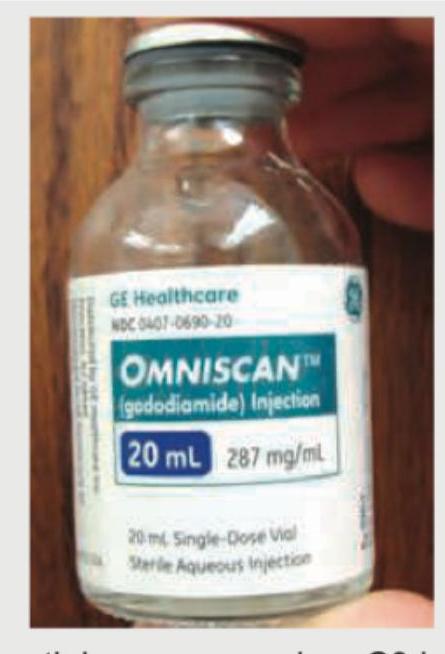
Gadolinium is a contrast agent used for:
Non-Iodine containing contrast is
Which of the following statements about contrast in radiography is true:
Which contrast agent is given in perforation peritonitis?
Which of the following contrast agents is PREFERRED in a patient with renal dysfunction for the prevention of contrast-induced nephropathy?
Which contrast agent is not used for CT scans?
Explanation: ***Multiple myeloma*** - Patients with **multiple myeloma** are at high risk of developing **contrast-induced nephropathy** due to the precipitation of Bence Jones proteins in renal tubules when exposed to iodinated contrast agents. - This can lead to **acute kidney injury** or worsening of pre-existing renal impairment, making excretory urography generally contraindicated. *Single kidney* - While careful consideration is needed, having a **single kidney** does not inherently contraindicate excretory urography if renal function is good. - The primary concern is protecting the remaining kidney from **contrast-induced nephropathy** in patients with pre-existing renal dysfunction, not the number of kidneys. *Trauma* - In cases of **renal trauma**, excretory urography (or more commonly, CT urography) can be used to assess the extent of injury and integrity of the urinary tract. - It is often indicated to evaluate **hematuria** or suspected kidney damage, not contraindicated. *Renal artery hypertension* - Excretory urography was historically used to evaluate for **renal artery stenosis**, a cause of **renal artery hypertension**, by looking for delayed contrast excretion or kidney size differences. - While it has largely been replaced by more modern imaging like CT angiography or MRA, it is not considered a contraindication and can provide some diagnostic information.
Explanation: ***Myodil*** - **Myodil** (Iophendylate) is an **oil-based** contrast medium previously used for myelography. - Due to its **oil-based nature**, it is not water-soluble and had to be removed after the procedure to prevent complications. *Iohexol* - **Iohexol** is a **non-ionic, water-soluble** contrast agent commonly used in various radiological procedures, including myelography. - Its water solubility allows for easy absorption and excretion from the body. *Conray 420* - **Conray 420** (Iothalamate meglumine) is an **ionic, water-soluble** contrast agent often used for angiography and urography. - It readily mixes with bodily fluids due to its water-soluble properties. *Metrizamide* - **Metrizamide** was an early **non-ionic, water-soluble** contrast agent specifically developed for myelography. - Although water-soluble, it had a higher incidence of neurotoxicity compared to newer agents like iohexol.
Explanation: ***Billigraffin*** - **Billigraffin** (also known as sodium **iodipamide**) was historically the **primary contrast agent** used in intravenous (IV) cholangiography. - It is an **iodinated contrast medium** specifically designed for excretion into the **biliary system**, allowing visualization of the bile ducts. *Conray* - **Conray** (iothalamate meglumine) is a general-purpose **ionic iodinated contrast medium** primarily used for **angiography, CT scans**, and **excretory urography**. - It is not specifically formulated for optimal **biliary excretion** and would not provide adequate visualization for IV cholangiography. *Myodil* - **Myodil** (iophendylate) is an **oil-based iodinated contrast medium** that was historically used for **myelography** to visualize the spinal canal. - Due to its **oil-based nature** and different excretion pathway, it is entirely unsuitable for **IV cholangiography**. *Dianosil* - **Dianosil** was a trade name for certain **bronchography contrast agents** containing iodized oil, used to visualize the tracheobronchial tree. - This type of contrast medium is designed for **pulmonary application** and would not be used for imaging the biliary system.
Explanation: ***Iohexol (Omnipaque)*** - Iohexol is a **non-ionic, low-osmolar monomeric contrast agent** and is the **most commonly used agent for myelography** worldwide. - It is **FDA-approved for intrathecal use** and has extensive safety data with **low neurotoxicity**. - Its widespread availability and proven safety profile make it the **standard choice** for myelography in clinical practice. *Iopamidol (Isovue)* - Iopamidol is also a **non-ionic, low-osmolar monomeric agent** that is FDA-approved for myelography. - While it is a suitable alternative to iohexol, **iohexol remains more commonly used** in most centers. - Both agents have similar safety profiles for intrathecal administration. *Iodixanol (Visipaque)* - Iodixanol is an **iso-osmolar dimeric contrast agent** primarily used for **cardiac and vascular imaging**. - While theoretically advantageous due to iso-osmolarity, it has **limited approval and use for myelography** compared to iohexol. - It is **not the standard or most commonly used agent** for this procedure. *Barium sulfate* - This is an **insoluble oral or rectal contrast agent** used exclusively for gastrointestinal imaging. - It is **absolutely contraindicated for intrathecal use** as it causes severe neurotoxicity and potentially fatal reactions. - Only **water-soluble iodinated contrast agents** should be used for myelography.
Explanation: ***MRI - Imaging*** - **Gadolinium** is a paramagnetic substance commonly used as a contrast agent in **Magnetic Resonance Imaging (MRI)**. - It works by altering the **T1 relaxation times** of protons in tissues, enhancing the signal and improving the visibility of certain structures or pathologies like **tumors** or **inflammation**. *CT - angiography* - **CT angiography** typically uses **iodine-based contrast agents**, not gadolinium, to visualize blood vessels. - Iodine contrast agents work by absorbing X-rays, making blood vessels appear bright on CT images. *Bronchography* - **Bronchography** is an older imaging technique that involved introducing an **iodinated contrast medium** directly into the bronchial tree. - It has largely been replaced by **high-resolution CT scans** for evaluating airways. *Contrast Sonography* - **Contrast-enhanced ultrasound (CEUS)**, or contrast sonography, primarily uses **microbubble contrast agents** made of inert gas. - These microbubbles enhance the reflectivity of blood, improving visualization of blood flow and organ perfusion.
Explanation: ***Gd DTPA*** - **Gadolinium-DTPA** (diethylenetriamine pentaacetic acid) is a **gadolinium-based contrast agent** used in MRI, which does not contain iodine. - It enhances images by shortening the **T1 relaxation time** of protons in tissues. *Diatrizoate* - **Diatrizoate** is an **iodinated contrast medium** commonly used in radiography and CT scans. - It contains iodine, which opacifies structures by **attenuating X-rays**. *Visipaque* - **Visipaque** (Iodixanol) is an **iodinated, non-ionic, dimeric contrast medium** with iso-osmolar properties. - It explicitly contains iodine as the contrast-enhancing element. *Iohexol* - **Iohexol** is another widely used **iodinated, non-ionic contrast agent** for various radiological procedures. - Its mechanism of action relies on the presence of iodine atoms to block X-rays.
Explanation: ***Ionic monomers have three iodine atoms per two particles in solution*** - **Ionic monomeric contrast agents** (e.g., diatrizoate, iothalamate) dissociate in solution, producing **two particles** (one cation and one anion containing three iodine atoms) per molecule. - This dissociation results in a **high osmolality** compared to non-ionic agents, as osmolality is determined by the number of particles in solution. *Gadolinium cannot cross an intact blood brain barrier* - This statement is **FALSE** - **Gadolinium-based contrast agents CAN cross the blood-brain barrier when it is compromised**. - They are used in MRI precisely because they extravasate into tissues where the **blood-brain barrier is disrupted**, such as in tumors, inflammation, or infections. - However, they do **not cross an intact BBB** due to their size and hydrophilicity. *Iohexol is a high osmolar contrast media* - **Iohexol** is a **non-ionic, low osmolality contrast medium** (LOCM). - Its non-ionic nature means it does not dissociate in solution, leading to a significantly lower osmolality compared to older ionic agents. *Non-ionic contrast agents are always high osmolar* - **Non-ionic contrast agents** are characterized by their molecular structure which **does not dissociate into ions** in solution. - This property makes them **low osmolar** or **iso-osmolar**, meaning they have fewer particles in solution compared to ionic agents, thereby reducing osmolality.
Explanation: ***Diatrizoate*** - **Diatrizoate**, a **water-soluble iodinated contrast agent**, is safe for use in suspected bowel perforation because it is absorbed and excreted by the kidneys if it extravasates into the peritoneal cavity. - Unlike barium, it does not cause severe **peritoneal inflammation** or scarring if it leaks into the peritoneum. *Iohexol* - Iohexol is a **non-ionic, low-osmolar contrast medium** primarily used for intravascular administration or for imaging structures like the urinary tract or cerebral arteries. - While water-soluble, it is generally not the first choice for gastrointestinal perforations as **Diatrizoate** has a longer established safety profile and lower cost for this specific indication. *Metrizoate* - Metrizoate is an **ionic, high-osmolar contrast media** that is less commonly used today due to its higher osmolarity and potential for side effects compared to newer agents. - It could theoretically be used in perforation due to its water solubility, but its higher osmolality makes it less preferred than **Diatrizoate**, which is more readily available and widely accepted for this specific application. *Iodixanol* - Iodixanol is an **iso-osmolar, non-ionic contrast medium** mainly used for intravascular procedures, particularly in patients at risk of contrast-induced nephropathy. - While it is water-soluble and safer for intravascular use, it is generally not used for suspected bowel perforations due to its higher cost and the established efficacy and safety of **Diatrizoate** for this specific indication.
Explanation: ***Iso-osmolar contrast*** - **Iso-osmolar contrast agents** (e.g., iodixanol) have an osmolality of ~290 mOsm/kg, which is identical to that of plasma. - **This is the PREFERRED choice** in patients with renal dysfunction as multiple studies demonstrate the lowest risk of contrast-induced nephropathy (CIN). - The iso-osmolar formulation minimizes osmotic stress on renal tubules and reduces the risk of acute kidney injury. - **Current guidelines recommend iso-osmolar agents as first-line** in high-risk patients with pre-existing renal impairment. *Low osmolar contrast* - **Low osmolar contrast agents** have osmolality of 600-900 mOsm/kg, which is significantly lower than high osmolar agents but still 2-3 times higher than plasma. - While **acceptable and safer than high osmolar agents**, they are not as optimal as iso-osmolar contrast for patients with renal dysfunction. - These agents are widely used and represent a reasonable alternative when iso-osmolar agents are not available. *High osmolar contrast* - **High osmolar contrast agents** have osmolality >1400 mOsm/kg (about 5 times that of plasma). - They carry the **highest risk of contrast-induced nephropathy** due to severe osmotic load and direct tubular toxicity. - **Contraindicated or strongly avoided** in patients with pre-existing renal dysfunction. *Ionic contrast* - **Ionic contrast** refers to the chemical structure (dissociates into ions) rather than osmolality. - Can be either high or low osmolar—the ionic nature alone does not determine renal safety. - The critical factor for nephrotoxicity prevention is osmolality, not ionic charge.
Explanation: ***CO2*** - **CO2** (carbon dioxide) is **not used as a contrast agent in CT scans**. - CO2 is primarily used in **angiography** (especially for peripheral vessels in patients with iodine allergy or renal insufficiency) where it acts as a negative contrast agent. - In CT, CO2 would appear as air/gas density and create artifacts rather than providing diagnostic enhancement, making it unsuitable for routine CT imaging. *Iodinated high-osmolality contrast media* - These are **iodinated contrast agents** that contain iodine atoms which strongly attenuate X-rays, making them highly effective for **CT imaging**. - High-osmolality contrast media (HOCM) like **diatrizoate** and **iothalamate** were the standard CT contrast agents historically. - They have largely been replaced by **low-osmolality** and **iso-osmolality** agents due to higher incidence of **adverse reactions**, but they are still used for CT scans. *Barium compounds* - **Barium sulfate** suspensions are widely used as **oral or rectal contrast agents** for CT imaging of the gastrointestinal tract. - Barium has high atomic number and effectively attenuates X-rays, making the **GI lumen clearly visible** on CT scans. - Used in **CT enterography**, **CT colonography**, and routine **abdominal/pelvic CT** protocols. *Gadolinium-based contrast agents* - **Gadolinium-based contrast agents (GBCAs)** are primarily designed for **MRI** due to their **paramagnetic properties**. - However, gadolinium DOES attenuate X-rays and can be used **off-label for CT** in patients with **severe iodine allergy** or **contraindications to iodinated contrast**. - While less effective than iodinated agents for CT (requiring higher doses), gadolinium-enhanced CT is a recognized alternative in special clinical circumstances.
Chemistry of Contrast Media
Practice Questions
Pharmacokinetics of Contrast Agents
Practice Questions
Classification of Contrast Reactions
Practice Questions
Risk Factors for Contrast Reactions
Practice Questions
Prevention of Contrast Reactions
Practice Questions
Treatment of Acute Contrast Reactions
Practice Questions
Contrast-Induced Nephropathy
Practice Questions
Nephrogenic Systemic Fibrosis
Practice Questions
Extravasation of Contrast Media
Practice Questions
Guidelines for Contrast Administration
Practice Questions
Alternative Contrast Agents
Practice Questions
Documentation and Medicolegal Aspects
Practice Questions
Get full access to all questions, explanations, and performance tracking.
Start For Free