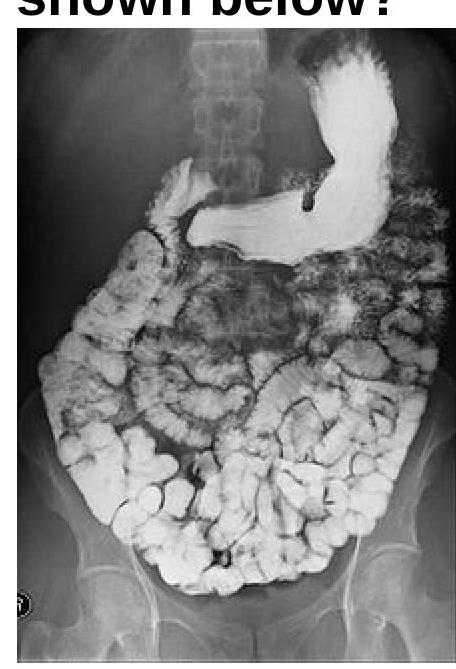
Identify the imaging modality and the location of pathology shown in the image.

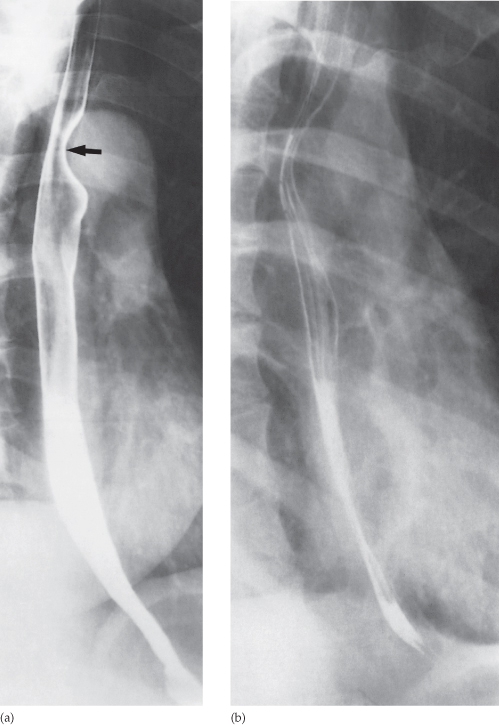
The Barium Swallow examination shows a mass in the esophagus. What can be the most probable diagnosis?
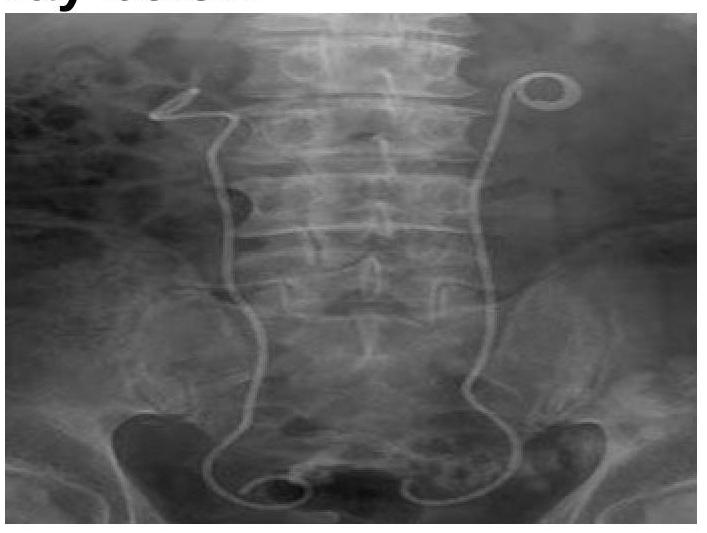
What is the structure seen in the X-ray?
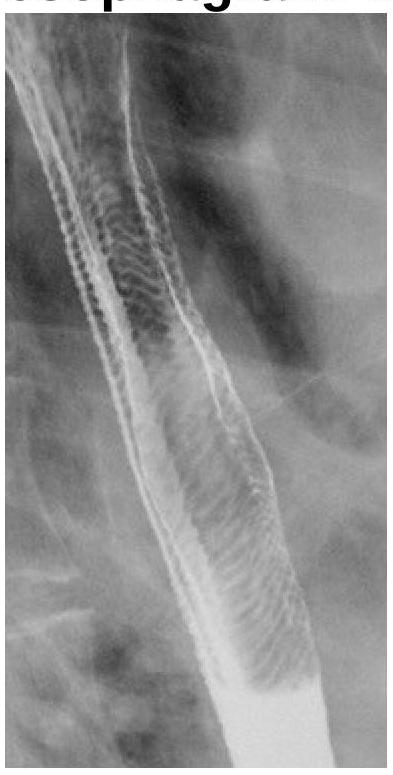
What does the following radiograph from a double contrast esophagram represent?
Which of the following imaging techniques is NOT typically used for diagnosing uterine anomalies?
Which of the following is not considered a contraindication for undergoing an MRI?
What is an X-ray artifact?
What is the investigation of choice for whole body imaging in metastatic breast cancer?
Barium swallow is used for -
The procedure of choice for the evaluation of aortic aneurysms is -
Explanation: ***MCU with Bulbar urethral stricture*** - The image shown is a **Micturating Cystourethrogram (MCU)** because the bladder is filled with contrast and the urethra is being visualized during urination. - There is a clear **narrowing (stricture)** in the **bulbar portion of the urethra**, appearing as a segment with reduced caliber, consistent with a bulbar urethral stricture. *MCU with penile stricture* - While it is an MCU, the stricture is located in the **bulbar urethra**, which is proximal to the penile (pendulous) urethra. - A penile stricture would be seen further distally in the urethra. *RGU with membranous stricture* - This is an **MCU**, not a Retrograde Urethrogram (RGU), which is performed by inserting contrast from the urethral meatus. In an MCU, the contrast flows antegrade from the bladder. - A **membranous stricture** would be located more proximally, within the deep perineal pouch, between the bulbar urethra and the prostatic urethra. *RGU with prostatic stricture* - As mentioned, this is an **MCU**, not an RGU. - A prostatic stricture would be located within the **prostatic urethra**, which is much more proximal than the stricture seen in this image.
Explanation: ***Esophageal Cancer*** - A **mass** identified in the esophagus on **Barium Swallow** is highly suggestive of esophageal cancer, typically presenting as a **solitary lesion**. - Other associated features may include **dysphagia**, weight loss, and potentially lymphadenopathy on imaging. *Esophageal Ring (Stricture)* - Usually presents as a **narrowing of the esophagus** rather than a distinct mass on imaging, often causing intermittent **dysphagia**. - The appearance is more likely to cause **functional obstruction** rather than present as a **solid mass** in the esophagus. *Esophageal Perforation* - This condition would not present as a **mass**; instead, symptoms include **severe chest pain**, and may show mediastinal air on imaging. - Perforation leads to **acute symptoms** and signs of **infection**, differentiating it from a neoplastic process. *Achalasia* - Characterized by **dilated esophagus** with a **bird-beak appearance** on imaging rather than a discrete mass. - It commonly results in **dysphagia** for solids and liquids, not presenting as a mass lesion on Barium Swallow.
Explanation: ***Stent*** - The image clearly shows **bilateral coiled structures** (pigtails) at the proximal and distal ends within the renal pelvis and bladder, which are characteristic features of **double J stents (ureteral stents)**. - These devices are used to maintain patency in the **ureters**, often to bypass obstructions or facilitate urine drainage. *Surgical clips* - **Surgical clips** are typically small, dense, metallic objects used to ligate vessels or tissue, appearing as tiny, bright specks on X-rays. - The structures seen in the image are long, tubular, and coiled, which is inconsistent with the appearance of surgical clips. *Foley catheter* - A **Foley catheter** is a flexible tube inserted into the bladder to drain urine, sometimes with a balloon tip. - It would typically be seen entirely within the **bladder**, and its path would not extend bilaterally into the renal pelvis as shown. *Intravesical wire* - An **intravesical wire** (a wire entirely within the bladder) would appear as a coiled or linear structure confined to the bladder itself. - The structures in the image extend from the renal region down into the bladder, traversing the **ureters**, which is not typical for an intravesical wire.
Explanation: **Feline esophagus (Correct)** - The image displays a characteristic transverse striation pattern along the esophageal mucosa, resembling the rings seen in the esophagus of a cat (hence "feline esophagus") - This finding is often associated with gastroesophageal reflux disease (GERD) or eosinophilic esophagitis, representing mucosal edema and inflammation - Also known as "ringed esophagus" or "corrugated esophagus" *Esophageal atresia (Incorrect)* - This is a congenital condition where the esophagus ends in a blind pouch, making it impossible for food to reach the stomach - The radiograph clearly shows a patent esophagus with contrast flowing through it, which rules out atresia *Esophageal stenosis (Incorrect)* - Esophageal stenosis refers to a narrowing of the esophagus, which would appear as a constricted segment on a barium swallow - While there is some irregularity, the primary pattern seen is transverse rings, not a focal, sustained narrowing typical of stenosis *Tracheoesophageal fistula (Incorrect)* - A tracheoesophageal fistula is an abnormal connection between the esophagus and the trachea - This would typically present with aspiration of contrast into the trachea or lungs, which is not evident in the provided image
Explanation: ***CT (Computed Tomography)*** - **CT scans** are generally not the preferred imaging modality for diagnosing uterine anomalies due to their **poor soft-tissue contrast** compared to MRI and ultrasound, and the associated **radiation exposure**. - While CT can visualize gross anatomical structures, it is less effective in differentiating the subtle architectural details of the uterus and its internal cavities that are crucial for anomaly detection. *MRI (Magnetic Resonance Imaging)* - **MRI** is considered the **gold standard** for diagnosing complex uterine anomalies due to its excellent **soft-tissue resolution** and multiplanar imaging capabilities. - It provides detailed anatomical information about the uterine muscular layers, uterine cavity, and cervix without the use of ionizing radiation. *Ultrasound (USG)* - **Transvaginal ultrasound (TVS)**, often supplemented with 3D ultrasound, is frequently the **first-line imaging technique** for evaluating uterine anomalies due to its non-invasiveness, accessibility, and ability to provide real-time images. - It can effectively visualize the uterine shape, septum, and fundal contour, and differentiate between various types of anomalies. *Hysterosalpingography (HSG)* - **HSG** is primarily used to evaluate the **patency of the fallopian tubes** and the **internal contour of the uterine cavity**. - While it can identify certain uterine anomalies like septate or bicornuate uteri by outlining the endometrial cavity, it provides limited information about the myometrial wall or external uterine contour.
Explanation: ***Ryle's tube*** - A **Ryle's tube** is a form of nasogastric tube made of radiopaque plastic, which is entirely **MRI-safe** and does not interact with magnetic fields. - It is made from inert materials that are **non-ferromagnetic**, posing no risk during an MRI scan. *Cardiac pacemaker* - **Cardiac pacemakers** contain metallic components that can malfunction, demagnetize, or migrate due to the strong magnetic fields and radiofrequency pulses of an MRI. - This can lead to **arrhythmias**, **pacemaker failure**, or **heating of leads**, posing a significant risk to the patient. *Cochlear implant* - **Cochlear implants** contain strong magnets and electronic components that can be damaged or displaced by the MRI's magnetic field. - This can cause **pain**, **implant damage**, or **hearing loss** for the patient. *Metallic splinter in eye* - A **metallic splinter in the eye** is a severe contraindication because the strong magnetic field can cause the metal fragment to move. - This movement can lead to **tissue damage**, **hemorrhage**, or **blindness** if it dislodges in the delicate structures of the eye.
Explanation: ***An unwanted image distortion that doesn't represent actual anatomy*** - An **X-ray artifact** is any feature or distortion on a radiographic image that is not present in the actual object being imaged. - These can arise from various sources such as patient movement, equipment malfunction, or improper technique, leading to **misinterpretation** of the image. - Artifacts are unwanted findings that can obscure true pathology or mimic disease. *A normal anatomical structure visible on X-ray* - This describes a **true anatomical finding**, which is the intended purpose of an X-ray. - Normal anatomical structures are expected and assist in diagnosis, unlike artifacts which obscure or mimic pathology. *An image distortion produced when the patient moves during the X-ray procedure* - While **patient motion** is a common cause of X-ray artifacts, this describes just one specific type (motion artifact), not a comprehensive definition of what an artifact is. - Other sources like metallic objects, scatter radiation, or detector issues can also cause artifacts. *A radiographic finding that indicates disease pathology* - This describes **true pathology** or disease findings, which is what radiologists aim to identify. - Artifacts are the opposite - they are false findings that do not represent actual anatomy or pathology.
Explanation: ***CT Scan (Correct answer for NEET 2013)*** - **Contrast-enhanced CT scan** was the standard imaging modality for **whole-body staging** in metastatic breast cancer at the time of this exam (2013). - CT offers **excellent spatial resolution** for detecting metastases in **bone, lung, liver, and lymph nodes**. - It is widely available, relatively quick, and provides comprehensive anatomical information. - **Modern Update:** While CT was the standard in 2013, **PET-CT (FDG-PET/CT) is now considered the gold standard** for whole-body staging in metastatic breast cancer due to its combined metabolic and anatomical imaging capabilities. However, PET-CT was not among the options in this historical question. *Magnetic Resonance Imaging* - **MRI** is highly sensitive for specific sites, particularly for **brain metastases** and **bone metastases (especially spine and bone marrow)**. - **Whole-body MRI** protocols are emerging but require longer acquisition times and specialized equipment. - Not ideal as a single first-line modality for comprehensive whole-body staging compared to CT (or modern PET-CT). *Angiography* - **Angiography** is an invasive vascular imaging procedure used to visualize **arterial blood flow**. - It has **no role in routine metastatic screening or staging** of breast cancer. - Reserved for specific indications like preoperative vascular mapping or interventional procedures. *Venography* - **Venography** specifically visualizes **venous structures** and is used to detect venous thrombosis or venous obstructions. - It is **not applicable** for detecting solid organ metastases, bone lesions, or lymph node involvement in cancer staging.
Explanation: ***Esophagus*** - A **barium swallow** specifically visualizes the **esophagus**, pharynx, and sometimes the early stomach. - It's used to identify abnormalities like **dysphagia**, strictures, **achalasia**, or tumors by coating the mucosal lining. *Colon* - The colon is typically examined using a **barium enema**, where barium sulfate is administered rectally. - This procedure is effective for visualizing the large intestine for conditions like **polyps**, diverticula, or inflammatory bowel disease. *Duodenum* - While a barium swallow may transiently show the **duodenum**, its primary target is the esophagus and stomach. - More detailed imaging of the duodenum often requires an **upper GI series (UGI)**, which is a broader study of the upper digestive tract. *Jejunum* - The jejunum is part of the small intestine and is best visualized through a **small bowel follow-through (SBFT)** procedure. - This involves ingesting barium and taking serial X-rays as it progresses through the small bowel, to detect conditions like **Crohn's disease** or obstructions.
Explanation: ***Computed tomography*** - **Computed tomography (CT)** offers excellent spatial resolution and is the gold standard for diagnosing, staging, and pre-operative planning for aortic aneurysms. - It precisely measures aneurysm size, detects mural thrombus, assesses rupture risk, and evaluates the extent of involvement with surrounding structures. *Ultrasonography* - While useful for initial screening and serial monitoring of known abdominal aortic aneurysms due to its non-invasiveness and cost-effectiveness, its accuracy can be limited by **patient body habitus** and **bowel gas**. - It may not reliably visualize the entire aorta or accurately assess complex anatomy and rupture. *Magnetic resonance imaging* - **Magnetic resonance imaging (MRI)** provides detailed anatomical information and avoids radiation exposure, but it is typically more expensive and time-consuming than CT. - It is often reserved for patients with **renal insufficiency** where iodinated contrast is a concern or when evaluating specific tissue characteristics not well seen on CT. *Arteriography* - **Arteriography** (angiography) is an invasive procedure involving direct contrast injection, carrying risks such as arterial injury and nephrotoxicity. - While it can visualize the aortic lumen, it primarily shows the patent lumen and may **underestimate the true aneurysm size** due to mural thrombus. It is typically used for intervention planning or specific contexts rather than initial diagnosis.
Iodinated Contrast Media
Practice Questions
MRI Contrast Agents
Practice Questions
Ultrasound Contrast Agents
Practice Questions
Adverse Reactions to Contrast Media
Practice Questions
Management of Contrast Reactions
Practice Questions
Contrast-Induced Nephropathy
Practice Questions
Barium Studies
Practice Questions
Intravenous Urography
Practice Questions
Angiography Techniques
Practice Questions
Lymphangiography
Practice Questions
Contrast Administration Protocols
Practice Questions
Pretesting and Premedication
Practice Questions
Get full access to all questions, explanations, and performance tracking.
Start For Free