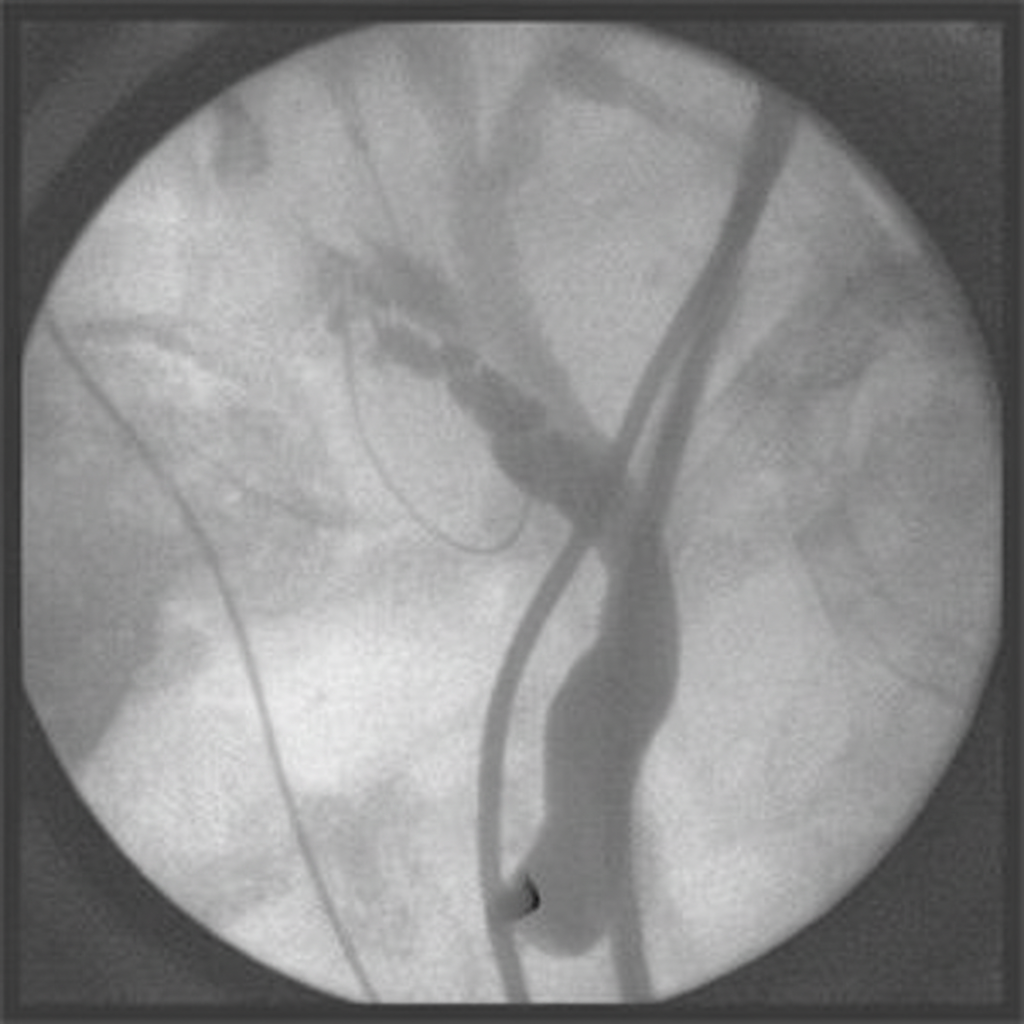
What is the gold standard investigation for renal artery stenosis in a 21-year-old girl?
Intravenous pyelography (IVP) is contraindicated in which of the following conditions?
All of the following are reasons for cone cut except?
All of the following procedures are recommended in darkroom processing except?
A DTPA scan of a hypertensive young lady is normal, and the USG shows a small left kidney. What is the next investigation?
In a patient with an unerupted and impacted maxillary canine, which radiographic techniques are ideal for localization?
Which of the following radiographic techniques minimizes image distortion?
What type of radiological contrast agent is preferred for demonstrating a tracheoesophageal fistula?
Which barium study has the highest pickup for a gastrojejunocolic fistula?
Which of the following is NOT a diagnostic barium follow-through feature of ileocecal tuberculosis?
Explanation: **Explanation:** **1. Why Renal Angiography is the Correct Answer:** Digital Subtraction Angiography (DSA) or **Renal Angiography** remains the **"Gold Standard"** for diagnosing renal artery stenosis (RAS). It provides the highest spatial resolution, allowing for the visualization of the main renal artery and its intrarenal branches. In a 21-year-old female, the most likely etiology is **Fibromuscular Dysplasia (FMD)**, which typically presents with a "string of beads" appearance. Angiography is not only diagnostic but also therapeutic, as it allows for immediate intervention via percutaneous transluminal angioplasty (PTA). **2. Why Other Options are Incorrect:** * **Renal Scan (Captopril Renography):** This is a functional test, not an anatomical one. While it helps assess the physiological significance of a known stenosis, it lacks the anatomical detail required for a definitive diagnosis. * **Ultrasound Doppler:** This is the preferred **initial screening test** because it is non-invasive and cost-effective. However, it is operator-dependent and frequently limited by bowel gas or patient habitus, making it less definitive than angiography. * **3D Contrast-enhanced MRA:** This is an excellent non-invasive alternative with high sensitivity. However, it can overestimate the degree of stenosis and is contraindicated in patients with metallic implants or severe renal failure (due to Nephrogenic Systemic Fibrosis). It remains secondary to the gold standard of invasive angiography. **3. Clinical Pearls for NEET-PG:** * **Most common cause of RAS:** Atherosclerosis (Elderly males; involves the ostium/proximal 1/3rd). * **Second most common cause:** Fibromuscular Dysplasia (Young females; involves the distal 2/3rd/branches). * **Screening Test of Choice:** Color Doppler Ultrasound. * **Investigation of Choice (Non-invasive):** CT Angiography (CTA) or MRA. * **Gold Standard:** Conventional Renal Angiography.
Explanation: **Explanation:** **Multiple Myeloma (Correct Answer):** Intravenous Pyelography (IVP) is contraindicated in Multiple Myeloma because the administration of iodinated contrast media can precipitate **acute renal failure**. In these patients, Bence-Jones proteins (light chains) in the renal tubules react with the contrast medium to form large, obstructive intratubular casts. This process, combined with the dehydration often associated with the procedure's preparation, leads to cast nephropathy and irreversible renal damage. **Incorrect Options:** * **Kidney stones:** IVP was historically the "gold standard" for diagnosing urolithiasis as it demonstrates the site and degree of obstruction. While Non-Contrast CT (NCCT) is now the preferred modality, stones are an indication, not a contraindication. * **Renal cyst:** IVP can help differentiate between solid and cystic masses by showing the "claw sign" or displacement of the pelvicalyceal system, making it a valid diagnostic tool. * **Transplanted kidney:** IVP can be performed on a transplanted kidney to evaluate for ureteral strictures or leaks, provided the graft function (GFR) is adequate. **Clinical Pearls for NEET-PG:** * **Absolute Contraindications to IVP:** Known severe allergy to iodinated contrast and anuria. * **Relative Contraindications:** Multiple myeloma, elevated serum creatinine (>2 mg/dL), pregnancy (due to radiation), and severe dehydration. * **Metformin Rule:** Metformin must be withheld for 48 hours after contrast administration in patients with renal impairment to prevent lactic acidosis. * **Preparation:** Adequate hydration is the most effective way to prevent Contrast-Induced Nephropathy (CIN).
Explanation: ### Explanation **Concept Overview:** A **"Cone Cut"** is a common technical error in intraoral radiography characterized by a clear (unexposed) curved or straight area on the processed film. It occurs when the primary X-ray beam is not centered over the film, resulting in a portion of the film remaining unexposed to radiation. **Why Option D is the Correct Answer:** * **Option D (Not enough film showing below/above crowns):** This describes a **positioning error** related to the film's vertical placement relative to the teeth, not the alignment of the X-ray beam. If the film is placed too high or too low, the apices or crowns may be "cut off" from the image, but this is a failure of film placement, not a "cone cut." **Analysis of Incorrect Options (Reasons for Cone Cut):** * **Option A (Cone not covering area of interest):** If the X-ray tube head (cone) is shifted too far in any direction, the circular beam will miss a portion of the film, creating the classic crescent-shaped radiolucent (clear) zone. * **Option B (PID not aligned with film holder):** The Position Indicating Device (PID) must be perfectly parallel and centered with the film/sensor. Misalignment (especially when using Rinn holders) ensures the beam path misses the edge of the film. * **Option C (Top of film not immersed in developer):** While technically a processing error, it mimics a "cone cut" appearance. If the developer level is low, the top portion of the film remains unexposed to the chemical reaction, leaving a straight, clear border that is often categorized under the differential diagnosis of cone cuts in clinical practice. **High-Yield Clinical Pearls for NEET-PG:** * **Appearance:** A true cone cut appears as a **clear, white (unexposed)** area. If the area is black, it is a light leak, not a cone cut. * **Shape:** If a round PID is used, the cut is **curved**; if a rectangular PID is used, the cut is **straight**. * **Prevention:** Using **Film Holding Devices** (like the XCP/Rinn system) significantly reduces the incidence of cone cuts by mechanically aligning the PID with the film.
Explanation: **Explanation:** The question asks for the incorrect procedure in darkroom processing. The correct answer is **Option A** because it contains a fundamental physical error regarding the properties of safelights. **1. Why Option A is the Correct Answer (The Incorrect Procedure):** Safelights in a darkroom must use **low intensity** and **long wavelength** light. In the electromagnetic spectrum, **Red light** has a long wavelength (approx. 620–750 nm) and low energy/frequency. Using high-intensity light or short-wavelength light (like blue or UV) would possess enough energy to interact with the silver halide crystals in the X-ray film, leading to "film fogging" (accidental exposure). **2. Analysis of Other Options:** * **Option B (4 feet distance):** This is a standard safety protocol. The safelight must be placed at a minimum distance of 4 feet (1.2 meters) from the working surface to ensure that even the low-intensity light does not cause fogging during the time required for processing. * **Option C (Placement):** Placing the light behind or away from the direct line of the processing tank helps provide indirect illumination, further reducing the risk of direct exposure to the film. * **Option D (GBX-2 Filter):** The **Kodak GBX-2 (Green-Blue X-ray)** is a universal ruby-red filter. It is specifically designed to be "safe" for both blue-sensitive and green-sensitive (orthochromatic) medical X-ray films. **High-Yield Clinical Pearls for NEET-PG:** * **Film Fog:** Any unintended density on the film. Causes include light leaks, outdated film, or incorrect safelights. * **Safelight Test:** The **"Coin Test"** is used to check the effectiveness of a darkroom safelight. * **Orthochromatic Films:** These are sensitive to blue and green light but insensitive to red; hence, a red safelight is mandatory. * **Wavelength-Energy Relationship:** Remember $E = hc/\lambda$. Longer wavelength ($\lambda$) means lower energy ($E$), which is why Red is the safest color for darkroom processing.
Explanation: ### Explanation **Correct Answer: C. Digital Subtraction Angiography (DSA)** The clinical presentation of a **hypertensive young lady** with a **small kidney** on ultrasound is highly suggestive of **Renovascular Hypertension**, most commonly caused by **Fibromuscular Dysplasia (FMD)** in this demographic. While a DTPA scan (which measures GFR and renal perfusion) is a common screening tool, a "normal" result does not rule out renal artery stenosis, especially if the stenosis is not yet hemodynamically significant enough to alter the tracer transit or if there is balanced bilateral disease. **Digital Subtraction Angiography (DSA)** remains the **Gold Standard** for diagnosing renal artery stenosis. It provides the highest spatial resolution to visualize the "string of beads" appearance characteristic of FMD and allows for simultaneous therapeutic intervention (angioplasty). **Why other options are incorrect:** * **CT Scan Abdomen:** While CT Angiography is a good non-invasive screening tool, it is less sensitive than DSA for detecting small-vessel FMD and does not allow for immediate treatment. * **Retrograde Pyelogram (RGP):** This procedure visualizes the collecting system (ureters and pelvis) to identify obstructions. It has no role in evaluating vascular causes of hypertension. * **DMSA Scan:** This is the gold standard for detecting **renal scarring** and calculating differential renal function. While it would confirm the small kidney's decreased function, it cannot diagnose the underlying vascular cause. **Clinical Pearls for NEET-PG:** * **Most common cause of Renovascular HTN:** Atherosclerosis (Elderly), Fibromuscular Dysplasia (Young females). * **Screening Test of Choice:** Doppler USG or CT Angiography. * **Gold Standard Investigation:** Digital Subtraction Angiography (DSA). * **Captopril Renography:** A DTPA scan performed after giving Captopril; a positive result (drop in GFR) is highly specific for significant renal artery stenosis.
Explanation: **Explanation:** The localization of an impacted maxillary canine is a classic high-yield topic in dental radiology. The fundamental principle used here is the **Tube Shift Technique (Clark’s Rule)** or the **Parallax Method**. **Why Option B is Correct:** To localize an object in three-dimensional space using two-dimensional radiographs, two views at different angulations are required. The **Maxillary Anterior Occlusal view** provides a broad perspective of the anterior maxilla, while the **Intraoral Periapical Radiograph (IOPA)** offers high-resolution detail. By comparing these two views (which are taken at different vertical and horizontal angulations), clinicians can apply the **SLOB rule (Same Lingual, Opposite Buccal)**. If the impacted tooth moves in the same direction as the X-ray tube shift, it is located lingually; if it moves in the opposite direction, it is located buccally. **Analysis of Incorrect Options:** * **Option A:** The Posteroanterior (PNS) view is primarily used for visualizing paranasal sinuses and facial fractures; it lacks the resolution and specific angulation needed for dental localization. * **Option C:** Bitewing radiographs are designed to detect interproximal caries and alveolar bone levels; they do not capture the full root or the apical area where impacted canines are typically located. * **Option D:** While this mentions IOPA and occlusal views, Option B is more specific by identifying the **Maxillary Anterior Occlusal view**, which is the standard protocol for canine localization. **Clinical Pearls for NEET-PG:** * **SLOB Rule:** **S**ame **L**ingual, **O**pposite **B**uccal. * **Right Angle Technique (Miller-Winter Technique):** Uses one periapical radiograph and one occlusal radiograph taken at a 90-degree angle to each other. * **Gold Standard:** While conventional radiographs are used for screening, **CBCT (Cone Beam Computed Tomography)** is now the gold standard for precise 3D localization of impacted teeth.
Explanation: ### Explanation The **Paralleling technique** (also known as the Extension Cone Paralleling or Right-angle technique) is the gold standard for intraoral radiography because it provides the most anatomically accurate image. **Why it is correct:** In this technique, the image receptor (film/sensor) is placed **parallel** to the long axis of the tooth, and the central X-ray beam is directed **perpendicularly** (at a right angle) to both. This geometry satisfies the principles of shadow casting, which minimizes **geometric distortion** (elongation or foreshortening) and provides superior dimensional accuracy. **Why the other options are incorrect:** * **Bisecting angle technique:** This is based on Cieszynski's Rule of Isometry. The X-ray beam is directed perpendicular to an imaginary line bisecting the angle between the tooth and the film. Because the film is not parallel to the tooth, it inherently causes more distortion and makes it difficult to reproduce the same image in follow-ups. * **Occlusal radiography:** This technique is used to visualize large areas of the maxilla or mandible. Due to the steep angulation required and the placement of the film, it is not designed for minimizing distortion but rather for detecting pathologies like impacted teeth or calculi. **High-Yield Clinical Pearls for NEET-PG:** * **Long-cone requirement:** The paralleling technique requires a **long PID (Position Indicating Device)** to increase the focal spot-to-object distance, which compensates for the increased object-to-film distance and reduces magnification. * **Accuracy:** It is the preferred technique for assessing **alveolar bone levels** in periodontics and for endodontic measurements. * **Rule of Isometry:** Remember that the Bisecting angle technique follows the principle that two triangles are equal if they share a common side and have two equal angles.
Explanation: ### Explanation The primary concern when evaluating a **Tracheoesophageal Fistula (TEF)** is the high risk of contrast aspiration into the lungs or leakage into the mediastinum. **Why Low Osmolar Iodine Contrast (LOCM) is correct:** LOCM (e.g., Iohexol or Iopamidol) is the preferred agent because it is **water-soluble** and **non-ionic**. If aspirated, LOCM is significantly less irritating to the pulmonary mucosa compared to other agents. It does not cause the severe chemical pneumonitis associated with barium, nor the life-threatening pulmonary edema associated with high-osmolar agents. **Analysis of Incorrect Options:** * **A. High Osmolar Iodine Contrast (HOCM):** These agents (e.g., Gastrografin) are hypertonic. If aspirated, they draw fluid into the alveoli via osmosis, leading to **acute pulmonary edema**, which can be fatal. * **C. Gadolinium-DTPA:** This is an MRI contrast agent. It is not used for fluoroscopic swallow studies or for demonstrating fistulous tracts in routine radiography. * **D. Thick Barium Sulfate:** Barium is inert but non-absorbable. If aspirated into the lungs or leaked into the mediastinum through a fistula, it can cause a severe **foreign body granulomatous reaction** and permanent scarring (fibrosis). **Clinical Pearls for NEET-PG:** * **Gold Standard for TEF:** Fluoroscopic swallow study using **LOCM**. * **Barium Contraindication:** Never use barium if a **perforation** or **fistula** is suspected (risk of mediastinitis/peritonitis). * **Water-Soluble Contraindication:** Avoid HOCM (Gastrografin) if **aspiration** is suspected; use LOCM instead. * **Safe Sequence:** In many GI studies, a water-soluble agent is used first to rule out a leak; if negative, barium may follow for better mucosal detail.
Explanation: **Explanation:** A **gastrojejunocolic fistula** is a late and serious complication of peptic ulcer surgery (typically following a gastrojejunostomy), where a marginal ulcer erodes through the transverse colon. **Why Barium Enema is the Correct Answer:** The **Barium Enema** is the gold standard and most sensitive diagnostic tool for this condition. The physiological pressure gradient favors the flow of contrast from the colon into the stomach. When barium is introduced via the rectum, it fills the colon and easily passes through the fistula into the jejunum and stomach. This provides a clear, high-contrast visualization of the fistulous tract. **Why Other Options are Incorrect:** * **Barium Swallow/Meal/Follow-through:** These are "antegrade" studies. In these procedures, the barium often bypasses the fistula or becomes too diluted by gastric and intestinal secretions by the time it reaches the site. Additionally, the mucosal folds of the jejunum can overlap and obscure the small fistulous opening when contrast flows in the normal aboral direction. **High-Yield Clinical Pearls for NEET-PG:** * **Clinical Triad:** The classic presentation includes **fecaloid vomiting** (vomiting material that smells/looks like feces), chronic diarrhea, and rapid weight loss/malnutrition. * **Pathophysiology:** The diarrhea is not just due to the fistula itself, but primarily due to **bacterial overgrowth** in the small intestine caused by the entry of colonic contents, leading to severe malabsorption. * **Sensitivity:** Barium enema has a sensitivity of nearly **90-100%**, whereas upper GI series (Barium meal) has a sensitivity of only about 30-40%.
Explanation: ### Explanation **Correct Answer: C. Wind-sock appearance of the duodenum** The **Wind-sock appearance** is a pathognomonic radiological sign of a **Duodenal Web** (a cause of congenital duodenal obstruction), not tuberculosis. It occurs when a thin diaphragm with a central aperture prolapses distally due to peristalsis, creating a "wind-sock" shape filled with barium. **Analysis of Incorrect Options (Features of Ileocecal TB):** Abdominal tuberculosis primarily affects the ileocecal region due to the abundance of lymphoid tissue (Peyer’s patches) and physiological stasis. * **A. Pulled up contracted cecum:** Chronic inflammation leads to fibrosis and longitudinal shortening of the ascending colon. This pulls the cecum superiorly out of the iliac fossa, a classic sign known as the **Stierlin sign** (when the cecum is irritable and empty) or a "conical cecum." * **B. Widening of the ileocecal angle:** Fibrosis and thickening of the terminal ileum and cecal wall cause the normal acute angle between the two to become obtuse or "widened." * **D. Strictures involving the terminal ileum:** TB is a common cause of "napkin-ring" or "apple-core" like strictures in the small bowel. Multiple short, smooth strictures are characteristic. **High-Yield Clinical Pearls for NEET-PG:** * **Goose-neck deformity:** Refers to the loss of the normal ileocecal valve anatomy with a fixed, dilated terminal ileum entering a contracted cecum. * **Sterling Sign:** Rapid emptying of the inflamed cecum so that barium only remains in the terminal ileum and ascending colon. * **Fleischner Sign:** An inverted umbrella appearance due to a thickened, gaping ileocecal valve. * **Differential Diagnosis:** Always consider **Crohn’s Disease**, which also presents with terminal ileitis but typically involves "string signs" and "skip lesions."
Iodinated Contrast Media
Practice Questions
MRI Contrast Agents
Practice Questions
Ultrasound Contrast Agents
Practice Questions
Adverse Reactions to Contrast Media
Practice Questions
Management of Contrast Reactions
Practice Questions
Contrast-Induced Nephropathy
Practice Questions
Barium Studies
Practice Questions
Intravenous Urography
Practice Questions
Angiography Techniques
Practice Questions
Lymphangiography
Practice Questions
Contrast Administration Protocols
Practice Questions
Pretesting and Premedication
Practice Questions
Get full access to all questions, explanations, and performance tracking.
Start For Free