Which radiographic projection is used to diagnose horizontally favourable and unfavourable fractures of the mandible?
What does CTDI represent?
Double contrast arthrography is used to study which of the following structures?
What is the safest contrast agent to use in suspected esophageal perforation?
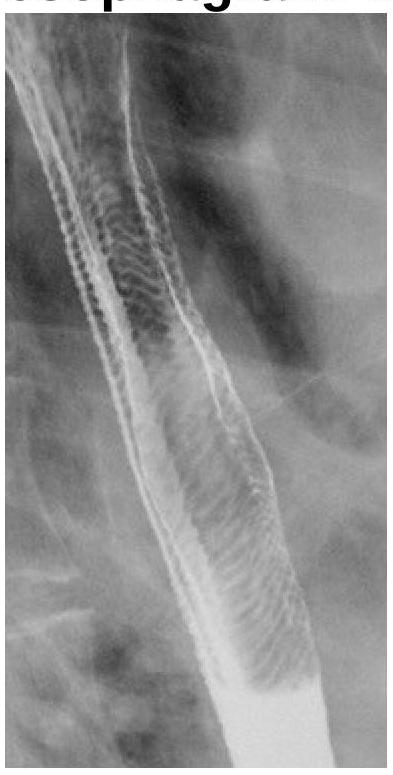
Which of the following is seen in carcinoma of the esophagus?
Which of the following statements about Magnetic Resonance Cholangiopancreatography (MRCP) is false?
What is the minimum amount of tooth demineralization required for radiographic detection of dental caries?
What can an occlusal radiograph locate?
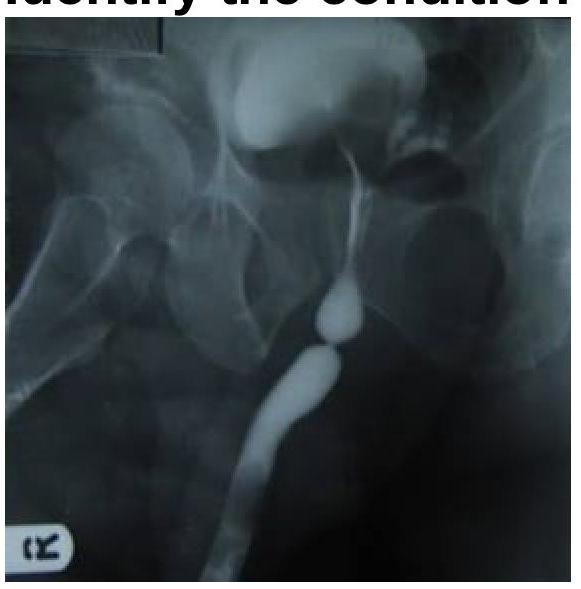
A voiding cystourethrogram, when viewed laterally, helps to diagnose all of the following conditions except:
3D information in IOPAs can be obtained by:
Explanation: **Explanation:** The **Lateral Oblique view of the mandible** is the preferred radiographic projection for diagnosing horizontally favorable and unfavorable fractures. This is because these fractures occur in the **body and angle of the mandible**, where the direction of the fracture line relative to the attachment of the masseter and pterygoid muscles determines stability. The lateral oblique view provides a clear, unobstructed profile of the mandibular body, angle, and ramus, allowing the clinician to visualize the displacement of fragments in the sagittal plane. **Analysis of Incorrect Options:** * **PA View of the Skull:** This view is primarily used to assess mediolateral displacement of mandibular fractures (e.g., symphysis or parasymphysis) but is less effective for evaluating the horizontal favorability of the angle or body due to superimposition of the cervical spine. * **Reverse Towne’s Projection:** This is the gold standard for visualizing **condylar fractures** and the mandibular neck, as it moves the condyles out of the shadow of the mastoid process. * **Waters View (Occipitomental):** This is the primary projection for the **maxillary sinuses** and mid-facial fractures (Zygomaticomaxillary complex). It does not provide adequate detail for the mandibular body. **Clinical Pearls for NEET-PG:** * **Horizontally Unfavorable:** The fracture line runs such that muscle pull (masseter/internal pterygoid) displaces the fragments apart. * **Vertically Unfavorable:** Best seen on a **PA view**; muscle pull displaces fragments medially. * **Gold Standard for Mandible:** While the lateral oblique is a classic radiographic answer, **Orthopantomogram (OPG)** is the modern clinical screening tool of choice for all mandibular fractures.
Explanation: **Explanation:** **CTDI (Computed Tomography Dose Index)** is the standardized measure used to quantify the radiation dose delivered during a single CT scan slice. It represents the average absorbed dose along the longitudinal (z-axis) of a scan, measured using a specialized 100-mm long ionization chamber (pencil probe) placed within a standardized acrylic phantom. **Why Option B is Correct:** CTDI is the fundamental metric for radiation dosimetry in CT imaging. It accounts for the primary beam dose as well as the "scatter tails" from adjacent slices. In modern practice, you will often see **CTDIvol**, which adjusts the index for the "pitch" (the overlap or gap between slices), providing a more accurate estimate of the average dose to the scanned volume. **Why Other Options are Incorrect:** * **A. CT Densitometry Index:** This is a distractor. Densitometry in CT refers to Hounsfield Units (HU), which measure tissue attenuation, not radiation dose. * **C. CT Duplication Index:** There is no such standard term in radiology. * **D. CT Detection Index:** While "detectability" is a concept in image quality, it is not represented by the acronym CTDI. **High-Yield Clinical Pearls for NEET-PG:** 1. **DLP (Dose Length Product):** Calculated as $CTDIvol \times \text{Scan Length}$. It represents the total radiation energy deposited in the patient and is measured in **mGy-cm**. 2. **Effective Dose:** Calculated by multiplying DLP by a tissue-specific weighting factor ($k$). It is measured in **Millisieverts (mSv)** and reflects the overall stochastic risk (cancer risk). 3. **ALARA Principle:** All CT protocols should follow "As Low As Reasonably Achievable" to minimize CTDI while maintaining diagnostic image quality.
Explanation: ### Explanation **Concept Overview:** Arthrography is a specialized radiological technique used to visualize the internal structures of a joint by injecting contrast media. **Double-contrast arthrography** involves the simultaneous injection of a radiopaque (positive) contrast agent (like iodine) and a radiolucent (negative) contrast agent (like air or carbon dioxide). This technique is specifically designed to outline the **joint space** and the internal lining of the joint capsule with high precision. **Why "Joint Space" is Correct:** The primary objective of double-contrast arthrography is to distend the **joint space** and coat the internal surfaces. The air provides a dark background (negative contrast) while the thin film of iodine coats the synovial lining, allowing for the detection of loose bodies, synovial proliferation, or subtle irregularities within the joint cavity. **Analysis of Incorrect Options:** * **Clicking and Deviation (Options A & B):** These are clinical symptoms and signs of TMJ dysfunction. While arthrography can help identify the *cause* of these symptoms, it is not used to "study the clicking" itself; clicking is a dynamic clinical finding often assessed via physical exam or dynamic MRI. * **Articular Disc (Option D):** While arthrography can indirectly show disc displacement (by observing how the contrast fills the compartments), **MRI** is the gold standard for studying the articular disc. Arthrography is invasive and less effective than MRI at visualizing the internal morphology of the fibrocartilage disc. **NEET-PG High-Yield Pearls:** * **Gold Standard:** MRI is now the investigation of choice for TMJ internal derangements (disc displacement). * **Indications:** Arthrography is primarily used when MRI is contraindicated or to identify joint space communications (e.g., a perforated disc). * **Technique:** In TMJ arthrography, contrast is typically injected into the **lower joint space** first, as this is where most pathology is visualized. * **Pneumoarthrography:** This refers to using air alone as a contrast medium.
Explanation: In the evaluation of a suspected esophageal perforation, the choice of contrast agent is dictated by the potential risk of leakage into the mediastinum or pleural space. **Why Iohexol is the Correct Answer:** Iohexol is a **low-osmolar, water-soluble iodinated contrast agent**. In cases of perforation, contrast leaks into the mediastinum. Water-soluble agents are easily absorbed by the pleura and mediastinal tissues without causing a significant inflammatory response. They are safer than high-osmolar agents (like Gastrografin), which are hypertonic and can cause severe pulmonary edema if aspirated. **Analysis of Incorrect Options:** * **Barium Sulphate:** This is strictly contraindicated if perforation is suspected. Barium is inert and non-absorbable; if it leaks into the mediastinum, it triggers a severe **granulomatous inflammatory reaction**, leading to fibrosing mediastinitis, which carries high morbidity. * **Gadolinium:** This is a paramagnetic contrast agent used primarily in MRI. It is not used for fluoroscopic swallow studies to detect structural leaks. * **Methylene Blue:** While sometimes used orally to bedside-detect a leak (by observing blue drainage in a chest tube), it provides no anatomical detail or radiological visualization of the perforation site. **Clinical Pearls for NEET-PG:** * **Stepwise Approach:** The standard protocol for suspected perforation is to start with a **water-soluble contrast swallow** (e.g., Iohexol/Diatrizoate). If this is negative, it is followed by a **Barium swallow**, as Barium has higher mucosal detail and may detect small leaks missed by water-soluble agents. * **Aspiration Risk:** If the patient is at high risk for aspiration (e.g., tracheoesophageal fistula), avoid high-osmolar Gastrografin; use low-osmolar agents like Iohexol to prevent chemical pneumonitis.
Explanation: ### Explanation **Correct Answer: A. Rat tail appearance** In **Carcinoma of the Esophagus**, the tumor grows circumferentially or asymmetrically, causing an irregular, eccentric narrowing of the esophageal lumen. On a Barium Swallow, this manifests as a short-segment, irregular stricture with "shouldering" (abrupt edges) and mucosal destruction, resembling a **Rat tail appearance**. This is characteristic of a malignant stricture. **Analysis of Incorrect Options:** * **B. Corkscrew appearance:** This is the hallmark of **Diffuse Esophageal Spasm (DES)**. It occurs due to simultaneous, non-peristaltic tertiary contractions that compartmentalize the esophagus, giving it a beaded or "rosary bead" appearance. * **C. Bird beak sign:** This is seen in **Achalasia Cardia**. It represents a smooth, symmetrical, tapered narrowing of the distal esophagus (at the GE junction) with proximal dilatation, caused by the failure of the Lower Esophageal Sphincter (LES) to relax. * **D. Caterpillar sign:** This is a radiological sign of **Hypertrophic Pyloric Stenosis (HPS)**. It refers to the appearance of hyperperistaltic waves of the stomach seen on an abdominal X-ray or during a barium meal as the stomach tries to force gastric contents through a stenosed pylorus. **High-Yield Clinical Pearls for NEET-PG:** * **Malignant vs. Benign Strictures:** Malignant strictures (Rat tail) are irregular with shouldering; benign strictures (e.g., peptic or corrosive) are usually smooth and long-segment. * **Apple Core Appearance:** Similar to the rat tail sign, this term is specifically used for circumferential **Colorectal Carcinoma** on a Barium Enema. * **Investigation of Choice:** While Barium Swallow is the initial screening tool for dysphagia, **Upper GI Endoscopy with Biopsy** is the gold standard for diagnosing esophageal cancer.
Explanation: ### Explanation **1. Why Option C is the Correct Answer (The False Statement):** MRCP is a specialized MRI technique that does **not** require the administration of any exogenous contrast agents (iodinated or gadolinium-based). It relies on a physical principle called **Heavy T2-weighting**. In these sequences, static or slow-moving fluids (like bile and pancreatic juice) have a very long T2 relaxation time and appear hyperintense (bright white), while background tissues with shorter T2 relaxation times appear dark. This creates a "natural contrast" effect. Iodinated contrast is used in CT scans and conventional ERCP, but not in MRCP. **2. Analysis of Other Options:** * **Option A (Non-invasive):** This is true. Unlike ERCP (Endoscopic Retrograde Cholangiopancreatography), which requires endoscopy and cannulation of the ampulla, MRCP is performed entirely outside the body without radiation or instrumentation. * **Option B (Visualization):** This is true. MRCP is the gold standard non-invasive modality for visualizing the anatomy and pathology of the biliary tree and pancreatic ducts, such as choledocholithiasis, strictures, or anatomical variants. **3. Clinical Pearls for NEET-PG:** * **Sequence used:** MRCP typically uses **SSFSE** (Single Shot Fast Spin Echo) or **HASTE** (Half-Fourier Acquisition Single-shot Turbo spin-Echo) sequences. * **Patient Preparation:** Patients are often kept NPO (nothing by mouth) for 4–6 hours to reduce gastric secretions and ensure the gallbladder is distended. * **Negative Contrast:** Sometimes, oral "negative" contrast agents (like pineapple juice or blueberry juice, which are rich in Manganese/Iron) are given to darken the signal from the stomach and duodenum, preventing them from overlapping with the bile duct image. * **Limitation:** Unlike ERCP, MRCP is purely **diagnostic** and cannot be used for therapeutic interventions (like stenting or stone extraction).
Explanation: **Explanation:** The radiographic detection of dental caries depends on the change in density of the tooth structure. For a carious lesion to become visible on a conventional radiograph, a significant amount of mineral loss must occur. **1. Why 40% is Correct:** Dental caries cause the demineralization of enamel and dentin, leading to a decrease in the attenuation of X-rays. Studies and clinical radiology textbooks indicate that approximately **30% to 40% demineralization** is required before the density change is perceptible to the human eye on a radiograph. Because the lesion must penetrate a certain thickness of the tooth to create a "radiolucent" shadow, the radiographic appearance always **underestimates** the actual histological extent of the decay. **2. Analysis of Incorrect Options:** * **A (20%):** At this stage, the mineral loss is insufficient to create a contrast difference significant enough to be distinguished from healthy tooth structure by standard radiographic techniques. * **C & D (60% and 80%):** While lesions with this level of demineralization are easily visible, they represent advanced decay. The question asks for the *minimum* threshold. Waiting for 60-80% demineralization would result in late diagnosis and potential pulpal involvement. **3. NEET-PG High-Yield Pearls:** * **Clinical vs. Radiographic:** Always remember that "Radiographs are a diagnostic aid, not a substitute for clinical exam." The actual lesion is always deeper than it appears on the X-ray. * **Best View:** The **Bitewing radiograph** is the gold standard for detecting interproximal (between teeth) caries. * **False Positives:** "Cervical burnout" (radiolucency near the CEJ) and "Adumbration" can often be mistaken for caries. * **Mach Band Effect:** An optical illusion where the high contrast between enamel and dentin makes the dentin appear darker, sometimes mimicking caries.
Explanation: **Explanation:** An **occlusal radiograph** is an intraoral projection where the film or sensor is placed on the occlusal plane (the biting surface) and the X-ray beam is directed at a steep angle. Its primary clinical value lies in its ability to provide a broader view of the maxilla or mandible compared to standard periapical films. **Why "All of the above" is correct:** 1. **Supernumerary and Impacted Teeth (Options A & B):** Occlusal views are excellent for determining the buccolingual position of unerupted, impacted, or supernumerary teeth (e.g., mesiodens). By using the **SLOB rule** (Same Lingual, Opposite Buccal) or comparing the occlusal view with a periapical view, clinicians can localize these structures in three dimensions. 2. **Salivary Stones (Option C):** Specifically, the **mandibular true occlusal view** is the gold standard for detecting **sialoliths (stones)** in the submandibular (Wharton’s) duct. Because the floor of the mouth is soft tissue, a stone will appear as a distinct radiopacity when viewed from this inferior-superior angle. **Clinical Pearls for NEET-PG:** * **Submandibular Gland:** 80% of all salivary stones occur here; the occlusal radiograph is the first-line imaging for suspected Wharton’s duct stones. * **Maxillary Occlusal:** Useful for visualizing the palate, clefts, and the base of the nasal septum. * **Limitation:** It provides less detail of the periodontium and root apex compared to a periapical radiograph. * **High-Yield Tip:** If a question asks for the best view for a stone in the *parotid* duct, the answer is usually a "puffed-cheek" AP view or sialography, not an occlusal radiograph.
Explanation: ### Explanation The **Voiding Cystourethrogram (VCUG)** is a dynamic fluoroscopic study used to evaluate the bladder and urethra. During the procedure, contrast is instilled into the bladder, and images are taken during the act of micturition (voiding). **Why Ureterovaginal Fistula is the Correct Answer:** A **Ureterovaginal fistula** involves an abnormal communication between the **ureter** and the vagina. Since contrast in a VCUG is introduced into the bladder and urethra, it does not routinely reflux into the ureters unless there is significant Vesicoureteral Reflux (VUR). To diagnose a ureterovaginal fistula, an **Intravenous Urogram (IVU)** or a **Retrograde Ureterogram** is required, as these methods visualize the upper urinary tract where the contrast can leak from the ureter into the vagina. **Analysis of Incorrect Options:** * **Vesicovaginal Fistula (VVF):** This is a communication between the bladder and the vagina. During the filling phase of a VCUG, contrast will leak directly from the bladder into the vaginal vault. * **Urethrovaginal Fistula:** This is a communication between the urethra and the vagina. During the voiding phase, contrast passing through the urethra will enter the vagina. * **Urethral Diverticulum:** This is an outpouching of the urethral wall. It is best visualized on a **lateral voiding film**, where the contrast fills the sac, appearing as a posterior or circumferential collection of contrast around the urethra. **High-Yield Clinical Pearls for NEET-PG:** * **Lateral View in VCUG:** Crucial for identifying posterior urethral valves (PUV), urethral diverticula, and fistulous tracts that may be obscured by the pubic symphysis on AP views. * **Gold Standard for VVF:** While VCUG can show it, the **Cystogram** is the primary radiological investigation. * **Methylene Blue Test:** Used clinically to differentiate VVF (swab turns blue) from Ureterovaginal fistula (swab stays clear, but urine is seen). * **Double Balloon Catheter (Trattner):** Used in a positive pressure urethrography to specifically diagnose urethral diverticula.
Explanation: **Explanation:** Intraoral Periapical Radiographs (IOPAs) are 2D representations of 3D structures. To localize an object in the third dimension (bucco-lingual depth), clinicians must use specific radiographic techniques. 1. **Examining two films at right angles (Right-angle technique):** This involves taking one standard IOPA and one occlusal radiograph. The IOPA shows the mesio-distal and supero-inferior positions, while the occlusal view (at 90°) reveals the bucco-lingual position. 2. **Examining two films at different angles (Tube-shift technique):** By changing the horizontal or vertical angulation of the X-ray tube between two exposures, the relative change in the position of the object allows for 3D localization. 3. **CLARK Rule (SLOB Rule):** This is the most common clinical application of the tube-shift technique. **SLOB** stands for **S**ame **L**ingual, **O**pposite **B**uccal. If an object moves in the same direction as the X-ray tube, it is located lingually; if it moves in the opposite direction, it is located buccally. Since all three methods are valid radiographic principles for obtaining depth information, **Option D** is the correct answer. **Clinical Pearls for NEET-PG:** * **SLOB Rule Application:** Essential for locating impacted teeth, foreign bodies, or identifying multiple root canals (e.g., MB2 in maxillary molars). * **Buccal Object Rule:** Another name for the Clark Rule/Tube-shift technique. * **Limitation:** While these techniques provide 3D "information," **CBCT (Cone Beam Computed Tomography)** is the gold standard for true 3D imaging in dentistry.
Iodinated Contrast Media
Practice Questions
MRI Contrast Agents
Practice Questions
Ultrasound Contrast Agents
Practice Questions
Adverse Reactions to Contrast Media
Practice Questions
Management of Contrast Reactions
Practice Questions
Contrast-Induced Nephropathy
Practice Questions
Barium Studies
Practice Questions
Intravenous Urography
Practice Questions
Angiography Techniques
Practice Questions
Lymphangiography
Practice Questions
Contrast Administration Protocols
Practice Questions
Pretesting and Premedication
Practice Questions
Get full access to all questions, explanations, and performance tracking.
Start For Free