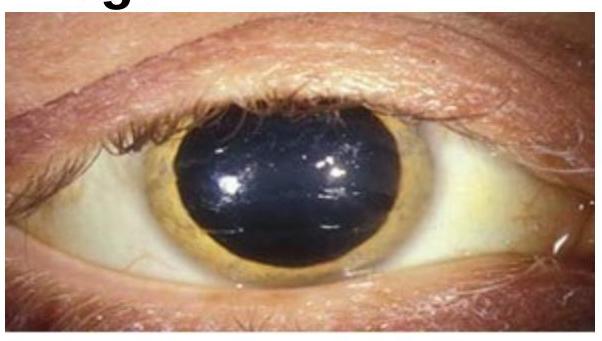
Choose the best method of diagnosis for the clinical sign represented in the image.
Which finding is NOT associated with pulmonary embolism on CT angiography?
A chest X-ray (CXR) of a patient is shown. What is the next step in management of this patient?

Which sign on chest X-ray indicates tension pneumothorax?
Which condition is characterized by a specific appearance on CT scans that resembles small centrilobular nodules with branching linear structures?
A chest X-ray shows a 'silhouette sign' with opacity obscuring the right heart border. Which lobe of the lung is most likely affected?
Pulmonary embolism is most commonly caused by:
A chest CT shows 'comet tail' sign in lung bases. Which additional finding would best support rounded atelectasis?
The following are direct signs of lung collapse seen on a chest X-ray, which one of the following is NOT a direct sign?
A 60-year-old woman presents with a history of smoking and cough. Chest X-ray shows a solitary pulmonary nodule. Which of the following is the most appropriate next step in management?
Explanation: ***Serum ceruloplasmin*** - The image shows a **Kayser-Fleischer ring**, a greenish-brown discoloration in the periphery of the cornea, which is pathognomonic for **Wilson's disease**. - **Wilson's disease** is a genetic disorder of copper metabolism characterized by **low serum ceruloplasmin** levels (the primary copper-carrying protein in the blood) and increased copper deposition in various tissues. *Serum copper* - While Wilson's disease involves copper accumulation, **total serum copper** can be normal or even elevated due to widespread tissue damage releasing copper into the circulation, making it an unreliable diagnostic marker on its own. - A low serum copper level can be seen, but it is not as specific as low ceruloplasmin, as much of the copper in serum is bound to ceruloplasmin. *Karyotyping* - **Karyotyping** is used to analyze the number and structure of chromosomes and is primarily indicated for diagnosing chromosomal abnormalities, such as Down syndrome or Turner syndrome. - It is not relevant for diagnosing metabolic disorders like Wilson's disease, which is caused by a mutation in a single gene (ATP7B), not a chromosomal aberration. *PCR* - **PCR (Polymerase Chain Reaction)** is a technique used to amplify DNA sequences and can be used for genetic testing to identify specific mutations. - While genetic testing for the **ATP7B gene** mutation is a confirmatory test for Wilson's disease, it is not the primary or best method for initial diagnosis, especially when classic clinical signs and biochemical markers (like low ceruloplasmin) are present.
Explanation: ***Hampton's hump*** - **Hampton's hump** is a **peripheral wedge-shaped opacity** representing **pulmonary infarction**, classically described as a **chest X-ray finding**, not a primary CT angiography (CTA) finding. - While the parenchymal opacity from infarction can be visualized on CT, it is **not what CTA is designed to detect**—CTA primarily visualizes the **pulmonary vasculature and intraluminal thrombi**. - Hampton's hump reflects a **consequence** of PE (tissue infarction) rather than the embolus itself, making it **NOT directly associated with PE on CTA**. *Filling defects* - **Filling defects** represent **intraluminal thrombus** within contrast-filled pulmonary arteries. - This is the **hallmark and primary diagnostic sign** of pulmonary embolism on CT angiography. - CTA is specifically performed to visualize these vascular abnormalities. *Enlarged pulmonary artery* - An **enlarged main pulmonary artery** (>29 mm) is a **secondary finding** on CTA that suggests **pulmonary hypertension**. - This can result from acute massive PE or chronic thromboembolic disease. - It is readily visualized and measured on CTA as part of PE assessment. *Oligemia* - **Oligemia (Westermark sign)** refers to **regional decreased vascularity** distal to a significant pulmonary artery obstruction. - While classically a **chest X-ray finding**, decreased vessel caliber and perfusion changes **can be appreciated on CTA**. - Unlike Hampton's hump (a parenchymal consequence), oligemia reflects the **vascular effect** of the obstruction and is thus more directly related to CTA findings.
Explanation: ***Exploratory laparotomy*** - The chest X-ray shows **free air under the diaphragm** on the right side, indicating **pneumoperitoneum**. - **Pneumoperitoneum** usually signifies a **perforated abdominal viscus**, a surgical emergency requiring immediate exploration to identify and repair the perforation. *Ventilation perfusion scan* - This scan is primarily used to diagnose **pulmonary embolism** and is not indicated for the current finding. - The chest X-ray does not show any signs suggestive of pulmonary embolism, such as a **Westermark sign** or a **Hampton hump**. *Bronchoalveolar lavage* - **Bronchoalveolar lavage (BAL)** is a diagnostic procedure used to retrieve fluid from the lower respiratory tract for analysis, typically for infections or inflammatory conditions. - It would not be helpful in evaluating **subdiaphragmatic free air**, which is an abdominal issue. *High resolution CT scan* - While a **CT scan** could further characterize the pneumoperitoneum, the presence of clear free air on a plain film warrants **immediate surgical intervention** rather than further imaging, especially in an acute setting. - A CT scan might be considered if the diagnosis is equivocal, but in this case, the finding is unequivocal and indicates an emergency.
Explanation: ***Mediastinal shift*** - **Mediastinal shift** away from the affected side is the **most specific and critical radiographic sign** of tension pneumothorax on chest X-ray. - The progressive air accumulation under positive pressure pushes the **mediastinum** (heart, great vessels, trachea) toward the contralateral side, causing life-threatening **cardiorespiratory compromise** by impeding venous return and cardiac output. - This finding distinguishes tension pneumothorax from simple pneumothorax and mandates **immediate needle decompression**. *Flattened diaphragm* - A **flattened or depressed hemidiaphragm** can occur in tension pneumothorax due to increased intrapleural pressure pushing the diaphragm downward. - However, this sign is **non-specific** as it also occurs in simple pneumothorax, hyperinflation, COPD, and other conditions. - While supportive, it does not definitively indicate the high-pressure tension state. *Deep sulcus sign* - The **deep sulcus sign** (abnormally deep and lucent costophrenic angle) is seen on **supine chest X-rays** when air accumulates anteriorly and inferiorly in the pleural space. - This indicates pneumothorax but is **not specific for tension pneumothorax** and can be seen in simple pneumothorax. - It is position-dependent and does not indicate mediastinal compression. *All of the options* - While flattened diaphragm and deep sulcus sign **may be present** in tension pneumothorax, only **mediastinal shift** is the **definitive radiographic indicator** that distinguishes tension from simple pneumothorax. - Mediastinal shift is the key finding that reflects the pathophysiological pressure differential causing cardiovascular compromise.
Explanation: ***Pulmonary tuberculosis*** - This description ("small centrilobular nodules with **branching linear structures**") is characteristic of the **tree-in-bud pattern** seen on CT scans, which is a hallmark finding in active **endobronchial spread of tuberculosis**. - The tree-in-bud pattern results from the impaction of tuberculous **granulomas** and caseous material in the terminal and respiratory bronchioles. *Silicosis* - Characterized by multiple small, well-defined **nodules** (often in the upper lobes) that tend to calcify, but typically lacks the fine **branching linear structures**. - It’s associated with occupational exposure to **silica dust** and may progress to **massive progressive fibrosis**. *Pulmonary hydatid cyst* - Presents as a well-defined, usually **single, large cystic lesion** on CT, often with internal membranes if ruptured (water lily sign or crumpled membrane sign). - It does not typically manifest with small centrilobular nodules or branching linear structures. *Small cell carcinoma* - Usually appears as a **large central mass**, often with mediastinal lymphadenopathy, and sometimes associated with obstructive pneumonitis. - It does not typically present as diffuse small centrilobular nodules with branching patterns.
Explanation: ***Right middle lobe*** - The **silhouette sign** occurs when two objects of similar radiographic density are in direct contact, obscuring their common border. - The **right middle lobe** is adjacent to the right heart border, so an opacity in this lobe will typically obscure the border. *Right upper lobe* - The right upper lobe is positioned superiorly and medially, meaning opacification would more likely obscure the **right paratracheal stripe** or the superior mediastinal borders. - It does not directly border the right heart, thus it would not produce a silhouette sign with the cardiac outline. *Right lower lobe* - The right lower lobe is primarily associated with obscuring the **right hemidiaphragm** when it collapses or becomes consolidated. - Although it is somewhat posterior to the heart, it usually does not directly obscure the anterior right heart border. *Left lower lobe* - The left lower lobe is on the opposite side of the chest and opacification would not affect the **right heart border**. - Consolidation here would more likely obscure the **left hemidiaphragm** or the medial part of the left cardiac silhouette in certain views.
Explanation: ***Deep vein thrombosis (DVT) of the leg*** - **Deep vein thrombosis (DVT)** in the leg is the most common source of emboli that travel to the lungs, leading to pulmonary embolism [1]. - The thrombus breaks off from the deep veins, typically in the **lower extremities**, and propagates through the venous system to the pulmonary arteries [1]. *Increased pulmonary pressure (a consequence of PE)* - **Increased pulmonary pressure** is a physiological consequence of a significant pulmonary embolism, as blood flow is obstructed, but it is not the cause of the embolism itself. - This option describes a **downstream effect**, rather than the origin of the embolus. *Fat embolism from pelvic fracture* - **Fat embolisms** can occur after long bone fractures (especially pelvic or femur fractures) and surgeries, but they are a less common cause of PE compared to DVT. - While they can lead to pulmonary symptoms, the mechanism involves **fat globules** entering the circulation, distinct from a thrombus. *Cardiac emboli from heart disease* - **Cardiac emboli** typically originate from the heart (e.g., from atrial fibrillation, mural thrombi after myocardial infarction, or valvular disease) and usually cause **systemic emboli** leading to strokes or limb ischemia. - While rare, paradoxal emboli can occur via a patent foramen ovale but are not the leading cause of "pulmonary" embolism.
Explanation: ***Pleural thickening*** - The 'comet tail' sign refers to **curved bronchi and vessels** leading into a rounded opaque lesion, which is highly characteristic of **rounded atelectasis**. - **Pleural thickening** is an almost universal finding in rounded atelectasis, as it commonly develops in areas of localized pleural inflammation and fibrosis. *Ground glass opacities* - **Ground glass opacities** indicate partial filling of airspaces or thickening of interstitial structures, but they do not specifically point to rounded atelectasis. - This finding is nonspecific and can be seen in various lung conditions, including infection, inflammation, or early fibrosis. *Tree-in-bud pattern* - A **tree-in-bud pattern** on CT suggests infection or inflammation of the small airways (**bronchioles**), commonly seen in conditions like **bronchiolitis**, tuberculosis, or aspiration. - It does not directly correlate with the development or features of rounded atelectasis. *Honeycomb changes* - **Honeycomb changes** are a hallmark of **end-stage pulmonary fibrosis**, representing clustered cystic airspaces with thickened walls. - While rounded atelectasis involves fibrosis, honeycomb changes represent a distinct and more severe pattern of lung damage.
Explanation: ***Mediastinal shift*** - While mediastinal shift can occur with lung collapse, it is an **indirect sign** caused by the volume loss in the affected hemithorax, pulling the mediastinum towards the collapsed lung. - Direct signs refer to changes observed *within* the collapsed lung tissue itself, such as increased density or displaced structures, whereas mediastinal shift is a secondary effect. *Crowding of the vessels* - This is a **direct sign** of lung collapse, as the pulmonary vessels become compacted due to the loss of lung volume. - The vessels appear closer together and more prominent in the area of collapse. *Loss of aeration* - This is a **direct sign** of lung collapse, as air is expelled or resorbed from the affected lung tissue, leading to increased opacity. - The collapsed lung appears denser and whiter on the X-ray compared to normally aerated lung. *Displacement of the fissure* - This is a **direct sign** of lung collapse, as the interlobar fissures are pulled towards the collapsed lobe due to volume loss. - The displacement of the fissure indicates the location and extent of the collapse.
Explanation: ***CT scan of the chest*** - A **CT scan** provides a more detailed imaging of the nodule, allowing for better characterization of its size, shape, margins, and density (e.g., calcifications). - This information helps in determining the likelihood of **malignancy** and guiding further management decisions, such as surveillance or biopsy. *Sputum cytology* - **Sputum cytology** has a low diagnostic yield for solitary pulmonary nodules, especially if the nodule is not centrally located or cavitating. - It is more useful for diagnosing **central airway lesions** or widespread pulmonary infiltrates rather than discrete nodules. *Bronchoscopy* - **Bronchoscopy** is generally considered after a CT scan has provided more detailed information about the nodule's location and characteristics. - Its utility in diagnosing a **solitary pulmonary nodule** depends on the nodule's size and proximity to the bronchial tree; peripheral nodules may be difficult to reach. *PET scan* - A **PET scan** is typically used to assess the metabolic activity of a nodule and for staging once malignancy is suspected or confirmed. - It is usually performed **after a CT scan** to characterize the nodule's features, especially if the nodule is indeterminate after initial imaging.
Get full access to all questions, explanations, and performance tracking.
Start For Free