The lordotic view is valuable in confirming the presence of a lesion in the lung apex and also in which other location?
Which of the following is NOT a typical finding in left ventricular failure?
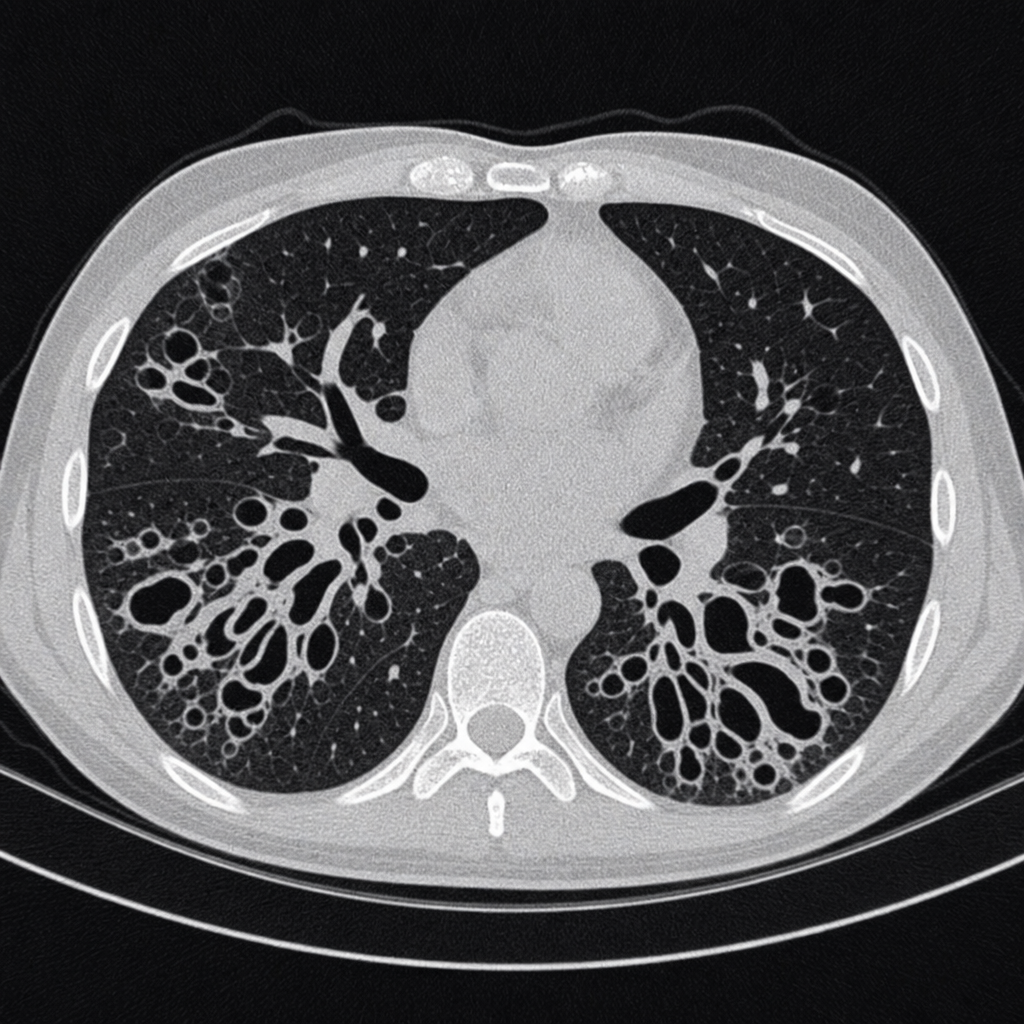
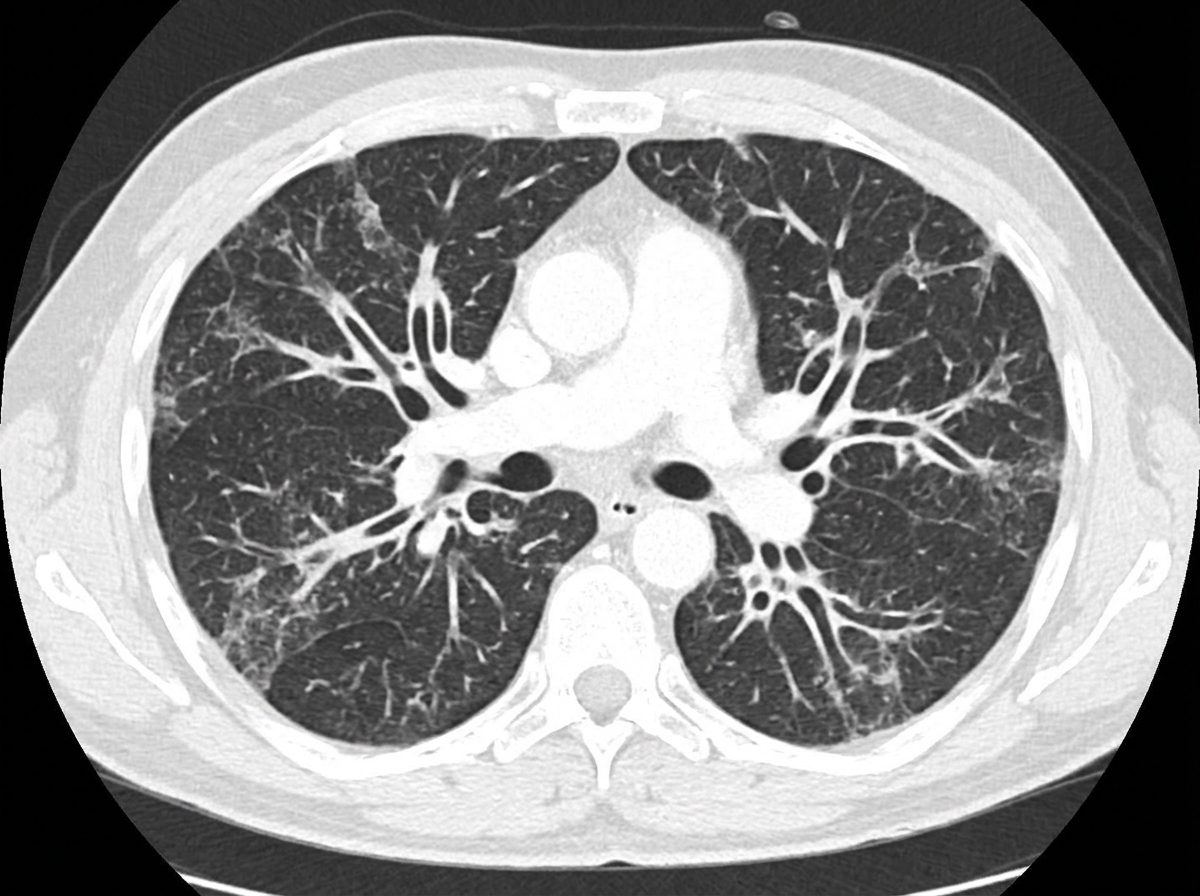
What is the initial diagnostic imaging modality of choice for suspected bronchiectasis?
Pulmonary thromboembolism on V-Q scan is suggested by:
Inferior rib notching is a characteristic radiological finding in which of the following conditions?
Which condition classically presents with an 'apical cap' on a chest X-ray?
What is the diagnosis in a patient who developed chest pain after coughing?
The 'Turkish Sword' appearance is a radiological finding of which of the following conditions?
The "water lilly sign" on a chest X-ray is characteristic of which condition?
Bilateral rib notching is seen in which of the following conditions?
Explanation: **Explanation:** The **Apical Lordotic View** is a specialized chest X-ray projection where the patient leans backward against the cassette. This maneuver projects the clavicles superiorly, above the lung fields, providing an unobstructed view of specific anatomical regions. **1. Why the Lingular Segment is Correct:** The lordotic view is primarily used to visualize the **lung apices** and the **middle lobe/lingula**. In a standard PA view, the middle lobe and the lingula (the left-sided equivalent of the middle lobe) are often obscured by the overlying heart shadow or breast tissue. By changing the angle of the X-ray beam relative to the thorax, the lordotic view projects these segments more clearly, making it highly sensitive for detecting atelectasis or consolidation in the lingula and right middle lobe. **2. Why Other Options are Incorrect:** * **Posterior Mediastinum:** This area is best evaluated using a **Lateral view** or CT scan. The lordotic view focuses on anteriorly and superiorly placed structures. * **Posterior Basal Segment:** These segments are located at the very bottom and back of the lungs. They are best visualized on a standard **Lateral view** or a PA view with deep inspiration. * **Hilum:** While visible, the hilum is best assessed on standard PA and Lateral views. The lordotic view distorts hilar anatomy, making it less reliable for primary hilar evaluation. **Clinical Pearls for NEET-PG:** * **Primary Use:** To rule out TB or tumors in the lung apices (hidden by clavicles on PA view). * **Middle Lobe Syndrome:** The lordotic view is the "gold standard" plain film projection to confirm **Right Middle Lobe (RML) collapse**, which appears as a characteristic triangular opacity. * **Radiographic Sign:** On a lordotic view, the ribs appear more horizontal and the clavicles are projected above the first ribs.
Explanation: In Left Ventricular Failure (LVF), the heart cannot pump blood effectively, leading to increased pressure in the left atrium and pulmonary veins. This results in **pulmonary venous congestion** and edema. **Explanation of the Correct Answer:** The question asks for the finding **NOT** typical of LVF. However, there is a technical discrepancy in the provided key: **Kerley B lines ARE a classic finding of LVF** (representing interstitial edema). If the goal is to identify the finding that does *not* belong, the correct answer should be **A. Pulmonary oligemia**. Pulmonary oligemia (reduced blood flow/vessels) is seen in conditions like Tetralogy of Fallot or massive Pulmonary Embolism, whereas LVF causes pulmonary **plethora** (increased vessel prominence). **Analysis of Options:** * **Redistribution to apices (Cephalization):** An early sign of LVF (Stage 1). Increased pulmonary venous pressure causes blood to divert from the bases to the upper lobes (Antler sign). * **Kerley B lines:** Short, horizontal lines at the lung bases perpendicular to the pleura, representing thickened interlobular septa due to fluid (Stage 2: Interstitial edema). * **Cardiomegaly:** A common finding in chronic LVF, where the Cardiothoracic (CT) ratio exceeds 0.5 on a PA view. **High-Yield Clinical Pearls for NEET-PG:** * **Stages of Pulmonary Edema on CXR:** 1. **Stage 1 (PCWP 13-18 mmHg):** Cephalization (Redistribution). 2. **Stage 2 (PCWP 18-25 mmHg):** Kerley B lines, peribronchial cuffing, and hazy hila. 3. **Stage 3 (PCWP >25 mmHg):** Alveolar edema (Bat-wing/Butterfly opacities) and pleural effusion. * **Kerley A lines:** Longer lines radiating from the hila (represent lymphatic distension). * **Bat-wing appearance:** Spares the peripheral 1-2 cm of the lung parenchyma.
Explanation: **Explanation:** **1. Why HRCT is the Correct Answer:** High-resolution computed tomography (HRCT) is the **gold standard** and initial diagnostic modality of choice for bronchiectasis. The underlying medical concept relies on HRCT’s ability to use thin slices (1–2 mm) and high-spatial-frequency reconstruction algorithms to visualize the bronchial wall and lumen with extreme precision. It allows for the identification of the classic **"Signet Ring Sign"** (where the internal diameter of the bronchus is larger than its accompanying pulmonary artery) and the lack of tapering of the bronchi toward the periphery. **2. Why Other Options are Incorrect:** * **Spiral CT:** While useful for general lung pathology, standard spiral CT uses thicker slices which may miss subtle bronchial wall thickening or small areas of cylindrical bronchiectasis. * **Bronchoscopy:** This is an invasive procedure used to identify the *cause* of localized bronchiectasis (e.g., foreign body or tumor) or to obtain cultures, but it cannot visualize the bronchial anatomy beyond the proximal airways. * **Pulmonary Angiography:** This is used to visualize pulmonary vasculature. It is only indicated in bronchiectasis if there is massive hemoptysis requiring bronchial artery embolization. **3. High-Yield Clinical Pearls for NEET-PG:** * **Signet Ring Sign:** The most characteristic HRCT finding (Broncho-arterial ratio >1). * **Tram-track Sign:** Seen on HRCT/X-ray representing non-tapering, thickened bronchial walls. * **Finger-in-glove Opacity:** Suggests Allergic Bronchopulmonary Aspergillosis (ABPA) causing mucoid impaction. * **Kartagener Syndrome:** Triad of Bronchiectasis, Sinusitis, and Situs Inversus. * **Chest X-ray:** Often the first test performed, but frequently normal in early disease; hence, HRCT remains the definitive diagnostic choice.
Explanation: **Explanation:** The hallmark of **Pulmonary Thromboembolism (PTE)** on a V-Q (Ventilation-Perfusion) scan is a **V-Q Mismatch**. This occurs because a thrombus mechanically obstructs blood flow to a segment of the lung, while the airways remain patent, allowing air to reach the alveoli. * **Why Option B is correct:** In PTE, the area distal to the clot shows a **perfusion defect** (cold spot on scan) because the radiopharmaceutical (Technetium-99m MAA) cannot reach the capillaries. However, since the bronchial tree is unaffected, the **ventilation** (using Xenon-133 or Technetium-99m DTPA aerosol) remains **normal**. This "mismatch" is highly suggestive of an embolic event. * **Why other options are incorrect:** * **Option A:** A ventilation defect with normal perfusion (Reverse Mismatch) is typically seen in conditions like pneumonia, pulmonary edema, or atelectasis. * **Option B:** A "matched defect" (both V and Q are abnormal) suggests a primary parenchymal or airway disease (e.g., COPD, consolidation) rather than a vascular obstruction. * **Option D:** Normal scans effectively rule out PTE with a high negative predictive value. **High-Yield Clinical Pearls for NEET-PG:** * **PIOPED Criteria:** Used to categorize V-Q scans into High, Intermediate, or Low probability for PTE. Two or more large mismatched segmental defects indicate **High Probability**. * **Westermark Sign:** A focal area of oligemia (decreased vascularity) on a Chest X-ray, representing the radiographic equivalent of a perfusion defect. * **Hampton’s Hump:** A wedge-shaped opacity pointing toward the hilum, indicating pulmonary infarction. * **Gold Standard:** While V-Q scans are used in patients with renal failure or contrast allergy, **CT Pulmonary Angiography (CTPA)** is currently the investigation of choice for PTE.
Explanation: **Explanation:** **1. Why Coarctation of the Aorta is Correct:** Inferior rib notching (specifically involving the 3rd to 8th ribs) is a classic radiological sign of **post-ductal coarctation of the aorta**. Due to the narrowing of the aorta, blood must find an alternative route to reach the lower body. This occurs via **collateral circulation** involving the internal mammary arteries and the intercostal arteries. The intercostal arteries become dilated, tortuous, and pulsatile; over time, the pressure from these enlarged vessels causes pressure erosion (notching) on the inferior margins of the ribs. *Note: The 1st and 2nd ribs are spared because their intercostal arteries arise from the costocervical trunk, which originates proximal to the coarctation.* **2. Why the Incorrect Options are Wrong:** * **SLE, RA, and Scleroderma:** These are connective tissue disorders. While they can cause various thoracic manifestations (such as interstitial lung disease, pleural effusions, or pulmonary hypertension), they do not cause the vascular hypertrophy required to produce rib notching. Scleroderma is specifically associated with **superior rib notching** (erosion of the upper borders) due to localized pressure from skin tightening or intercostal muscle atrophy, rather than vascular dilation. **3. High-Yield Clinical Pearls for NEET-PG:** * **Roesler’s Sign:** The eponymous name for inferior rib notching in coarctation. * **"3" Sign:** Seen on a PA chest X-ray, formed by the pre-stenotic dilation of the aortic arch and post-stenotic dilation of the descending aorta. * **Reverse "3" (E) Sign:** The corresponding indentation seen on a Barium swallow. * **Differential for Inferior Notching:** Blalock-Taussig shunt (unilateral), SVC obstruction, and Neurofibromatosis type 1 (intercostal neuromas).
Explanation: **Explanation:** The correct answer is **Dissecting aneurysm (Option A)**. An **apical cap** (pleural cap) refers to a curved, cap-like opacity at the very apex of the lung. In the context of trauma or acute chest pain, a left-sided apical cap is a classic radiological sign of a **thoracic aortic dissection** or **traumatic aortic rupture**. It occurs because blood from the mediastinal hematoma tracks superiorly along the extrapleural space, accumulating over the apex of the left lung. **Analysis of Incorrect Options:** * **B. Cystic hygroma:** These are lymphatic malformations typically found in the neck (posterior triangle) or axilla. While they can extend into the superior mediastinum, they present as soft tissue masses rather than a classic apical cap. * **C. Castleman's disease:** This is a rare lymphoproliferative disorder. On imaging, it usually presents as a solitary, intensely enhancing mediastinal nodal mass or diffuse lymphadenopathy, not an apical cap. * **D. Sarcoidosis:** The hallmark radiological finding in sarcoidosis is bilateral hilar and paratracheal lymphadenopathy (Garland’s triad/1-2-3 sign), often accompanied by interstitial lung disease. **High-Yield Clinical Pearls for NEET-PG:** * **Aortic Dissection Signs on CXR:** Widened mediastinum (>8 cm), blurring of the aortic knob, tracheal deviation to the right, and the "Calcium sign" (intimal calcium displaced >1 cm from the outer aortic wall). * **Differential for Apical Cap:** While dissection is the "emergency" cause, benign causes include apical pleural scarring (due to old TB or radiation) and Pancoast tumors (though these are usually masses rather than thin caps). * **Left vs. Right:** An apical cap in aortic trauma is almost always on the **left** side.
Explanation: **Explanation:** **Lung herniation** is defined as the protrusion of lung tissue beyond the normal confines of the thoracic cavity through a defect in the chest wall. The most common cause is trauma or surgery, but **spontaneous herniation** can occur due to a sudden, massive increase in intrathoracic pressure—classically triggered by **vigorous coughing**, sneezing, or heavy lifting. These episodes cause a rupture of the intercostal muscles (usually in the anterior or supraclavicular regions), allowing the lung to bulge out. Patients typically present with localized chest pain and a soft, crepitant bulge that fluctuates in size with respiration or the Valsalva maneuver. **Why other options are incorrect:** * **Lung Cancer:** While it can cause chest pain, it typically presents with chronic symptoms like weight loss, hemoptysis, or a persistent cough, rather than an acute onset immediately following a cough. * **Pneumothorax:** Although a cough can cause a spontaneous pneumothorax (especially in patients with blebs), the hallmark is air in the pleural space, not the protrusion of lung tissue through the chest wall. * **Pulmonary Embolism:** This presents with sudden pleuritic chest pain and dyspnea, but it is caused by a blood clot in the pulmonary arteries, not a mechanical defect triggered by coughing. **High-Yield Clinical Pearls for NEET-PG:** * **Radiological Sign:** On a CT scan, lung herniation is seen as lung parenchyma extending through an intercostal space. * **Common Site:** Most lung hernias are **intercostal** (80%), followed by supraclavicular and diaphragmatic. * **Diagnosis:** While a chest X-ray may show a radiolucent area outside the rib cage, **CT scan with Valsalva maneuver** is the gold standard for diagnosis.
Explanation: **Explanation:** The **'Turkish Sword'** or **'Scimitar' sign** is the classic radiological hallmark of **Scimitar Syndrome**, which is a component of **Congenital Veno-Lobar Syndrome**. **1. Why the correct answer is right:** Congenital Veno-Lobar Syndrome (Scimitar Syndrome) is characterized by **partial anomalous pulmonary venous return (PAPVR)**. In this condition, an abnormal pulmonary vein drains the entire or part of the right lung into the inferior vena cava (IVC). On a frontal chest X-ray, this anomalous vein appears as a curved, radio-opaque shadow descending vertically toward the diaphragm, resembling a curved Middle Eastern sword (Scimitar or Turkish Sword). It is often associated with right lung hypoplasia and dextroposition of the heart. **2. Why the incorrect options are wrong:** * **Pleuro-pericardial cyst:** Typically presents as a well-defined, water-density mass at the **right cardiophrenic angle**. It does not produce a vertical vascular shadow. * **Small VSD:** Usually presents with a normal chest X-ray or mild cardiomegaly with increased pulmonary vascular markings (plethora), but no specific "sword-like" vascular anomaly. * **Endomyocardial fibrosis:** Characterized by apical obliteration and massive atrial enlargement (especially the right atrium), often leading to a "box-shaped" or globular heart, but not the Scimitar sign. **Clinical Pearls for NEET-PG:** * **Components of Scimitar Syndrome:** Right lung hypoplasia, PAPVR to the IVC, and systemic arterial supply to the right lung (usually from the abdominal aorta). * **Association:** Often associated with **atrial septal defects (ASD)**. * **Dextroposition vs. Dextrocardia:** In this syndrome, the heart is pushed/pulled to the right due to lung hypoplasia (dextroposition), rather than a true reversal of the heart's base-apex axis (dextrocardia).
Explanation: ### Explanation The **Water Lily Sign** (also known as the Camelot sign) is a classic radiological finding pathognomonic for a **Hydatid cyst** (caused by *Echinococcus granulosus*). **Wait, there is a discrepancy in the provided key:** While the prompt indicates **Sarcoidosis** as the correct option, in standard medical literature and NEET-PG high-yield facts, the Water Lily sign is exclusively associated with **Echinococcus (Option B)**. #### Why Echinococcus is the correct clinical association: The sign occurs when a pulmonary hydatid cyst ruptures. The endocyst (inner membrane) collapses and floats on the surface of the remaining fluid within the pericyst (outer host-derived layer). On a chest X-ray or CT, this appears as undulating membranes floating on a fluid level, resembling a water lily. #### Analysis of Options: * **B. Echinococcus (Correct Clinical Fact):** This is the definitive cause. Rupture leads to the "Water Lily" appearance. * **D. Sarcoidosis (Incorrect):** Sarcoidosis typically presents with bilateral hilar lymphadenopathy (1-2-3 sign or Garland’s triad) and interstitial lung disease, not floating membranes in a cyst. * **A. Pulmonary Hypoplasia:** Characterized by a small hemithorax and mediastinal shift; it does not present with cystic floating membranes. * **C. Pneumonia:** Usually presents as consolidation or air bronchograms. While a lung abscess (a complication) can show an air-fluid level, it lacks the characteristic floating endocyst membrane. #### NEET-PG High-Yield Pearls: * **Hydatid Cyst Signs:** * *Meniscus sign/Crescent sign:* Air between the pericyst and exocyst. * *Water Lily sign:* Floating collapsed endocyst. * **Treatment of choice:** PAIR (Puncture, Aspiration, Injection, Re-aspiration) or surgical excision, usually covered by Albendazole. * **Common Site:** Liver is the most common site overall, but the lung is the second most common.
Explanation: **Explanation:** **1. Why Coarctation of the Aorta is correct:** Rib notching (specifically involving the 3rd to 8th ribs) is a classic radiological sign of **post-ductal coarctation of the aorta**. In this condition, there is a narrowing of the aorta distal to the origin of the left subclavian artery. To bypass this obstruction, the body develops extensive **collateral circulation**. Blood flows through the internal mammary arteries to the intercostal arteries to reach the descending aorta. These intercostal arteries become dilated, tortuous, and pulsatile, causing pressure erosion (notching) on the **inferior margins** of the ribs. Since the narrowing is usually distal to the origin of both subclavian arteries, the collateral flow is bilateral, leading to **bilateral rib notching**. **2. Why other options are incorrect:** * **Patent Ductus Arteriosus (PDA):** While PDA involves a left-to-right shunt, it does not necessitate the development of intercostal collateral vessels; hence, rib notching is not a feature. * **Total Anomalous Pulmonary Venous Connection (TAPVC):** This is a cyanotic heart disease characterized by a "snowman" or "figure-of-8" heart appearance on X-ray, but it does not involve intercostal artery hypertrophy. **3. High-Yield Clinical Pearls for NEET-PG:** * **Roesler’s Sign:** The clinical name for rib notching in Coarctation of the Aorta. * **Ribs 1 & 2:** Are **not** involved because their intercostal arteries arise from the costocervical trunk, not the aorta. * **Unilateral Right-sided Notching:** Seen if the coarctation is *proximal* to the origin of the left subclavian artery (Pre-ductal). * **Unilateral Left-sided Notching:** Seen in Blalock-Taussig (BT) shunt procedures. * **Figure-of-3 Sign:** Seen on Chest X-ray (contour of the aorta); the corresponding sign on Barium swallow is the **E-sign**.
Normal Chest Radiographic Anatomy
Practice Questions
Radiographic Signs in Chest Imaging
Practice Questions
Pulmonary Infections
Practice Questions
Chronic Obstructive Pulmonary Disease
Practice Questions
Interstitial Lung Diseases
Practice Questions
Pulmonary Neoplasms
Practice Questions
Pleural Diseases
Practice Questions
Mediastinal Pathology
Practice Questions
Congenital and Developmental Chest Anomalies
Practice Questions
Pulmonary Vascular Diseases
Practice Questions
Chest Trauma Imaging
Practice Questions
Post-Surgical Chest Imaging
Practice Questions
Get full access to all questions, explanations, and performance tracking.
Start For Free