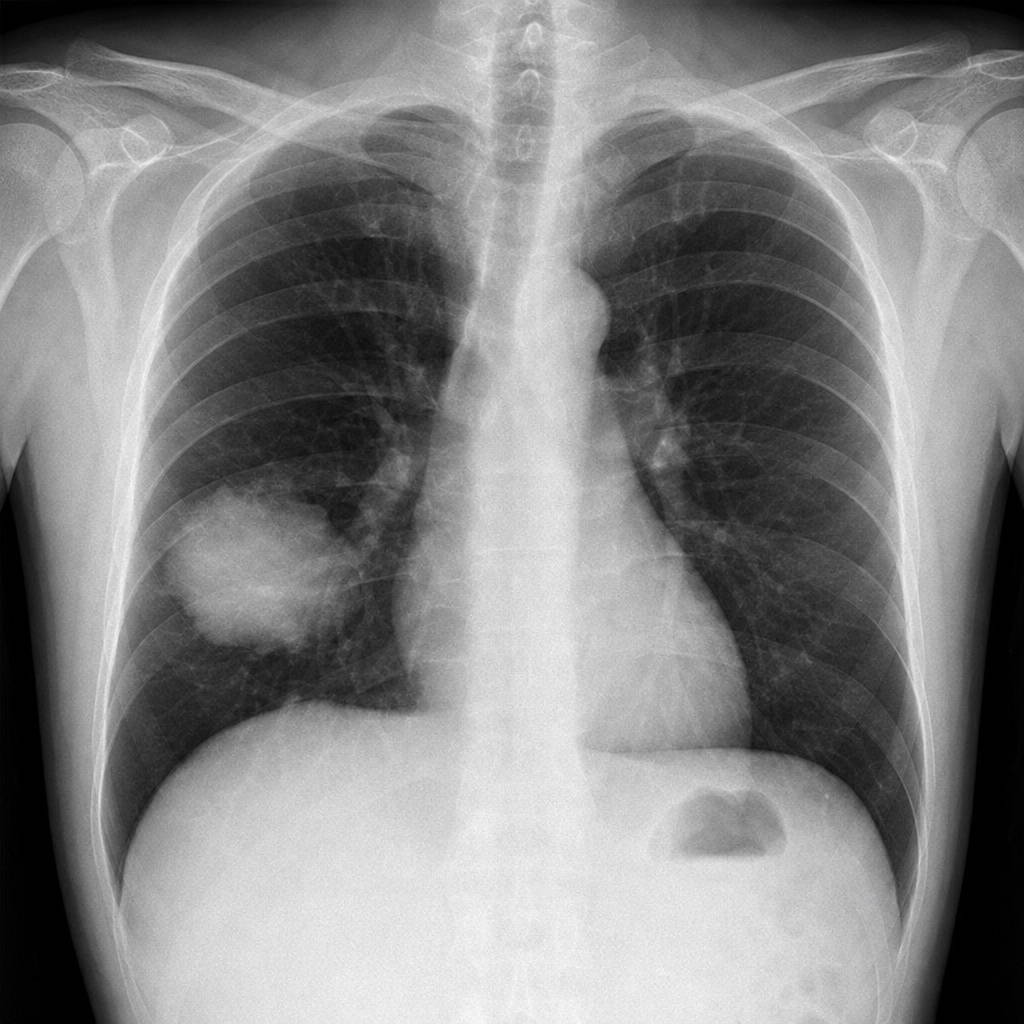
What is the most common cause of an air bronchogram?
Consolidation of which part of the lung is likely to obliterate the aortic knuckle on a chest X-ray?
Egg shell calcification is seen in which of the following conditions?
A 25-year-old man presented with fever, cough, expectoration, and breathlessness of 2 months' duration. Contrast-enhanced computed tomography of the chest showed bilateral upper lobe fibrotic lesions and mediastinal enlarged necrotic nodes with peripheral rim enhancement. Which one of the following is the most probable diagnosis?
Which of the following is NOT typically seen in congestive cardiac failure?
Pruned tree appearance of pulmonary circulation is a feature of which condition?
Miliary shadow on chest X-ray is seen in which of the following conditions?
Which of the following conditions is best investigated with a non-contrast CT scan?
Hampton hump is a feature of which of the following conditions?
Left atrial enlargement is best seen with which imaging view?
Explanation: ### Explanation **Concept:** An **air bronchogram** is a radiographic phenomenon where air-filled bronchi (dark/lucent) become visible against a background of opacified (white) lung parenchyma. Normally, bronchi are not visible because they are surrounded by air-filled alveoli. When the surrounding alveoli are filled with fluid, pus, or cells, the density difference makes the air-filled tubes stand out. **Why Consolidation is the Correct Answer:** **Consolidation** is the most common cause of this sign. In conditions like lobar pneumonia, the alveoli are filled with inflammatory exudate (pus), but the large conducting airways (bronchi) often remain patent and air-filled. This creates the classic "silhouette" effect required for an air bronchogram. **Analysis of Incorrect Options:** * **Pulmonary Edema:** While it can cause air bronchograms (especially in the alveolar stage), it more typically presents with Kerley B lines, peribronchial cuffing, and "bat-wing" opacities. * **Hyaline Membrane Disease (RDS):** This is a classic cause in **neonates** due to diffuse alveolar collapse (atelectasis) against patent bronchi. However, it is not the "most common" cause in the general population. * **Alveolar Cell Carcinoma (Adenocarcinoma in situ):** This can present with air bronchograms (the "bronchogram sign"), but it is a rare neoplastic cause compared to the high frequency of infectious pneumonia. **NEET-PG High-Yield Pearls:** * **Significance:** The presence of an air bronchogram **excludes** a pleural lesion or a mediastinal mass; it confirms the pathology is within the lung parenchyma. * **Atelectasis Exception:** Air bronchograms are usually *absent* in resorptive (obstructive) atelectasis because the bronchus itself is blocked. If seen in collapsed lung, it suggests non-obstructive atelectasis. * **CT Correlation:** The "CT Angiogram Sign" (vessels visible against low-attenuation consolidation) is often associated with Alveolar Cell Carcinoma or Lymphoma.
Explanation: ### Explanation The correct answer is **Left upper lobe (posterior segment)**. This question is based on the **Silhouette Sign**, a fundamental principle in chest radiology. The silhouette sign occurs when two structures of similar radiographic density (e.g., water/soft tissue) are in direct anatomical contact; their borders become indistinguishable on an X-ray. **Why the Correct Answer is Right:** The **aortic knuckle** (the arch of the aorta) is a posterior structure located in the superior mediastinum. The **apicoposterior segment of the left upper lobe** lies in direct contact with the aortic arch. Therefore, consolidation in this specific segment will obliterate the sharp interface between the lung and the aorta, causing the aortic knuckle to "disappear" or become blurred. **Analysis of Incorrect Options:** * **A. Left Lingula:** The lingula is the anterior-inferior portion of the left upper lobe. It lies adjacent to the **left heart border**. Consolidation here obliterates the left heart border, not the aortic knuckle. * **B. Right Upper Lobe:** This lobe is on the opposite side of the mediastinum. Consolidation here would obliterate the **right paratracheal stripe** or the superior vena cava border. * **C. Apex of the Lower Lobe:** While the lower lobe is posterior, its apex (superior segment) typically lies below the level of the aortic arch. Consolidation here may overlap the arch on a frontal view but usually does not obliterate its superior contour as effectively as the posterior segment of the upper lobe. **High-Yield Clinical Pearls for NEET-PG:** * **Right Heart Border:** Obliterated by Right Middle Lobe (RML) consolidation. * **Right Hemidiaphragm:** Obliterated by Right Lower Lobe (RLL) consolidation. * **Left Heart Border:** Obliterated by Lingular segment (Left Upper Lobe) consolidation. * **Descending Aorta:** Obliterated by Left Lower Lobe (LLL) consolidation. * **Aortic Knuckle:** Obliterated by Left Upper Lobe (Posterior segment) consolidation.
Explanation: **Explanation:** **Eggshell calcification** refers to the peripheral, rim-like calcification of the hilar or mediastinal lymph nodes. It is a classic radiological sign where the outer shell of the node is calcified while the center remains relatively lucent. **Why Sarcoidosis is the correct answer:** While historically associated most strongly with silicosis, **Sarcoidosis** is a frequent cause of eggshell calcification (seen in approximately 5% of cases). In the context of NEET-PG questions, if both are present, Sarcoidosis is often the preferred answer for "most common" or "most likely" in modern clinical practice, though both are high-yield associations. The calcification occurs due to chronic granulomatous inflammation within the lymph nodes. **Analysis of Incorrect Options:** * **Silicosis:** This is the *classic* association for eggshell calcification. However, it is a type of pneumoconiosis. If "Pneumoconiosis" and "Silicosis" are both listed alongside "Sarcoidosis," the examiner is often testing the specific differential. * **Pneumoconiosis:** This is a broad category of occupational lung diseases. While Silicosis and Coal Worker’s Pneumoconiosis (CWP) can cause this sign, Sarcoidosis remains a more frequent non-occupational cause. * **Lung Cancer:** Malignancy typically causes stippled, eccentric, or amorphous calcifications (if any), but rarely the distinct peripheral "eggshell" pattern. **Clinical Pearls for NEET-PG:** * **Differential Diagnosis for Eggshell Calcification:** Remember the mnemonic **"S-S-C-H-A-M-P"**: **S**ilicosis, **S**arcoidosis, **C**oal Worker’s Pneumoconiosis, **H**istoplasmosis, **A**myloidosis, **M**etastatic carcinoma (treated), and **P**ost-irradiation (Hodgkin’s Lymphoma). * **Sarcoidosis Hallmark:** Look for "1-2-3 Sign" (Garland’s Triad) consisting of right paratracheal, right hilar, and left hilar lymphadenopathy. * **Silicosis Hallmark:** Look for "Snowstorm appearance" or "nodular opacities" in the upper lobes.
Explanation: ### Explanation The clinical and radiological presentation is classic for **Post-primary (Reactivation) Tuberculosis**. **Why Tuberculosis is correct:** In a young patient with a chronic history (2 months) of constitutional symptoms (fever, cough, expectoration), the presence of **bilateral upper lobe fibrotic lesions** is highly suggestive of TB, as the organism (*Mycobacterium tuberculosis*) prefers the high oxygen tension found in the lung apices. The pathognomonic CT finding here is **mediastinal lymphadenopathy with peripheral rim enhancement and central necrosis**. This "rim sign" represents granulomatous inflammation with central caseous necrosis, which is the hallmark of tubercular lymphadenitis. **Why other options are incorrect:** * **Sarcoidosis:** Typically presents with bilateral symmetrical hilar lymphadenopathy and perilymphatic nodules. While it can cause upper lobe fibrosis in Stage IV, the nodes are usually "potato-like" (well-defined, non-matted) and **homogeneously enhancing**, not necrotic. * **Lymphoma:** Usually presents with a large anterior mediastinal mass. While nodes can be bulky, they typically show **homogeneous enhancement**. Necrosis is rare unless the tumor is very large or post-treatment. * **Silicosis:** Characterized by multiple small, well-defined nodules in the upper lobes and "eggshell calcification" of hilar nodes. It does not typically present with necrotic nodes or acute febrile illness. **NEET-PG High-Yield Pearls:** * **Rim-enhancing necrotic nodes:** Think Tuberculosis first (especially in the Indian context). * **Eggshell calcification:** Classic for Silicosis; also seen in Sarcoidosis (rarely). * **1-2-3 Sign (Garland’s Triad):** Right paratracheal, right hilar, and left hilar lymphadenopathy—characteristic of Sarcoidosis. * **Tree-in-bud appearance:** On CT, this signifies endobronchial spread of infection (highly suggestive of active TB).
Explanation: In Congestive Cardiac Failure (CCF), the hallmark finding on a chest X-ray is **Cephalization** (also known as the Antler sign). This refers to the redistribution of blood flow to the upper lobes. **Explanation of the Correct Answer:** * **Prominent lower lobe vessels (Option B):** In a normal upright chest X-ray, gravity causes the lower lobe vessels to be more prominent than the upper lobe vessels. However, in CCF, increased pulmonary venous pressure leads to perivascular edema, which compresses the lower lobe vessels. This causes a redistribution of blood flow to the upper lobes. Therefore, **prominent lower lobe vessels are a normal finding**, while their absence (cephalization) is a sign of heart failure. **Explanation of Incorrect Options:** * **Kerley B lines (Option A):** These are short (1-2 cm), horizontal peripheral lines seen at the lung bases. They represent thickened interlobular septa due to fluid accumulation and are a classic sign of pulmonary edema. * **Pleural effusions (Option C):** Increased hydrostatic pressure leads to fluid transudation into the pleural space. In CCF, effusions are typically bilateral; if unilateral, they are more common on the right side. * **Cardiomegaly (Option D):** Defined as a cardiothoracic ratio >0.5 on a PA view, this is a common finding in chronic heart failure, indicating ventricular enlargement. **High-Yield Clinical Pearls for NEET-PG:** * **Stages of Pulmonary Edema on CXR:** 1. **Stage 1 (PCWP 13-18 mmHg):** Cephalization (Upper lobe diversion). 2. **Stage 2 (PCWP 18-25 mmHg):** Interstitial edema (Kerley B lines, peribronchial cuffing). 3. **Stage 3 (PCWP >25 mmHg):** Alveolar edema (Bat-wing appearance). * **Vanishing Tumor:** A localized pleural effusion in the interlobar fissures (usually the minor fissure) that disappears with diuretic therapy is called a "pseudotumor" or "phantom tumor."
Explanation: **Explanation:** The **"Pruned Tree Appearance"** is a classic radiological sign of **Pulmonary Artery Hypertension (PAH)**. It occurs due to the marked dilation of the central pulmonary arteries (the "trunk") followed by a rapid, abrupt narrowing (tapering) of the peripheral pulmonary vessels. This peripheral tapering is caused by increased pulmonary vascular resistance and obliterative changes in the small distal vessels, making the lungs look like a tree with its outer branches cut off. **Analysis of Options:** * **Pulmonary Artery Hypertension (Correct):** High pressure leads to proximal vessel distension and distal vasoconstriction/obliteration, creating the characteristic "pruned" look on a chest X-ray or CT. * **Pulmonary Stenosis:** Typically results in **post-stenotic dilation** of the main pulmonary artery (especially the left branch) and *decreased* pulmonary vascular markings (oligemia), but not the specific pruned-tree pattern. * **Pulmonary Regurgitation:** Usually leads to right ventricular enlargement and potentially dilated central arteries due to volume overload, but it lacks the abrupt peripheral tapering seen in PAH. * **Pulmonary Embolism:** Acute PE may show **Westermark’s sign** (focal oligemia) or **Fleischner sign** (distended central artery), but "pruning" is a chronic feature of vascular remodeling. **High-Yield Clinical Pearls for NEET-PG:** * **Westermark Sign:** Focal area of lucency (oligemia) distal to an embolus in Pulmonary Embolism. * **Hampton’s Hump:** Wedge-shaped opacity at the periphery indicating pulmonary infarction. * **Knuckle Sign:** Abrupt tapering of a pulmonary artery branch due to an embolus. * **PAH on X-ray:** Right descending pulmonary artery diameter **>16 mm** in males or **>15 mm** in females is a strong indicator of PAH.
Explanation: **Explanation:** A **miliary pattern** on a chest X-ray is characterized by numerous small, discrete, rounded opacities (typically 1–3 mm in diameter) distributed uniformly throughout both lungs. This pattern represents the hematogenous or lymphatic spread of a disease process. **Why Option C is Correct:** The correct answer includes conditions known to present with diffuse micronodular patterns: * **Tuberculosis:** The classic cause (Miliary TB), resulting from hematogenous spread. * **Metastasis:** Common in thyroid (medullary/papillary), renal cell carcinoma, melanoma, and trophoblastic tumors. * **Rheumatoid Arthritis:** Can present as rheumatoid nodules or interstitial lung disease with a nodular component. * **COPD:** While primarily an obstructive airway disease, advanced stages or specific phenotypes (like centrilobular emphysema) can occasionally mimic a fine nodular/miliary pattern on imaging due to vascular changes or associated smoking-related interstitial diseases. **Analysis of Incorrect Options:** The inclusion of **Pneumoconiosis** (found in A, B, and D) is the primary differentiator. While Silicosis and Coal Worker’s Pneumoconiosis cause nodular opacities, they are typically larger, more irregular, and predominantly involve the upper lobes rather than a true, uniform "miliary" distribution seen in systemic spread. **High-Yield Clinical Pearls for NEET-PG:** * **Mnemonic for Miliary Shadows (MaST):** **M**etastasis, **a**nthracosis (Pneumoconiosis - though less "miliary" than others), **S**arcoidosis/Silicosis, **T**uberculosis. * **Most Common Cause:** In the Indian context, Miliary TB is the most common cause. * **HRCT Correlation:** HRCT is the gold standard for evaluating miliary patterns, showing a "random distribution" of nodules in relation to the secondary pulmonary lobule. * **Differential Diagnosis Tip:** If the nodules are calcified, think of healed TB, Silicosis, or Mitral Stenosis (ossification).
Explanation: **Explanation:** The primary goal of a CT scan in **Interstitial Lung Disease (ILD)** is to visualize the fine structural details of the lung parenchyma, such as reticulations, ground-glass opacities, and honeycombing. This is achieved through **High-Resolution Computed Tomography (HRCT)**, which uses thin slices (1–2 mm) and a high-spatial-frequency reconstruction algorithm. Since the natural contrast between air-filled alveoli and the lung interstitium is high, intravenous contrast is unnecessary and may even obscure subtle parenchymal details. **Analysis of Incorrect Options:** * **A. Mediastinal mass:** Contrast (CECT) is essential to differentiate the mass from adjacent vascular structures, identify the degree of vascularity, and check for invasion into the heart or great vessels. * **B. Lung mass:** CECT is required to evaluate the vascularity of the lesion, its relationship with the hilum, and to identify mediastinal lymphadenopathy (staging). * **C. Nodular thickening of pleura:** Contrast helps distinguish between simple pleural fluid and pleural thickening/masses. It also highlights "pleural enhancement," which is a key sign of inflammation or malignancy (e.g., Mesothelioma). **Clinical Pearls for NEET-PG:** * **HRCT** is the "Gold Standard" for diagnosing ILD and Bronchiectasis. * **Non-Contrast CT (NCCT)** is also the investigation of choice for **Ureteric Calculi** (KUB) and **Acute Head Injury** (to rule out hemorrhage). * **Contrast (CECT)** is generally mandatory for evaluating **malignancies, infections (abscesses), and vascular pathologies** (Aortic dissection/PE).
Explanation: **Explanation:** **Hampton Hump** is a classic radiographic sign of **Pulmonary Embolism (PE)**, specifically representing **pulmonary infarction**. It appears as a shallow, wedge-shaped, pleural-based opacification with a rounded (convex) apex pointing toward the hilum. It is most commonly found in the lower lobes at the costophrenic angles. The "hump" represents distal hemorrhage and necrosis resulting from the occlusion of a peripheral pulmonary artery. **Analysis of Options:** * **Pulmonary Embolism (Correct):** While PE often presents with a normal chest X-ray, Hampton Hump is a specific (though insensitive) sign of infarction. * **Pulmonary Tuberculosis:** Typically presents with apical infiltrates, cavitary lesions, or Ghon complexes, rather than peripheral wedge-shaped opacities. * **Pulmonary Hemorrhage:** Usually manifests as diffuse, patchy alveolar opacities or ground-glass shadows, lacking the distinct wedge-shaped pleural base characteristic of the hump. * **Bronchogenic Carcinoma:** Generally presents as a central or peripheral mass, often with irregular or spiculated margins, and may be associated with lobar collapse or hilar lymphadenopathy. **High-Yield Clinical Pearls for NEET-PG:** * **Westermark Sign:** Focal oligemia (translucency) distal to the embolus; another specific sign of PE. * **Fleischner Sign:** Prominent central pulmonary artery due to a large clot (often seen in saddle embolism). * **Knuckle Sign:** Abrupt tapering of a pulmonary artery. * **Gold Standard Investigation:** CT Pulmonary Angiography (CTPA) is the investigation of choice for PE. * **Palla’s Sign:** Enlargement of the right descending pulmonary artery.
Explanation: ### Explanation **1. Why the Correct Answer is Right:** The **Left Atrium (LA)** is the most posterior chamber of the heart. In the mediastinum, it lies in direct contact with the anterior wall of the mid-esophagus. When the left atrium enlarges, it displaces the esophagus posteriorly and to the right. In a **Barium swallow Right Anterior Oblique (RAO) view**, the esophagus is projected between the heart and the spine. This specific orientation provides the highest sensitivity for detecting early LA enlargement, as the opacified esophagus will show a characteristic **posterior indentation or displacement**. **2. Why the Other Options are Wrong:** * **Chest X-ray AP View:** While LA enlargement can be seen here (e.g., double atrial shadow, splaying of the carina), it is less sensitive than barium studies for early detection because the heart is a 3D structure projected onto a 2D plane, leading to overlap. * **Chest X-ray Left Lateral View:** This view can show posterior displacement of the esophagus or the left main bronchus (walking-man sign), but the RAO view with barium provides better anatomical separation and visualization of the esophageal-atrial interface. * **Barium Swallow LAO View:** In the Left Anterior Oblique view, the left atrium is not the primary structure indenting the esophagus; this view is better suited for evaluating the aortic arch and the right ventricle. **3. High-Yield Clinical Pearls for NEET-PG:** * **Earliest sign of LA enlargement on CXR PA view:** Straightening of the left cardiac border. * **Most specific sign on CXR PA view:** Double atrial shadow (Double density sign). * **Carinal Angle:** LA enlargement causes widening of the subcarinal angle (>90 degrees) and elevation of the left main bronchus (**"Walking Man Sign"** on lateral view). * **Mitral Stenosis:** The most common cause of isolated left atrial enlargement.
Normal Chest Radiographic Anatomy
Practice Questions
Radiographic Signs in Chest Imaging
Practice Questions
Pulmonary Infections
Practice Questions
Chronic Obstructive Pulmonary Disease
Practice Questions
Interstitial Lung Diseases
Practice Questions
Pulmonary Neoplasms
Practice Questions
Pleural Diseases
Practice Questions
Mediastinal Pathology
Practice Questions
Congenital and Developmental Chest Anomalies
Practice Questions
Pulmonary Vascular Diseases
Practice Questions
Chest Trauma Imaging
Practice Questions
Post-Surgical Chest Imaging
Practice Questions
Get full access to all questions, explanations, and performance tracking.
Start For Free