For small pneumothorax, in which view is an X-ray best performed to increase sensitivity?
Egg shell calcification is seen in which of the following conditions?
Which of the following radiological findings does NOT indicate increased pulmonary blood flow?
What is the cause of an opaque hemithorax?
Inferior rib notching is characteristically present in which of the following congenital cardiac anomalies?
What is the imaging modality for confirming the diagnosis of bronchiectasis?
An expiratory chest radiograph is particularly useful to detect which of the following conditions?
Rib notching is seen in all of the following conditions except:
A 45-year-old male presents to the emergency department at 1 AM after binge drinking, complaining of severe chest pain following an episode of vomiting. A chest radiograph of this patient demonstrates which of the following signs?
Which one of the following diagnostic techniques is most specific for pulmonary embolism?
Explanation: **Explanation:** The detection of a small pneumothorax on a chest X-ray depends on the contrast between the lung parenchyma and the pleural air. **Why Expiration PA view is correct:** During **expiration**, the volume of the thoracic cavity decreases and the lungs deflate. However, the volume of air in the pleural space (the pneumothorax) remains constant. This leads to two effects that increase sensitivity: 1. **Relative Density:** The lung becomes more dense (opaque) as air is pushed out, making the thin, visceral pleural line of the pneumothorax more visible against the darker pleural air. 2. **Relative Volume:** The pneumothorax occupies a larger percentage of the hemithorax during expiration, making it easier to spot at the lung apex. **Analysis of Incorrect Options:** * **Inspiration PA view:** This is the standard view for most chest pathologies. However, during deep inspiration, the expanded, air-filled lungs can mask a small pneumothorax by pushing it against the chest wall. * **Lateral decubitus view:** While highly sensitive (it can detect as little as 5ml of air), it is primarily used to detect **pleural effusion** (fluid) or to confirm a pneumothorax in neonates/non-ambulatory patients. It is not the standard "next step" for a suspected small pneumothorax in an upright adult. * **Supine view:** This is the least sensitive view. In supine patients (e.g., trauma), air collects anteriorly and inferiorly, often presenting only as the **"Deep Sulcus Sign"** rather than a clear pleural line. **Clinical Pearls for NEET-PG:** * **Gold Standard:** CT Chest is the most sensitive modality for pneumothorax. * **Deep Sulcus Sign:** A high-yield radiological sign of pneumothorax on a **supine** film, characterized by an abnormally deepened and lucent costophrenic angle. * **Initial Investigation:** The standard initial film is an upright PA inspiration film; however, if clinical suspicion is high and the initial film is negative, an **expiratory film** is the preferred provocative maneuver.
Explanation: **Explanation:** **Eggshell calcification** refers to a characteristic radiological pattern where calcium deposits form in the periphery of hilar or mediastinal lymph nodes. This occurs due to the peripheral rim-like calcification of the lymph node capsule. **1. Why Silicosis is Correct:** Silicosis is the most classic and common association for eggshell calcification. Inhalation of silica particles leads to a chronic inflammatory response in the pulmonary lymphatics. The resulting fibrosis and dystrophic calcification occur predominantly at the periphery of the enlarged hilar lymph nodes, creating the "eggshell" appearance on a chest X-ray or CT scan. **2. Analysis of Incorrect Options:** * **Bronchiolitis (A):** This is an inflammatory condition of the small airways (bronchioles), typically presenting with "tree-in-bud" patterns or air trapping, not lymph node calcification. * **Carcinoma of Bronchus (C):** While lung cancer can cause lymphadenopathy, the nodes are usually bulky and necrotic. Calcification is rare unless it is a mucinous adenocarcinoma or occurs after radiotherapy. * **Sarcoidosis (D):** While Sarcoidosis is a major differential for eggshell calcification, **Silicosis remains the primary and most classic association** for this specific pattern. In Sarcoidosis, lymph nodes more commonly show "potato-like" bilateral hilar lymphadenopathy or "popcorn" calcification. **3. NEET-PG High-Yield Pearls:** * **Differential Diagnosis for Eggshell Calcification:** Silicosis (Most common), Coal Worker’s Pneumoconiosis (CWP), Sarcoidosis (5% of cases), treated Lymphoma, and occasionally Blastomycosis. * **Silicosis Key Features:** Upper lobe predominant nodules, "progressive massive fibrosis" (PMF), and an increased risk of Tuberculosis (Silicotuberculosis). * **Snowstorm Appearance:** Seen on X-ray in acute silicosis (miliary pattern).
Explanation: This question tests the ability to distinguish between **Pulmonary Hyperemia** (increased blood flow, e.g., Left-to-Right shunts) and **Pulmonary Venous Hypertension** (congestion, e.g., Mitral Stenosis or Heart Failure). ### **Why Kerley B lines is the correct answer:** **Kerley B lines** are a hallmark of **Pulmonary Venous Hypertension/Congestion** and interstitial pulmonary edema. They represent thickened interlobular septa caused by fluid accumulation or lymphatic engorgement. They do not indicate increased arterial flow (hyperemia), but rather a backup of pressure from the left heart or pulmonary veins. ### **Analysis of Incorrect Options (Findings of Increased Flow):** * **A. Descending pulmonary artery >16 mm:** In adults, the normal diameter of the right descending pulmonary artery is <16 mm. Dilatation beyond this indicates increased pulmonary blood flow or pulmonary arterial hypertension. * **C. Artery-to-Bronchus ratio >1:** Normally, a peripheral pulmonary artery is roughly the same size as its accompanying bronchus. If the diameter of two or more arteries exceeds their bronchi, it signifies increased flow (hyperemia). * **D. >6 peripheral vessels in the outer 1/3rd:** In a normal chest X-ray, the outer third of the lung field is relatively "vessel-free." Visualizing more than six vessels in this zone is a classic sign of increased pulmonary blood flow. ### **High-Yield Clinical Pearls for NEET-PG:** * **Kerley A lines:** Longer (2–6 cm) lines radiating from the hila (peribronchovascular thickening). * **Kerley B lines:** Short (1–2 cm), horizontal lines at the lung bases, perpendicular to the pleura. * **Cephalization (Antler Sign):** Redirection of blood flow to the upper lobes; the earliest sign of pulmonary venous hypertension (PCWP 12–18 mmHg). * **Shunt Vascularity:** Increased flow seen in ASD, VSD, and PDA.
Explanation: **Explanation:** An **opaque hemithorax** (white-out of one lung) occurs when the lung becomes airless or is replaced by fluid/mass, causing it to appear radio-opaque on a chest X-ray. **1. Why Foreign Body is correct:** In pediatric cases, a long-standing inhaled **foreign body** can cause complete bronchial obstruction. This leads to **resorptive atelectasis** (collapse) of the entire lung. As the air is absorbed and the lung collapses, the hemithorax becomes opaque, typically accompanied by an **ipsilateral mediastinal shift** (pulling the heart and trachea toward the side of the opacity). **2. Analysis of Incorrect Options:** * **Poland’s Syndrome:** Characterized by the congenital absence of the pectoralis major muscle. On X-ray, this results in a **hyperlucent** (darker) hemithorax due to the lack of overlying soft tissue, not opacity. * **McLeod’s Syndrome (Swyer-James Syndrome):** A post-infectious sequela of childhood bronchiolitis obliterans resulting in a small, **hyperlucent** lung with decreased vascularity. * **Congenital Lobar Emphysema:** This involves over-distension of a lung lobe (usually the left upper lobe). On X-ray, it presents as a **hyperlucent** area that causes a contralateral mediastinal shift (pushing the heart away). **Clinical Pearls for NEET-PG:** * **Differential Diagnosis of Opaque Hemithorax:** 1. **Large Pleural Effusion:** Mediastinal shift to the **opposite** side (Push). 2. **Total Lung Collapse (e.g., Foreign body, Mucus plug):** Mediastinal shift to the **same** side (Pull). 3. **Pneumonectomy:** Surgical removal; shift to the **same** side with rib crowding. 4. **Diaphragmatic Hernia:** Bowel loops may mimic opacity or lucency depending on content. * **Key Rule:** If the mediastinum is central in an opaque hemithorax, suspect a consolidation or a combination of collapse and effusion.
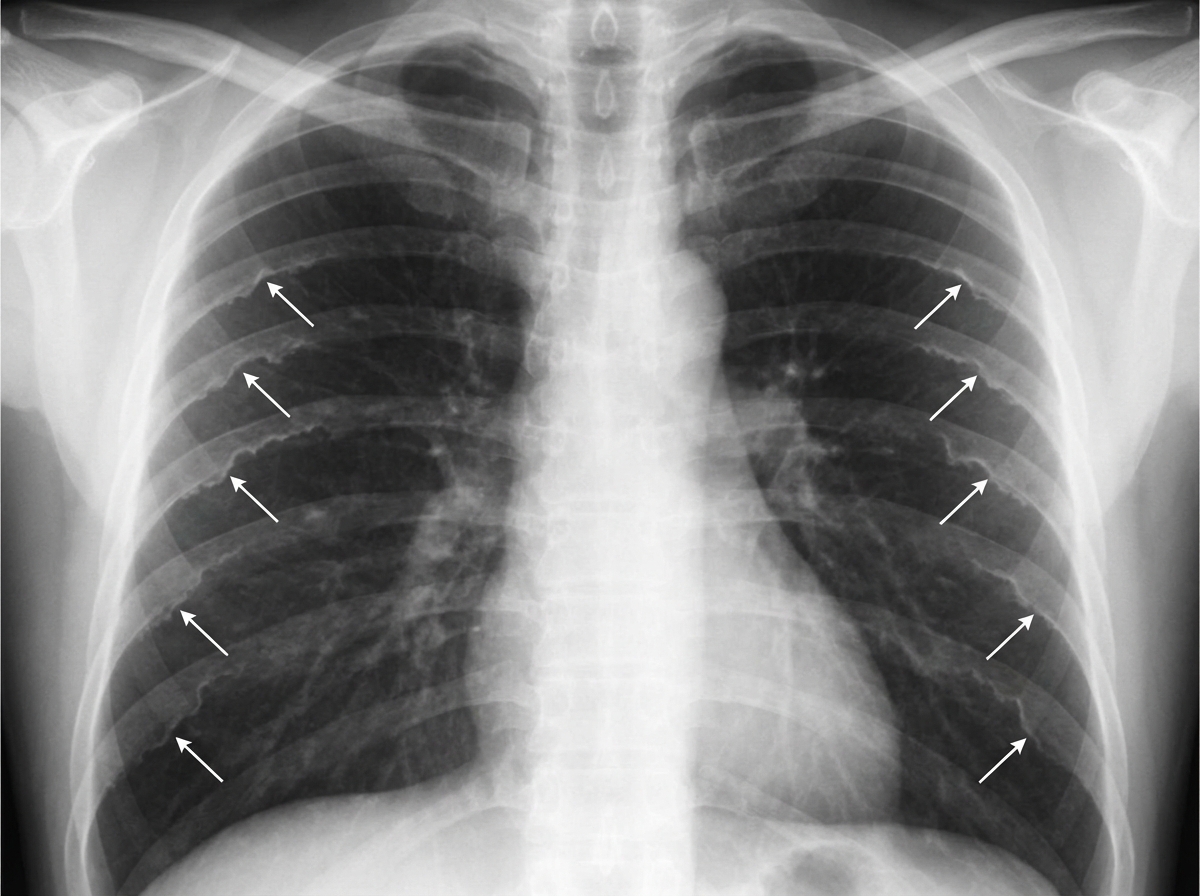
Explanation: **Explanation:** **1. Why Coarctation of Aorta is correct:** Inferior rib notching (Roesler’s sign) is a classic radiological finding in **post-ductal coarctation of the aorta**. Due to the narrowing of the aorta distal to the left subclavian artery, the body develops collateral circulation to bypass the obstruction and supply the lower body. The primary pathway involves the **intercostal arteries**. These arteries become dilated, tortuous, and pulsatile. As they run along the inferior groove of the ribs, the constant pressure and pulsation cause pressure erosion (notching) of the **3rd to 9th ribs**. The 1st and 2nd ribs are spared because their intercostal arteries do not originate from the post-stenotic aorta. **2. Why the other options are incorrect:** * **TAPVC:** Characterized by the **"Snowman sign"** or "Figure-of-8" appearance on a chest X-ray due to a dilated supracardiac venous shadow. * **Tetralogy of Fallot:** Classically presents with a **"Boot-shaped heart"** (Coeur en Sabot) due to right ventricular hypertrophy and an upturned apex. * **Ventricular Septal Defect:** Typically shows features of increased pulmonary blood flow (plethora) and left-sided heart enlargement, but does not involve collateral arterial pathways that erode ribs. **3. High-Yield Clinical Pearls for NEET-PG:** * **Roesler’s Sign:** Inferior rib notching (3rd–9th ribs). * **3-Sign:** Seen on X-ray (formed by pre-stenotic dilation, the coarctation itself, and post-stenotic dilation). * **Reverse 3-Sign (E-sign):** Seen on Barium swallow. * **Superior Rib Notching:** Rare; associated with conditions like Neurofibromatosis-1, Marfan syndrome, or Polio. * **Clinical Hallmark:** Radio-femoral delay and upper limb hypertension.
Explanation: **Explanation:** **1. Why Chest CT Scan is the Correct Answer:** High-Resolution Computed Tomography (HRCT) is the **gold standard** and investigation of choice for diagnosing bronchiectasis. It allows for the direct visualization of permanent bronchial dilation. The hallmark signs on CT include the **"Signet Ring Sign"** (where the internal diameter of the bronchus is wider than its accompanying pulmonary artery) and the **"Tram-track sign"** (non-tapering, thickened bronchial walls). CT is essential not only for confirmation but also for determining the distribution (focal vs. diffuse) and the morphological type (cylindrical, varicose, or cystic). **2. Why Other Options are Incorrect:** * **X-ray Chest:** While often the initial screening tool, it lacks sensitivity. It may show "tram-track" opacities or "honeycombing" in advanced cases, but a normal X-ray does not rule out bronchiectasis. * **MRI Chest:** MRI has limited utility in lung parenchyma imaging due to low proton density and motion artifacts. It is not used for diagnosing airway diseases like bronchiectasis. * **Bronchoscopy:** This is an invasive procedure used to identify the *cause* of focal bronchiectasis (e.g., an obstructing tumor or foreign body) or to obtain cultures, but it cannot visualize the bronchial wall dilation required for a definitive diagnosis. **3. High-Yield Clinical Pearls for NEET-PG:** * **Gold Standard:** HRCT Chest (1mm slices). * **Signet Ring Sign:** Bronchus-to-artery ratio > 1-1.5. * **Finger-in-glove appearance:** Classic for Allergic Bronchopulmonary Aspergillosis (ABPA) causing mucoid impaction. * **Kartagener Syndrome Triad:** Bronchiectasis, Sinusitis, and Situs Inversus. * **Most common cause (Global):** Post-infectious (e.g., Tuberculosis, Measles).
Explanation: **Explanation:** In a standard inspiratory chest X-ray, the lungs are fully expanded, which can sometimes mask a small or apical pneumothorax. An **expiratory film** is a high-yield diagnostic maneuver for this condition due to two physiological reasons: 1. **Volume Reduction:** During expiration, the lung volume decreases while the volume of the intrapleural air remains constant. This makes the pneumothorax occupy a larger relative proportion of the hemithorax. 2. **Increased Lung Density:** As air is exhaled, the lung parenchyma becomes more radiopaque (whiter). This provides a sharper contrast against the radiolucent (black) pleural air, making the visceral pleural line much easier to visualize. **Analysis of Incorrect Options:** * **A. Pleural effusion:** Best detected on an **Inspiratory Erect** film (for blunting of costophrenic angles) or a **Lateral Decubitus** view (to detect small amounts of fluid or determine if it is free-flowing). * **C. Pulmonary edema:** Characterized by Kerley B lines, cephalization, and perihilar haze; these are best evaluated on a standard inspiratory film to assess heart size and vascular markings accurately. * **D. Pulmonary infarct:** Presents as "Hampton’s Hump" (wedge-shaped opacity); it does not require expiratory films for identification. **NEET-PG High-Yield Pearls:** * **Indications for Expiratory X-ray:** Small pneumothorax, foreign body aspiration (demonstrates air trapping/obstructive emphysema), and evaluating diaphragmatic excursion. * **Gold Standard:** While expiratory films are useful, **NCCT Chest** is the most sensitive investigation for detecting a pneumothorax. * **Tension Pneumothorax:** This is a **clinical diagnosis**. Do not wait for an X-ray; immediate needle decompression is required.
Explanation: **Explanation:** Rib notching is a classic radiological sign characterized by erosions on the inferior or superior margins of the ribs. The question asks which condition does **not** cause rib notching; since all listed conditions are known causes, "None of the above" is the correct answer. **1. Coarctation of the Aorta (Option B):** This is the most common cause of **inferior rib notching**. In post-ductal coarctation, blood flow to the lower body is maintained via collateral circulation. The intercostal arteries become dilated and tortuous to bypass the obstruction, causing pressure erosion on the lower borders of the 3rd to 8th ribs. (Note: The 1st and 2nd ribs are spared as they are supplied by the costocervical trunk). **2. Blalock-Taussig (BT) Shunt (Option A):** A classic BT shunt involves anastomosing the subclavian artery to the pulmonary artery. This reduces blood flow to the ipsilateral intercostal arteries, leading to **unilateral rib notching** on the side of the shunt due to compensatory collateral development. **3. Tricuspid Valve Obstruction (Option C):** In conditions like Tricuspid Atresia or severe stenosis, there is decreased pulmonary blood flow. This triggers the development of extensive systemic-to-pulmonary collaterals involving the intercostal arteries, resulting in rib notching. **High-Yield Clinical Pearls for NEET-PG:** * **Inferior Notching (Roesler’s Sign):** Seen in Coarctation of aorta, BT Shunt, and SVC obstruction. * **Superior Notching:** Less common; seen in connective tissue diseases (SLE, RA), Hyperparathyroidism, and restrictive lung disease. * **"3" Sign:** Seen on Chest X-ray in Coarctation (pre-stenotic dilation, the indentation, and post-stenotic dilation). * **Reverse "3" or "E" Sign:** Seen on Barium swallow in Coarctation.
Explanation: ### **Explanation** **Correct Answer: B. Naclerio V sign** The clinical presentation describes **Boerhaave Syndrome** (spontaneous esophageal perforation), typically occurring after forceful vomiting or retching (often post-alcohol binge). When the esophagus ruptures, air escapes into the mediastinum (**pneumomediastinum**). The **Naclerio V sign** is a classic radiologic finding in Boerhaave syndrome. It represents air outlining the lower lateral margin of the descending aorta and the left hemidiaphragm, forming a "V" shape. This occurs because gas tracks between the parietal pleura and the mediastinal fascia. --- ### **Analysis of Incorrect Options** * **A. Silhouette Sign:** This occurs when two structures of similar radiographic density are in anatomical contact, causing the border between them to disappear (e.g., right middle lobe pneumonia obscuring the right heart border). It is not specific to esophageal rupture. * **C. Spinnaker Sign (Angel Wing Sign):** This refers to the elevation of the thymic lobes by air in the mediastinum. While it is a sign of pneumomediastinum, it is primarily seen in **neonates** and infants, not adults. * **D. Hilum Overlay Sign:** This is used to differentiate a hilar mass from an enlarged heart or a mass in the anterior/posterior mediastinum. If hilar vessels are visible through the mass, the lesion is not in the hilum. --- ### **High-Yield Clinical Pearls for NEET-PG** * **Mackler’s Triad:** Vomiting, chest pain, and subcutaneous emphysema (pathognomonic for Boerhaave syndrome). * **Most Common Site of Rupture:** Left posterolateral aspect of the distal esophagus (2–3 cm above the gastroesophageal junction). * **Hamman’s Crunch:** A crunching sound heard over the precordium synchronous with the heartbeat, indicating pneumomediastinum. * **Gold Standard Investigation:** Gastrografin (water-soluble contrast) swallow study. Avoid Barium initially due to the risk of mediastinitis.
Explanation: **Explanation:** **Pulmonary Angiography** is considered the **"Gold Standard"** and the most specific diagnostic technique for pulmonary embolism (PE). It involves the direct injection of radiopaque contrast into the pulmonary arteries via a catheter. A definitive diagnosis is made by the direct visualization of an intraluminal filling defect or the abrupt "cutoff" of a vessel. While highly specific, it is an invasive procedure and has largely been replaced in clinical practice by CT Pulmonary Angiography (CTPA). **Why other options are incorrect:** * **Ventilation (V) and Perfusion (Q) Lung Scanning:** These are functional imaging tests. While a "mismatch" (normal ventilation with a perfusion defect) suggests PE, these tests are often non-specific. Conditions like pneumonia, COPD, or old scars can cause defects, leading to "intermediate" or "low probability" results that are not definitive. * **Arterial Blood Gas (ABG) Analysis:** ABG typically shows hypoxemia, hypocapnia, and respiratory alkalosis in PE. However, these findings are highly non-specific and can be seen in numerous other cardiac and pulmonary conditions. A normal ABG does not rule out PE. **High-Yield Clinical Pearls for NEET-PG:** * **Investigation of Choice (IOC):** CT Pulmonary Angiography (CTPA) is the current IOC due to its high sensitivity and non-invasive nature. * **Gold Standard:** Invasive Pulmonary Angiography (as per the question). * **Initial Screening Test:** Chest X-ray (usually normal, but look for *Hampton’s Hump* or *Westermark Sign*). * **Best Initial Bedside Test:** ECG (most common finding is Sinus Tachycardia; most specific is S1Q3T3). * **D-Dimer:** High negative predictive value (useful to rule out PE in low-risk patients).
Normal Chest Radiographic Anatomy
Practice Questions
Radiographic Signs in Chest Imaging
Practice Questions
Pulmonary Infections
Practice Questions
Chronic Obstructive Pulmonary Disease
Practice Questions
Interstitial Lung Diseases
Practice Questions
Pulmonary Neoplasms
Practice Questions
Pleural Diseases
Practice Questions
Mediastinal Pathology
Practice Questions
Congenital and Developmental Chest Anomalies
Practice Questions
Pulmonary Vascular Diseases
Practice Questions
Chest Trauma Imaging
Practice Questions
Post-Surgical Chest Imaging
Practice Questions
Get full access to all questions, explanations, and performance tracking.
Start For Free