Inhalational anthrax is characterized by:
Cavitating pulmonary lesions can be seen in the following except:
Which of the following is the current preferred first-line diagnostic test for pulmonary embolism?
All are radiological features of mitral stenosis except:
Which of the following conditions is most commonly associated with eggshell calcifications?
Best diagnostic aid for bronchiectasis is
A 70-year-old male presented with complaints of breathlessness and exhibited abnormal bronchial breath sounds on examination. What is the most probable diagnosis based on the provided X-ray image?
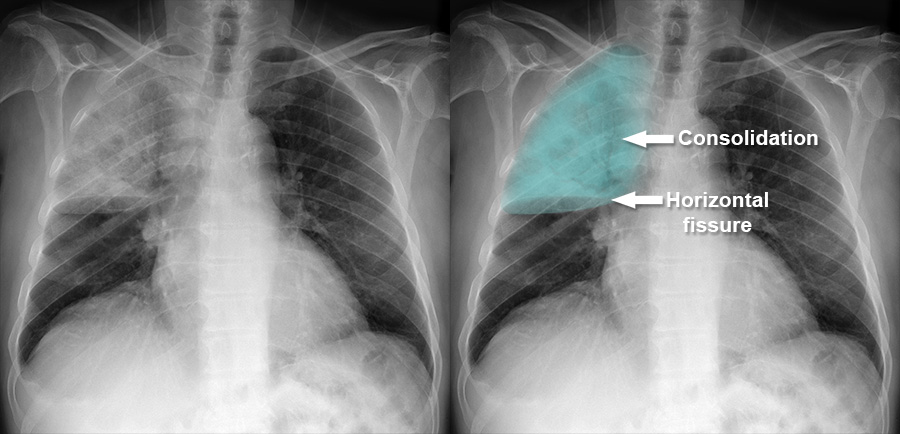
The following are direct signs of lung collapse seen on a chest X-ray, which one of the following is NOT a direct sign?
Ring sign with dilated bronchi on CXR is a feature of
Kerley-B lines are seen when pulmonary venous pressure is what?
Explanation: ***Mediastinal widening and pleural effusion*** - The spores of *Bacillus anthracis* are taken up by macrophages, transported to mediastinal lymph nodes, causing lymphadenitis and edema that appears as **mediastinal widening** on chest X-ray. - Hemorrhagic mediastinitis and subsequent vascular compromise lead to the development of hemorrhagic **pleural effusions**, which are characteristic of inhalational anthrax. *Consolidation and pleural effusion* - While pleural effusions are seen, lobar consolidation is more typical of bacterial pneumonias caused by common bacteria, not primarily inhalational anthrax initially. - The primary lung manifestation in anthrax is not parenchymal consolidation but rather hemorrhagic mediastinitis extending to the pleura. *Bilateral patchy opacities with pleural effusion* - Bilateral patchy opacities are more indicative of conditions like atypical pneumonia, viral pneumonia, or acute respiratory distress syndrome (ARDS), which are not the presenting radiographic signs of early inhalational anthrax. - Although advanced cases might show some parenchymal involvement, the hallmark features remain mediastinal and pleural. *None of the options* - This option is incorrect because mediastinal widening and pleural effusion are classic and well-documented radiological findings in inhalational anthrax.
Explanation: ***Sarcoidosis*** - While sarcoidosis often presents with a variety of pulmonary manifestations like **nodules**, **hilar lymphadenopathy**, and **interstitial lung disease**, **cavitating lesions** are highly atypical and rare. - Cavitation in sarcoidosis, if it occurs, usually suggests **secondary infection** (such as aspergilloma in pre-existing cysts) or a different diagnosis altogether. - Sarcoidosis typically shows **non-caseating granulomas** without tissue necrosis, which explains the absence of cavitation. *Tuberculosis* - **Pulmonary tuberculosis**, particularly the post-primary or reactivation form, commonly manifests with **cavitating lesions**, especially in the **upper lobes**. - Cavitation is a hallmark of active disease due to **caseating necrosis** and facilitates the airborne spread of bacteria. *Carcinoma of lung* - **Squamous cell carcinoma** is the most common histological type of lung cancer to present with **cavitating lesions** (seen in 10-20% of cases). - Cavitation occurs due to **central necrosis** of the tumor mass. - Other types like adenocarcinoma can also cavitate, though less frequently. *Wegener's granulomatosis* - **Granulomatosis with polyangiitis (GPA)**, formerly known as Wegener's granulomatosis, classically presents with **multiple cavitating nodules** in the lungs. - This is part of the **necrotizing granulomatous vasculitis** affecting small and medium-sized vessels. - Cavitation is seen in 25-50% of pulmonary nodules in GPA.
Explanation: ***CT pulmonary angiography (CTPA)*** * **CT pulmonary angiography** is considered the **gold standard** for diagnosing pulmonary embolism due to its high resolution and ability to directly visualize emboli within the pulmonary arteries. * It provides direct visualization of the **pulmonary vasculature** and can detect both central and peripheral emboli, as well as alternative diagnoses. *Ventilation-perfusion (V/Q) scan* * A **V/Q scan** measures airflow and blood flow in the lungs and is used when CTPA is contraindicated (e.g., renal failure, contrast allergy), but it is generally less specific for PE. * It is considered **indeterminate** in a significant proportion of cases, especially in patients with pre-existing lung disease, limiting its definitive diagnostic capability. *Pulmonary angiography (PA)* * **Selective pulmonary angiography** was historically the gold standard but is now rarely performed due to its **invasive nature** and the availability of less invasive, yet highly accurate, alternatives like CTPA. * It involves direct catheterization of the pulmonary artery and injection of contrast, carrying risks like vessel injury and arrhythmia. *D-dimer assay* * A **D-dimer assay** is a blood test used to rule out pulmonary embolism in patients with a low pretest probability, but it is **not diagnostic** on its own. * Elevated D-dimer levels can indicate clot formation but are **non-specific** and can be raised in many other conditions (e.g., infection, inflammation, surgery, pregnancy).
Explanation: ***Oligemia of upper lung fields*** - This is **NOT a feature of mitral stenosis** and is therefore the correct answer to this EXCEPT question. - Mitral stenosis causes **cephalization of pulmonary blood flow** (also called upper lobe blood diversion), which means **increased vascularity** in the upper lung fields, not oligemia (decreased blood flow). - Due to pulmonary venous hypertension, there is redistribution of blood flow from the lower lobes to the upper lobes, making the upper lobe vessels appear **more prominent**, not oligemic. - **Oligemia** (reduced blood flow) is the opposite of what occurs in mitral stenosis. *Straight left border of heart* - This is a **characteristic feature** of mitral stenosis. - Results from enlargement of the **left atrial appendage**, which straightens the normally concave left heart border. - Creates a distinctive silhouette on PA chest X-ray due to left atrial pressure overload. *Pulmonary hemosiderosis* - This is a **feature of chronic severe mitral stenosis**. - Occurs due to recurrent microhemorrhages from chronically congested pulmonary capillaries. - Hemosiderin-laden macrophages (heart failure cells) accumulate in the alveoli. - May present as fine reticulonodular opacities on chest X-ray. *Lifting of left bronchus* - This is a **classic feature** of mitral stenosis with significant left atrial enlargement. - The enlarged left atrium pushes the **left main bronchus** upward, best seen on lateral chest X-ray. - The angle between the main bronchi increases (normally 60-70°, may exceed 90° in severe cases).
Explanation: **Silicosis** - **Eggshell calcifications** in hilar lymph nodes are a **pathognomonic finding** for silicosis. - This condition is caused by the inhalation of **silica dust**, leading to fibrotic changes in the lungs. *Sarcoidosis* - Characterized by **non-caseating granulomas** and can cause hilar lymphadenopathy, but typically does not manifest as eggshell calcifications. - More commonly associated with **bilateral hilar lymphadenopathy** that is symmetric and often resolves spontaneously. *Aspergillosis* - Primarily a **fungal infection** that can cause various lung manifestations, including aspergillomas and invasive aspergillosis. - Does not typically lead to **eggshell calcifications** of the lymph nodes. *Pulmonary artery hypertension* - Involves **elevated pressures in the pulmonary arteries** and is not associated with calcifications of lymph nodes. - Often manifests with **right heart enlargement** and specific vascular changes on imaging.
Explanation: ***CT scan*** - **High-resolution computed tomography (HRCT)** is considered the **gold standard** for diagnosing bronchiectasis due to its ability to visualize airway dilation and wall thickening with high detail. - CT scans can accurately identify the characteristic **"signet ring" sign** (dilated bronchus adjacent to a pulmonary artery) and **lack of bronchial tapering**. *Bronchoscopy* - While useful for evaluating the airways for obstruction, performing biopsies, or obtaining samples for microbiology, **bronchoscopy** is not the primary diagnostic tool for bronchiectasis itself. - It may be indicated in cases where the cause of bronchiectasis is unclear or to rule out endobronchial lesions. *X-ray* - A **chest X-ray** can show non-specific findings such as increased bronchial markings or cystic shadows, but it is **not sensitive or specific enough** to reliably diagnose bronchiectasis. - **Early or mild cases** of bronchiectasis are often missed on a plain chest X-ray. *Bronchography* - **Bronchography**, an older technique involving the injection of contrast material into the airways, was once used for diagnosing bronchiectasis but has largely been **replaced by HRCT**. - It is an **invasive procedure** with potential complications and poorer resolution compared to modern CT imaging.
Explanation: ***Metastasis*** - The provided X-ray image shows a **large, well-defined mass** in the upper right lung field, which could represent a **pulmonary metastasis** from an occult primary tumor or a primary lung malignancy. - The **well-circumscribed borders** and **smooth margins** are more suggestive of a metastatic deposit than a primary bronchogenic carcinoma, which typically has more irregular borders. - The clinical presentation with breathlessness and bronchial breath sounds indicates a significant space-occupying lesion causing local compression effects. - **Note:** Without history of a known primary malignancy, distinguishing metastasis from primary lung cancer requires clinical correlation, CT imaging, and histopathology. *Bronchogenic carcinoma* - **Bronchogenic carcinoma** is indeed a close differential, especially in a 70-year-old male (common demographic for lung cancer). - Primary lung cancers typically present with **irregular margins**, **speculation**, **pleural tethering**, or associated features like **hilar lymphadenopathy** or **obstructive pneumonitis**. - The relatively **smooth, well-defined borders** of this mass make a metastatic lesion slightly more likely on imaging alone, though clinical history is essential for definitive differentiation. *Pulmonary TB* - **Pulmonary tuberculosis** typically presents with upper lobe infiltrates, cavitation, fibrotic changes, or miliary patterns. - A solitary, large, well-circumscribed mass is **not characteristic** of typical TB presentations. - While TB can cause breathlessness, the radiographic appearance does not support this diagnosis. *Sarcoidosis* - **Sarcoidosis** characteristically shows **bilateral hilar lymphadenopathy** with or without interstitial infiltrates or multiple small nodules. - The presence of a **solitary, unilateral, large mass** is inconsistent with typical sarcoidosis imaging patterns. - The radiographic features clearly point away from this diagnosis.
Explanation: ***Mediastinal shift*** - While mediastinal shift can occur with lung collapse, it is an **indirect sign** caused by the volume loss in the affected hemithorax, pulling the mediastinum towards the collapsed lung. - Direct signs refer to changes observed *within* the collapsed lung tissue itself, such as increased density or displaced structures, whereas mediastinal shift is a secondary effect. *Crowding of the vessels* - This is a **direct sign** of lung collapse, as the pulmonary vessels become compacted due to the loss of lung volume. - The vessels appear closer together and more prominent in the area of collapse. *Loss of aeration* - This is a **direct sign** of lung collapse, as air is expelled or resorbed from the affected lung tissue, leading to increased opacity. - The collapsed lung appears denser and whiter on the X-ray compared to normally aerated lung. *Displacement of the fissure* - This is a **direct sign** of lung collapse, as the interlobar fissures are pulled towards the collapsed lobe due to volume loss. - The displacement of the fissure indicates the location and extent of the collapse.
Explanation: ***Bronchiectasis*** - The "ring sign" on a Chest X-Ray (CXR) is characteristic of **bronchiectasis**, representing the cross-sectional view of a **dilated bronchus**. - **Bronchial wall thickening** and dilation create this appearance, often accompanied by **"tram lines"** (parallel lines corresponding to longitudinal views of dilated bronchi). *Asthma* - CXR in asthma is often normal but may show signs of **hyperinflation** or **bronchial wall thickening** in severe cases. - It does not typically present with the "ring sign" of permanently dilated bronchi. *Bronchiolitis* - This condition primarily affects the **small airways (bronchioles)** and is common in infants. - CXR findings typically include **hyperinflation**, **peribronchial thickening**, and **atelectasis**, but not dilated bronchi forming ring signs. *Candidiasis* - Pulmonary candidiasis is a fungal infection that can cause various CXR findings like **infiltrates**, **nodules**, or **cavities**. - It does not typically lead to bronchial dilation or the characteristic "ring sign" seen in bronchiectasis.
Explanation: ***20 mmHg*** - **Kerley B lines** indicate **interstitial edema** due to elevated **pulmonary venous pressure**, typically occurring when pressure exceeds 18-20 mmHg. - This level of pressure signifies early fluid transudation into the **interstitium**, making these lines visible on chest X-ray. *5 mmHg* - A pulmonary venous pressure of 5 mmHg is considered **normal** or within a healthy range. - At this pressure, there would be **no fluid transudation** into the interstitium, hence no Kerley B lines. *10 mmHg* - A pressure of 10 mmHg is still within the **normal or borderline normal range** for pulmonary venous pressure. - It is **insufficient** to cause the significant interstitial edema required for the formation of Kerley B lines. *40 mmHg* - A pulmonary venous pressure of 40 mmHg indicates **severe pulmonary edema**, often leading to **alveolar edema**. - At this high pressure, there would likely be diffuse, widespread opacities and **"bat wing" appearance**, not just isolated Kerley B lines.
Normal Chest Radiographic Anatomy
Practice Questions
Radiographic Signs in Chest Imaging
Practice Questions
Pulmonary Infections
Practice Questions
Chronic Obstructive Pulmonary Disease
Practice Questions
Interstitial Lung Diseases
Practice Questions
Pulmonary Neoplasms
Practice Questions
Pleural Diseases
Practice Questions
Mediastinal Pathology
Practice Questions
Congenital and Developmental Chest Anomalies
Practice Questions
Pulmonary Vascular Diseases
Practice Questions
Chest Trauma Imaging
Practice Questions
Post-Surgical Chest Imaging
Practice Questions
Get full access to all questions, explanations, and performance tracking.
Start For Free