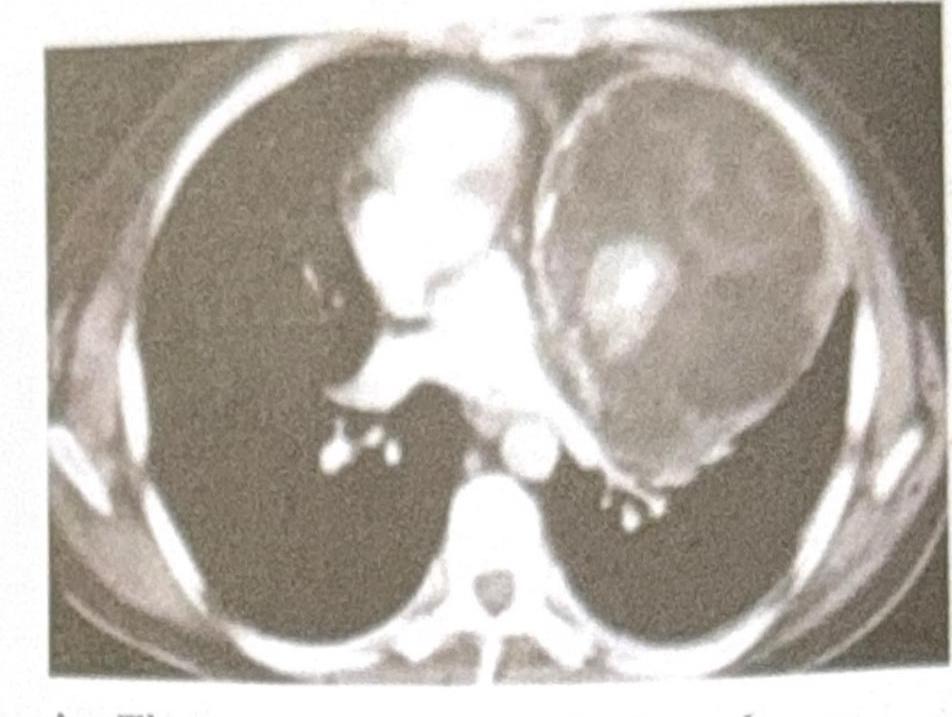
A 25-year-old male presents with chest pain and shortness of breath. A CT scan of the chest is performed, and the image provided shows a large, well-defined mass in the anterior mediastinum. The mass contains both cystic and solid components, along with areas of calcification. Based on the clinical presentation and imaging findings, what is the most likely diagnosis?
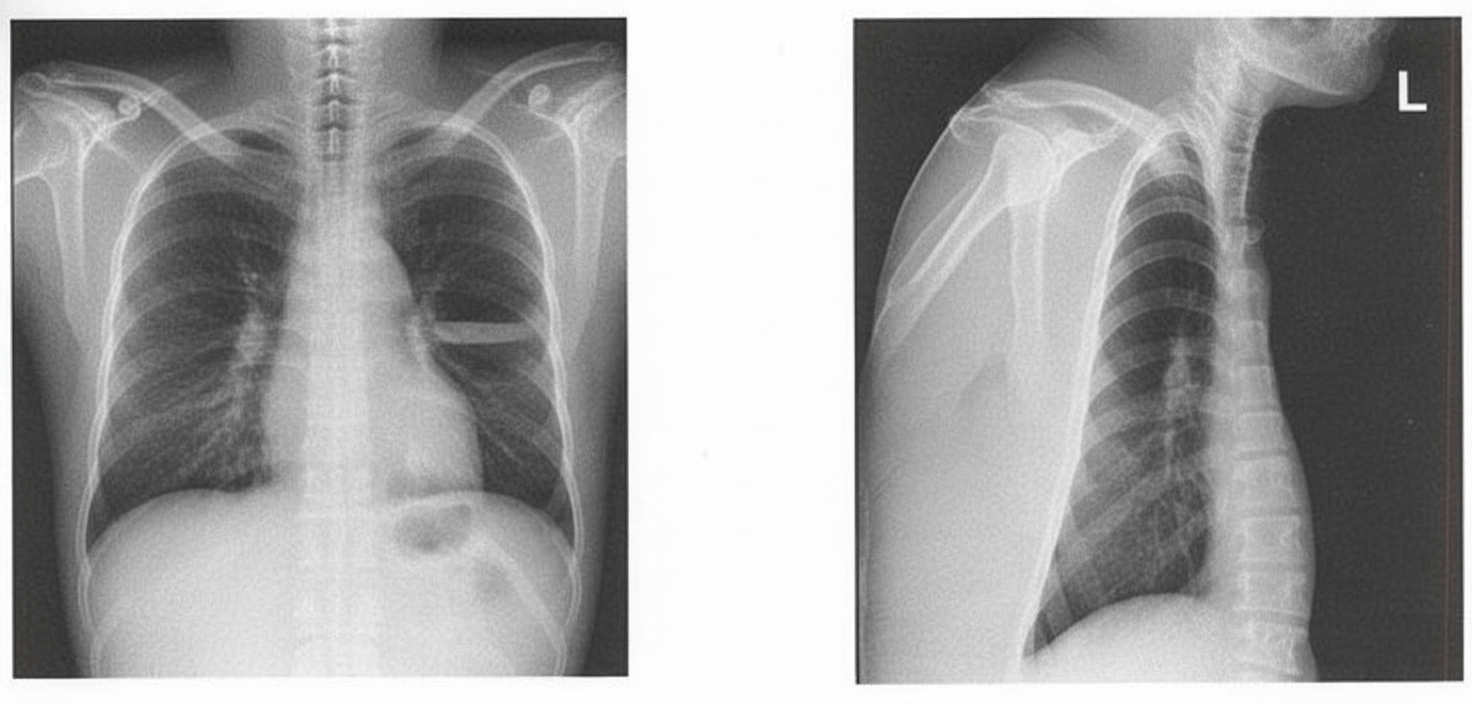
A patient presents with foul-smelling sputum along with breathlessness and fever. Using the X-ray below, identify the diagnosis.
Which of the following findings are seen in a high-resolution CT scan of fungal pneumonia? 1. Interlobular septations 2. Peripheral wedge-shaped consolidation 3. Pleural effusion 4. Cavitatory lesions with surrounding ground glass opacities
A chest CT shows 'doughnut sign' in mediastinum. Which additional finding would best support pulmonary artery sling?
A CT chest shows 'galaxy sign' in lung parenchyma. Which additional finding would best support sarcoidosis?
A chest CT shows 'comet tail' sign in lung bases. Which additional finding would best support rounded atelectasis?
A chest CT shows 'finger-in-glove' sign. Which additional finding would best support allergic bronchopulmonary aspergillosis?
A chest CT shows 'signet ring' sign. Which additional finding would best support bronchiectasis?
A CT pulmonary angiogram shows intravascular webs and bands. Which additional finding would best support chronic pulmonary embolism?
A lung biopsy shows 'temporal heterogeneity' with fibroblastic foci. Which radiological pattern would best support usual interstitial pneumonia?
Explanation: ***Teratoma*** - The presence of a **well-defined anterior mediastinal mass** with **cystic and solid components** and **calcifications** is highly characteristic of a teratoma. - Teratomas are **germ cell tumors** containing tissues derived from all three embryonic germ layers, which explains their varied composition on imaging. *Thymoma* - While thymomas are common in the **anterior mediastinum**, they typically present as **solid masses** and calcifications are less common. - They are often associated with paraneoplastic syndromes like **myasthenia gravis**, which is not mentioned in this case. *Lymphoma* - Lymphoma in the anterior mediastinum often presents as a **lobulated, homogeneous mass**, and can be associated with **lymphadenopathy** elsewhere. - While it can be large, the specific features of cystic components and calcification are less typical for lymphoma. *Bronchogenic cyst* - Bronchogenic cysts are typically **unilocular, fluid-filled cystic lesions** and are usually found in the middle mediastinum or adjacent to the trachea/main bronchi. - They rarely contain significant solid components or calcifications, unlike the described mass.
Explanation: ***Lung Abscess*** - The combination of **foul-smelling sputum** (indicating anaerobic bacterial infection), breathlessness, and fever is **pathognomonic for lung abscess** - The X-ray demonstrates a **characteristic air-fluid level** within the lung parenchyma, which is the hallmark radiographic finding of a cavitating lung abscess - When a lung abscess ruptures into a bronchus, it produces the typical **foul-smelling, purulent sputum** described in this case - Common causes include aspiration pneumonia, particularly in patients with risk factors like alcoholism, poor dental hygiene, or altered consciousness *Pleural Effusion* - While pleural effusion can present with breathlessness and fever, it would **not produce foul-smelling sputum** - A simple pleural effusion appears as **blunting of the costophrenic angle** or a **meniscus sign**, not an air-fluid level within the lung field - An empyema (infected pleural effusion) with bronchopleural fistula could theoretically show an air-fluid level, but this would be in the **pleural space**, not within the lung parenchyma, and is much less common than lung abscess *Pneumothorax* - Pneumothorax shows **air in the pleural space** with visible lung edge and absent lung markings peripherally - There would be **no fluid component** and no foul-smelling sputum - The air-fluid level seen here indicates a cavitary lesion, not a pneumothorax *Pericardial Effusion* - Pericardial effusion presents with an **enlarged, globular cardiac silhouette** ("water bottle heart") - It would **not cause respiratory symptoms** like foul-smelling sputum or the radiographic findings shown - The pathology is clearly in the **lung field**, not around the heart
Explanation: ***1,2,4*** - **Interlobular septations** and **peripheral wedge-shaped consolidations** are common findings due to the **vascular invasion** and **infarction** characteristic of fungal pneumonia. - **Cavitary lesions with surrounding ground-glass opacity**, also known as the **halo sign**, are highly suggestive of invasive fungal infections like aspergillosis. *1,2,3* - While interlobular septations and peripheral wedge-shaped consolidations are seen in fungal pneumonia, **pleural effusion** is less common and not a primary diagnostic feature. - The absence of the characteristic cavitary lesions with ground-glass opacities makes this option incomplete. *2,3,4* - This option correctly includes peripheral wedge-shaped consolidation and cavitary lesions with ground-glass opacity, but the inclusion of **pleural effusion** and exclusion of **interlobular septations** make it less accurate. - Interlobular septations are a significant indicator of **lymphatic involvement** as seen in fungal diseases. *1,3,4* - Although interlobular septations and cavitary lesions with ground-glass opacities are relevant, the presence of **pleural effusion** as a primary finding is less typical for fungal pneumonia. - The absence of **peripheral wedge-shaped consolidation**, which arises from vascular occlusion, makes this option less comprehensive.
Explanation: ***Right aortic arch*** - A **right aortic arch** is a common associated anomaly with **pulmonary artery sling**, increasing the likelihood of **tracheal compression** and airway symptoms. - The combination of a right aortic arch with the characteristic "doughnut sign" (trachea encircled by vascular structures) is highly suggestive of pulmonary artery sling. *Patent ductus arteriosus* - A **patent ductus arteriosus (PDA)** is a common congenital heart defect but does not specifically contribute to the characteristic vascular encirclement of the trachea seen in pulmonary artery sling. - While a PDA can cause left-to-right shunting and pulmonary vascular changes, it is not directly involved in the anatomical sling mechanism. *Cardiac dextroposition* - **Cardiac dextroposition** refers to the heart being positioned on the right side of the chest, often due to extrinsic factors or lung hypoplasia, but it does not inherently relate to the specific vascular anomaly of a pulmonary artery sling. - It doesn't explain the "doughnut sign" or the aberrant course of the pulmonary artery around the trachea. *Rightward course of left pulmonary artery* - **Pulmonary artery sling** itself is defined by the **left pulmonary artery** originating abnormally from the right pulmonary artery and passing between the trachea and esophagus, often giving it a "rightward course" relative to its usual position. - This option essentially describes the pathology of a pulmonary artery sling rather than an *additional* finding that would help *support* the diagnosis. The "doughnut sign" already implies this abnormal course, and we are looking for a separate associated anomaly.
Explanation: ***Bilateral hilar lymphadenopathy*** - The 'galaxy sign' (a large nodule surrounded by smaller satellite nodules) in sarcoidosis typically represents **conglomerate granulomas**. - **Bilateral hilar lymphadenopathy** is a hallmark radiological finding in sarcoidosis, occurring in over 90% of cases, and its presence alongside the galaxy sign strongly supports the diagnosis. *Cavitation* - **Cavitation** in lung nodules is rare in sarcoidosis and is more characteristic of infectious processes like **tuberculosis** or fungal infections, or malignancies. - While possible in atypical sarcoidosis, it is not a typical supporting feature and would prompt consideration of other diagnoses. *Tree-in-bud pattern* - The **tree-in-bud pattern** on CT is indicative of **bronchiolar impaction** and filling, commonly seen in infectious or inflammatory conditions affecting the small airways, such as **bronchiolitis**, **mycobacterial infections**, or aspiration. - This pattern is not characteristic of sarcoidosis, which primarily involves the interstitium and lymphatics. *Ground glass opacity* - **Ground glass opacity (GGO)** represents partial filling of airspaces or interstitial thickening and can be seen in a wide range of pulmonary diseases, including infections, diffuse alveolar damage, and some forms of interstitial pneumonia. - While GGO can occur in sarcoidosis, it is a non-specific finding and does not specifically support the diagnosis, especially when considering more specific patterns like the galaxy sign.
Explanation: ***Pleural thickening*** - The 'comet tail' sign refers to **curved bronchi and vessels** leading into a rounded opaque lesion, which is highly characteristic of **rounded atelectasis**. - **Pleural thickening** is an almost universal finding in rounded atelectasis, as it commonly develops in areas of localized pleural inflammation and fibrosis. *Ground glass opacities* - **Ground glass opacities** indicate partial filling of airspaces or thickening of interstitial structures, but they do not specifically point to rounded atelectasis. - This finding is nonspecific and can be seen in various lung conditions, including infection, inflammation, or early fibrosis. *Tree-in-bud pattern* - A **tree-in-bud pattern** on CT suggests infection or inflammation of the small airways (**bronchioles**), commonly seen in conditions like **bronchiolitis**, tuberculosis, or aspiration. - It does not directly correlate with the development or features of rounded atelectasis. *Honeycomb changes* - **Honeycomb changes** are a hallmark of **end-stage pulmonary fibrosis**, representing clustered cystic airspaces with thickened walls. - While rounded atelectasis involves fibrosis, honeycomb changes represent a distinct and more severe pattern of lung damage.
Explanation: ***Central bronchiectasis*** - The "finger-in-glove" sign represents **bronchial impaction** with mucus, which is a classic finding of **allergic bronchopulmonary aspergillosis (ABPA)** and is often accompanied by **central bronchiectasis**. - **Bronchiectasis** is a key diagnostic criterion for ABPA, indicating irreversible dilation of the bronchi, more prominent in the central airways due to chronic inflammation and obstruction. *Ground glass opacities* - While **ground-glass opacities** can be seen in various lung conditions, including some inflammatory processes, they are not specific to ABPA and do not directly relate to the "finger-in-glove" sign. - These opacities suggest partial filling of air spaces or interstitial thickening, but do not specifically point to **mucus impaction** or airway dilation seen in ABPA. *Centrilobular nodules* - **Centrilobular nodules** are typically associated with conditions like **bronchiolitis**, hypersensitivity pneumonitis, or respiratory bronchiolitis-associated interstitial lung disease. - They reflect inflammation or accumulation of material around the **centrilobular bronchiole** and are not a hallmark feature of ABPA. *Pleural plaques* - **Pleural plaques** are fibrotic thickenings of the pleura, almost exclusively associated with **asbestos exposure**. - They indicate a history of occupational or environmental exposure and have no direct connection to the pathophysiology or diagnosis of ABPA.
Explanation: ***Tramline shadowing*** - This refers to parallel opacities outlining dilated and thickened bronchial walls, which are a direct morphological correlate of **bronchiectasis**. - It is a classic radiological sign seen on chest X-rays and CT scans, representing the thickened bronchial walls viewed on edge. - This is the **most specific additional finding** for confirming bronchiectasis alongside the signet ring sign. *Ground glass opacity* - This describes a hazy increase in lung attenuation with preservation of bronchial and vascular margins, often seen in conditions like **pneumonitis**, **pulmonary edema**, or **alveolar hemorrhage**. - It does not specifically indicate bronchial dilation or thickening and is not characteristic of bronchiectasis. *Tree-in-bud pattern* - This pattern consists of centrilobular nodules with branching linear opacities, representing dilated and inspissated bronchioles filled with mucus or inflammatory material. - It is commonly **seen in bronchiectasis**, especially when complicated by infection, and indicates **endobronchial spread** (often mycobacterial infection or bacterial colonization). - However, tree-in-bud reflects **small airway involvement** rather than the larger bronchial dilation itself, making tramline shadowing a more direct indicator of bronchiectasis. *Honeycomb pattern* - This describes thick-walled cystic spaces grouped together with shared walls, typically associated with **end-stage interstitial lung disease** and pulmonary fibrosis. - It represents irreversible lung damage and architectural distortion, not the bronchial wall thickening and dilation seen in bronchiectasis.
Explanation: ***Mosaic perfusion*** - **Mosaic perfusion** on CT is a characteristic sign of **chronic pulmonary embolism (CPE)**, indicating areas of differentially perfused and attenuated lung parenchyma due to chronic vascular obstruction. - This finding, combined with **intravascular webs and bands** (representing organized chronic thrombus), strongly supports the diagnosis of CPE. - Together, these constitute hallmark CT findings of chronic thromboembolic pulmonary hypertension (CTEPH). *Hampton's hump* - **Hampton's hump** is a pleura-based, wedge-shaped opacity representing **pulmonary infarction**, typically associated with **acute PE**. - While suggestive of PE, it is specific for acute disease and does not indicate chronic vascular changes or remodeling. *Westermark sign* - The **Westermark sign** is focal oligemia (decreased vascular markings) distal to a pulmonary embolism on chest X-ray, suggestive of **acute PE**. - It reflects reduced blood flow due to acute obstruction, not the chronic vascular remodeling and organized thrombus seen in CPE. *Fleischner lines* - **Fleischner lines** are horizontal linear opacities on chest X-ray, representing **atelectasis** or **subsegmental collapse**. - These are non-specific findings that can occur in various conditions and do not provide direct evidence of chronic thromboembolic disease.
Explanation: ***Peripheral and basal honeycombing*** - The combination of **temporal heterogeneity** and **fibroblastic foci** on biopsy is pathognomonic for usual interstitial pneumonia (UIP). - Radiologically, UIP is characterized by **peripheral, basal, reticular opacities** with **honeycombing**, often accompanied by **traction bronchiectasis**. *Peribronchovascular nodules* - This pattern is more commonly seen in **sarcoidosis**, a granulomatous disease, rather than UIP. - Sarcoidosis involves lymphocytic inflammation and non-caseating granulomas, which is distinct from the fibrotic process of UIP. *Central ground glass opacities* - While ground-glass opacities can be seen in various interstitial lung diseases, a **central distribution** is less typical for UIP. - More commonly associated with **acute interstitial pneumonia** or **non-specific interstitial pneumonia (NSIP)**. *Upper lobe nodules* - **Upper lobe predominance** with nodules is characteristic of conditions like **silicosis**, **coal workers' pneumoconiosis**, or **hypersensitivity pneumonitis**. - UIP typically involves the **lower lobes** and presents as reticular opacities and honeycombing rather than discrete nodules.
Normal Chest Radiographic Anatomy
Practice Questions
Radiographic Signs in Chest Imaging
Practice Questions
Pulmonary Infections
Practice Questions
Chronic Obstructive Pulmonary Disease
Practice Questions
Interstitial Lung Diseases
Practice Questions
Pulmonary Neoplasms
Practice Questions
Pleural Diseases
Practice Questions
Mediastinal Pathology
Practice Questions
Congenital and Developmental Chest Anomalies
Practice Questions
Pulmonary Vascular Diseases
Practice Questions
Chest Trauma Imaging
Practice Questions
Post-Surgical Chest Imaging
Practice Questions
Get full access to all questions, explanations, and performance tracking.
Start For Free