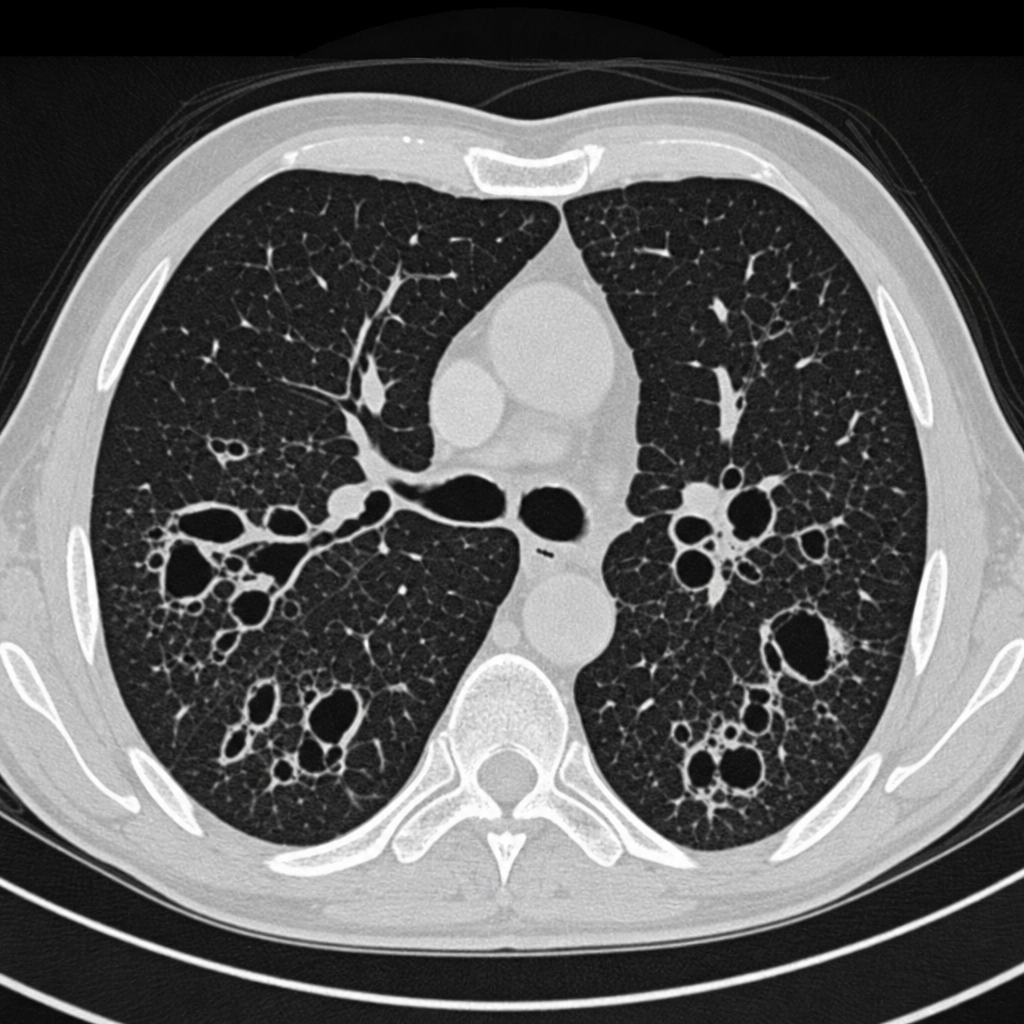
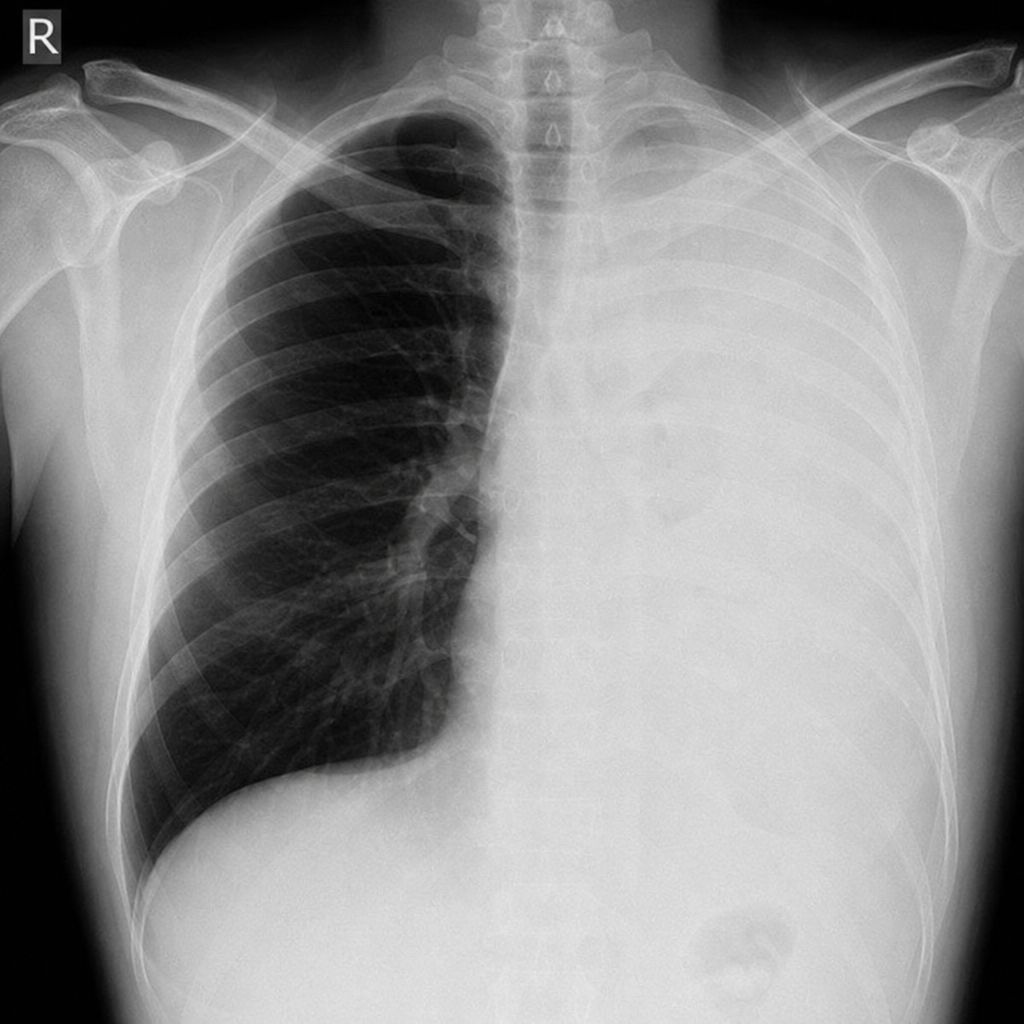
Based on the provided image, what is the most likely diagnosis?

What is the most helpful radiological investigation in a patient suspected of left pleural effusion?
What is the earliest radiological sign of pulmonary venous hypertension on a chest X-ray?
Which of the following is NOT a feature of loculated pleural effusion on X-ray chest?
The "sandstorm" appearance on a chest radiograph is characteristic of which condition?
High-resolution CT of the lung is a specialized CT technique that utilizes what to provide greater detail of lung parenchyma?
The 'Comet Tail Sign' is most characteristically seen in which of the following conditions?
Egg shell calcification seen in silicosis is due to?
The plain X-ray chest finding that suggests syphilitic cardiovascular disease is:
Which of the following is a cause of a unilateral hyperlucent lung on chest radiography?
Explanation: ***Emphysema*** - Classic chest X-ray features include **hyperinflation** with **flattened diaphragms**, **barrel chest** appearance, and **hyperlucent lung fields** with **attenuated vascular markings**. - The **increased anteroposterior diameter** and **reduced cardiac silhouette** are characteristic findings in advanced emphysema. *Pneumothorax* - Would show **absent lung markings** in the affected area with a visible **visceral pleural line** separating collapsed lung from pleural space. - Typically presents with **sudden onset chest pain** and **dyspnea**, not the chronic progressive pattern seen in emphysema. *Bronchiectasis* - Characterized by **tramline shadows** (parallel lines representing dilated bronchi) and **ring shadows** (dilated bronchi seen end-on). - Often shows **increased markings** and **honeycombing** rather than the hyperlucent fields typical of emphysema. *Cardiomegaly* - Defined by **cardiothoracic ratio >0.5** with an enlarged cardiac silhouette on chest X-ray. - The heart shadow would be **prominently enlarged**, which contrasts with the **small heart** appearance often seen in emphysema due to hyperinflation.
Explanation: **Explanation:** The diagnosis of pleural effusion relies on the movement of free fluid within the pleural space due to gravity. **Why Left Lateral Decubitus is correct:** In a **lateral decubitus view**, the patient lies on their side. Gravity causes free pleural fluid to accumulate along the dependent (downward) chest wall. This creates a linear opacity between the lung and the ribs, making it much easier to detect small amounts of fluid compared to a standard erect film. For a suspected **left-sided** effusion, the patient must lie on their **left side** (Left Lateral Decubitus) so that the fluid layers out along the left costal margin. This view can detect as little as **5–10 mL** of fluid. **Why the other options are incorrect:** * **Right lateral decubitus:** This would be used to detect a *right-sided* effusion. If a patient with a left effusion lies on their right side, the fluid shifts toward the mediastinum, making it difficult to visualize. * **Left/Right lateral erect:** While a lateral erect film can show blunting of the posterior costophrenic angle, it requires at least **50–75 mL** of fluid to be visible. It is less sensitive than the decubitus view for small effusions. **High-Yield Clinical Pearls for NEET-PG:** * **Sensitivity Hierarchy:** USG Chest > Lateral Decubitus View > Lateral Erect > PA View (Erect). * **PA View:** Requires **~150–200 mL** of fluid to cause blunting of the lateral costophrenic angle (the "Meniscus sign"). * **Subpulmonic Effusion:** Suspect this if there is an apparent elevation of the hemidiaphragm with the apex shifted laterally. * **Loculated Effusion:** If fluid does *not* shift on a decubitus film, it suggests the effusion is loculated (common in empyema).
Explanation: **Explanation:** Pulmonary venous hypertension (PVH) occurs when left-sided heart pressure increases (e.g., Mitral Stenosis or Left Ventricular Failure). This leads to a predictable sequence of radiological changes based on the pulmonary capillary wedge pressure (PCWP). **1. Why Cephalization is Correct:** Cephalization (also known as **Antler sign** or **Upper Lobe Blood Diversion**) is the earliest radiological sign of PVH, typically occurring when PCWP reaches **12–18 mmHg**. In a normal upright chest X-ray, gravity causes the lower lobe vessels to be larger than the upper lobe vessels. In PVH, perivascular edema in the lower lobes causes reflex vasoconstriction, diverting blood flow to the upper lobes, making the superior vessels appear more prominent. **2. Analysis of Incorrect Options:** * **Kerley B Lines (Option C):** These represent interlobular septal thickening due to interstitial edema. They appear later than cephalization, typically when PCWP is **18–25 mmHg**. * **Alveolar Pulmonary Edema (Option D):** This presents as "Bat-wing" opacities and occurs during the final stage of heart failure when PCWP exceeds **25 mmHg**. * **Pleural Effusion (Option B):** While common in congestive heart failure, it is a later finding and not the specific "earliest" vascular change. **High-Yield Clinical Pearls for NEET-PG:** * **Staging of PVH:** * **Stage I (12-18 mmHg):** Cephalization. * **Stage II (18-25 mmHg):** Interstitial Edema (Kerley B lines, peribronchial cuffing, hazy hila). * **Stage III (>25 mmHg):** Alveolar Edema (Bat-wing appearance). * **Kerley B lines** are best seen at the lung bases/costophrenic angles, perpendicular to the pleura. * **Cephalization** is only a reliable sign on **upright** films; it cannot be accurately assessed on supine AP views.
Explanation: ### Explanation **1. Why "Air bronchogram present" is the correct answer:** An **air bronchogram** is a classic sign of **parenchymal lung disease** (e.g., pneumonia, pulmonary edema, or atelectasis). It occurs when air-filled bronchi are visualized against a background of fluid-filled or collapsed alveoli. Since a pleural effusion (loculated or free) is located in the **pleural space** (outside the lung parenchyma), it does not involve the bronchi. Therefore, an air bronchogram is never a feature of pleural effusion; its presence helps differentiate a lung mass or consolidation from a pleural collection. **2. Analysis of incorrect options:** * **Option B (Margins in oblique view):** Loculated effusions are often lenticular (lens-shaped). When viewed "en face," the margins appear ill-defined/diffuse, but when viewed "end-on" (tangential), the margins appear sharp. This is a characteristic radiological feature of extrapulmonary lesions. * **Option C (Not limited to one segment):** Unlike lobar pneumonia, which is confined by fissural boundaries to a specific bronchopulmonary segment, a loculated effusion in the pleural space (often in the periphery or fissures) does not follow segmental anatomy. * **Option D (Obtuse angle with mediastinum):** This is a key rule in radiology. **Extrapulmonary masses** (pleural or mediastinal) typically form **obtuse angles** with the chest wall or mediastinum, whereas intrapulmonary masses form acute angles. **3. High-Yield Clinical Pearls for NEET-PG:** * **D-sign:** A loculated effusion in the peripheral pleura often resembles a capital "D" (convex border towards the lung). * **Vanishing Tumor (Pseudotumor):** A loculated effusion within a minor fissure (common in CHF) that disappears with diuretic therapy. * **Lateral Decubitus View:** The gold standard for detecting small amounts of **free** pleural fluid (as little as 5-10 ml), but loculated fluid will **not** shift on this view.
Explanation: **Explanation:** The "sandstorm" appearance is a classic radiological sign pathognomonic for **Pulmonary Alveolar Microlithiasis (PAM)**. This rare genetic condition (mutation in the *SLC34A2* gene) results in the accumulation of tiny calcium phosphate crystals (microliths) within the alveoli. On a chest X-ray, these thousands of microliths appear as diffuse, fine, sand-like calcifications that often obscure the heart borders and diaphragm, creating the characteristic "sandstorm" effect. **Analysis of Options:** * **Pulmonary Alveolar Microlithiasis (Correct):** The dense, calcific micronodules (1–3 mm) are most concentrated in the lower zones, leading to the "sandstorm" appearance and the "black pleura" sign (a lucent line between the calcified lung and the ribs). * **Pulmonary Edema:** Typically presents with "Bat-wing" opacities, Kerley B lines, and cardiomegaly, representing fluid rather than calcification. * **Pulmonary Alveolar Proteinosis (PAP):** Characterized by a "Crazy Paving" pattern on HRCT (ground-glass opacities with superimposed interlobular septal thickening), not sand-like calcifications. * **Pulmonary Thromboembolism:** Classic X-ray signs include Westermark sign (focal oligemia) and Hampton’s hump (wedge-shaped opacity), which are vascular/infarct-related findings. **NEET-PG High-Yield Pearls:** * **Black Pleura Sign:** Seen in PAM due to the contrast between dense calcified lung and the pleura. * **Clinical-Radiological Dissociation:** Patients with PAM often remain asymptomatic for a long time despite the dramatic "sandstorm" appearance on imaging. * **Gene Mutation:** *SLC34A2* gene (encodes a sodium-dependent phosphate cotransporter).
Explanation: **Explanation:** High-resolution CT (HRCT) is a specialized technique designed to visualize the lung parenchyma with maximum clarity, specifically targeting the secondary pulmonary lobule. **Why the correct answer is right:** The use of a **high-spatial-frequency reconstruction algorithm (Bone algorithm)** is fundamental to HRCT. Unlike standard soft tissue algorithms that smooth images to reduce noise, the bone algorithm sharpens the edges of structures. This enhances the interface between air and the delicate pulmonary interstitium, allowing for the detection of fine details like subtle ground-glass opacities, reticulation, and early bronchiectasis. **Analysis of incorrect options:** * **A. Special lung filters:** While "filters" is a term sometimes used interchangeably with "kernels" or "algorithms" in older literature, the technical requirement is specifically the mathematical reconstruction algorithm (Bone/Sharp kernel). * **B. Thick collimation:** This is the opposite of HRCT technique. HRCT requires **thin collimation** (typically 0.625 mm to 1.5 mm) to minimize volume averaging and improve spatial resolution. * **D. Large field of view:** HRCT utilizes a **targeted (small) field of view (FOV)**. By reconstructing only the area of the lungs rather than the entire chest circumference, the pixel size is reduced, further increasing spatial resolution. **High-Yield Clinical Pearls for NEET-PG:** * **The HRCT Triad:** 1. Thin sections (≤1.5 mm), 2. High-spatial-frequency (Bone) algorithm, 3. Small/Targeted FOV. * **Inspiratory vs. Expiratory HRCT:** Expiratory scans are specifically used to detect **air trapping** (seen in obliterative bronchiolitis or asthma). * **Prone HRCT:** Used to differentiate dependent atelectasis (which clears in prone position) from early interstitial lung disease/asbestosis (which persists).
Explanation: **Explanation:** The **Comet Tail Sign** is the pathognomonic radiological feature of **Round Atelectasis** (also known as Blesovsky’s syndrome). **Why it is correct:** Round atelectasis occurs when a portion of the lung collapses in a rounded shape, usually adjacent to pleural thickening (often due to asbestos exposure). As the lung collapses and "curls" inward, the associated bronchovascular bundles (bronchi and pulmonary vessels) are pulled toward the mass-like area. On a CT scan, these converging vessels and bronchi create a curvilinear opacity extending from the hilum to the mass, resembling the tail of a comet. **Why the other options are incorrect:** * **A & C (Lobe Collapse):** While round atelectasis is a form of collapse, typical lobar collapses present with characteristic signs like the *Golden S-sign* (RUL collapse with a mass) or shifting of fissures, rather than a focal "comet tail" appearance. * **D (Consolidation):** Consolidation typically presents with *air bronchograms* and ill-defined margins. It does not cause the architectural distortion or the curvilinear pulling of vessels seen in round atelectasis. **High-Yield Pearls for NEET-PG:** * **Triad of Round Atelectasis:** (1) Pleural-based rounded opacity, (2) Associated pleural thickening, and (3) The Comet Tail Sign. * **Common Association:** Asbestos-related pleural disease is the most common cause. * **Clinical Significance:** It is a benign condition but is frequently mistaken for a peripheral lung carcinoma (bronchogenic carcinoma). * **Crow’s Feet Sign:** Another term sometimes used to describe the radiating bands seen in this condition.
Explanation: **Explanation:** **Eggshell calcification** is a classic radiological sign characterized by a thin, peripheral rim of calcification around the periphery of a lymph node. In the context of **Silicosis**, this occurs due to the inhalation of silica particles, which are transported via lymphatics to the **hilar and mediastinal lymph nodes**. The resulting chronic inflammatory response and granuloma formation lead to dystrophic calcification, specifically at the periphery of these enlarged nodes. **Why the other options are incorrect:** * **Pleural thickening:** While silicosis can involve the pleura, "eggshell" patterns are specific to nodal architecture, not the flat surfaces of the pleura (which typically show plaques in asbestosis). * **Pulmonary edema:** This presents as "Bat-wing" opacities or Kerley B lines due to fluid in the interstitium/alveoli, not discrete calcifications. * **Dilated vessels:** Vascular enlargement (e.g., in pulmonary hypertension) appears as prominent hila but lacks the distinct peripheral calcific rim. **High-Yield Clinical Pearls for NEET-PG:** * **Differential Diagnosis for Eggshell Calcification:** While **Silicosis** is the most common cause, it is also seen in **Coal Worker’s Pneumoconiosis (CWP)** and **Sarcoidosis** (less common). * **Silicosis & TB:** Patients with silicosis have a 30-fold increased risk of developing Tuberculosis (**Silicotuberculosis**) because silica impairs macrophage function. * **Upper Lobe Predominance:** Silicotic nodules and Progressive Massive Fibrosis (PMF) primarily affect the upper lobes of the lungs. * **Occupational History:** Always look for keywords like "sandblasting," "mining," or "stone cutting" in the clinical stem.
Explanation: ### Explanation **1. Why Option A is Correct:** Syphilitic aortitis (a manifestation of tertiary syphilis) typically involves the **ascending aorta**. The underlying pathology is *vasa vasorum* endarteritis, which leads to ischemia and destruction of the tunica media. As the elastic tissue is replaced by fibrous tissue, the vessel wall weakens and dilates. Over time, dystrophic **linear (eggshell) calcification** develops within the intima of the dilated ascending aorta. This is a classic radiological hallmark; while atherosclerosis commonly affects the arch and descending aorta, calcification isolated to the ascending aorta is highly suggestive of syphilis. **2. Why the Other Options are Incorrect:** * **Options B & D (Aortic Arch):** While syphilis can involve the arch, calcification of the aortic arch is much more commonly associated with **atherosclerosis**. In NEET-PG, if calcification is localized to the ascending aorta, syphilis is the primary diagnosis; if it is in the arch or descending aorta, atherosclerosis is the likely cause. * **Option C (Speckled Calcification):** Syphilitic calcification is typically **linear and continuous** along the wall of the dilated vessel. "Speckled" or "patchy" calcification is less characteristic of the transmural inflammatory process seen in syphilitic aortitis. **3. Clinical Pearls for NEET-PG:** * **The "Rule of Ascending Aorta":** Calcification of the ascending aorta in a patient under 50 is syphilis until proven otherwise. * **Complications:** Syphilitic aortitis leads to three main complications: (1) Aortic Regurgitation (due to root dilation), (2) Aneurysm formation (usually saccular), and (3) Coronary ostial stenosis. * **Tree-barking appearance:** This is the classic **gross pathological** description of the intimal wrinkling seen in syphilitic aortitis. * **Imaging Sign:** The presence of a dilated ascending aorta with linear calcification is sometimes referred to as the "eggshell" appearance of the aorta.
Explanation: **Explanation:** The correct answer is **Poland syndrome**. A unilateral hyperlucent lung on a chest X-ray occurs when one lung field appears darker (more radiolucent) than the other. This can be due to either increased air in the lung (obstructive) or a decrease in the thickness of the overlying soft tissues (extrapulmonary). **1. Why Poland Syndrome is correct:** Poland syndrome is a congenital anomaly characterized by the **unilateral absence of the pectoralis major muscle** (and sometimes the pectoralis minor). Because there is less soft tissue to attenuate the X-ray beam on the affected side, more radiation reaches the film, resulting in a **false hyperlucency** of the lung on that side, despite the lung parenchyma itself being normal. **2. Why the other options are incorrect:** * **Asthma & Acute Bronchiolitis:** These typically present with **bilateral** hyperlucency due to generalized air trapping and hyperinflation. While focal air trapping can occur, they are not classic causes of a persistent unilateral hyperlucent lung. * **Pleural Effusion:** This causes **increased radiopacity** (whiteness) on the affected side, not hyperlucency. **3. NEET-PG High-Yield Pearls:** * **Differential Diagnosis of Unilateral Hyperlucent Lung:** * *Technical:* Rotation of the patient. * *Extrapulmonary:* Poland syndrome, Mastectomy. * *Pulmonary:* **Swyer-James-MacLeod Syndrome** (post-infectious obliterative bronchiolitis), Pneumothorax, Large Bullae, or Obstructive Emphysema (e.g., foreign body acting as a check-valve). * **Poland Syndrome triad:** Unilateral absence of pectoralis major, chest wall depression, and **ipsilateral syndactyly** (brachysyndactyly). * **Swyer-James-MacLeod Syndrome:** Look for a small, hyperlucent lung with reduced vascular markings and air trapping on expiration.
Normal Chest Radiographic Anatomy
Practice Questions
Radiographic Signs in Chest Imaging
Practice Questions
Pulmonary Infections
Practice Questions
Chronic Obstructive Pulmonary Disease
Practice Questions
Interstitial Lung Diseases
Practice Questions
Pulmonary Neoplasms
Practice Questions
Pleural Diseases
Practice Questions
Mediastinal Pathology
Practice Questions
Congenital and Developmental Chest Anomalies
Practice Questions
Pulmonary Vascular Diseases
Practice Questions
Chest Trauma Imaging
Practice Questions
Post-Surgical Chest Imaging
Practice Questions
Get full access to all questions, explanations, and performance tracking.
Start For Free