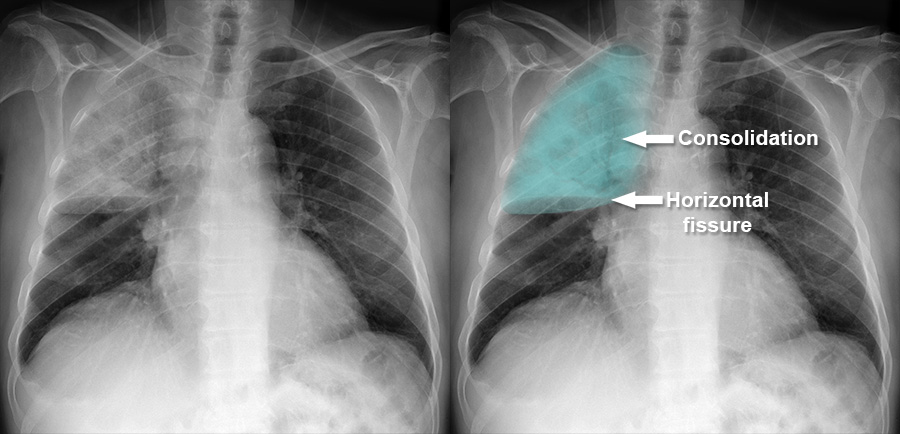
Obliteration of the left cardiac shadow on a PA view is typically due to which of the following?
Minimum fluid collection required for radiological detection of pleural effusion in lateral decubitus view is:
A young man with tuberculosis presents with massive recurrent hemoptysis. What is the most probable cause?
What is the most reliable method for diagnosing pulmonary embolism?
Eggshell calcification is seen in all of the following conditions EXCEPT?
Which of the following is NOT a radiographic finding of Congestive Heart Failure (CHF)?
Which of the following causes both superior and inferior rib notching in a chest radiograph?
A patient presents with bilateral hilar lymphadenopathy with eggshell calcification on chest X-ray. What is the most likely diagnosis?
A patient presents with SOB and fatigue. CXR was done. What is the diagnosis? 
A chest X-ray is shown below. What is the most likely diagnosis?
Explanation: ### Explanation The correct answer is **A. Lingular lesion**. This question tests the concept of the **Silhouette Sign**, a fundamental principle in chest radiology. The silhouette sign occurs when two structures of similar radiographic density (e.g., soft tissue or fluid) are in direct anatomical contact, causing the border between them to be obliterated. **1. Why Lingular Lesion is Correct:** The **lingula** is the anatomical equivalent of the middle lobe in the left lung. It is part of the Left Upper Lobe but is positioned anteriorly, directly adjacent to the **left heart border**. Therefore, any opacification in the lingula (such as pneumonia or collapse) will obliterate the left cardiac shadow. **2. Analysis of Incorrect Options:** * **Left lower lobe lesion:** The left lower lobe is located posteriorly. While it may overlap the heart on a PA view, it is not in direct contact with the heart border. A lower lobe lesion will typically obliterate the **diaphragmatic shadow** but leave the heart border sharp. * **Left hilar lymphadenopathy:** This involves structures at the lung root. While it may enlarge the hilum, it does not typically obliterate the heart border unless it is massive and extends anteriorly. * **Left upper lobe apical lesion:** The apex of the lung is located superiorly and posteriorly, far from the cardiac silhouette. **3. High-Yield Clinical Pearls for NEET-PG:** * **Right Heart Border:** Obliterated by **Right Middle Lobe** lesions. * **Right Diaphragm:** Obliterated by **Right Lower Lobe** lesions. * **Left Heart Border:** Obliterated by **Lingular** lesions. * **Left Diaphragm:** Obliterated by **Left Lower Lobe** lesions. * **Aortic Knuckle:** Obliterated by **Left Upper Lobe (Apico-posterior segment)** lesions. * **Ascending Aorta:** Obliterated by **Right Upper Lobe (Anterior segment)** lesions.
Explanation: **Explanation:** The detection of pleural effusion on imaging depends significantly on the patient's position and the sensitivity of the modality used. **Why 25 ml is correct:** The **lateral decubitus view** (with the affected side down) is the most sensitive conventional radiographic projection for detecting small amounts of pleural fluid. In this position, gravity causes the fluid to layer along the dependent chest wall. It can detect as little as **5–25 ml** of fluid. In the context of standard medical examinations like NEET-PG, **25 ml** is the classically accepted threshold for reliable visualization in this view. **Analysis of Incorrect Options:** * **15 ml:** While some modern high-quality films might show traces at this level, 25 ml is the standard academic benchmark for detection. * **35 ml & 45 ml:** These volumes are well above the minimum threshold for a lateral decubitus film. These amounts are still too small to be seen on a standard upright PA view. **High-Yield Clinical Pearls for NEET-PG:** * **USG (Ultrasonography):** The most sensitive bedside tool; can detect as little as **5–10 ml**. * **Lateral Decubitus View:** Detects **25 ml**. * **Lateral View (Upright):** Detects **50–75 ml** (seen as blunting of the posterior costophrenic angle). * **PA View (Upright):** Detects **150–200 ml** (seen as blunting of the lateral costophrenic angle). * **Ellis S-shaped curve:** The characteristic upper border of a moderate-to-large free pleural effusion seen on an upright X-ray.
Explanation: **Explanation:** In the context of chronic inflammatory lung diseases like **Tuberculosis (TB)**, the most common source of massive hemoptysis is the **Bronchial Artery (90% of cases)**. Chronic inflammation leads to the release of angiogenic factors, causing the bronchial arteries (which are part of the high-pressure systemic circulation) to become hypertrophied, dilated, and fragile. In TB, this often manifests as a **Rasmussen aneurysm** (classically involving the pulmonary artery) or, more frequently, as hypervascularity of the bronchial circulation. Because bronchial arteries carry blood at systemic pressure (mean ~90 mmHg) compared to the low-pressure pulmonary system (mean ~15 mmHg), their rupture results in life-threatening, massive hemorrhage. **Analysis of Options:** * **A. Pulmonary Artery:** While a Rasmussen aneurysm (a pseudoaneurysm of the pulmonary artery) is a classic TB complication, it accounts for only ~5-10% of massive hemoptysis cases. * **C & D. Pulmonary Vein / Superior Vena Cava:** These are low-pressure venous systems. While they can be involved in trauma or malignancy, they are rarely the source of massive hemoptysis in inflammatory conditions like TB. **High-Yield Facts for NEET-PG:** * **Definition of Massive Hemoptysis:** Expectoration of >300–600 ml of blood within 24 hours. * **Gold Standard Investigation:** **MDCT Angiography** is the initial investigation of choice to localize the site and source. * **Treatment of Choice:** **Bronchial Artery Embolization (BAE)** is the definitive non-surgical management for stabilizing massive hemoptysis. * **Most common source:** Bronchial arteries (90%); **Non-bronchial systemic arteries** (e.g., intercostal, subclavian) account for the remainder.
Explanation: **Explanation:** **1. Why Pulmonary Angiography is Correct:** Pulmonary angiography remains the **"Gold Standard"** and the most reliable method for diagnosing pulmonary embolism (PE). It involves the direct injection of contrast into the pulmonary arteries under fluoroscopy. The definitive diagnostic finding is a **filling defect** or an abrupt "cutoff" of a vessel. While CT Pulmonary Angiography (CTPA) is the first-line investigation in clinical practice due to its non-invasive nature, conventional catheter angiography is the most accurate (highest sensitivity and specificity). **2. Why Other Options are Incorrect:** * **Plain Skiagram (Chest X-ray):** Usually normal or shows non-specific findings (e.g., atelectasis). While specific signs like **Westermark sign** (focal oligemia) or **Hampton’s Hump** (wedge-shaped opacity) exist, they are rare and have low sensitivity. * **Perfusion Scan (V/Q Scan):** This is a screening tool, not a definitive diagnostic one. It is useful when CTPA is contraindicated (e.g., renal failure or pregnancy), but it often yields "intermediate probability" results which require further testing. * **Electrocardiography (ECG):** Most commonly shows sinus tachycardia. The classic **S1Q3T3 pattern** is specific but only seen in about 10-15% of cases (indicative of right heart strain). **3. High-Yield Clinical Pearls for NEET-PG:** * **Investigation of Choice (IOC):** CT Pulmonary Angiography (CTPA). * **Gold Standard:** Pulmonary Angiography. * **Best Initial Screening Test:** D-Dimer (High negative predictive value; used to rule out PE in low-risk patients). * **Most Common Finding on CXR:** Normal Chest X-ray. * **Most Common ECG Finding:** Sinus Tachycardia.
Explanation: **Explanation:** **Eggshell calcification** refers to a specific radiological pattern where thin, peripheral rim-like calcification occurs in the capsule of hilar or mediastinal lymph nodes. **Why Bronchogenic Carcinoma is the correct answer:** Bronchogenic carcinoma typically presents with a central, stippled, or amorphous calcification pattern (if calcification is present at all). It does **not** cause eggshell calcification. This sign is highly characteristic of benign, granulomatous, or occupational lung diseases rather than primary malignancy. **Analysis of other options:** * **Silicosis:** This is the most common cause of eggshell calcification. It occurs in approximately 5% of patients, typically involving the hilar and mediastinal nodes due to the inhalation of inorganic silica dust. * **Sarcoidosis:** A multi-system granulomatous disease where eggshell calcification is seen in about 5% of cases, usually in long-standing disease. * **Post-irradiation Lymphoma:** Patients treated with radiotherapy for Hodgkin’s lymphoma can develop eggshell calcifications in the mediastinal nodes years after treatment. **Clinical Pearls for NEET-PG:** 1. **Mnemonic for Eggshell Calcification:** **"S-S-H-P"** (Silicosis, Sarcoidosis, Histoplasmosis, Post-irradiation Lymphoma). 2. **Coal Worker's Pneumoconiosis (CWP):** Can also rarely show this pattern. 3. **Differential Diagnosis:** If you see eggshell calcification in a patient with a history of sandblasting or mining, prioritize **Silicosis**. 4. **Blastomycosis and Histoplasmosis** are the primary fungal infections associated with this finding.
Explanation: **Explanation:** Congestive Heart Failure (CHF) leads to pulmonary venous hypertension and fluid extravasation into the lung parenchyma and pleural space. The radiographic findings follow a predictable sequence based on pulmonary capillary wedge pressure (PCWP). **Why Oligemia is the correct answer:** **Oligemia** refers to a reduction in pulmonary blood volume, appearing as "translucent" or darker lung fields with thin, sparse vessels. This is a hallmark of conditions with decreased pulmonary blood flow, such as **Tetralogy of Fallot (TOF)** or pulmonary embolism, not CHF. In contrast, CHF causes **Pulmonary Hyperemia** and **Cephalization** (redistribution of blood flow to the upper lobes). **Analysis of Incorrect Options:** * **Cardiomegaly:** Usually the earliest sign of CHF (on PA view, Cardiothoracic ratio >0.5). It indicates ventricular enlargement or pericardial effusion. * **Kerley B lines:** These are short (1-2 cm), horizontal peripheral lines at the lung bases, perpendicular to the pleura. They represent thickened interlobular septa due to edema (PCWP 18–22 mmHg). * **Kerley A lines:** Longer (2-6 cm) linear opacities radiating from the hila toward the periphery in the mid and upper zones. They represent distended anastomotic lymphatic channels. **High-Yield Clinical Pearls for NEET-PG:** * **Stages of CHF on CXR:** 1. **Stage I (PCWP 13-18 mmHg):** Cephalization (Antler sign). 2. **Stage II (PCWP 18-25 mmHg):** Interstitial edema (Kerley lines, peribronchial cuffing, hazy hila). 3. **Stage III (PCWP >25 mmHg):** Alveolar edema (**Bat-wing/Butterfly appearance**) and pleural effusions. * **Kerley B lines** are the most common and specific sign of interstitial pulmonary edema.
Explanation: **Explanation:** **1. Why Neurofibromatosis type 1 (NF-1) is correct:** NF-1 is the classic cause of **both superior and inferior rib notching**. Unlike vascular causes that result from pressure erosion by dilated vessels, notching in NF-1 is primarily due to **intercostal neurofibromas** (tumors arising from the nerve sheath). These tumors can grow large enough to erode both the upper and lower margins of adjacent ribs. Additionally, NF-1 is associated with **mesodermal dysplasia**, leading to intrinsically weakened bones that are more susceptible to remodeling and "rib ribboning." **2. Why the other options are incorrect:** * **Coarctation of the Aorta:** This is the most common cause of **inferior rib notching** (3rd to 9th ribs). It occurs due to pressure erosion from dilated, tortuous intercostal arteries acting as collateral pathways. It does *not* typically cause superior notching. * **Blalock-Taussig (BT) Shunt:** This surgical procedure (subclavian to pulmonary artery shunt) causes **unilateral inferior rib notching** on the side of the shunt due to altered hemodynamics and collateral formation. * **SVC Occlusion:** This leads to **superior rib notching** (rarely inferior) as collateral venous flow (e.g., via the intercostal veins) returns blood to the heart, eroding the upper borders of the ribs. **3. Clinical Pearls for NEET-PG:** * **Inferior Notching (Roesler’s Sign):** Most common in Coarctation of Aorta (bilateral) or BT Shunt (unilateral). * **Superior Notching:** Think of connective tissue disorders (SLE, RA), hyperparathyroidism, or SVC syndrome. * **NF-1 Triad on Chest X-ray:** Rib notching/ribboning, posterior mediastinal mass (neurofibroma), and lateral meningocele. * **Coarctation Rule:** Notching spares the 1st and 2nd ribs because their intercostal arteries arise from the costocervical trunk, not the aorta distal to the coarctation.
Explanation: ***Silicosis*** - The presence of **bilateral hilar lymphadenopathy** with **eggshell calcification** is a classic, pathognomonic finding for silicosis. - This pneumoconiosis is caused by inhalation of silica dust, often seen in miners and sandblasters, and typically shows multiple small nodules predominantly in the **upper lung zones**. *Sarcoidosis* - While sarcoidosis is a common cause of **bilateral hilar lymphadenopathy**, the presence of **eggshell calcification** is much less frequent compared to silicosis. - Calcification in sarcoidosis, when it occurs, is more often amorphous or diffuse, not the distinct peripheral rim seen in the image. *Tuberculosis* - Tuberculosis can cause hilar lymphadenopathy, but it is often **unilateral**, and calcification typically occurs in a healed **Ghon complex** as a solid, dense nodule. - The specific pattern of **eggshell calcification** is not a characteristic feature of tuberculosis. *Pneumoconiosis due to asbestos* - Asbestosis characteristically involves the **lower lung zones** and is associated with **pleural plaques**, pleural thickening, and interstitial fibrosis. - Significant hilar lymphadenopathy and **eggshell calcification** are not typical features of asbestos-related lung disease.
Explanation: ***Asbestosis*** - The chest X-ray demonstrates classic features of asbestosis, including **pleural plaques** (calcifications on the pleura) and diffuse **interstitial fibrosis**, which is most prominent in the **lower lung zones**. - Asbestosis is a type of pneumoconiosis caused by the inhalation of **asbestos fibers**, and these radiographic findings are highly characteristic of long-term exposure. *TB* - Tuberculosis typically presents with findings in the **upper lobes** or apical segments of the lungs, such as **cavitations**, consolidation, or a **Ghon complex**. - The diffuse lower lobe interstitial pattern and pleural plaques seen in this image are not features of a typical TB infection. *Silicosis* - Silicosis is a pneumoconiosis that classically affects the **upper lung zones**, presenting as multiple small, rounded opacities that can coalesce into larger masses. - A characteristic finding, though not always present, is **"eggshell calcification"** of the hilar lymph nodes, which is absent here. Pleural plaques are not a typical feature. *Byssinosis* - Byssinosis, or "brown lung disease," is caused by exposure to cotton dust and often presents with a normal chest X-ray or non-specific findings of hyperinflation. - The diagnosis is primarily clinical, based on a history of chest tightness and dyspnea that improves over the work week. It does not cause the distinct pleural and parenchymal changes seen in asbestosis.
Explanation: ***Pulmonary oedema*** - The chest X-ray shows classic features of pulmonary oedema, including **bilateral diffuse opacities**, particularly in the perihilar region (a "bat's wing" appearance), and **cephalization** of the pulmonary vessels. - These findings indicate the accumulation of fluid within the lung's interstitial and alveolar spaces, commonly due to increased pulmonary capillary hydrostatic pressure, often from **left-sided heart failure**. *Hydrothorax* - Hydrothorax refers to the accumulation of serous fluid (transudate) specifically within the **pleural space**, not the lung parenchyma itself. - Radiographically, this would present as **blunting of the costophrenic angle** and a **meniscus sign**, which are not the primary features seen in this image. *Pleural effusion* - This is a general term for fluid in the pleural space. The dominant pathology in the provided X-ray is within the **lung parenchyma**, not the pleural cavity. - While a small reactive effusion can accompany pulmonary oedema, the main findings are the diffuse **alveolar infiltrates**, not a large fluid collection obscuring the lung base. *Pulmonary fibrosis* - Pulmonary fibrosis involves chronic **scarring of lung tissue**, which appears as **reticular patterns**, **honeycombing**, or traction bronchiectasis on an X-ray. - The opacities in this image are hazy and "fluffy," which is characteristic of acute fluid accumulation, not the fine, linear patterns of chronic fibrosis.
Normal Chest Radiographic Anatomy
Practice Questions
Radiographic Signs in Chest Imaging
Practice Questions
Pulmonary Infections
Practice Questions
Chronic Obstructive Pulmonary Disease
Practice Questions
Interstitial Lung Diseases
Practice Questions
Pulmonary Neoplasms
Practice Questions
Pleural Diseases
Practice Questions
Mediastinal Pathology
Practice Questions
Congenital and Developmental Chest Anomalies
Practice Questions
Pulmonary Vascular Diseases
Practice Questions
Chest Trauma Imaging
Practice Questions
Post-Surgical Chest Imaging
Practice Questions
Get full access to all questions, explanations, and performance tracking.
Start For Free