The following chest X-ray findings are all suggestive of malignancy except?
A 65-year-old man developed severe, acute onset breathlessness within a few hours of aortic valve replacement. What is the likely diagnosis based on a chest X-ray?

The signet ring sign is typically seen in which of the following conditions?
Miliary mottling is typically found in which of the following conditions?
In coarctation of the aorta, at which aspect of the rib is notching typically observed?
The tube visible in the chest X-ray below is located in which anatomical space?

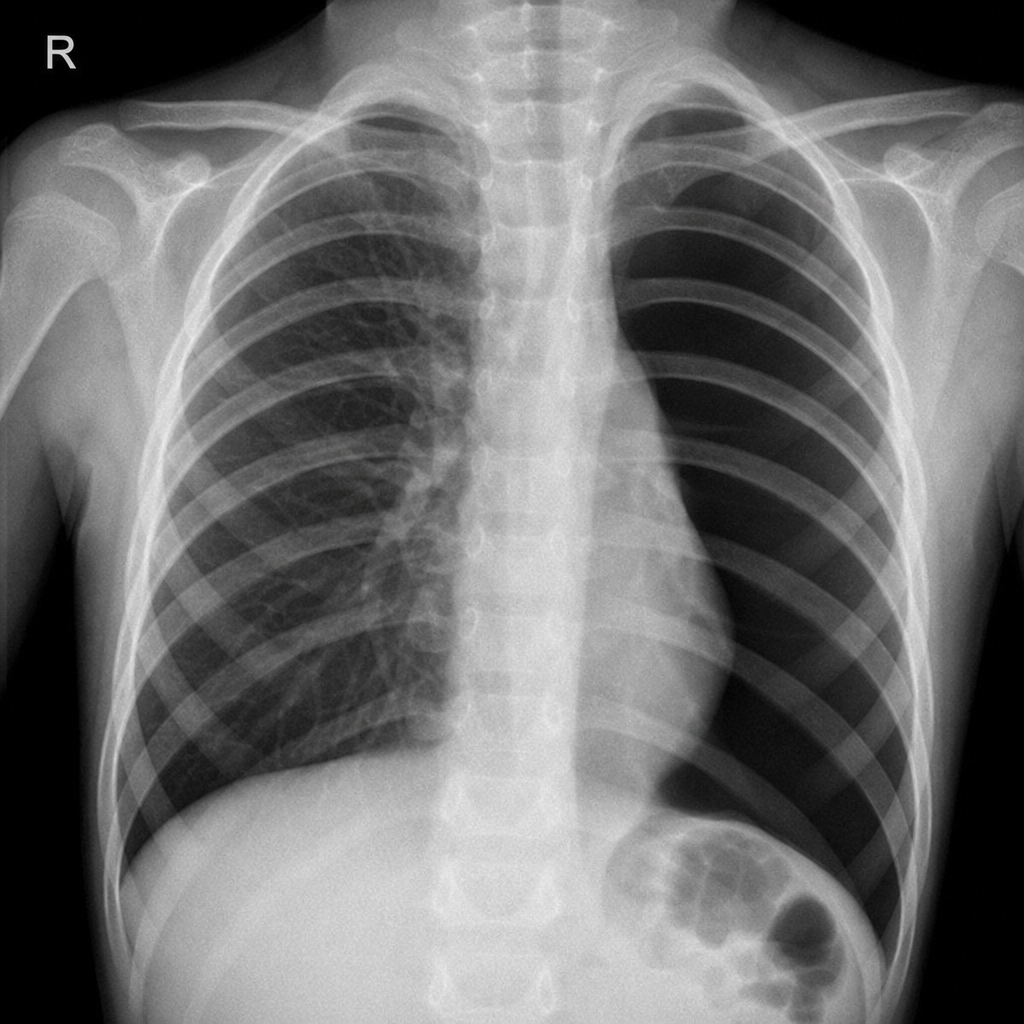
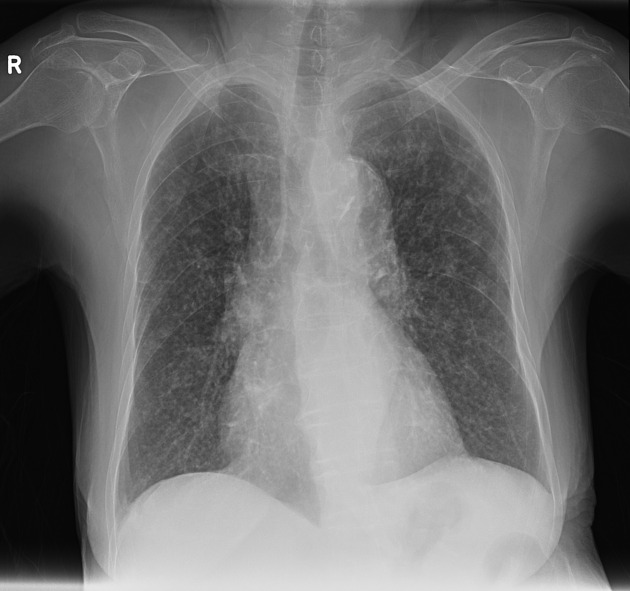
A 53-year-old female nonsmoker is being evaluated with symptoms of progressive shortness of breath. She has a past history of trauma to the right side of the chest. There is no history of asthma, sputum production, or recent chest pain. Chest X-ray is shown. What is the likely diagnosis?

In a right-sided hemithorax on chest X-ray PA view, what can be excluded?
Steeple sign is seen in which of the following conditions?
HRCT is the investigation of choice for diagnosing all of the following conditions, EXCEPT?
Explanation: ### **Explanation** In chest radiology, the presence and pattern of calcification are the most reliable indicators for distinguishing between benign and malignant pulmonary nodules. **1. Why "Diffuse Calcification" is the correct answer:** Calcification within a solitary pulmonary nodule (SPN) generally indicates a benign process. Specifically, **diffuse, central, laminated (popcorn-like), or solid** patterns of calcification are hallmarks of benign lesions like granulomas (e.g., TB or Histoplasmosis) or hamartomas. Malignant lesions rarely calcify; if they do, the calcification is usually **eccentric or stippled**, often representing a pre-existing granuloma being engulfed by a growing tumor. **2. Analysis of Incorrect Options (Signs of Malignancy):** * **Umbilicated surface (Rigler’s Notch):** A notch or indentation on the margin of a nodule, often representing the site where a vessel enters or where localized scarring occurs. It is highly suggestive of malignancy (specifically adenocarcinoma). * **Spiculated surface (Corona Radiata):** Fine, linear strands extending from the nodule into the lung parenchyma. This represents malignant infiltration along the lymphatics or interstitium and carries a high positive predictive value for lung cancer. * **Peripheral cavitation:** While benign lesions (like abscesses) can cavitate, a **thick-walled (>15mm)**, irregular, or eccentric cavity is a classic sign of malignancy, particularly Squamous Cell Carcinoma. ### **High-Yield Clinical Pearls for NEET-PG:** * **Popcorn Calcification:** Pathognomonic for **Pulmonary Hamartoma**. * **Doubling Time:** A nodule that remains stable in size for **2 years** is considered benign. Malignant nodules typically have a doubling time between 20 and 400 days. * **Feeding Vessel Sign:** Often seen in septic emboli or metastasis. * **Air Bronchogram Sign:** Frequently associated with Bronchioloalveolar carcinoma (now Adenocarcinoma in situ).
Explanation: ***Pericardial tamponade*** - **Acute breathlessness** following **cardiac surgery** strongly suggests pericardial tamponade due to **pericardial bleeding** or fluid accumulation. - Chest X-ray shows the classic **"water-bottle heart"** sign with **clear lung fields**, as the issue is cardiac compression rather than pulmonary pathology. *Gross bilateral pleural effusion* - Would show **bilateral blunting** of **costophrenic angles** and **opacification** of lower lung fields on chest X-ray. - Typically develops **gradually** over days rather than causing **acute severe breathlessness** within hours. *Left tension pneumothorax* - Chest X-ray would show **complete absence** of lung markings on the left side with **mediastinal shift** to the right. - Associated with **tracheal deviation** and **hyperexpanded** left hemithorax, not the water-bottle heart appearance. *Entire left lung collapse* - Would present with **complete opacification** of the left hemithorax and **mediastinal shift** toward the affected side. - Typically associated with **bronchial obstruction** rather than post-surgical cardiac complications.
Explanation: ### Explanation The **Signet Ring Sign** is a classic high-resolution computed tomography (HRCT) finding diagnostic of **Bronchiectasis**. **1. Understanding the Signet Ring Sign:** Under normal conditions, the internal diameter of a bronchus is equal to the diameter of its accompanying pulmonary artery (broncho-arterial ratio = 1:1). In bronchiectasis, chronic inflammation leads to permanent abnormal dilatation of the airways. On a CT scan, when the bronchus and artery are imaged in cross-section, the dilated, thick-walled bronchus appears much larger than the adjacent small pulmonary artery. This resembles a ring with a "stone" or "gem" (the artery) on its rim. **2. Analysis of Incorrect Options:** * **Blastomycosis:** Typically presents with non-specific findings like consolidation, nodules, or mass-like lesions, but not airway dilatation. * **Bronchogenic Carcinoma:** Usually presents as a solitary pulmonary nodule or mass with irregular/spiculated margins. It may cause secondary obstructive changes but not the signet ring sign. * **Invasive Aspergillosis:** Characterized by the **Halo Sign** (ground-glass opacity surrounding a nodule) or the **Air Crescent Sign** (seen during the recovery phase). **3. High-Yield Clinical Pearls for NEET-PG:** * **Gold Standard Investigation:** HRCT is the investigation of choice for bronchiectasis. * **Tram-track Sign:** Parallel linear opacities representing thickened bronchial walls seen on a chest X-ray. * **Finger-in-glove Sign:** Seen in Allergic Bronchopulmonary Aspergillosis (ABPA) due to mucoid impaction in dilated bronchi. * **Reversed Halo Sign (Atoll Sign):** Characteristic of Cryptogenic Organizing Pneumonia (COP).
Explanation: **Explanation:** **Miliary mottling** refers to the presence of numerous small (1–3 mm), discrete, grain-like opacities distributed throughout the lung fields on a chest X-ray. **Why Congestive Heart Failure (CHF) is the correct answer:** While miliary patterns are classically associated with infections, **Congestive Heart Failure** can present with a "pseudo-miliary" pattern. This occurs due to interstitial pulmonary edema, where fluid accumulates in the interlobular septa and perivascular spaces. Specifically, chronic pulmonary venous hypertension leads to the prominence of small vessels and interstitial fluid nodules that mimic miliary mottling. In the context of many standardized exams, if TB is not the intended answer or if the clinical context points toward fluid overload, CHF is a recognized cause of fine granular opacities. **Analysis of Incorrect Options:** * **A. Rheumatoid Arthritis:** Typically presents with a basal-predominant Interstitial Lung Disease (ILD) pattern, such as Usual Interstitial Pneumonia (UIP) or Non-Specific Interstitial Pneumonia (NSIP), rather than acute miliary mottling. * **B. Tuberculosis:** While **Miliary TB** is the most famous cause of this pattern (hematogenous spread), in the context of this specific question's key, CHF is highlighted to test the student's knowledge of non-infectious mimics. * **C. Pneumocystis carinii (jirovecii) pneumonia:** Classically presents with bilateral, perihilar "ground-glass" opacities or a "bat-wing" appearance, rather than discrete miliary nodules. **NEET-PG High-Yield Pearls:** * **Mnemonic for Miliary Mottling (M-I-L-I-A-R-Y):** **M**iliary TB (most common), **I**dle dust (Pneumoconiosis like Silicosis), **L**ymphangitis carcinomatosis, **I**diopathic pulmonary fibrosis, **A**lveolar microlithiasis, **R**eticulosis (Histiocytosis X), and **Y**east (Fungal infections like Histoplasmosis). * **Differential Diagnosis:** Always distinguish between "miliary" (discrete nodules) and "ground-glass" (hazy opacification). * **Radiology Tip:** In CHF, look for associated signs like Kerley B lines, cardiomegaly, and pleural effusion to differentiate it from TB.
Explanation: **Explanation:** **1. Why the Inferior Aspect is Correct:** In post-ductal coarctation of the aorta, there is a narrowing of the aortic arch distal to the origin of the left subclavian artery. To bypass this obstruction, the body develops extensive collateral circulation. Blood flows from the subclavian arteries into the internal thoracic arteries, then through the **posterior intercostal arteries** to reach the descending aorta. The increased pressure and volume cause these posterior intercostal arteries to become dilated, tortuous, and pulsatile. Because these arteries run in the **costal groove** located on the **inferior (lower) border** of the ribs, the chronic pulsations lead to pressure erosion and "notching" of the bone. **2. Analysis of Incorrect Options:** * **Superior aspect of the rib:** This is incorrect because the neurovascular bundle (Intercostal vein, artery, and nerve) is located at the inferior margin. Notching on the superior aspect is rare and associated with conditions like Hyperparathyroidism or Polio. * **At the sternum/vertebra:** While collateral vessels exist in these areas (e.g., internal mammary artery), they do not run in close enough proximity to the bone to cause localized pressure erosion or "notching" visible on a chest X-ray. **3. NEET-PG High-Yield Pearls:** * **Roesler’s Sign:** The clinical name for rib notching in coarctation. * **Ribs Involved:** Typically involves the **3rd to 8th ribs**. The 1st and 2nd ribs are spared because their intercostal arteries arise from the costocervical trunk (proximal to the coarctation). * **"Figure of 3" Sign:** Seen on CXR; formed by pre-stenotic dilation, the site of coarctation, and post-stenotic dilation. * **Reverse "3" or "E" Sign:** The corresponding indentation seen on a Barium swallow study.
Explanation: ***Pleural space*** - Chest tubes are specifically inserted into the **pleural space** to drain air (pneumothorax) or fluid (pleural effusion) between the visceral and parietal pleura. - On chest X-ray, the tube appears positioned laterally in the **intercostal space**, following the natural anatomical pathway into the pleural cavity. *Pericardial cavity* - The **pericardial cavity** surrounds the heart and would require **pericardiocentesis** or pericardial drain placement, not a standard chest tube. - Radiographically appears as the space immediately around the **cardiac silhouette**, much more medial than typical chest tube placement. *Mediastinum* - The **mediastinum** contains the heart, great vessels, trachea, and esophagus in the central chest compartment. - Chest tubes are not placed in this space; mediastinal drains would be positioned more **centrally** and typically after cardiac surgery. *Lung parenchyma* - The **lung parenchyma** refers to the actual lung tissue containing alveoli and bronchioles. - Tubes placed directly into lung tissue would cause **pneumothorax** and significant lung injury, which is not the therapeutic intent.
Explanation: ***Organized hemothorax*** - **Post-traumatic history** of right chest trauma combined with **progressive dyspnea** and **pleural thickening** on chest X-ray strongly suggests organized hemothorax (fibrothorax). - Blood collection in the pleural space after trauma can organize into **fibrous tissue**, causing **pleural restriction** and progressive respiratory symptoms. *Calcified cyst* - Would typically appear as a **well-defined, round lesion** with **rim calcification** on chest X-ray, not diffuse pleural thickening. - **No association** with chest trauma history and would not cause progressive dyspnea through pleural restriction. *Blastomycosis* - A **fungal infection** that typically presents with **pulmonary nodules** or **mass-like lesions**, not pleural thickening. - Would be associated with **systemic symptoms** like fever, weight loss, and **productive cough**, which are absent in this case. *Asbestosis* - Requires **occupational exposure** to asbestos fibers, typically in construction or shipyard workers. - Presents with **bilateral lower lobe fibrosis** and **pleural plaques**, not unilateral right-sided pleural thickening following trauma.
Explanation: **Explanation:** The question asks which condition can be excluded when a pleural effusion is strictly localized to the **right side** (unilateral) in a patient. **1. Why Congestive Cardiac Failure (CCF) is the correct answer:** In CCF, pleural effusion occurs due to increased hydrostatic pressure in the systemic and pulmonary capillaries. Because this is a systemic hemodynamic process, the effusion is typically **bilateral**. If it is unilateral, it is statistically more common on the right side; however, a strictly right-sided effusion in a patient with suspected heart failure should prompt a search for an alternative cause or a complicating factor (like pneumonia). Crucially, in the context of "excluding" a diagnosis, CCF is the least likely cause of a truly isolated, localized hemithorax pathology compared to localized inflammatory or infectious processes. **2. Why the other options are incorrect:** * **Tuberculosis (TB):** TB is a classic cause of unilateral pleural effusion (exudative). It often presents as a primary infection or a reactivation, typically affecting one hemithorax. * **Pulmonary Infarct:** Resulting from Pulmonary Embolism (PE), an infarct is a localized vascular event. The associated pleural effusion is almost always unilateral and occurs on the side of the vascular occlusion. **High-Yield Clinical Pearls for NEET-PG:** * **Bilateral Effusion:** Think systemic causes—CCF (most common), Cirrhosis (Hypoalbuminemia), and Nephrotic Syndrome. * **Unilateral Effusion:** Think localized causes—Infections (Pneumonia, TB), Malignancy, or Pulmonary Embolism. * **Light’s Criteria:** Essential for differentiating Exudate (Protein >0.5, LDH >0.6) from Transudate. CCF is the classic cause of **Transudative** effusion. * **Hampton’s Hump:** A wedge-shaped opacity seen in pulmonary infarction, typically localized to one side.
Explanation: **Explanation:** The **Steeple sign** (also known as the wine bottle sign) is a classic radiological finding seen on an **Anteroposterior (AP) view** of the neck. It is diagnostic of **Laryngotracheobronchitis (Croup)**, typically caused by the Parainfluenza virus. **1. Why Option B is Correct:** In Croup, inflammatory edema occurs in the **subglottic region**. This causes a symmetric narrowing of the proximal trachea, leading to the loss of the normal lateral convexities of the subglottic airway. On an X-ray, this narrowed airway resembles a tapered church steeple or an inverted 'V'. **2. Why Other Options are Incorrect:** * **Acute Epiglottitis (Option A):** This is a medical emergency usually caused by *H. influenzae* type B. It involves inflammation of the supraglottic structures. The characteristic radiological finding is the **Thumb sign**, seen on a **Lateral neck X-ray**, representing an edematous, enlarged epiglottis. * **Option C & D:** These are incorrect because the Steeple sign and Thumb sign are pathognomonic for two distinct anatomical levels of obstruction (subglottic vs. supraglottic). **High-Yield Clinical Pearls for NEET-PG:** * **Croup:** Characterized by a "barking" seal-like cough and inspiratory stridor. Most common in children aged 6 months to 3 years. * **Epiglottitis:** Characterized by the "4 Ds": Drooling, Dysphagia, Dysphonia, and Distressed inspiratory efforts (Tripod position). * **Omega Sign:** Seen on laryngoscopy in Laryngomalacia (the most common cause of congenital stridor). * **Thumbprint Sign:** Do not confuse the "Thumb sign" of epiglottitis with the "Thumbprinting" seen on abdominal X-rays in ischemic colitis.
Explanation: **Explanation:** High-Resolution Computed Tomography (HRCT) is the gold standard for evaluating the **lung parenchyma** and small airways. It uses thin slices (1–2 mm) and high-spatial-frequency reconstruction algorithms to provide detailed images of the pulmonary interstitium. **Why Pulmonary Artery Aneurysm is the Correct Answer:** A pulmonary artery aneurysm is a **vascular pathology**. HRCT is performed without intravenous contrast and is optimized for air-filled structures and lung tissue, making it inadequate for visualizing the vascular lumen. The investigation of choice for diagnosing vascular abnormalities like aneurysms or pulmonary embolism is **CT Pulmonary Angiography (CTPA)**, which utilizes a rapid bolus of IV contrast. **Analysis of Other Options:** * **Sarcoidosis:** HRCT is excellent for identifying characteristic perilymphatic nodules, hilar lymphadenopathy, and parenchymal changes. * **Miliary Tuberculosis:** HRCT is highly sensitive in detecting the classic 1–3 mm "miliary" (randomly distributed) nodules that may be missed on a standard chest X-ray. * **Interstitial Fibrosis:** HRCT is the definitive tool for diagnosing Interstitial Lung Diseases (ILD). It identifies specific patterns like honeycombing, traction bronchiectasis, and reticular opacities (e.g., UIP pattern). **NEET-PG High-Yield Pearls:** * **HRCT slice thickness:** 1 to 2 mm (compared to 5–10 mm in conventional CT). * **Windowing:** Uses a "Lung Window" (Width: 1500 HU; Level: -600 to -700 HU). * **Signet Ring Sign:** Seen on HRCT in Bronchiectasis (dilated bronchus larger than its accompanying artery). * **Halo Sign:** Characteristic of Invasive Aspergillosis. * **Crazy Paving Pattern:** Classically seen in Alveolar Proteinosis.
Normal Chest Radiographic Anatomy
Practice Questions
Radiographic Signs in Chest Imaging
Practice Questions
Pulmonary Infections
Practice Questions
Chronic Obstructive Pulmonary Disease
Practice Questions
Interstitial Lung Diseases
Practice Questions
Pulmonary Neoplasms
Practice Questions
Pleural Diseases
Practice Questions
Mediastinal Pathology
Practice Questions
Congenital and Developmental Chest Anomalies
Practice Questions
Pulmonary Vascular Diseases
Practice Questions
Chest Trauma Imaging
Practice Questions
Post-Surgical Chest Imaging
Practice Questions
Get full access to all questions, explanations, and performance tracking.
Start For Free