The Hilar Dance Sign is characteristically seen in which of the following cardiac conditions?
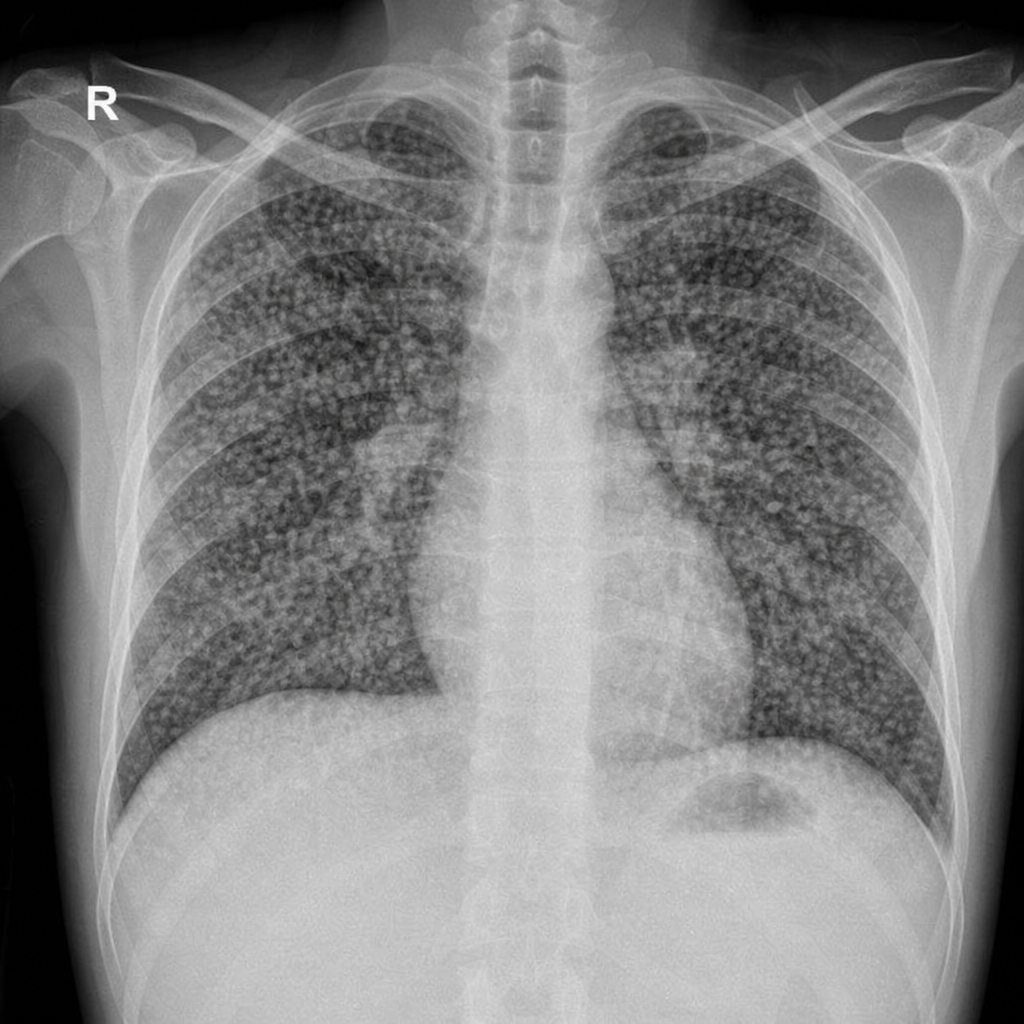
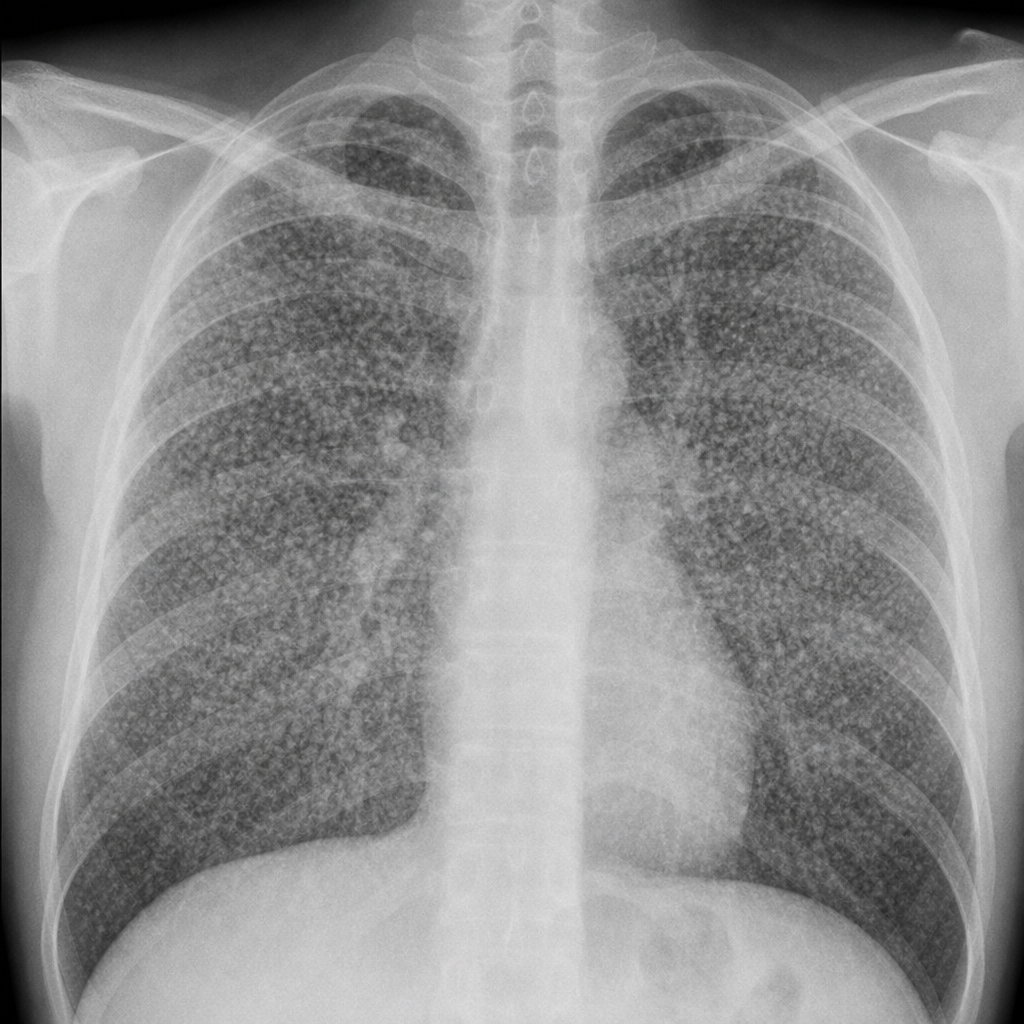
What is the likely diagnosis based on the provided chest X-ray?

Bilateral pleural thickening in the lower and middle lung zones is a radiological feature of which condition?
Which among the following is NOT a cause of calcification in an anterior mediastinal mass?
Which of the following features on X-ray chest can differentiate an Atrial Septal Defect (ASD) from a Ventricular Septal Defect (VSD)?
An X-ray film for closed pneumothorax should be taken during which of the following?
Which type of lung cancer resembles pneumonia with the air bronchogram sign?
Minimal pleural effusion is best detected by which X-ray view?
What are the X-ray features of sarcoidosis stage 2 according to the Scadding system?
What is the effective dose of a standard chest X-ray?
Explanation: **Explanation:** The **Hilar Dance Sign** is a classic fluoroscopic finding characterized by vigorous pulsations of the enlarged pulmonary arteries. This occurs due to a combination of increased stroke volume and high pulmonary blood flow (left-to-right shunt) coupled with low pulmonary vascular resistance. **1. Why Atrial Septal Defect (ASD) is correct:** In ASD, there is a significant left-to-right shunt at the atrial level, leading to **volume overload of the right ventricle**. This results in a massive increase in pulmonary blood flow. Because the pulmonary artery is compliant and the pressure remains relatively low for a long time, the large volume of blood ejected during systole causes the prominent, rhythmic pulsations seen as the "Hilar Dance." **2. Analysis of Incorrect Options:** * **Ventricular Septal Defect (VSD) & Patent Ductus Arteriosus (PDA):** While these are also left-to-right shunts that increase pulmonary flow, they are typically associated with higher pressure systems. The Hilar Dance is historically and most classically associated with ASD due to the specific compliance and volume dynamics of the right heart in this condition. * **Tetralogy of Fallot (TOF):** This is a cyanotic heart disease characterized by **decreased pulmonary blood flow** (due to pulmonary stenosis). On X-ray, this presents with a "coeur-en-sabot" (boot-shaped heart) and oligemic lung fields, the opposite of the plethora required for a Hilar Dance. **Clinical Pearls for NEET-PG:** * **Radiological Triad of ASD:** Cardiomegaly (Right heart enlargement), prominent pulmonary segment, and peripheral pulmonary plethora. * **Auscultation:** ASD is characterized by a **fixed wide split S2**. * **Lutembacher Syndrome:** ASD associated with acquired Mitral Stenosis. * **Imaging Modality:** While "Hilar Dance" was traditionally described on fluoroscopy, **Echocardiography** is now the gold standard for diagnosis.
Explanation: ***Tetralogy of Fallot (TOF)*** - Classic **"boot-shaped heart"** (coeur en sabot) appearance on chest X-ray with **upturned apex** due to right ventricular hypertrophy and **concave main pulmonary artery segment**. - **Decreased pulmonary vascularity** (oligemia) is characteristic due to pulmonary stenosis limiting blood flow to the lungs. *Total anomalous pulmonary venous connection (TAPVC)* - Typically shows the **"snowman sign"** or **"figure-of-8"** configuration on chest X-ray due to dilated vertical vein and left innominate vein. - Associated with **increased pulmonary vascularity** and **cardiomegaly**, not the boot-shaped heart seen here. *Ventricular septal defect (VSD)* - Chest X-ray shows **increased pulmonary vascularity** due to left-to-right shunting and **cardiomegaly** from volume overload. - Heart shape remains **normal** without the characteristic boot appearance or decreased pulmonary flow. *Atrial septal defect (ASD)* - Presents with **cardiomegaly** and **prominent pulmonary vasculature** due to increased pulmonary blood flow from left-to-right shunting. - **Right heart enlargement** may be present but lacks the specific boot-shaped configuration and pulmonary oligemia.
Explanation: **Explanation:** **Asbestosis** is the correct answer because asbestos-related lung disease has a unique predilection for the **pleura** and the **lower lung zones**. The hallmark radiological features include bilateral pleural plaques (circumscribed thickening) and diffuse pleural thickening, typically involving the middle and lower zones. This distribution occurs because asbestos fibers are inhaled and gravitate toward the lung bases due to gravity and diaphragmatic movement. Over time, these fibers cause subpleural fibrosis and calcification (the "Holly Leaf" sign). **Why the other options are incorrect:** * **Silicosis (A):** Characteristically involves the **upper lobes**. It presents with multiple small, rounded opacities and "Eggshell calcification" of the hilar lymph nodes, rather than primary pleural thickening. * **Stannosis (B):** Caused by tin dust inhalation. It is a benign pneumoconiosis characterized by very dense, small "tin-like" opacities distributed throughout the lung parenchyma, but it does not typically cause pleural thickening. * **Siderosis (C):** Caused by iron oxide (welder's lung). Like stannosis, it is a benign condition showing fine reticulonodular shadows without significant pleural involvement or progressive fibrosis. **High-Yield Clinical Pearls for NEET-PG:** * **Distribution:** Asbestosis = Lower Lobes; Silicosis/Coal Worker's Pneumoconiosis = Upper Lobes. * **Pleural Plaques:** These are the most common manifestation of asbestos exposure and are typically **parietal**, sparing the costophrenic angles. * **Malignancy:** Asbestosis increases the risk of both Bronchogenic Carcinoma (most common) and Mesothelioma (most specific). * **Imaging:** HRCT is the gold standard for detecting early subpleural curvilinear lines and honeycombing in asbestosis.
Explanation: **Explanation:** The key to solving this question lies in understanding the **anatomical compartmentalization** of the mediastinum. **1. Why Option D is the Correct Answer:** The **esophagus** is located in the **posterior mediastinum**. Therefore, a leiomyoma of the esophagus would present as a posterior mediastinal mass, not an anterior one. While leiomyomas can occasionally undergo calcification, their anatomical location automatically excludes them from being a primary cause of an *anterior* mediastinal mass. **2. Analysis of Incorrect Options (Causes of Anterior Mediastinal Calcification):** * **Lymphoma after radiotherapy (Option A):** While untreated lymphoma rarely calcifies, it frequently develops coarse or punctate calcifications following chemotherapy or radiotherapy. * **Aneurysm of ascending aorta (Option B):** The ascending aorta is an anterior mediastinal structure. Atherosclerotic plaques within an aneurysm can lead to curvilinear calcification of the vessel wall. * **Germ cell tumor (Option C):** Specifically, **Mature Teratomas** (the most common germ cell tumor) frequently contain calcifications, which may represent bone, teeth, or rim calcification of the cyst wall. **High-Yield Clinical Pearls for NEET-PG:** * **The "4 Ts" of Anterior Mediastinal Masses:** Thymoma, Teratoma (Germ cell tumors), Thyroid (Retrosternal goiter), and "Terrible" Lymphoma. * **Thymoma:** The most common primary anterior mediastinal neoplasm; calcification is seen in about 10-15% of cases. * **Eggshell Calcification:** Classically associated with Silicosis and Sarcoidosis (hilar lymph nodes), but can occasionally be seen in treated Lymphoma. * **Phleboliths:** If seen in an anterior mediastinal mass, they are highly suggestive of a **Hemangioma**.
Explanation: **Explanation:** The key to differentiating **Atrial Septal Defect (ASD)** from **Ventricular Septal Defect (VSD)** on a chest X-ray lies in identifying which cardiac chambers are dilated. **1. Why "Enlarged Left Atrium" is the correct answer:** In a **VSD**, the left-to-right shunt occurs at the ventricular level. The extra blood volume returns from the lungs into the left atrium and then into the left ventricle, leading to **Left Atrial (LA) and Left Ventricular (LV) enlargement**. In an **ASD**, the shunt occurs at the atrial level. The extra blood flows from the left atrium directly into the right atrium. Consequently, the left atrium decompresses into the right side and **does not enlarge**. Therefore, the presence of LA enlargement on an X-ray (e.g., double atrial shadow, splaying of the carina) strongly suggests VSD (or PDA) rather than ASD. **2. Why other options are incorrect:** * **Pulmonary Plethora:** This refers to increased pulmonary vascular markings. It is seen in **both** ASD and VSD due to the left-to-right shunt increasing pulmonary blood flow. * **Enlarged Pulmonary Artery:** Both conditions involve increased flow to the lungs, leading to a prominent pulmonary conflux and dilated central pulmonary arteries. * **Enlarged Aorta:** In both ASD and VSD, the aorta is typically **small or normal** because blood is shunted away from the systemic circulation into the pulmonary circulation. (A large aorta is characteristic of Patent Ductus Arteriosus). **High-Yield Clinical Pearls for NEET-PG:** * **ASD:** Characterized by Right Atrial (RA) and Right Ventricular (RV) enlargement. The LA is **normal**. * **VSD:** Characterized by LA and LV enlargement. It is the most common congenital heart disease. * **PDA:** Characterized by LA and LV enlargement **plus** a prominent/enlarged aortic knuckle. * **Eisenmenger Syndrome:** Look for "pruning" of peripheral vessels (dilated central arteries with abrupt narrowing).
Explanation: **Explanation:** The correct answer is **Deep expiration**. **Why Deep Expiration is Correct:** In a pneumothorax, air enters the pleural space, causing the lung to collapse away from the chest wall. During **expiration**, the volume of the thoracic cavity decreases, and the lungs deflate. However, the volume of the intrapleural air remains constant. This makes the pneumothorax appear relatively larger in proportion to the lung volume, increasing its radiodensity contrast against the lung parenchyma. Additionally, during expiration, the lung becomes denser (more opaque), making the thin, visceral pleural line of the pneumothorax much easier to visualize. **Analysis of Incorrect Options:** * **B. Deep inspiration:** This is the standard for most chest X-rays because it expands the lungs and provides better detail of the parenchyma. However, in a small pneumothorax, inspiration expands the lung toward the chest wall, potentially masking a small pocket of air. * **C. Supine position:** This is generally avoided for pneumothorax detection. In a supine patient, air collects anteromedially and basally rather than at the apex, often manifesting only as a "deep sulcus sign," which is harder to interpret than an apical line. * **D. Lateral position:** While a lateral decubitus view (with the affected side up) is highly sensitive for small pleural effusions or pneumothoraces, a standard lateral view is not the primary choice for initial screening of a closed pneumothorax. **Clinical Pearls for NEET-PG:** * **Gold Standard:** The most sensitive plain film for a small pneumothorax is the **Lateral Decubitus view** (affected side up). * **Deep Sulcus Sign:** A high-yield radiological sign of pneumothorax in a **supine** patient (common in ICU/Trauma settings). * **Initial Investigation:** An upright, PA view in expiration is the classic teaching for suspected small pneumothorax. * **Tension Pneumothorax:** This is a clinical diagnosis; do not wait for an X-ray if the patient is hemodynamically unstable.
Explanation: ### Explanation **1. Why Bronchoalveolar Carcinoma (BAC) is Correct:** Bronchoalveolar Carcinoma (now classified under **Adenocarcinoma in situ** or **Lepidic predominant adenocarcinoma**) has a unique growth pattern called **lepidic growth**. It spreads along the intact alveolar walls without invading the underlying stroma or destroying the lung architecture. Because the alveolar spaces fill with mucin or tumor cells while the conducting airways remain patent, it creates a **consolidation pattern** on imaging. This mimics lobar pneumonia and frequently displays the **Air Bronchogram Sign** (radiolucent air-filled bronchi outlined by opaque fluid/cells). On CT, this may also present as the "CT Angiogram Sign," where pulmonary vessels are seen clearly against the low-attenuation consolidated lung. **2. Why Other Options are Incorrect:** * **Squamous Cell Carcinoma (A):** Typically presents as a **hilar/central mass** with a strong association with smoking. It is the most common lung cancer to undergo **cavitation**, not pneumonia-like consolidation. * **Large Cell Carcinoma (B):** Usually presents as a large, **peripheral bulky mass** with rapid growth and early metastasis. It does not typically follow a lepidic growth pattern. * **Small Cell Carcinoma (C):** A central tumor arising from neuroendocrine cells. It typically presents with **hilar/mediastinal lymphadenopathy** and "bulky" narrowing of the bronchi rather than air bronchograms. **3. High-Yield Clinical Pearls for NEET-PG:** * **Pneumonic form of BAC:** If a "pneumonia" fails to resolve with antibiotics, always suspect BAC/Adenocarcinoma. * **Bronchorrhea:** The production of large volumes of watery, mucoid sputum is a classic clinical clue for BAC. * **Most Common:** Adenocarcinoma (including BAC subtypes) is the most common lung cancer in **non-smokers** and **women**. * **Imaging Sign:** Look for the **"CT Angiogram Sign"**—vessels appearing prominent within the consolidation—as a specific indicator for this diagnosis.
Explanation: **Explanation:** The detection of pleural effusion on a chest X-ray depends on the accumulation of fluid in the most dependent parts of the pleural space. **Why Lateral View is Correct:** The **Lateral view** is the most sensitive conventional radiographic projection for detecting minimal pleural effusion. In an upright position, fluid first collects in the **posterior costophrenic angle**, which is the deepest part of the pleural space. Blunting of the posterior costophrenic angle on a lateral film can be seen with as little as **25–75 mL** of fluid. **Analysis of Incorrect Options:** * **Posteroanterior (PA) View:** In this view, fluid must fill the lateral costophrenic angles. Because these are shallower than the posterior angles, blunting on a PA view typically requires at least **150–200 mL** of fluid. * **Anteroposterior (AP) View:** Usually performed in supine or semi-recumbent patients (e.g., ICU). Fluid layers posteriorly, causing a non-specific "veiling opacity" or ground-glass appearance over the lung field. It is very insensitive for small volumes. * **Oblique View:** This view is primarily used for visualizing rib fractures or localizing pleural plaques/masses, not for detecting free-flowing minimal effusion. **NEET-PG High-Yield Pearls:** 1. **Most Sensitive Radiographic View:** While the Lateral view is the best *standard* view, the **Lateral Decubitus view** (with the affected side down) is even more sensitive, detecting as little as **5–10 mL** of fluid. 2. **Gold Standard for Detection:** **Ultrasonography (USG)** is superior to any X-ray view, capable of detecting <5 mL of fluid and differentiating between localized fluid and pleural thickening. 3. **Ellis S-shaped curve:** This is the characteristic upper border of a large, free-flowing pleural effusion seen on a PA view.
Explanation: The **Scadding System** is the standard staging classification for thoracic sarcoidosis based on initial chest X-ray findings. It is a high-yield topic for NEET-PG as the stages do not necessarily represent the chronicity of the disease but rather the pattern of involvement. ### **Explanation of the Correct Answer** **Stage 2** is characterized by the presence of **bilateral hilar lymphadenopathy (BHL) PLUS parenchymal opacities** (typically reticulonodular infiltrates). The lymphadenopathy in sarcoidosis is classically "peripheral" or "symmetric," often involving the bronchopulmonary nodes. Therefore, Stage 2 represents a transition where both the lymphatic system and the lung parenchyma are involved simultaneously. ### **Analysis of Incorrect Options** * **B. Diffuse fibrosis:** This corresponds to **Stage 4**. It represents end-stage lung disease with permanent scarring, honeycombing, and volume loss (usually in the upper lobes). * **C. Pleural effusion:** This is an **atypical** finding in sarcoidosis (occurring in <5% of cases). It is not part of the Scadding staging system. * **D. Mediastinal lymphadenopathy:** While mediastinal nodes (like the paratracheal nodes) are often involved alongside hilar nodes, isolated lymphadenopathy without parenchymal involvement defines **Stage 1**. ### **NEET-PG High-Yield Pearls** * **Scadding Stages Summary:** * **Stage 0:** Normal Chest X-ray. * **Stage 1:** BHL only (Best prognosis). * **Stage 2:** BHL + Parenchymal infiltrates. * **Stage 3:** Parenchymal infiltrates only (BHL has resolved). * **Stage 4:** Pulmonary Fibrosis. * **Garland’s Triad (1-2-3 Sign):** Right paratracheal, right hilar, and left hilar lymphadenopathy—highly suggestive of sarcoidosis. * **Lofgren Syndrome:** A triad of BHL, erythema nodosum, and polyarthritis (associated with a good prognosis).
Explanation: The effective dose of radiation is a measure used to estimate the potential health risks (stochastic effects) to the whole body. In chest radiology, the standard PA (Posteroanterior) view is the baseline for comparison in radiation safety. **Why 0.02 mSv is correct:** A standard adult chest X-ray (PA view) delivers an effective dose of approximately **0.02 mSv** (2 mrem). This is a very low dose, equivalent to about **3 days of natural background radiation** or the radiation exposure received during a 4-hour commercial flight. **Analysis of Incorrect Options:** * **0.05 mSv (Option C):** This is closer to the dose of a two-view chest X-ray (PA and Lateral). A lateral view typically doubles or triples the exposure of a PA view. * **0.1 mSv (Option D):** This is the dose for a screening mammogram or a hand X-ray series. It is significantly higher than a single chest film. * **0.2 mSv (Option B):** This value is too high for a plain radiograph and is more representative of specialized views or very low-dose CT protocols. **High-Yield Clinical Pearls for NEET-PG:** * **Background Radiation:** The average annual background radiation is ~3 mSv. * **CT Comparison:** A CT Chest (approx. 7–8 mSv) is equivalent to roughly **400 chest X-rays**. * **ALARA Principle:** "As Low As Reasonably Achievable" is the guiding principle for radiation safety. * **Radiosensitivity:** The most sensitive cells to radiation are those with high mitotic rates (e.g., bone marrow, lymphoid tissue, and gonads). * **Pregnancy:** A chest X-ray is generally considered safe in pregnancy with abdominal shielding, as the fetal dose is negligible (<0.01 mGy).
Normal Chest Radiographic Anatomy
Practice Questions
Radiographic Signs in Chest Imaging
Practice Questions
Pulmonary Infections
Practice Questions
Chronic Obstructive Pulmonary Disease
Practice Questions
Interstitial Lung Diseases
Practice Questions
Pulmonary Neoplasms
Practice Questions
Pleural Diseases
Practice Questions
Mediastinal Pathology
Practice Questions
Congenital and Developmental Chest Anomalies
Practice Questions
Pulmonary Vascular Diseases
Practice Questions
Chest Trauma Imaging
Practice Questions
Post-Surgical Chest Imaging
Practice Questions
Get full access to all questions, explanations, and performance tracking.
Start For Free